Organizational Culture
Presented by:
Nikhil Burde
Vishal Lokre
Sai Chaitanya
Pooja Kumavat
Sharvarish Nandanwar
Sanjay Prajapati
Mufaddal Nazmi
Content
 Introduction
 Definition
 Key Characteristics of Organizational/Corporate Culture
 Some Types of Culture
 How Employees Learn Culture
 Importance of Organizational/Corporate Culture
 Organizational Culture Vs. National Culture
 Creation of a Culture
 Keeping a Culture Alive
 Socialization
 Outcomes of Socialization Process
 Relationship Between Culture & Organization
 Building a Strong Organizational Culture
 Steps to Build Strong Organizational Culture
 Cultural Iceberg
Introduction
 The concept of organizational culture was introduced to the field of management and
organization studies in the late 1970s, and it began to attract significant scholarly
attention in the early to mid-1980s.
 Building on insights from sociology and anthropology, organizational scholars argued
that organizations could possess distinct cultures, or sets of shared values, beliefs, and
norms that guide the attitudes and actions of organizational members.
 Researchers suggested that organizational culture could significantly affect
organizational outcomes, reasoning that culture could be used as a resource to affect
employee actions, distinguish firms from one another, and create competitive
advantage for those with superior cultures.
 As a result, researchers in management and organization have taken a range of
approaches to understanding organizational culture, from exploring the forces that may
create and change culture, to studying it as a driver of performance and effectiveness,
to linking it with identity and employee personality.
Introductory Works
 1979 - Andrew Pettigrew for introducing the concept of organizational culture to the field
with his 1979 article “On Studying Organizational Cultures.”
 1982 - Deal and Kennedy studied culture as the manner in which things “get done” in an
organization, offering a model of culture based on four organizational prototypes
 1983 - Smircich offered an introduction to modes of analysis of culture
 1985 - Schein, a foundational volume, discusses an organization’s culture as the basic
assumptions
 1990 - Schein offered a more concise, peer-reviewed version of the arguments put forth
in Schein’s Foundational Volume
 1992 - Martin offered one such perspective as she examined organizational culture from an
interpretive paradigm; Martin highlighted three prototypes of cultures that may exist in
organizations, thereby contrasting the functionalist approach of Schein 1985
 1996 - Schultz and Hatch also shed light on paradigmatic disagreement in the study of
culture in organizations as they proposed a multiparadigm approach to research to promote
interplay between the functionalist and interpretive paradigms.
Definition
 Organizational culture is a system of shared assumptions, values, and beliefs, which
governs how people behave in organizations.
 These shared values have a strong influence on the people in the organization and
dictate how they dress, act, and perform their jobs.
 Every organization develops and maintains a unique culture, which provides guidelines
and boundaries for the behavior of the members of the organization.
ORGANIZATIONAL CULTURE
Introduction of corporate culture
 “Corporate culture is system of shared values,assumptions,beliefs,and norms that unite
the members of an organization”
 -Kathryn bartol,management
 The Organizational culture or corporate culture comprises the attitudes.experiences,
beliefes and values of an organization
 It has been defined as the specific collection of values and norms that are shared by
people and groups in an organization and that control the way they interact with each
other and intract with each other and with stakeholders outside the organization
IMPORTANCE OF CORPORATE CULTURE
 Talent –attractor
 Talent-retainer
 Engages people
 Creates energy and momentum
 Changes the view of “work”
 Creates greater synergy
 Makes everyone more successful
Oragnizational culture vs national culture
Layers of culture
 National level
 Regional-ethnic-religious-linguistic level
 Gender level
 Social class level
 Organizational/corporate level
NATIONAL CULTURE
 Culture in the sense includes system of values are among the building blocks of
culture
 Althoug national culture grows with generations but still stabilizing in patterns
across generations using some mechanisms
MODELS OF NATIONAL CULTURE
 Single dimension models
 Multiple dimensions models
 Historical-social models
3 aspects of organizational culture
 The general relationship between employees and their organization
 The vertical or hierarchial system of authority defining superiors and subordinates
 The general views of employees about the organization’s destinty,purpose and
goals and their place in it
Differences in national and organizational
culture
 A nation is not an organization
 Extrenal signs are usually considered and people think that national cultures are
becoming same as organizational cultures
 National cultures and organizational cultures are two different phenomena
Differences between organizational and
national culture
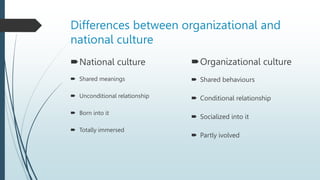
National culture
 Shared meanings
 Unconditional relationship
 Born into it
 Totally immersed
Organizational culture
 Shared behaviours
 Conditional relationship
 Socialized into it
 Partly ivolved
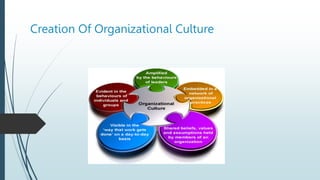
Creation Of Organizational Culture
Where Do Cultures Come
 Understanding this question is important so that you know how they can be changed.
 An organization’s culture is shaped as the organization faces external and internal
challenges and learns how to deal with them.
 When the organization’s way of doing business provides a successful adaptation to
environmental challenges and ensures success, those values are retained.
 With the organizational success, the founder’s personality is embedded in the
organizational culture.
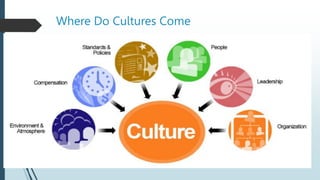
Where Do Culture come from?
• There are only two main ways to build an organizational culture: either with
consideration and conscious intent; or, by contrast, to let the culture come together as it
does, giving it little thought in the process.
• What follows is our recipe for consciously creating an organizational culture. Like all
recipes, it’s not perfect. But, if you use it, you will radically increase the odds of creating
the culture you want.
• The formula for successfully building a culture of great service here at Zingerman’s is
applicable to the building of an organization’s overall culture as well.
Points to remember for creating
organizational culture
 As a company matures, its cultural values are refined and strengthened. The early values of a
company’s culture exert influence over its future values. It is possible to think of organizational
culture as an organism that protects itself from external forces.
 We will also examine the role of leaders and reward systems in shaping and maintaining an
organization’s culture. It is important to remember two points: The process of culture creation is in
fact more complex and less clean than the name implies. Additionally, the influence of each factor
on culture creation is reciprocal.
 For example, just as leaders may influence what type of values the company has, the culture may
also determine what types of behaviors leaders demonstrate.
How Cultures maintained?
 The first such practice is the careful selection of candidates. Standardized procedures should be used to
hire right people for right jobs.
 Trained personnel interview the candidates and attempt to screen out those whose personal styles and
values do not fit with the organization’s culture.
 By identifying the candidates who can culturally match the organisational culture, selection helps
sustain culture to a large extent.
 Additionally, the selection process provides to the applicants, information about the organisational
culture.
 If the applicants perceive a conflict between their values and values of the organisation, they can
themselves decide not to join the organisation.
How to keep cultures alive?
RELATIONSHIP BETWEEN CULTURE &
ORGANIZATION STRUCTURE
 Structure
• One theory that is common in the literature is the strong culture theory. This theory
assumes that if managers and employees within an organization are fully
committed to collective principles, customs and morals this will result in positive
outcomes in the organization.
• The theory also proves that there is a relationship between strong corporate culture
and organization performance or profits. – Denison (1984) states the point as
follows; “the ‘strength’ of ‘corporate culture’ is directly correlated with the level of
profits in a company”.
 Culture
• Every organization has the unwritten beliefs, norms, values, attitudes and
expectations about who people are and how people work which is culture of
organization. The organizational culture is the big picture of the entity. It is how the
company does business, both internally and externally. the organizational culture
will not stand without structure.
• The culture is what we do, what we say, the way we behave, the the way we treat
each other, our products, customers, communities & ourselves.
 Organizational structure works within an organizational culture, but it is not
completely separate. The two are very much intertwined.
STEPS TO BUILD A STRONG
ORGANIZATION CULTURE
 Start with a purpose.
 Define a common language, values and standards.
 Lead by example.
 Identify your (cultural) ambassadors.
 Be truthful and always communicate.
 Treat people right.

Organizational_Culture.pptx

  • 1.
    Organizational Culture Presented by: NikhilBurde Vishal Lokre Sai Chaitanya Pooja Kumavat Sharvarish Nandanwar Sanjay Prajapati Mufaddal Nazmi
  • 2.
    Content  Introduction  Definition Key Characteristics of Organizational/Corporate Culture  Some Types of Culture  How Employees Learn Culture  Importance of Organizational/Corporate Culture  Organizational Culture Vs. National Culture  Creation of a Culture  Keeping a Culture Alive  Socialization  Outcomes of Socialization Process  Relationship Between Culture & Organization  Building a Strong Organizational Culture  Steps to Build Strong Organizational Culture  Cultural Iceberg
  • 3.
    Introduction  The conceptof organizational culture was introduced to the field of management and organization studies in the late 1970s, and it began to attract significant scholarly attention in the early to mid-1980s.  Building on insights from sociology and anthropology, organizational scholars argued that organizations could possess distinct cultures, or sets of shared values, beliefs, and norms that guide the attitudes and actions of organizational members.  Researchers suggested that organizational culture could significantly affect organizational outcomes, reasoning that culture could be used as a resource to affect employee actions, distinguish firms from one another, and create competitive advantage for those with superior cultures.  As a result, researchers in management and organization have taken a range of approaches to understanding organizational culture, from exploring the forces that may create and change culture, to studying it as a driver of performance and effectiveness, to linking it with identity and employee personality.
  • 4.
    Introductory Works  1979- Andrew Pettigrew for introducing the concept of organizational culture to the field with his 1979 article “On Studying Organizational Cultures.”  1982 - Deal and Kennedy studied culture as the manner in which things “get done” in an organization, offering a model of culture based on four organizational prototypes  1983 - Smircich offered an introduction to modes of analysis of culture  1985 - Schein, a foundational volume, discusses an organization’s culture as the basic assumptions  1990 - Schein offered a more concise, peer-reviewed version of the arguments put forth in Schein’s Foundational Volume  1992 - Martin offered one such perspective as she examined organizational culture from an interpretive paradigm; Martin highlighted three prototypes of cultures that may exist in organizations, thereby contrasting the functionalist approach of Schein 1985  1996 - Schultz and Hatch also shed light on paradigmatic disagreement in the study of culture in organizations as they proposed a multiparadigm approach to research to promote interplay between the functionalist and interpretive paradigms.
  • 5.
    Definition  Organizational cultureis a system of shared assumptions, values, and beliefs, which governs how people behave in organizations.  These shared values have a strong influence on the people in the organization and dictate how they dress, act, and perform their jobs.  Every organization develops and maintains a unique culture, which provides guidelines and boundaries for the behavior of the members of the organization.
  • 6.
  • 7.
    Introduction of corporateculture  “Corporate culture is system of shared values,assumptions,beliefs,and norms that unite the members of an organization”  -Kathryn bartol,management  The Organizational culture or corporate culture comprises the attitudes.experiences, beliefes and values of an organization  It has been defined as the specific collection of values and norms that are shared by people and groups in an organization and that control the way they interact with each other and intract with each other and with stakeholders outside the organization
  • 8.
    IMPORTANCE OF CORPORATECULTURE  Talent –attractor  Talent-retainer  Engages people  Creates energy and momentum  Changes the view of “work”  Creates greater synergy  Makes everyone more successful
  • 9.
    Oragnizational culture vsnational culture Layers of culture  National level  Regional-ethnic-religious-linguistic level  Gender level  Social class level  Organizational/corporate level
  • 10.
    NATIONAL CULTURE  Culturein the sense includes system of values are among the building blocks of culture  Althoug national culture grows with generations but still stabilizing in patterns across generations using some mechanisms
  • 11.
    MODELS OF NATIONALCULTURE  Single dimension models  Multiple dimensions models  Historical-social models
  • 12.
    3 aspects oforganizational culture  The general relationship between employees and their organization  The vertical or hierarchial system of authority defining superiors and subordinates  The general views of employees about the organization’s destinty,purpose and goals and their place in it
  • 13.
    Differences in nationaland organizational culture  A nation is not an organization  Extrenal signs are usually considered and people think that national cultures are becoming same as organizational cultures  National cultures and organizational cultures are two different phenomena
  • 14.
    Differences between organizationaland national culture National culture  Shared meanings  Unconditional relationship  Born into it  Totally immersed Organizational culture  Shared behaviours  Conditional relationship  Socialized into it  Partly ivolved
  • 15.
  • 16.
  • 17.
     Understanding thisquestion is important so that you know how they can be changed.  An organization’s culture is shaped as the organization faces external and internal challenges and learns how to deal with them.  When the organization’s way of doing business provides a successful adaptation to environmental challenges and ensures success, those values are retained.  With the organizational success, the founder’s personality is embedded in the organizational culture. Where Do Culture come from?
  • 18.
    • There areonly two main ways to build an organizational culture: either with consideration and conscious intent; or, by contrast, to let the culture come together as it does, giving it little thought in the process. • What follows is our recipe for consciously creating an organizational culture. Like all recipes, it’s not perfect. But, if you use it, you will radically increase the odds of creating the culture you want. • The formula for successfully building a culture of great service here at Zingerman’s is applicable to the building of an organization’s overall culture as well. Points to remember for creating organizational culture
  • 19.
     As acompany matures, its cultural values are refined and strengthened. The early values of a company’s culture exert influence over its future values. It is possible to think of organizational culture as an organism that protects itself from external forces.  We will also examine the role of leaders and reward systems in shaping and maintaining an organization’s culture. It is important to remember two points: The process of culture creation is in fact more complex and less clean than the name implies. Additionally, the influence of each factor on culture creation is reciprocal.  For example, just as leaders may influence what type of values the company has, the culture may also determine what types of behaviors leaders demonstrate. How Cultures maintained?
  • 20.
     The firstsuch practice is the careful selection of candidates. Standardized procedures should be used to hire right people for right jobs.  Trained personnel interview the candidates and attempt to screen out those whose personal styles and values do not fit with the organization’s culture.  By identifying the candidates who can culturally match the organisational culture, selection helps sustain culture to a large extent.  Additionally, the selection process provides to the applicants, information about the organisational culture.  If the applicants perceive a conflict between their values and values of the organisation, they can themselves decide not to join the organisation. How to keep cultures alive?
  • 21.
    RELATIONSHIP BETWEEN CULTURE& ORGANIZATION STRUCTURE  Structure • One theory that is common in the literature is the strong culture theory. This theory assumes that if managers and employees within an organization are fully committed to collective principles, customs and morals this will result in positive outcomes in the organization. • The theory also proves that there is a relationship between strong corporate culture and organization performance or profits. – Denison (1984) states the point as follows; “the ‘strength’ of ‘corporate culture’ is directly correlated with the level of profits in a company”.
  • 22.
     Culture • Everyorganization has the unwritten beliefs, norms, values, attitudes and expectations about who people are and how people work which is culture of organization. The organizational culture is the big picture of the entity. It is how the company does business, both internally and externally. the organizational culture will not stand without structure. • The culture is what we do, what we say, the way we behave, the the way we treat each other, our products, customers, communities & ourselves.  Organizational structure works within an organizational culture, but it is not completely separate. The two are very much intertwined.
  • 23.
    STEPS TO BUILDA STRONG ORGANIZATION CULTURE  Start with a purpose.  Define a common language, values and standards.  Lead by example.  Identify your (cultural) ambassadors.  Be truthful and always communicate.  Treat people right.