ORGANIZATIONAL
CONFLICT - IV
Dr. Smriti Mathur
Assistant Professor
Babu Banarasi Das University, Lucknow
PhD (Commerce), UGC NET (Commerce)
M.Com (Applied Economics)
Conflict
Resolution
Techniques
or Methods
Content
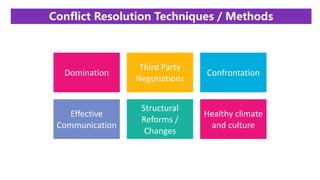
Conflict Resolution Techniques / Methods
Domination
Third Party
Negotiations
Confrontation
Effective
Communication
Structural
Reforms /
Changes
Healthy climate
and culture
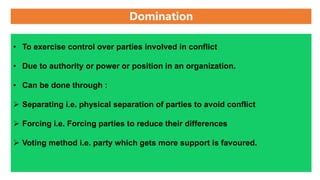
Domination
• To exercise control over parties involved in conflict
• Due to authority or power or position in an organization.
• Can be done through :
 Separating i.e. physical separation of parties to avoid conflict
 Forcing i.e. Forcing parties to reduce their differences
 Voting method i.e. party which gets more support is favoured.
Third Party Negotiation
• Third party is involved to find a solution.
• According to robbins, four methods are used to resolve conflict by a third
party negotiator:
Arbitration Mediator Conciliator
Consultant
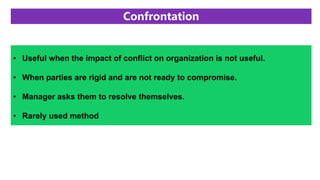
Confrontation
• Useful when the impact of conflict on organization is not useful.
• When parties are rigid and are not ready to compromise.
• Manager asks them to resolve themselves.
• Rarely used method
Effective Communication
• Useful method to resolve conflicts.
• Right message is conveyed by the right sender to the right receiver
through the right channel in the right manner at the right time.
• Minimizes ambiguities and clarifies the matter.
• Keeps people informed, connected and active
Structural Reform/ Changes
• Creating appropriate organiztional structure.
• Modifying organizational structure when required.
• Promote and maintain satisfactory level of conflict
Healthy Climate and Culture
• Creating and maintaining healthy climate is culture is helpful in promoting
cooperation.
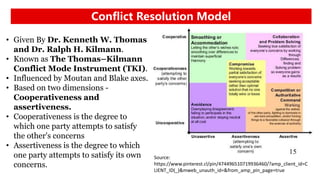
Conflict Resolution Model
Source:
https://www.pinterest.cl/pin/474496510719936460/?amp_client_id=C
LIENT_ID(_)&mweb_unauth_id=&from_amp_pin_page=true
• Given By Dr. Kenneth W. Thomas
and Dr. Ralph H. Kilmann.
• Known as The Thomas–Kilmann
Conflict Mode Instrument (TKI).
• Influenced by Moutan and Blake axes.
• Based on two dimensions -
Cooperativeness and
assertiveness.
• Cooperativeness is the degree to
which one party attempts to satisfy
the other's concerns
• Assertiveness is the degree to which
one party attempts to satisfy its own
concerns.

Organizational conflict iv

  • 1.
    ORGANIZATIONAL CONFLICT - IV Dr.Smriti Mathur Assistant Professor Babu Banarasi Das University, Lucknow PhD (Commerce), UGC NET (Commerce) M.Com (Applied Economics)
  • 2.
  • 3.
    Conflict Resolution Techniques/ Methods Domination Third Party Negotiations Confrontation Effective Communication Structural Reforms / Changes Healthy climate and culture
  • 4.
    Domination • To exercisecontrol over parties involved in conflict • Due to authority or power or position in an organization. • Can be done through :  Separating i.e. physical separation of parties to avoid conflict  Forcing i.e. Forcing parties to reduce their differences  Voting method i.e. party which gets more support is favoured.
  • 5.
    Third Party Negotiation •Third party is involved to find a solution. • According to robbins, four methods are used to resolve conflict by a third party negotiator: Arbitration Mediator Conciliator Consultant
  • 6.
    Confrontation • Useful whenthe impact of conflict on organization is not useful. • When parties are rigid and are not ready to compromise. • Manager asks them to resolve themselves. • Rarely used method
  • 7.
    Effective Communication • Usefulmethod to resolve conflicts. • Right message is conveyed by the right sender to the right receiver through the right channel in the right manner at the right time. • Minimizes ambiguities and clarifies the matter. • Keeps people informed, connected and active
  • 8.
    Structural Reform/ Changes •Creating appropriate organiztional structure. • Modifying organizational structure when required. • Promote and maintain satisfactory level of conflict Healthy Climate and Culture • Creating and maintaining healthy climate is culture is helpful in promoting cooperation.
  • 9.
    Conflict Resolution Model Source: https://www.pinterest.cl/pin/474496510719936460/?amp_client_id=C LIENT_ID(_)&mweb_unauth_id=&from_amp_pin_page=true •Given By Dr. Kenneth W. Thomas and Dr. Ralph H. Kilmann. • Known as The Thomas–Kilmann Conflict Mode Instrument (TKI). • Influenced by Moutan and Blake axes. • Based on two dimensions - Cooperativeness and assertiveness. • Cooperativeness is the degree to which one party attempts to satisfy the other's concerns • Assertiveness is the degree to which one party attempts to satisfy its own concerns.