ORGANIZATIONAL CHANGEA Venture into Impermanence
The Forces of ChangeWe live everyday with the forces of changeTransience (all things seem to alter and evolve over time … few things seem to endure)Novelty (we face new opportunities and threats for which the past provides limited guidance … or actually may be misleading)Uncertainty (causes and effects become harder to discern and to depend on)Diversity (we face a great variety of challenges that present challenging and even conflicting demands on us)Interdependence (things interact meaning that solving one issue might aggravate another)
Resistance to ChangeOrganizational change is ALWAYS a challenge to achieveMomentum: organizations and individuals tend to persist in their processes and habits and to resist efforts to stopInertia: organizations and individuals tend to resist efforts to start new processes or habitsGravity: organizations and individuals tend to gradually “settle” for lower and lower levels of effectiveness (goal achievement) and efficiency (resource conservation)Entropy: organizations and individuals tend to loose both energy and direction (purposefulness)
Christian Worldview and ChangeA Biblically faithful worldview provides important insights into changeTransformation: the Christian faith targets changing the hearts and minds of individuals and the purposes and processes of institutionsRedemption: the Christian faith seeks to take fallen people and organizations and to restore them to healthy and value-creating conditionCreation: the Christian faith seeks to take basic elements and develop new and original designsWisdom: the Christian faith seeks to understand all of life in detail and in-depthStewardship: the Christian faith seeks to find ever better ways to develop effective and efficient ways to achieve God-honoring results
The Challenges in Understanding ChangeDeveloping both valid (trust worthy) and reliable (insights that allow us to make an impact) about change is intellectually and practically challengingChange occurs in a variety of ways, both small and large, easy to see and more subtle, in discernible steps and in sudden jumps.Change is both rational and irrational, both subject to scientific analysis and also subject to the unexpected and unexplainableChange has been viewed differently by many different theories and models around which there is limited consensus
The Challenges in Understanding ChangeDeveloping both valid (trust worthy) and reliable (insights that allow us to make an impact) about change is intellectually and practically challengingChange is complex, involving the interaction of individual, interpersonal and institutional elements in often non-obvious and unexpected waysChange is viewed in many different ways, as an opportunity and as a threat, as desirable and as undesirable, as subject to control and as beyond control
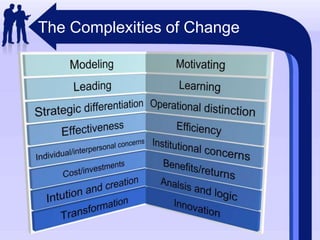
The Complexities of Change

Organizational change an introduction

  • 1.
  • 2.
    The Forces ofChangeWe live everyday with the forces of changeTransience (all things seem to alter and evolve over time … few things seem to endure)Novelty (we face new opportunities and threats for which the past provides limited guidance … or actually may be misleading)Uncertainty (causes and effects become harder to discern and to depend on)Diversity (we face a great variety of challenges that present challenging and even conflicting demands on us)Interdependence (things interact meaning that solving one issue might aggravate another)
  • 3.
    Resistance to ChangeOrganizationalchange is ALWAYS a challenge to achieveMomentum: organizations and individuals tend to persist in their processes and habits and to resist efforts to stopInertia: organizations and individuals tend to resist efforts to start new processes or habitsGravity: organizations and individuals tend to gradually “settle” for lower and lower levels of effectiveness (goal achievement) and efficiency (resource conservation)Entropy: organizations and individuals tend to loose both energy and direction (purposefulness)
  • 4.
    Christian Worldview andChangeA Biblically faithful worldview provides important insights into changeTransformation: the Christian faith targets changing the hearts and minds of individuals and the purposes and processes of institutionsRedemption: the Christian faith seeks to take fallen people and organizations and to restore them to healthy and value-creating conditionCreation: the Christian faith seeks to take basic elements and develop new and original designsWisdom: the Christian faith seeks to understand all of life in detail and in-depthStewardship: the Christian faith seeks to find ever better ways to develop effective and efficient ways to achieve God-honoring results
  • 5.
    The Challenges inUnderstanding ChangeDeveloping both valid (trust worthy) and reliable (insights that allow us to make an impact) about change is intellectually and practically challengingChange occurs in a variety of ways, both small and large, easy to see and more subtle, in discernible steps and in sudden jumps.Change is both rational and irrational, both subject to scientific analysis and also subject to the unexpected and unexplainableChange has been viewed differently by many different theories and models around which there is limited consensus
  • 6.
    The Challenges inUnderstanding ChangeDeveloping both valid (trust worthy) and reliable (insights that allow us to make an impact) about change is intellectually and practically challengingChange is complex, involving the interaction of individual, interpersonal and institutional elements in often non-obvious and unexpected waysChange is viewed in many different ways, as an opportunity and as a threat, as desirable and as undesirable, as subject to control and as beyond control
  • 7.