
CONTRASTING WORLDVIEWS
      IN BUSINESS
The Big Ideas

• Worldviews really do differ from each other
  both in terms of IDEA and IMPACTS.
• Worldviews matter because ideas have
  impacts.
• While no worldview discussed in this course
  is practiced in a “pure” form, we can capture
  the major IDEAS underlying worldviews.
• All these worldviews are found in whole or
  part in the business thinking today.
• All worldviews have both positive impacts and
  problematic issues.
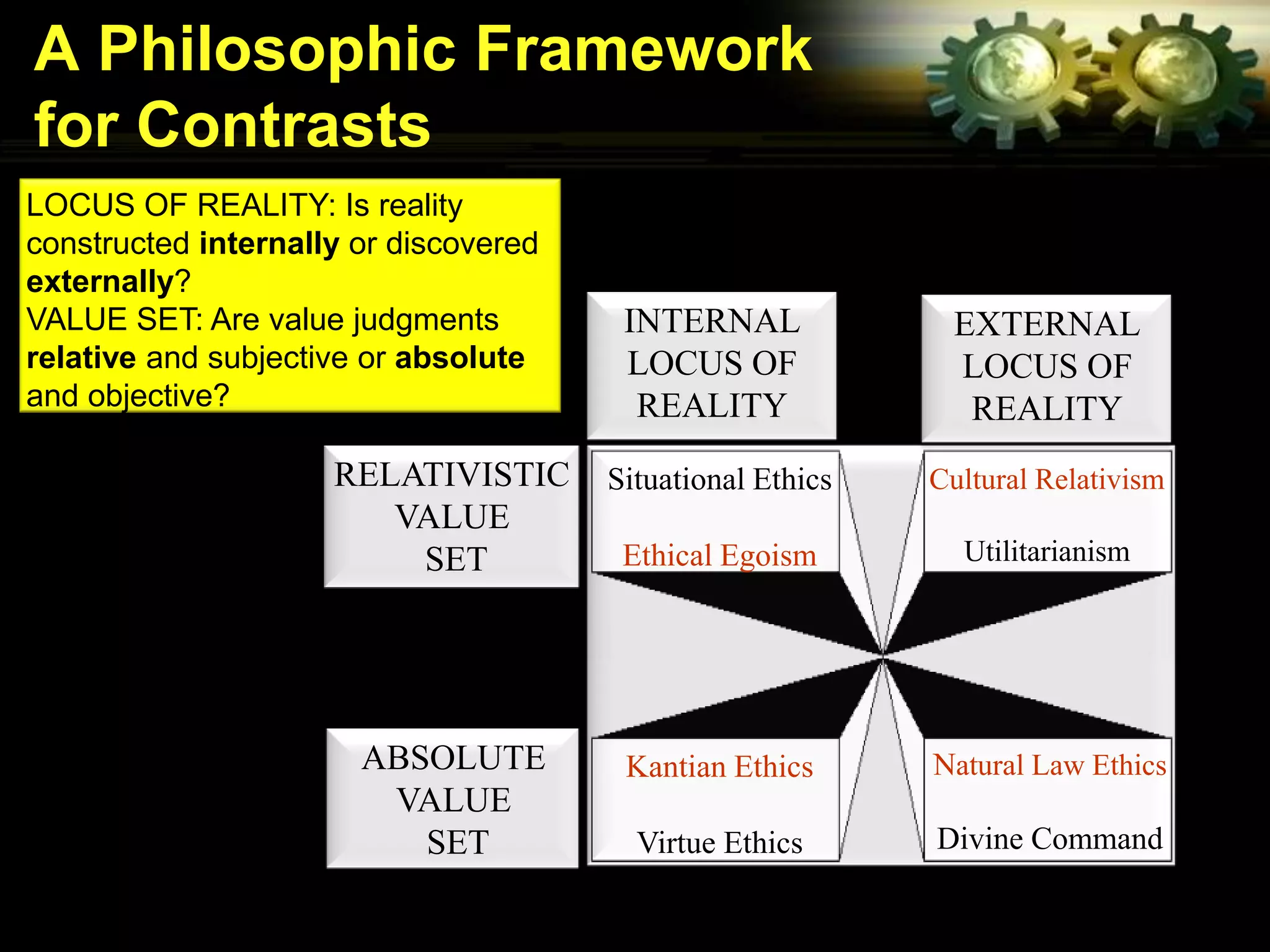
A Philosophic Framework
for Contrasts
LOCUS OF REALITY: Is reality
constructed internally or discovered
externally?
VALUE SET: Are value judgments          INTERNAL             EXTERNAL
relative and subjective or absolute     LOCUS OF             LOCUS OF
and objective?                           REALITY              REALITY
                     RELATIVISTIC      Situational Ethics   Cultural Relativism
                        VALUE
                         SET            Ethical Egoism        Utilitarianism


                       ABSOLUTE         Kantian Ethics      Natural Law Ethics
                        VALUE
                          SET            Virtue Ethics      Divine Command
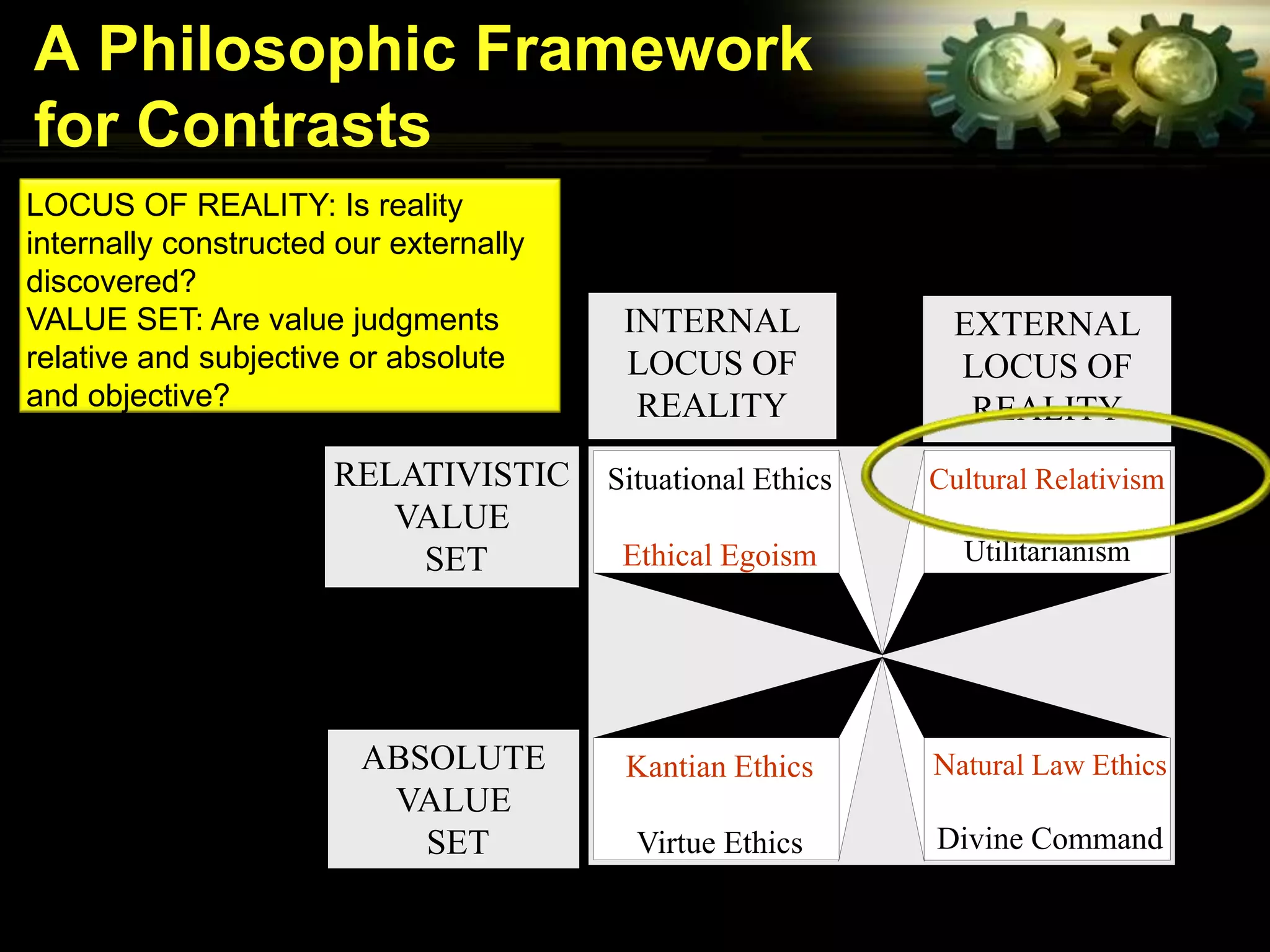
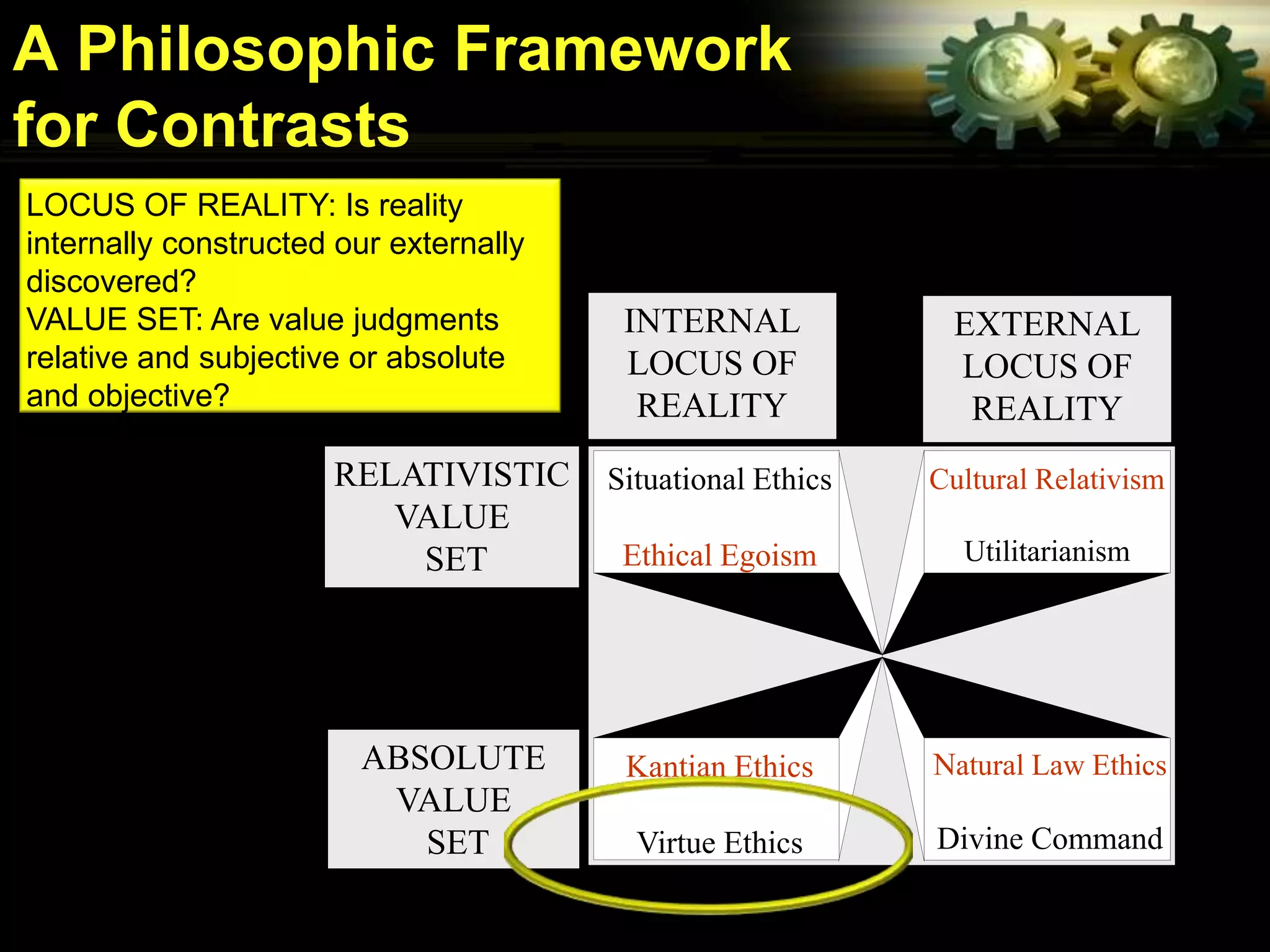
A Philosophic Framework
for Contrasts
LOCUS OF REALITY: Is reality
internally constructed our externally
discovered?
VALUE SET: Are value judgments           INTERNAL             EXTERNAL
relative and subjective or absolute      LOCUS OF             LOCUS OF
and objective?                            REALITY              REALITY
                      RELATIVISTIC      Situational Ethics   Cultural Relativism
                         VALUE
                          SET            Ethical Egoism        Utilitarianism


                        ABSOLUTE         Kantian Ethics      Natural Law Ethics
                         VALUE
                           SET            Virtue Ethics      Divine Command
CULTURAL RELATIVISM
• Propositions
  – From one culture to another, and from one time to another within the
    same culture, there is diversity in what is considered right and wrong.
  – There are no absolute standards for right or wrong because all standards
    for determining right or wrong are relative.
  – Ultimately each person's culture is the standard by which actions are to
    be measured.
  – Therefore, no moral truth applies to all people at all times.
  – No ethical system is any better than any other.
    The only thing we can say about different cultural practices is that they
    are different, not better or worse.
  – People are obligated to follow the norms of the culture in which they live-
    accepted practices constitute the moral obligations of that society.
  – The first step toward eliminating intolerance is an awareness that all our
    judgments of right or wrong are driven (even determined) by the circle of
    cultural tradition and thought-forms.
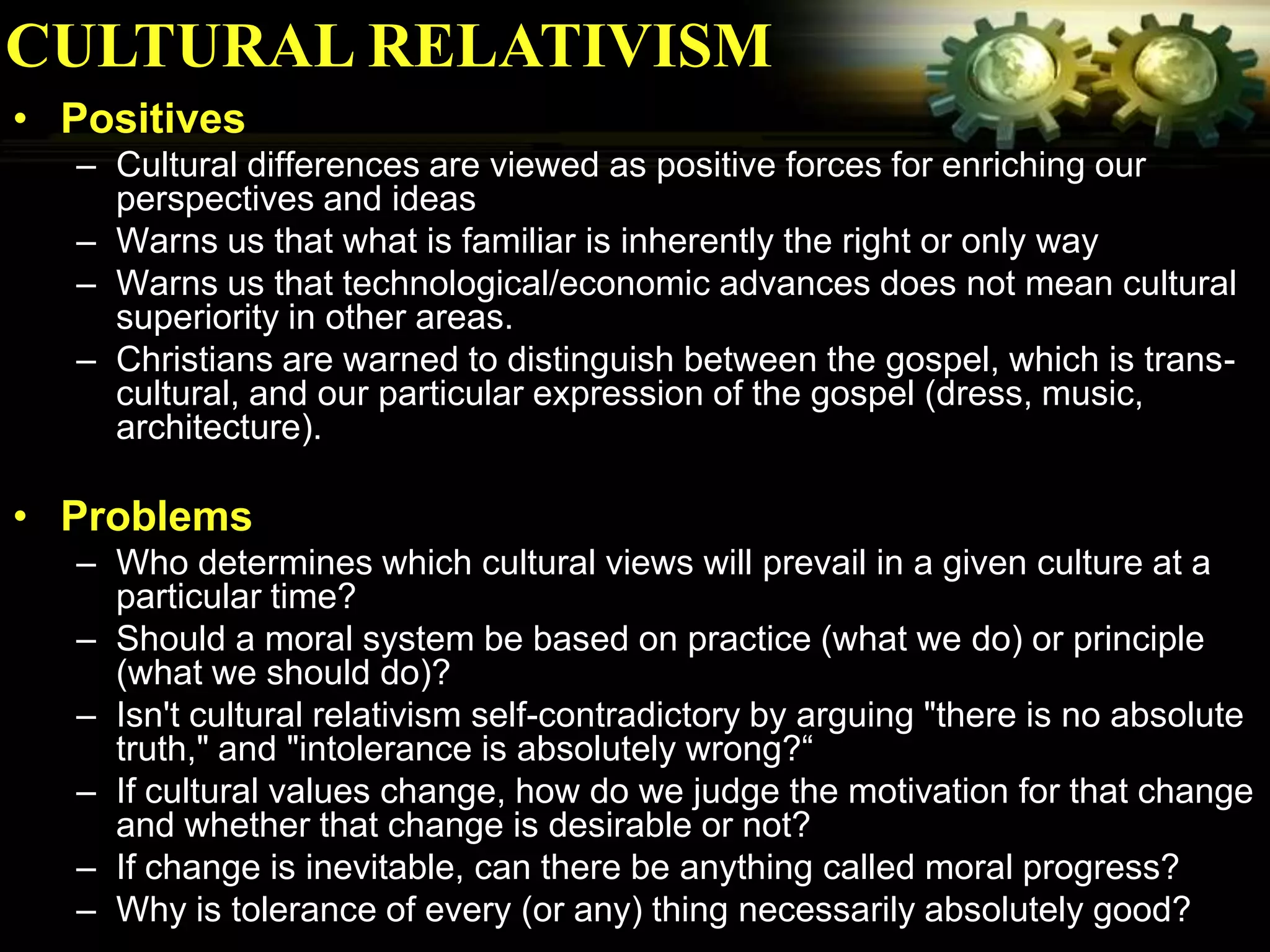
CULTURAL RELATIVISM
• Positives
  – Cultural differences are viewed as positive forces for enriching our
    perspectives and ideas
  – Warns us that what is familiar is inherently the right or only way
  – Warns us that technological/economic advances does not mean cultural
    superiority in other areas.
  – Christians are warned to distinguish between the gospel, which is trans-
    cultural, and our particular expression of the gospel (dress, music,
    architecture).

• Problems
  – Who determines which cultural views will prevail in a given culture at a
    particular time?
  – Should a moral system be based on practice (what we do) or principle
    (what we should do)?
  – Isn't cultural relativism self-contradictory by arguing "there is no absolute
    truth," and "intolerance is absolutely wrong?“
  – If cultural values change, how do we judge the motivation for that change
    and whether that change is desirable or not?
  – If change is inevitable, can there be anything called moral progress?
  – Why is tolerance of every (or any) thing necessarily absolutely good?
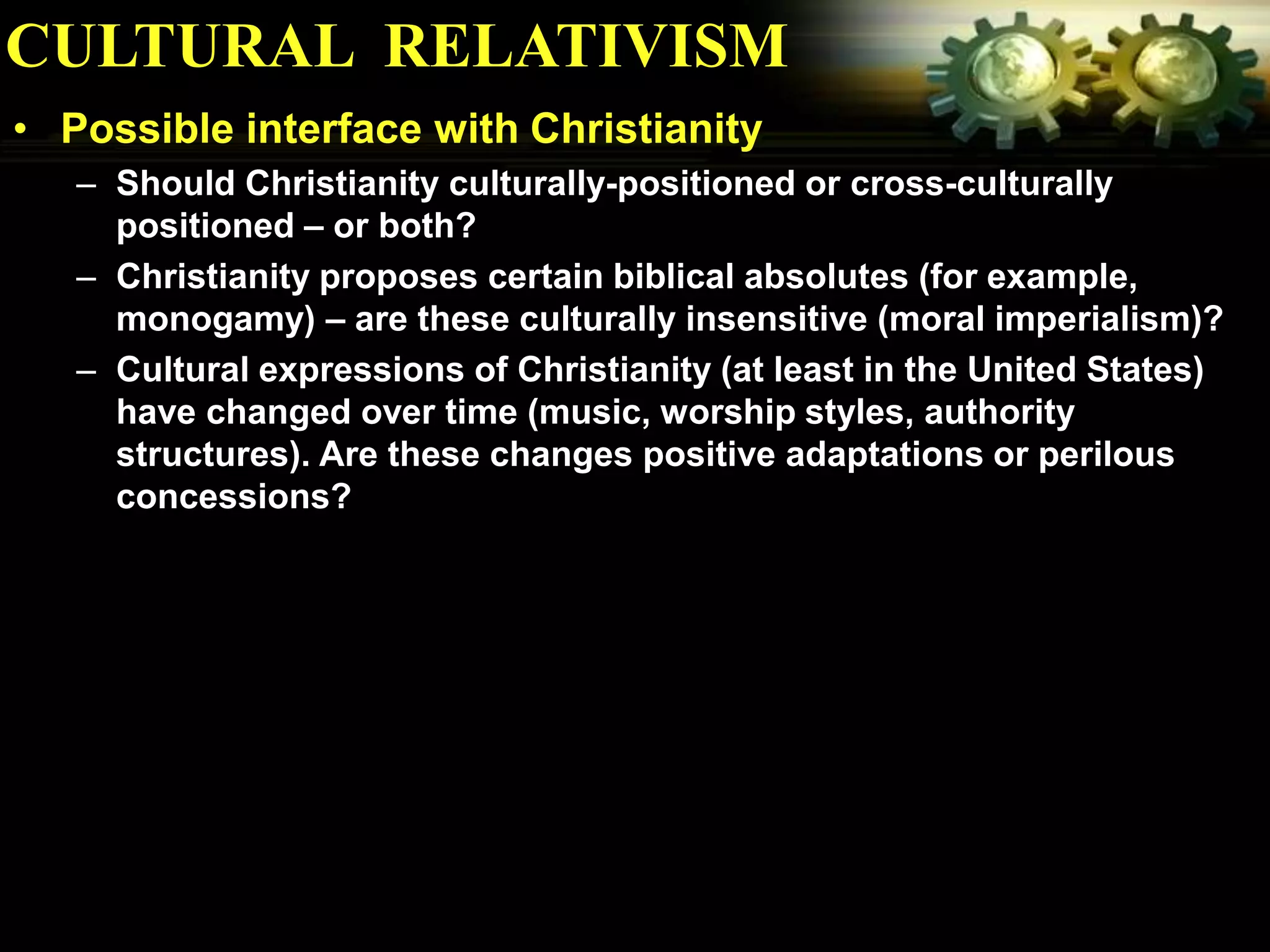
CULTURAL RELATIVISM
• Possible interface with Christianity
   – Should Christianity culturally-positioned or cross-culturally
     positioned – or both?
   – Christianity proposes certain biblical absolutes (for example,
     monogamy) – are these culturally insensitive (moral imperialism)?
   – Cultural expressions of Christianity (at least in the United States)
     have changed over time (music, worship styles, authority
     structures). Are these changes positive adaptations or perilous
     concessions?
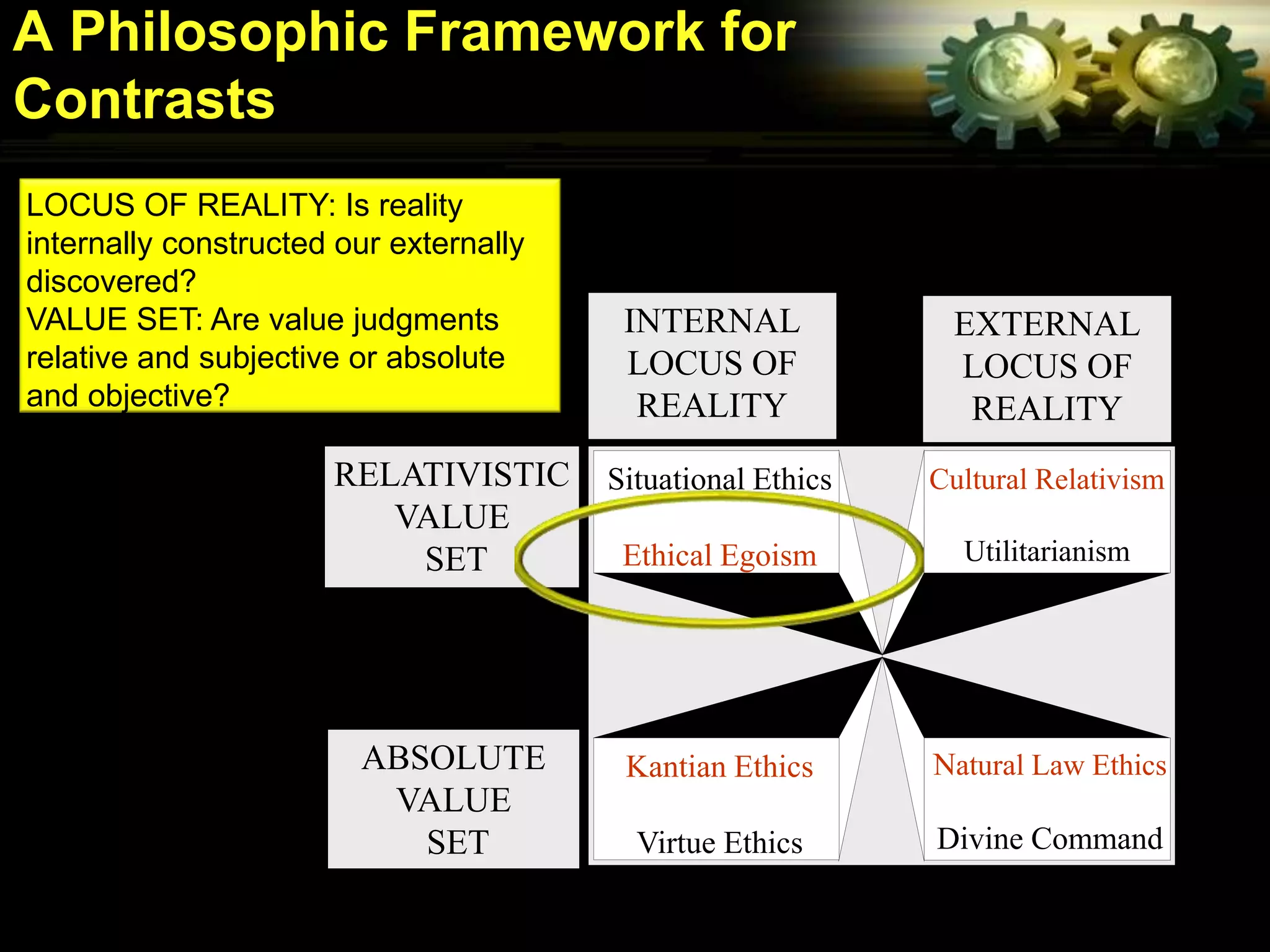
A Philosophic Framework for
Contrasts
LOCUS OF REALITY: Is reality
internally constructed our externally
discovered?
VALUE SET: Are value judgments           INTERNAL             EXTERNAL
relative and subjective or absolute      LOCUS OF             LOCUS OF
and objective?                            REALITY              REALITY
                      RELATIVISTIC      Situational Ethics   Cultural Relativism
                         VALUE
                          SET            Ethical Egoism        Utilitarianism


                        ABSOLUTE         Kantian Ethics      Natural Law Ethics
                         VALUE
                           SET            Virtue Ethics      Divine Command
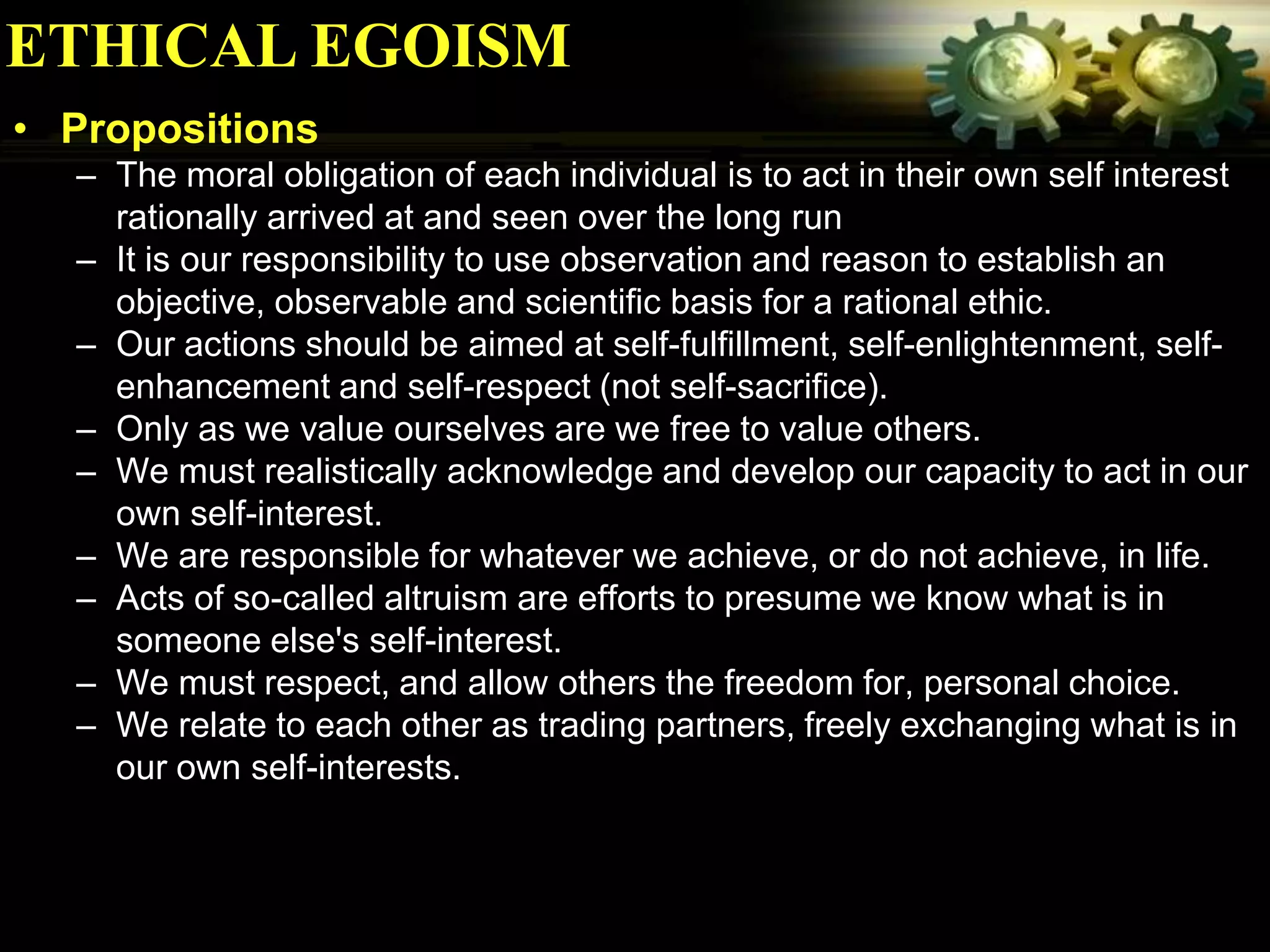
ETHICAL EGOISM
• Propositions
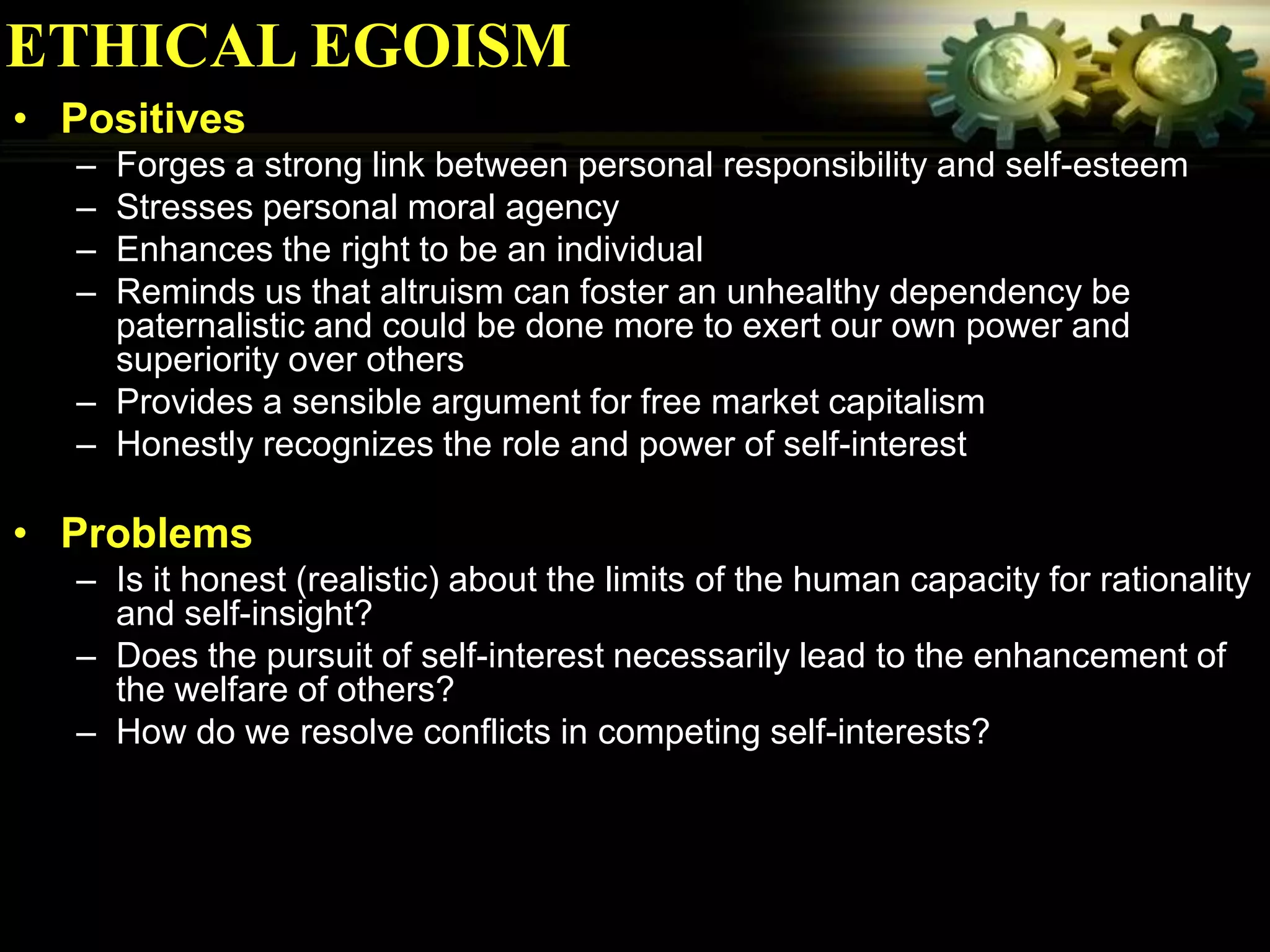
  – The moral obligation of each individual is to act in their own self interest
    rationally arrived at and seen over the long run
  – It is our responsibility to use observation and reason to establish an
    objective, observable and scientific basis for a rational ethic.
  – Our actions should be aimed at self-fulfillment, self-enlightenment, self-
    enhancement and self-respect (not self-sacrifice).
  – Only as we value ourselves are we free to value others.
  – We must realistically acknowledge and develop our capacity to act in our
    own self-interest.
  – We are responsible for whatever we achieve, or do not achieve, in life.
  – Acts of so-called altruism are efforts to presume we know what is in
    someone else's self-interest.
  – We must respect, and allow others the freedom for, personal choice.
  – We relate to each other as trading partners, freely exchanging what is in
    our own self-interests.
ETHICAL EGOISM
• Positives
  – Forges a strong link between personal responsibility and self-esteem
  – Stresses personal moral agency
  – Enhances the right to be an individual
  – Reminds us that altruism can foster an unhealthy dependency be
    paternalistic and could be done more to exert our own power and
    superiority over others
  – Provides a sensible argument for free market capitalism
  – Honestly recognizes the role and power of self-interest

• Problems
  – Is it honest (realistic) about the limits of the human capacity for rationality
    and self-insight?
  – Does the pursuit of self-interest necessarily lead to the enhancement of
    the welfare of others?
  – How do we resolve conflicts in competing self-interests?
ETHICAL EGOISM
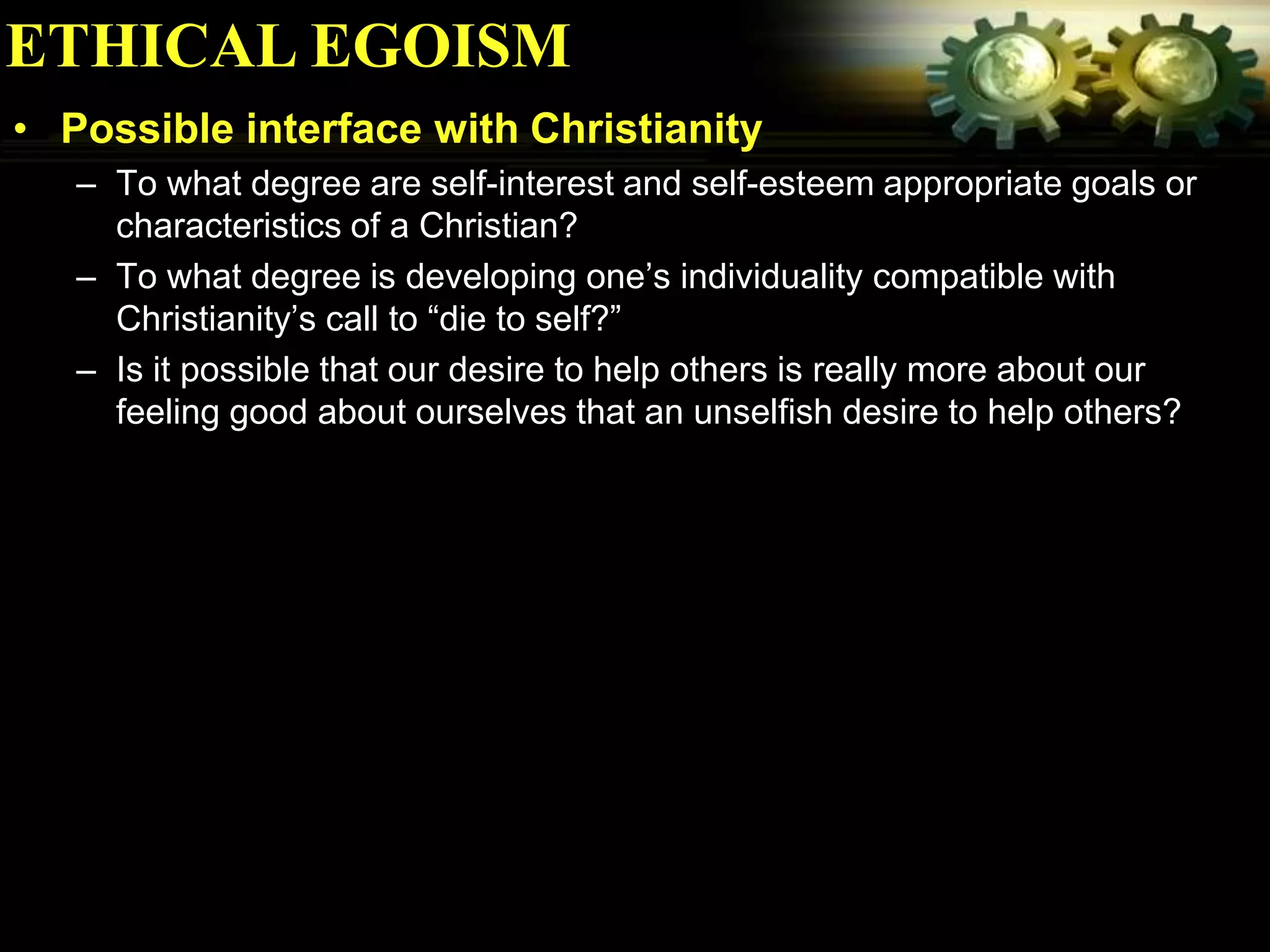
• Possible interface with Christianity
   – To what degree are self-interest and self-esteem appropriate goals or
     characteristics of a Christian?
   – To what degree is developing one’s individuality compatible with
     Christianity’s call to “die to self?”
   – Is it possible that our desire to help others is really more about our
     feeling good about ourselves that an unselfish desire to help others?
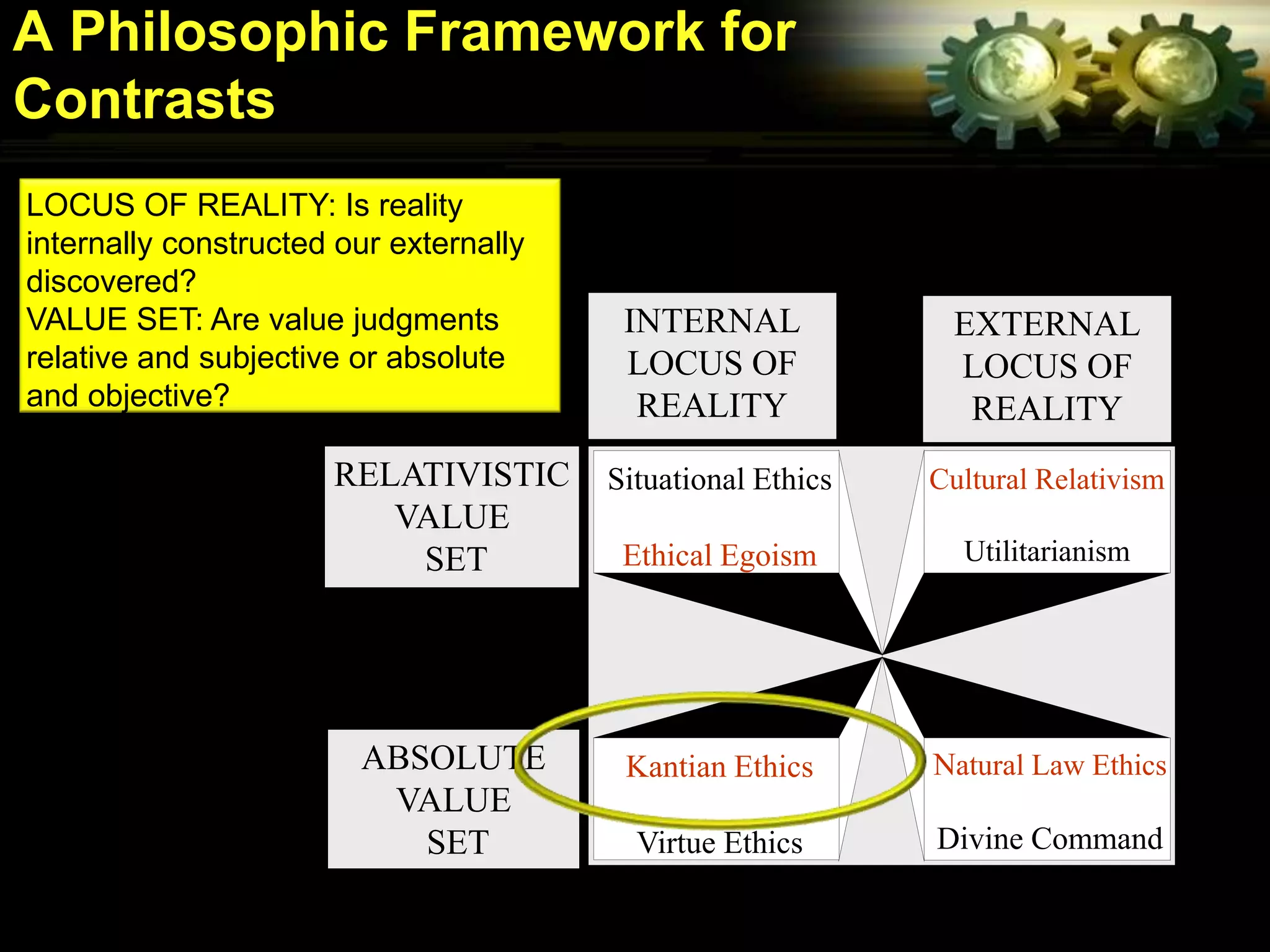
A Philosophic Framework for
Contrasts
LOCUS OF REALITY: Is reality
internally constructed our externally
discovered?
VALUE SET: Are value judgments           INTERNAL             EXTERNAL
relative and subjective or absolute      LOCUS OF             LOCUS OF
and objective?                            REALITY              REALITY
                      RELATIVISTIC      Situational Ethics   Cultural Relativism
                         VALUE
                          SET            Ethical Egoism        Utilitarianism


                        ABSOLUTE         Kantian Ethics      Natural Law Ethics
                         VALUE
                           SET            Virtue Ethics      Divine Command
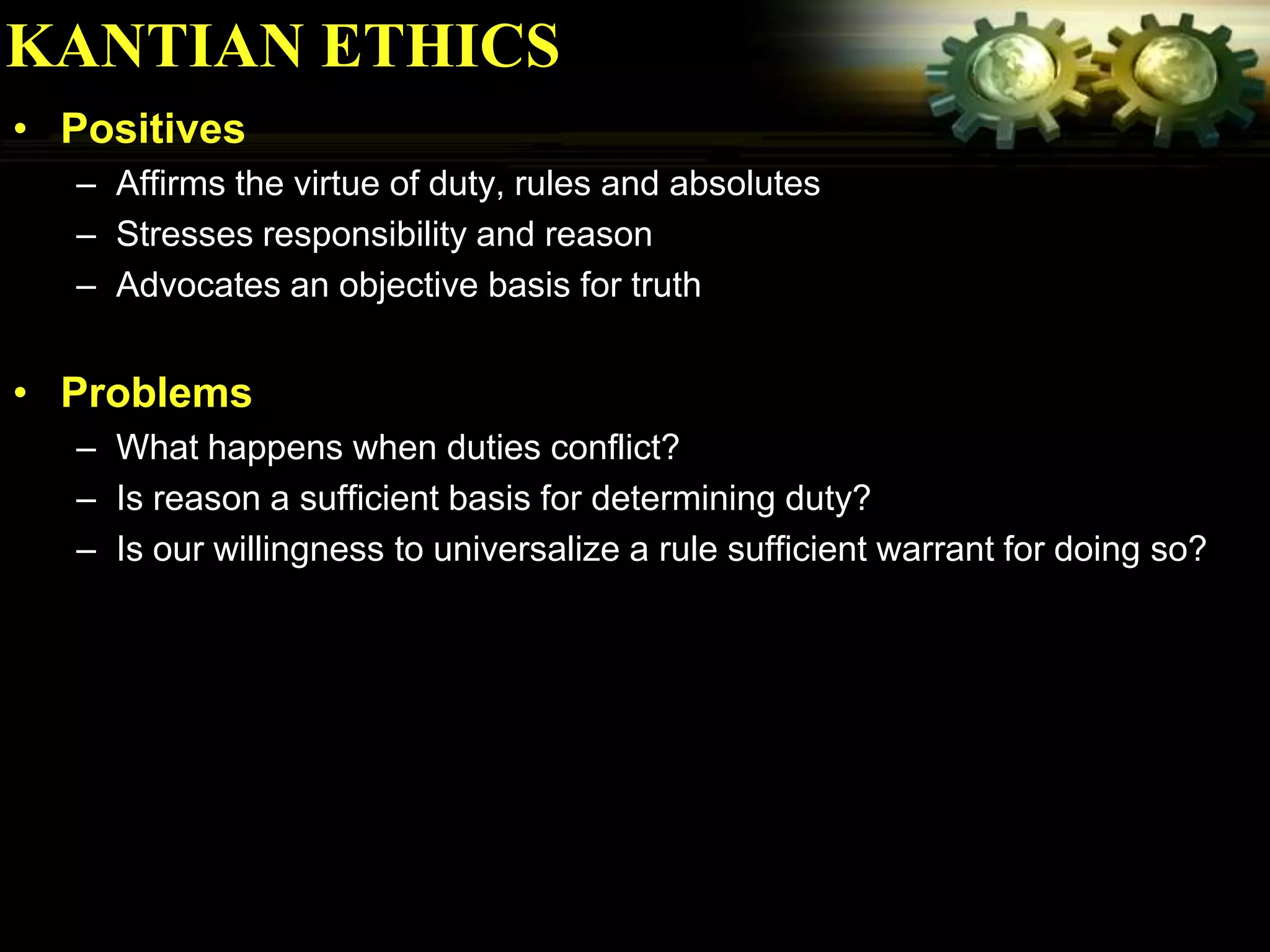
KANTIAN ETHICS
• Propositions
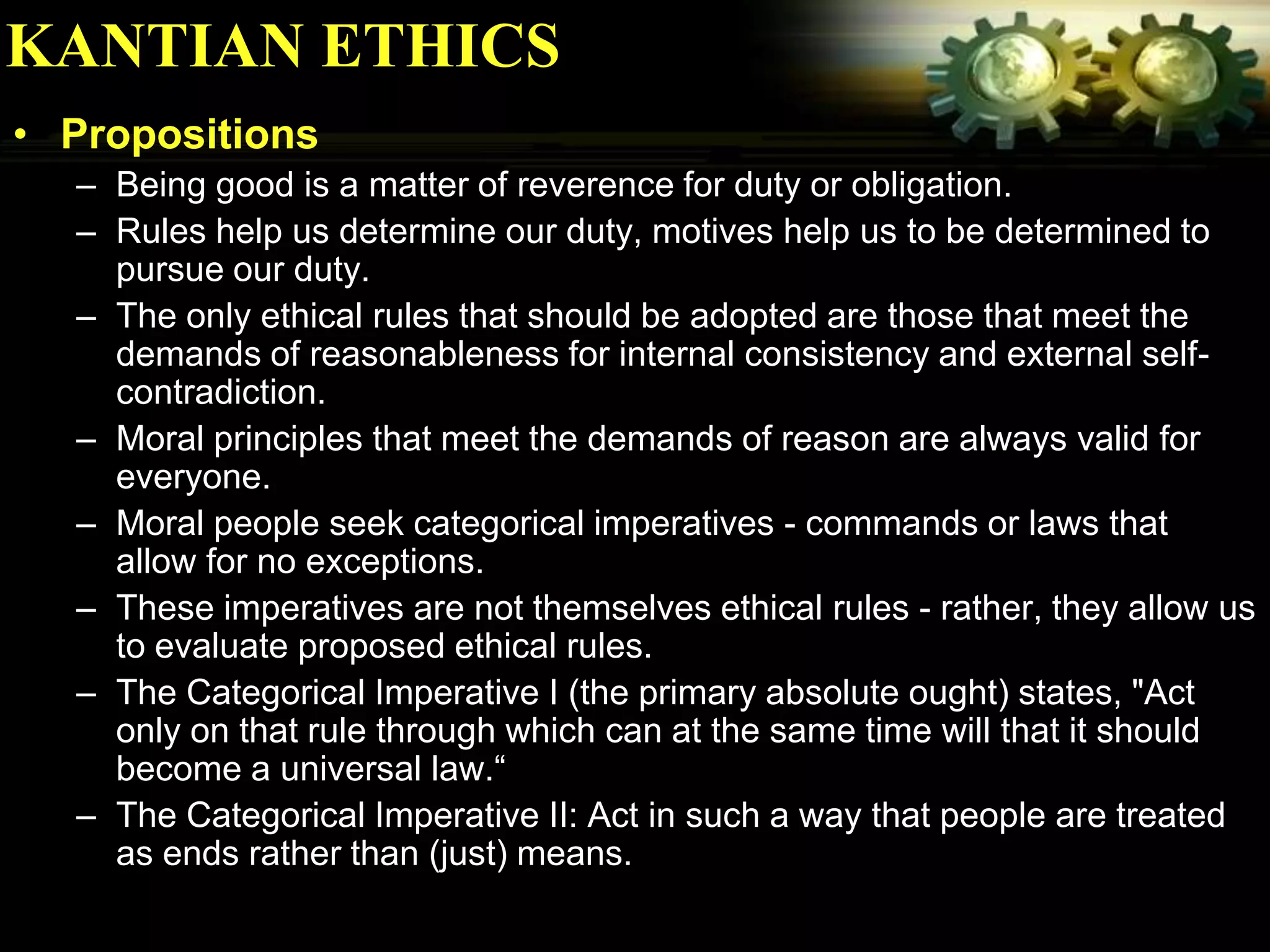
  – Being good is a matter of reverence for duty or obligation.
  – Rules help us determine our duty, motives help us to be determined to
    pursue our duty.
  – The only ethical rules that should be adopted are those that meet the
    demands of reasonableness for internal consistency and external self-
    contradiction.
  – Moral principles that meet the demands of reason are always valid for
    everyone.
  – Moral people seek categorical imperatives - commands or laws that
    allow for no exceptions.
  – These imperatives are not themselves ethical rules - rather, they allow us
    to evaluate proposed ethical rules.
  – The Categorical Imperative I (the primary absolute ought) states, "Act
    only on that rule through which can at the same time will that it should
    become a universal law.“
  – The Categorical Imperative II: Act in such a way that people are treated
    as ends rather than (just) means.
KANTIAN ETHICS
• Positives
  – Affirms the virtue of duty, rules and absolutes
  – Stresses responsibility and reason
  – Advocates an objective basis for truth


• Problems
  – What happens when duties conflict?
  – Is reason a sufficient basis for determining duty?
  – Is our willingness to universalize a rule sufficient warrant for doing so?
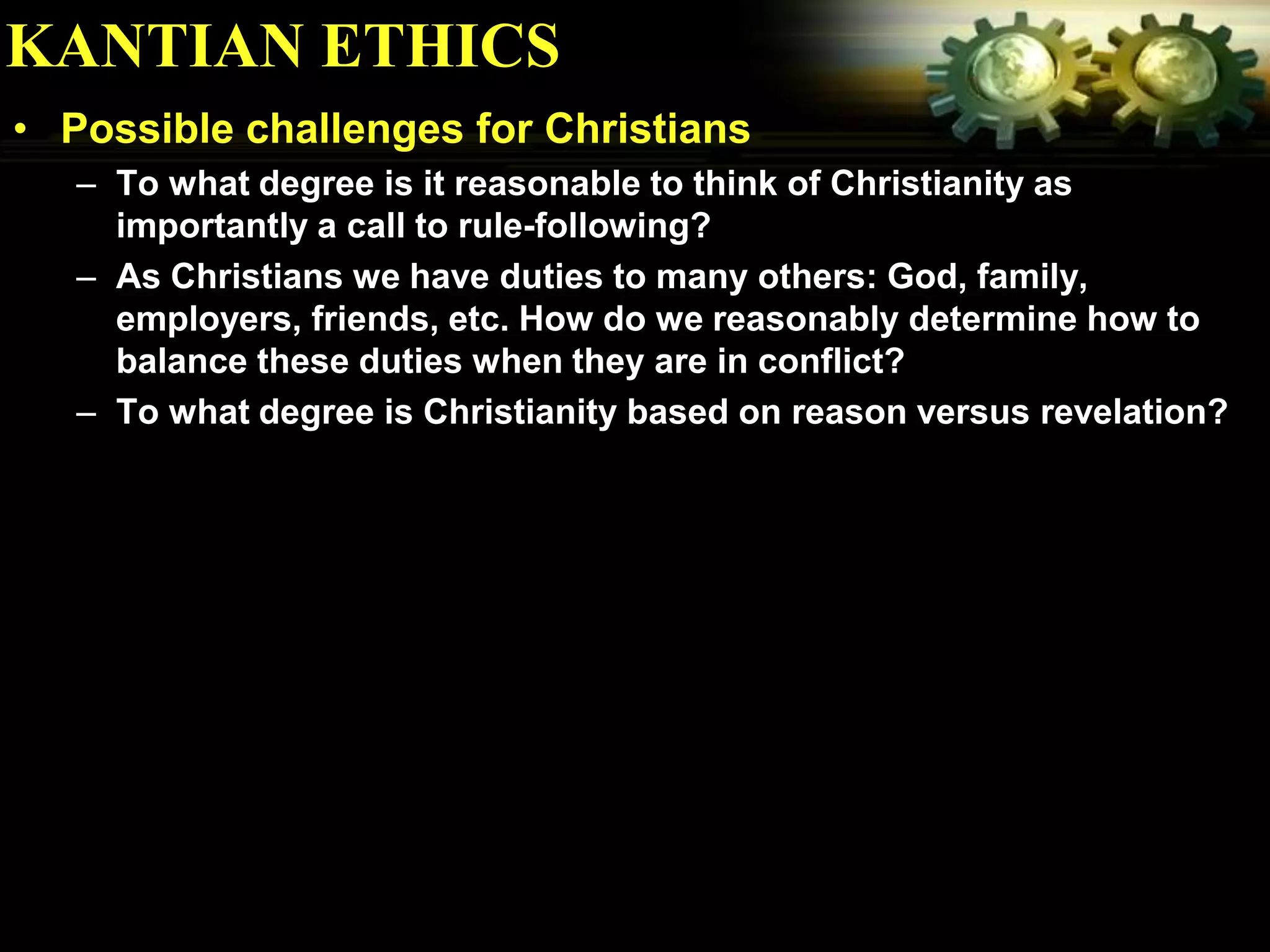
KANTIAN ETHICS
• Possible challenges for Christians
   – To what degree is it reasonable to think of Christianity as
     importantly a call to rule-following?
   – As Christians we have duties to many others: God, family,
     employers, friends, etc. How do we reasonably determine how to
     balance these duties when they are in conflict?
   – To what degree is Christianity based on reason versus revelation?
A Philosophic Framework
for Contrasts
LOCUS OF REALITY: Is reality
internally constructed our externally
discovered?
VALUE SET: Are value judgments           INTERNAL             EXTERNAL
relative and subjective or absolute      LOCUS OF             LOCUS OF
and objective?                            REALITY              REALITY
                      RELATIVISTIC      Situational Ethics   Cultural Relativism
                         VALUE
                          SET            Ethical Egoism        Utilitarianism


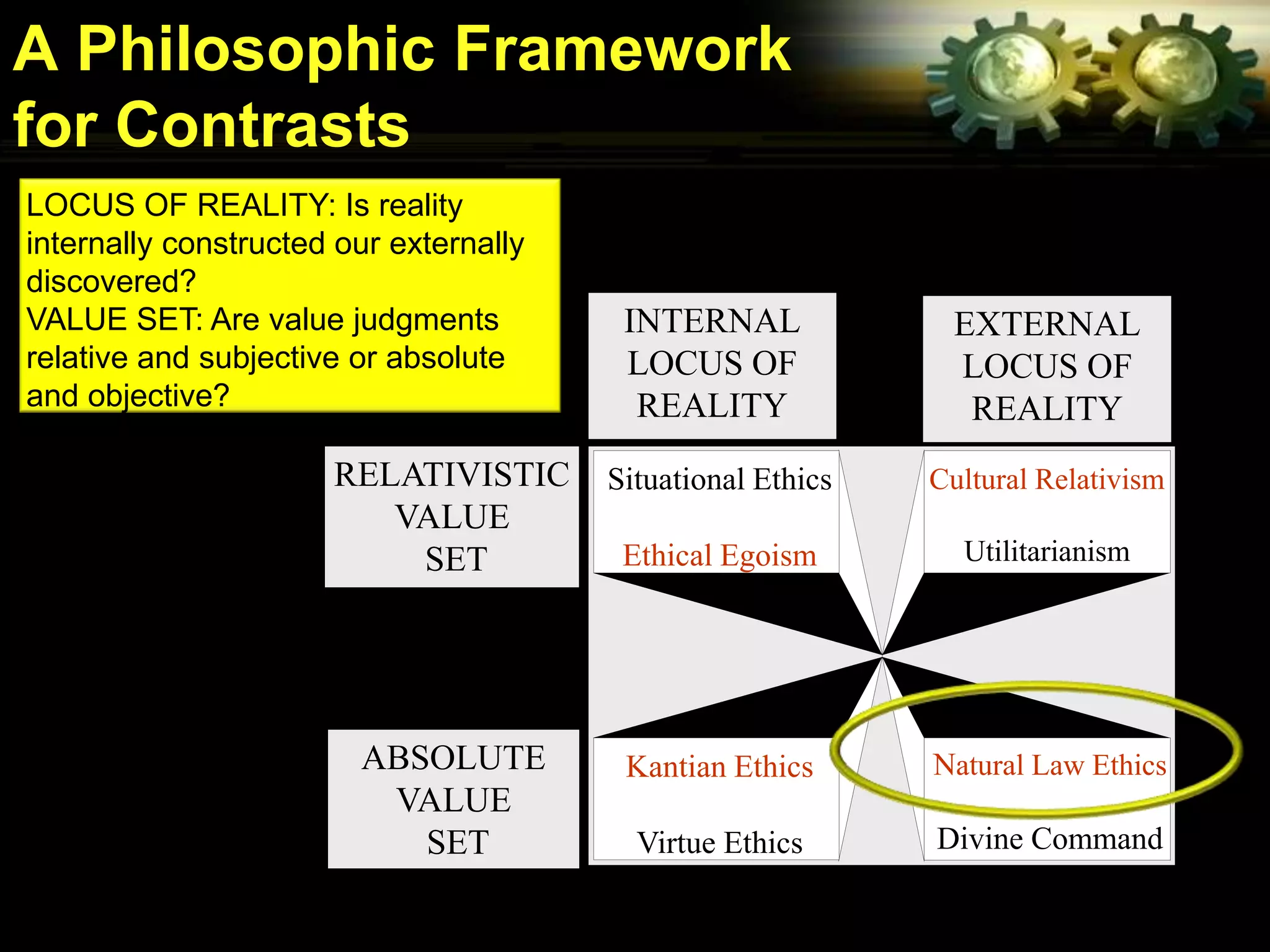
                        ABSOLUTE         Kantian Ethics      Natural Law Ethics
                         VALUE
                           SET            Virtue Ethics      Divine Command
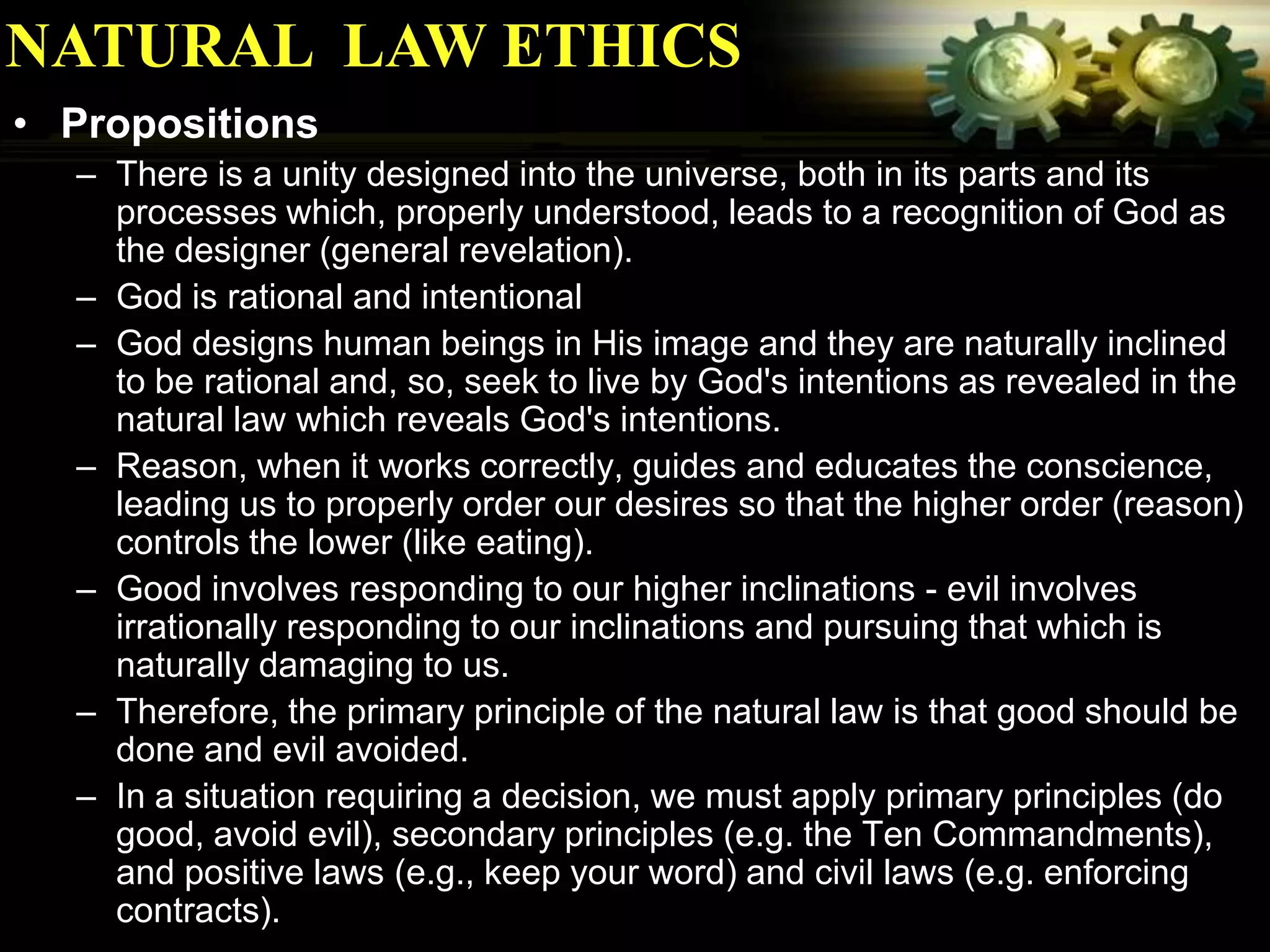
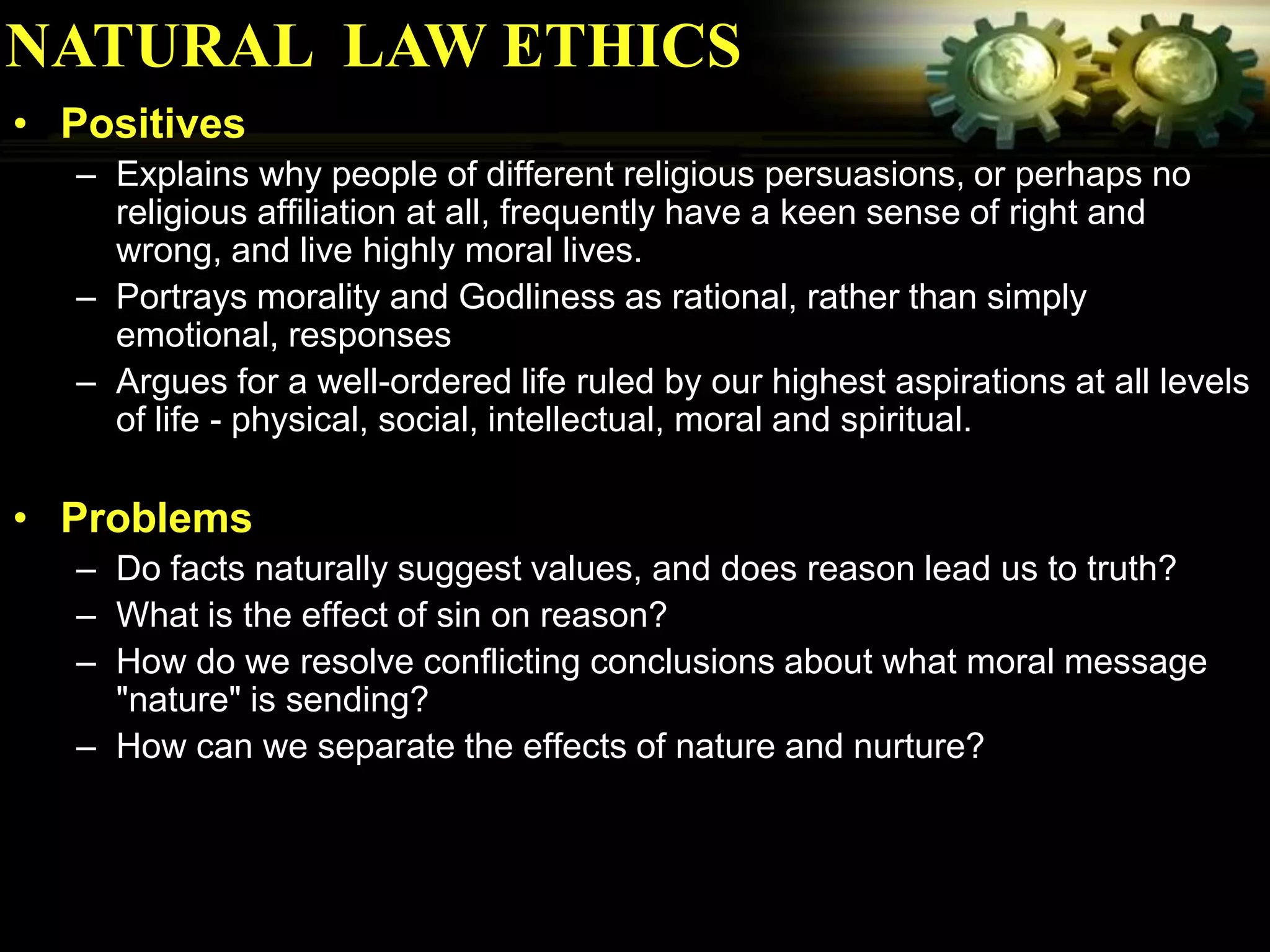
NATURAL LAW ETHICS
• Propositions
  – There is a unity designed into the universe, both in its parts and its
    processes which, properly understood, leads to a recognition of God as
    the designer (general revelation).
  – God is rational and intentional
  – God designs human beings in His image and they are naturally inclined
    to be rational and, so, seek to live by God's intentions as revealed in the
    natural law which reveals God's intentions.
  – Reason, when it works correctly, guides and educates the conscience,
    leading us to properly order our desires so that the higher order (reason)
    controls the lower (like eating).
  – Good involves responding to our higher inclinations - evil involves
    irrationally responding to our inclinations and pursuing that which is
    naturally damaging to us.
  – Therefore, the primary principle of the natural law is that good should be
    done and evil avoided.
  – In a situation requiring a decision, we must apply primary principles (do
    good, avoid evil), secondary principles (e.g. the Ten Commandments),
    and positive laws (e.g., keep your word) and civil laws (e.g. enforcing
    contracts).
NATURAL LAW ETHICS
• Positives
  – Explains why people of different religious persuasions, or perhaps no
    religious affiliation at all, frequently have a keen sense of right and
    wrong, and live highly moral lives.
  – Portrays morality and Godliness as rational, rather than simply
    emotional, responses
  – Argues for a well-ordered life ruled by our highest aspirations at all levels
    of life - physical, social, intellectual, moral and spiritual.

• Problems
  – Do facts naturally suggest values, and does reason lead us to truth?
  – What is the effect of sin on reason?
  – How do we resolve conflicting conclusions about what moral message
    "nature" is sending?
  – How can we separate the effects of nature and nurture?
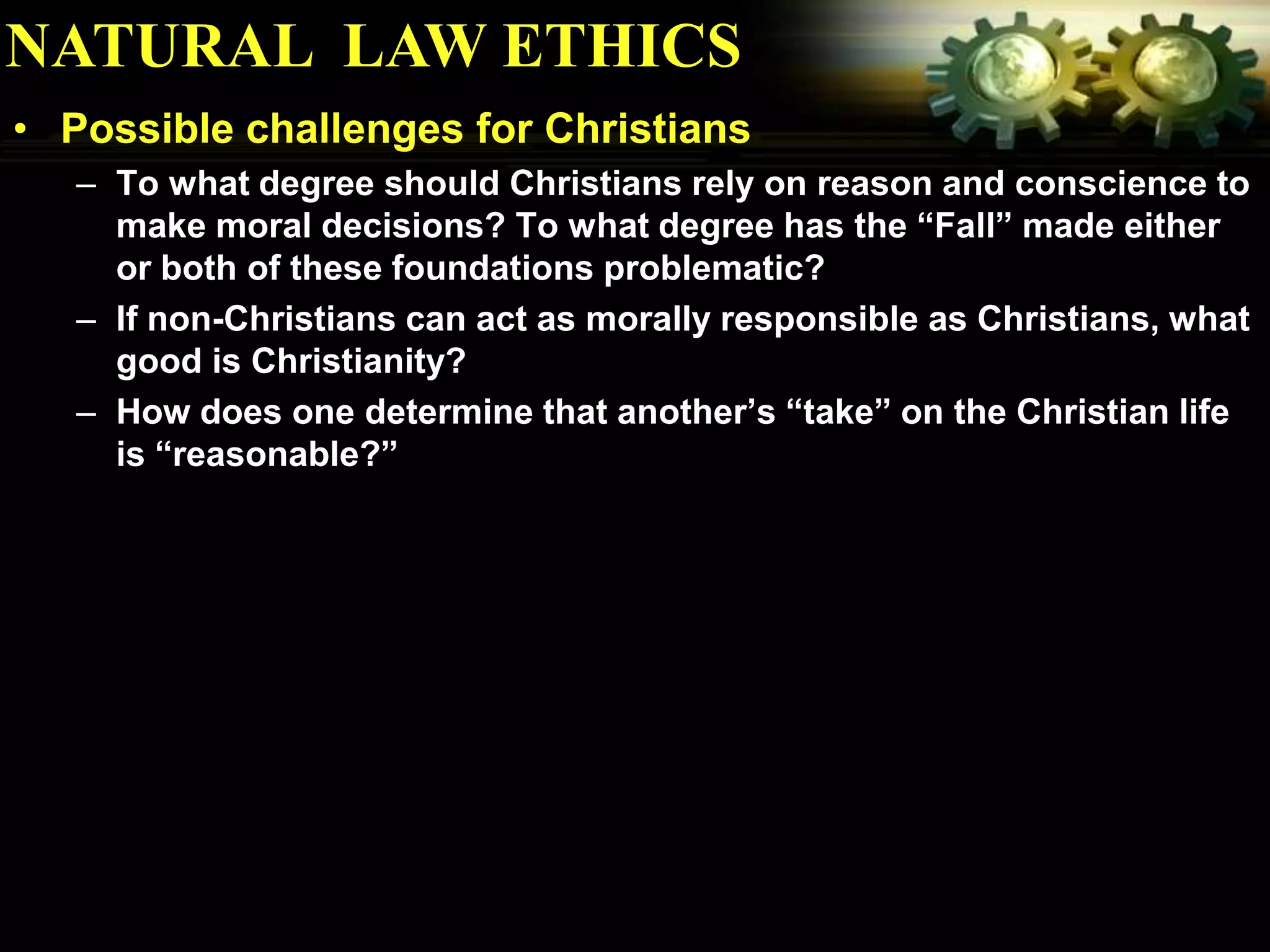
NATURAL LAW ETHICS
• Possible challenges for Christians
   – To what degree should Christians rely on reason and conscience to
     make moral decisions? To what degree has the “Fall” made either
     or both of these foundations problematic?
   – If non-Christians can act as morally responsible as Christians, what
     good is Christianity?
   – How does one determine that another’s “take” on the Christian life
     is “reasonable?”
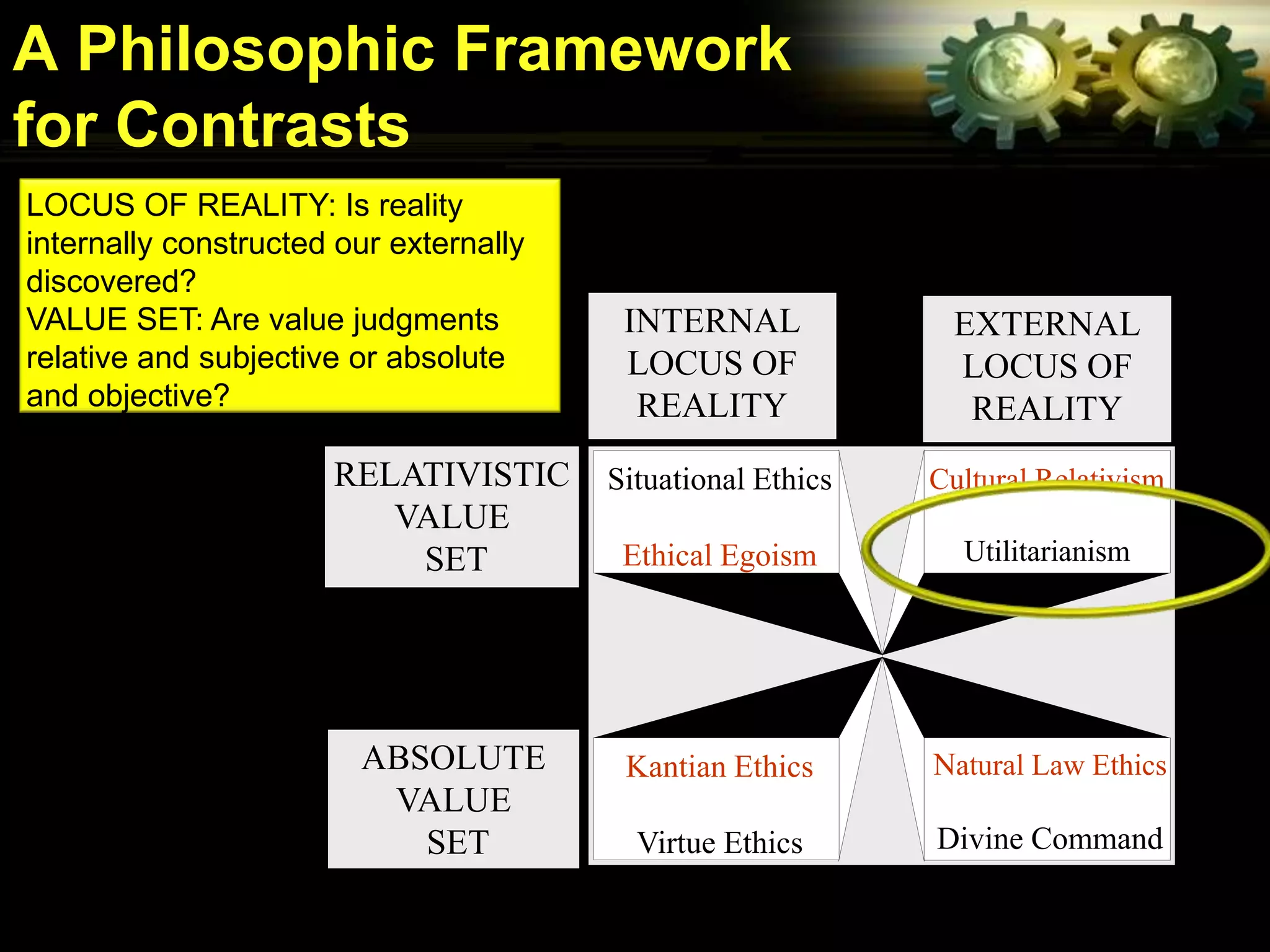
A Philosophic Framework
for Contrasts
LOCUS OF REALITY: Is reality
internally constructed our externally
discovered?
VALUE SET: Are value judgments           INTERNAL             EXTERNAL
relative and subjective or absolute      LOCUS OF             LOCUS OF
and objective?                            REALITY              REALITY
                      RELATIVISTIC      Situational Ethics   Cultural Relativism
                         VALUE
                          SET            Ethical Egoism        Utilitarianism


                        ABSOLUTE         Kantian Ethics      Natural Law Ethics
                         VALUE
                           SET            Virtue Ethics      Divine Command
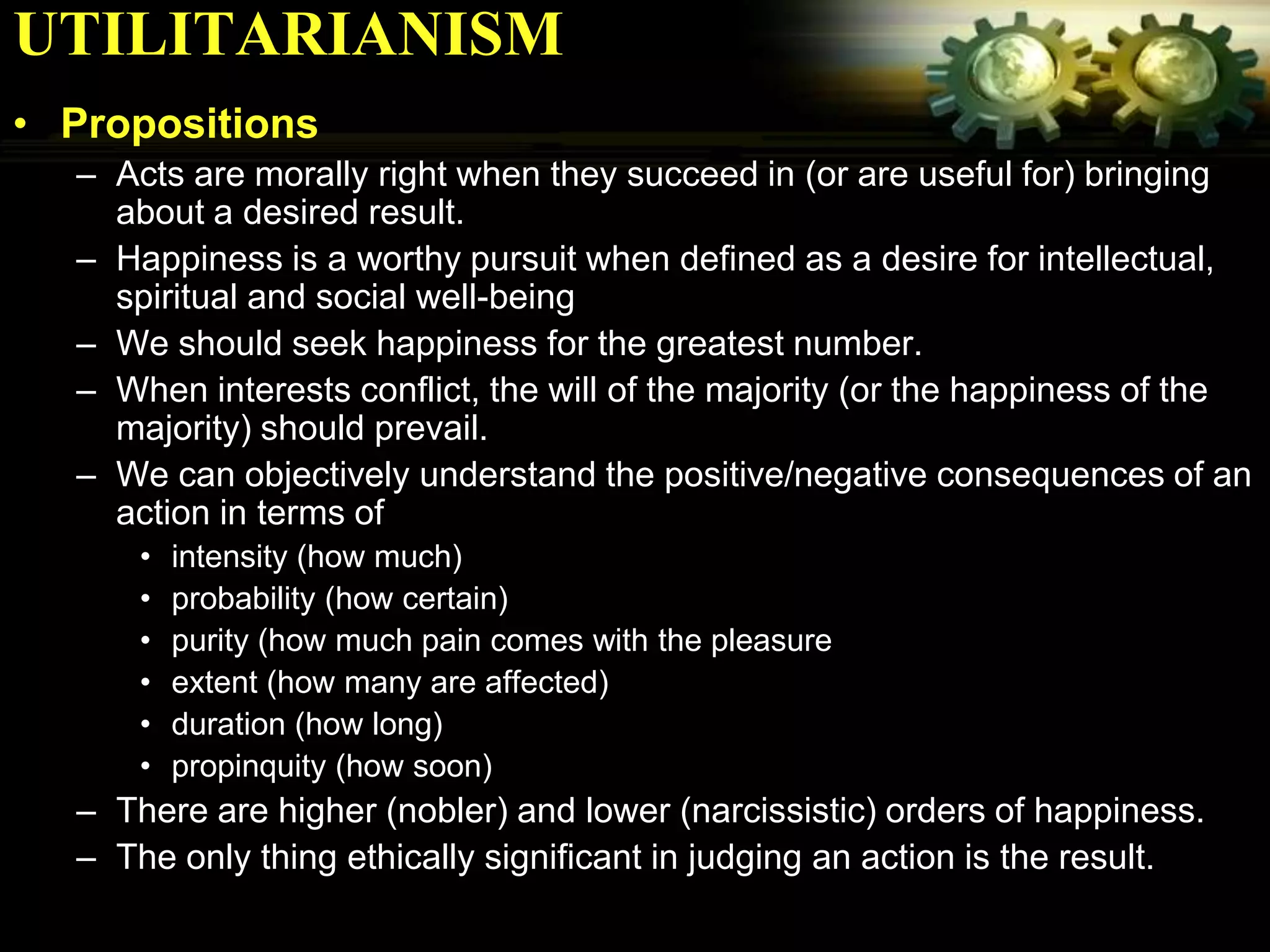
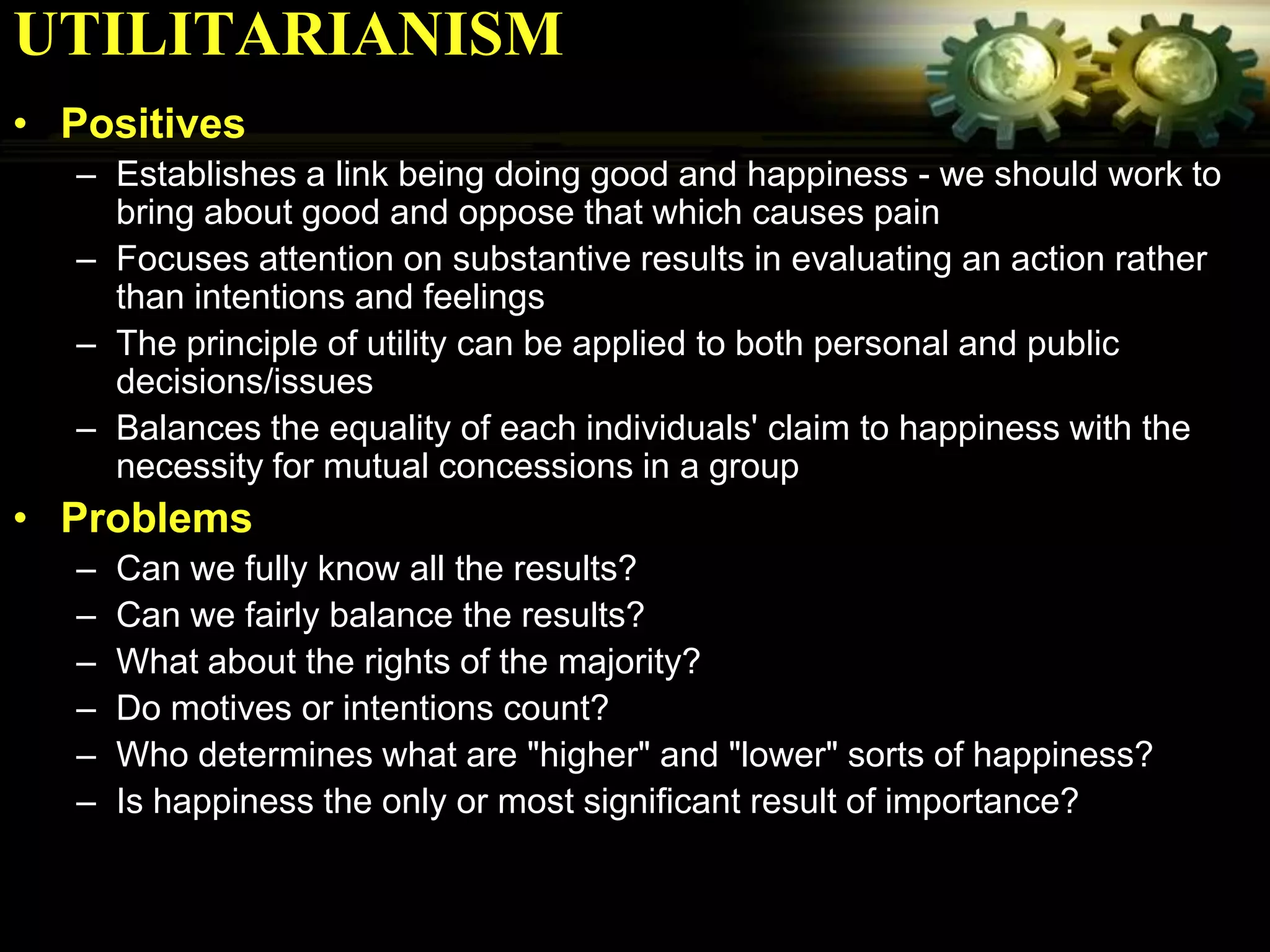
UTILITARIANISM
• Propositions
  – Acts are morally right when they succeed in (or are useful for) bringing
    about a desired result.
  – Happiness is a worthy pursuit when defined as a desire for intellectual,
    spiritual and social well-being
  – We should seek happiness for the greatest number.
  – When interests conflict, the will of the majority (or the happiness of the
    majority) should prevail.
  – We can objectively understand the positive/negative consequences of an
    action in terms of
      •   intensity (how much)
      •   probability (how certain)
      •   purity (how much pain comes with the pleasure
      •   extent (how many are affected)
      •   duration (how long)
      •   propinquity (how soon)
  – There are higher (nobler) and lower (narcissistic) orders of happiness.
  – The only thing ethically significant in judging an action is the result.
UTILITARIANISM
• Positives
  – Establishes a link being doing good and happiness - we should work to
    bring about good and oppose that which causes pain
  – Focuses attention on substantive results in evaluating an action rather
    than intentions and feelings
  – The principle of utility can be applied to both personal and public
    decisions/issues
  – Balances the equality of each individuals' claim to happiness with the
    necessity for mutual concessions in a group
• Problems
  –   Can we fully know all the results?
  –   Can we fairly balance the results?
  –   What about the rights of the majority?
  –   Do motives or intentions count?
  –   Who determines what are "higher" and "lower" sorts of happiness?
  –   Is happiness the only or most significant result of importance?
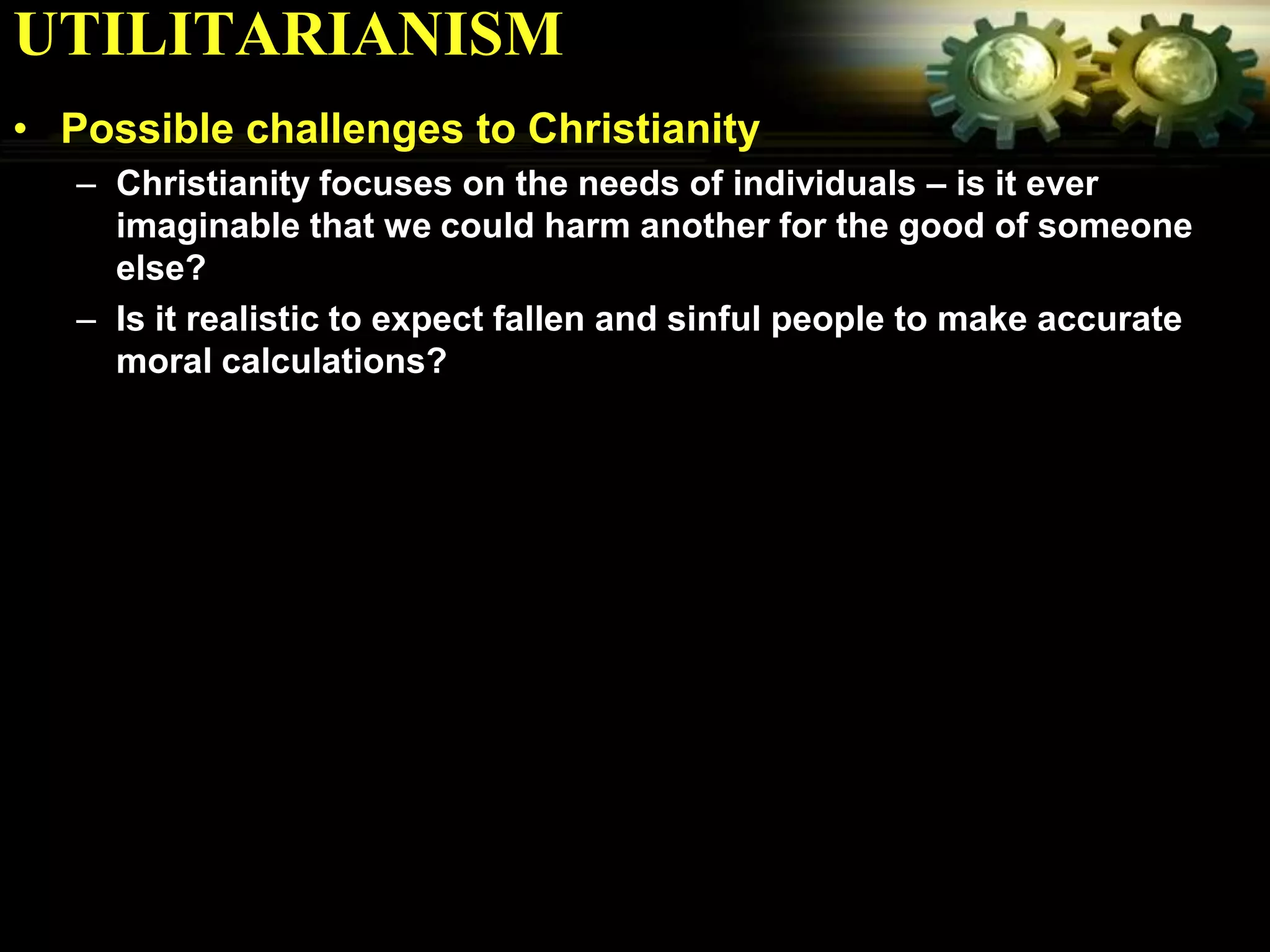
UTILITARIANISM
• Possible challenges to Christianity
   – Christianity focuses on the needs of individuals – is it ever
     imaginable that we could harm another for the good of someone
     else?
   – Is it realistic to expect fallen and sinful people to make accurate
     moral calculations?
A Philosophic Framework
for Contrasts
LOCUS OF REALITY: Is reality
internally constructed our externally
discovered?
VALUE SET: Are value judgments           INTERNAL             EXTERNAL
relative and subjective or absolute      LOCUS OF             LOCUS OF
and objective?                            REALITY              REALITY
                      RELATIVISTIC      Situational Ethics   Cultural Relativism
                         VALUE
                          SET            Ethical Egoism        Utilitarianism


                        ABSOLUTE         Kantian Ethics      Natural Law Ethics
                         VALUE
                           SET            Virtue Ethics      Divine Command
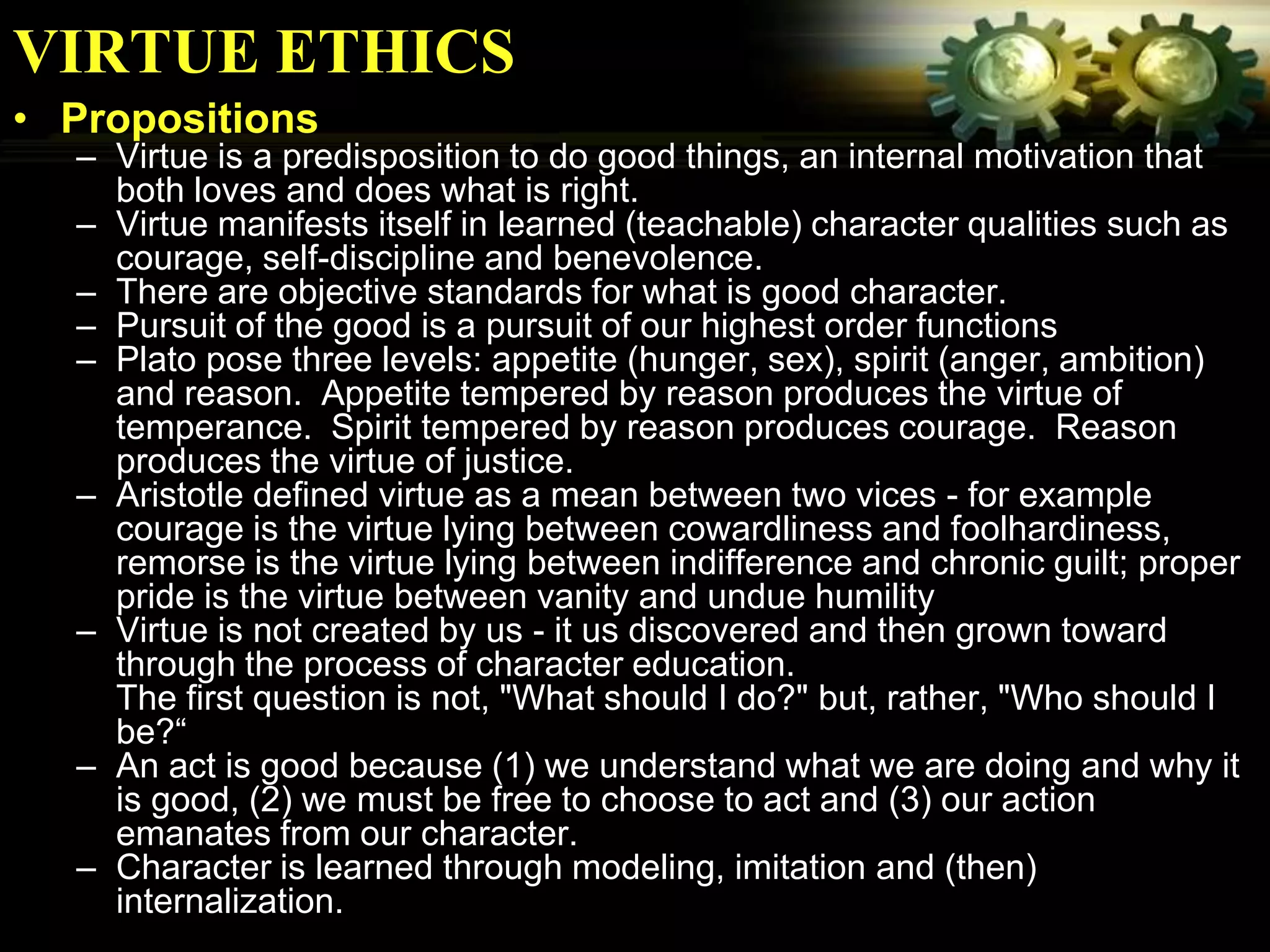
VIRTUE ETHICS
• Propositions
  – Virtue is a predisposition to do good things, an internal motivation that
    both loves and does what is right.
  – Virtue manifests itself in learned (teachable) character qualities such as
    courage, self-discipline and benevolence.
  – There are objective standards for what is good character.
  – Pursuit of the good is a pursuit of our highest order functions
  – Plato pose three levels: appetite (hunger, sex), spirit (anger, ambition)
    and reason. Appetite tempered by reason produces the virtue of
    temperance. Spirit tempered by reason produces courage. Reason
    produces the virtue of justice.
  – Aristotle defined virtue as a mean between two vices - for example
    courage is the virtue lying between cowardliness and foolhardiness,
    remorse is the virtue lying between indifference and chronic guilt; proper
    pride is the virtue between vanity and undue humility
  – Virtue is not created by us - it us discovered and then grown toward
    through the process of character education.
    The first question is not, "What should I do?" but, rather, "Who should I
    be?“
  – An act is good because (1) we understand what we are doing and why it
    is good, (2) we must be free to choose to act and (3) our action
    emanates from our character.
  – Character is learned through modeling, imitation and (then)
    internalization.
VIRTUE ETHICS
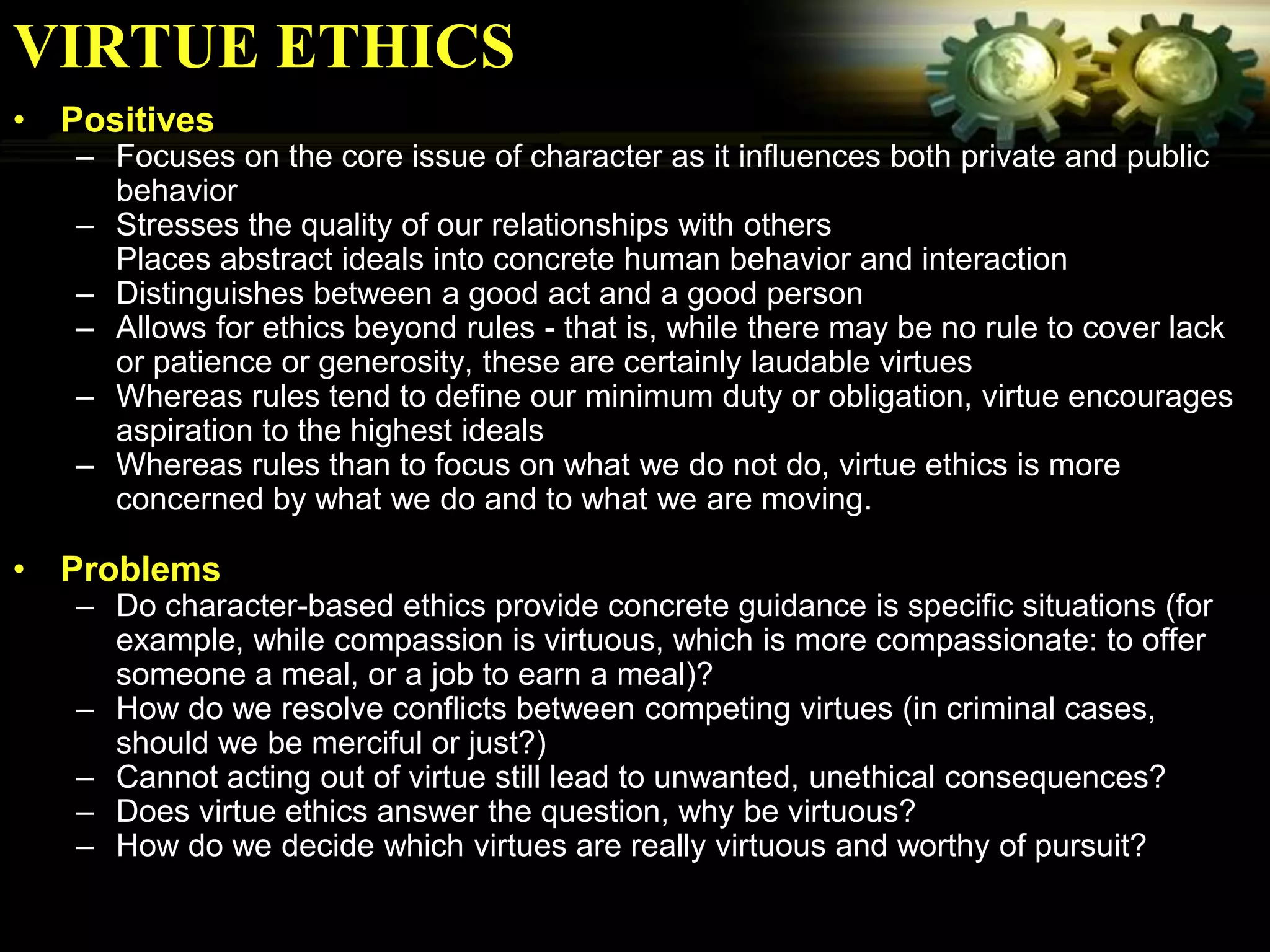
• Positives
   – Focuses on the core issue of character as it influences both private and public
     behavior
   – Stresses the quality of our relationships with others
     Places abstract ideals into concrete human behavior and interaction
   – Distinguishes between a good act and a good person
   – Allows for ethics beyond rules - that is, while there may be no rule to cover lack
     or patience or generosity, these are certainly laudable virtues
   – Whereas rules tend to define our minimum duty or obligation, virtue encourages
     aspiration to the highest ideals
   – Whereas rules than to focus on what we do not do, virtue ethics is more
     concerned by what we do and to what we are moving.

• Problems
   – Do character-based ethics provide concrete guidance is specific situations (for
     example, while compassion is virtuous, which is more compassionate: to offer
     someone a meal, or a job to earn a meal)?
   – How do we resolve conflicts between competing virtues (in criminal cases,
     should we be merciful or just?)
   – Cannot acting out of virtue still lead to unwanted, unethical consequences?
   – Does virtue ethics answer the question, why be virtuous?
   – How do we decide which virtues are really virtuous and worthy of pursuit?
VIRTUE ETHICS
• Possible challenges to Christianity
   – Can fallen and sinful people really ever choose to be good – and
     why would they?”
   – Even IF we might choose to be good, what would allow us to
     achieve that goal?
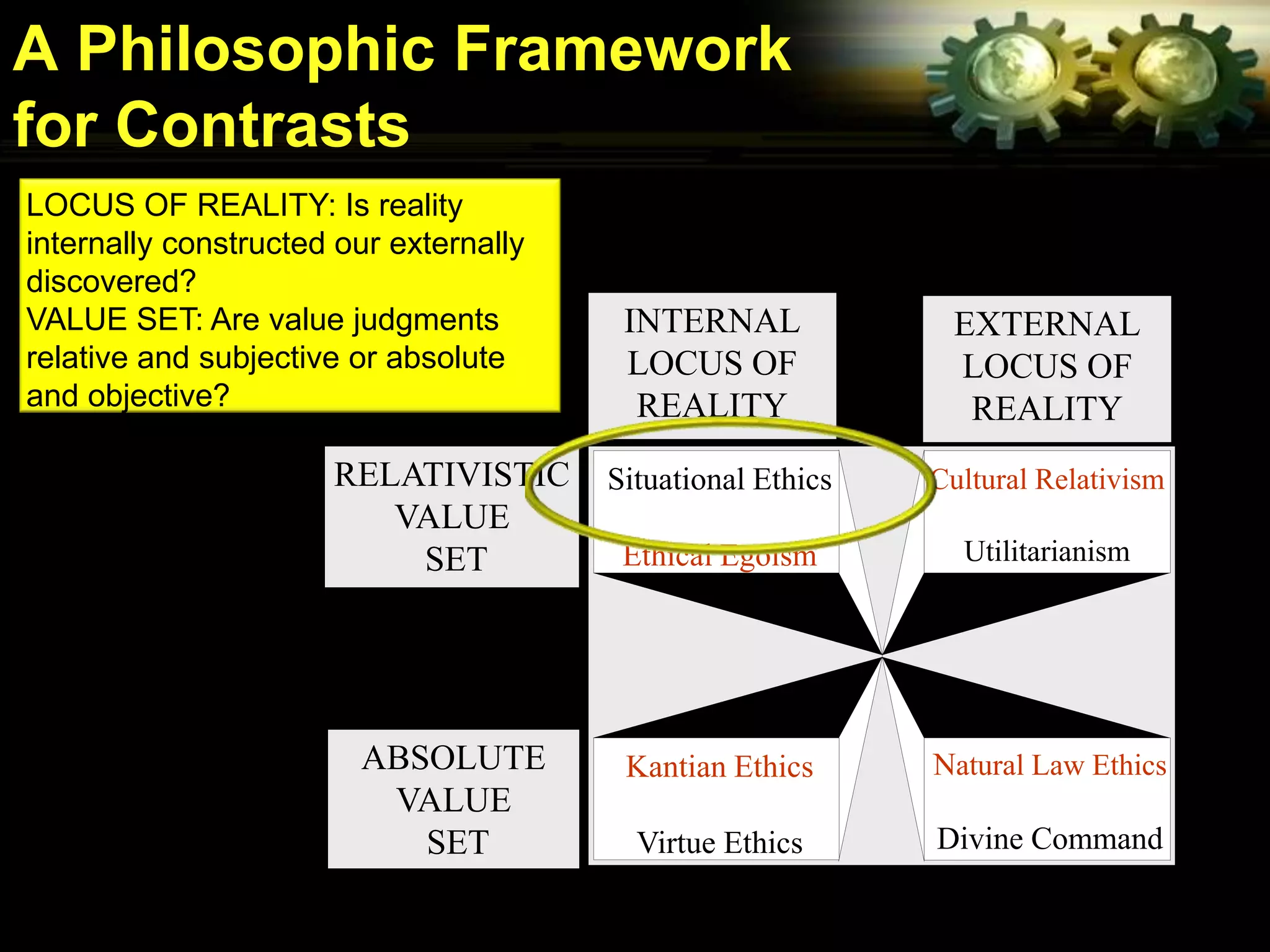
A Philosophic Framework
for Contrasts
LOCUS OF REALITY: Is reality
internally constructed our externally
discovered?
VALUE SET: Are value judgments           INTERNAL             EXTERNAL
relative and subjective or absolute      LOCUS OF             LOCUS OF
and objective?                            REALITY              REALITY
                      RELATIVISTIC      Situational Ethics   Cultural Relativism
                         VALUE
                          SET            Ethical Egoism        Utilitarianism


                        ABSOLUTE         Kantian Ethics      Natural Law Ethics
                         VALUE
                           SET            Virtue Ethics      Divine Command
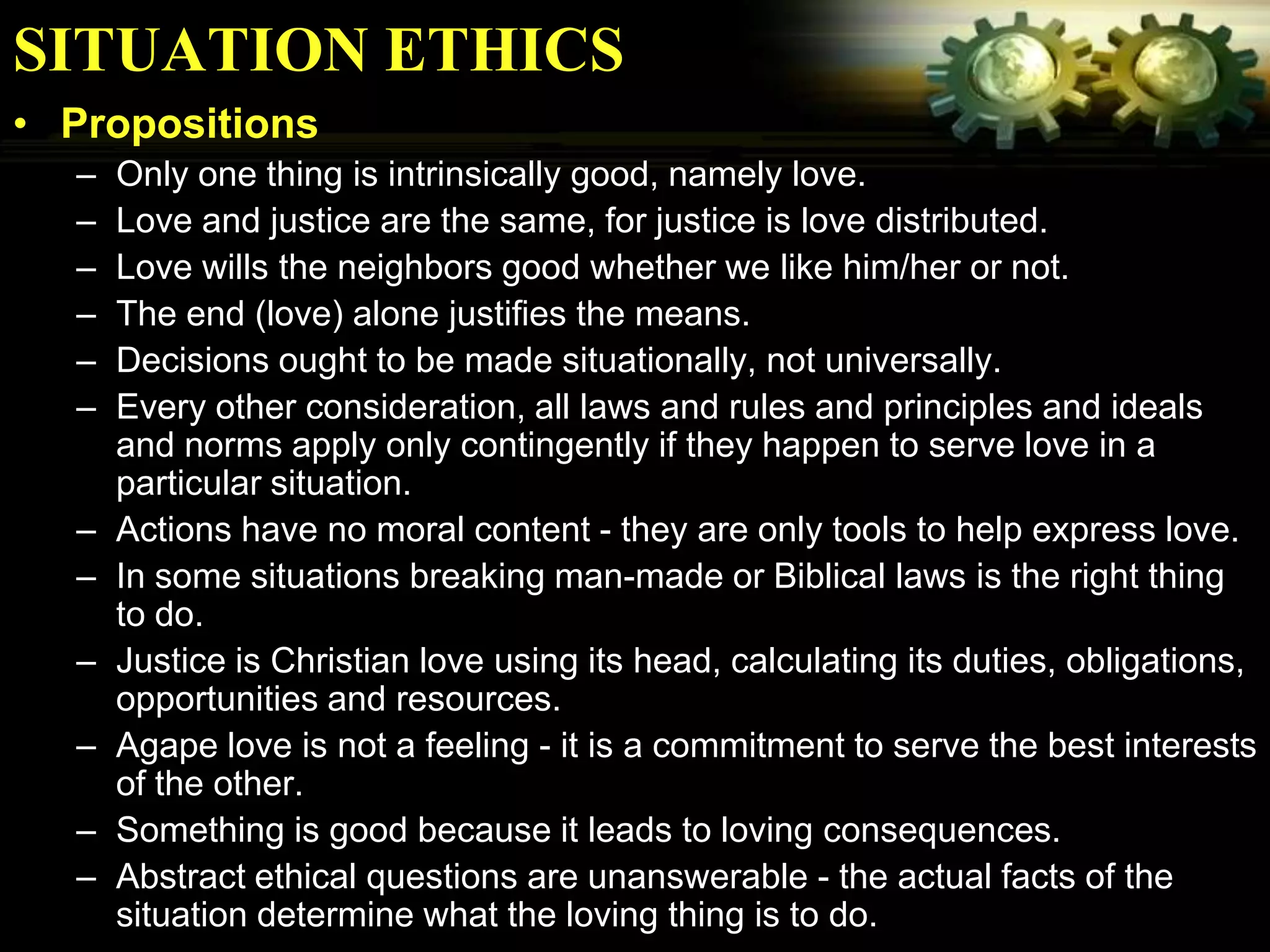
SITUATION ETHICS
• Propositions
  –   Only one thing is intrinsically good, namely love.
  –   Love and justice are the same, for justice is love distributed.
  –   Love wills the neighbors good whether we like him/her or not.
  –   The end (love) alone justifies the means.
  –   Decisions ought to be made situationally, not universally.
  –   Every other consideration, all laws and rules and principles and ideals
      and norms apply only contingently if they happen to serve love in a
      particular situation.
  –   Actions have no moral content - they are only tools to help express love.
  –   In some situations breaking man-made or Biblical laws is the right thing
      to do.
  –   Justice is Christian love using its head, calculating its duties, obligations,
      opportunities and resources.
  –   Agape love is not a feeling - it is a commitment to serve the best interests
      of the other.
  –   Something is good because it leads to loving consequences.
  –   Abstract ethical questions are unanswerable - the actual facts of the
      situation determine what the loving thing is to do.
SITUATION ETHICS
• Positives
  – It provides an absolute foundation for all action – love
  – It is based on the character of God
  – It advocates a deep concern for others and a realistic appraisal of
    situational demands
  – It focuses on our personal responsibility to decide and to act

• Problems
  – How do we determine all that should be included in our appraisal of a
    situation? Who should be included? What time period should be
    included? What consequences should be recognized?
  – How are we to determine with any confidence what love is?
  – How can we ever judge the rightness or wrongness of anyone's
    situation?
  – How do we resolve conflicting judgments about what love demands?
  – Why is love the preeminent value?
  – What allows, or even encourages, anyone to act in a loving way?
SITUATION ETHICS
• Possible challenges to Christianity
   – Is the loving thing to do always clear – what happens when love
     may demand action the other considers “unloving?”
   – How does one deal with the apparent “unloving” remarks and
     actions of Christ?
   – Is the essential essence of God love – rather than holiness, justice,
     etc.
   – Is the loving thing to do always the pleasing thing to do – can love
     be “tough?”
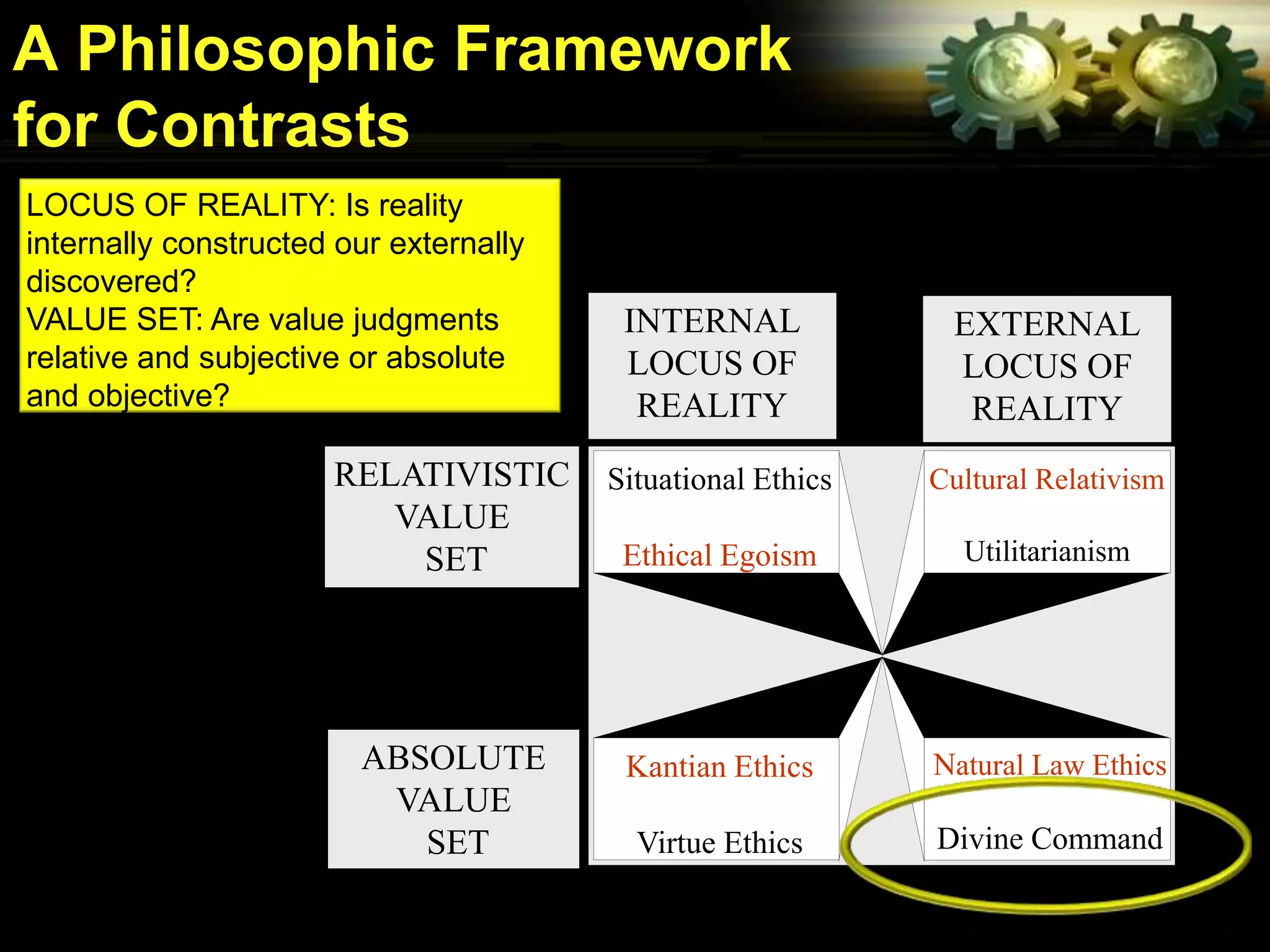
A Philosophic Framework
for Contrasts
LOCUS OF REALITY: Is reality
internally constructed our externally
discovered?
VALUE SET: Are value judgments           INTERNAL             EXTERNAL
relative and subjective or absolute      LOCUS OF             LOCUS OF
and objective?                            REALITY              REALITY
                      RELATIVISTIC      Situational Ethics   Cultural Relativism
                         VALUE
                          SET            Ethical Egoism        Utilitarianism


                        ABSOLUTE         Kantian Ethics      Natural Law Ethics
                         VALUE
                           SET            Virtue Ethics      Divine Command
DIVINE COMMAND THEORY
• Propositions
  – God has made and communicated clear rules of right and wrong and our
    duty is to obey these rules.
  – Sin is missing the standard (God's Will) and rebelling against God who
    has the right to our loyalty and obedience.
  – Mankind is limited in nature, mentally and spirit - thus only following
    (trusting and obeying) God (who is unlimited in all ways) will lead us to
    live a moral life.
    God reveals His will propositionally in the Bible as the Holy Spirit
    provides illumination.
  – Our chief point of contact with God is our will , not our mind - the
    principle issue is the submission of our will through a conscious choice of
    obedience.
  – Obedience to God's authority places us in a redemptive relationship with
    Him.
DIVINE COMMAND THEORY
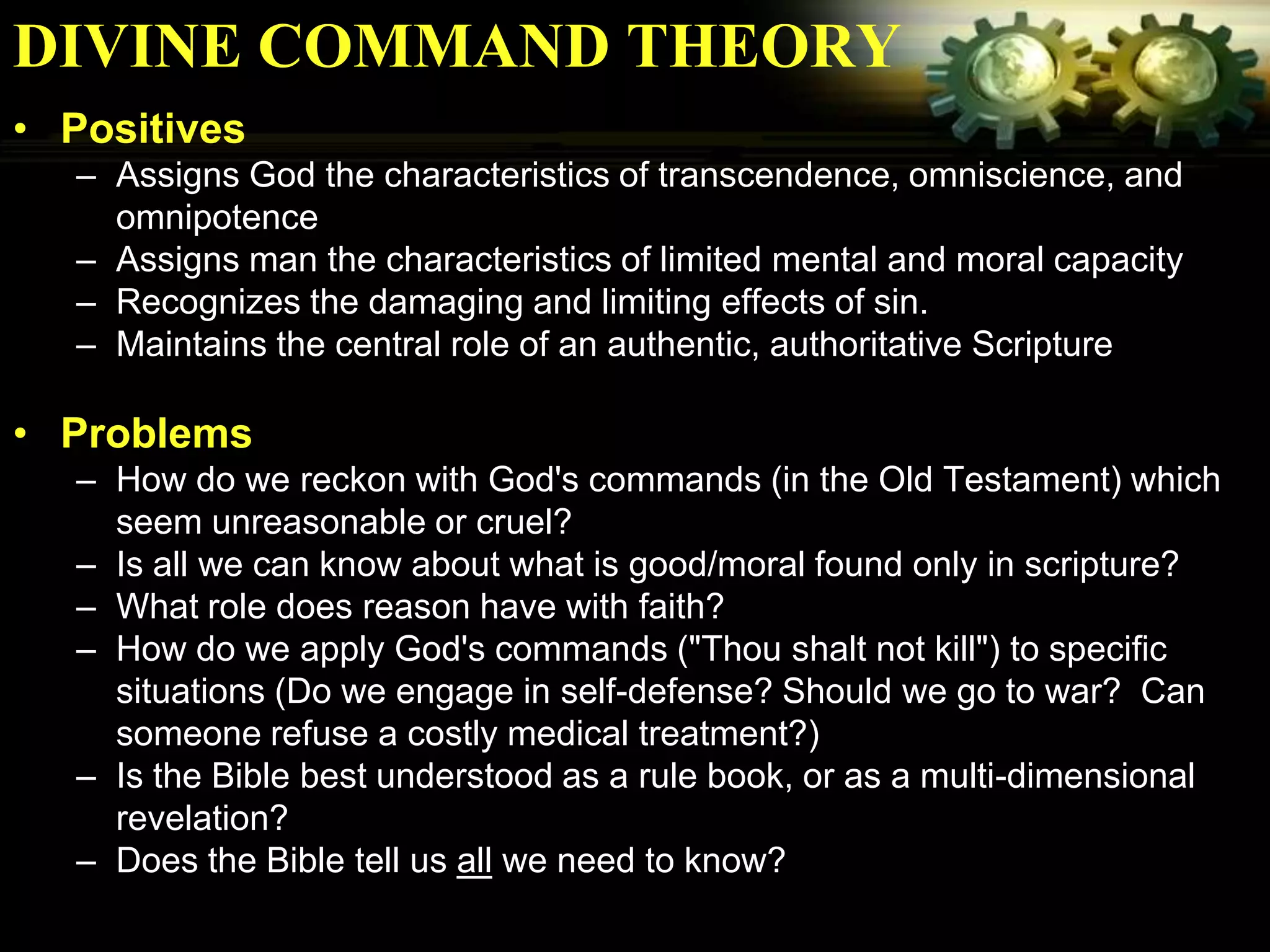
• Positives
  – Assigns God the characteristics of transcendence, omniscience, and
    omnipotence
  – Assigns man the characteristics of limited mental and moral capacity
  – Recognizes the damaging and limiting effects of sin.
  – Maintains the central role of an authentic, authoritative Scripture

• Problems
  – How do we reckon with God's commands (in the Old Testament) which
    seem unreasonable or cruel?
  – Is all we can know about what is good/moral found only in scripture?
  – What role does reason have with faith?
  – How do we apply God's commands ("Thou shalt not kill") to specific
    situations (Do we engage in self-defense? Should we go to war? Can
    someone refuse a costly medical treatment?)
  – Is the Bible best understood as a rule book, or as a multi-dimensional
    revelation?
  – Does the Bible tell us all we need to know?
DIVINE COMMAND THEORY
• Possible challenges to Christianity
   – Is there the very real possibility that rules will substitute for a living
     relationship with God?
   – Is there the very real possibility that we will confuse human rules
     for God’s rules?
   – How do we determine which Old Testament rules still apply?
   – What is the role of grace and forgiveness
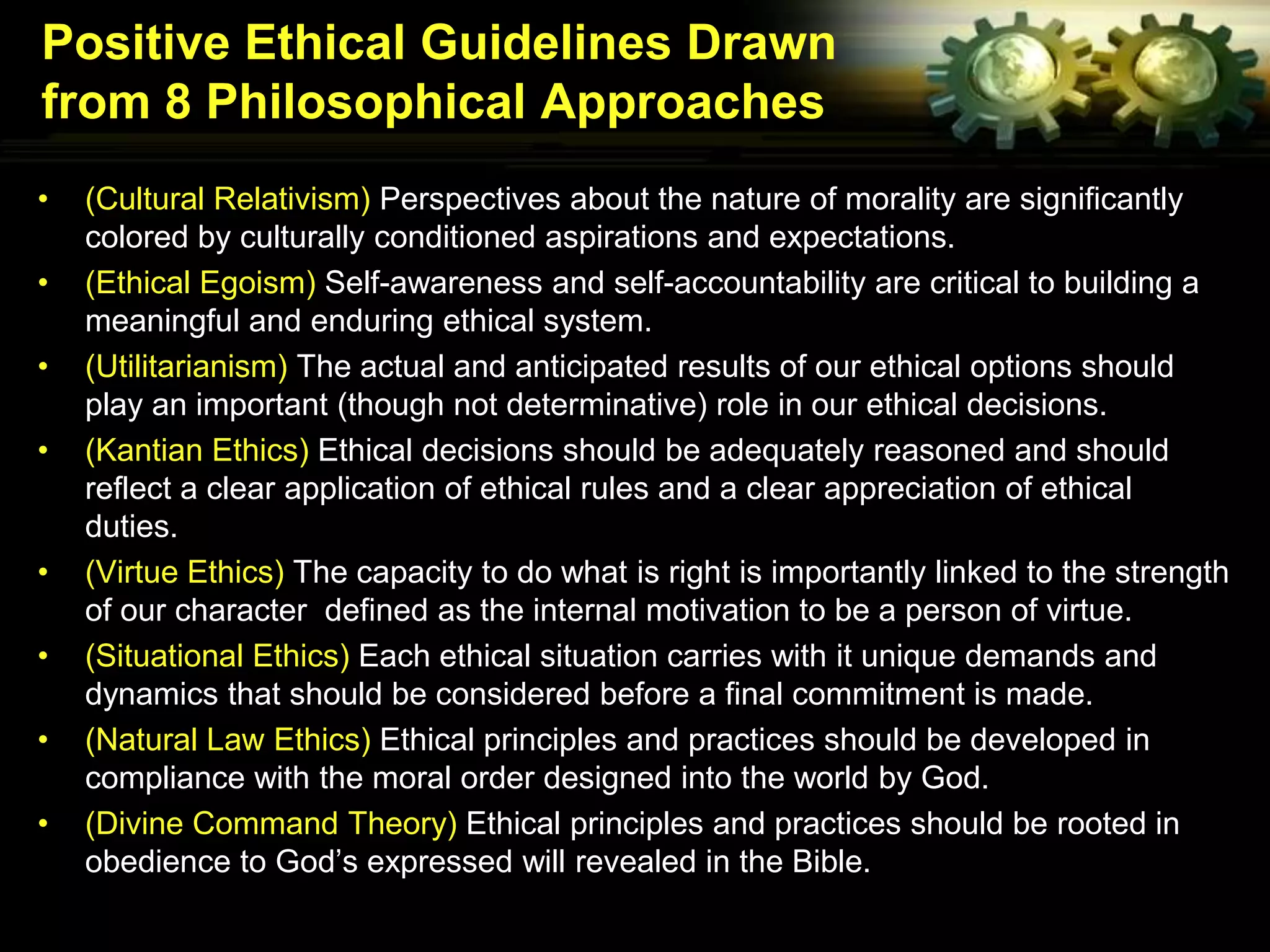
Positive Ethical Guidelines Drawn
from 8 Philosophical Approaches
•   (Cultural Relativism) Perspectives about the nature of morality are significantly
    colored by culturally conditioned aspirations and expectations.
•   (Ethical Egoism) Self-awareness and self-accountability are critical to building a
    meaningful and enduring ethical system.
•   (Utilitarianism) The actual and anticipated results of our ethical options should
    play an important (though not determinative) role in our ethical decisions.
•   (Kantian Ethics) Ethical decisions should be adequately reasoned and should
    reflect a clear application of ethical rules and a clear appreciation of ethical
    duties.
•   (Virtue Ethics) The capacity to do what is right is importantly linked to the strength
    of our character defined as the internal motivation to be a person of virtue.
•   (Situational Ethics) Each ethical situation carries with it unique demands and
    dynamics that should be considered before a final commitment is made.
•   (Natural Law Ethics) Ethical principles and practices should be developed in
    compliance with the moral order designed into the world by God.
•   (Divine Command Theory) Ethical principles and practices should be rooted in
    obedience to God’s expressed will revealed in the Bible.

Slide set 6 contrasting worldviews in business

  • 1.
  • 2.
    The Big Ideas •Worldviews really do differ from each other both in terms of IDEA and IMPACTS. • Worldviews matter because ideas have impacts. • While no worldview discussed in this course is practiced in a “pure” form, we can capture the major IDEAS underlying worldviews. • All these worldviews are found in whole or part in the business thinking today. • All worldviews have both positive impacts and problematic issues.
  • 3.
    A Philosophic Framework forContrasts LOCUS OF REALITY: Is reality constructed internally or discovered externally? VALUE SET: Are value judgments INTERNAL EXTERNAL relative and subjective or absolute LOCUS OF LOCUS OF and objective? REALITY REALITY RELATIVISTIC Situational Ethics Cultural Relativism VALUE SET Ethical Egoism Utilitarianism ABSOLUTE Kantian Ethics Natural Law Ethics VALUE SET Virtue Ethics Divine Command
  • 4.
    A Philosophic Framework forContrasts LOCUS OF REALITY: Is reality internally constructed our externally discovered? VALUE SET: Are value judgments INTERNAL EXTERNAL relative and subjective or absolute LOCUS OF LOCUS OF and objective? REALITY REALITY RELATIVISTIC Situational Ethics Cultural Relativism VALUE SET Ethical Egoism Utilitarianism ABSOLUTE Kantian Ethics Natural Law Ethics VALUE SET Virtue Ethics Divine Command
  • 5.
    CULTURAL RELATIVISM • Propositions – From one culture to another, and from one time to another within the same culture, there is diversity in what is considered right and wrong. – There are no absolute standards for right or wrong because all standards for determining right or wrong are relative. – Ultimately each person's culture is the standard by which actions are to be measured. – Therefore, no moral truth applies to all people at all times. – No ethical system is any better than any other. The only thing we can say about different cultural practices is that they are different, not better or worse. – People are obligated to follow the norms of the culture in which they live- accepted practices constitute the moral obligations of that society. – The first step toward eliminating intolerance is an awareness that all our judgments of right or wrong are driven (even determined) by the circle of cultural tradition and thought-forms.
  • 6.
    CULTURAL RELATIVISM • Positives – Cultural differences are viewed as positive forces for enriching our perspectives and ideas – Warns us that what is familiar is inherently the right or only way – Warns us that technological/economic advances does not mean cultural superiority in other areas. – Christians are warned to distinguish between the gospel, which is trans- cultural, and our particular expression of the gospel (dress, music, architecture). • Problems – Who determines which cultural views will prevail in a given culture at a particular time? – Should a moral system be based on practice (what we do) or principle (what we should do)? – Isn't cultural relativism self-contradictory by arguing "there is no absolute truth," and "intolerance is absolutely wrong?“ – If cultural values change, how do we judge the motivation for that change and whether that change is desirable or not? – If change is inevitable, can there be anything called moral progress? – Why is tolerance of every (or any) thing necessarily absolutely good?
  • 7.
    CULTURAL RELATIVISM • Possibleinterface with Christianity – Should Christianity culturally-positioned or cross-culturally positioned – or both? – Christianity proposes certain biblical absolutes (for example, monogamy) – are these culturally insensitive (moral imperialism)? – Cultural expressions of Christianity (at least in the United States) have changed over time (music, worship styles, authority structures). Are these changes positive adaptations or perilous concessions?
  • 8.
    A Philosophic Frameworkfor Contrasts LOCUS OF REALITY: Is reality internally constructed our externally discovered? VALUE SET: Are value judgments INTERNAL EXTERNAL relative and subjective or absolute LOCUS OF LOCUS OF and objective? REALITY REALITY RELATIVISTIC Situational Ethics Cultural Relativism VALUE SET Ethical Egoism Utilitarianism ABSOLUTE Kantian Ethics Natural Law Ethics VALUE SET Virtue Ethics Divine Command
  • 9.
    ETHICAL EGOISM • Propositions – The moral obligation of each individual is to act in their own self interest rationally arrived at and seen over the long run – It is our responsibility to use observation and reason to establish an objective, observable and scientific basis for a rational ethic. – Our actions should be aimed at self-fulfillment, self-enlightenment, self- enhancement and self-respect (not self-sacrifice). – Only as we value ourselves are we free to value others. – We must realistically acknowledge and develop our capacity to act in our own self-interest. – We are responsible for whatever we achieve, or do not achieve, in life. – Acts of so-called altruism are efforts to presume we know what is in someone else's self-interest. – We must respect, and allow others the freedom for, personal choice. – We relate to each other as trading partners, freely exchanging what is in our own self-interests.
  • 10.
    ETHICAL EGOISM • Positives – Forges a strong link between personal responsibility and self-esteem – Stresses personal moral agency – Enhances the right to be an individual – Reminds us that altruism can foster an unhealthy dependency be paternalistic and could be done more to exert our own power and superiority over others – Provides a sensible argument for free market capitalism – Honestly recognizes the role and power of self-interest • Problems – Is it honest (realistic) about the limits of the human capacity for rationality and self-insight? – Does the pursuit of self-interest necessarily lead to the enhancement of the welfare of others? – How do we resolve conflicts in competing self-interests?
  • 11.
    ETHICAL EGOISM • Possibleinterface with Christianity – To what degree are self-interest and self-esteem appropriate goals or characteristics of a Christian? – To what degree is developing one’s individuality compatible with Christianity’s call to “die to self?” – Is it possible that our desire to help others is really more about our feeling good about ourselves that an unselfish desire to help others?
  • 12.
    A Philosophic Frameworkfor Contrasts LOCUS OF REALITY: Is reality internally constructed our externally discovered? VALUE SET: Are value judgments INTERNAL EXTERNAL relative and subjective or absolute LOCUS OF LOCUS OF and objective? REALITY REALITY RELATIVISTIC Situational Ethics Cultural Relativism VALUE SET Ethical Egoism Utilitarianism ABSOLUTE Kantian Ethics Natural Law Ethics VALUE SET Virtue Ethics Divine Command
  • 13.
    KANTIAN ETHICS • Propositions – Being good is a matter of reverence for duty or obligation. – Rules help us determine our duty, motives help us to be determined to pursue our duty. – The only ethical rules that should be adopted are those that meet the demands of reasonableness for internal consistency and external self- contradiction. – Moral principles that meet the demands of reason are always valid for everyone. – Moral people seek categorical imperatives - commands or laws that allow for no exceptions. – These imperatives are not themselves ethical rules - rather, they allow us to evaluate proposed ethical rules. – The Categorical Imperative I (the primary absolute ought) states, "Act only on that rule through which can at the same time will that it should become a universal law.“ – The Categorical Imperative II: Act in such a way that people are treated as ends rather than (just) means.
  • 14.
    KANTIAN ETHICS • Positives – Affirms the virtue of duty, rules and absolutes – Stresses responsibility and reason – Advocates an objective basis for truth • Problems – What happens when duties conflict? – Is reason a sufficient basis for determining duty? – Is our willingness to universalize a rule sufficient warrant for doing so?
  • 15.
    KANTIAN ETHICS • Possiblechallenges for Christians – To what degree is it reasonable to think of Christianity as importantly a call to rule-following? – As Christians we have duties to many others: God, family, employers, friends, etc. How do we reasonably determine how to balance these duties when they are in conflict? – To what degree is Christianity based on reason versus revelation?
  • 16.
    A Philosophic Framework forContrasts LOCUS OF REALITY: Is reality internally constructed our externally discovered? VALUE SET: Are value judgments INTERNAL EXTERNAL relative and subjective or absolute LOCUS OF LOCUS OF and objective? REALITY REALITY RELATIVISTIC Situational Ethics Cultural Relativism VALUE SET Ethical Egoism Utilitarianism ABSOLUTE Kantian Ethics Natural Law Ethics VALUE SET Virtue Ethics Divine Command
  • 17.
    NATURAL LAW ETHICS •Propositions – There is a unity designed into the universe, both in its parts and its processes which, properly understood, leads to a recognition of God as the designer (general revelation). – God is rational and intentional – God designs human beings in His image and they are naturally inclined to be rational and, so, seek to live by God's intentions as revealed in the natural law which reveals God's intentions. – Reason, when it works correctly, guides and educates the conscience, leading us to properly order our desires so that the higher order (reason) controls the lower (like eating). – Good involves responding to our higher inclinations - evil involves irrationally responding to our inclinations and pursuing that which is naturally damaging to us. – Therefore, the primary principle of the natural law is that good should be done and evil avoided. – In a situation requiring a decision, we must apply primary principles (do good, avoid evil), secondary principles (e.g. the Ten Commandments), and positive laws (e.g., keep your word) and civil laws (e.g. enforcing contracts).
  • 18.
    NATURAL LAW ETHICS •Positives – Explains why people of different religious persuasions, or perhaps no religious affiliation at all, frequently have a keen sense of right and wrong, and live highly moral lives. – Portrays morality and Godliness as rational, rather than simply emotional, responses – Argues for a well-ordered life ruled by our highest aspirations at all levels of life - physical, social, intellectual, moral and spiritual. • Problems – Do facts naturally suggest values, and does reason lead us to truth? – What is the effect of sin on reason? – How do we resolve conflicting conclusions about what moral message "nature" is sending? – How can we separate the effects of nature and nurture?
  • 19.
    NATURAL LAW ETHICS •Possible challenges for Christians – To what degree should Christians rely on reason and conscience to make moral decisions? To what degree has the “Fall” made either or both of these foundations problematic? – If non-Christians can act as morally responsible as Christians, what good is Christianity? – How does one determine that another’s “take” on the Christian life is “reasonable?”
  • 20.
    A Philosophic Framework forContrasts LOCUS OF REALITY: Is reality internally constructed our externally discovered? VALUE SET: Are value judgments INTERNAL EXTERNAL relative and subjective or absolute LOCUS OF LOCUS OF and objective? REALITY REALITY RELATIVISTIC Situational Ethics Cultural Relativism VALUE SET Ethical Egoism Utilitarianism ABSOLUTE Kantian Ethics Natural Law Ethics VALUE SET Virtue Ethics Divine Command
  • 21.
    UTILITARIANISM • Propositions – Acts are morally right when they succeed in (or are useful for) bringing about a desired result. – Happiness is a worthy pursuit when defined as a desire for intellectual, spiritual and social well-being – We should seek happiness for the greatest number. – When interests conflict, the will of the majority (or the happiness of the majority) should prevail. – We can objectively understand the positive/negative consequences of an action in terms of • intensity (how much) • probability (how certain) • purity (how much pain comes with the pleasure • extent (how many are affected) • duration (how long) • propinquity (how soon) – There are higher (nobler) and lower (narcissistic) orders of happiness. – The only thing ethically significant in judging an action is the result.
  • 22.
    UTILITARIANISM • Positives – Establishes a link being doing good and happiness - we should work to bring about good and oppose that which causes pain – Focuses attention on substantive results in evaluating an action rather than intentions and feelings – The principle of utility can be applied to both personal and public decisions/issues – Balances the equality of each individuals' claim to happiness with the necessity for mutual concessions in a group • Problems – Can we fully know all the results? – Can we fairly balance the results? – What about the rights of the majority? – Do motives or intentions count? – Who determines what are "higher" and "lower" sorts of happiness? – Is happiness the only or most significant result of importance?
  • 23.
    UTILITARIANISM • Possible challengesto Christianity – Christianity focuses on the needs of individuals – is it ever imaginable that we could harm another for the good of someone else? – Is it realistic to expect fallen and sinful people to make accurate moral calculations?
  • 24.
    A Philosophic Framework forContrasts LOCUS OF REALITY: Is reality internally constructed our externally discovered? VALUE SET: Are value judgments INTERNAL EXTERNAL relative and subjective or absolute LOCUS OF LOCUS OF and objective? REALITY REALITY RELATIVISTIC Situational Ethics Cultural Relativism VALUE SET Ethical Egoism Utilitarianism ABSOLUTE Kantian Ethics Natural Law Ethics VALUE SET Virtue Ethics Divine Command
  • 25.
    VIRTUE ETHICS • Propositions – Virtue is a predisposition to do good things, an internal motivation that both loves and does what is right. – Virtue manifests itself in learned (teachable) character qualities such as courage, self-discipline and benevolence. – There are objective standards for what is good character. – Pursuit of the good is a pursuit of our highest order functions – Plato pose three levels: appetite (hunger, sex), spirit (anger, ambition) and reason. Appetite tempered by reason produces the virtue of temperance. Spirit tempered by reason produces courage. Reason produces the virtue of justice. – Aristotle defined virtue as a mean between two vices - for example courage is the virtue lying between cowardliness and foolhardiness, remorse is the virtue lying between indifference and chronic guilt; proper pride is the virtue between vanity and undue humility – Virtue is not created by us - it us discovered and then grown toward through the process of character education. The first question is not, "What should I do?" but, rather, "Who should I be?“ – An act is good because (1) we understand what we are doing and why it is good, (2) we must be free to choose to act and (3) our action emanates from our character. – Character is learned through modeling, imitation and (then) internalization.
  • 26.
    VIRTUE ETHICS • Positives – Focuses on the core issue of character as it influences both private and public behavior – Stresses the quality of our relationships with others Places abstract ideals into concrete human behavior and interaction – Distinguishes between a good act and a good person – Allows for ethics beyond rules - that is, while there may be no rule to cover lack or patience or generosity, these are certainly laudable virtues – Whereas rules tend to define our minimum duty or obligation, virtue encourages aspiration to the highest ideals – Whereas rules than to focus on what we do not do, virtue ethics is more concerned by what we do and to what we are moving. • Problems – Do character-based ethics provide concrete guidance is specific situations (for example, while compassion is virtuous, which is more compassionate: to offer someone a meal, or a job to earn a meal)? – How do we resolve conflicts between competing virtues (in criminal cases, should we be merciful or just?) – Cannot acting out of virtue still lead to unwanted, unethical consequences? – Does virtue ethics answer the question, why be virtuous? – How do we decide which virtues are really virtuous and worthy of pursuit?
  • 27.
    VIRTUE ETHICS • Possiblechallenges to Christianity – Can fallen and sinful people really ever choose to be good – and why would they?” – Even IF we might choose to be good, what would allow us to achieve that goal?
  • 28.
    A Philosophic Framework forContrasts LOCUS OF REALITY: Is reality internally constructed our externally discovered? VALUE SET: Are value judgments INTERNAL EXTERNAL relative and subjective or absolute LOCUS OF LOCUS OF and objective? REALITY REALITY RELATIVISTIC Situational Ethics Cultural Relativism VALUE SET Ethical Egoism Utilitarianism ABSOLUTE Kantian Ethics Natural Law Ethics VALUE SET Virtue Ethics Divine Command
  • 29.
    SITUATION ETHICS • Propositions – Only one thing is intrinsically good, namely love. – Love and justice are the same, for justice is love distributed. – Love wills the neighbors good whether we like him/her or not. – The end (love) alone justifies the means. – Decisions ought to be made situationally, not universally. – Every other consideration, all laws and rules and principles and ideals and norms apply only contingently if they happen to serve love in a particular situation. – Actions have no moral content - they are only tools to help express love. – In some situations breaking man-made or Biblical laws is the right thing to do. – Justice is Christian love using its head, calculating its duties, obligations, opportunities and resources. – Agape love is not a feeling - it is a commitment to serve the best interests of the other. – Something is good because it leads to loving consequences. – Abstract ethical questions are unanswerable - the actual facts of the situation determine what the loving thing is to do.
  • 30.
    SITUATION ETHICS • Positives – It provides an absolute foundation for all action – love – It is based on the character of God – It advocates a deep concern for others and a realistic appraisal of situational demands – It focuses on our personal responsibility to decide and to act • Problems – How do we determine all that should be included in our appraisal of a situation? Who should be included? What time period should be included? What consequences should be recognized? – How are we to determine with any confidence what love is? – How can we ever judge the rightness or wrongness of anyone's situation? – How do we resolve conflicting judgments about what love demands? – Why is love the preeminent value? – What allows, or even encourages, anyone to act in a loving way?
  • 31.
    SITUATION ETHICS • Possiblechallenges to Christianity – Is the loving thing to do always clear – what happens when love may demand action the other considers “unloving?” – How does one deal with the apparent “unloving” remarks and actions of Christ? – Is the essential essence of God love – rather than holiness, justice, etc. – Is the loving thing to do always the pleasing thing to do – can love be “tough?”
  • 32.
    A Philosophic Framework forContrasts LOCUS OF REALITY: Is reality internally constructed our externally discovered? VALUE SET: Are value judgments INTERNAL EXTERNAL relative and subjective or absolute LOCUS OF LOCUS OF and objective? REALITY REALITY RELATIVISTIC Situational Ethics Cultural Relativism VALUE SET Ethical Egoism Utilitarianism ABSOLUTE Kantian Ethics Natural Law Ethics VALUE SET Virtue Ethics Divine Command
  • 33.
    DIVINE COMMAND THEORY •Propositions – God has made and communicated clear rules of right and wrong and our duty is to obey these rules. – Sin is missing the standard (God's Will) and rebelling against God who has the right to our loyalty and obedience. – Mankind is limited in nature, mentally and spirit - thus only following (trusting and obeying) God (who is unlimited in all ways) will lead us to live a moral life. God reveals His will propositionally in the Bible as the Holy Spirit provides illumination. – Our chief point of contact with God is our will , not our mind - the principle issue is the submission of our will through a conscious choice of obedience. – Obedience to God's authority places us in a redemptive relationship with Him.
  • 34.
    DIVINE COMMAND THEORY •Positives – Assigns God the characteristics of transcendence, omniscience, and omnipotence – Assigns man the characteristics of limited mental and moral capacity – Recognizes the damaging and limiting effects of sin. – Maintains the central role of an authentic, authoritative Scripture • Problems – How do we reckon with God's commands (in the Old Testament) which seem unreasonable or cruel? – Is all we can know about what is good/moral found only in scripture? – What role does reason have with faith? – How do we apply God's commands ("Thou shalt not kill") to specific situations (Do we engage in self-defense? Should we go to war? Can someone refuse a costly medical treatment?) – Is the Bible best understood as a rule book, or as a multi-dimensional revelation? – Does the Bible tell us all we need to know?
  • 35.
    DIVINE COMMAND THEORY •Possible challenges to Christianity – Is there the very real possibility that rules will substitute for a living relationship with God? – Is there the very real possibility that we will confuse human rules for God’s rules? – How do we determine which Old Testament rules still apply? – What is the role of grace and forgiveness
  • 36.
    Positive Ethical GuidelinesDrawn from 8 Philosophical Approaches • (Cultural Relativism) Perspectives about the nature of morality are significantly colored by culturally conditioned aspirations and expectations. • (Ethical Egoism) Self-awareness and self-accountability are critical to building a meaningful and enduring ethical system. • (Utilitarianism) The actual and anticipated results of our ethical options should play an important (though not determinative) role in our ethical decisions. • (Kantian Ethics) Ethical decisions should be adequately reasoned and should reflect a clear application of ethical rules and a clear appreciation of ethical duties. • (Virtue Ethics) The capacity to do what is right is importantly linked to the strength of our character defined as the internal motivation to be a person of virtue. • (Situational Ethics) Each ethical situation carries with it unique demands and dynamics that should be considered before a final commitment is made. • (Natural Law Ethics) Ethical principles and practices should be developed in compliance with the moral order designed into the world by God. • (Divine Command Theory) Ethical principles and practices should be rooted in obedience to God’s expressed will revealed in the Bible.