WELCOME
Consumer behaviour, Attitude and
perception towards organic products- A
study in Puducherry
Chair person – Dr. T. Ponnarasi
Asst. Professor
Presented by Malcomestar L . Mawnai
Reason for study
 Why organic products are still not highly adopted by
Indian consumers?
 What the drawbacks of Indian consumers to go organic ?
Objective of the study
 To understand the social distribution on consumers toward organic
products.
 To understand the consumer attitude and perception towards organic
products.
 To understand the problems of consumers in going for organic
products.
About organic products
What is organic products?
Organic products are the products that are produced, processed, packed and sold
without using any chemicals. Organic products include fruits, vegetables, cereals, milk and
meat products, etc.
**Organic farming doesn’t mean that they go back to methods used hundreds of
years ago.
**But by taking modern scientific knowledge and combine them with useful
traditional farming methods.
**Organic farming isn’t just for vegetables, but animals as well.
**Converting land to organic status is a 6 year process to meet standards set by
the National Organic standards Board.
**Organic food tends to cost more than conventionally grown food because it more
closely reflects the true cost of growing the food.
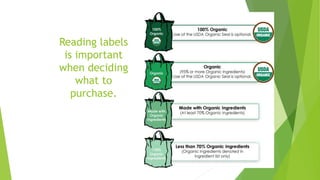
Reading labels
is important
when deciding
what to
purchase.
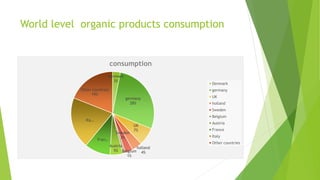
World level organic products consumption
Denmark
3%
germany
28%
UK
7%
holland
4%
Sweden
3%
Belgium
1%
Austria
5%
Fran…
Ita…
Other countries
19%
consumption
Denmark
germany
UK
holland
Sweden
Belgium
Austria
France
Italy
Other countries
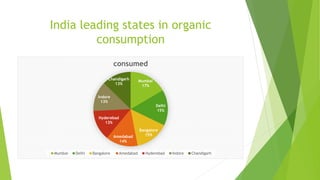
India leading states in organic
consumption
Mumbai
17%
Delhi
15%
Bangalore
15%Amedabad
14%
Hyderebad
13%
Indore
13%
Chandigarh
13%
consumed
Mumbai Delhi Bangalore Amedabad Hyderebad Indore Chandigarh
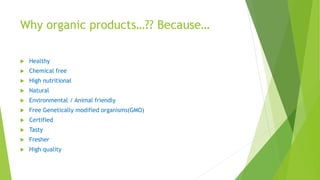
Why organic products…?? Because…
 Healthy
 Chemical free
 High nutritional
 Natural
 Environmental / Animal friendly
 Free Genetically modified organisms(GMO)
 Certified
 Tasty
 Fresher
 High quality
Methodology of the case study
 Area of study - Pondicherry
Bon Appetit store , Go organic
Ambour salai, chetty street
 Data - Primary data
 Sampling size - 25
 Based on - Consumer Response (Questionnaire method)
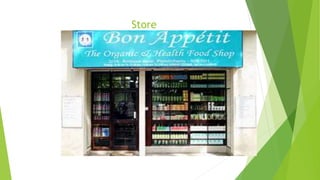
Store
About Bon Appetit store
 Bon Appetit is a 6 year old registered firm situated in the Union Territory of
Pondicherry, on the coromandel coast region about 160 kms south of Chennai.
 Bon Appetit strives to create awareness amongst the people about our
environment & good healthy living, by promoting Organic & Health Food
Products. Never ending thirst of sourcing these products across our vast
continent, we have tied up with leading Indian Firms, Associations & Local
Farmers.
 They also associated with Keystone Foundation an NGO based in the Nilgiris
whose Mission is to enhance the Quality of Life and the Environment with
Indigenous Communities using Eco-development Approaches.
Major organic product brand in store
 Organic India -Spices, tea, coffee, etc.
 Farm 2 kitchen -Vegetables, fruits, etc.
 Humble seeds -Cereals (red rice, white rice)
 Almond Laboratorios in Spain -Fresh vegetables, nuts, etc.
 Argital in ItalyCastagno in Italy -Flowers , oil , wax,etc
 Celnat in France - Flours for bakeries, oat flakes and barley
 Danival in France - Ready to eat salads, soups products, oats, etc.
 Emile Noel in France - crush organic seeds, oil, etc.
 Holle in Switzerland - Baby food products
 La Mandorle in France - Dry fruits , dry vegetables, etc.
 Nutriops in Spain - Organic nut drinks, syrups, fruits juice, etc.
 Vigean in France - Gourmet and dietary oils
 Vitagermine in France -Soups, sauces, vegetable spreads, etc.
CONSUMER BEHAVIOUR , ATTITUDE AND
PERCEPTION TOWARD ORGANIC PRODUCTS
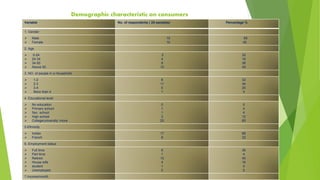
Demographic characteristic on consumers
Variable No. of respondents ( 25 samples) Percentage %
1. Gender
 Male
 Female
15
10
60
40
2. Age
 0-24
 24-34
 34-50
 Above 50
2
4
9
10
32
16
36
40
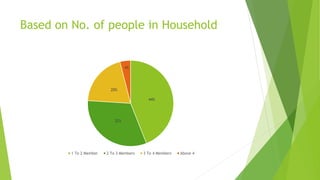
3. NO. of people in a Household
 1-2
 2-3
 3-4
 More than 4
8
11
5
1
32
44
20
4
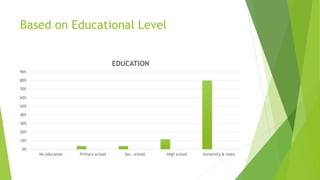
4. Educational level
 No education
 Primary school
 Sec. school
 High school
 College/university /more
0
1
1
3
20
0
4
4
12
80
5.Ethnicity
 Indian
 French
17
8
68
32
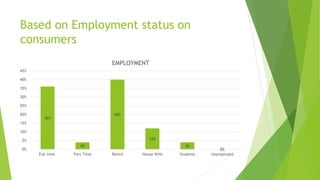
6. Employment status
 Full time
 Part time
 Retired
 House wife
 student
 Unemployed
9
1
10
4
1
0
36
4
40
16
4
0
7.Income/month
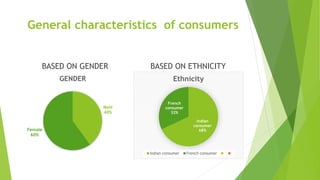
General characteristics of consumers
BASED ON GENDER
Male
40%
Female
60%
GENDER
BASED ON ETHNICITY
Indian
consumer
68%
French
consumer
32%
Ethnicity
Indian consumer French consumer
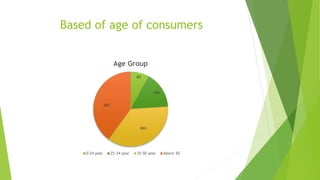
Based of age of consumers
8%
16%
36%
40%
Age Group
0-24 year 25-34 year 35-50 year Above 50
Based on No. of people in Household
44%
32%
20%
4%
1 To 2 Member 2 To 3 Members 3 To 4 Members Above 4
Based on Educational Level
0%
10%
20%
30%
40%
50%
60%
70%
80%
90%
No education Primary school Sec. school High school University & more
EDUCATION
Based on Employment status on
consumers
36%
4%
40%
12%
4%
0%0%
5%
10%
15%
20%
25%
30%
35%
40%
45%
Full time Part Time Retird House Wife Students Unemployed
EMPLOYMENT
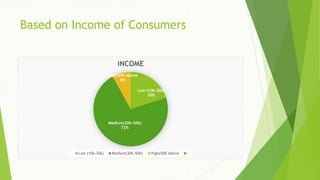
Based on Income of Consumers
Low (10k-30k)
20%
Medium(30k-50K)
72%
High(50K Above
8%
iNCOME
Low (10k-30k) Medium(30k-50K) High(50K Above
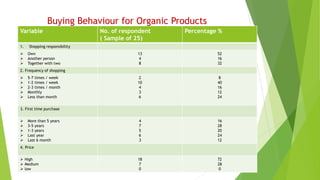
Buying Behaviour for Organic Products
Variable No. of respondent
( Sample of 25)
Percentage %
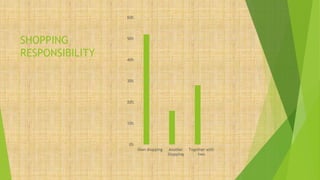
1. Shopping responsibility
 Own
 Another person
 Together with two
13
4
8
52
16
32
2. Frequency of shopping
 5-7 times / week
 1-2 times / week
 2-3 times / month

 Monthly
 Less than month
2
10
4
3
6
8
40
16
12
24
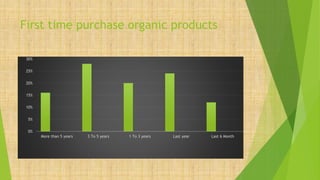
3. First time purchase
 More than 5 years
 3-5 years
 1-3 years
 Last year
 Last 6 month
4
7
5
6
3
16
28
20
24
12
4. Price
 High
 Medium
 low
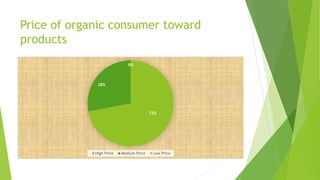
18
7
0
72
28
0
SHOPPING
RESPONSIBILITY
0%
10%
20%
30%
40%
50%
60%
Own shopping Another
Shopping
Together with
two
First time purchase organic products
0%
5%
10%
15%
20%
25%
30%
More than 5 years 3 To 5 years 1 To 3 years Last year Last 6 Month
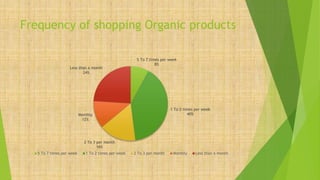
Frequency of shopping Organic products
5 To 7 times per week
8%
1 To 2 times per week
40%
2 To 3 per month
16%
Monthly
12%
Less than a month
24%
5 To 7 times per week 1 To 2 times per week 2 To 3 per month Monthly Less than a month
Price of organic consumer toward
products
72%
28%
0%
High Price Medium Price Low Price
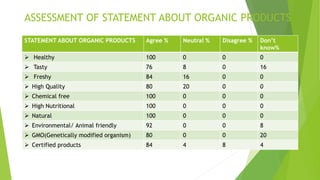
ASSESSMENT OF STATEMENT ABOUT ORGANIC PRODUCTS
STATEMENT ABOUT ORGANIC PRODUCTS Agree % Neutral % Disagree % Don’t
know%
 Healthy 100 0 0 0
 Tasty 76 8 0 16
 Freshy 84 16 0 0
 High Quality 80 20 0 0
 Chemical free 100 0 0 0
 High Nutritional 100 0 0 0
 Natural 100 0 0 0
 Environmental/ Animal friendly 92 0 0 8
 GMO(Genetically modified organism) 80 0 0 20
 Certified products 84 4 8 4
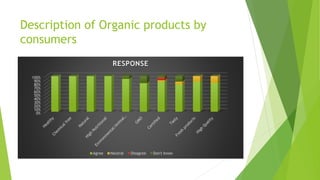
Description of Organic products by
consumers
0%
10%
20%
30%
40%
50%
60%
70%
80%
90%
100%
RESPONSE
Agree Neutral Disagree Don't know
General findings from the study
 From all the aspects that we have discussed, I also find that the
products consumed by the people are a mixed of Indian and imported
products.
 No . Of buyers are less.
 Consumer standard of living is High.
 Consumer are both Indian and French (Indian territory )
 Price tagging are done for the products .
 Price comparison.
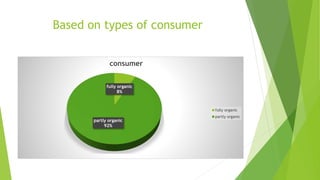
Based on types of consumer
fully organic
8%
partly organic
92%
consumer
fully organic
partly organic
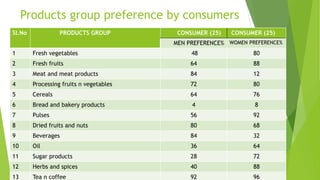
Products group preference by consumers
Sl.No PRODUCTS GROUP CONSUMER (25) CONSUMER (25)
MEN PREFERENCE% WOMEN PREFERENCE%
1 Fresh vegetables 48 80
2 Fresh fruits 64 88
3 Meat and meat products 84 12
4 Processing fruits n vegetables 72 80
5 Cereals 64 76
6 Bread and bakery products 4 8
7 Pulses 56 92
8 Dried fruits and nuts 80 68
9 Beverages 84 32
10 Oil 36 64
11 Sugar products 28 72
12 Herbs and spices 40 88
13 Tea n coffee 92 96
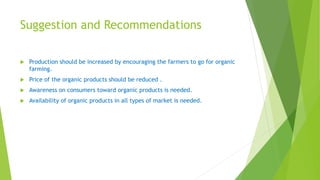
Suggestion and Recommendations
 Production should be increased by encouraging the farmers to go for organic
farming.
 Price of the organic products should be reduced .
 Awareness on consumers toward organic products is needed.
 Availability of organic products in all types of market is needed.
In the organic sector we often hear the
question: is organic more expensive, and why
is that?
The fact is organic foods are not more expensive when considering
social, economic, political and environmental dimensions, but to
understand that statement we have to look at who and what pays
for the true costs of food production.
Non-organic agriculture is subsidized in most part of the world. In
other words, if the market does not pay what it costs to grow a
crop the government often steps in with a subsidy to the farmers.
Then It Is The Tax Payers Who Pays.
The most important Costs for Organic Agriculture are the Costs for
the Consultants, Inspection & Certification Process. Certified by
National organic standard board , USDA, etc.
Conclusion
 According to the study which was based on the reposed of the sample taking,
I conclude that organic consumer in Puducherry is well aware of the goodness
of organic products .
 Also the organic products is costly when compare to non – organic products
that why most of the consumer deflect there mind toward non- organic .
 Organic products has less shelf life and more storage pest attack, which make
the consumer feels uncomfortable to go for organic products.
 Potential demand of organic products in the future.
 And till date , most of the consumer are still consumed both organic and non-
organic products.
THANK YOU

Consumer behaviour, Attitude and perception towards organic products- A study in Puducherry

  • 1.
  • 2.
    Consumer behaviour, Attitudeand perception towards organic products- A study in Puducherry Chair person – Dr. T. Ponnarasi Asst. Professor Presented by Malcomestar L . Mawnai
  • 3.
    Reason for study Why organic products are still not highly adopted by Indian consumers?  What the drawbacks of Indian consumers to go organic ?
  • 4.
    Objective of thestudy  To understand the social distribution on consumers toward organic products.  To understand the consumer attitude and perception towards organic products.  To understand the problems of consumers in going for organic products.
  • 5.
    About organic products Whatis organic products? Organic products are the products that are produced, processed, packed and sold without using any chemicals. Organic products include fruits, vegetables, cereals, milk and meat products, etc. **Organic farming doesn’t mean that they go back to methods used hundreds of years ago. **But by taking modern scientific knowledge and combine them with useful traditional farming methods. **Organic farming isn’t just for vegetables, but animals as well. **Converting land to organic status is a 6 year process to meet standards set by the National Organic standards Board. **Organic food tends to cost more than conventionally grown food because it more closely reflects the true cost of growing the food.
  • 6.
    Reading labels is important whendeciding what to purchase.
  • 7.
    World level organicproducts consumption Denmark 3% germany 28% UK 7% holland 4% Sweden 3% Belgium 1% Austria 5% Fran… Ita… Other countries 19% consumption Denmark germany UK holland Sweden Belgium Austria France Italy Other countries
  • 8.
    India leading statesin organic consumption Mumbai 17% Delhi 15% Bangalore 15%Amedabad 14% Hyderebad 13% Indore 13% Chandigarh 13% consumed Mumbai Delhi Bangalore Amedabad Hyderebad Indore Chandigarh
  • 9.
    Why organic products…??Because…  Healthy  Chemical free  High nutritional  Natural  Environmental / Animal friendly  Free Genetically modified organisms(GMO)  Certified  Tasty  Fresher  High quality
  • 10.
    Methodology of thecase study  Area of study - Pondicherry Bon Appetit store , Go organic Ambour salai, chetty street  Data - Primary data  Sampling size - 25  Based on - Consumer Response (Questionnaire method)
  • 11.
  • 12.
    About Bon Appetitstore  Bon Appetit is a 6 year old registered firm situated in the Union Territory of Pondicherry, on the coromandel coast region about 160 kms south of Chennai.  Bon Appetit strives to create awareness amongst the people about our environment & good healthy living, by promoting Organic & Health Food Products. Never ending thirst of sourcing these products across our vast continent, we have tied up with leading Indian Firms, Associations & Local Farmers.  They also associated with Keystone Foundation an NGO based in the Nilgiris whose Mission is to enhance the Quality of Life and the Environment with Indigenous Communities using Eco-development Approaches.
  • 13.
    Major organic productbrand in store  Organic India -Spices, tea, coffee, etc.  Farm 2 kitchen -Vegetables, fruits, etc.  Humble seeds -Cereals (red rice, white rice)  Almond Laboratorios in Spain -Fresh vegetables, nuts, etc.  Argital in ItalyCastagno in Italy -Flowers , oil , wax,etc  Celnat in France - Flours for bakeries, oat flakes and barley  Danival in France - Ready to eat salads, soups products, oats, etc.  Emile Noel in France - crush organic seeds, oil, etc.  Holle in Switzerland - Baby food products  La Mandorle in France - Dry fruits , dry vegetables, etc.  Nutriops in Spain - Organic nut drinks, syrups, fruits juice, etc.  Vigean in France - Gourmet and dietary oils  Vitagermine in France -Soups, sauces, vegetable spreads, etc.
  • 14.
    CONSUMER BEHAVIOUR ,ATTITUDE AND PERCEPTION TOWARD ORGANIC PRODUCTS
  • 15.
    Demographic characteristic onconsumers Variable No. of respondents ( 25 samples) Percentage % 1. Gender  Male  Female 15 10 60 40 2. Age  0-24  24-34  34-50  Above 50 2 4 9 10 32 16 36 40 3. NO. of people in a Household  1-2  2-3  3-4  More than 4 8 11 5 1 32 44 20 4 4. Educational level  No education  Primary school  Sec. school  High school  College/university /more 0 1 1 3 20 0 4 4 12 80 5.Ethnicity  Indian  French 17 8 68 32 6. Employment status  Full time  Part time  Retired  House wife  student  Unemployed 9 1 10 4 1 0 36 4 40 16 4 0 7.Income/month
  • 16.
    General characteristics ofconsumers BASED ON GENDER Male 40% Female 60% GENDER BASED ON ETHNICITY Indian consumer 68% French consumer 32% Ethnicity Indian consumer French consumer
  • 17.
    Based of ageof consumers 8% 16% 36% 40% Age Group 0-24 year 25-34 year 35-50 year Above 50
  • 18.
    Based on No.of people in Household 44% 32% 20% 4% 1 To 2 Member 2 To 3 Members 3 To 4 Members Above 4
  • 19.
    Based on EducationalLevel 0% 10% 20% 30% 40% 50% 60% 70% 80% 90% No education Primary school Sec. school High school University & more EDUCATION
  • 20.
    Based on Employmentstatus on consumers 36% 4% 40% 12% 4% 0%0% 5% 10% 15% 20% 25% 30% 35% 40% 45% Full time Part Time Retird House Wife Students Unemployed EMPLOYMENT
  • 21.
    Based on Incomeof Consumers Low (10k-30k) 20% Medium(30k-50K) 72% High(50K Above 8% iNCOME Low (10k-30k) Medium(30k-50K) High(50K Above
  • 22.
    Buying Behaviour forOrganic Products Variable No. of respondent ( Sample of 25) Percentage % 1. Shopping responsibility  Own  Another person  Together with two 13 4 8 52 16 32 2. Frequency of shopping  5-7 times / week  1-2 times / week  2-3 times / month  Monthly  Less than month 2 10 4 3 6 8 40 16 12 24 3. First time purchase  More than 5 years  3-5 years  1-3 years  Last year  Last 6 month 4 7 5 6 3 16 28 20 24 12 4. Price  High  Medium  low 18 7 0 72 28 0
  • 23.
  • 24.
    First time purchaseorganic products 0% 5% 10% 15% 20% 25% 30% More than 5 years 3 To 5 years 1 To 3 years Last year Last 6 Month
  • 25.
    Frequency of shoppingOrganic products 5 To 7 times per week 8% 1 To 2 times per week 40% 2 To 3 per month 16% Monthly 12% Less than a month 24% 5 To 7 times per week 1 To 2 times per week 2 To 3 per month Monthly Less than a month
  • 26.
    Price of organicconsumer toward products 72% 28% 0% High Price Medium Price Low Price
  • 27.
    ASSESSMENT OF STATEMENTABOUT ORGANIC PRODUCTS STATEMENT ABOUT ORGANIC PRODUCTS Agree % Neutral % Disagree % Don’t know%  Healthy 100 0 0 0  Tasty 76 8 0 16  Freshy 84 16 0 0  High Quality 80 20 0 0  Chemical free 100 0 0 0  High Nutritional 100 0 0 0  Natural 100 0 0 0  Environmental/ Animal friendly 92 0 0 8  GMO(Genetically modified organism) 80 0 0 20  Certified products 84 4 8 4
  • 28.
    Description of Organicproducts by consumers 0% 10% 20% 30% 40% 50% 60% 70% 80% 90% 100% RESPONSE Agree Neutral Disagree Don't know
  • 29.
    General findings fromthe study  From all the aspects that we have discussed, I also find that the products consumed by the people are a mixed of Indian and imported products.  No . Of buyers are less.  Consumer standard of living is High.  Consumer are both Indian and French (Indian territory )  Price tagging are done for the products .  Price comparison.
  • 30.
    Based on typesof consumer fully organic 8% partly organic 92% consumer fully organic partly organic
  • 31.
    Products group preferenceby consumers Sl.No PRODUCTS GROUP CONSUMER (25) CONSUMER (25) MEN PREFERENCE% WOMEN PREFERENCE% 1 Fresh vegetables 48 80 2 Fresh fruits 64 88 3 Meat and meat products 84 12 4 Processing fruits n vegetables 72 80 5 Cereals 64 76 6 Bread and bakery products 4 8 7 Pulses 56 92 8 Dried fruits and nuts 80 68 9 Beverages 84 32 10 Oil 36 64 11 Sugar products 28 72 12 Herbs and spices 40 88 13 Tea n coffee 92 96
  • 32.
    Suggestion and Recommendations Production should be increased by encouraging the farmers to go for organic farming.  Price of the organic products should be reduced .  Awareness on consumers toward organic products is needed.  Availability of organic products in all types of market is needed.
  • 33.
    In the organicsector we often hear the question: is organic more expensive, and why is that? The fact is organic foods are not more expensive when considering social, economic, political and environmental dimensions, but to understand that statement we have to look at who and what pays for the true costs of food production. Non-organic agriculture is subsidized in most part of the world. In other words, if the market does not pay what it costs to grow a crop the government often steps in with a subsidy to the farmers. Then It Is The Tax Payers Who Pays. The most important Costs for Organic Agriculture are the Costs for the Consultants, Inspection & Certification Process. Certified by National organic standard board , USDA, etc.
  • 34.
    Conclusion  According tothe study which was based on the reposed of the sample taking, I conclude that organic consumer in Puducherry is well aware of the goodness of organic products .  Also the organic products is costly when compare to non – organic products that why most of the consumer deflect there mind toward non- organic .  Organic products has less shelf life and more storage pest attack, which make the consumer feels uncomfortable to go for organic products.  Potential demand of organic products in the future.  And till date , most of the consumer are still consumed both organic and non- organic products.
  • 35.