Symmetry and Point Groups
Chapter 4
Monday, September 28, 2015
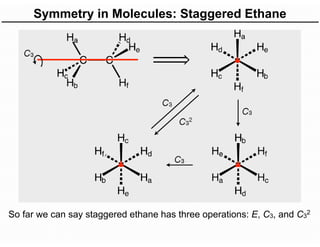
Symmetry in Molecules: Staggered Ethane
So far we can say staggered ethane has three operations: E, C3, and C3
2
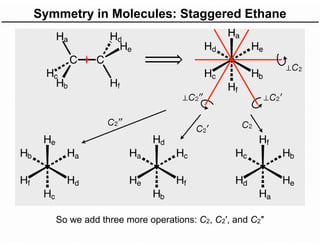
Symmetry in Molecules: Staggered Ethane
So we add three more operations: C2, C2′, and C2″
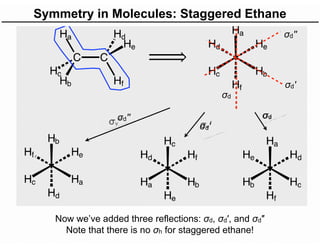
Now we’ve added three reflections: σd, σd′, and σd″
Note that there is no σh for staggered ethane!
Symmetry in Molecules: Staggered Ethane
σd
σd'
σd''
σd
σd'
σd''
Symmetry in Molecules: Staggered Ethane
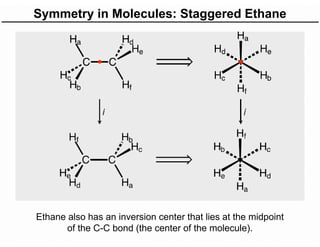
Ethane also has an inversion center that lies at the midpoint
of the C-C bond (the center of the molecule).
Symmetry in Molecules: Staggered Ethane
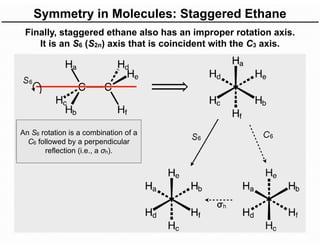
Finally, staggered ethane also has an improper rotation axis.
It is an S6 (S2n) axis that is coincident with the C3 axis.
An S6 rotation is a combination of a
C6 followed by a perpendicular
reflection (i.e., a σh).
Symmetry in Molecules: Staggered Ethane
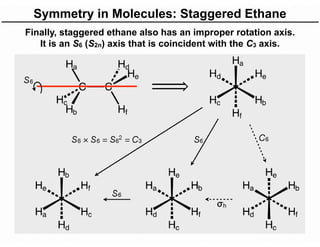
Finally, staggered ethane also has an improper rotation axis.
It is an S6 (S2n) axis that is coincident with the C3 axis.
Symmetry in Molecules: Staggered Ethane
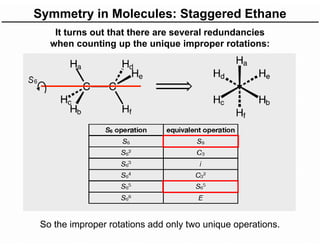
It turns out that there are several redundancies
when counting up the unique improper rotations:
So the improper rotations add only two unique operations.
Symmetry in Molecules: Staggered Ethane
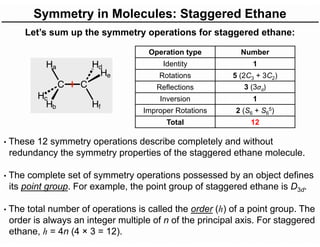
Let’s sum up the symmetry operations for staggered ethane:
Operation type Number
Identity 1
Rotations 5 (2C3 + 3C2)
Reflections 3 (3σd)
Inversion 1
Improper Rotations 2 (S6 + S6
5)
Total 12
• These 12 symmetry operations describe completely and without
redundancy the symmetry properties of the staggered ethane molecule.
• The complete set of symmetry operations possessed by an object defines
its point group. For example, the point group of staggered ethane is D3d.
• The total number of operations is called the order (h) of a point group. The
order is always an integer multiple of n of the principal axis. For staggered
ethane, h = 4n (4 × 3 = 12).
Summary
Symmetry Elements and Operations
• elements are imaginary points, lines, or planes within the object.
• operations are movements that take an object between equivalent
configurations – indistinguishable from the original configuration,
although not necessarily identical to it.
• for molecules we use “point” symmetry operations, which include
rotations, reflections, inversion, improper rotations, and the
identity. At least one point remains stationary in a point operation.
• some symmetry operations are redundant (e.g., S6
2 ≡ C3); in these
cases, the convention is to list the simpler operation.
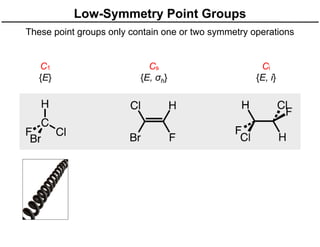
Low-Symmetry Point Groups
These point groups only contain one or two symmetry operations
C1
{E}
Cs
{E, σh}
Ci
{E, i}
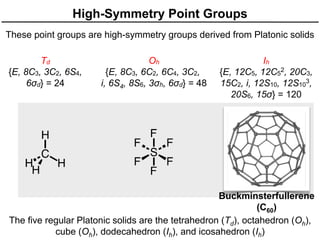
High-Symmetry Point Groups
These point groups are high-symmetry groups derived from Platonic solids
Ih
{E, 12C5, 12C5
2, 20C3,
15C2, i, 12S10, 12S10
3,
20S6, 15σ} = 120
Oh
{E, 8C3, 6C2, 6C4, 3C2,
i, 6S4, 8S6, 3σh, 6σd} = 48
Td
{E, 8C3, 3C2, 6S4,
6σd} = 24
The five regular Platonic solids are the tetrahedron (Td), octahedron (Oh),
cube (Oh), dodecahedron (Ih), and icosahedron (Ih)
Buckminsterfullerene
(C60)
High-Symmetry Point Groups
Th example:
In addition to Td, Oh, and Ih, there are corresponding point groups that
lack the mirror planes (T, O, and I).
Adding an inversion center to the T point group gives the Th point group.
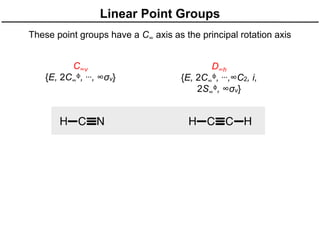
Linear Point Groups
These point groups have a C∞ axis as the principal rotation axis
D∞h
{E, 2C∞
φ, …,∞C2, i,
2S∞
φ, ∞σv}
C∞v
{E, 2C∞
φ, …, ∞σv}
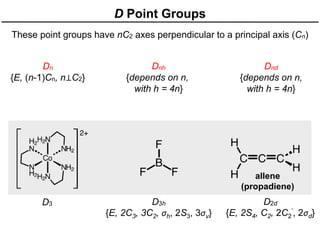
D Point Groups
These point groups have nC2 axes perpendicular to a principal axis (Cn)
Dn
{E, (n-1)Cn, n٣C2}
Dnh
{depends on n,
with h = 4n}
Dnd
{depends on n,
with h = 4n}
D3 D3h
{E, 2C3, 3C2, σh, 2S3, 3σv}
D2d
{E, 2S4, C2, 2C2
’, 2σd}
allene
(propadiene)
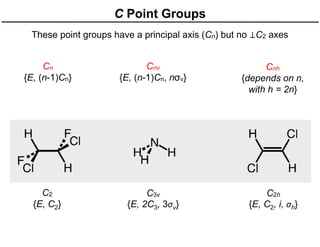
C Point Groups
These point groups have a principal axis (Cn) but no ٣C2 axes
Cnv
{E, (n-1)Cn, nσv}
Cnh
{depends on n,
with h = 2n}
Cn
{E, (n-1)Cn}
C2
{E, C2}
C3v
{E, 2C3, 3σv}
C2h
{E, C2, i, σh}
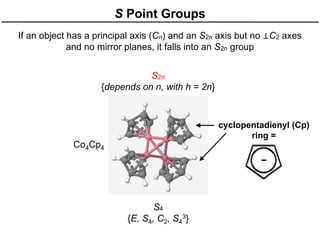
S Point Groups
If an object has a principal axis (Cn) and an S2n axis but no ٣C2 axes
and no mirror planes, it falls into an S2n group
S2n
{depends on n, with h = 2n}
S4
{E, S4, C2, S4
3}
cyclopentadienyl (Cp)
ring =
Co4Cp4

Organic Stereochemistry point group 1.pdf

  • 1.
    Symmetry and PointGroups Chapter 4 Monday, September 28, 2015
  • 2.
    Symmetry in Molecules:Staggered Ethane So far we can say staggered ethane has three operations: E, C3, and C3 2
  • 3.
    Symmetry in Molecules:Staggered Ethane So we add three more operations: C2, C2′, and C2″
  • 4.
    Now we’ve addedthree reflections: σd, σd′, and σd″ Note that there is no σh for staggered ethane! Symmetry in Molecules: Staggered Ethane σd σd' σd'' σd σd' σd''
  • 5.
    Symmetry in Molecules:Staggered Ethane Ethane also has an inversion center that lies at the midpoint of the C-C bond (the center of the molecule).
  • 6.
    Symmetry in Molecules:Staggered Ethane Finally, staggered ethane also has an improper rotation axis. It is an S6 (S2n) axis that is coincident with the C3 axis. An S6 rotation is a combination of a C6 followed by a perpendicular reflection (i.e., a σh).
  • 7.
    Symmetry in Molecules:Staggered Ethane Finally, staggered ethane also has an improper rotation axis. It is an S6 (S2n) axis that is coincident with the C3 axis.
  • 8.
    Symmetry in Molecules:Staggered Ethane It turns out that there are several redundancies when counting up the unique improper rotations: So the improper rotations add only two unique operations.
  • 9.
    Symmetry in Molecules:Staggered Ethane Let’s sum up the symmetry operations for staggered ethane: Operation type Number Identity 1 Rotations 5 (2C3 + 3C2) Reflections 3 (3σd) Inversion 1 Improper Rotations 2 (S6 + S6 5) Total 12 • These 12 symmetry operations describe completely and without redundancy the symmetry properties of the staggered ethane molecule. • The complete set of symmetry operations possessed by an object defines its point group. For example, the point group of staggered ethane is D3d. • The total number of operations is called the order (h) of a point group. The order is always an integer multiple of n of the principal axis. For staggered ethane, h = 4n (4 × 3 = 12).
  • 10.
    Summary Symmetry Elements andOperations • elements are imaginary points, lines, or planes within the object. • operations are movements that take an object between equivalent configurations – indistinguishable from the original configuration, although not necessarily identical to it. • for molecules we use “point” symmetry operations, which include rotations, reflections, inversion, improper rotations, and the identity. At least one point remains stationary in a point operation. • some symmetry operations are redundant (e.g., S6 2 ≡ C3); in these cases, the convention is to list the simpler operation.
  • 11.
    Low-Symmetry Point Groups Thesepoint groups only contain one or two symmetry operations C1 {E} Cs {E, σh} Ci {E, i}
  • 12.
    High-Symmetry Point Groups Thesepoint groups are high-symmetry groups derived from Platonic solids Ih {E, 12C5, 12C5 2, 20C3, 15C2, i, 12S10, 12S10 3, 20S6, 15σ} = 120 Oh {E, 8C3, 6C2, 6C4, 3C2, i, 6S4, 8S6, 3σh, 6σd} = 48 Td {E, 8C3, 3C2, 6S4, 6σd} = 24 The five regular Platonic solids are the tetrahedron (Td), octahedron (Oh), cube (Oh), dodecahedron (Ih), and icosahedron (Ih) Buckminsterfullerene (C60)
  • 13.
    High-Symmetry Point Groups Thexample: In addition to Td, Oh, and Ih, there are corresponding point groups that lack the mirror planes (T, O, and I). Adding an inversion center to the T point group gives the Th point group.
  • 14.
    Linear Point Groups Thesepoint groups have a C∞ axis as the principal rotation axis D∞h {E, 2C∞ φ, …,∞C2, i, 2S∞ φ, ∞σv} C∞v {E, 2C∞ φ, …, ∞σv}
  • 15.
    D Point Groups Thesepoint groups have nC2 axes perpendicular to a principal axis (Cn) Dn {E, (n-1)Cn, n٣C2} Dnh {depends on n, with h = 4n} Dnd {depends on n, with h = 4n} D3 D3h {E, 2C3, 3C2, σh, 2S3, 3σv} D2d {E, 2S4, C2, 2C2 ’, 2σd} allene (propadiene)
  • 16.
    C Point Groups Thesepoint groups have a principal axis (Cn) but no ٣C2 axes Cnv {E, (n-1)Cn, nσv} Cnh {depends on n, with h = 2n} Cn {E, (n-1)Cn} C2 {E, C2} C3v {E, 2C3, 3σv} C2h {E, C2, i, σh}
  • 17.
    S Point Groups Ifan object has a principal axis (Cn) and an S2n axis but no ٣C2 axes and no mirror planes, it falls into an S2n group S2n {depends on n, with h = 2n} S4 {E, S4, C2, S4 3} cyclopentadienyl (Cp) ring = Co4Cp4