Symmetry and Group Theory
Advanced Inorganic Chemistry
Symmetry and Introduction to Group Theory
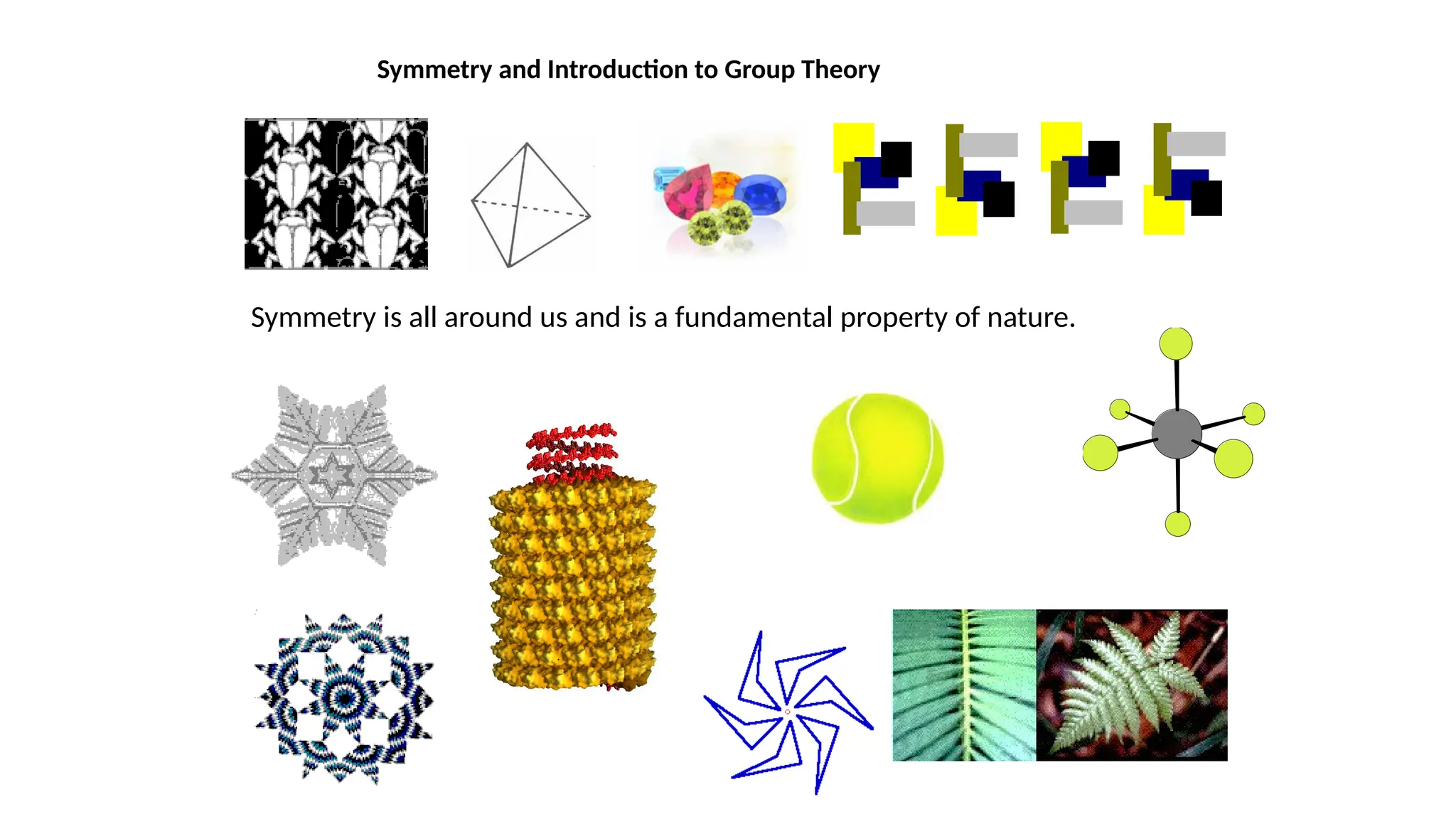
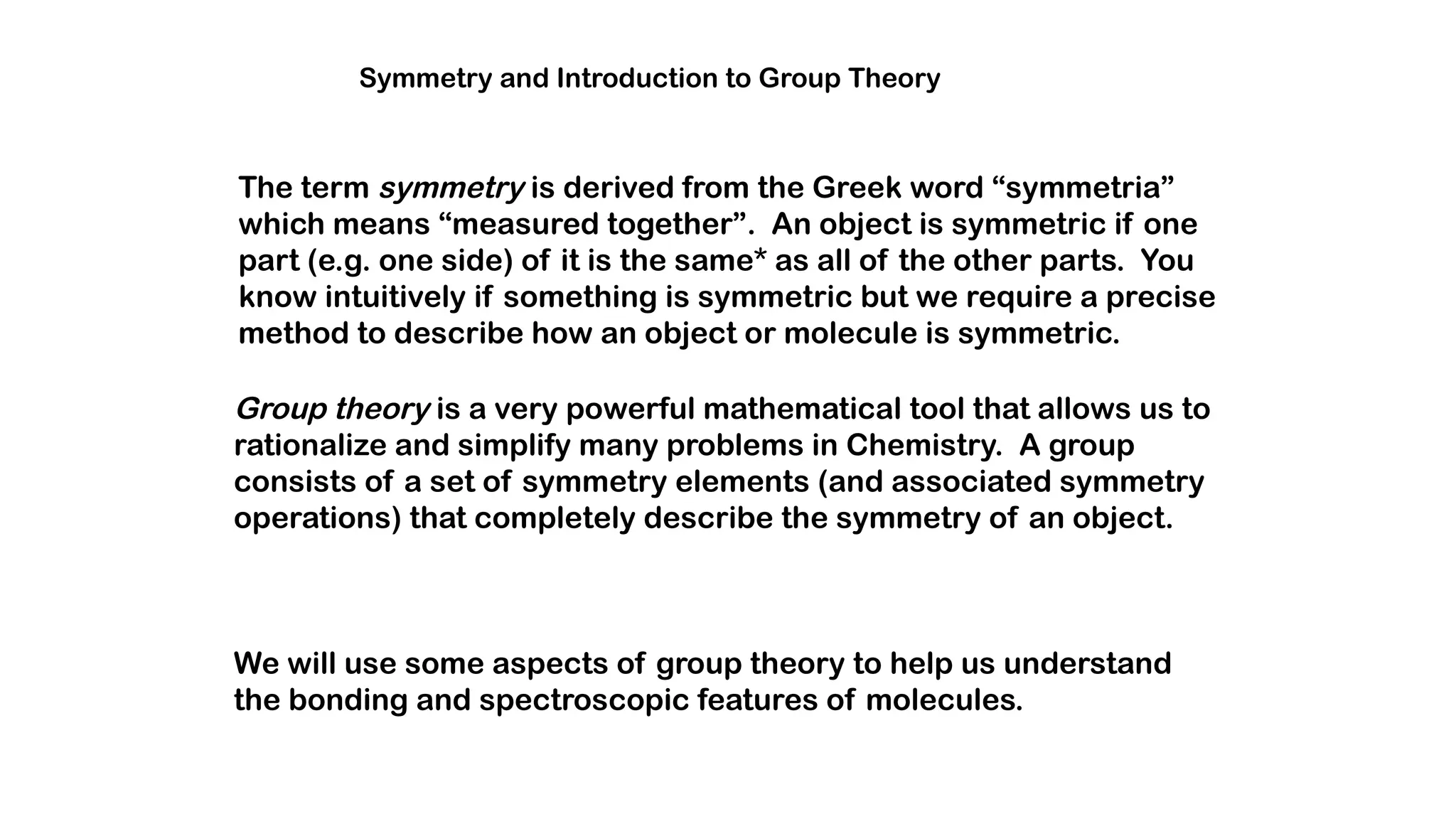
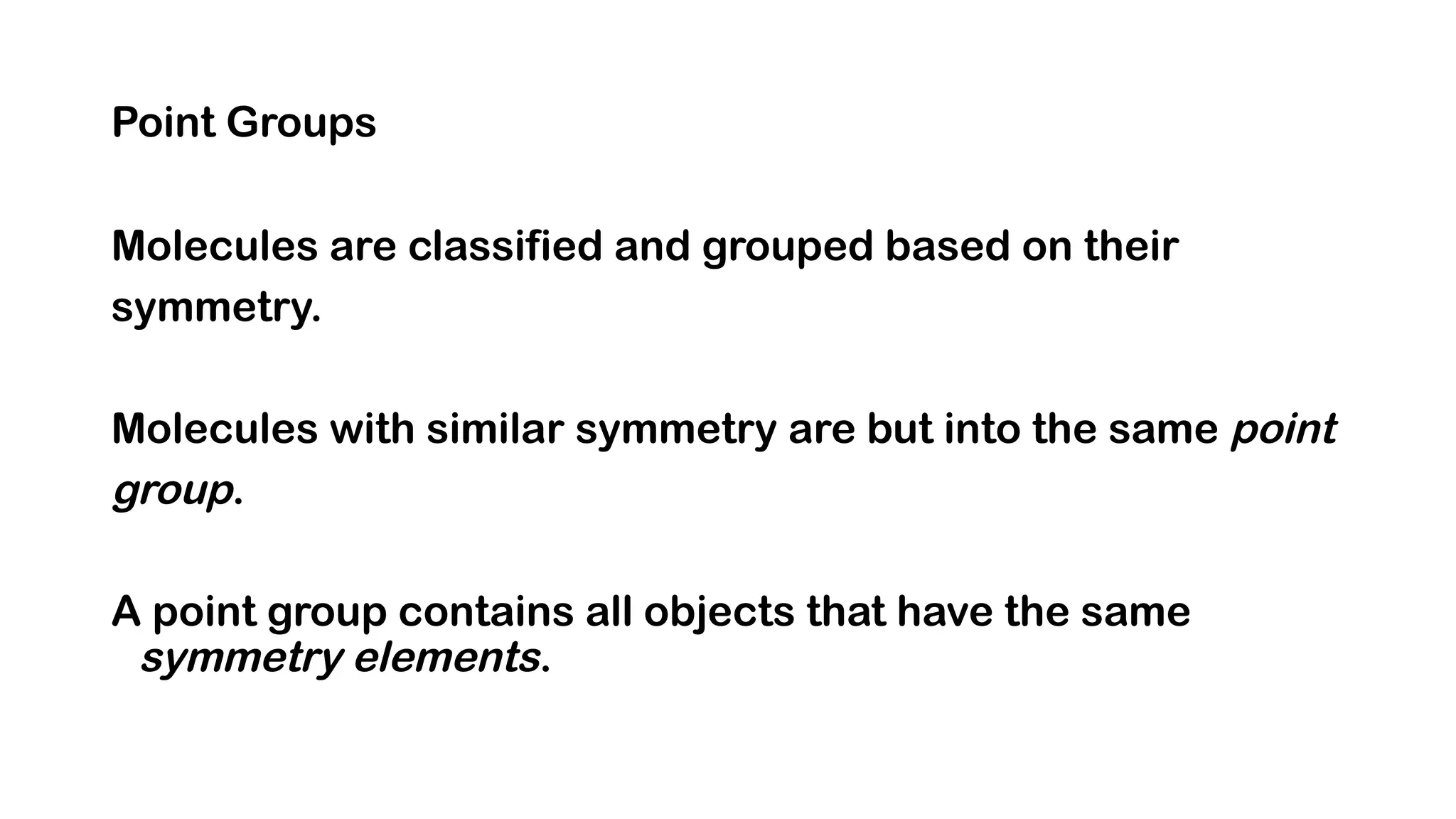
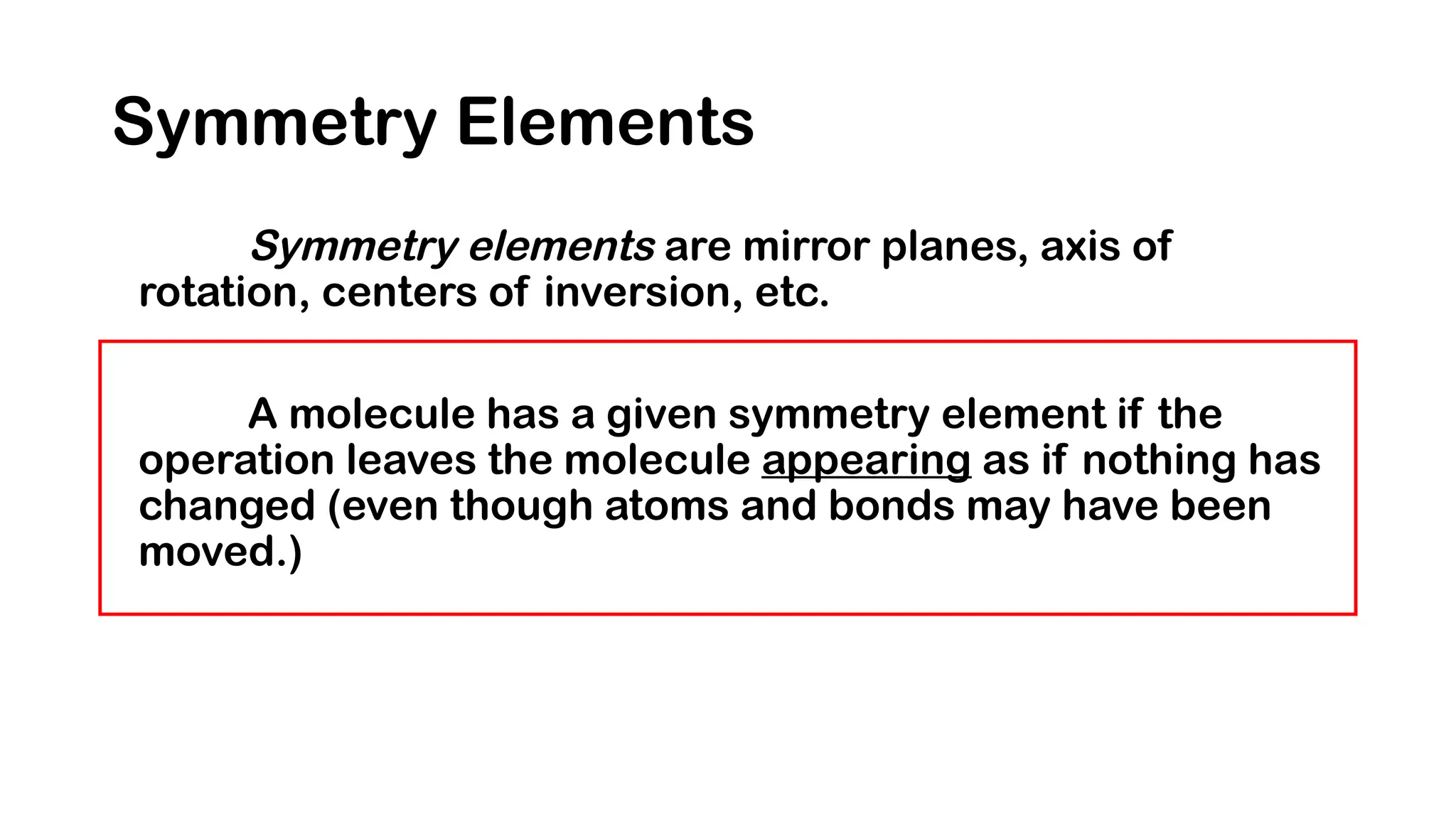
Symmetry is all around us and is a fundamental property of nature.
Symmetry and Introduction to Group Theory
The term symmetry is derived from the Greek word “symmetria”
which means “measured together”. An object is symmetric if one
part (e.g. one side) of it is the same* as all of the other parts. You
know intuitively if something is symmetric but we require a precise
method to describe how an object or molecule is symmetric.
Group theory is a very powerful mathematical tool that allows us to
rationalize and simplify many problems in Chemistry. A group
consists of a set of symmetry elements (and associated symmetry
operations) that completely describe the symmetry of an object.
We will use some aspects of group theory to help us understand
the bonding and spectroscopic features of molecules.
Point Groups
Molecules are classified and grouped based on their
symmetry.
Molecules with similar symmetry are but into the same point
group.
A point group contains all objects that have the same
symmetry elements.
Symmetry Elements
Symmetry elements are mirror planes, axis of
rotation, centers of inversion, etc.
A molecule has a given symmetry element if the
operation leaves the molecule appearing as if nothing has
changed (even though atoms and bonds may have been
moved.)
Symmetry Elements
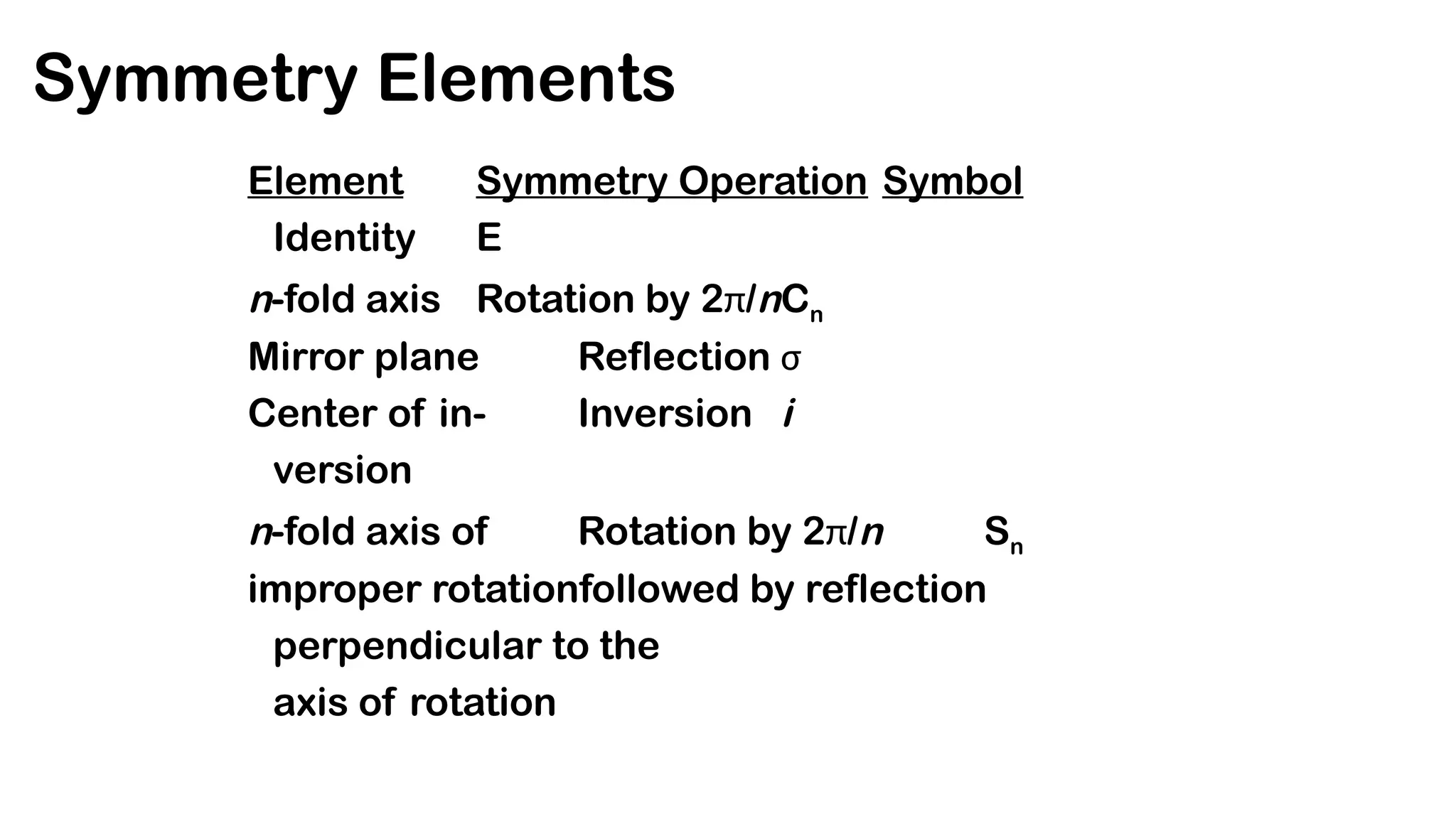
Element Symmetry Operation Symbol
Identity E
n-fold axis Rotation by 2π/nCn
Mirror plane Reflection σ
Center of in- Inversion i
version
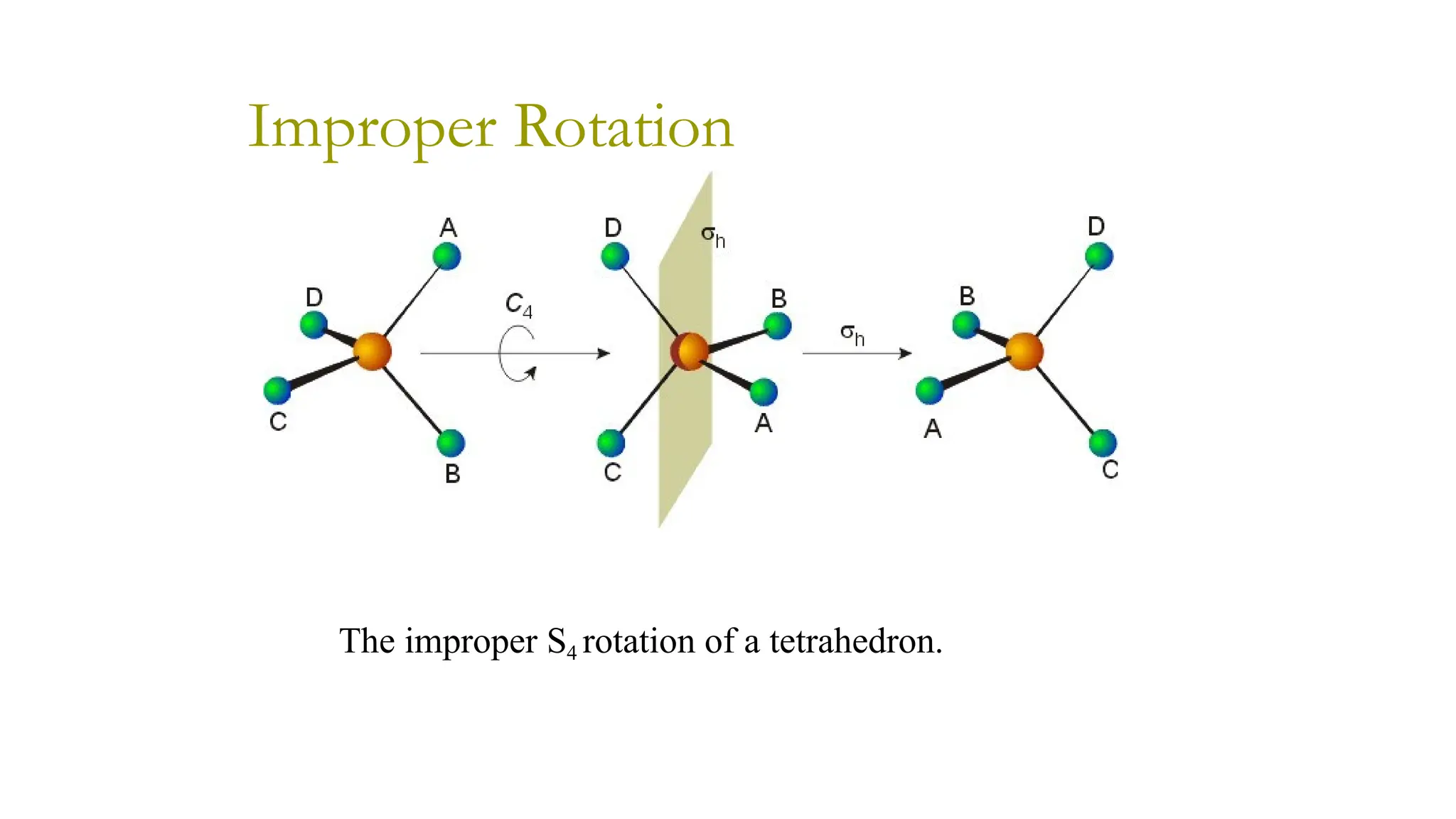
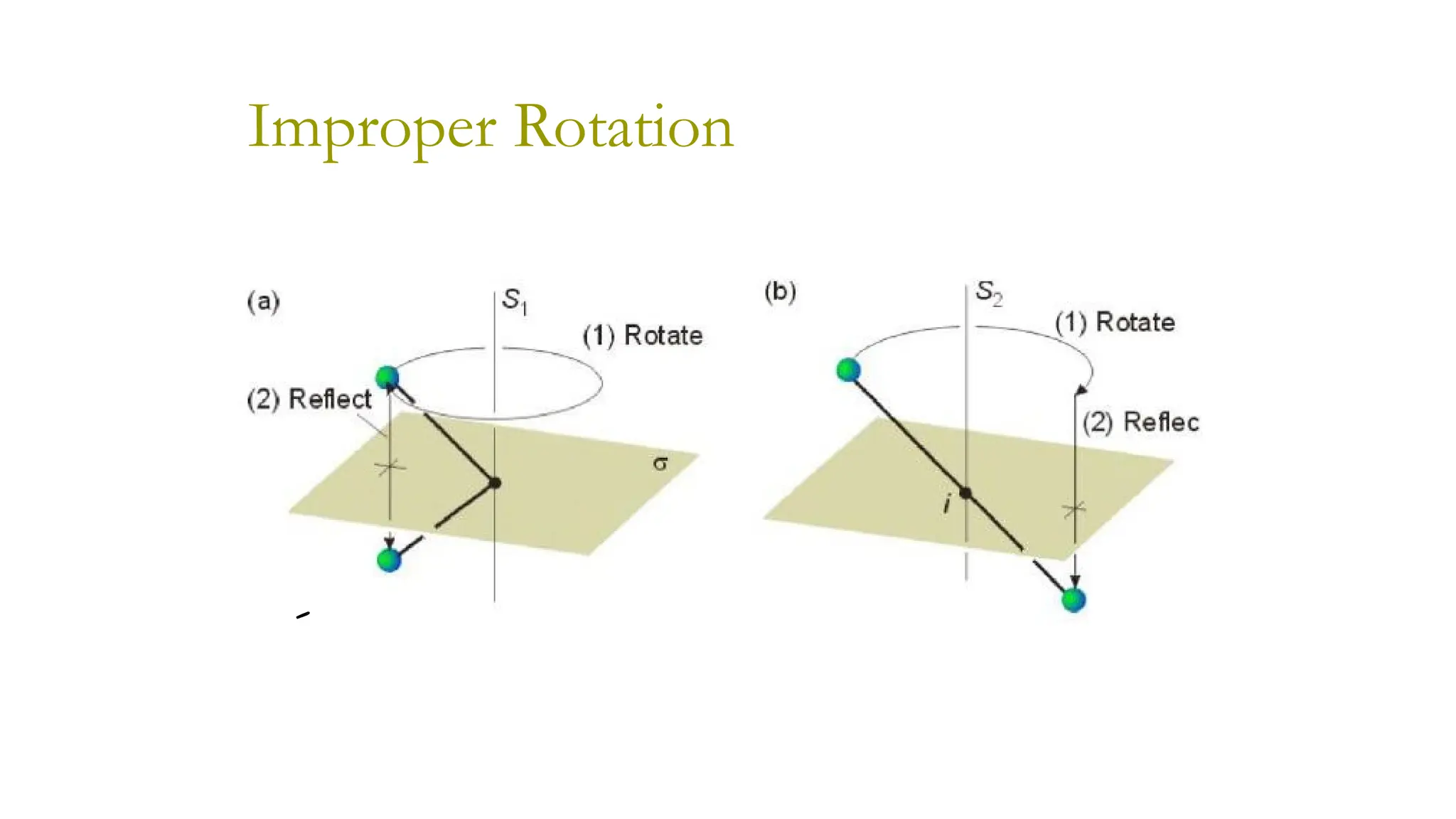
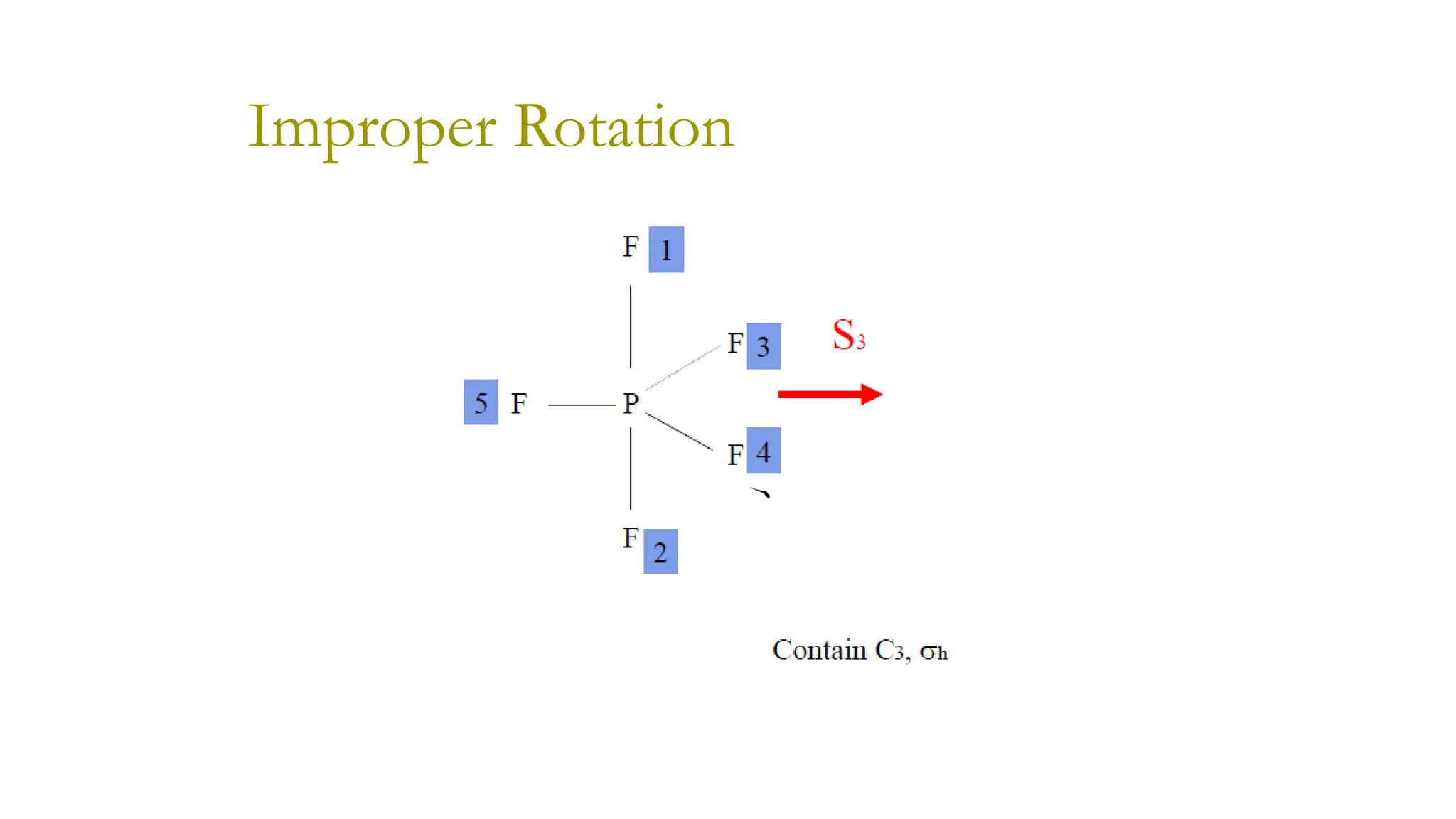
n-fold axis of Rotation by 2π/n Sn
improper rotationfollowed by reflection
perpendicular to the
axis of rotation
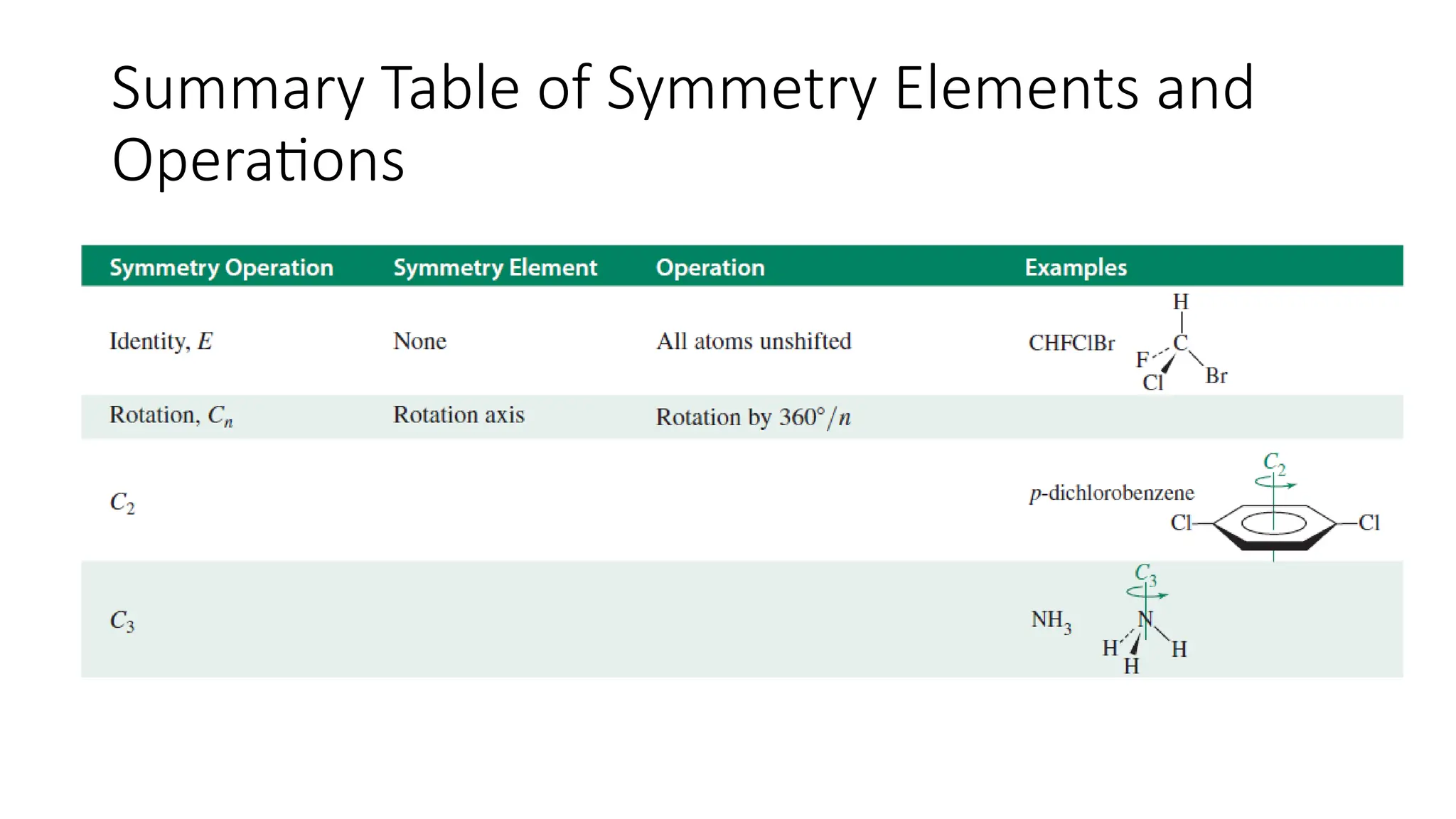
Identity, E
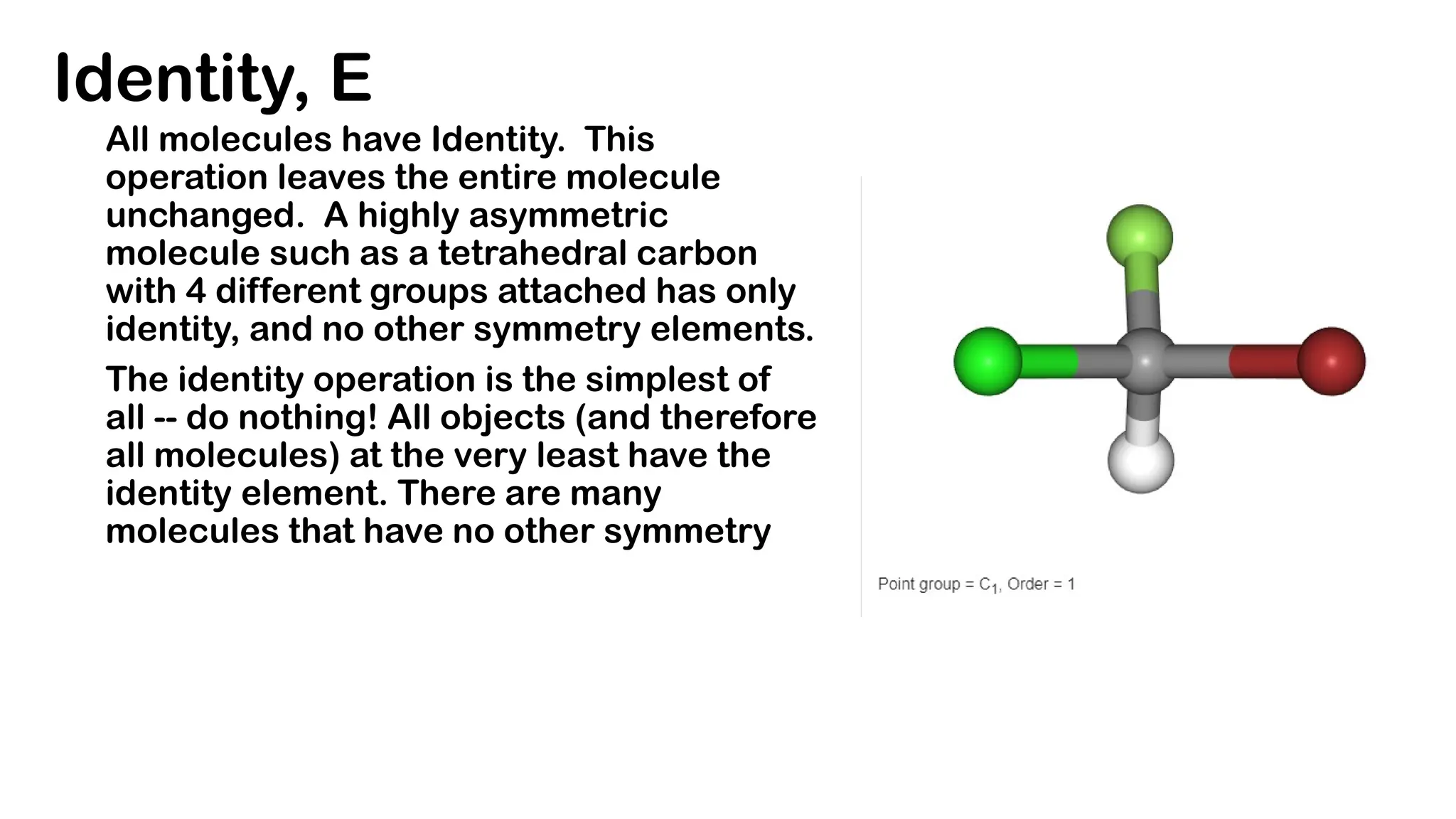
All molecules have Identity. This
operation leaves the entire molecule
unchanged. A highly asymmetric
molecule such as a tetrahedral carbon
with 4 different groups attached has only
identity, and no other symmetry elements.
The identity operation is the simplest of
all -- do nothing! All objects (and therefore
all molecules) at the very least have the
identity element. There are many
molecules that have no other symmetry
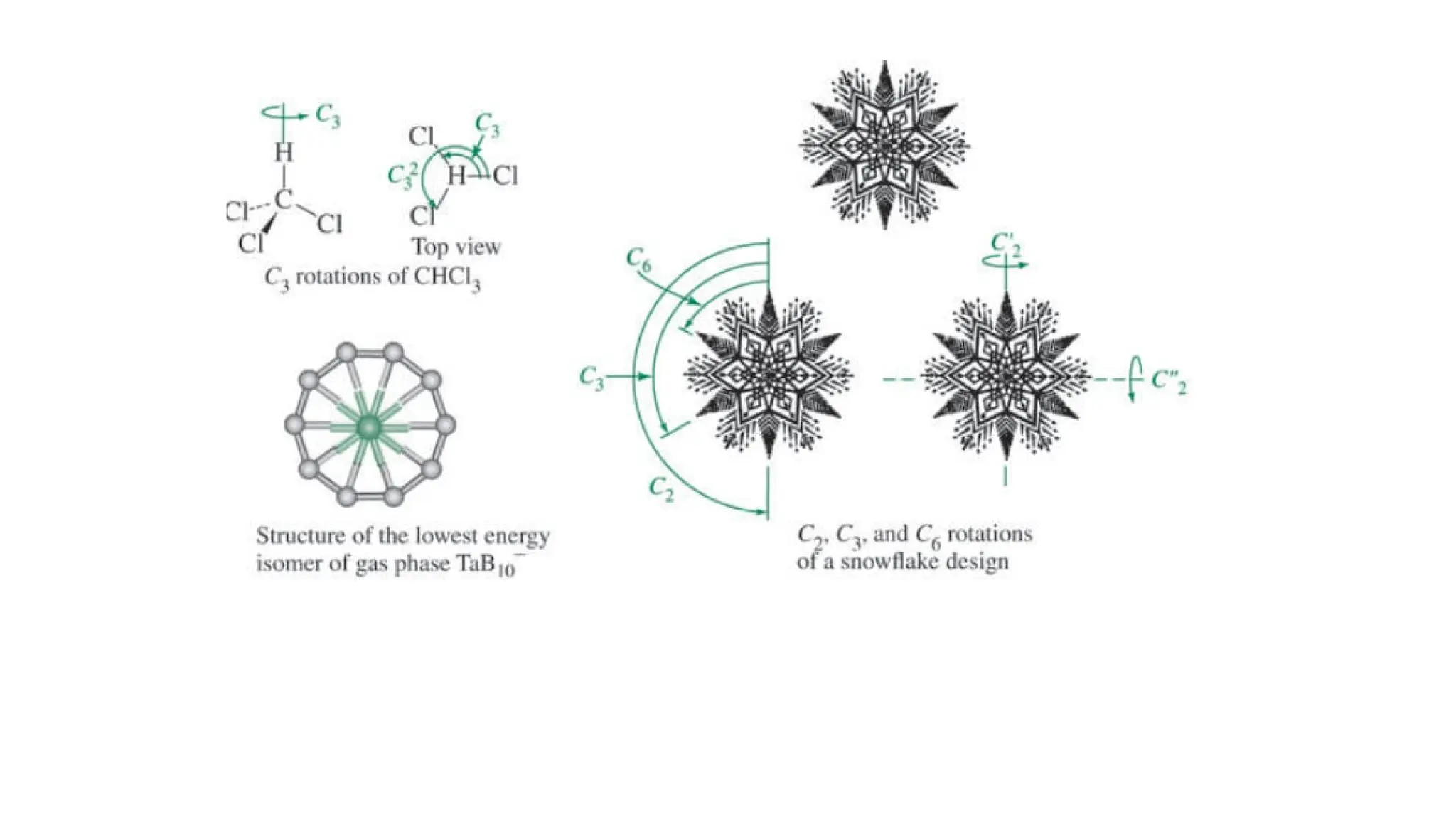
n-fold Rotation/Proper Rotation
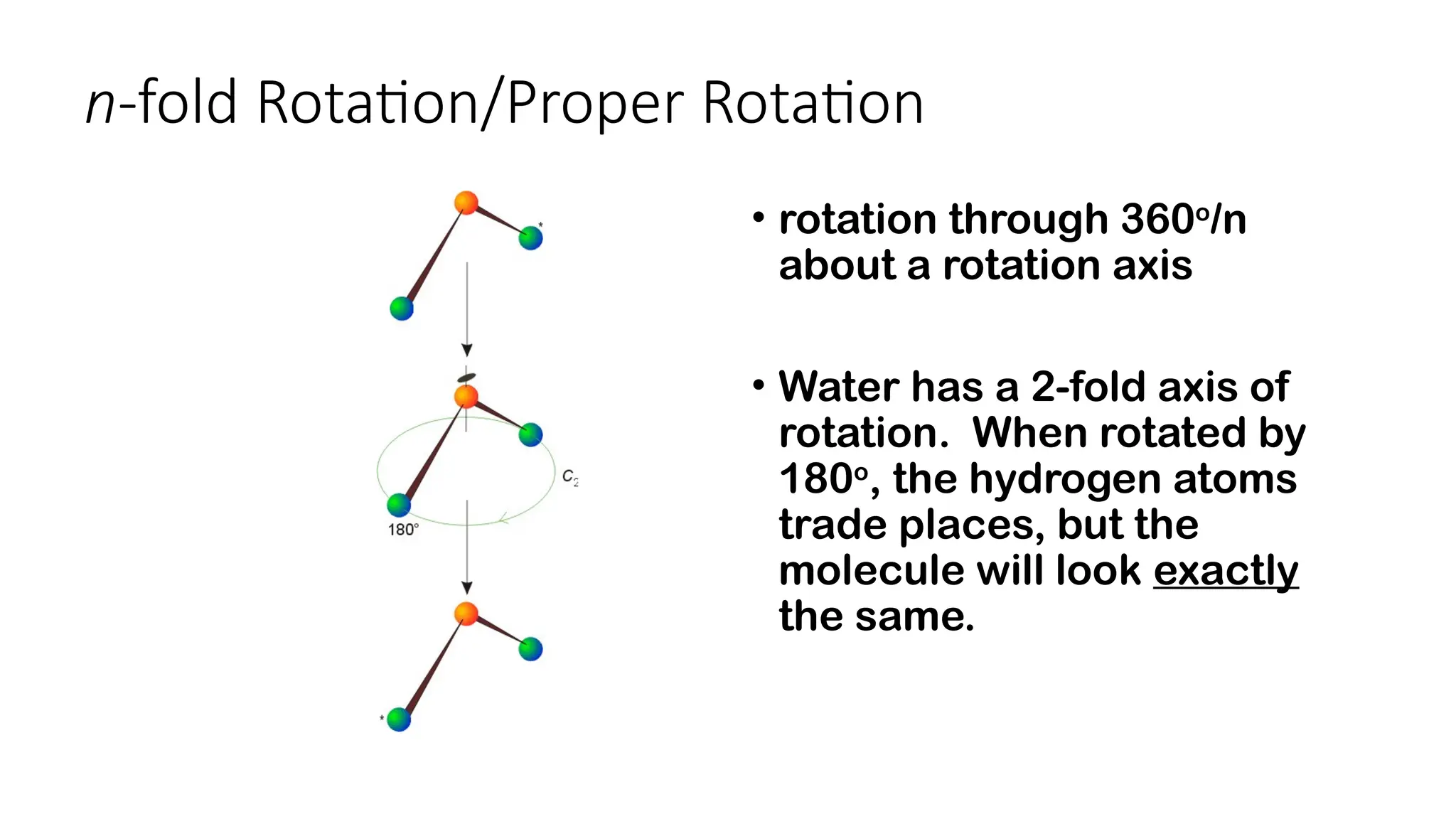
• rotation through 360o
/n
about a rotation axis
• Water has a 2-fold axis of
rotation. When rotated by
180o
, the hydrogen atoms
trade places, but the
molecule will look exactly
the same.
n-fold Axis of Rotation
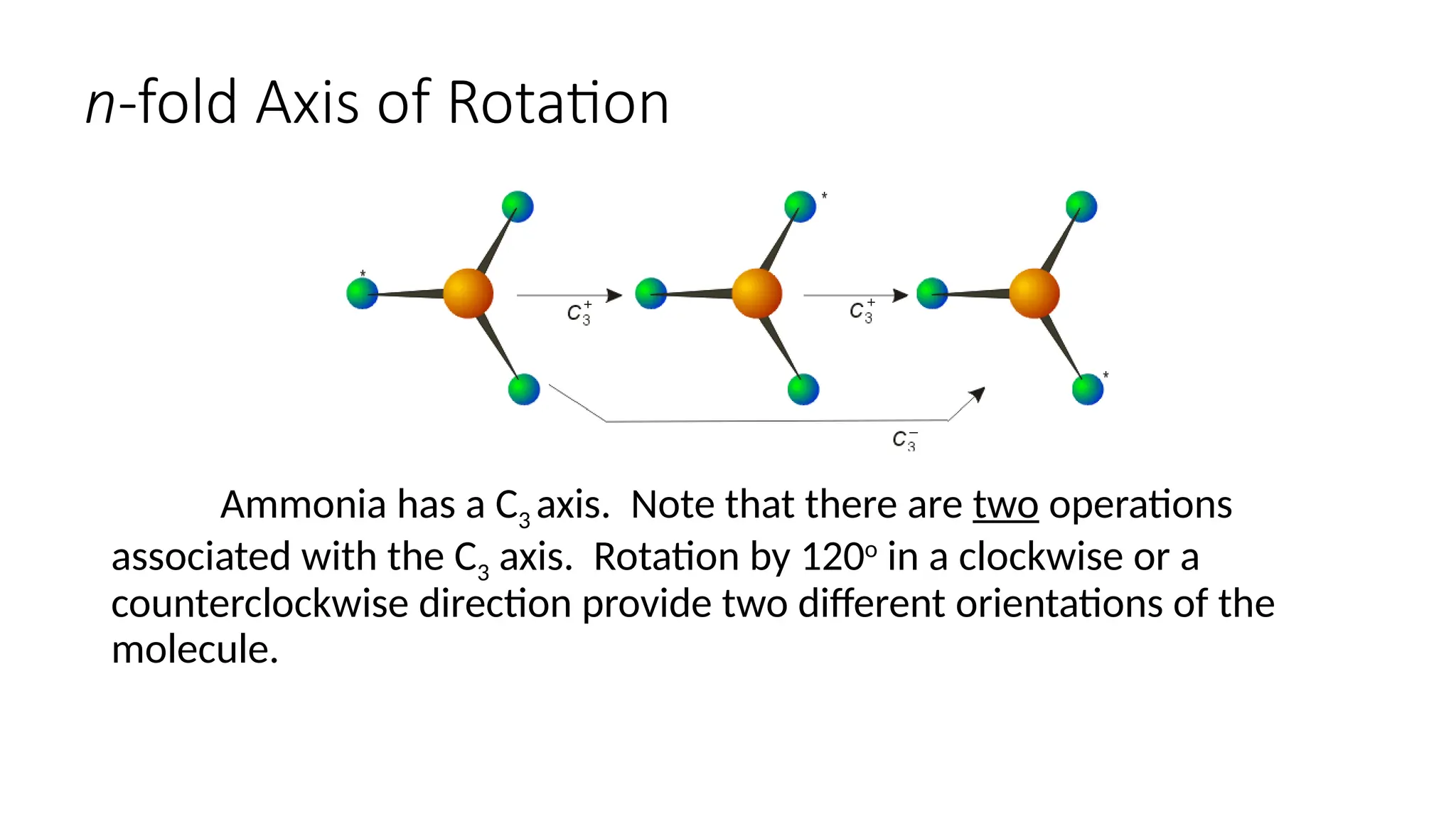
Ammonia has a C3 axis. Note that there are two operations
associated with the C3 axis. Rotation by 120o
in a clockwise or a
counterclockwise direction provide two different orientations of the
molecule.
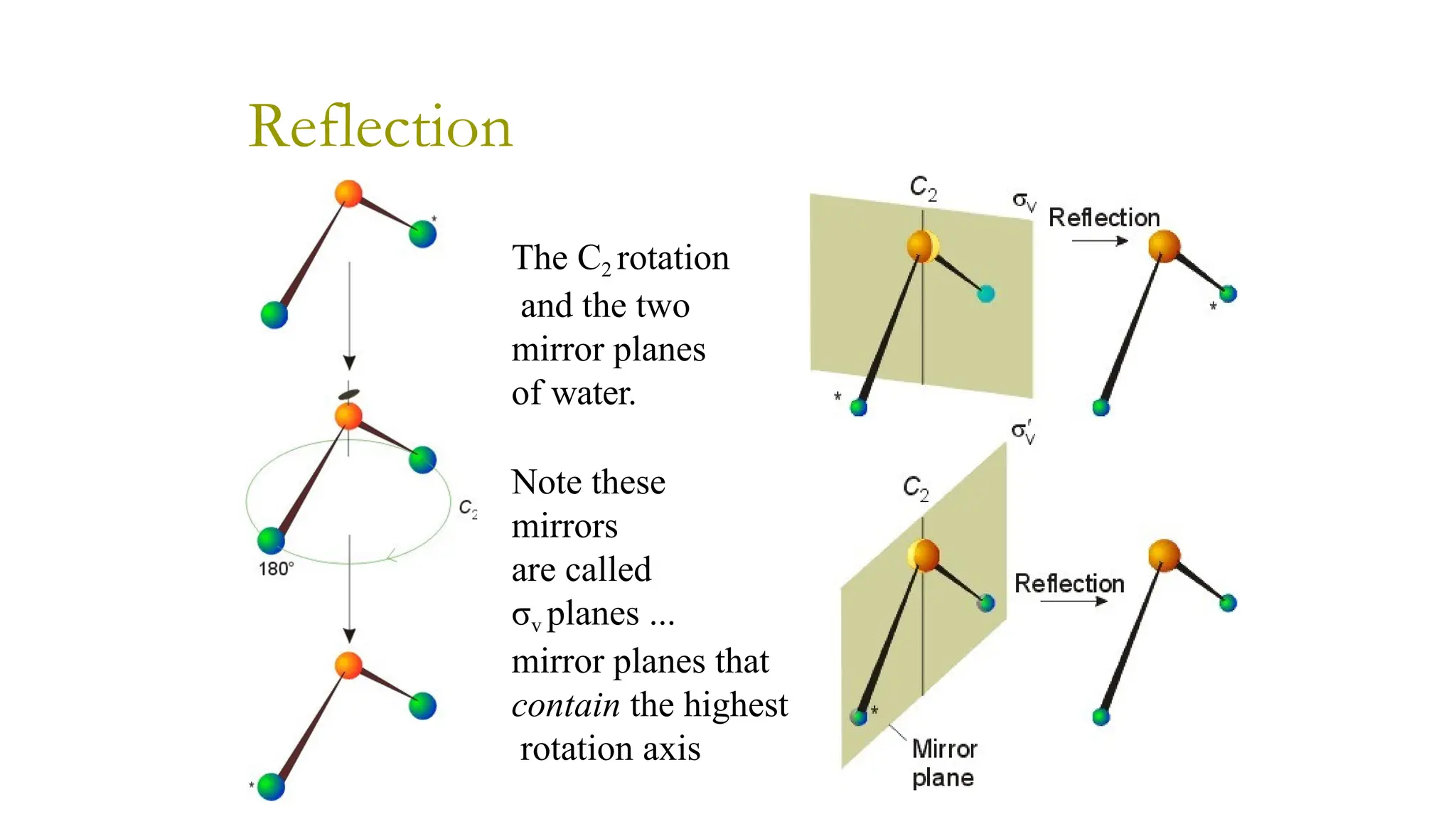
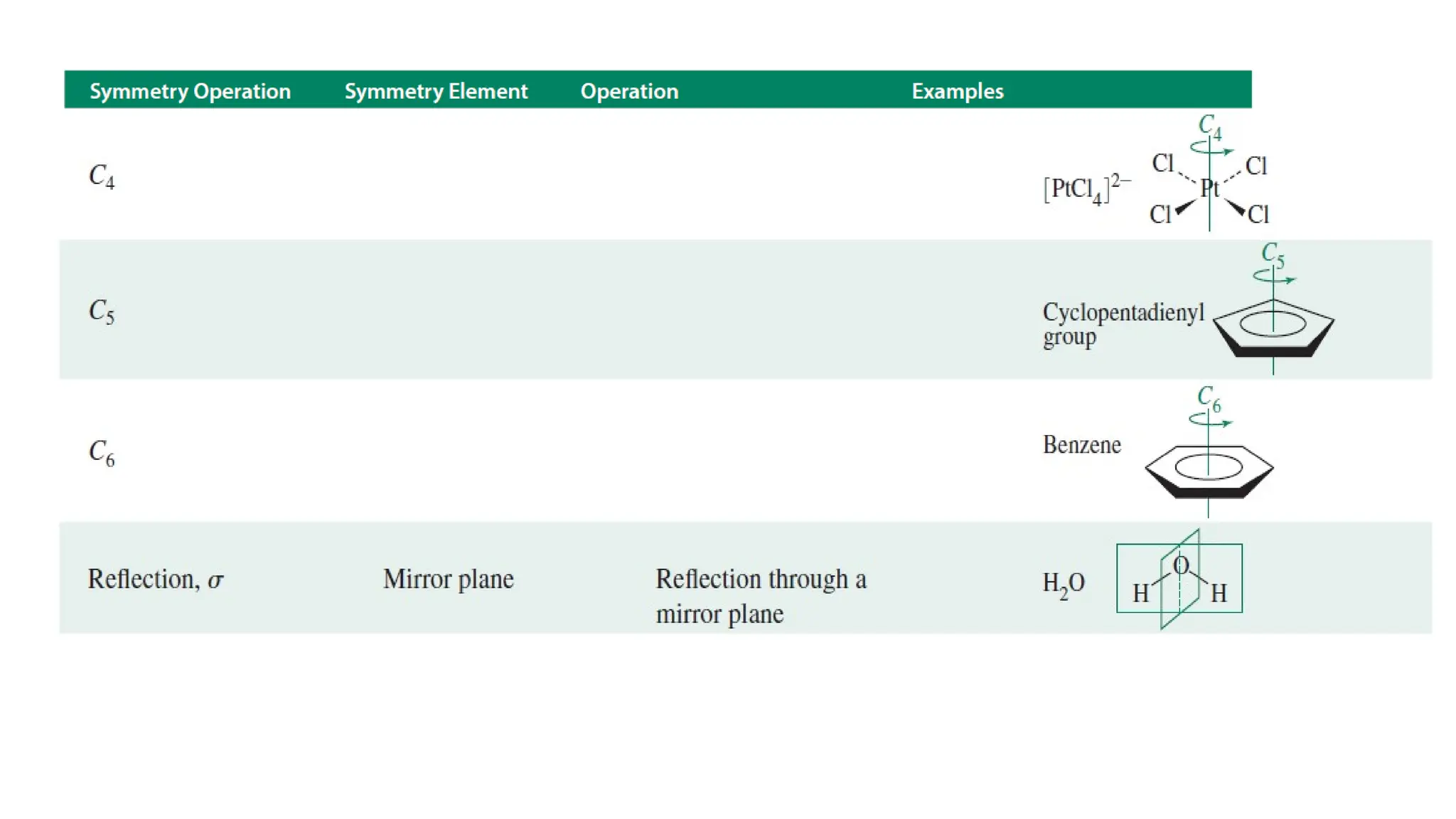
The C2 rotation
and the two
mirror planes
of water.
Note these
mirrors
are called
σv planes ...
mirror planes that
contain the highest
rotation axis
Reflection
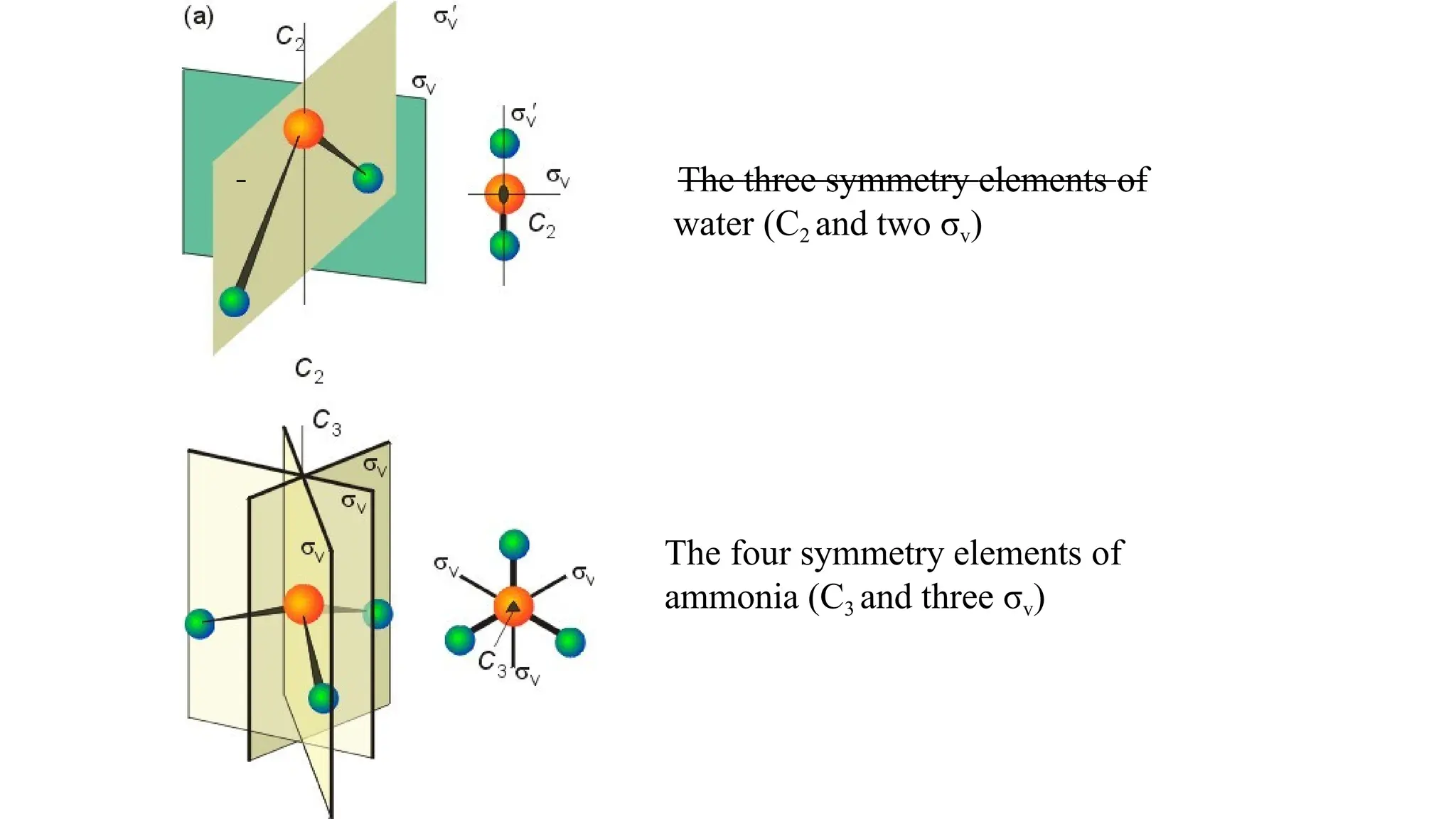
Water and Ammonia
The three symmetry elements of
water (C2 and two σv)
The four symmetry elements of
ammonia (C3 and three σv)
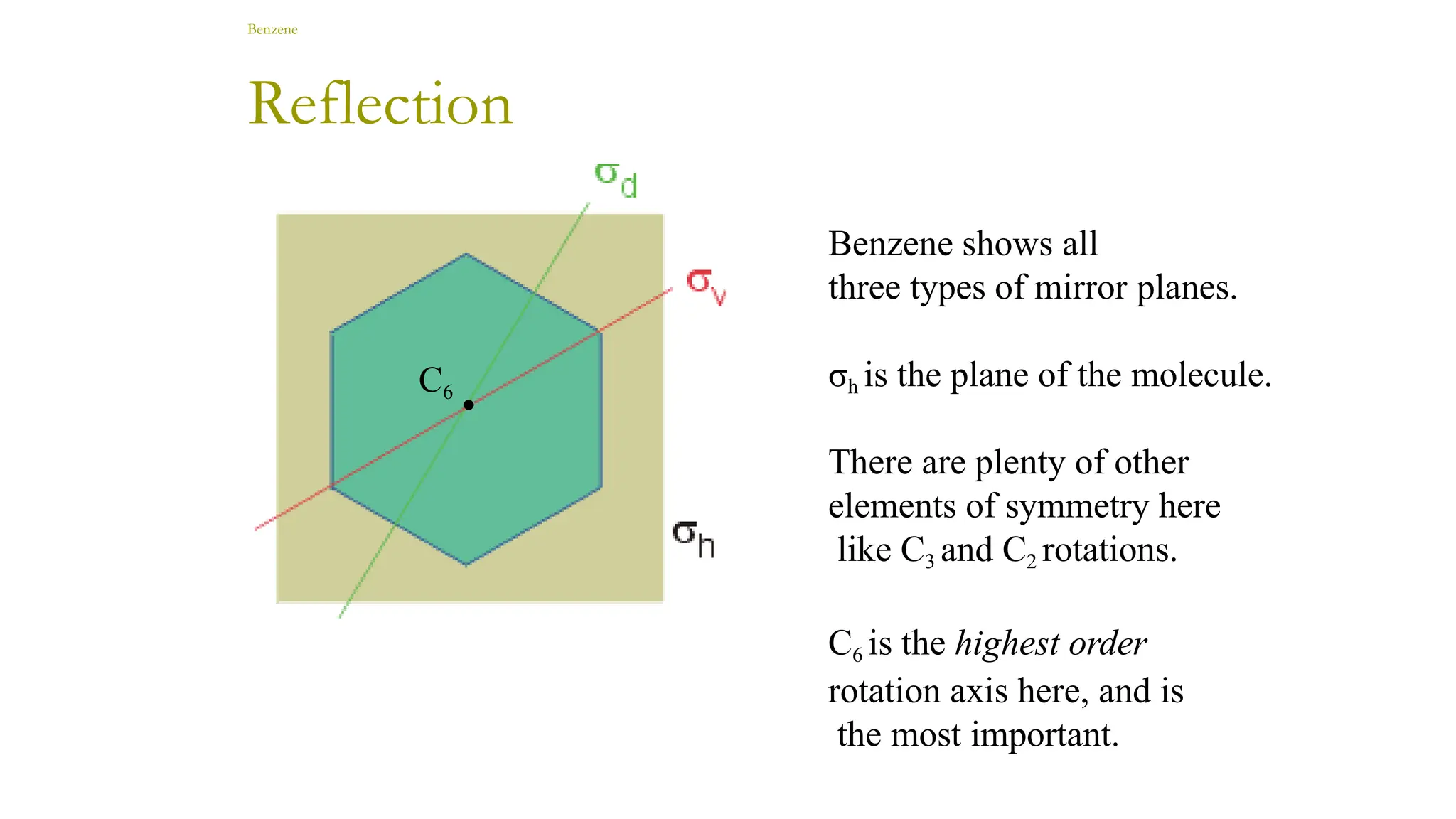
Benzene
C6
Benzene shows all
three types of mirror planes.
σh is the plane of the molecule.
There are plenty of other
elements of symmetry here
like C3 and C2 rotations.
C6 is the highest order
rotation axis here, and is
the most important.
Reflection
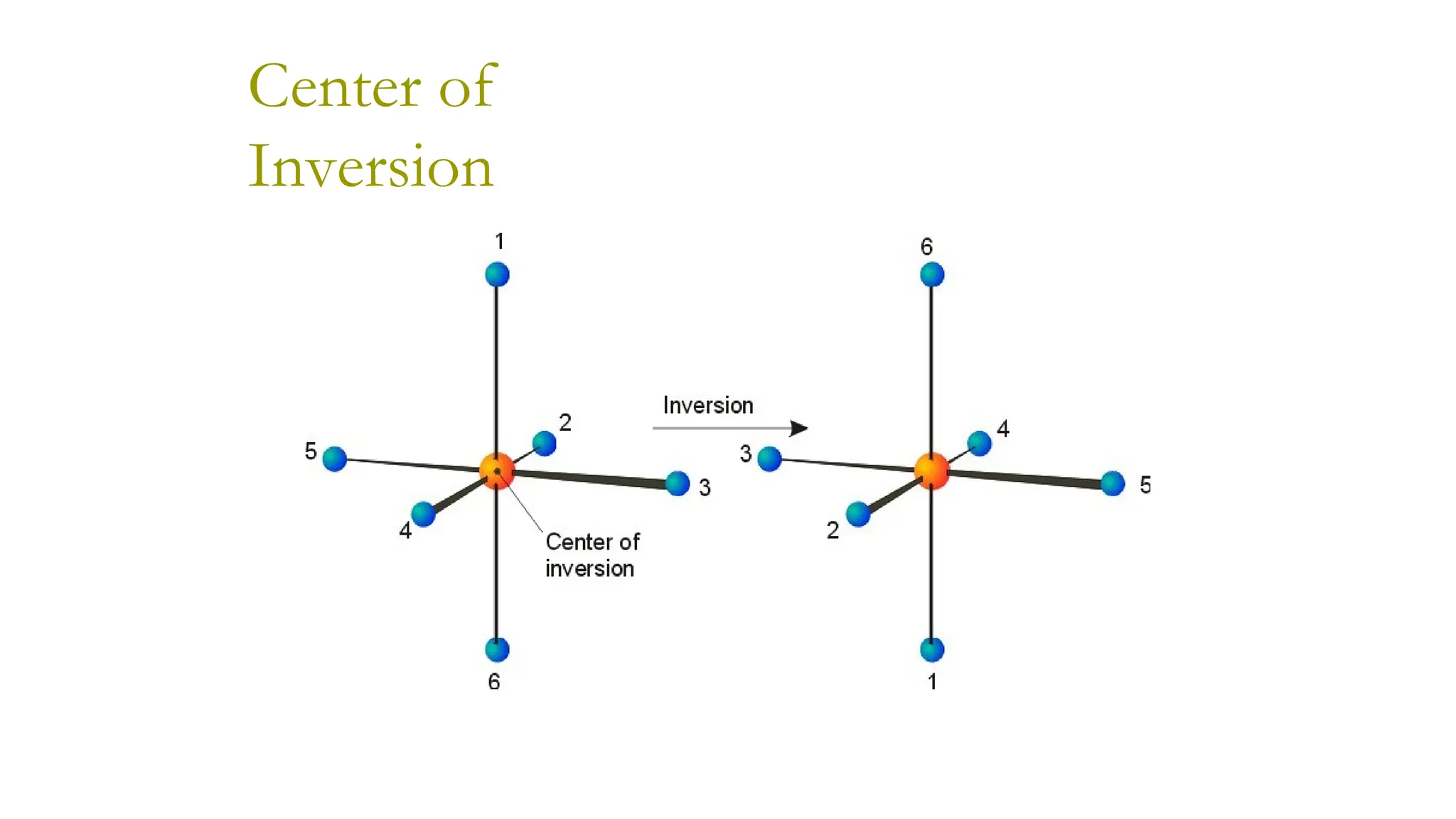
Center of
Inversion
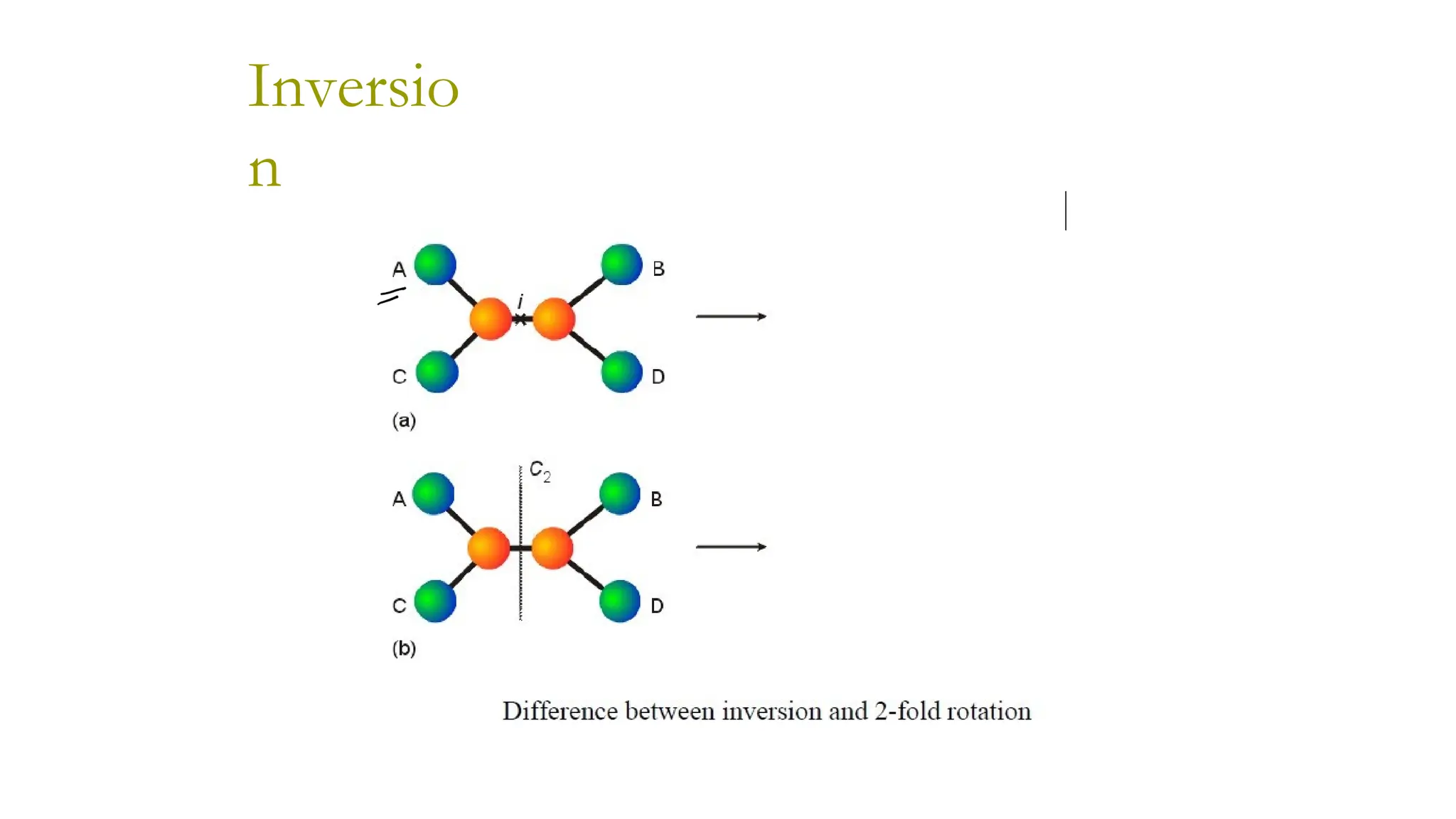
Inversio
n
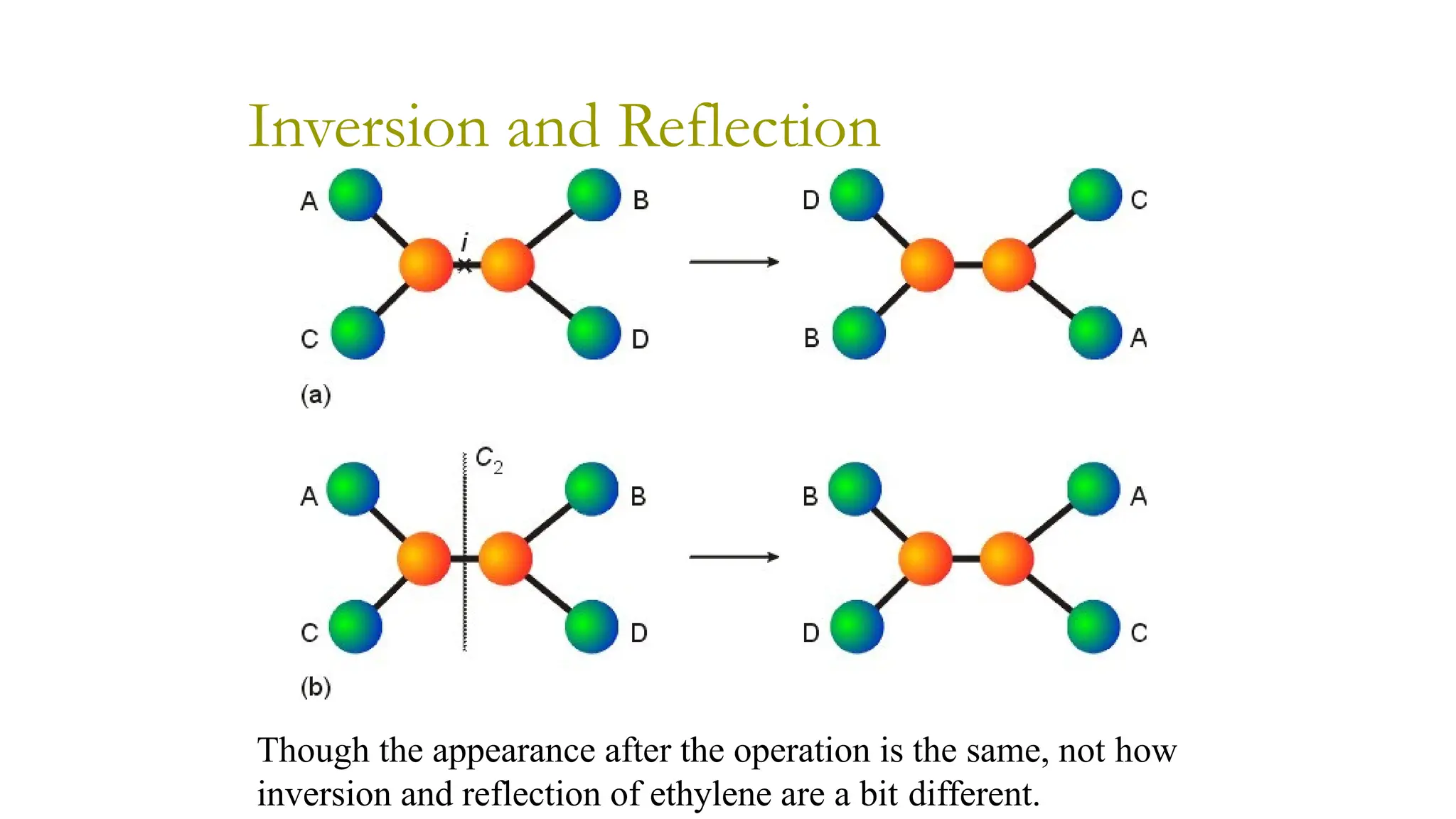
Though the appearance after the operation is the same, not how
inversion and reflection of ethylene are a bit different.
Inversion and Reflection
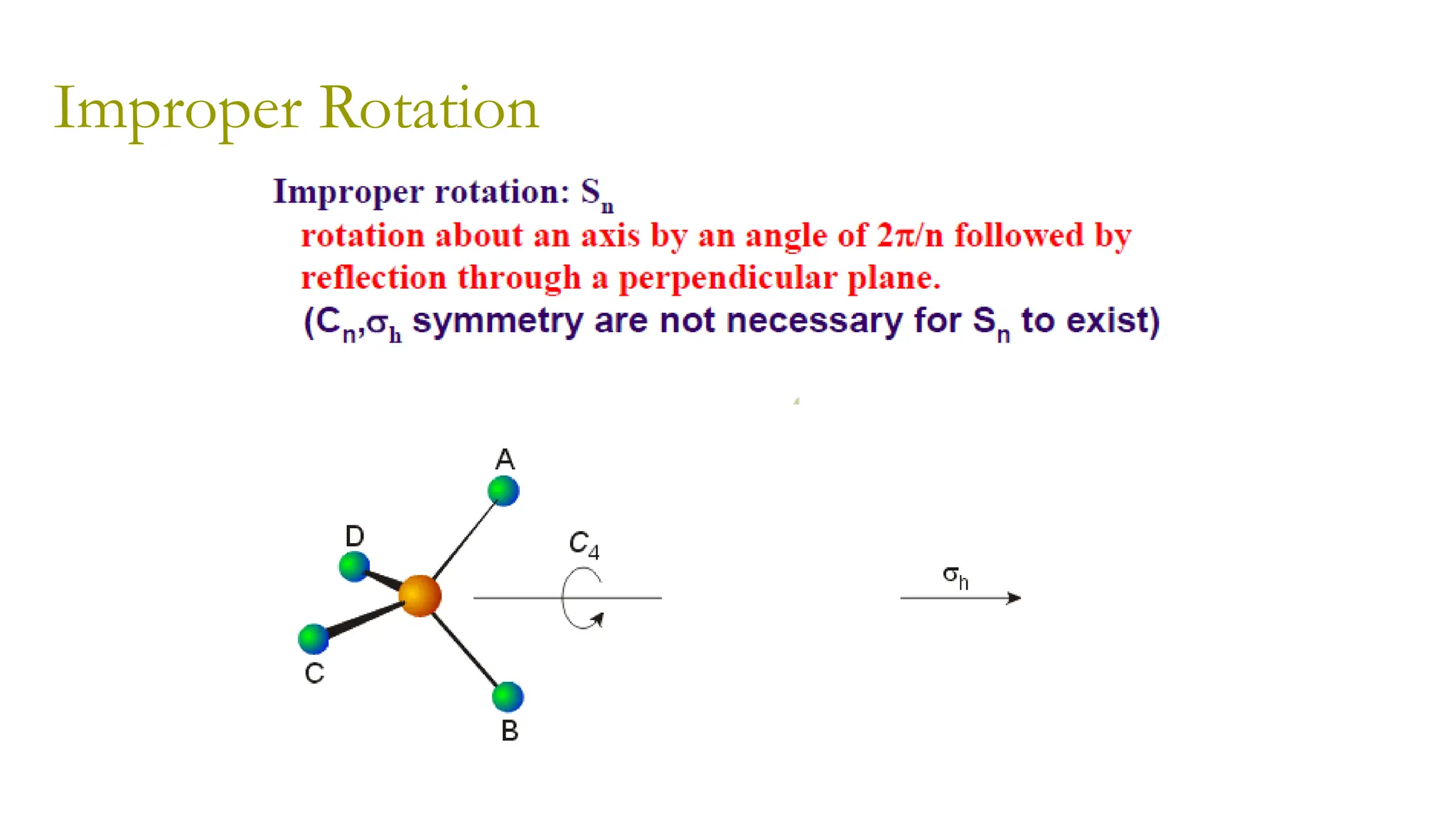
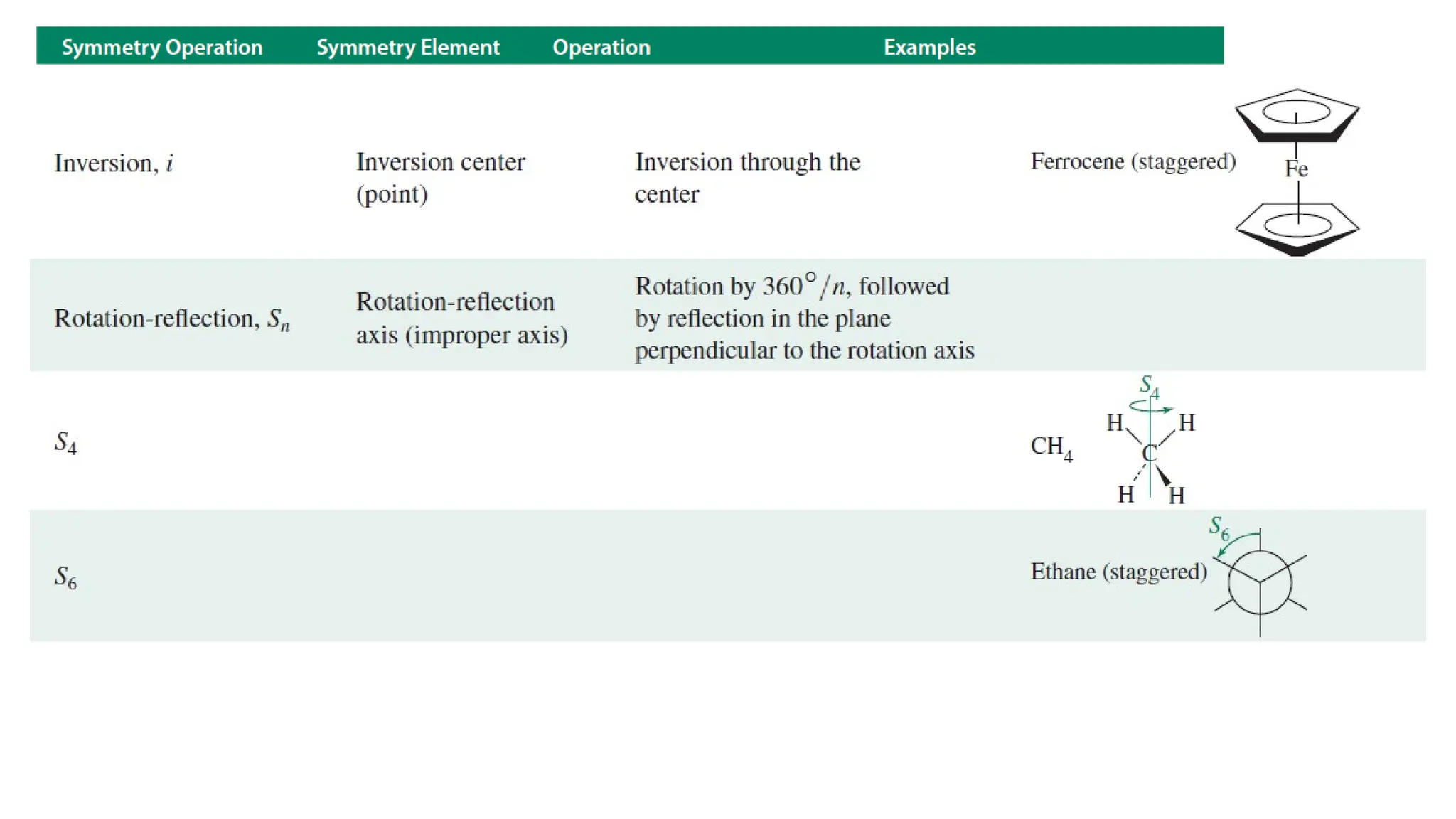
Improper Rotation
The improper S4 rotation of a tetrahedron.
Improper Rotation
Improper Rotation
Improper Rotation
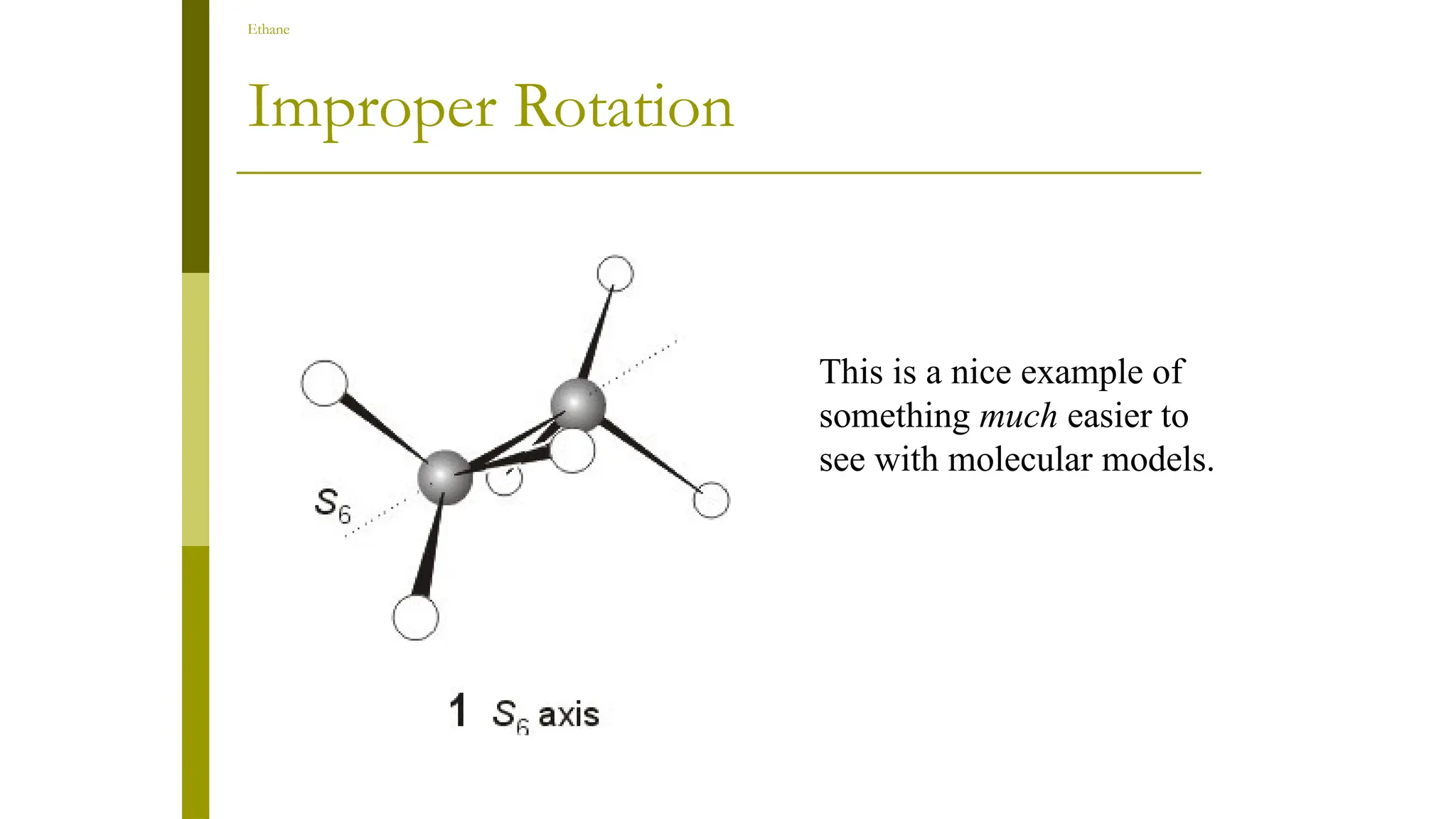
Ethane
This is a nice example of
something much easier to
see with molecular models.
Improper Rotation
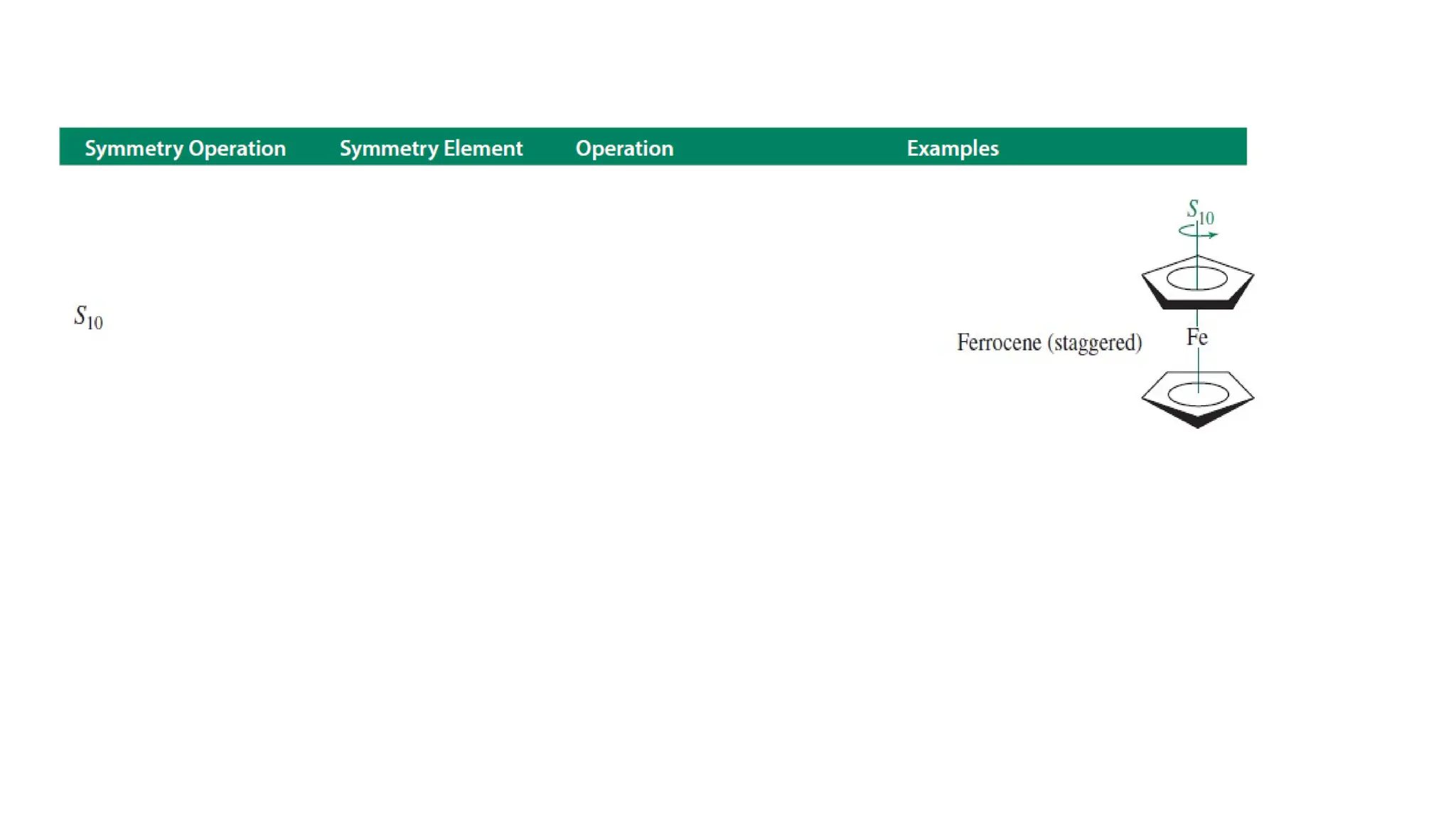
Summary Table of Symmetry Elements and
Operations
Point Groups
• symmetry operations that describes the molecule's overall symmetry.
• Group theory , the mathematical treatment of the properties of
groups, can be used to determine the molecular orbitals, vibrations,
and other molecular properties.
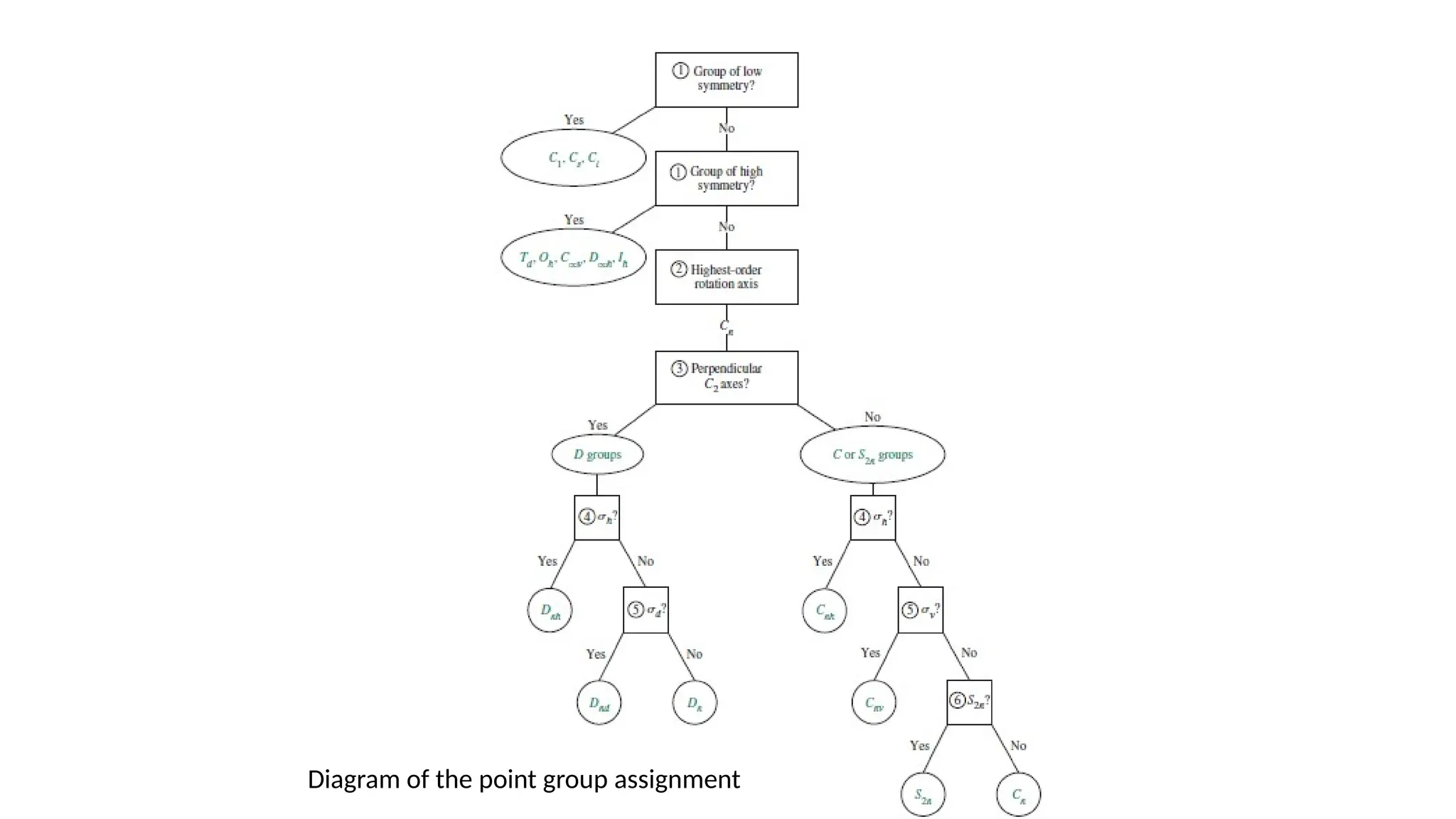
Diagram of the point group assignment
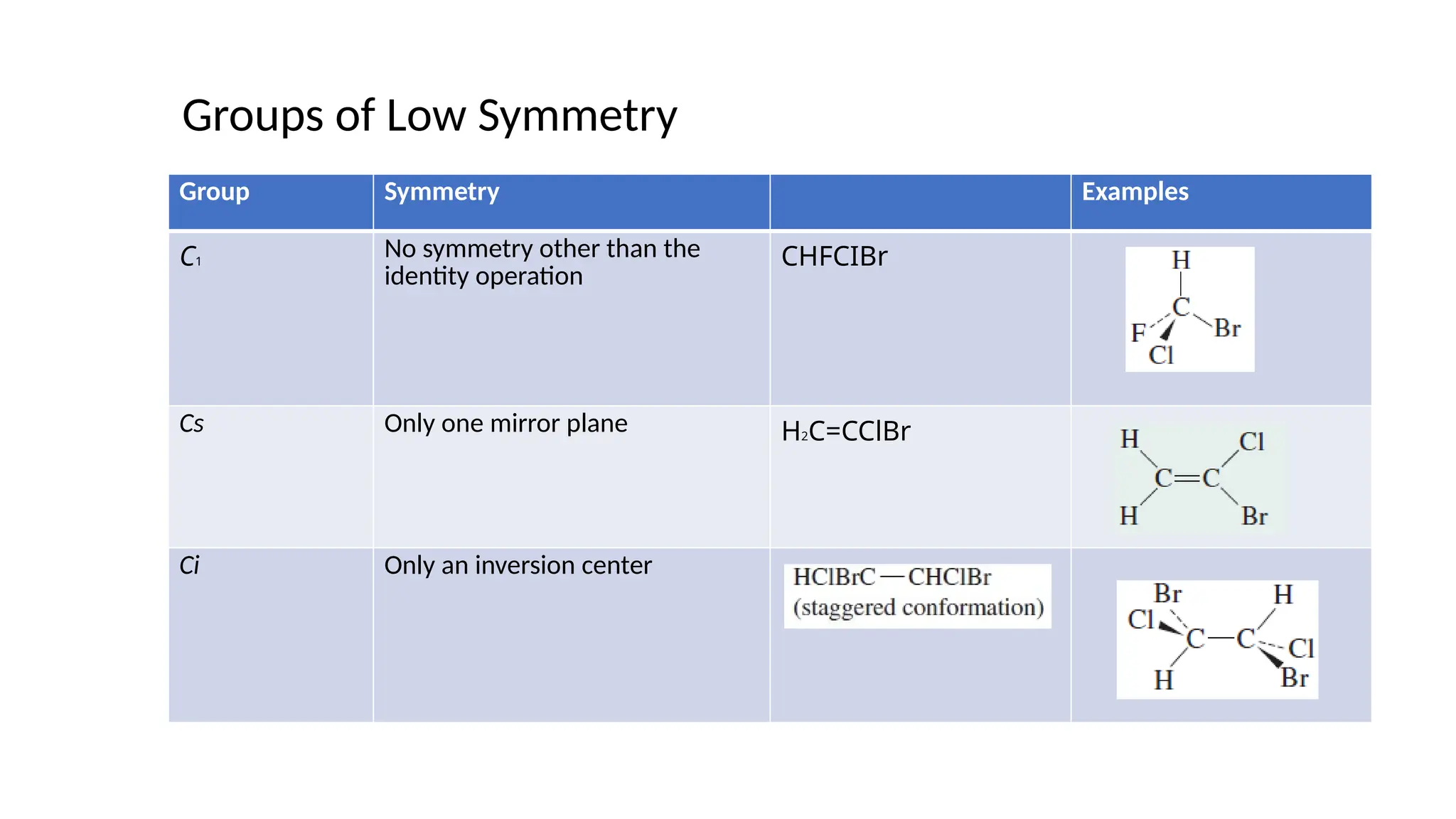
Groups of Low Symmetry
Group Symmetry Examples
C1
No symmetry other than the
identity operation
CHFCIBr
Cs Only one mirror plane H2C=CClBr
Ci Only an inversion center
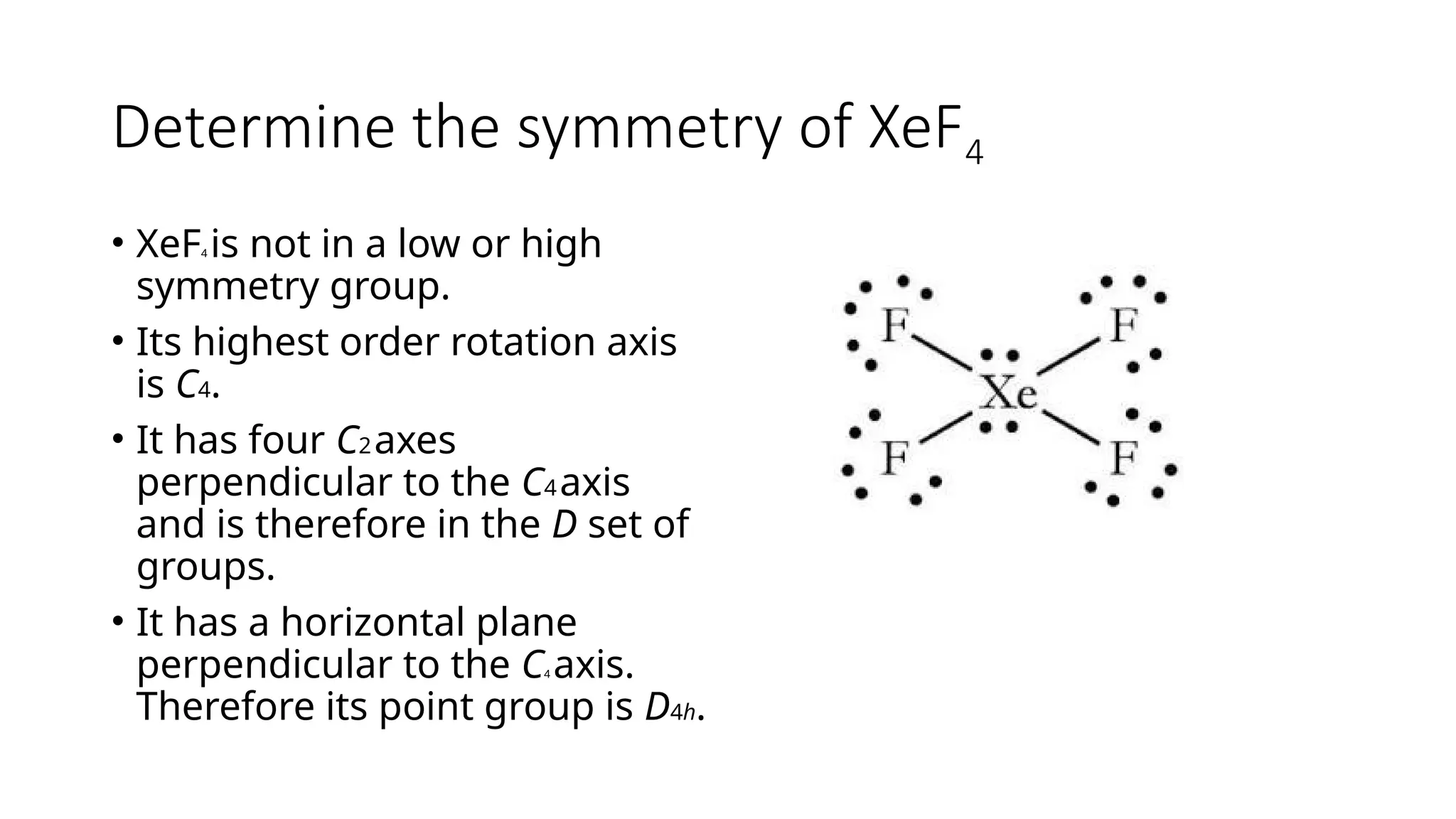
Determine the symmetry of XeF4
• XeF4 is not in a low or high
symmetry group.
• Its highest order rotation axis
is C4.
• It has four C2axes
perpendicular to the C4axis
and is therefore in the D set of
groups.
• It has a horizontal plane
perpendicular to the C4 axis.
Therefore its point group is D4h.
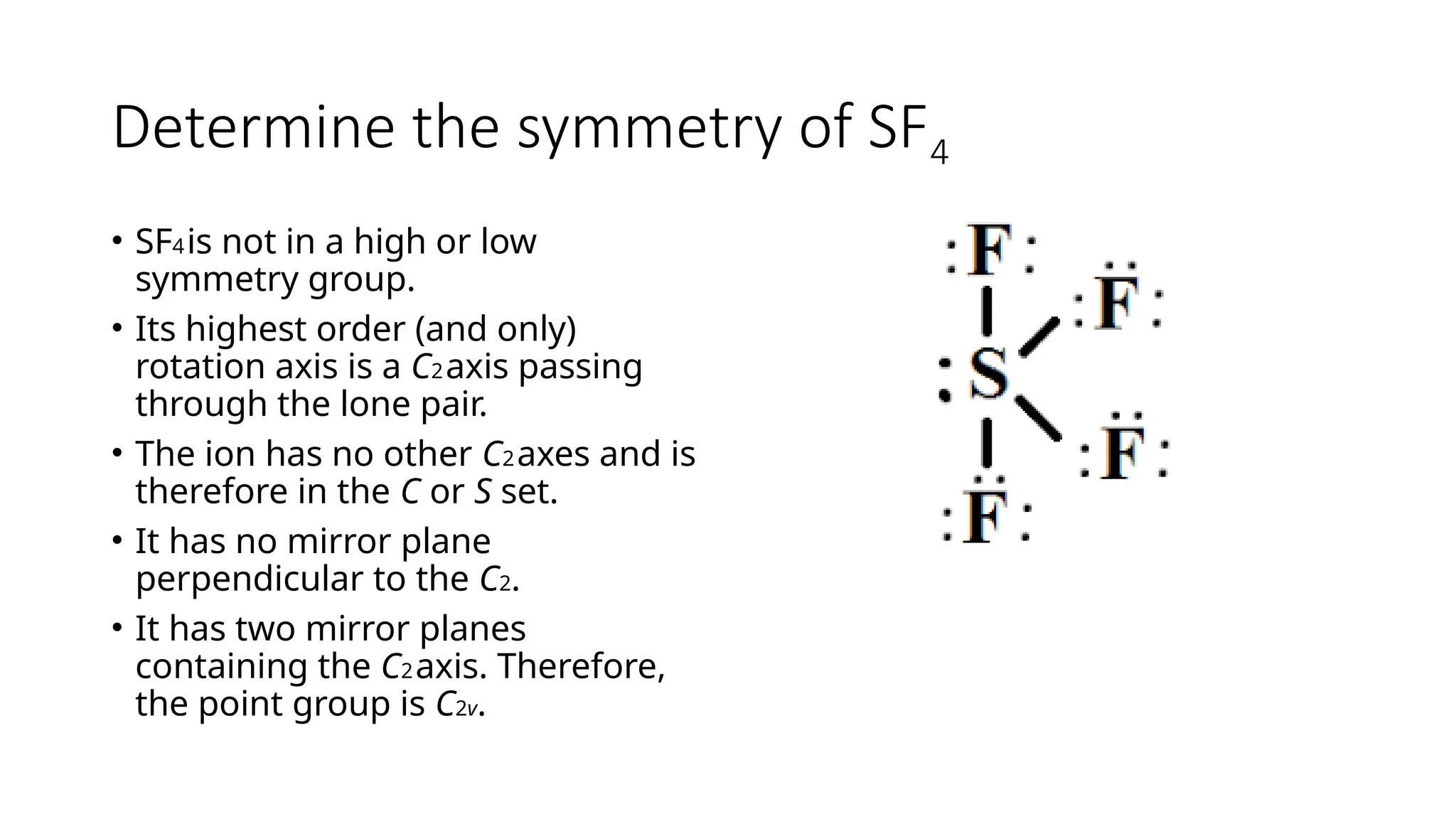
Determine the symmetry of SF4
• SF4is not in a high or low
symmetry group.
• Its highest order (and only)
rotation axis is a C2axis passing
through the lone pair.
• The ion has no other C2axes and is
therefore in the C or S set.
• It has no mirror plane
perpendicular to the C2.
• It has two mirror planes
containing the C2axis. Therefore,
the point group is C2v.
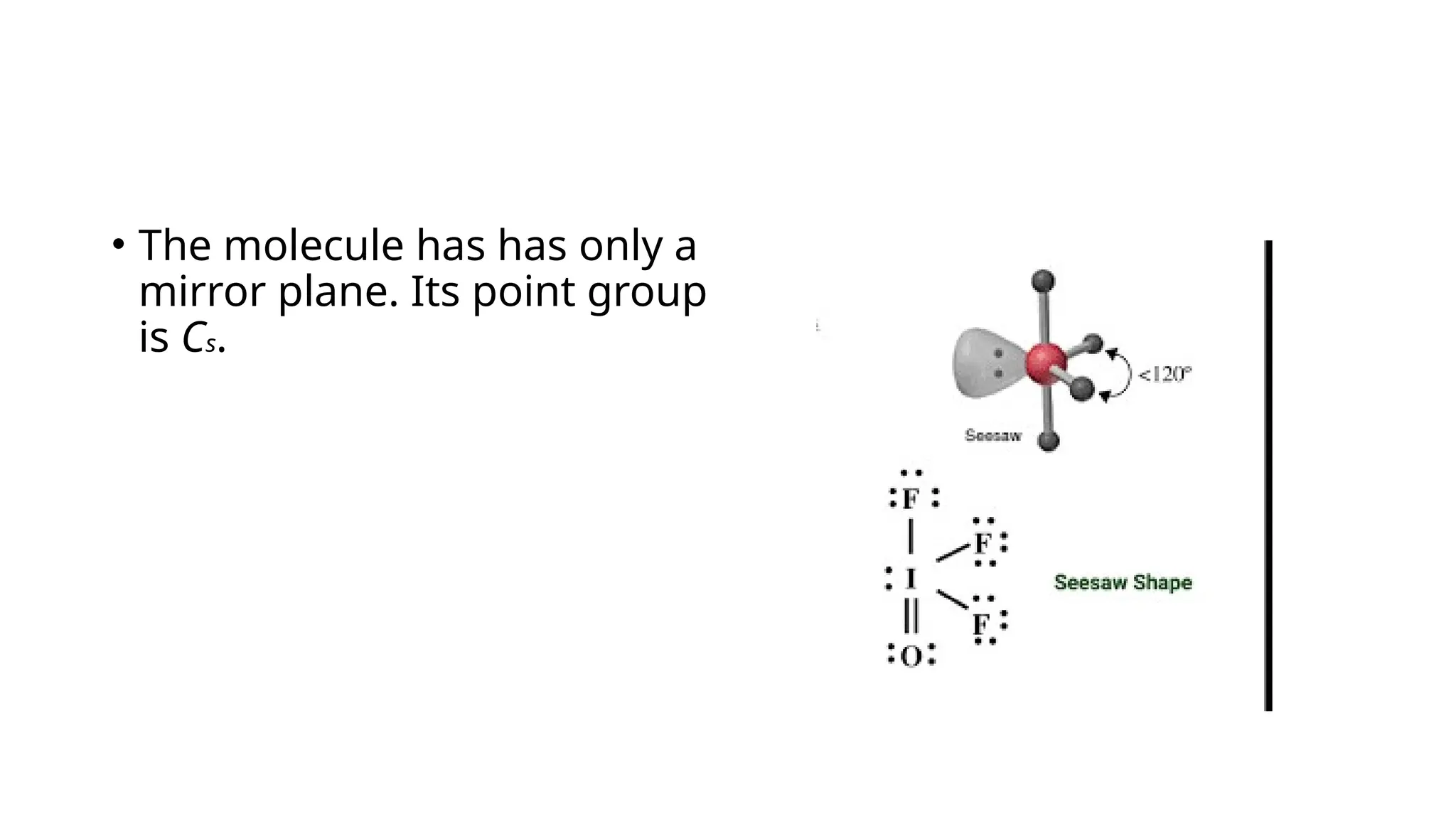
• The molecule has has only a
mirror plane. Its point group
is Cs.
3_Symmetry and Groupllllllllllllllllllllllllllllllll Theory.pptx

  • 1.
    Symmetry and GroupTheory Advanced Inorganic Chemistry
  • 2.
    Symmetry and Introductionto Group Theory Symmetry is all around us and is a fundamental property of nature.
  • 3.
    Symmetry and Introductionto Group Theory The term symmetry is derived from the Greek word “symmetria” which means “measured together”. An object is symmetric if one part (e.g. one side) of it is the same* as all of the other parts. You know intuitively if something is symmetric but we require a precise method to describe how an object or molecule is symmetric. Group theory is a very powerful mathematical tool that allows us to rationalize and simplify many problems in Chemistry. A group consists of a set of symmetry elements (and associated symmetry operations) that completely describe the symmetry of an object. We will use some aspects of group theory to help us understand the bonding and spectroscopic features of molecules.
  • 4.
    Point Groups Molecules areclassified and grouped based on their symmetry. Molecules with similar symmetry are but into the same point group. A point group contains all objects that have the same symmetry elements.
  • 5.
    Symmetry Elements Symmetry elementsare mirror planes, axis of rotation, centers of inversion, etc. A molecule has a given symmetry element if the operation leaves the molecule appearing as if nothing has changed (even though atoms and bonds may have been moved.)
  • 6.
    Symmetry Elements Element SymmetryOperation Symbol Identity E n-fold axis Rotation by 2π/nCn Mirror plane Reflection σ Center of in- Inversion i version n-fold axis of Rotation by 2π/n Sn improper rotationfollowed by reflection perpendicular to the axis of rotation
  • 7.
    Identity, E All moleculeshave Identity. This operation leaves the entire molecule unchanged. A highly asymmetric molecule such as a tetrahedral carbon with 4 different groups attached has only identity, and no other symmetry elements. The identity operation is the simplest of all -- do nothing! All objects (and therefore all molecules) at the very least have the identity element. There are many molecules that have no other symmetry
  • 8.
    n-fold Rotation/Proper Rotation •rotation through 360o /n about a rotation axis • Water has a 2-fold axis of rotation. When rotated by 180o , the hydrogen atoms trade places, but the molecule will look exactly the same.
  • 9.
    n-fold Axis ofRotation Ammonia has a C3 axis. Note that there are two operations associated with the C3 axis. Rotation by 120o in a clockwise or a counterclockwise direction provide two different orientations of the molecule.
  • 11.
    The C2 rotation andthe two mirror planes of water. Note these mirrors are called σv planes ... mirror planes that contain the highest rotation axis Reflection
  • 12.
    Water and Ammonia Thethree symmetry elements of water (C2 and two σv) The four symmetry elements of ammonia (C3 and three σv)
  • 13.
    Benzene C6 Benzene shows all threetypes of mirror planes. σh is the plane of the molecule. There are plenty of other elements of symmetry here like C3 and C2 rotations. C6 is the highest order rotation axis here, and is the most important. Reflection
  • 14.
  • 15.
  • 16.
    Though the appearanceafter the operation is the same, not how inversion and reflection of ethylene are a bit different. Inversion and Reflection
  • 17.
  • 18.
    The improper S4rotation of a tetrahedron. Improper Rotation
  • 19.
  • 20.
  • 21.
    Ethane This is anice example of something much easier to see with molecular models. Improper Rotation
  • 22.
    Summary Table ofSymmetry Elements and Operations
  • 26.
    Point Groups • symmetryoperations that describes the molecule's overall symmetry. • Group theory , the mathematical treatment of the properties of groups, can be used to determine the molecular orbitals, vibrations, and other molecular properties.
  • 27.
    Diagram of thepoint group assignment
  • 28.
    Groups of LowSymmetry Group Symmetry Examples C1 No symmetry other than the identity operation CHFCIBr Cs Only one mirror plane H2C=CClBr Ci Only an inversion center
  • 31.
    Determine the symmetryof XeF4 • XeF4 is not in a low or high symmetry group. • Its highest order rotation axis is C4. • It has four C2axes perpendicular to the C4axis and is therefore in the D set of groups. • It has a horizontal plane perpendicular to the C4 axis. Therefore its point group is D4h.
  • 32.
    Determine the symmetryof SF4 • SF4is not in a high or low symmetry group. • Its highest order (and only) rotation axis is a C2axis passing through the lone pair. • The ion has no other C2axes and is therefore in the C or S set. • It has no mirror plane perpendicular to the C2. • It has two mirror planes containing the C2axis. Therefore, the point group is C2v.
  • 33.
    • The moleculehas has only a mirror plane. Its point group is Cs.