HISTORY
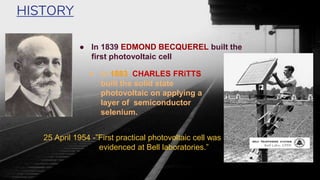
● In 1839 EDMOND BECQUEREL built the
first photovoltaic cell
● In 1883 CHARLES FRiTTS
built the solid state
photovoltaic on applying a
layer of semiconductor
selenium.
25 April 1954 -”First practical photovoltaic cell was
evidenced at Bell laboratories.”
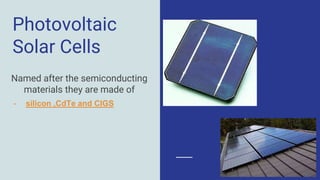
Photovoltaic
Solar Cells
Named after the semiconducting
materials they are made of
- silicon ,CdTe and CIGS
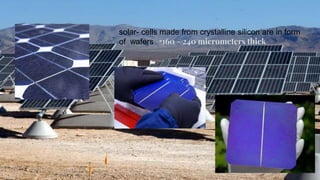
solar- cells made from crystalline silicon are in form
of wafers *160 - 240 micrometers thick
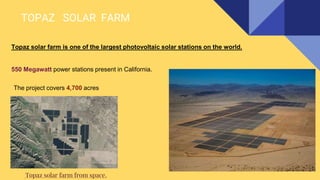
TOPAZ SOLAR FARM
Topaz solar farm is one of the largest photovoltaic solar stations on the world.
550 Megawatt power stations present in California.
Topaz solar farm from space.
The project covers 4,700 acres
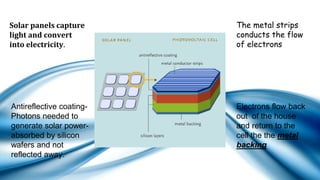
Solar panels capture
light and convert
into electricity.
The metal strips
conducts the flow
of electrons
Electrons flow back
out of the house
and return to the
cell the the metal
backing
Antireflective coating-
Photons needed to
generate solar power-
absorbed by silicon
wafers and not
reflected away.
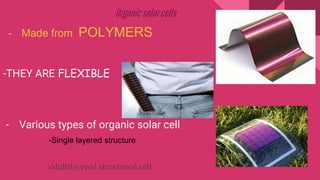
-THEY ARE FLEXIBLE
- Various types of organic solar cell
- Made from POLYMERS
-Single layered structure
-Multilayered structured cell
Organicsolarcells
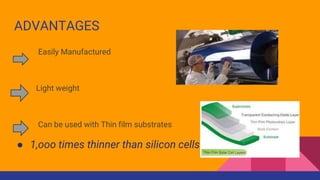
ADVANTAGES
Easily Manufactured
Light weight
Can be used with Thin film substrates
● 1,ooo times thinner than silicon cells
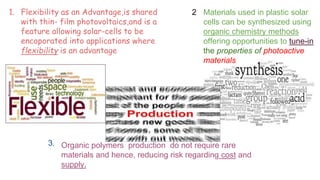
1. Flexibility as an Advantage,is shared
with thin- film photovoltaics,and is a
feature allowing solar-cells to be
encoporated into applications where
flexibility is an advantage
Materials used in plastic solar
cells can be synthesized using
organic chemistry methods
offering opportunities to tune-in
the properties of photoactive
materials
2
Organic polymers production do not require rare
materials and hence, reducing risk regarding cost and
supply.
3.
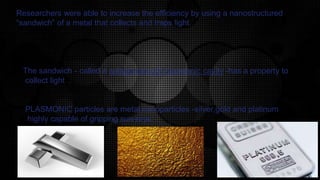
Researchers were able to increase the efficiency by using a nanostructured
“sandwich” of a metal that collects and traps light.
The sandwich - called a subwavelength plasmonic cavity -has a property to
collect light .
PLASMONIC particles are metal nanoparticles -silver,gold and platinum
highly capable of gripping sun-rays.
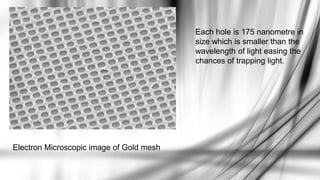
Electron Microscopic image of Gold mesh
Each hole is 175 nanometre in
size which is smaller than the
wavelength of light easing the
chances of trapping light.
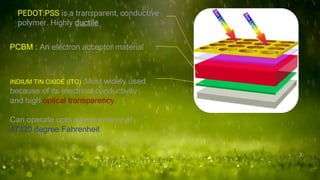
PEDOT:PSS is a transparent, conductive
polymer. Highly ductile
PCBM : An electron acceptor material
INDIUM TIN OXIDE (ITO) :Most widely used
because of its electrical conductivity
and high optical transparency.
Can operate upto a temperature of
47320 degree Fahrenheit
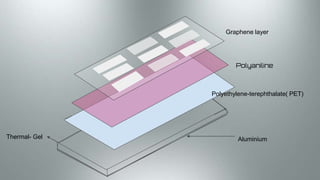
Aluminium
Polyethylene-terephthalate( PET)
Polyaniline
Thermal- Gel
Graphene layer
Organic / Polymer solar cells

Organic / Polymer solar cells

  • 2.
    HISTORY ● In 1839EDMOND BECQUEREL built the first photovoltaic cell ● In 1883 CHARLES FRiTTS built the solid state photovoltaic on applying a layer of semiconductor selenium. 25 April 1954 -”First practical photovoltaic cell was evidenced at Bell laboratories.”
  • 3.
    Photovoltaic Solar Cells Named afterthe semiconducting materials they are made of - silicon ,CdTe and CIGS
  • 4.
    solar- cells madefrom crystalline silicon are in form of wafers *160 - 240 micrometers thick
  • 5.
    TOPAZ SOLAR FARM Topazsolar farm is one of the largest photovoltaic solar stations on the world. 550 Megawatt power stations present in California. Topaz solar farm from space. The project covers 4,700 acres
  • 6.
    Solar panels capture lightand convert into electricity. The metal strips conducts the flow of electrons Electrons flow back out of the house and return to the cell the the metal backing Antireflective coating- Photons needed to generate solar power- absorbed by silicon wafers and not reflected away.
  • 7.
    -THEY ARE FLEXIBLE -Various types of organic solar cell - Made from POLYMERS -Single layered structure -Multilayered structured cell Organicsolarcells
  • 8.
    ADVANTAGES Easily Manufactured Light weight Canbe used with Thin film substrates ● 1,ooo times thinner than silicon cells
  • 10.
    1. Flexibility asan Advantage,is shared with thin- film photovoltaics,and is a feature allowing solar-cells to be encoporated into applications where flexibility is an advantage Materials used in plastic solar cells can be synthesized using organic chemistry methods offering opportunities to tune-in the properties of photoactive materials 2 Organic polymers production do not require rare materials and hence, reducing risk regarding cost and supply. 3.
  • 11.
    Researchers were ableto increase the efficiency by using a nanostructured “sandwich” of a metal that collects and traps light. The sandwich - called a subwavelength plasmonic cavity -has a property to collect light . PLASMONIC particles are metal nanoparticles -silver,gold and platinum highly capable of gripping sun-rays.
  • 13.
    Electron Microscopic imageof Gold mesh Each hole is 175 nanometre in size which is smaller than the wavelength of light easing the chances of trapping light.
  • 14.
    PEDOT:PSS is atransparent, conductive polymer. Highly ductile PCBM : An electron acceptor material INDIUM TIN OXIDE (ITO) :Most widely used because of its electrical conductivity and high optical transparency. Can operate upto a temperature of 47320 degree Fahrenheit
  • 15.