Download free for 30 days
Sign in
Upload
Language (EN)
Support
Business
Mobile
Social Media
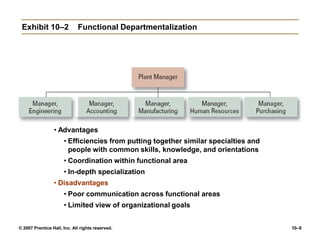
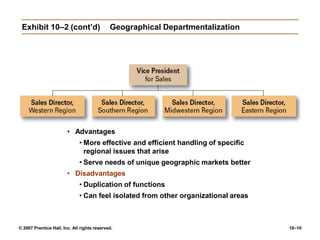
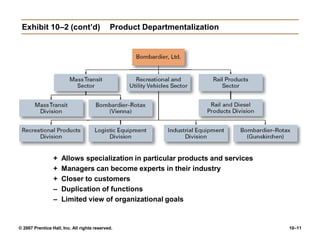
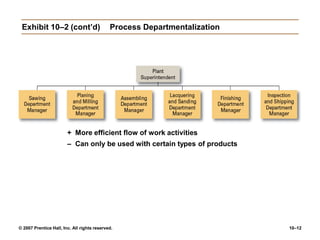
Marketing
Technology
Art & Photos
Career
Design
Education
Presentations & Public Speaking
Government & Nonprofit
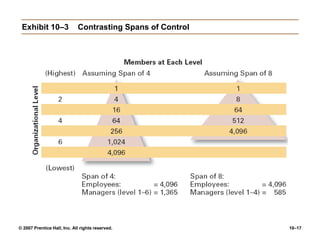
Healthcare
Internet
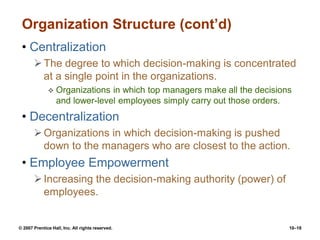
Law
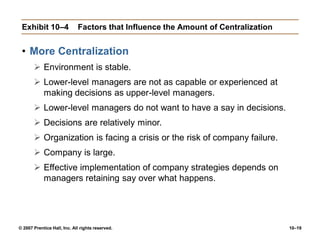
Leadership & Management
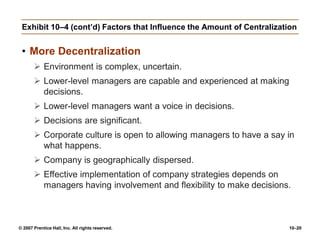
Automotive
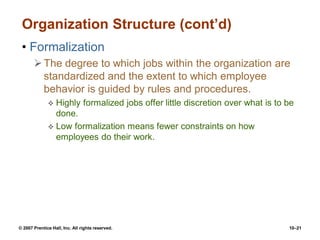
Engineering
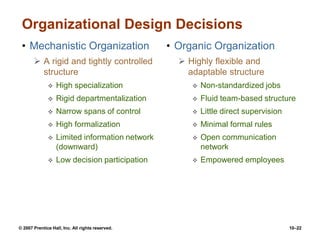
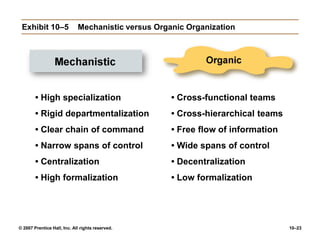
Software
Recruiting & HR
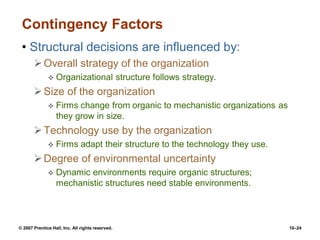
Retail
Sales
Services
Science
Small Business & Entrepreneurship
Food
Environment
Economy & Finance
Data & Analytics
Investor Relations
Sports
Spiritual
News & Politics
Travel
Self Improvement
Real Estate
Entertainment & Humor
Health & Medicine
Devices & Hardware
Lifestyle
Change Language
Language
English
Español
Português
Français
Deutsche
Cancel
Save
EN
Uploaded by
TikaRahmaYaniSiregar
77 views
Ppt introduction to management robbins mary
Ppt
Business
◦
Read more
0
Save
Share
Embed
Embed presentation
Download
Download to read offline
1
/ 41
2
/ 41
3
/ 41
4
/ 41
5
/ 41
6
/ 41
7
/ 41
8
/ 41
9
/ 41
10
/ 41
11
/ 41
12
/ 41
13
/ 41
14
/ 41
15
/ 41
16
/ 41
17
/ 41
18
/ 41
19
/ 41
20
/ 41
21
/ 41
22
/ 41
23
/ 41
24
/ 41
25
/ 41
26
/ 41
27
/ 41
28
/ 41
29
/ 41
30
/ 41
31
/ 41
32
/ 41
33
/ 41
34
/ 41
35
/ 41
36
/ 41
37
/ 41
38
/ 41
39
/ 41
40
/ 41
41
/ 41
More Related Content
PPT
Chapter10organizationalstructureanddesignppt10 100223215434-phpapp01
by
mmmikenike
PPT
Struktur Organisasi Organisasi Manajemen Industri.ppt
by
anandadwip1
PPT
Structure and Design.ppt
by
JiaJunWang17
PPT
Organizational Structure and Design
by
Abdul Wahab Raza
PPT
Chapter10organizationalstructureanddesignppt10 100223215434-phpapp01
by
mmmikenike
PPT
Struktur Organisasi Organisasi Manajemen Industri.ppt
by
anandadwip1
PPT
Structure and Design.ppt
by
JiaJunWang17
PPT
Organizational Structure and Design
by
Abdul Wahab Raza
Chapter10organizationalstructureanddesignppt10 100223215434-phpapp01
by
mmmikenike
Struktur Organisasi Organisasi Manajemen Industri.ppt
by
anandadwip1
Structure and Design.ppt
by
JiaJunWang17
Organizational Structure and Design
by
Abdul Wahab Raza
Chapter10organizationalstructureanddesignppt10 100223215434-phpapp01
by
mmmikenike
Struktur Organisasi Organisasi Manajemen Industri.ppt
by
anandadwip1
Structure and Design.ppt
by
JiaJunWang17
Organizational Structure and Design
by
Abdul Wahab Raza
Similar to Ppt introduction to management robbins mary
PPT
Pengamen_materi_10.ppt Pengantar Manajemen
by
ulfaazizah15
PPT
Pengamen_materi_10.ppt Pengantar Manajemen
by
ulfaazizah15
PPT
Chap10organizationalstructuredesign managementbyrobbinscoulter9e-130131125934...
by
Ambreen Zaineb
PPT
Chap10organizationalstructuredesign managementbyrobbinscoulter9e-130131125934...
by
Ambreen Zaineb
PPT
Organisational structure
by
pareshpanshikar
PPT
Chap10organizationalstructuredesign managementbyrobbinscoulter9e-130131125934...
by
Ambreen Zaineb
PPT
Chap10organizationalstructuredesign managementbyrobbinscoulter9e-130131125934...
by
Ambreen Zaineb
PPT
Organisational structure
by
pareshpanshikar
PPT
Organisational structure and design in management sciences
by
KamranNazakat1
PPT
Organisational structure and design in management sciences
by
KamranNazakat1
PPT
Management ch10 (2)
by
Fida Karim 🇵🇰
PPT
Management ch10 (2)
by
Fida Karim 🇵🇰
PPT
Robbins9 ppt10
by
Raviraj Prasad Kushwaha
PPT
Robbins9 ppt10
by
Raviraj Prasad Kushwaha
PPT
Organizational Structure and designe
by
Aashray For Everyone
PPT
Management ch10
by
julianmillar
PPT
Organizational Structure and designe
by
Aashray For Everyone
PPT
Management ch10
by
julianmillar
PPT
Organizational Structure and Design
by
RAKIBULISLAMPRANTO1
PPT
Organizational Structure and Design
by
RAKIBULISLAMPRANTO1
Pengamen_materi_10.ppt Pengantar Manajemen
by
ulfaazizah15
Pengamen_materi_10.ppt Pengantar Manajemen
by
ulfaazizah15
Chap10organizationalstructuredesign managementbyrobbinscoulter9e-130131125934...
by
Ambreen Zaineb
Chap10organizationalstructuredesign managementbyrobbinscoulter9e-130131125934...
by
Ambreen Zaineb
Organisational structure
by
pareshpanshikar
Chap10organizationalstructuredesign managementbyrobbinscoulter9e-130131125934...
by
Ambreen Zaineb
Chap10organizationalstructuredesign managementbyrobbinscoulter9e-130131125934...
by
Ambreen Zaineb
Organisational structure
by
pareshpanshikar
Organisational structure and design in management sciences
by
KamranNazakat1
Organisational structure and design in management sciences
by
KamranNazakat1
Management ch10 (2)
by
Fida Karim 🇵🇰
Management ch10 (2)
by
Fida Karim 🇵🇰
Robbins9 ppt10
by
Raviraj Prasad Kushwaha
Robbins9 ppt10
by
Raviraj Prasad Kushwaha
Organizational Structure and designe
by
Aashray For Everyone
Management ch10
by
julianmillar
Organizational Structure and designe
by
Aashray For Everyone
Management ch10
by
julianmillar
Organizational Structure and Design
by
RAKIBULISLAMPRANTO1
Organizational Structure and Design
by
RAKIBULISLAMPRANTO1
Recently uploaded
PDF
Top Five Trends Shaping RCM in 2026 - Revenue Cycle Resources-HUB
by
Revenue Cycle Resources-HUB
DOCX
Buy Old Gmail Accounts_ Top Benefits and Legal Considerations.docx
by
pvasmmpath
PDF
rf_mccaffrey_stocksforthelongrun_revisited_online.v2 (1).pdf
by
Henry Tapper
PDF
ICv2 White Paper - Navigating the New World of Comics
by
DennisViau
PDF
Ultra Map Section II Multifaceted Second Edition.pdf
by
Brij Consulting, LLC
DOCX
What Are Telegram Accounts and Why Are They Important for Global Communicatio...
by
x24gm4qs23vusc8s2b53
PDF
AnyDesk, The Leading Remote Desktop Software | AnyDesk, o software líder em a...
by
TechMeetups
PDF
Rami Tawasha - Specializes In High-Impact Work
by
Rami Tawasha
DOCX
8 Best Places to Buy Facebook Accounts at Wholesale Prices.docx
by
Facebook Accounts
PDF
𝐋𝐚𝐮𝐧𝐜𝐡 𝐘𝐨𝐮𝐫 𝐎𝐰𝐧 𝐀𝐥𝐥 𝐢𝐧 𝐎𝐧𝐞 𝐃𝐞𝐥𝐢𝐯𝐞𝐫𝐲 𝐀𝐩𝐩 𝐏𝐥𝐚𝐭𝐟𝐨𝐫𝐦 𝐋𝐢𝐤𝐞 𝐆𝐥𝐨𝐯𝐨
by
V3CUBE TECHNOLABS
PDF
How To B,u,y Verified Cash App Accounts – Understanding Safe Usage, BTC Featu...
by
apasanilion108
PDF
John Michael Philbin - An Avid Hiking Enthusiast
by
John Michael Philbin
PPTX
5, Money Number Tax and Wages 19072017.pptx
by
Adrian Hawkes
PDF
Guide to Safely Buying Gmail Accounts for Safely-Aged.pdf
by
smartusapva.com
PDF
How to Buy Old Gmail Accounts in Bulk Safely in the USA.pdf
by
pvaisback is Online Marketing site
PDF
Iryna Rudenko: Follow the Money: How Investment Trends Define IT Niches (UA)
by
Lviv Startup Club
PDF
Safe Ways to Purchase Gmail Accounts (PVA & Aged) for Your Team.pdf
by
pvaisback
PDF
How Oversize Embroidery Design Size Is Measured
by
Inkdnylon
DOCX
Buy Verified Cash App Accounts In The Us
by
sebastianparsonst8
DOCX
Best Place to Learn Old or Aged Verified Square Accounts in WWW.docx
by
TopSelleriT
Top Five Trends Shaping RCM in 2026 - Revenue Cycle Resources-HUB
by
Revenue Cycle Resources-HUB
Buy Old Gmail Accounts_ Top Benefits and Legal Considerations.docx
by
pvasmmpath
rf_mccaffrey_stocksforthelongrun_revisited_online.v2 (1).pdf
by
Henry Tapper
ICv2 White Paper - Navigating the New World of Comics
by
DennisViau
Ultra Map Section II Multifaceted Second Edition.pdf
by
Brij Consulting, LLC
What Are Telegram Accounts and Why Are They Important for Global Communicatio...
by
x24gm4qs23vusc8s2b53
AnyDesk, The Leading Remote Desktop Software | AnyDesk, o software líder em a...
by
TechMeetups
Rami Tawasha - Specializes In High-Impact Work
by
Rami Tawasha
8 Best Places to Buy Facebook Accounts at Wholesale Prices.docx
by
Facebook Accounts
𝐋𝐚𝐮𝐧𝐜𝐡 𝐘𝐨𝐮𝐫 𝐎𝐰𝐧 𝐀𝐥𝐥 𝐢𝐧 𝐎𝐧𝐞 𝐃𝐞𝐥𝐢𝐯𝐞𝐫𝐲 𝐀𝐩𝐩 𝐏𝐥𝐚𝐭𝐟𝐨𝐫𝐦 𝐋𝐢𝐤𝐞 𝐆𝐥𝐨𝐯𝐨
by
V3CUBE TECHNOLABS
How To B,u,y Verified Cash App Accounts – Understanding Safe Usage, BTC Featu...
by
apasanilion108
John Michael Philbin - An Avid Hiking Enthusiast
by
John Michael Philbin
5, Money Number Tax and Wages 19072017.pptx
by
Adrian Hawkes
Guide to Safely Buying Gmail Accounts for Safely-Aged.pdf
by
smartusapva.com
How to Buy Old Gmail Accounts in Bulk Safely in the USA.pdf
by
pvaisback is Online Marketing site
Iryna Rudenko: Follow the Money: How Investment Trends Define IT Niches (UA)
by
Lviv Startup Club
Safe Ways to Purchase Gmail Accounts (PVA & Aged) for Your Team.pdf
by
pvaisback
How Oversize Embroidery Design Size Is Measured
by
Inkdnylon
Buy Verified Cash App Accounts In The Us
by
sebastianparsonst8
Best Place to Learn Old or Aged Verified Square Accounts in WWW.docx
by
TopSelleriT
Ppt introduction to management robbins mary
1.
ninth edition ninth edition STEPHEN
P. ROBBINS STEPHEN P. ROBBINS PowerPoint Presentation by Charlie Cook The University of West Alabama MARY COULTER MARY COULTER © 2007 Prentice Hall, Inc. All rights reserved. Organizational Structure and Design Chapter 10
2.
© 2007 Prentice
Hall, Inc. All rights reserved. 10–2 L E A R N I N G O U T L I N E Follow this Learning Outline as you read and study this chapter. Defining Organizational Structure • Discuss the traditional and contemporary views of work specialization, chain of command, and span of control. • Describe each of the five forms of departmentalization. • Explain cross-functional teams. • Differentiate, authority, responsibility, and unity of command. • Tell what factors influence the amount of centralization and decentralization. • Explain how formalization is used in organizational design.
3.
© 2007 Prentice
Hall, Inc. All rights reserved. 10–3 L E A R N I N G O U T L I N E (cont’d) Follow this Learning Outline as you read and study this chapter. Organizational Design Decisions • Contrast mechanistic and organic organizations. • Explain the relationship between strategy and structure. • Tell how organizational size affects organizational design. • Discuss Woodward’s findings on the relationship of technology and structure. • Explain how environmental uncertainty affects organizational design.
4.
© 2007 Prentice
Hall, Inc. All rights reserved. 10–4 L E A R N I N G O U T L I N E (cont’d) Follow this Learning Outline as you read and study this chapter. Common Organizational Designs • Contrast the three traditional organizational designs. • Explain team, matrix, and project structures. • Describe the design of virtual and network organizations. • Discuss the organizational design challenges facing managers today.
5.
© 2007 Prentice
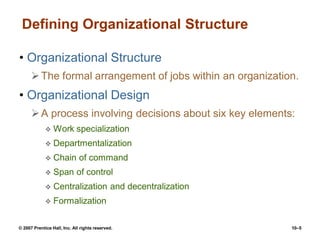
Hall, Inc. All rights reserved. 10–5 Defining Organizational Structure • Organizational Structure The formal arrangement of jobs within an organization. • Organizational Design A process involving decisions about six key elements: Work specialization Departmentalization Chain of command Span of control Centralization and decentralization Formalization
6.
© 2007 Prentice
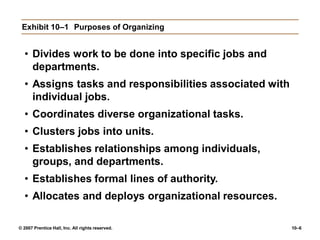
Hall, Inc. All rights reserved. 10–6 Exhibit 10–1 Purposes of Organizing • Divides work to be done into specific jobs and departments. • Assigns tasks and responsibilities associated with individual jobs. • Coordinates diverse organizational tasks. • Clusters jobs into units. • Establishes relationships among individuals, groups, and departments. • Establishes formal lines of authority. • Allocates and deploys organizational resources.
7.
© 2007 Prentice
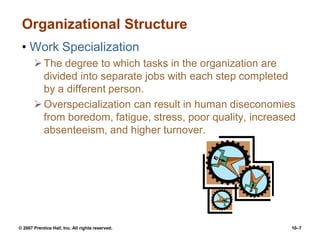
Hall, Inc. All rights reserved. 10–7 Organizational Structure • Work Specialization The degree to which tasks in the organization are divided into separate jobs with each step completed by a different person. Overspecialization can result in human diseconomies from boredom, fatigue, stress, poor quality, increased absenteeism, and higher turnover.
8.
© 2007 Prentice
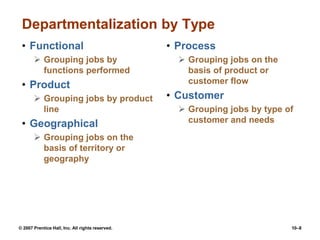
Hall, Inc. All rights reserved. 10–8 Departmentalization by Type • Functional Grouping jobs by functions performed • Product Grouping jobs by product line • Geographical Grouping jobs on the basis of territory or geography • Process Grouping jobs on the basis of product or customer flow • Customer Grouping jobs by type of customer and needs
9.
© 2007 Prentice
Hall, Inc. All rights reserved. 10–9 Exhibit 10–2 Functional Departmentalization • Advantages • Efficiencies from putting together similar specialties and people with common skills, knowledge, and orientations • Coordination within functional area • In-depth specialization • Disadvantages • Poor communication across functional areas • Limited view of organizational goals
10.
© 2007 Prentice
Hall, Inc. All rights reserved. 10–10 Exhibit 10–2 (cont’d) Geographical Departmentalization • Advantages • More effective and efficient handling of specific regional issues that arise • Serve needs of unique geographic markets better • Disadvantages • Duplication of functions • Can feel isolated from other organizational areas
11.
© 2007 Prentice
Hall, Inc. All rights reserved. 10–11 Exhibit 10–2 (cont’d) Product Departmentalization + Allows specialization in particular products and services + Managers can become experts in their industry + Closer to customers – Duplication of functions – Limited view of organizational goals
12.
© 2007 Prentice
Hall, Inc. All rights reserved. 10–12 Exhibit 10–2 (cont’d) Process Departmentalization + More efficient flow of work activities – Can only be used with certain types of products
13.
© 2007 Prentice
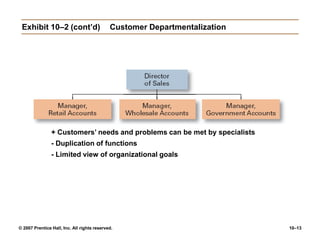
Hall, Inc. All rights reserved. 10–13 Exhibit 10–2 (cont’d) Customer Departmentalization + Customers’ needs and problems can be met by specialists - Duplication of functions - Limited view of organizational goals
14.
© 2007 Prentice
Hall, Inc. All rights reserved. 10–14 Organization Structure (cont’d) • Chain of Command The continuous line of authority that extends from upper levels of an organization to the lowest levels of the organization and clarifies who reports to who.
15.
© 2007 Prentice
Hall, Inc. All rights reserved. 10–15 Organization Structure (cont’d) • Authority The rights inherent in a managerial position to tell people what to do and to expect them to do it. • Responsibility The obligation or expectation to perform. • Unity of Command The concept that a person should have one boss and should report only to that person.
16.
© 2007 Prentice
Hall, Inc. All rights reserved. 10–16 Organization Structure (cont’d) • Span of Control The number of employees who can be effectively and efficiently supervised by a manager. Width of span is affected by: Skills and abilities of the manager Employee characteristics Characteristics of the work being done Similarity of tasks Complexity of tasks Physical proximity of subordinates Standardization of tasks
17.
© 2007 Prentice
Hall, Inc. All rights reserved. 10–17 Exhibit 10–3 Contrasting Spans of Control
18.
© 2007 Prentice
Hall, Inc. All rights reserved. 10–18 Organization Structure (cont’d) • Centralization The degree to which decision-making is concentrated at a single point in the organizations. Organizations in which top managers make all the decisions and lower-level employees simply carry out those orders. • Decentralization Organizations in which decision-making is pushed down to the managers who are closest to the action. • Employee Empowerment Increasing the decision-making authority (power) of employees.
19.
© 2007 Prentice
Hall, Inc. All rights reserved. 10–19 Exhibit 10–4 Factors that Influence the Amount of Centralization • More Centralization Environment is stable. Lower-level managers are not as capable or experienced at making decisions as upper-level managers. Lower-level managers do not want to have a say in decisions. Decisions are relatively minor. Organization is facing a crisis or the risk of company failure. Company is large. Effective implementation of company strategies depends on managers retaining say over what happens.
20.
© 2007 Prentice
Hall, Inc. All rights reserved. 10–20 Exhibit 10–4 (cont’d) Factors that Influence the Amount of Centralization • More Decentralization Environment is complex, uncertain. Lower-level managers are capable and experienced at making decisions. Lower-level managers want a voice in decisions. Decisions are significant. Corporate culture is open to allowing managers to have a say in what happens. Company is geographically dispersed. Effective implementation of company strategies depends on managers having involvement and flexibility to make decisions.
21.
© 2007 Prentice
Hall, Inc. All rights reserved. 10–21 Organization Structure (cont’d) • Formalization The degree to which jobs within the organization are standardized and the extent to which employee behavior is guided by rules and procedures. Highly formalized jobs offer little discretion over what is to be done. Low formalization means fewer constraints on how employees do their work.
22.
© 2007 Prentice
Hall, Inc. All rights reserved. 10–22 Organizational Design Decisions • Mechanistic Organization A rigid and tightly controlled structure High specialization Rigid departmentalization Narrow spans of control High formalization Limited information network (downward) Low decision participation • Organic Organization Highly flexible and adaptable structure Non-standardized jobs Fluid team-based structure Little direct supervision Minimal formal rules Open communication network Empowered employees
23.
© 2007 Prentice
Hall, Inc. All rights reserved. 10–23 Exhibit 10–5 Mechanistic versus Organic Organization • High specialization • Rigid departmentalization • Clear chain of command • Narrow spans of control • Centralization • High formalization • Cross-functional teams • Cross-hierarchical teams • Free flow of information • Wide spans of control • Decentralization • Low formalization
24.
© 2007 Prentice
Hall, Inc. All rights reserved. 10–24 Contingency Factors • Structural decisions are influenced by: Overall strategy of the organization Organizational structure follows strategy. Size of the organization Firms change from organic to mechanistic organizations as they grow in size. Technology use by the organization Firms adapt their structure to the technology they use. Degree of environmental uncertainty Dynamic environments require organic structures; mechanistic structures need stable environments.
25.
© 2007 Prentice
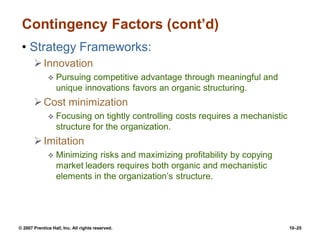
Hall, Inc. All rights reserved. 10–25 Contingency Factors (cont’d) • Strategy Frameworks: Innovation Pursuing competitive advantage through meaningful and unique innovations favors an organic structuring. Cost minimization Focusing on tightly controlling costs requires a mechanistic structure for the organization. Imitation Minimizing risks and maximizing profitability by copying market leaders requires both organic and mechanistic elements in the organization’s structure.
26.
© 2007 Prentice
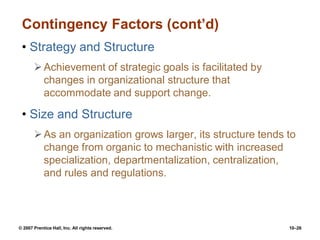
Hall, Inc. All rights reserved. 10–26 Contingency Factors (cont’d) • Strategy and Structure Achievement of strategic goals is facilitated by changes in organizational structure that accommodate and support change. • Size and Structure As an organization grows larger, its structure tends to change from organic to mechanistic with increased specialization, departmentalization, centralization, and rules and regulations.
27.
© 2007 Prentice
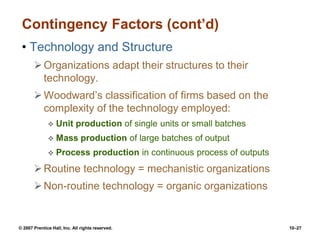
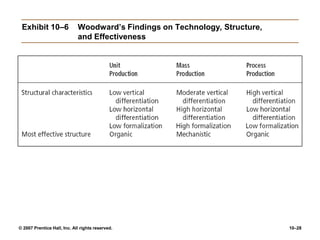
Hall, Inc. All rights reserved. 10–27 Contingency Factors (cont’d) • Technology and Structure Organizations adapt their structures to their technology. Woodward’s classification of firms based on the complexity of the technology employed: Unit production of single units or small batches Mass production of large batches of output Process production in continuous process of outputs Routine technology = mechanistic organizations Non-routine technology = organic organizations
28.
© 2007 Prentice
Hall, Inc. All rights reserved. 10–28 Exhibit 10–6 Woodward’s Findings on Technology, Structure, and Effectiveness
29.
© 2007 Prentice
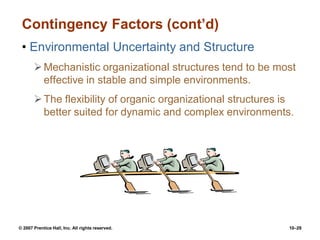
Hall, Inc. All rights reserved. 10–29 Contingency Factors (cont’d) • Environmental Uncertainty and Structure Mechanistic organizational structures tend to be most effective in stable and simple environments. The flexibility of organic organizational structures is better suited for dynamic and complex environments.
30.
© 2007 Prentice
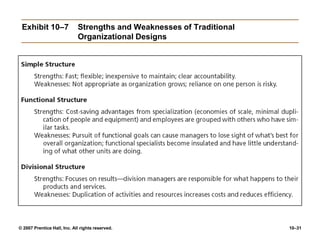
Hall, Inc. All rights reserved. 10–30 Common Organizational Designs • Traditional Designs Simple structure Low departmentalization, wide spans of control, centralized authority, little formalization Functional structure Departmentalization by function – Operations, finance, human resources, and product research and development Divisional structure Composed of separate business units or divisions with limited autonomy under the coordination and control the parent corporation.
31.
© 2007 Prentice
Hall, Inc. All rights reserved. 10–31 Exhibit 10–7 Strengths and Weaknesses of Traditional Organizational Designs
32.
© 2007 Prentice
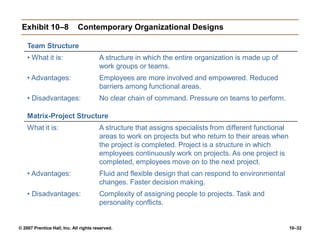
Hall, Inc. All rights reserved. 10–32 Exhibit 10–8 Contemporary Organizational Designs Team Structure • What it is: A structure in which the entire organization is made up of work groups or teams. • Advantages: Employees are more involved and empowered. Reduced barriers among functional areas. • Disadvantages: No clear chain of command. Pressure on teams to perform. Matrix-Project Structure What it is: A structure that assigns specialists from different functional areas to work on projects but who return to their areas when the project is completed. Project is a structure in which employees continuously work on projects. As one project is completed, employees move on to the next project. • Advantages: Fluid and flexible design that can respond to environmental changes. Faster decision making. • Disadvantages: Complexity of assigning people to projects. Task and personality conflicts.
33.
© 2007 Prentice
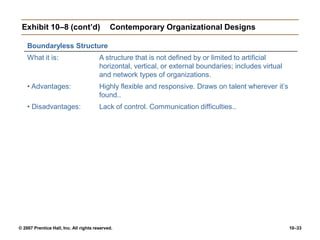
Hall, Inc. All rights reserved. 10–33 Exhibit 10–8 (cont’d) Contemporary Organizational Designs Boundaryless Structure What it is: A structure that is not defined by or limited to artificial horizontal, vertical, or external boundaries; includes virtual and network types of organizations. • Advantages: Highly flexible and responsive. Draws on talent wherever it’s found.. • Disadvantages: Lack of control. Communication difficulties..
34.
© 2007 Prentice
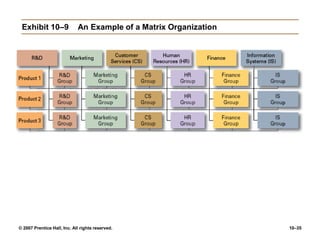
Hall, Inc. All rights reserved. 10–34 Organizational Designs (cont’d) • Contemporary Organizational Designs Team structures The entire organization is made up of work groups or self- managed teams of empowered employees. Matrix and project structures Specialists from different functional departments are assigned to work on projects led by project managers. Matrix and project participants have two managers. In project structures, employees work continuously on projects; moving on to another project as each project is completed.
35.
© 2007 Prentice
Hall, Inc. All rights reserved. 10–35 Exhibit 10–9 An Example of a Matrix Organization
36.
© 2007 Prentice
Hall, Inc. All rights reserved. 10–36 Organizational Designs (cont’d) • Contemporary Organizational Designs (cont’d) Boundaryless Organization An flexible and unstructured organizational design that is intended to break down external barriers between the organization and its customers and suppliers. Removes internal (horizontal) boundaries: – Eliminates the chain of command – Has limitless spans of control – Uses empowered teams rather than departments Eliminates external boundaries: – Uses virtual, network, and modular organizational structures to get closer to stakeholders.
37.
© 2007 Prentice
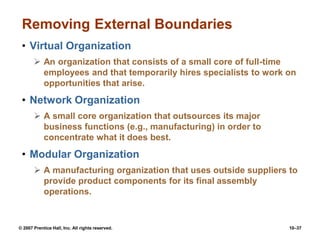
Hall, Inc. All rights reserved. 10–37 Removing External Boundaries • Virtual Organization An organization that consists of a small core of full-time employees and that temporarily hires specialists to work on opportunities that arise. • Network Organization A small core organization that outsources its major business functions (e.g., manufacturing) in order to concentrate what it does best. • Modular Organization A manufacturing organization that uses outside suppliers to provide product components for its final assembly operations.
38.
© 2007 Prentice
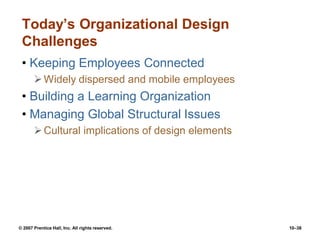
Hall, Inc. All rights reserved. 10–38 Today’s Organizational Design Challenges • Keeping Employees Connected Widely dispersed and mobile employees • Building a Learning Organization • Managing Global Structural Issues Cultural implications of design elements
39.
© 2007 Prentice
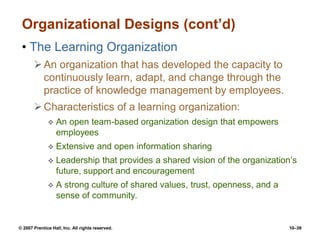
Hall, Inc. All rights reserved. 10–39 Organizational Designs (cont’d) • The Learning Organization An organization that has developed the capacity to continuously learn, adapt, and change through the practice of knowledge management by employees. Characteristics of a learning organization: An open team-based organization design that empowers employees Extensive and open information sharing Leadership that provides a shared vision of the organization’s future, support and encouragement A strong culture of shared values, trust, openness, and a sense of community.
40.
© 2007 Prentice
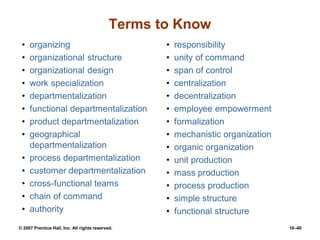
Hall, Inc. All rights reserved. 10–40 Terms to Know • organizing • organizational structure • organizational design • work specialization • departmentalization • functional departmentalization • product departmentalization • geographical departmentalization • process departmentalization • customer departmentalization • cross-functional teams • chain of command • authority • responsibility • unity of command • span of control • centralization • decentralization • employee empowerment • formalization • mechanistic organization • organic organization • unit production • mass production • process production • simple structure • functional structure
41.
© 2007 Prentice
Hall, Inc. All rights reserved. 10–41 Terms to Know • divisional structure • team structure • matrix structure • project structure • boundaryless organization • virtual organization • network organization • learning organization • organizational chart
Download