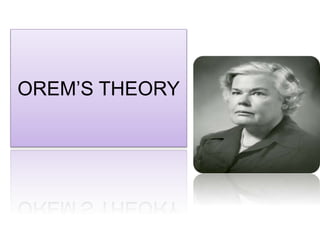
OREM’S THEORY
Born 1914 in Baltimore, US
Earned her diploma at Providence Hospital
– Washington, DC
1939 – BSN Ed., Catholic University of
America
1945 – MSN Ed., Catholic University of
America
She worked as a staff nurse, private duty
nurse, nurse educator and administrator
and nurse consultant.
Received honorary Doctor of Science
degree in 1976.
Theory was first published in Nursing:
Concepts of Practice in 1971, second in
Nursing – is an art, a helping service, and a
technology
• Actions deliberately selected and
performed by nurses to help individuals
or groups under their care to maintain or
change conditions in themselves or their
environments
• Encompasses the patient’s perspective of
health condition ,the physician’s
perspective , and the nursing perspective
Goal of nursing – to render the patient or
members of his family capable of
meeting the patient’s self care needs
• To maintain a state of health
• To regain normal or near normal state of
health in the event of disease or injury
• To stabilize ,control ,or minimize the
effects of chronic disorder,poor health or
disability
OREM’S GENERAL THEORY OF NURSING
• Orem’s general theory of nursing in three
related parts:-
1. self care
2. self care deficit
3. nursing system
1.THEORY OF SELF CARE
This theory Includes:
• Self care practice of activities that individual initiates and
perform on their own behalf in maintaining life ,health and
well being
• Self care agency is a human ability which is "the ability for
engaging in self care" -conditioned by age developmental
state, life experience, sociocultural orientation, health and
available resources
• Therapeutic self care demand "totality of self care
actions to be performed for some duration in order to meet
self care requisites by using valid methods and related sets of
operations and actions"
• Self care requisites . 3 categories of self care requisites
are-
1. Universal self care requisites
2. Developmental self care requisites
3. Health deviation self care requisites
Universal Self Care Requisites
Universal self care requisites are associated with life
processes and the maintenance of the integrity of
human structure and functioning. They are common
to all human beings during all stages of the life cycle
and should be viewed as interrelated factors,
Such as
• The maintenance of a sufficient intake of air
• The maintenance of a sufficient intake of water
• The maintenance of a sufficient intake of food
• The maintenance of a balance between
activity and rest
• The maintenance of a balance between
solitude and social interaction
• The prevention of hazards to human life
human functioning and human well-being
Developmental Self Care Requisites
Developmental self care requisites are specialized
universal self care requisites that results from
maturation or new requisites that develop as a
result of a condition or event such as
• Adjusting to the loss of a spouse,
• Adjusting to a new job,
• Adjusting to body changes such as facial lines or
gray hair.
Health Deviation Self Care
• Seeking and securing appropriate medical
assistance
• Being aware of and attending to the effects
and results of pathologic condition and states
• Effectively carrying out medically prescribed
measures. Being aware of and attending to or
regulating the discomforting or deleterious
effects
2.THEORY OF SELF CARE DEFICIT
• Specifies when nursing is needed
• Nursing is required when an adult (or in the case of a
dependent, the patient) is incapable or limited in the
provision of continuous effective self care.
• Orem identifies 5 methods of helping:
1. Acting for and doing for others
2. Guiding others
3. Supporting another
4. Providing an environment promoting personal
development in relation to meet future demands
5. Teaching another
3.THEORY OF NURSING SYSTEMS
• The nursing system, designed by the nurse, is
based on the self care needs and abilities of
patient to perform self care activities.
• Orem has identified 3classification of nursing
system
These are
Wholly compensatory system
Partly compensatory system
Supportive – educative system
Continued……..
The design and elements of the nursing system
define;
1. The scope of nursing responsibility in health care
situation
2. The general and specific roles of nurses and
patients
3. Reasons for nurses relationship with patients
4. The kinds of actions to be performed and the
performance patterns and nurses and patients
actions in regulating patients’ self care agency
and in meeting their therapeutic self care
demand
Continued……..
Technologies in Nursing
A technology is systematized information about a
process or a method for affecting some desired
result through deliberate practical endeavor, with
or without a use of materials and instruments
Two categories of technologies used in nursing are
• social or interpersonal technologies
• Regulatory technologies.
Social and Interpersonal Technology
• Communication adjusted to age and
developmental state, to health state, and to socio
cultural orientation.
• Bringing about and maintaining interpersonal,
intergroup relations for coordination of effort.
• Bringing about and maintaining therapeutic
relations in light of psychosocial modes of
functioning in health and disease.
• Giving human assistance adapted to human
needs and action abilities and limitation.
Regulatory Technologies
• Maintaining and promoting life process
• Regulating psycho physiological modes of
functioning in health and disease
• Promoting human growth and development
Orem’s Theory and Nursing process
• Nursing process presents a method to
determine the self care deficits and then to
define the roles of person or nurse to meet
the self care demands.
• Orem emphasizes that the technological
component "must be coordinated with
interpersonal and social processes within
nursing situations
The steps of Orem’s nursing process
Step 1
The initial and continuing determination of why a person
should be under nursing care
Step 2
The designing of a system of nursing and planning for the
delivery of nursing according to the designed system
Step 3
The initiation, conduction and control of assisting action
to
 Compensate for the patients self care limitations
 Overcome when possible self care limitation
 Foster and protect the patient’s self care abilities
Comparison of Orem's Nursing Process and the
Nursing Process
Application of Orem’s Nursing Process
• Ms Madhuri a well groomed university faculty member , is
48 years old, 5 feet 2 inches, and weighs 85 kg .
• She smoke 1 and ½ packs of cigarettes per day, she had
very happily married for 25 years and has been widowed
for six month. She and her husband enjoyed social
activities, including playing bridge, collecting antiques.
• She has not participated in any of these activities since her
husband’s death because of lack of interest and energy.
• Currently, she engages in no regular exercise, eats mainly
fast-food during her 12 hour working day, and eats a late
evening meal before retiring.
• Ms. M’s mother died of a stroke and her father
had a heart attack at age 50.
• Her vital signs were 138/86, P -92, R- 30, T-98.4.
• Her laboratory values were all with in normal
limits except a blood cholesterol of 280mg.
• Her physician advised her to loss 40 pounds, but
recognize that she has inadequate knowledge of
basic nutrition and has not been motivated to
lose weight.
• She foresees potential problems related to
cardiovascular disease.
Step 1
Specific data are gathered in the areas of individuals
universal, developmental, and health deviation self
care needs and their relationship.
Once the data have been gathered, they must be
analyzed.
• Analyzing Ms. M’s data: in the category of universal self
care needs, Ms. M demonstrates a deficit in adequate
air, water, and food intake –she is 5’2’’, weight 175
pounds, consumes excessive calories and cholesterol
from fast food and late night meals.
• Ms M shows imbalance between activity and rest since
she has minimal exercise.
Step 1 Cont…
• There is also an imbalance between her solitude and social
interaction since her husband’s death
• This represents a significant loss for her in the mid life
developmental needs category.
• Ms M’s elevated cholesterol levels when interrelated with her
family history of stroke and heart attack present a hazard to
her life, functioning, and well being
• Physician gave advise to loss weight 40 pounds ,She has
limited nutritional knowledge
• She has motivational deficit to lose weight because her
western cultural tradition associates food with family and
love.
Step 2
• The goal for Ms M. would be – decrease her risk of
cardiovascular impairment
• Once the goals have been determined, the objectives
can be stated e.g. Ms M. will state that high
cholesterol levels increase her risk for cardiac
impairment
• Other objectives might relate to the risk factors of
obesity, lack of exercise, smoking, and family history.
• The designed nursing system for Ms M. would be the
supportive –educative nursing system
Step 3
• Ms M. keep a 3 day food diary
• The nurse would provide information about
cholesterol and its effect on cardiovascular function.
• The nurse would provide information about specific
foods that are low in cholesterol, those food items
that help reduce cholesterol ,and a list of fast food
restaurant that offer low cholesterol food items
• Together they analyze 3 day food diary and decide
how Ms. M modify her diet to reduce her cholesterol
intake
Step 3 Cont….
• They will determine which western dishes are low in cholesterol
or how these recipes can be adopted
• During this implementation, the nurse teaches, guides, and
supports Ms. M. while providing a developmental environment
• Includes evaluation- together do the evaluation
• Question might ask are – does she understand that her present life style
may increase her risk of developing a heart attack or stroke ?
Did she select low cholesterol fast foods ?
Did she attain her goal of reducing her cholesterol levels ?
• Evaluation is an on going process. It is essential that the nurse
and patient continually evaluate any changes in the data that would affect
the self care deficit, self care agent, and the nursing system.
Strengths of Orem’s Theory
• Provides a comprehensive base to nursing
practice
• It has utility for professional nursing in the areas
of nursing practice nursing curricula ,nursing
education administration ,and nursing research
• Specifies when nursing is needed
• Her self-care approach is contemporary with the
concepts of health promotion and health
maintenance
Limitations of Orem’s Theory
• Health is often viewed as dynamic and ever
changing.
• The theory is illness oriented.
• Orem’s self care deficit theory may not
encompass all aspects of care and needs of a
specific client.
For e.g. having an unclear definition of family, the nurse-society
relationship and public education areas are weak.
JOHNSON'S
THEORY
• Dorothy E. Johnson was born August 21, 1919, in
Savannah, Georgia.
• B. S. N. from Vanderbilt University in Nashville,
Tennessee, in 1942; and her M.P.H. from Harvard
University in Boston in 1948.
• From 1949 till retirement in 1978 she was an assistant
professor of pediatric nursing, an associate professor of
nursing, and a professor of nursing at the University of
California in Los Angeles.
• Johnson stressed the importance of research-based
knowledge about the effect of nursing care on clients.
DEFINITION OF NURSING
She defined nursing as “an external regulatory
force which acts to preserve the organization
and integration of the patients behaviors at an
optimum level under those conditions in which
the behaviors constitutes a threat to the
physical or social health, or in which illness is
found”
FOUR GOALS OF NURSING are to assist the patient:
• Whose behavior commensurate with social
demands.
• Who is able to modify his behavior in ways that it
supports biological imperatives
• Who is able to benefit up to the full extent
during illness from the physicians knowledge and
skill.
• Whose behavior does not give evidence of
unnecessary trauma as a consequence of illness
There are several layers of assumptions
that Johnson makes in the development
of conceptualization of the
BEHAVIORAL SYSTEM MODEL
ASSUMPTIONS OF THE BEHAVIORAL
SYSTEMMODEL
1st Assumption
In constructing a behavioral system, the assumption is
made that there is “organization, interaction,
interdependency, and integration of the parts and
elements of behavior that go to make up the system”
2nd Assumption
• A system “tends to achieve a balance among the
various forces operating within and upon it, and that
man strives continually to maintain a behavioral system
balance and steady states by more or less
automatic adjustments and adaptations to the natural
forces impinging (effect)upon him”
Continued…….
3rd Assumption
• A behavioral system , “which both requires and
results in some degree of regularity and
constancy in behavior, is essential to man”
4th Assumption
• The behavioral system is that the“ system balance
reflects adjustments and adaptations that are
successful in some way and to some degree”
JOHNSON’S 7 BEHAVIORAL SUBSYSTEMS
• Attachment or affiliative
• Dependency
• Ingestive
• Eliminative
• Sexual
• Aggressive
• Achievement
• Attachment or affiliative subsystem: “social
inclusion intimacy and the formation and
attachment of a strong social bond.”
• Dependency subsystem: “approval, attention
or recognition and physical assistance”
• Ingestive subsystem: “the emphasis is on the
meaning and structures of the social
events surrounding the occasion when the
food is eaten”
• Eliminative subsystem: “human cultures have
defined different socially acceptable behaviors
for excretion of waste ,but the existence of
such a pattern remains different from culture
to Culture.”
• Sexual subsystem:" both biological and social
factor affect the behavior in the sexual
subsystem”
• Aggressive subsystem: " it relates to the
behaviors concerned with protection and self
preservation Johnson views aggressive
subsystem as one that generates defensive
response from the individual when life or
territory is being threatened”
• Achievement subsystem: " provokes behavior
that attempt to control the environment
intellectual, physical, creative, mechanical and
social skills achievement are some of the areas
that Johnson recognizes".
FOUR MAJOR CONCEPTS
1.“Human being” as having two major systems,
the biological system and the behavioral
system. It is role of the medicine to focus on
biological system where as Nursling's focus is
the behavioral system.
2.“Society” relates to the environment on which
the individual exists. According to Johnson an
individual’s behavior is influenced by the
events in the environment
3.“Health” is a purposeful adaptive response,
physically mentally, emotionally, and socially
to internal and external stimuli in order to
maintain stability and comfort.
4.“Nursing” has a primary goal that is to foster
equilibrium within the individual. Nursing is
concerned with the organized and integrated
whole, but that the major focus is on
maintaining a balance in the Behavior system
when illness occurs in an individual.
JOHNSON’S BEHAVIORALSYSTEM AND
THE NURSING PROCESS
Johnson’s Behavioral System easily fits the nursing process
model.
assessment tool based on Johnson’s seven
subsystem,
• Affiliation
• Dependency
• Sexuality
• Aggression
• Elimination
• Ingestion
• Achievement
Diagnosis
• Diagnosis tends to be general to the system
than specific to the problem. 4 categories of
nursing diagnosis derived from Johnson's
behavioral system model:
• Insufficiency
• Discrepancy
• Incompatibility
• Dominance
Insufficiency– a state which exists when a
particular subsystem is not functioning or
developed to its full capacity due to
inadequacy.
Discrepancy – a behavior that doe snot meet
the intended goal.
• Incompatibility– the goals or behaviors of two
sub system in the same situation conflict with
each other to the detriment of the individual.
• Dominance– the behavior in one subsystem is
used more than any other sub system
regardless of the situation or to the detriment
of the other subsystems.
Planning and implementation
• Implementation of the nursing care related to
the diagnosis is the plan which will focus on
nurses actions to modify clients behavior,
these plan than have a goal ,to bring about
homeostasis in a subsystem, based on nursing
assessment of the individuals drive, set
behavior, and observable behavior. The plan
may include protection, nurturance or
stimulation of the identified subsystem.
Evaluation
• Evaluation is based on the attainment of a
goal of balance in the identified subsystems. If
the alterations in the behavior that are
planned do occur, the nurse should be able to
observe the return to the previous behavior
patterns. Johnson's behavioral model with the
nursing process is a nurse centered activity,
with the nurse determining the clients needs
and state behavior appropriate for that need.
STRENGTHS
• Dorothy Jonhson’s Behavioral System model
contributed much on the nursing
profession. She also identified in her theory
the major purpose and role of the theory in
the nursing profession and that is to keep the
level of behavioral system in equilibrium up
to the highest level. Until now this is our goal
and that is to maintain client’s health to the
optimum level.
• Her theory change how the world see nursing
profession separate in medicine because
Johnson believes that nursing care has a
definite effect on the health of a person
which is not the same on how medicine
perform its duties and responsibilities in
alleviating the health of the person. This
theory contributed very much in shaping the
future of our profession and on how nursing
profession was viewed today.
LIMITATIONS
• It is difficult to test Johnson's model by
development of hypothesis.
• The focus on the behavioral system makes it
difficult for nurses to work with physically
impaired individual to use this theory.
• The model is very individual oriented so the
nurses working with the group have difficulty
in its implementation.
BIBLIOGRAPHY
Orem theory and johnson theory

Orem theory and johnson theory

  • 2.
  • 3.
    Born 1914 inBaltimore, US Earned her diploma at Providence Hospital – Washington, DC 1939 – BSN Ed., Catholic University of America 1945 – MSN Ed., Catholic University of America She worked as a staff nurse, private duty nurse, nurse educator and administrator and nurse consultant. Received honorary Doctor of Science degree in 1976. Theory was first published in Nursing: Concepts of Practice in 1971, second in
  • 4.
    Nursing – isan art, a helping service, and a technology • Actions deliberately selected and performed by nurses to help individuals or groups under their care to maintain or change conditions in themselves or their environments • Encompasses the patient’s perspective of health condition ,the physician’s perspective , and the nursing perspective
  • 5.
    Goal of nursing– to render the patient or members of his family capable of meeting the patient’s self care needs • To maintain a state of health • To regain normal or near normal state of health in the event of disease or injury • To stabilize ,control ,or minimize the effects of chronic disorder,poor health or disability
  • 6.
    OREM’S GENERAL THEORYOF NURSING • Orem’s general theory of nursing in three related parts:- 1. self care 2. self care deficit 3. nursing system
  • 7.
    1.THEORY OF SELFCARE This theory Includes: • Self care practice of activities that individual initiates and perform on their own behalf in maintaining life ,health and well being • Self care agency is a human ability which is "the ability for engaging in self care" -conditioned by age developmental state, life experience, sociocultural orientation, health and available resources • Therapeutic self care demand "totality of self care actions to be performed for some duration in order to meet self care requisites by using valid methods and related sets of operations and actions" • Self care requisites . 3 categories of self care requisites are- 1. Universal self care requisites 2. Developmental self care requisites 3. Health deviation self care requisites
  • 8.
    Universal Self CareRequisites Universal self care requisites are associated with life processes and the maintenance of the integrity of human structure and functioning. They are common to all human beings during all stages of the life cycle and should be viewed as interrelated factors, Such as • The maintenance of a sufficient intake of air • The maintenance of a sufficient intake of water • The maintenance of a sufficient intake of food
  • 9.
    • The maintenanceof a balance between activity and rest • The maintenance of a balance between solitude and social interaction • The prevention of hazards to human life human functioning and human well-being
  • 10.
    Developmental Self CareRequisites Developmental self care requisites are specialized universal self care requisites that results from maturation or new requisites that develop as a result of a condition or event such as • Adjusting to the loss of a spouse, • Adjusting to a new job, • Adjusting to body changes such as facial lines or gray hair.
  • 11.
    Health Deviation SelfCare • Seeking and securing appropriate medical assistance • Being aware of and attending to the effects and results of pathologic condition and states • Effectively carrying out medically prescribed measures. Being aware of and attending to or regulating the discomforting or deleterious effects
  • 12.
    2.THEORY OF SELFCARE DEFICIT • Specifies when nursing is needed • Nursing is required when an adult (or in the case of a dependent, the patient) is incapable or limited in the provision of continuous effective self care. • Orem identifies 5 methods of helping: 1. Acting for and doing for others 2. Guiding others 3. Supporting another 4. Providing an environment promoting personal development in relation to meet future demands 5. Teaching another
  • 13.
    3.THEORY OF NURSINGSYSTEMS • The nursing system, designed by the nurse, is based on the self care needs and abilities of patient to perform self care activities. • Orem has identified 3classification of nursing system These are Wholly compensatory system Partly compensatory system Supportive – educative system
  • 14.
    Continued…….. The design andelements of the nursing system define; 1. The scope of nursing responsibility in health care situation 2. The general and specific roles of nurses and patients 3. Reasons for nurses relationship with patients 4. The kinds of actions to be performed and the performance patterns and nurses and patients actions in regulating patients’ self care agency and in meeting their therapeutic self care demand
  • 15.
    Continued…….. Technologies in Nursing Atechnology is systematized information about a process or a method for affecting some desired result through deliberate practical endeavor, with or without a use of materials and instruments Two categories of technologies used in nursing are • social or interpersonal technologies • Regulatory technologies.
  • 16.
    Social and InterpersonalTechnology • Communication adjusted to age and developmental state, to health state, and to socio cultural orientation. • Bringing about and maintaining interpersonal, intergroup relations for coordination of effort. • Bringing about and maintaining therapeutic relations in light of psychosocial modes of functioning in health and disease. • Giving human assistance adapted to human needs and action abilities and limitation.
  • 17.
    Regulatory Technologies • Maintainingand promoting life process • Regulating psycho physiological modes of functioning in health and disease • Promoting human growth and development
  • 18.
    Orem’s Theory andNursing process • Nursing process presents a method to determine the self care deficits and then to define the roles of person or nurse to meet the self care demands. • Orem emphasizes that the technological component "must be coordinated with interpersonal and social processes within nursing situations
  • 19.
    The steps ofOrem’s nursing process Step 1 The initial and continuing determination of why a person should be under nursing care Step 2 The designing of a system of nursing and planning for the delivery of nursing according to the designed system Step 3 The initiation, conduction and control of assisting action to  Compensate for the patients self care limitations  Overcome when possible self care limitation  Foster and protect the patient’s self care abilities
  • 20.
    Comparison of Orem'sNursing Process and the Nursing Process
  • 21.
    Application of Orem’sNursing Process • Ms Madhuri a well groomed university faculty member , is 48 years old, 5 feet 2 inches, and weighs 85 kg . • She smoke 1 and ½ packs of cigarettes per day, she had very happily married for 25 years and has been widowed for six month. She and her husband enjoyed social activities, including playing bridge, collecting antiques. • She has not participated in any of these activities since her husband’s death because of lack of interest and energy. • Currently, she engages in no regular exercise, eats mainly fast-food during her 12 hour working day, and eats a late evening meal before retiring.
  • 22.
    • Ms. M’smother died of a stroke and her father had a heart attack at age 50. • Her vital signs were 138/86, P -92, R- 30, T-98.4. • Her laboratory values were all with in normal limits except a blood cholesterol of 280mg. • Her physician advised her to loss 40 pounds, but recognize that she has inadequate knowledge of basic nutrition and has not been motivated to lose weight. • She foresees potential problems related to cardiovascular disease.
  • 23.
    Step 1 Specific dataare gathered in the areas of individuals universal, developmental, and health deviation self care needs and their relationship. Once the data have been gathered, they must be analyzed. • Analyzing Ms. M’s data: in the category of universal self care needs, Ms. M demonstrates a deficit in adequate air, water, and food intake –she is 5’2’’, weight 175 pounds, consumes excessive calories and cholesterol from fast food and late night meals. • Ms M shows imbalance between activity and rest since she has minimal exercise.
  • 24.
    Step 1 Cont… •There is also an imbalance between her solitude and social interaction since her husband’s death • This represents a significant loss for her in the mid life developmental needs category. • Ms M’s elevated cholesterol levels when interrelated with her family history of stroke and heart attack present a hazard to her life, functioning, and well being • Physician gave advise to loss weight 40 pounds ,She has limited nutritional knowledge • She has motivational deficit to lose weight because her western cultural tradition associates food with family and love.
  • 25.
    Step 2 • Thegoal for Ms M. would be – decrease her risk of cardiovascular impairment • Once the goals have been determined, the objectives can be stated e.g. Ms M. will state that high cholesterol levels increase her risk for cardiac impairment • Other objectives might relate to the risk factors of obesity, lack of exercise, smoking, and family history. • The designed nursing system for Ms M. would be the supportive –educative nursing system
  • 26.
    Step 3 • MsM. keep a 3 day food diary • The nurse would provide information about cholesterol and its effect on cardiovascular function. • The nurse would provide information about specific foods that are low in cholesterol, those food items that help reduce cholesterol ,and a list of fast food restaurant that offer low cholesterol food items • Together they analyze 3 day food diary and decide how Ms. M modify her diet to reduce her cholesterol intake
  • 27.
    Step 3 Cont…. •They will determine which western dishes are low in cholesterol or how these recipes can be adopted • During this implementation, the nurse teaches, guides, and supports Ms. M. while providing a developmental environment • Includes evaluation- together do the evaluation • Question might ask are – does she understand that her present life style may increase her risk of developing a heart attack or stroke ? Did she select low cholesterol fast foods ? Did she attain her goal of reducing her cholesterol levels ? • Evaluation is an on going process. It is essential that the nurse and patient continually evaluate any changes in the data that would affect the self care deficit, self care agent, and the nursing system.
  • 28.
    Strengths of Orem’sTheory • Provides a comprehensive base to nursing practice • It has utility for professional nursing in the areas of nursing practice nursing curricula ,nursing education administration ,and nursing research • Specifies when nursing is needed • Her self-care approach is contemporary with the concepts of health promotion and health maintenance
  • 29.
    Limitations of Orem’sTheory • Health is often viewed as dynamic and ever changing. • The theory is illness oriented. • Orem’s self care deficit theory may not encompass all aspects of care and needs of a specific client. For e.g. having an unclear definition of family, the nurse-society relationship and public education areas are weak.
  • 30.
  • 31.
    • Dorothy E.Johnson was born August 21, 1919, in Savannah, Georgia. • B. S. N. from Vanderbilt University in Nashville, Tennessee, in 1942; and her M.P.H. from Harvard University in Boston in 1948. • From 1949 till retirement in 1978 she was an assistant professor of pediatric nursing, an associate professor of nursing, and a professor of nursing at the University of California in Los Angeles. • Johnson stressed the importance of research-based knowledge about the effect of nursing care on clients.
  • 32.
    DEFINITION OF NURSING Shedefined nursing as “an external regulatory force which acts to preserve the organization and integration of the patients behaviors at an optimum level under those conditions in which the behaviors constitutes a threat to the physical or social health, or in which illness is found”
  • 33.
    FOUR GOALS OFNURSING are to assist the patient: • Whose behavior commensurate with social demands. • Who is able to modify his behavior in ways that it supports biological imperatives • Who is able to benefit up to the full extent during illness from the physicians knowledge and skill. • Whose behavior does not give evidence of unnecessary trauma as a consequence of illness
  • 34.
    There are severallayers of assumptions that Johnson makes in the development of conceptualization of the BEHAVIORAL SYSTEM MODEL
  • 35.
    ASSUMPTIONS OF THEBEHAVIORAL SYSTEMMODEL 1st Assumption In constructing a behavioral system, the assumption is made that there is “organization, interaction, interdependency, and integration of the parts and elements of behavior that go to make up the system” 2nd Assumption • A system “tends to achieve a balance among the various forces operating within and upon it, and that man strives continually to maintain a behavioral system balance and steady states by more or less automatic adjustments and adaptations to the natural forces impinging (effect)upon him”
  • 36.
    Continued……. 3rd Assumption • Abehavioral system , “which both requires and results in some degree of regularity and constancy in behavior, is essential to man” 4th Assumption • The behavioral system is that the“ system balance reflects adjustments and adaptations that are successful in some way and to some degree”
  • 37.
    JOHNSON’S 7 BEHAVIORALSUBSYSTEMS • Attachment or affiliative • Dependency • Ingestive • Eliminative • Sexual • Aggressive • Achievement
  • 38.
    • Attachment oraffiliative subsystem: “social inclusion intimacy and the formation and attachment of a strong social bond.”
  • 39.
    • Dependency subsystem:“approval, attention or recognition and physical assistance”
  • 40.
    • Ingestive subsystem:“the emphasis is on the meaning and structures of the social events surrounding the occasion when the food is eaten”
  • 41.
    • Eliminative subsystem:“human cultures have defined different socially acceptable behaviors for excretion of waste ,but the existence of such a pattern remains different from culture to Culture.”
  • 42.
    • Sexual subsystem:"both biological and social factor affect the behavior in the sexual subsystem”
  • 43.
    • Aggressive subsystem:" it relates to the behaviors concerned with protection and self preservation Johnson views aggressive subsystem as one that generates defensive response from the individual when life or territory is being threatened”
  • 44.
    • Achievement subsystem:" provokes behavior that attempt to control the environment intellectual, physical, creative, mechanical and social skills achievement are some of the areas that Johnson recognizes".
  • 45.
    FOUR MAJOR CONCEPTS 1.“Humanbeing” as having two major systems, the biological system and the behavioral system. It is role of the medicine to focus on biological system where as Nursling's focus is the behavioral system.
  • 46.
    2.“Society” relates tothe environment on which the individual exists. According to Johnson an individual’s behavior is influenced by the events in the environment
  • 47.
    3.“Health” is apurposeful adaptive response, physically mentally, emotionally, and socially to internal and external stimuli in order to maintain stability and comfort.
  • 48.
    4.“Nursing” has aprimary goal that is to foster equilibrium within the individual. Nursing is concerned with the organized and integrated whole, but that the major focus is on maintaining a balance in the Behavior system when illness occurs in an individual.
  • 49.
    JOHNSON’S BEHAVIORALSYSTEM AND THENURSING PROCESS Johnson’s Behavioral System easily fits the nursing process model. assessment tool based on Johnson’s seven subsystem, • Affiliation • Dependency • Sexuality • Aggression • Elimination • Ingestion • Achievement
  • 50.
    Diagnosis • Diagnosis tendsto be general to the system than specific to the problem. 4 categories of nursing diagnosis derived from Johnson's behavioral system model: • Insufficiency • Discrepancy • Incompatibility • Dominance
  • 51.
    Insufficiency– a statewhich exists when a particular subsystem is not functioning or developed to its full capacity due to inadequacy. Discrepancy – a behavior that doe snot meet the intended goal.
  • 52.
    • Incompatibility– thegoals or behaviors of two sub system in the same situation conflict with each other to the detriment of the individual. • Dominance– the behavior in one subsystem is used more than any other sub system regardless of the situation or to the detriment of the other subsystems.
  • 53.
    Planning and implementation •Implementation of the nursing care related to the diagnosis is the plan which will focus on nurses actions to modify clients behavior, these plan than have a goal ,to bring about homeostasis in a subsystem, based on nursing assessment of the individuals drive, set behavior, and observable behavior. The plan may include protection, nurturance or stimulation of the identified subsystem.
  • 54.
    Evaluation • Evaluation isbased on the attainment of a goal of balance in the identified subsystems. If the alterations in the behavior that are planned do occur, the nurse should be able to observe the return to the previous behavior patterns. Johnson's behavioral model with the nursing process is a nurse centered activity, with the nurse determining the clients needs and state behavior appropriate for that need.
  • 59.
    STRENGTHS • Dorothy Jonhson’sBehavioral System model contributed much on the nursing profession. She also identified in her theory the major purpose and role of the theory in the nursing profession and that is to keep the level of behavioral system in equilibrium up to the highest level. Until now this is our goal and that is to maintain client’s health to the optimum level.
  • 60.
    • Her theorychange how the world see nursing profession separate in medicine because Johnson believes that nursing care has a definite effect on the health of a person which is not the same on how medicine perform its duties and responsibilities in alleviating the health of the person. This theory contributed very much in shaping the future of our profession and on how nursing profession was viewed today.
  • 61.
    LIMITATIONS • It isdifficult to test Johnson's model by development of hypothesis. • The focus on the behavioral system makes it difficult for nurses to work with physically impaired individual to use this theory. • The model is very individual oriented so the nurses working with the group have difficulty in its implementation.
  • 65.