

By: Asmat Babar
www.asmatbabar.blogspot.com

ORDER HEMIPTERA
HEMIPTERA
• Hemiptera means “half wing,”.
• Front pair of wings are leathery near their base
and membranous towards the tips.
• True bugs have slender, beak-like mouthparts
that arise from the front of the head.
• All hemipterans undergo incomplete
metamorphosis.
• Well developed legs.
• Piercing and sucking mouth parts
CLASSIFICATION OF HEMIPTERA
• HEMIPTERA
• Suborder: Cryptocerata (shorthorned bugs)
•
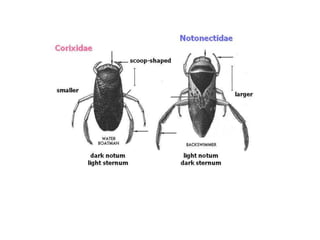
Corixidae (water boatmen)
•
Notonectidae (backswimmers)
•
Nepidae (water scorpions)
•
Belostomatidae (giant water bugs)
• Suborder: Gymnocerata (longhorned bugs)
•
Gerridae (water striders)
•
Miridae (leaf bugs, plant bugs)
•
Phymatidae (ambush bugs)
•
Reduviidae (assassin bugs)
•
Tingidae (sugarcane lace bug, avocado lace bug, lace bugs)
•
Lygaeidae (seed bugs, big eyed bugs, milkweed bugs)
•
Coreidae (leaf-footed bugs, squash bugs)
•
Pentatomidae (stink bugs)
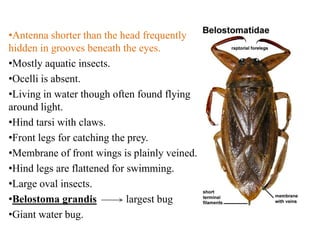
•Antenna shorter than the head frequently
hidden in grooves beneath the eyes.
•Mostly aquatic insects.
•Ocelli is absent.
•Living in water though often found flying
around light.
•Hind tarsi with claws.
•Front legs for catching the prey.
•Membrane of front wings is plainly veined.
•Hind legs are flattened for swimming.
•Large oval insects.
•Belostoma grandis
largest bug
•Giant water bug.
Tingidae

•Antenna longer than the head not hidden in
the grooves except phymatidae.
• Antenna with less than 5 segments.
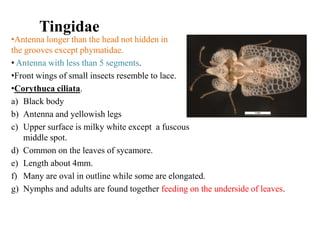
•Front wings of small insects resemble to lace.
•Corythuca ciliata.
a) Black body
b) Antenna and yellowish legs
c) Upper surface is milky white except a fuscous
middle spot.
d) Common on the leaves of sycamore.
e) Length about 4mm.
f) Many are oval in outline while some are elongated.
g) Nymphs and adults are found together feeding on the underside of leaves.
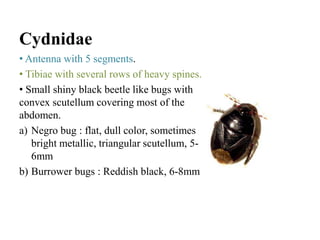
Cydnidae
• Antenna with 5 segments.
• Tibiae with several rows of heavy spines.
• Small shiny black beetle like bugs with
convex scutellum covering most of the
abdomen.
a) Negro bug : flat, dull color, sometimes
bright metallic, triangular scutellum, 56mm
b) Burrower bugs : Reddish black, 6-8mm
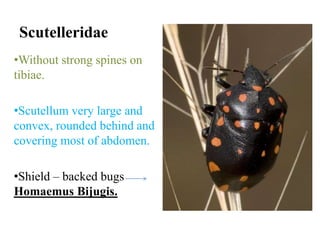
Scutelleridae
•Without strong spines on
tibiae.
•Scutellum very large and
convex, rounded behind and
covering most of abdomen.

•Shield – backed bugs
Homaemus Bijugis.
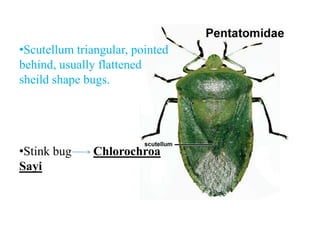
•Scutellum triangular, pointed
behind, usually flattened
sheild shape bugs.

•Stink bug
Sayi

Chlorochroa
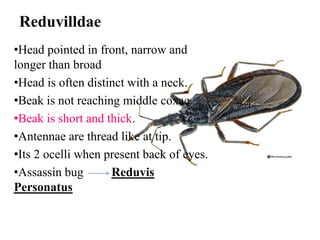
Reduvilldae
•Head pointed in front, narrow and
longer than broad
•Head is often distinct with a neck.
•Beak is not reaching middle coxae.
•Beak is short and thick.
•Antennae are thread like at tip.
•Its 2 ocelli when present back of eyes.
•Assassin bug
Reduvis
Personatus
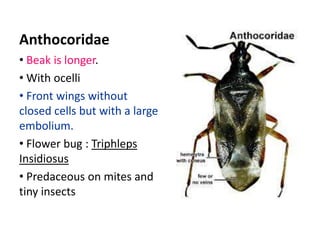
Anthocoridae
• Beak is longer.
• With ocelli
• Front wings without
closed cells but with a large
embolium.
• Flower bug : Triphleps
Insidiosus
• Predaceous on mites and
tiny insects
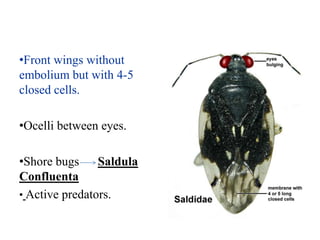
•Front wings without
embolium but with 4-5
closed cells.
•Ocelli between eyes.
•Shore bugs
Saldula
Confluenta
• Active predators.
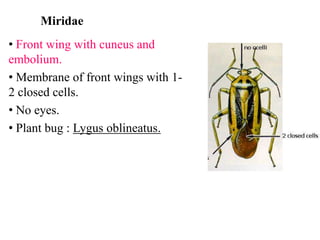
Miridae
• Front wing with cuneus and
embolium.
• Membrane of front wings with 12 closed cells.
• No eyes.
• Plant bug : Lygus oblineatus.
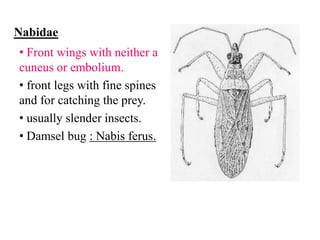
Nabidae
• Front wings with neither a
cuneus or embolium.
• front legs with fine spines
and for catching the prey.
• usually slender insects.
• Damsel bug : Nabis ferus.
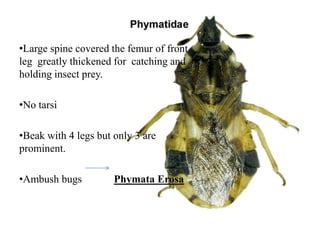
•Large spine covered the femur of front
leg greatly thickened for catching and
holding insect prey.
•No tarsi

•Beak with 4 legs but only 3 are
prominent.
•Ambush bugs

Phymata Erosa
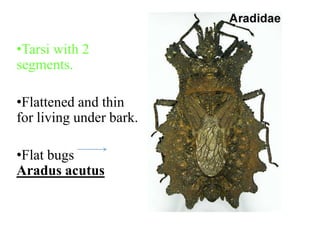
•Tarsi with 2
segments.
•Flattened and thin
for living under bark.
•Flat bugs
Aradus acutus
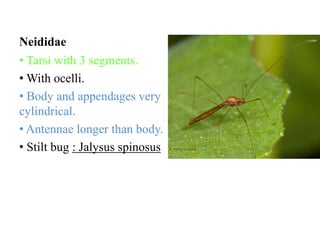
Neididae
• Tarsi with 3 segments.
• With ocelli.
• Body and appendages very
cylindrical.
• Antennae longer than body.
• Stilt bug : Jalysus spinosus
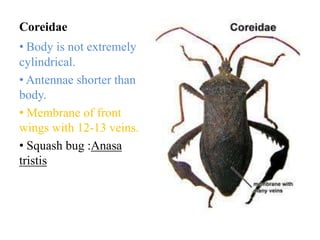
Coreidae
• Body is not extremely
cylindrical.
• Antennae shorter than
body.
• Membrane of front
wings with 12-13 veins.
• Squash bug :Anasa
tristis
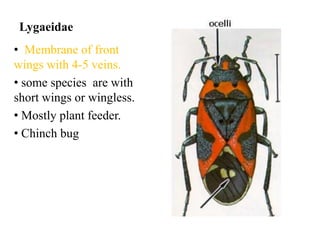
Lygaeidae
• Membrane of front
wings with 4-5 veins.
• some species are with
short wings or wingless.
• Mostly plant feeder.
• Chinch bug
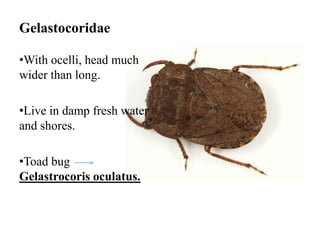
Gelastocoridae
•With ocelli, head much
wider than long.
•Live in damp fresh water
and shores.
•Toad bug
Gelastrocoris oculatus.
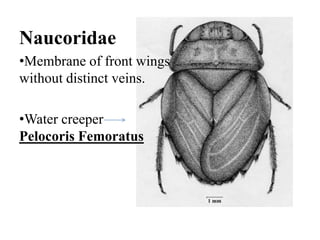
Naucoridae
•Membrane of front wings
without distinct veins.
•Water creeper
Pelocoris Femoratus
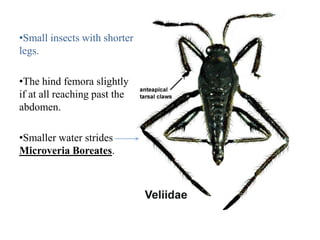
•Small insects with shorter
legs.

•The hind femora slightly
if at all reaching past the
abdomen.
•Smaller water strides
Microveria Boreates.
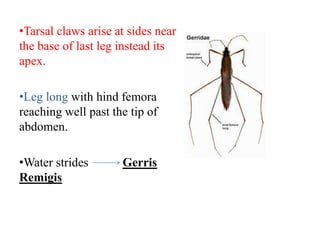
•Tarsal claws arise at sides near
the base of last leg instead its
apex.
•Leg long with hind femora
reaching well past the tip of
abdomen.
•Water strides
Remigis

Gerris
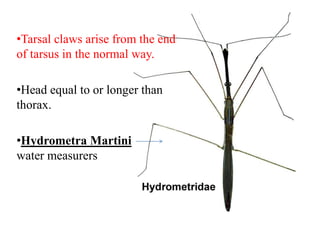
•Tarsal claws arise from the end
of tarsus in the normal way.

•Head equal to or longer than
thorax.
•Hydrometra Martini
water measurers
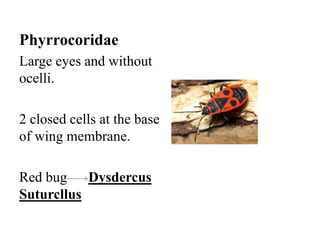
Phyrrocoridae
Large eyes and without
ocelli.
2 closed cells at the base
of wing membrane.
Red bug Dysdercus
Suturcllus
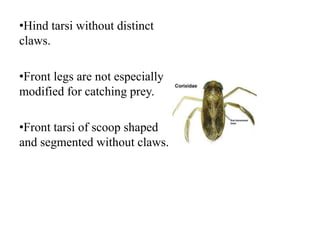
•Hind tarsi without distinct
claws.
•Front legs are not especially
modified for catching prey.
•Front tarsi of scoop shaped
and segmented without claws.
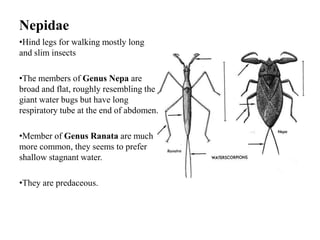
Nepidae
•Hind legs for walking mostly long
and slim insects
•The members of Genus Nepa are
broad and flat, roughly resembling the
giant water bugs but have long
respiratory tube at the end of abdomen.

•Member of Genus Ranata are much
more common, they seems to prefer
shallow stagnant water.
•They are predaceous.
THANK YOU

Order Hemiptera

  • 1.
  • 2.
    HEMIPTERA • Hemiptera means“half wing,”. • Front pair of wings are leathery near their base and membranous towards the tips. • True bugs have slender, beak-like mouthparts that arise from the front of the head. • All hemipterans undergo incomplete metamorphosis. • Well developed legs. • Piercing and sucking mouth parts
  • 3.
    CLASSIFICATION OF HEMIPTERA •HEMIPTERA • Suborder: Cryptocerata (shorthorned bugs) • Corixidae (water boatmen) • Notonectidae (backswimmers) • Nepidae (water scorpions) • Belostomatidae (giant water bugs) • Suborder: Gymnocerata (longhorned bugs) • Gerridae (water striders) • Miridae (leaf bugs, plant bugs) • Phymatidae (ambush bugs) • Reduviidae (assassin bugs) • Tingidae (sugarcane lace bug, avocado lace bug, lace bugs) • Lygaeidae (seed bugs, big eyed bugs, milkweed bugs) • Coreidae (leaf-footed bugs, squash bugs) • Pentatomidae (stink bugs)
  • 4.
    •Antenna shorter thanthe head frequently hidden in grooves beneath the eyes. •Mostly aquatic insects. •Ocelli is absent. •Living in water though often found flying around light. •Hind tarsi with claws. •Front legs for catching the prey. •Membrane of front wings is plainly veined. •Hind legs are flattened for swimming. •Large oval insects. •Belostoma grandis largest bug •Giant water bug.
  • 5.
    Tingidae •Antenna longer thanthe head not hidden in the grooves except phymatidae. • Antenna with less than 5 segments. •Front wings of small insects resemble to lace. •Corythuca ciliata. a) Black body b) Antenna and yellowish legs c) Upper surface is milky white except a fuscous middle spot. d) Common on the leaves of sycamore. e) Length about 4mm. f) Many are oval in outline while some are elongated. g) Nymphs and adults are found together feeding on the underside of leaves.
  • 6.
    Cydnidae • Antenna with5 segments. • Tibiae with several rows of heavy spines. • Small shiny black beetle like bugs with convex scutellum covering most of the abdomen. a) Negro bug : flat, dull color, sometimes bright metallic, triangular scutellum, 56mm b) Burrower bugs : Reddish black, 6-8mm
  • 7.
    Scutelleridae •Without strong spineson tibiae. •Scutellum very large and convex, rounded behind and covering most of abdomen. •Shield – backed bugs Homaemus Bijugis.
  • 8.
    •Scutellum triangular, pointed behind,usually flattened sheild shape bugs. •Stink bug Sayi Chlorochroa
  • 9.
    Reduvilldae •Head pointed infront, narrow and longer than broad •Head is often distinct with a neck. •Beak is not reaching middle coxae. •Beak is short and thick. •Antennae are thread like at tip. •Its 2 ocelli when present back of eyes. •Assassin bug Reduvis Personatus
  • 10.
    Anthocoridae • Beak islonger. • With ocelli • Front wings without closed cells but with a large embolium. • Flower bug : Triphleps Insidiosus • Predaceous on mites and tiny insects
  • 11.
    •Front wings without emboliumbut with 4-5 closed cells. •Ocelli between eyes. •Shore bugs Saldula Confluenta • Active predators.
  • 12.
    Miridae • Front wingwith cuneus and embolium. • Membrane of front wings with 12 closed cells. • No eyes. • Plant bug : Lygus oblineatus.
  • 13.
    Nabidae • Front wingswith neither a cuneus or embolium. • front legs with fine spines and for catching the prey. • usually slender insects. • Damsel bug : Nabis ferus.
  • 14.
    •Large spine coveredthe femur of front leg greatly thickened for catching and holding insect prey. •No tarsi •Beak with 4 legs but only 3 are prominent. •Ambush bugs Phymata Erosa
  • 15.
    •Tarsi with 2 segments. •Flattenedand thin for living under bark. •Flat bugs Aradus acutus
  • 16.
    Neididae • Tarsi with3 segments. • With ocelli. • Body and appendages very cylindrical. • Antennae longer than body. • Stilt bug : Jalysus spinosus
  • 17.
    Coreidae • Body isnot extremely cylindrical. • Antennae shorter than body. • Membrane of front wings with 12-13 veins. • Squash bug :Anasa tristis
  • 18.
    Lygaeidae • Membrane offront wings with 4-5 veins. • some species are with short wings or wingless. • Mostly plant feeder. • Chinch bug
  • 19.
    Gelastocoridae •With ocelli, headmuch wider than long. •Live in damp fresh water and shores. •Toad bug Gelastrocoris oculatus.
  • 20.
    Naucoridae •Membrane of frontwings without distinct veins. •Water creeper Pelocoris Femoratus
  • 21.
    •Small insects withshorter legs. •The hind femora slightly if at all reaching past the abdomen. •Smaller water strides Microveria Boreates.
  • 22.
    •Tarsal claws ariseat sides near the base of last leg instead its apex. •Leg long with hind femora reaching well past the tip of abdomen. •Water strides Remigis Gerris
  • 23.
    •Tarsal claws arisefrom the end of tarsus in the normal way. •Head equal to or longer than thorax. •Hydrometra Martini water measurers
  • 24.
    Phyrrocoridae Large eyes andwithout ocelli. 2 closed cells at the base of wing membrane. Red bug Dysdercus Suturcllus
  • 25.
    •Hind tarsi withoutdistinct claws. •Front legs are not especially modified for catching prey. •Front tarsi of scoop shaped and segmented without claws.
  • 27.
    Nepidae •Hind legs forwalking mostly long and slim insects •The members of Genus Nepa are broad and flat, roughly resembling the giant water bugs but have long respiratory tube at the end of abdomen. •Member of Genus Ranata are much more common, they seems to prefer shallow stagnant water. •They are predaceous.
  • 28.