ORCID & other Person iDs
Simeon Warner
http://orcid.org/0000-0002-7970-7855
http://www.isni.org/isni/0000000351311901
http://www.researcherid.com/rid/E-2423-2011
https://www.scopus.com/authid/detail.uri?authorId=7103063073
https://arxiv.org/a/warner_s_1
http://vivo.cornell.edu/display/individual24416
https://github.com/zimeon
http://zimeon.com/me
IMLS Authorities Forum, Library of Congress, DC, 2017-04-10
ORCID: Open Researcher and Contributor ID
“ORCID’s vision is a world where all who participate in research,
scholarship, and innovation are uniquely identified and connected
to their contributions across disciplines, borders, and time.”
“ORCID provides an identifier for individuals to use with their
name as they engage in research, scholarship, and innovation
activities. We provide open tools that enable transparent and
trustworthy connections between researchers, their
contributions, and affiliations. We provide this service to help
people find information and to simplify reporting and
analysis.” (https://orcid.org/)
Ø  Research and scholarship focus
Ø  Expect use by individuals identified in workflows
How is ORCID doing? – Very well!
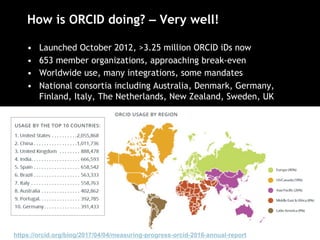
•  Launched October 2012, >3.25 million ORCID iDs now
•  653 member organizations, approaching break-even
•  Worldwide use, many integrations, some mandates
•  National consortia including Australia, Denmark, Germany,
Finland, Italy, The Netherlands, New Zealand, Sweden, UK
https://orcid.org/blog/2017/04/04/measuring-progress-orcid-2016-annual-report
C1
C3
C2
O1
O4
O2
O3
O5
Contributed-to
Cites
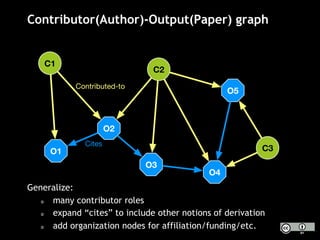
Contributor(Author)-Output(Paper) graph
Generalize:
o  many contributor roles
o  expand “cites” to include other notions of derivation
o  add organization nodes for affiliation/funding/etc.
Why must ORCID be different?
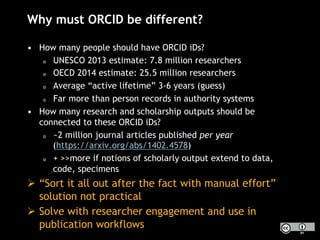
•  How many people should have ORCID iDs?
o  UNESCO 2013 estimate: 7.8 million researchers
o  OECD 2014 estimate: 25.5 million researchers
o  Average “active lifetime” 3-6 years (guess)
o  Far more than person records in authority systems
•  How many research and scholarship outputs should be
connected to these ORCID iDs?
o  ~2 million journal articles published per year
(https://arxiv.org/abs/1402.4578)
o  + >>more if notions of scholarly output extend to data,
code, specimens
Ø  “Sort it all out after the fact with manual effort”
solution not practical
Ø  Solve with researcher engagement and use in
publication workflows
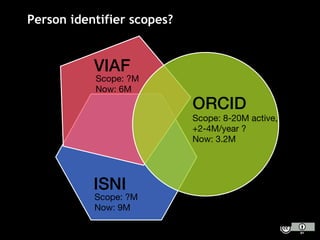
ORCID
ISNI
VIAF
Scope: 8-20M active,
+2-4M/year ?
Now: 3.2M
Scope: ?M
Now: 9M
Scope: ?M
Now: 6M
Person identifier scopes?
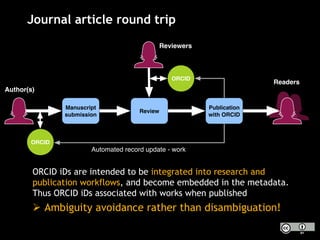
Journal article round trip
ORCID iDs are intended to be integrated into research and
publication workflows, and become embedded in the metadata.
Thus ORCID iDs associated with works when published
Ø  Ambiguity avoidance rather than disambiguation!
ORCID
Manuscript
submission
Review
Publication
with ORCID
ORCID
Author(s)
Readers
Reviewers
Automated record update - work
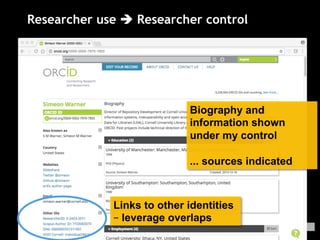
Links to other identities
– leverage overlaps
Biography and
information shown
under my control
... sources indicated
Researcher use è Researcher control
That’s all folks…

ORCID & other Person iDs

  • 1.
    ORCID & otherPerson iDs Simeon Warner http://orcid.org/0000-0002-7970-7855 http://www.isni.org/isni/0000000351311901 http://www.researcherid.com/rid/E-2423-2011 https://www.scopus.com/authid/detail.uri?authorId=7103063073 https://arxiv.org/a/warner_s_1 http://vivo.cornell.edu/display/individual24416 https://github.com/zimeon http://zimeon.com/me IMLS Authorities Forum, Library of Congress, DC, 2017-04-10
  • 2.
    ORCID: Open Researcherand Contributor ID “ORCID’s vision is a world where all who participate in research, scholarship, and innovation are uniquely identified and connected to their contributions across disciplines, borders, and time.” “ORCID provides an identifier for individuals to use with their name as they engage in research, scholarship, and innovation activities. We provide open tools that enable transparent and trustworthy connections between researchers, their contributions, and affiliations. We provide this service to help people find information and to simplify reporting and analysis.” (https://orcid.org/) Ø  Research and scholarship focus Ø  Expect use by individuals identified in workflows
  • 3.
    How is ORCIDdoing? – Very well! •  Launched October 2012, >3.25 million ORCID iDs now •  653 member organizations, approaching break-even •  Worldwide use, many integrations, some mandates •  National consortia including Australia, Denmark, Germany, Finland, Italy, The Netherlands, New Zealand, Sweden, UK https://orcid.org/blog/2017/04/04/measuring-progress-orcid-2016-annual-report
  • 4.
    C1 C3 C2 O1 O4 O2 O3 O5 Contributed-to Cites Contributor(Author)-Output(Paper) graph Generalize: o  manycontributor roles o  expand “cites” to include other notions of derivation o  add organization nodes for affiliation/funding/etc.
  • 5.
    Why must ORCIDbe different? •  How many people should have ORCID iDs? o  UNESCO 2013 estimate: 7.8 million researchers o  OECD 2014 estimate: 25.5 million researchers o  Average “active lifetime” 3-6 years (guess) o  Far more than person records in authority systems •  How many research and scholarship outputs should be connected to these ORCID iDs? o  ~2 million journal articles published per year (https://arxiv.org/abs/1402.4578) o  + >>more if notions of scholarly output extend to data, code, specimens Ø  “Sort it all out after the fact with manual effort” solution not practical Ø  Solve with researcher engagement and use in publication workflows
  • 6.
    ORCID ISNI VIAF Scope: 8-20M active, +2-4M/year? Now: 3.2M Scope: ?M Now: 9M Scope: ?M Now: 6M Person identifier scopes?
  • 7.
    Journal article roundtrip ORCID iDs are intended to be integrated into research and publication workflows, and become embedded in the metadata. Thus ORCID iDs associated with works when published Ø  Ambiguity avoidance rather than disambiguation! ORCID Manuscript submission Review Publication with ORCID ORCID Author(s) Readers Reviewers Automated record update - work
  • 8.
    Links to otheridentities – leverage overlaps Biography and information shown under my control ... sources indicated Researcher use è Researcher control
  • 9.