ORCID webinar
Sarah Townsend, Senior Advisor
MBIE
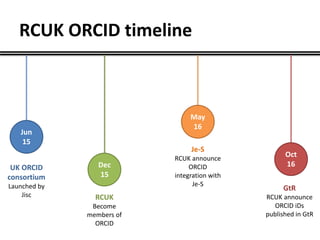
RCUK ORCID timeline
Jun
15
Dec
15
May
16
Oct
16UK ORCID
consortium
Launched by
Jisc RCUK
Become
members of
ORCID
Je-S
RCUK announce
ORCID
integration with
Je-S
GtR
RCUK announce
ORCID iDs
published in GtR
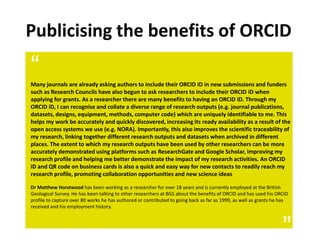
“Many journals are already asking authors to include their ORCID iD in new submissions and funders
such as Research Councils have also begun to ask researchers to include their ORCID iD when
applying for grants. As a researcher there are many benefits to having an ORCID iD. Through my
ORCID iD, I can recognise and collate a diverse range of research outputs (e.g. journal publications,
datasets, designs, equipment, methods, computer code) which are uniquely identifiable to me. This
helps my work be accurately and quickly discovered, increasing its ready availability as a result of the
open access systems we use (e.g. NORA). Importantly, this also improves the scientific traceability of
my research, linking together different research outputs and datasets when archived in different
places. The extent to which my research outputs have been used by other researchers can be more
accurately demonstrated using platforms such as ResearchGate and Google Scholar, improving my
research profile and helping me better demonstrate the impact of my research activities. An ORCID
iD and QR code on business cards is also a quick and easy way for new contacts to readily reach my
research profile, promoting collaboration opportunities and new science ideas
Dr Matthew Horstwood has been working as a researcher for over 18 years and is currently employed at the British
Geological Survey. He has been talking to other researchers at BGS about the benefits of ORCID and has used his ORCID
profile to capture over 80 works he has authored or contributed to going back as far as 1999, as well as grants he has
received and his employment history.
”
Publicising the benefits of ORCID
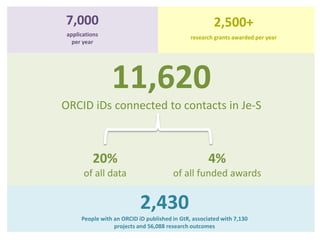
11,620
ORCID iDs connected to contacts in Je-S
20%
of all data
4%
of all funded awards
7,000
applications
per year
2,500+
research grants awarded per year
2,430
People with an ORCID iD published in GtR, associated with 7,130
projects and 56,088 research outcomes
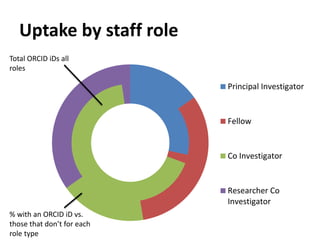
Uptake by staff role
Principal Investigator
Fellow
Co Investigator
Researcher Co
Investigator
Total ORCID iDs all
roles
% with an ORCID iD vs.
those that don’t for each
role type
Uptake by discipline area
PIs with an ORCID iD as % of all records in GtR
AHRC
BBSRC
EPSRC
ESRC
MRC
NERC
STFC
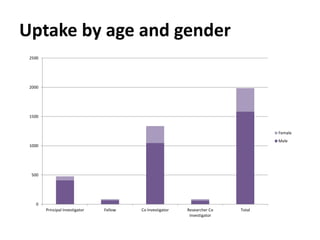
Uptake by age and gender
0
500
1000
1500
2000
2500
Principal Investigator Fellow Co Investigator Researcher Co
Investigator
Total
Female
Male
0
2000
4000
6000
8000
10000
12000
Principal Investigator Fellow Co Investigator Researcher Co Investigator Total
With iD
Total Male
0
500
1000
1500
2000
2500
Principal Investigator Fellow Co Investigator Researcher Co Investigator Total
With iD
Total Female
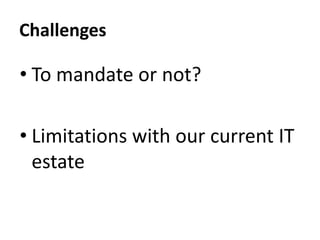
Challenges
• To mandate or not?
• Limitations with our current IT
estate
Top tips
• Keep things simple and prioritise requirements – helps
manage expectations!
• Think from the start where you want to be heading –
don’t close the door to future developments
• Focus on building work flows that create benefits for
researchers and wider system
• Tell the community what you're up to – blog, tweet etc.

ORCID for funders - Sarah Townsend

  • 1.
    ORCID webinar Sarah Townsend,Senior Advisor MBIE
  • 2.
    RCUK ORCID timeline Jun 15 Dec 15 May 16 Oct 16UKORCID consortium Launched by Jisc RCUK Become members of ORCID Je-S RCUK announce ORCID integration with Je-S GtR RCUK announce ORCID iDs published in GtR
  • 6.
    “Many journals arealready asking authors to include their ORCID iD in new submissions and funders such as Research Councils have also begun to ask researchers to include their ORCID iD when applying for grants. As a researcher there are many benefits to having an ORCID iD. Through my ORCID iD, I can recognise and collate a diverse range of research outputs (e.g. journal publications, datasets, designs, equipment, methods, computer code) which are uniquely identifiable to me. This helps my work be accurately and quickly discovered, increasing its ready availability as a result of the open access systems we use (e.g. NORA). Importantly, this also improves the scientific traceability of my research, linking together different research outputs and datasets when archived in different places. The extent to which my research outputs have been used by other researchers can be more accurately demonstrated using platforms such as ResearchGate and Google Scholar, improving my research profile and helping me better demonstrate the impact of my research activities. An ORCID iD and QR code on business cards is also a quick and easy way for new contacts to readily reach my research profile, promoting collaboration opportunities and new science ideas Dr Matthew Horstwood has been working as a researcher for over 18 years and is currently employed at the British Geological Survey. He has been talking to other researchers at BGS about the benefits of ORCID and has used his ORCID profile to capture over 80 works he has authored or contributed to going back as far as 1999, as well as grants he has received and his employment history. ” Publicising the benefits of ORCID
  • 7.
    11,620 ORCID iDs connectedto contacts in Je-S 20% of all data 4% of all funded awards 7,000 applications per year 2,500+ research grants awarded per year 2,430 People with an ORCID iD published in GtR, associated with 7,130 projects and 56,088 research outcomes
  • 10.
    Uptake by staffrole Principal Investigator Fellow Co Investigator Researcher Co Investigator Total ORCID iDs all roles % with an ORCID iD vs. those that don’t for each role type
  • 11.
    Uptake by disciplinearea PIs with an ORCID iD as % of all records in GtR AHRC BBSRC EPSRC ESRC MRC NERC STFC
  • 12.
    Uptake by ageand gender 0 500 1000 1500 2000 2500 Principal Investigator Fellow Co Investigator Researcher Co Investigator Total Female Male
  • 13.
    0 2000 4000 6000 8000 10000 12000 Principal Investigator FellowCo Investigator Researcher Co Investigator Total With iD Total Male 0 500 1000 1500 2000 2500 Principal Investigator Fellow Co Investigator Researcher Co Investigator Total With iD Total Female
  • 14.
    Challenges • To mandateor not? • Limitations with our current IT estate
  • 15.
    Top tips • Keepthings simple and prioritise requirements – helps manage expectations! • Think from the start where you want to be heading – don’t close the door to future developments • Focus on building work flows that create benefits for researchers and wider system • Tell the community what you're up to – blog, tweet etc.

Editor's Notes

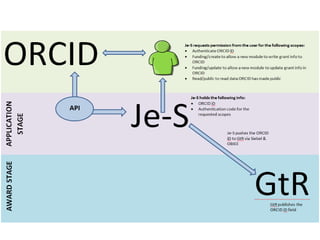
  • #4 This is what we’ve built
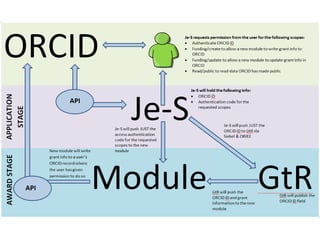
  • #5 This is where we’d like to be in future
  • #6 We did a lot to promote the integration of ORCID with our grants system including several blog posts
  • #7 A particular highlight was getting a researcher to talk about the benefits of ORCID in their own words and I think we should do more of this
  • #8 A few key numbers
  • #9 Here is what an ORCID iD looks like in GtR
  • #10 By holding the ORCID iD at the person account level in our system we are able to connect that person to all interactions they have had with the Research Councils. This also means that when their iD is published in GtR we get a public picture of all the funding they have received including legacy data. In this example I used Professor Donnison’s ORCID iD to search the GtR database. These results show me he has had a very active career going back to 2006 having been involved with 39 projects, from three different funders. 17 times as a Principal Investigator, 15 times as a co-Investigator and 7 times as a training grant holder. He is associated with 345 outcomes as a result of those 39 awards which I am able to drill down into if I want to find out more. All this starts to build a picture of a persons research career and their connections to other people involved with those awards and research outcomes. This information is publicly available and can be exported for further analysis.
  • #11 Looking at the data for one RC we can see that the largest proportion of roles types with an ORCID iD are Co and Principal Investigators. However looking at percentage of each role type who have an ORCID iD vs those that don’t for the same role type we see that Researcher Co-Investigators and Fellows are far more likely to have connected their ORCID iD with the Je-S system. PI – 17% with an ORCID iD/ 83% don’t Fellow – 36% with an ORCID iD/ 64% don’t Co-I – 20% with an ORCID iD/ 80% don’t Researcher Co-I – 39% with an ORCID iD/ 61% don’t
  • #12 Data taken from the RCUK Gateway to Research shows Principal Applicants by Research Council with an ORCID iD as a percentage of all records in GtR. Uptake appears to be most significant amongst principal applicants in the Science and Technology, Biological and Biosciences and Natural Environment discipline areas. Uptake appears to be lowest amongst applicants in the Economic and Social research disciplines. AHRC 4% BBSRC 7% EPSRC 6% ESRC 3% MRC 5% NERC 7% STFC 8%
  • #13 Researcher Co-Is and Fellows tend to primarily be researchers early in their career which could suggest that this is a factor in uptake. Looking further at our data the average age of Researcher Co-Investigators who have connected their ORCID iDs with Je-S is 38 years old compared to PIs who are 45 years old on average. The comparison in age between those that have an iD vs. those that don’t shows a slight preference towards younger researchers but only very marginally (only about 3 years difference across all role types). This would suggest that career stage is more significant than age.
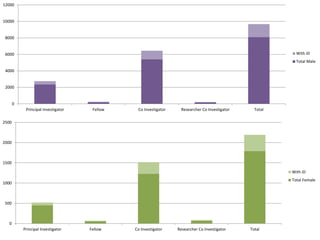
  • #14 Though from a numbers point of view females are grossly under represented, this is reflective of the imbalance of male to female contacts in the system overall. Looking at male/female ORCID iD connections in Je-S as a percentage of the total contacts in the system for one RC where a gender is present women are broadly similar to their male counterparts or even higher for some role types.