ORCID: RESEARCH IN A WORLD
WHERE MACHINES READ
ORCID WORKSHOP, VANCOUVER| OCTOBER 7, 2016
MATTHEW BUYS
orcid.org/0000-0001-7234-3684
REGIONAL DIRECTOR
ENGAGING RESEARCHERS
“Researchers want to be read,
acknowledged, and quoted.”
“Researchers want to spend
their time on research,
not reporting”
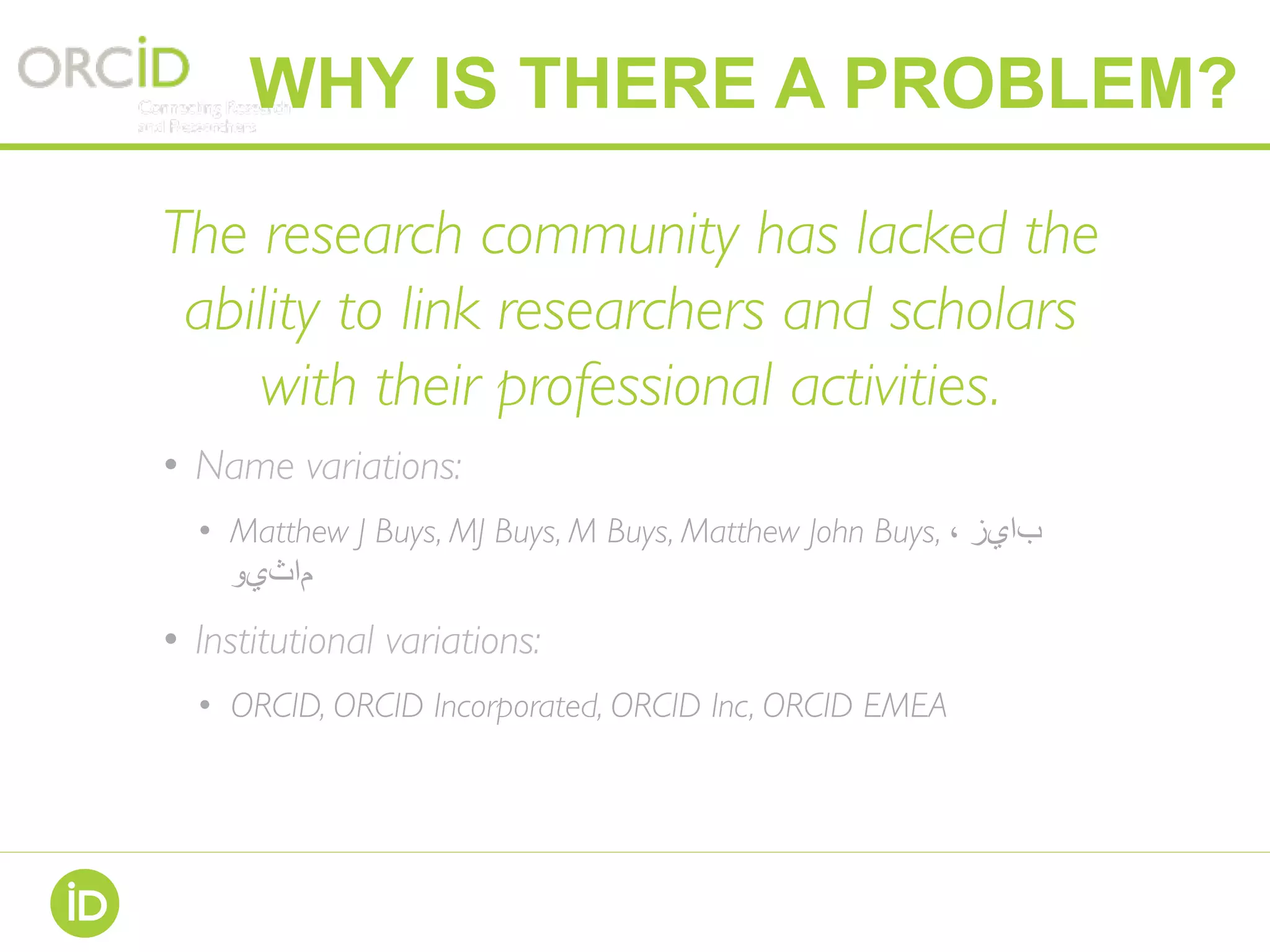
The research community has lacked the
ability to link researchers and scholars
with their professional activities.
•  Name variations:
•  Matthew J Buys, MJ Buys, M Buys, Matthew John Buys, ، ‫بايز‬
‫ماثيو‬
•  Institutional variations:
•  ORCID, ORCID Incorporated, ORCID Inc, ORCID EMEA
WHY IS THERE A PROBLEM?
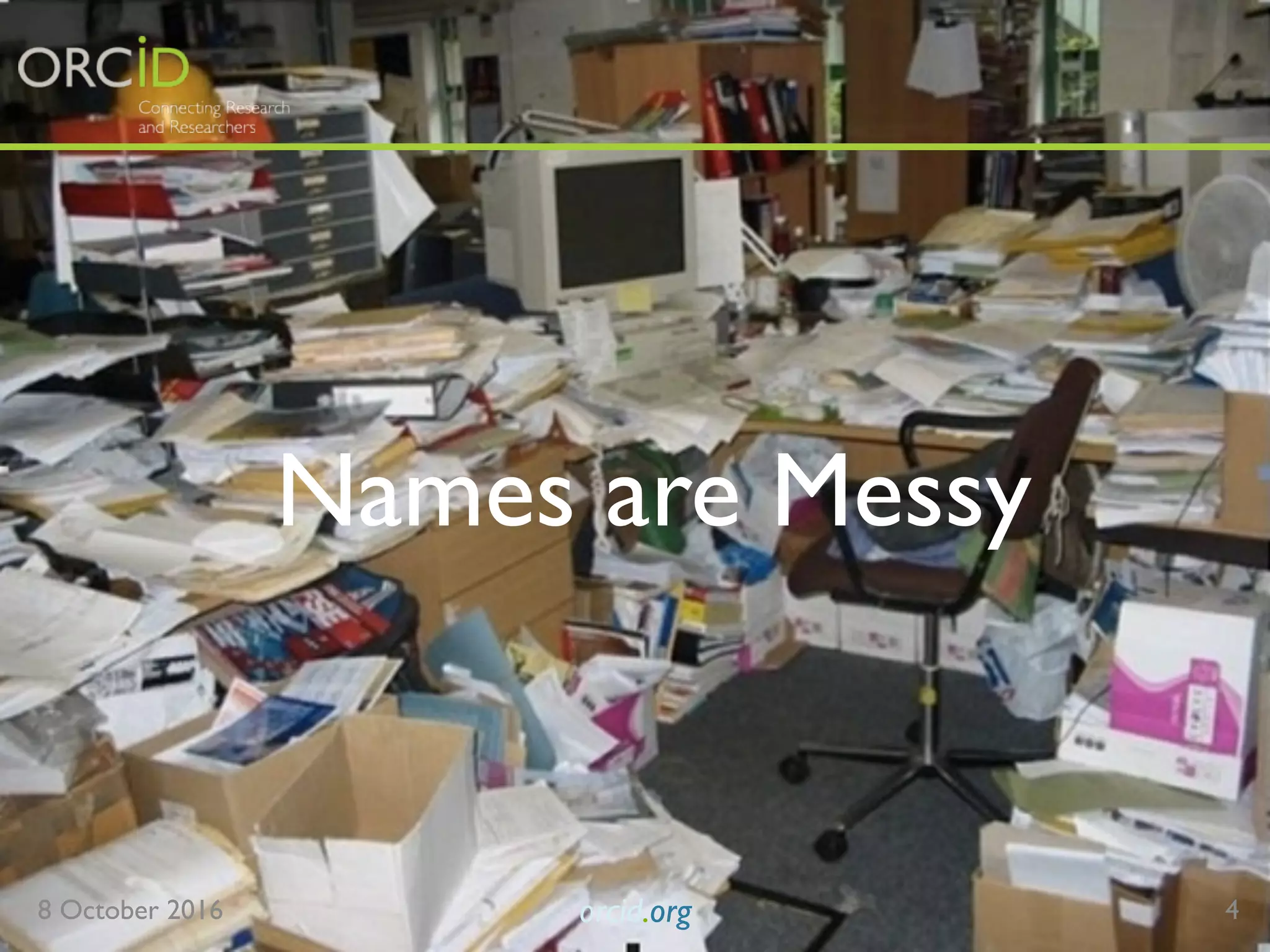
Names are Messy
8 October 2016 orcid.org 4
CAN NAMES BE CLEANED UP?
Of course they can!
We need to use digital names:
persistent identifiers that uniquely
specify the person, organization, or
object to which a name refers
SECTOR CHALLENGES
Publishers
•  Identity of an
author?
Affiliation?
•  Reviewer
credibility?
Employers
•  Tracking
research
outputs?
•  Tenure,
promotion?
•  External
funding?
Funders
•  Pre-award
evaluation?
•  Applicant
affiliation?
•  Post-award
evaluation?
RESEARCHER CHALLENGES
•  Unique identity? Multiple profiles?
•  Different affiliations?
•  Time consuming reporting requirements?
•  Linked professional activities from trusted
sources?
•  Peer review?
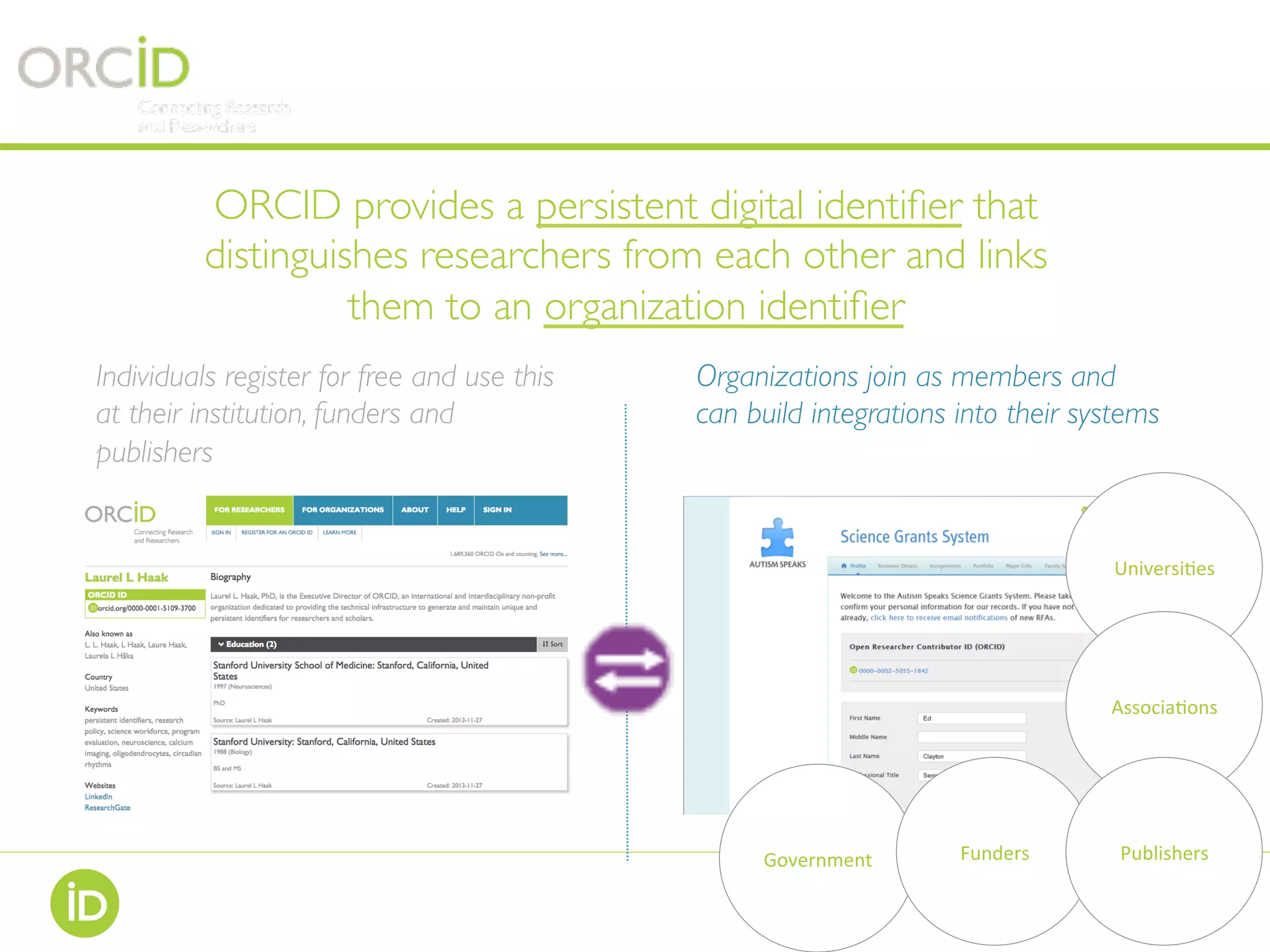
Government	
ORCID provides a persistent digital identifier that
distinguishes researchers from each other and links
them to an organization identifier
Individuals register for free and use this
at their institution, funders and
publishers
Organizations join as members and
can build integrations into their systems
Universi-es	
Funders	
Associa-ons	
Publishers
ORCID IS OPEN
• Non-proprietary and platform-neutral
• International service that integrates with
other researcher identifiers
• Registry use is free for individuals
• Independent non-profit membership
organization
• Open data, software, APIs, and
documentation
9
RESEARCHER
RESPONSIBILITY
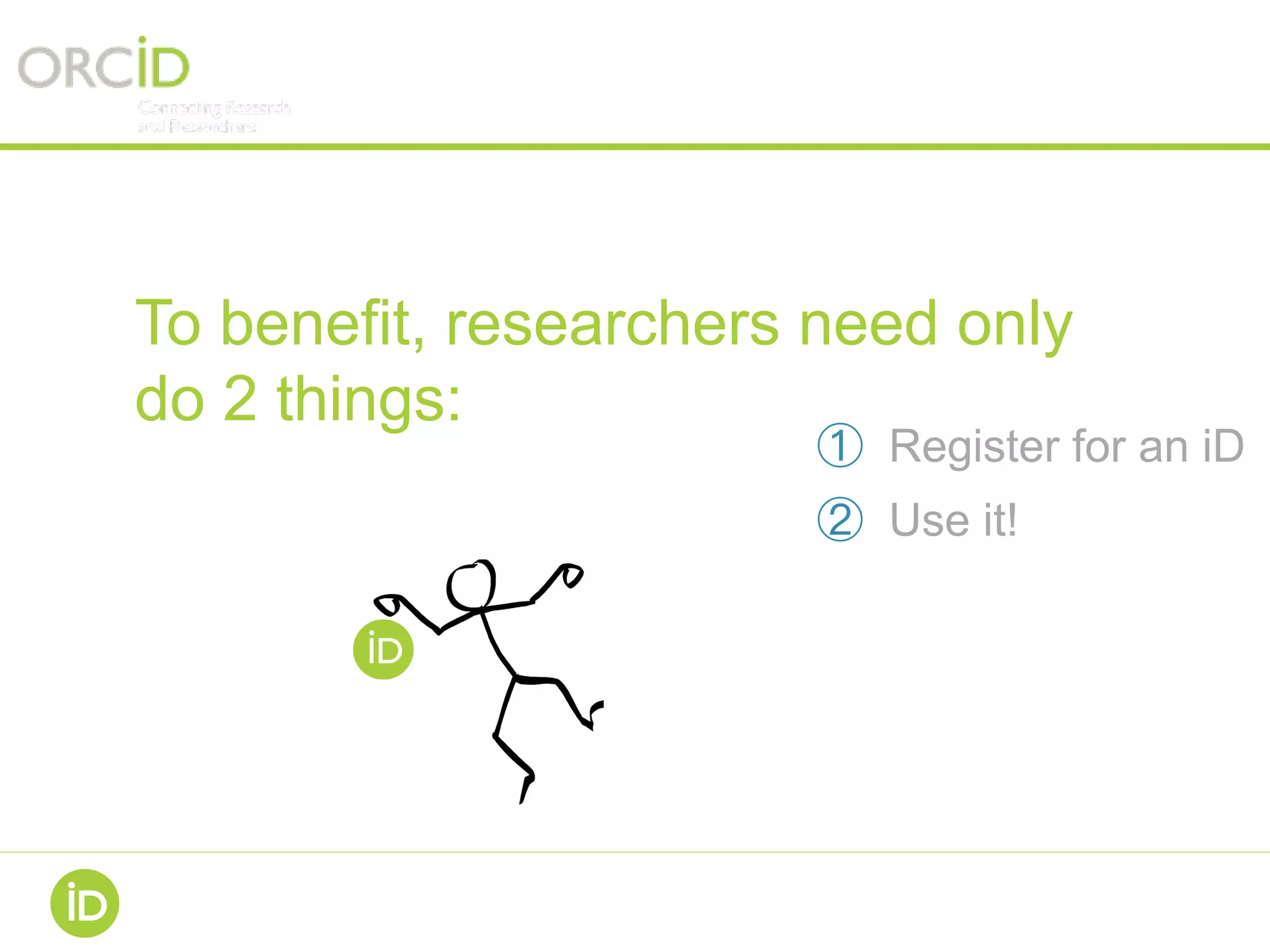
To benefit, researchers need only
do 2 things:
  Register for an iD
  Use it!
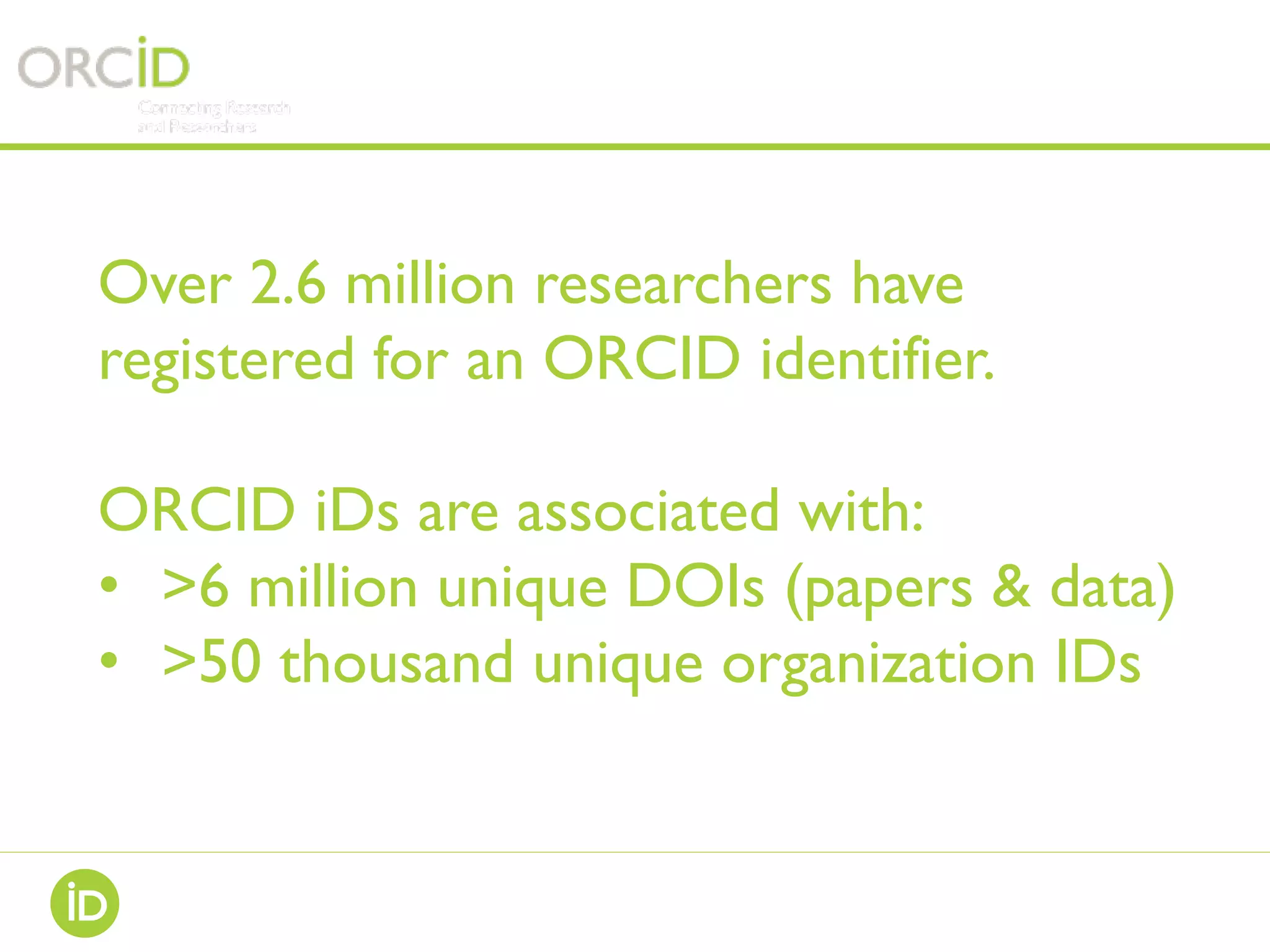
Over 2.6 million researchers have
registered for an ORCID identifier.
ORCID iDs are associated with:
•  >6 million unique DOIs (papers & data)
•  >50 thousand unique organization IDs
8 October 2016 orcid.org 12
8 October 2016 orcid.org 13
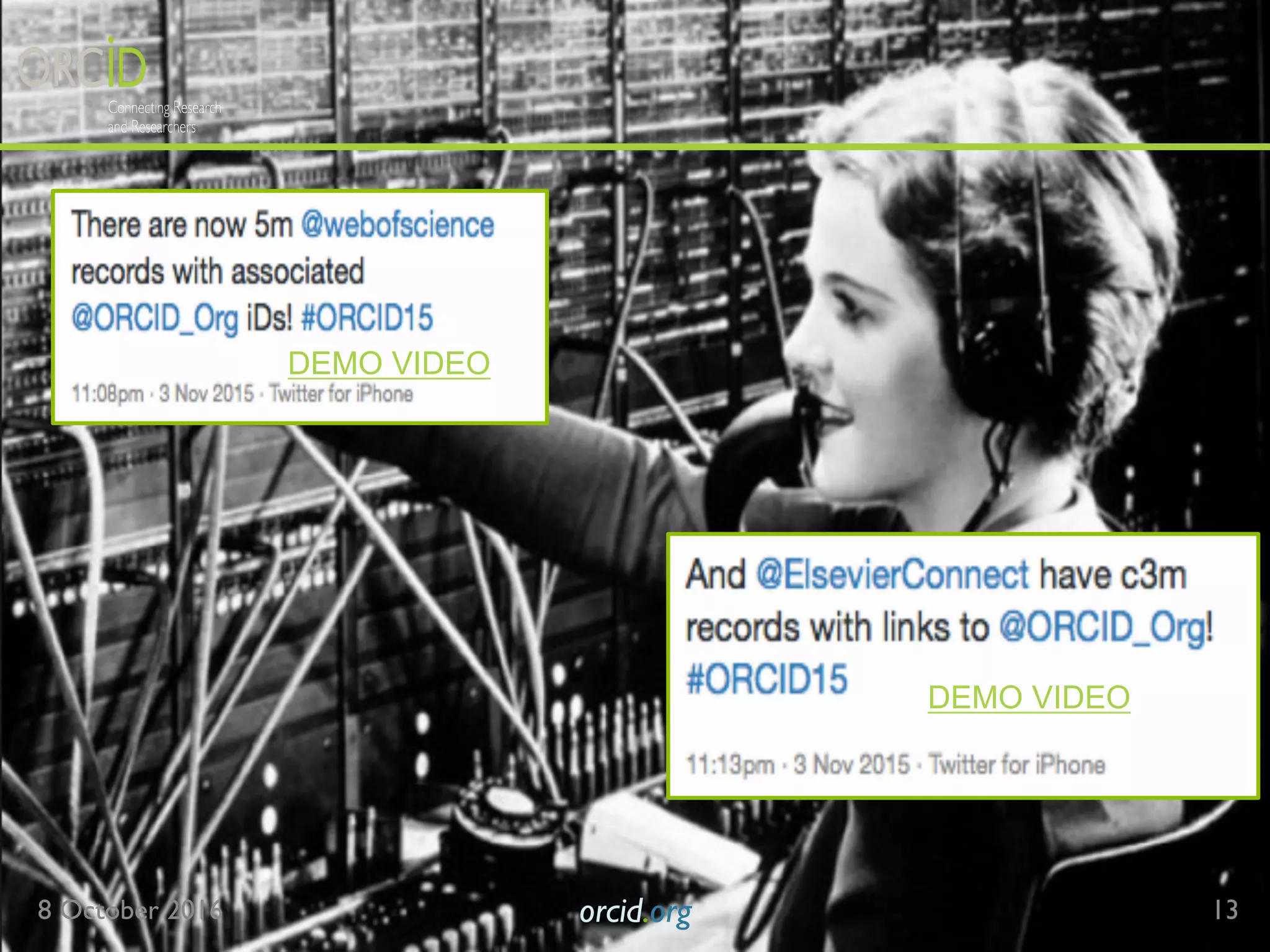
DEMO VIDEO
DEMO VIDEO
ORCID ENABLES ASSERTIONS
Organiza-ons	are	
use	ORCID	APIs	to	
authen-cate,	collect,	
display,	and	connect	
persistent	iden-fiers	
for	people,	places,	
and	things	in	
research	workflows
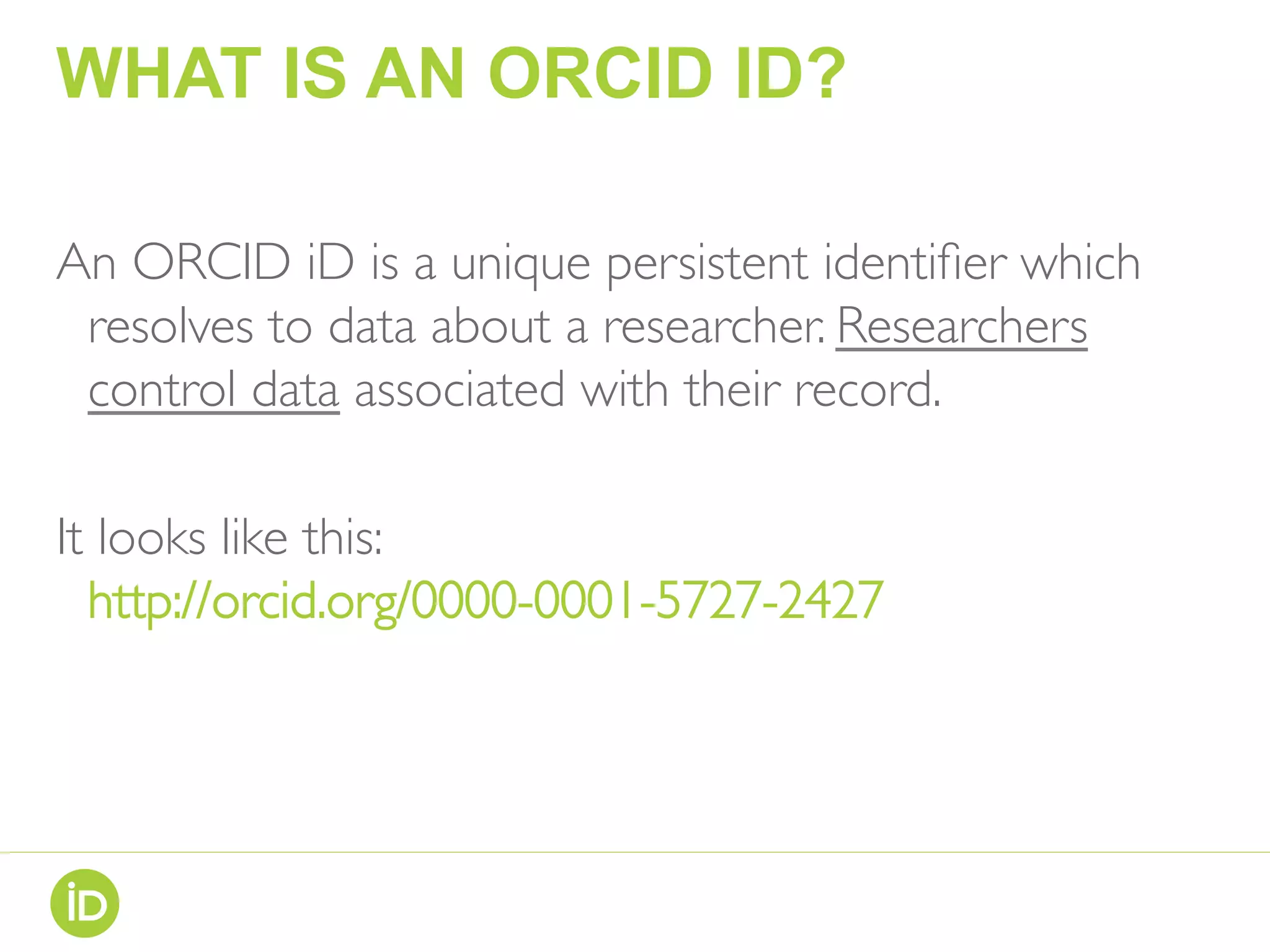
WHAT IS AN ORCID ID?
An ORCID iD is a unique persistent identifier which
resolves to data about a researcher. Researchers
control data associated with their record.
It looks like this:
http://orcid.org/0000-0001-5727-2427
WHAT’S IN A ORCID RECORD?
Organized into two sections.
Person:
Names, Countries, Keywords,Websites, Person
Identifiers, Biography
Activities:
Education, Employment, Funding, Peer Reviews, and
Works
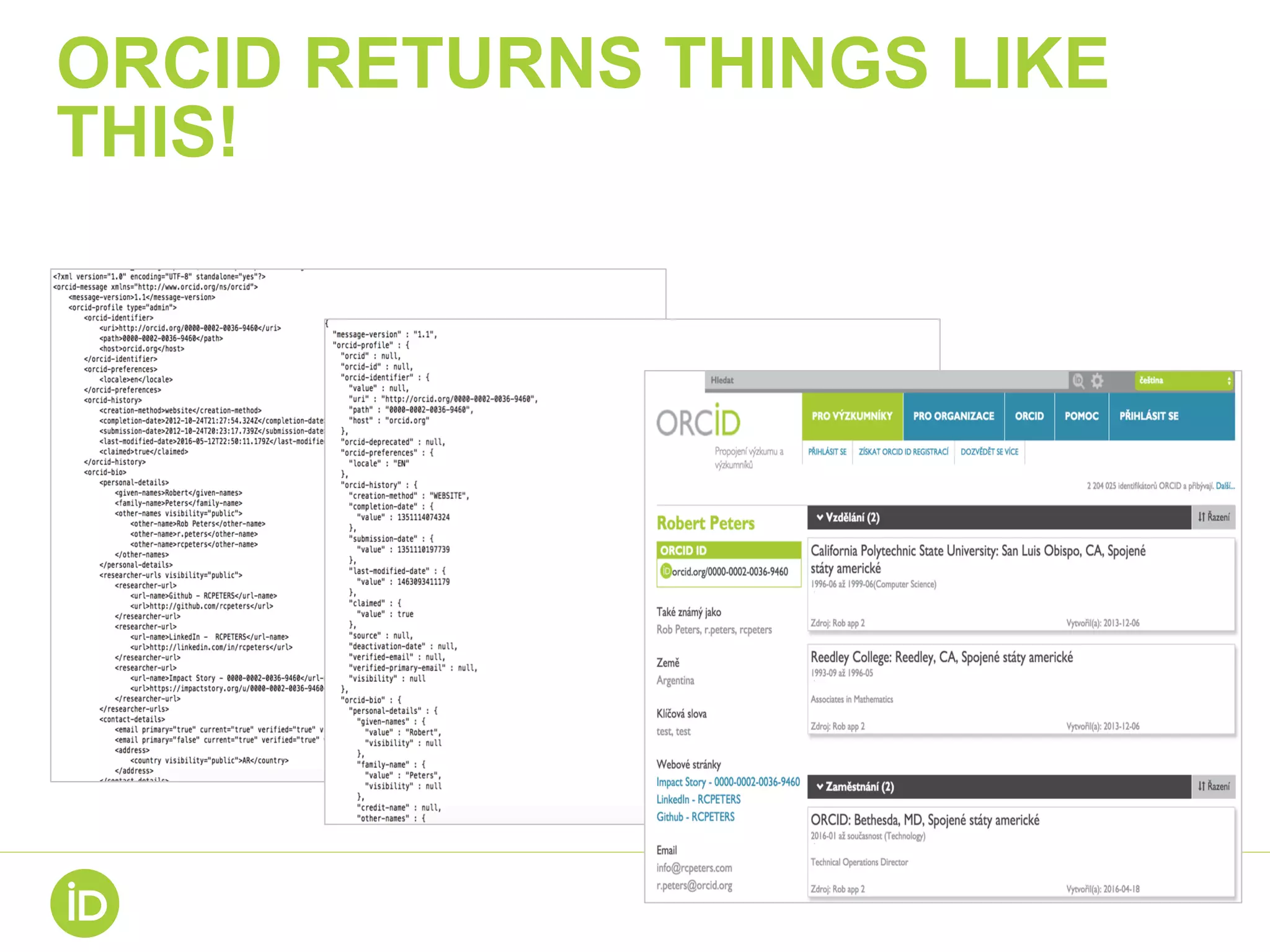
ORCID RETURNS THINGS LIKE
THIS!
XML	Data	
JSON	Data	
HTML
ORCID MEMBER API
Member API - Only available to member organizations
○ Read Limited (non-public information a researcher chooses
to share with a member organization)
○ Add and update records (requires users permission)
○ Webhooks
○ Researcher Notifications
ANY DISCIPLINE, ANY
COUNTRY
•  ORCID can connect to over 30 work types, in any
language
•  The Registry is available in 11 languages
•  We have staff in 9 countries who speak 7 languages
•  We have members in over 20 countries, across
disciplines
•  We have users in every country
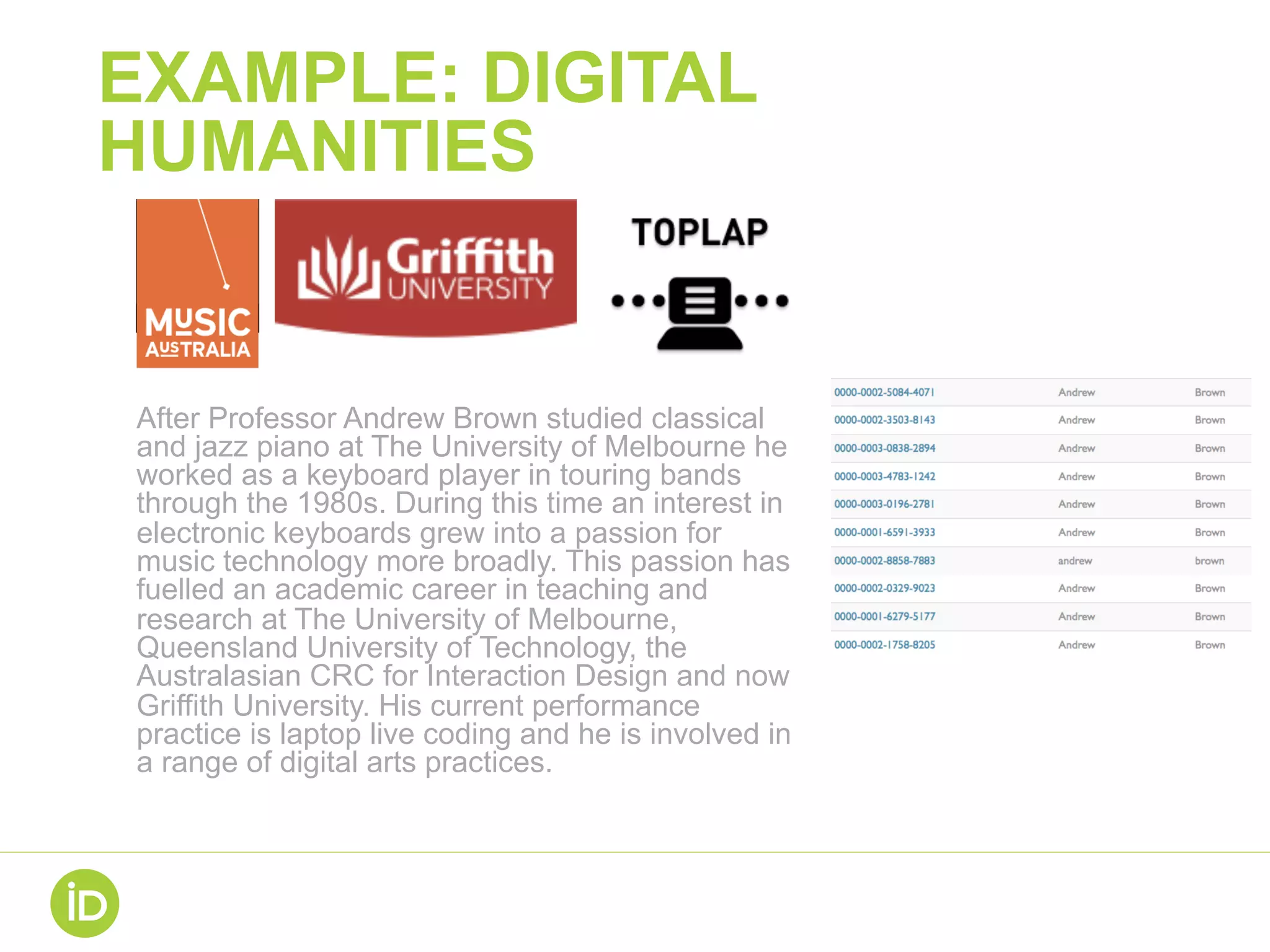
EXAMPLE: DIGITAL
HUMANITIES
After Professor Andrew Brown studied classical
and jazz piano at The University of Melbourne he
worked as a keyboard player in touring bands
through the 1980s. During this time an interest in
electronic keyboards grew into a passion for
music technology more broadly. This passion has
fuelled an academic career in teaching and
research at The University of Melbourne,
Queensland University of Technology, the
Australasian CRC for Interaction Design and now
Griffith University. His current performance
practice is laptop live coding and he is involved in
a range of digital arts practices.
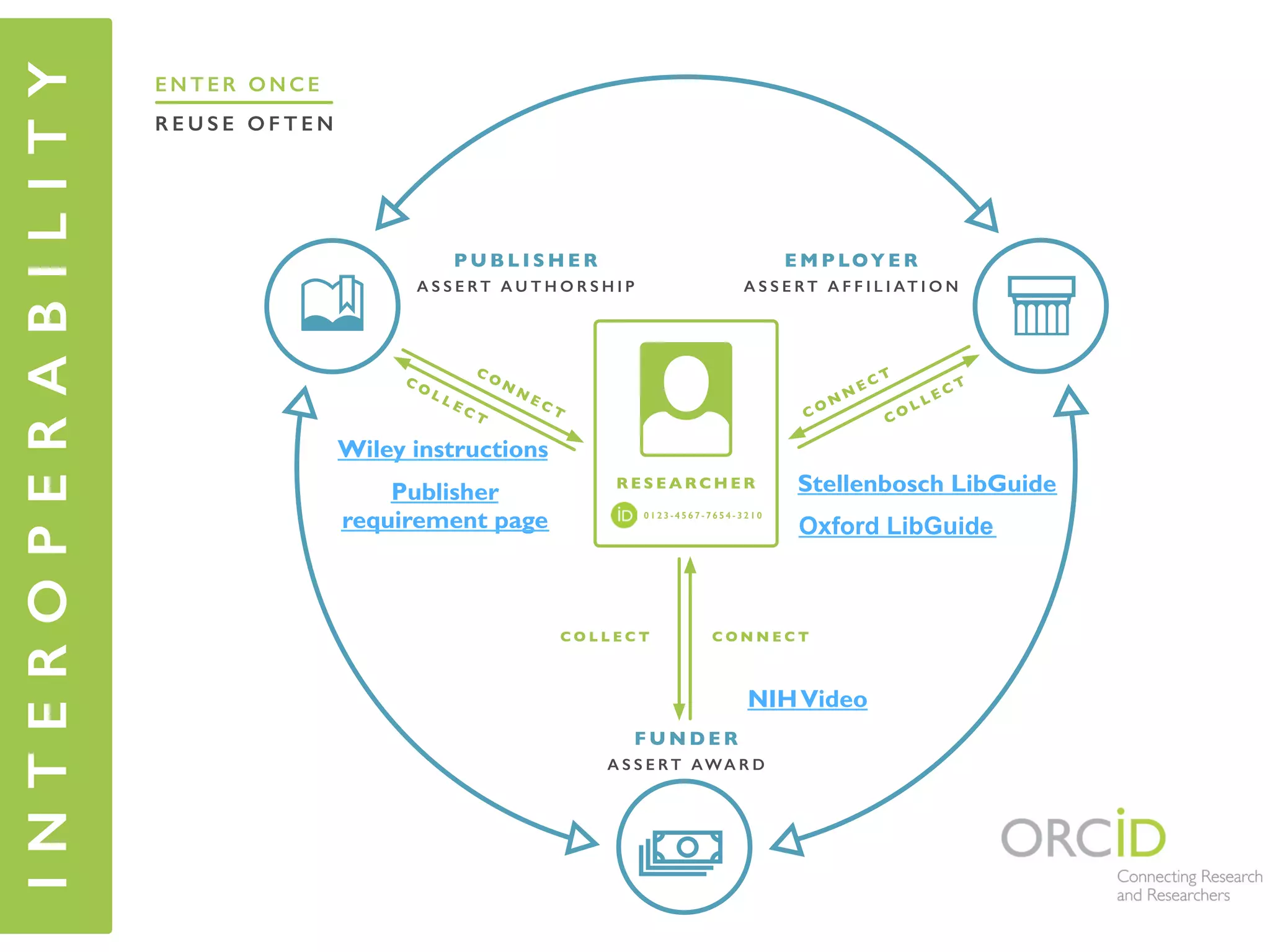
E N T E R O N C E
R E U S E O F T E N
INTEROPERABILITY
P U B L I S H E R
A S S E RT A U T H O R S H I P
E M P LOY E R
A S S E RT A F F I L I AT I O N
F U N D E R
A S S E RT AWA R D
C O N N E C TC O N
N
E C T
C O L L E C TC O L L E C T
C O L L E C T
R E S E A R C H E R
C O N N E C T
0 1 2 3 - 4 5 6 7 - 7 6 5 4 - 3 2 1 0
NIHVideo
Wiley instructions
Publisher
requirement page Oxford LibGuide
Stellenbosch LibGuide
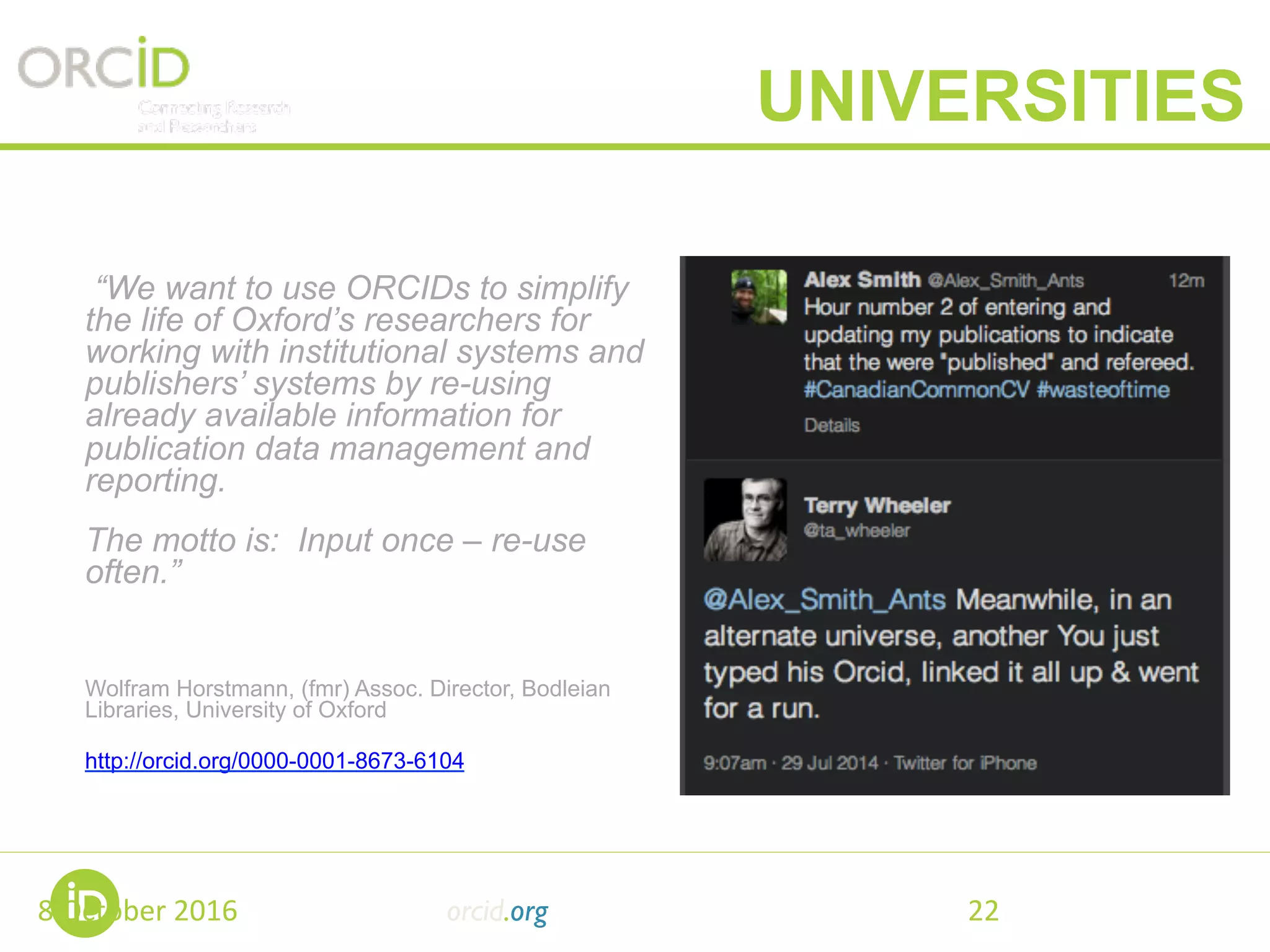
“We want to use ORCIDs to simplify
the life of Oxford’s researchers for
working with institutional systems and
publishers’ systems by re-using
already available information for
publication data management and
reporting.
The motto is: Input once – re-use
often.”
Wolfram Horstmann, (fmr) Assoc. Director, Bodleian
Libraries, University of Oxford
http://orcid.org/0000-0001-8673-6104
8	October	2016	 orcid.org 22	
UNIVERSITIES
FUNDERS
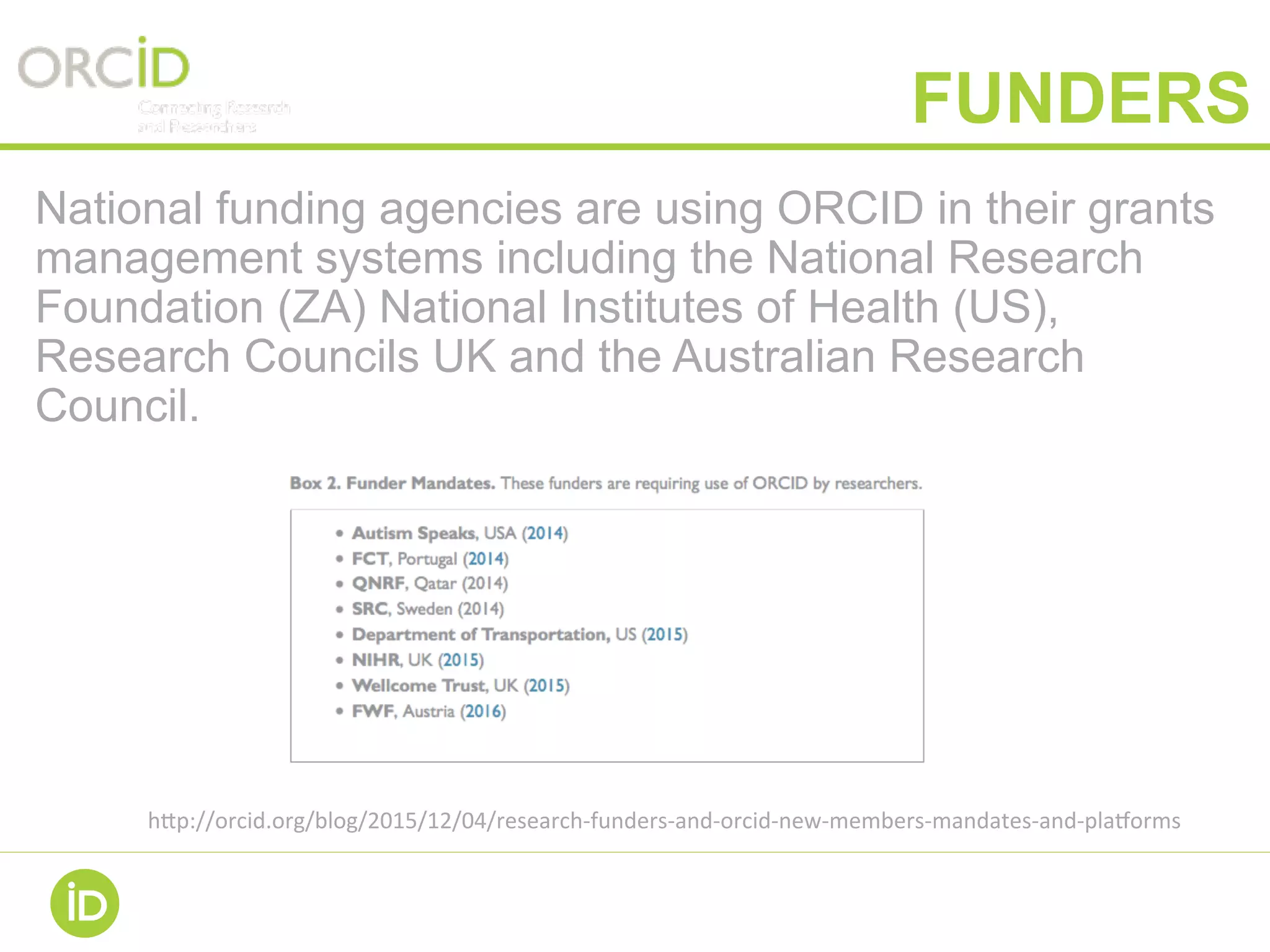
National funding agencies are using ORCID in their grants
management systems including the National Research
Foundation (ZA) National Institutes of Health (US),
Research Councils UK and the Australian Research
Council.
hMp://orcid.org/blog/2015/12/04/research-funders-and-orcid-new-members-mandates-and-plaTorms
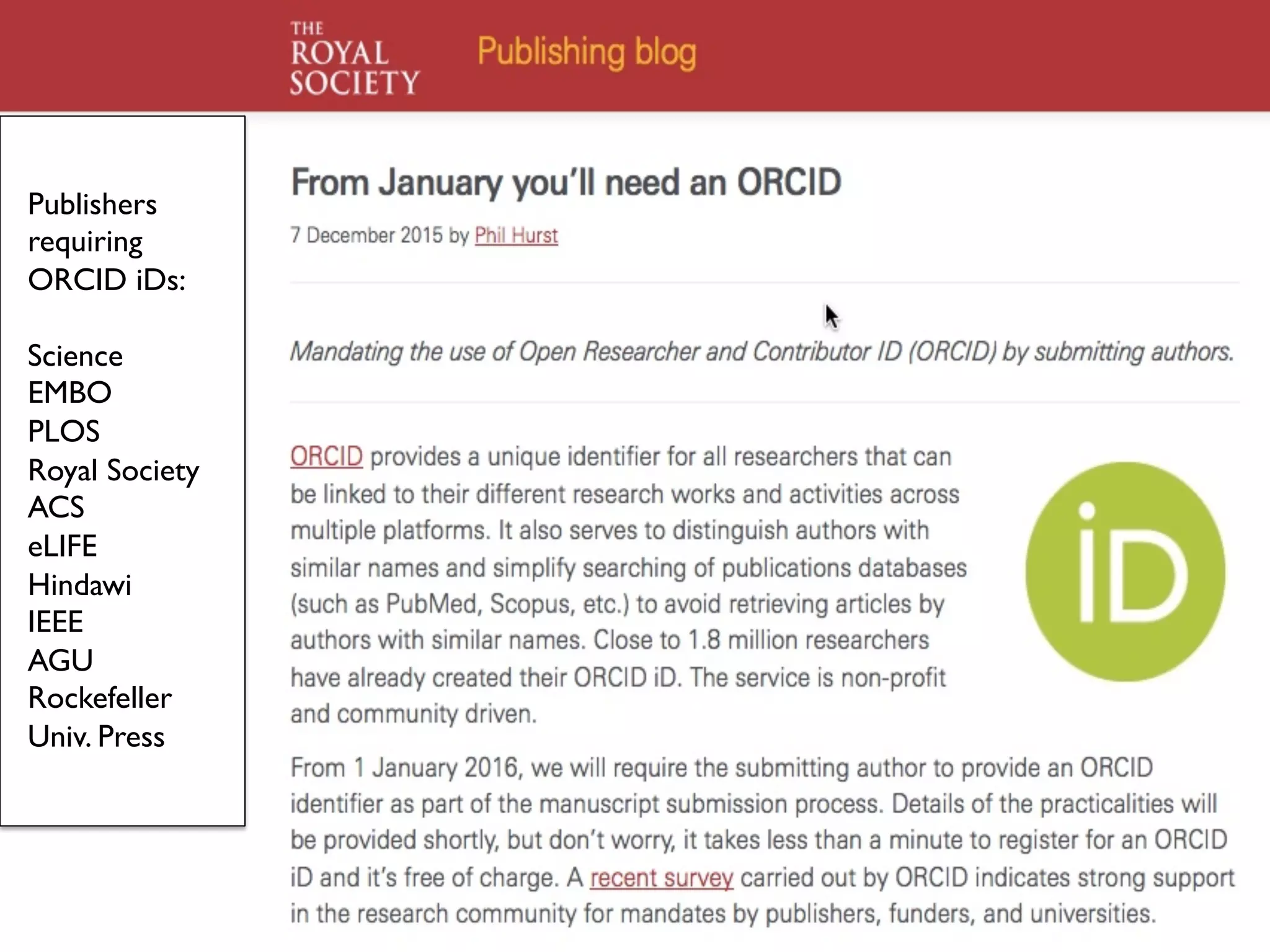
Publishers
requiring
ORCID iDs:
Science
EMBO
PLOS
Royal Society
ACS
eLIFE
Hindawi
IEEE
AGU
Rockefeller
Univ. Press
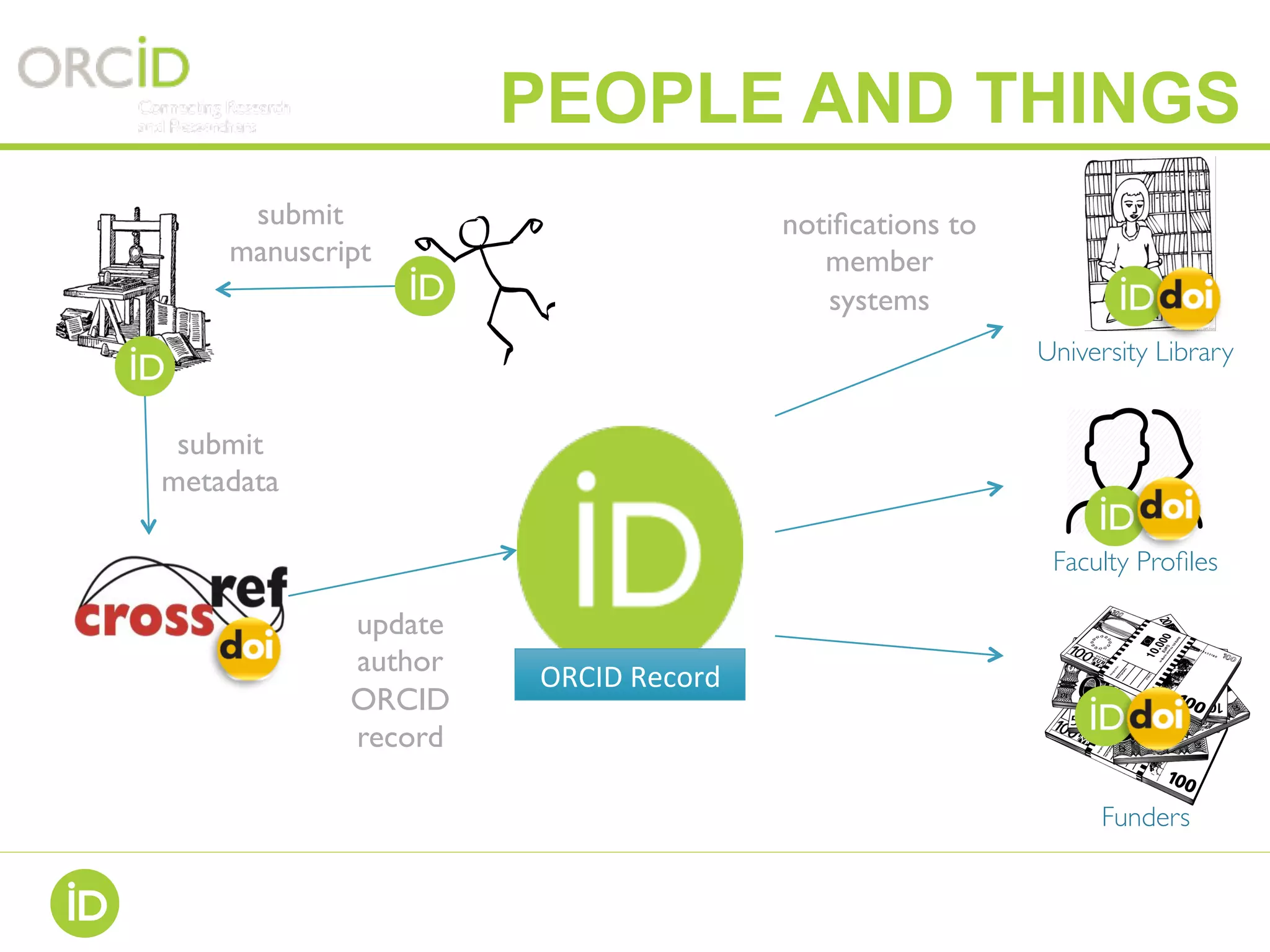
PEOPLE AND THINGS
ORCID	Record	
University Library
Funders
submit
manuscript
notifications to
member
systems
Faculty Profiles
submit
metadata
update
author
ORCID
record
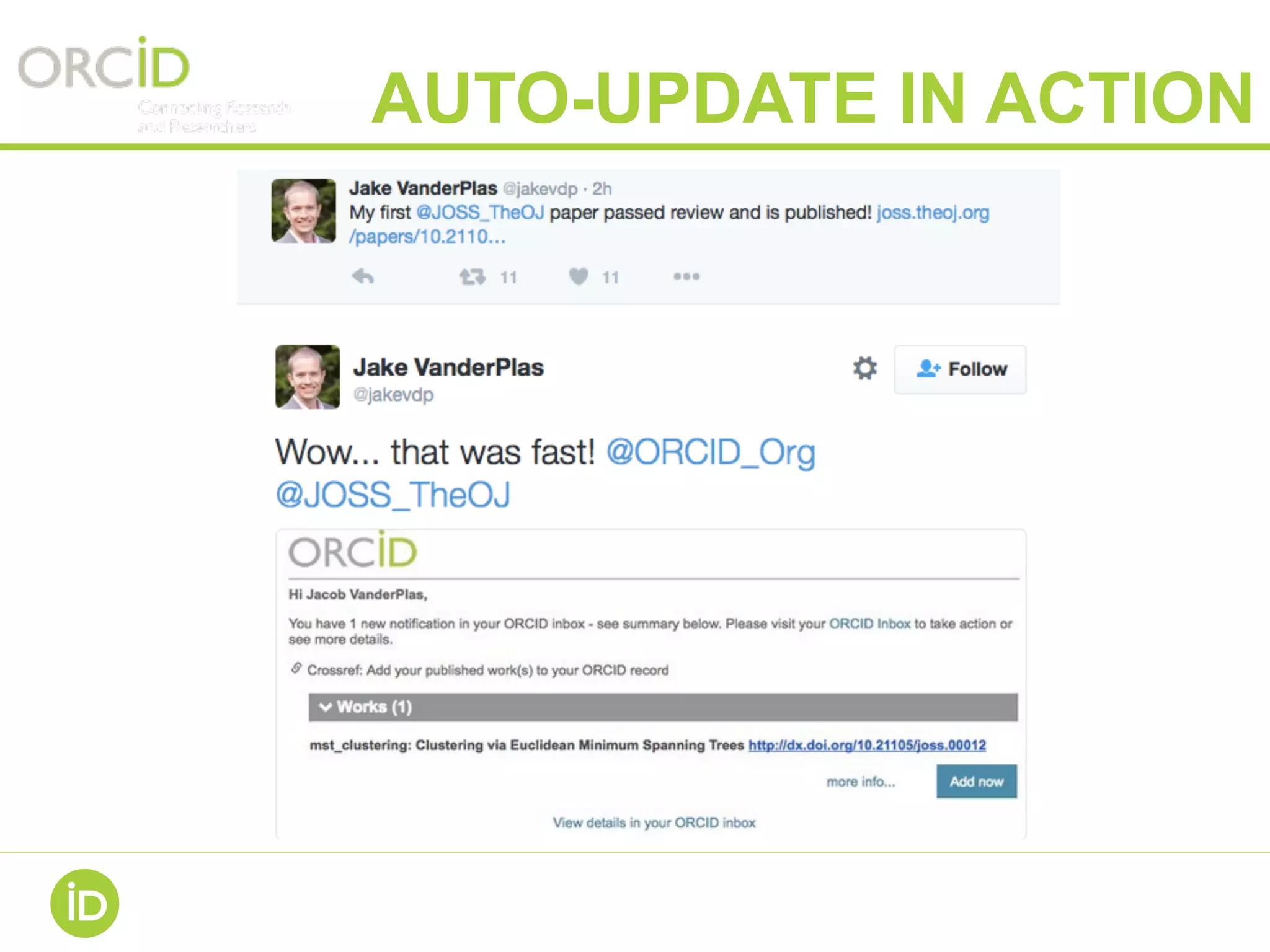
AUTO-UPDATE IN ACTION
The	ability	to	uniquely	iden-fy	
contributors	is	a	decep-vely	simple	
concept	which,	if	realised,	could	enable	
forms	of	real--me	understanding	of	
scien-fic	research	that	up	to	now	have	
been	extremely	costly	(if	not	impossible).	
--Jonathan	Kram,	Wellcome	Trust

Research in a world where machines read (Matthew Buys)

  • 1.
    ORCID: RESEARCH INA WORLD WHERE MACHINES READ ORCID WORKSHOP, VANCOUVER| OCTOBER 7, 2016 MATTHEW BUYS orcid.org/0000-0001-7234-3684 REGIONAL DIRECTOR
  • 2.
    ENGAGING RESEARCHERS “Researchers wantto be read, acknowledged, and quoted.” “Researchers want to spend their time on research, not reporting”
  • 3.
    The research communityhas lacked the ability to link researchers and scholars with their professional activities. •  Name variations: •  Matthew J Buys, MJ Buys, M Buys, Matthew John Buys, ، ‫بايز‬ ‫ماثيو‬ •  Institutional variations: •  ORCID, ORCID Incorporated, ORCID Inc, ORCID EMEA WHY IS THERE A PROBLEM?
  • 4.
    Names are Messy 8October 2016 orcid.org 4
  • 5.
    CAN NAMES BECLEANED UP? Of course they can! We need to use digital names: persistent identifiers that uniquely specify the person, organization, or object to which a name refers
  • 6.
    SECTOR CHALLENGES Publishers •  Identityof an author? Affiliation? •  Reviewer credibility? Employers •  Tracking research outputs? •  Tenure, promotion? •  External funding? Funders •  Pre-award evaluation? •  Applicant affiliation? •  Post-award evaluation?
  • 7.
    RESEARCHER CHALLENGES •  Uniqueidentity? Multiple profiles? •  Different affiliations? •  Time consuming reporting requirements? •  Linked professional activities from trusted sources? •  Peer review?
  • 8.
    Government ORCID provides apersistent digital identifier that distinguishes researchers from each other and links them to an organization identifier Individuals register for free and use this at their institution, funders and publishers Organizations join as members and can build integrations into their systems Universi-es Funders Associa-ons Publishers
  • 9.
    ORCID IS OPEN • Non-proprietaryand platform-neutral • International service that integrates with other researcher identifiers • Registry use is free for individuals • Independent non-profit membership organization • Open data, software, APIs, and documentation 9
  • 10.
    RESEARCHER RESPONSIBILITY To benefit, researchersneed only do 2 things:   Register for an iD   Use it!
  • 11.
    Over 2.6 millionresearchers have registered for an ORCID identifier. ORCID iDs are associated with: •  >6 million unique DOIs (papers & data) •  >50 thousand unique organization IDs
  • 12.
    8 October 2016orcid.org 12
  • 13.
    8 October 2016orcid.org 13 DEMO VIDEO DEMO VIDEO
  • 14.
  • 15.
    WHAT IS ANORCID ID? An ORCID iD is a unique persistent identifier which resolves to data about a researcher. Researchers control data associated with their record. It looks like this: http://orcid.org/0000-0001-5727-2427
  • 16.
    WHAT’S IN AORCID RECORD? Organized into two sections. Person: Names, Countries, Keywords,Websites, Person Identifiers, Biography Activities: Education, Employment, Funding, Peer Reviews, and Works
  • 17.
    ORCID RETURNS THINGSLIKE THIS! XML Data JSON Data HTML
  • 18.
    ORCID MEMBER API MemberAPI - Only available to member organizations ○ Read Limited (non-public information a researcher chooses to share with a member organization) ○ Add and update records (requires users permission) ○ Webhooks ○ Researcher Notifications
  • 19.
    ANY DISCIPLINE, ANY COUNTRY • ORCID can connect to over 30 work types, in any language •  The Registry is available in 11 languages •  We have staff in 9 countries who speak 7 languages •  We have members in over 20 countries, across disciplines •  We have users in every country
  • 20.
    EXAMPLE: DIGITAL HUMANITIES After ProfessorAndrew Brown studied classical and jazz piano at The University of Melbourne he worked as a keyboard player in touring bands through the 1980s. During this time an interest in electronic keyboards grew into a passion for music technology more broadly. This passion has fuelled an academic career in teaching and research at The University of Melbourne, Queensland University of Technology, the Australasian CRC for Interaction Design and now Griffith University. His current performance practice is laptop live coding and he is involved in a range of digital arts practices.
  • 21.
    E N TE R O N C E R E U S E O F T E N INTEROPERABILITY P U B L I S H E R A S S E RT A U T H O R S H I P E M P LOY E R A S S E RT A F F I L I AT I O N F U N D E R A S S E RT AWA R D C O N N E C TC O N N E C T C O L L E C TC O L L E C T C O L L E C T R E S E A R C H E R C O N N E C T 0 1 2 3 - 4 5 6 7 - 7 6 5 4 - 3 2 1 0 NIHVideo Wiley instructions Publisher requirement page Oxford LibGuide Stellenbosch LibGuide
  • 22.
    “We want touse ORCIDs to simplify the life of Oxford’s researchers for working with institutional systems and publishers’ systems by re-using already available information for publication data management and reporting. The motto is: Input once – re-use often.” Wolfram Horstmann, (fmr) Assoc. Director, Bodleian Libraries, University of Oxford http://orcid.org/0000-0001-8673-6104 8 October 2016 orcid.org 22 UNIVERSITIES
  • 23.
    FUNDERS National funding agenciesare using ORCID in their grants management systems including the National Research Foundation (ZA) National Institutes of Health (US), Research Councils UK and the Australian Research Council. hMp://orcid.org/blog/2015/12/04/research-funders-and-orcid-new-members-mandates-and-plaTorms
  • 24.
  • 25.
    PEOPLE AND THINGS ORCID Record UniversityLibrary Funders submit manuscript notifications to member systems Faculty Profiles submit metadata update author ORCID record
  • 26.
  • 27.