Oral Presentation Skills
Oral Presentation Skills 
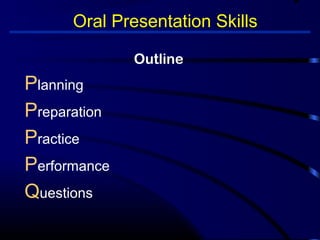
Outline 
Planning 
Preparation 
Practice 
Performance 
Questions
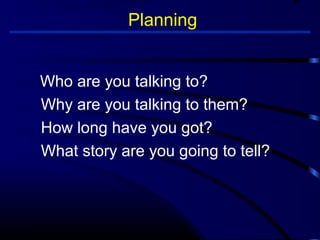
Planning 
 Who are you talking to? 
 Why are you talking to them? 
 How long have you got? 
 What story are you going to tell?
Preparation 
 Outline and sketch slides 
 Prepare slides 
 Proof read 
 Prepare notes - 
brief keywords and phrases, except 
maybe first couple of paragraphs
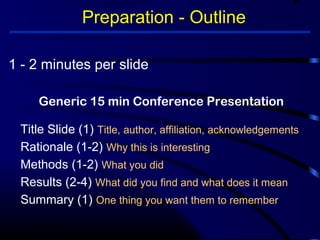
Preparation - Outline 
1 - 2 minutes per slide 
Generic 15 min Conference Presentation 
Title Slide (1) Title, author, affiliation, acknowledgements 
Rationale (1-2) Why this is interesting 
Methods (1-2) What you did 
Results (2-4) What did you find and what does it mean 
Summary (1) One thing you want them to remember
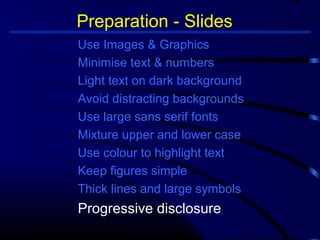
Preparation - Slides 
Use Images  Graphics 
Relevant images communicate, 
and maintain interest
Preparation - Slides 
Use Images  Graphics 
Minimise text  numbers
Preparation - Slides 
Use Images  Graphics 
Minimise text  numbers 
Light text on dark background
Preparation - Slides 
Use Images  Graphics 
Minimise text  numbers 
Light text on dark background 
Avoid distracting backgrounds
Preparation - Slides 
Use Images  Graphics 
Minimise text  numbers 
Light text on dark background 
Avoid distracting backgrounds 
Use large sans serif fonts 
Helvetica or Arial rather than serif fonts like Times 
24 pt is minimum, 32 pt, or even 36 pt is better
Preparation - Slides 
Use Images  Graphics 
Minimise text  numbers 
Light text on dark background 
Avoid distracting backgrounds 
Use large sans serif fonts 
Mix upper and lower case 
ALL CAPITALS IS HARDER TO READ, 
ALTHOUGH IT MIGHT BE OK FOR THE 
ODD TITLE
Preparation - Slides 
Use Images  Graphics 
Minimise text  numbers 
Light text on dark background 
Avoid distracting backgrounds 
Use large sans serif fonts 
Mix upper and lower case 
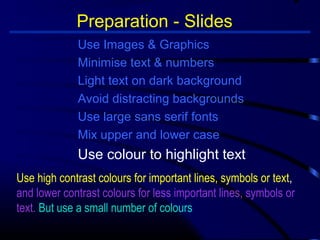
Use colour to highlight text 
Use high contrast colours for important lines, symbols or text, 
and lower contrast colours for less important lines, symbols or 
text. But use a small number of colours
Preparation - Slides 
Use Images  Graphics 
Minimise text  numbers 
Light text on dark background 
Avoid distracting backgrounds 
Use large sans serif fonts 
Mixture upper and lower case 
Use colour to highlight text 
Keep figures simple
Preparation - Slides 
Use Images  Graphics 
Minimise text  numbers 
Light text on dark background 
Avoid distracting backgrounds 
Use large sans serif fonts 
Mixture upper and lower case 
Use colour to highlight text 
Keep figures simple 
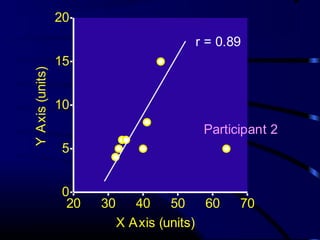
Thick lines and large symbols
20 
15 
r = 0.89 
units) 
(10 
Axis Y 5 
0 
20 30 40 50 60 70 Participant 2 
X Axis (units)
Preparation - Slides 
Use Images  Graphics 
Minimise text  numbers 
Light text on dark background 
Avoid distracting backgrounds 
Use large sans serif fonts 
Mixture upper and lower case 
Use colour to highlight text 
Keep figures simple 
Thick lines and large symbols 
Progressive disclosure
Practice 
Practice, practice, practice 
Get feedback, and use it. 
Be ruthless - delete unnecessary 
information
Performance 
Don’t Apologise 
Speak loudly  clearly 
Use short simple sentences 
Avoid jargon  abbrev. 
Vary pitch, tone, volume, speed and pauses
Performance 
Avoid distracting mannerisms 
Relax, be enthusiastic 
Make eye contact 
Keep an eye on the time remaining
Performance 
Explain figures, and 
point to important aspects 
Give a clear and concise summary, 
then stop. 
Don’t go overtime. Ever.
Questions 
Anticipate likely questions and 
prepare extra slides with the answers 
Maybe even plant a stooge
Questions 
Paraphrase questions 
1. so that other people hear the question
Questions 
Paraphrase questions 
1. so that other people hear the question 
2. to check you understand the questions
Questions 
Paraphrase questions 
1. so that other people hear the question 
2. to check you understand the questions 
3. to stall while you think about an answer
Questions 
If you don’t know the answer, say so. 
Offer to find out. 
Ask the audience.
Summary 
Like most things, 
the best way to learn is to do
ANY QUESTIONS … ?

Oral presentation skills

  • 1.
  • 2.
    Oral Presentation Skills Outline Planning Preparation Practice Performance Questions
  • 3.
    Planning Whoare you talking to? Why are you talking to them? How long have you got? What story are you going to tell?
  • 4.
    Preparation Outlineand sketch slides Prepare slides Proof read Prepare notes - brief keywords and phrases, except maybe first couple of paragraphs
  • 5.
    Preparation - Outline 1 - 2 minutes per slide Generic 15 min Conference Presentation Title Slide (1) Title, author, affiliation, acknowledgements Rationale (1-2) Why this is interesting Methods (1-2) What you did Results (2-4) What did you find and what does it mean Summary (1) One thing you want them to remember
  • 6.
    Preparation - Slides Use Images Graphics Relevant images communicate, and maintain interest
  • 7.
    Preparation - Slides Use Images Graphics Minimise text numbers
  • 8.
    Preparation - Slides Use Images Graphics Minimise text numbers Light text on dark background
  • 9.
    Preparation - Slides Use Images Graphics Minimise text numbers Light text on dark background Avoid distracting backgrounds
  • 10.
    Preparation - Slides Use Images Graphics Minimise text numbers Light text on dark background Avoid distracting backgrounds Use large sans serif fonts Helvetica or Arial rather than serif fonts like Times 24 pt is minimum, 32 pt, or even 36 pt is better
  • 11.
    Preparation - Slides Use Images Graphics Minimise text numbers Light text on dark background Avoid distracting backgrounds Use large sans serif fonts Mix upper and lower case ALL CAPITALS IS HARDER TO READ, ALTHOUGH IT MIGHT BE OK FOR THE ODD TITLE
  • 12.
    Preparation - Slides Use Images Graphics Minimise text numbers Light text on dark background Avoid distracting backgrounds Use large sans serif fonts Mix upper and lower case Use colour to highlight text Use high contrast colours for important lines, symbols or text, and lower contrast colours for less important lines, symbols or text. But use a small number of colours
  • 13.
    Preparation - Slides Use Images Graphics Minimise text numbers Light text on dark background Avoid distracting backgrounds Use large sans serif fonts Mixture upper and lower case Use colour to highlight text Keep figures simple
  • 14.
    Preparation - Slides Use Images Graphics Minimise text numbers Light text on dark background Avoid distracting backgrounds Use large sans serif fonts Mixture upper and lower case Use colour to highlight text Keep figures simple Thick lines and large symbols
  • 15.
    20 15 r= 0.89 units) (10 Axis Y 5 0 20 30 40 50 60 70 Participant 2 X Axis (units)
  • 16.
    Preparation - Slides Use Images Graphics Minimise text numbers Light text on dark background Avoid distracting backgrounds Use large sans serif fonts Mixture upper and lower case Use colour to highlight text Keep figures simple Thick lines and large symbols Progressive disclosure
  • 17.
    Practice Practice, practice,practice Get feedback, and use it. Be ruthless - delete unnecessary information
  • 18.
    Performance Don’t Apologise Speak loudly clearly Use short simple sentences Avoid jargon abbrev. Vary pitch, tone, volume, speed and pauses
  • 19.
    Performance Avoid distractingmannerisms Relax, be enthusiastic Make eye contact Keep an eye on the time remaining
  • 20.
    Performance Explain figures,and point to important aspects Give a clear and concise summary, then stop. Don’t go overtime. Ever.
  • 21.
    Questions Anticipate likelyquestions and prepare extra slides with the answers Maybe even plant a stooge
  • 22.
    Questions Paraphrase questions 1. so that other people hear the question
  • 23.
    Questions Paraphrase questions 1. so that other people hear the question 2. to check you understand the questions
  • 24.
    Questions Paraphrase questions 1. so that other people hear the question 2. to check you understand the questions 3. to stall while you think about an answer
  • 25.
    Questions If youdon’t know the answer, say so. Offer to find out. Ask the audience.
  • 26.
    Summary Like mostthings, the best way to learn is to do
  • 27.