© led
Functions, Nature and Process
of Communication
MERAVE M. CANDELARIA
TEACHER III
At the end of the session, the Grade 11 students
should be able to perform the following tasks
with 75% success:
I.Objectives:
© led
Define communication,
Demonstrate the different ways of
communication,
Appreciate the importance of
communication
Develop sense of respect when
© led
II. Subject Matter
Content Standards
The learner understands the nature and elements
of oral communication in context.
PerformanceStandards
The learner designs and performs effective
controlled and uncontrolled oral
communication activities based on context.
© led
D. Materials
1.Video Clip
2.Laptop
3.LED Monitor
4.Textbook
5.Picture cut-outs
© led
Introductory Activity
COMMUNICATI ON
Processing of Output:
1.Are these words relevant to our
community?
2.How do we communicate in the
community?
3.Why is communication important
in community?
There is no doubt that
communication plays a vital role
in human life and human society.
It not only helps to facilitate the
process of sharing information and
knowledge with others, but also
helps people to develop
relationships with others.
PERFORMANCE ACTIVITY
Each group will perform the
different ways of communication.
Group 1: Teenager asking permission
from his/her parents to attend a
party, however the parents did not
allow the teenager to go because of
COVID 19 Pandemic.(dialogue)
Group 2: A wife having a
conversation with her
husband who is under a
strict quarantine.(creative
monologue)
Group 3: DRRM personnel
giving announcement about
the incoming typhoon thru
radio and TV.(newscasting)
RUBRICS
Criteria
Excellent (4) Proficient
(3)
Adequate (2) Limited (1)
Participation
Always
willing and
focused
during group
work and
presentation
Usually
willing and
focused
during group
work and
presentation
Sometimes
willing and
focused
during group
work and
presentation
Rarely
willing and
focused
during group
work and
presentation
Achievement of purpose
Use of non- verbal cues
(voice, gestures, eye
contact)
Imagination and Creativity
Purpose is
clearly
established
and
effectively
sustained
Purpose is
clearly
established
and
generally
sustained
Purpose is
established
but may not
be sustained
Purpose is
vaguely
established
and may
not be
sustained
Use of non- verbal cues
(voice, gestures, eye
contact)
Impressive
variety of
non-verbal
cues are
used in an
exemplary
way
Good
variety of
non-verbal
cues are
used in an
competent
way
Satisfactory
variety of
non-verbal
cues are
used in an
acceptable
way
Limited
variety of
non-verbal
cues are
used in an
developing
way
Imagination and Creativity Choices
demonstrate
insight and
powerfully
enhance role
play
Choices
demonstrat
e
thoughtfuln
ess and
completely
Choices
demonstrat e
awareness
and
developing
acceptably
Choices
demonstrat
e little
awareness
and do little
to enhance
Guide Questions:
How did you find the activity?
How did the characters in the scenario
deliver the message?
Are the messages clear?
What are the ways of communication
that were used in the presentation?
If there is one thing you wanted to
emphasize in the delivery of the
message, what would it be?
What is communication?
Communication comes from the
latin term “communis” which
means to “ share and inform
ideas, feelings, etc.”
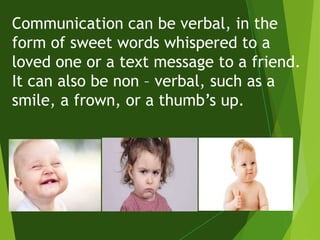
Communication can be verbal, in the
form of sweet words whispered to a
loved one or a text message to a friend.
It can also be non – verbal, such as a
smile, a frown, or a thumb’s up.
lt is the process of sharing our
ideas, thoughts, and feelings with
other people and having those
ideas, thoughts, and feelings
understood by the people we are
talking with.
 When we communicate we speak,
listen, and observe.
Guide Questions:
 Which picture depicts good
communication? Why did you say
so?
What is the importance of
communication?
How are you going to use the
different ways of communication?
“As you continue to reach your goals,
specifically your educational goals,
communication will become
increasingly more important.
 The ability to communicate is a
primary skill.
The more you become an effective
communicator; the more likely you are
to achieve what you want.
When you improve your communication
skills, you will have a clearer
understanding of what people are
saying to you, others will be less likely to
misunderstand you, problems will be
solved quickly, and you will be able to
resolve conflict.”
When you improve your communication
skills, you will have a clearer
understanding of what people are
saying to you, others will be less likely to
misunderstand you, problems will be
solved quickly, and you will be able to
resolve conflict.”
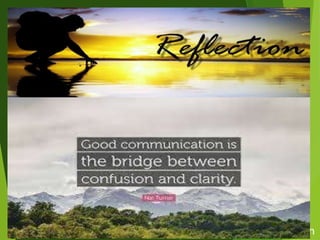
Write a reflective essay regarding their
understanding on communication and
how it will help them become an
effective communicator. Have it
recorded and send the video through
email.
© Joash
Thank you..

ORAL COM-CO.pptx

  • 1.
    © led Functions, Natureand Process of Communication MERAVE M. CANDELARIA TEACHER III
  • 2.
    At the endof the session, the Grade 11 students should be able to perform the following tasks with 75% success: I.Objectives: © led Define communication, Demonstrate the different ways of communication, Appreciate the importance of communication Develop sense of respect when
  • 3.
    © led II. SubjectMatter Content Standards The learner understands the nature and elements of oral communication in context. PerformanceStandards The learner designs and performs effective controlled and uncontrolled oral communication activities based on context.
  • 4.
    © led D. Materials 1.VideoClip 2.Laptop 3.LED Monitor 4.Textbook 5.Picture cut-outs
  • 5.
  • 6.
  • 7.
    Processing of Output: 1.Arethese words relevant to our community? 2.How do we communicate in the community? 3.Why is communication important in community?
  • 8.
    There is nodoubt that communication plays a vital role in human life and human society. It not only helps to facilitate the process of sharing information and knowledge with others, but also helps people to develop relationships with others.
  • 9.
    PERFORMANCE ACTIVITY Each groupwill perform the different ways of communication. Group 1: Teenager asking permission from his/her parents to attend a party, however the parents did not allow the teenager to go because of COVID 19 Pandemic.(dialogue)
  • 10.
    Group 2: Awife having a conversation with her husband who is under a strict quarantine.(creative monologue) Group 3: DRRM personnel giving announcement about the incoming typhoon thru radio and TV.(newscasting)
  • 11.
    RUBRICS Criteria Excellent (4) Proficient (3) Adequate(2) Limited (1) Participation Always willing and focused during group work and presentation Usually willing and focused during group work and presentation Sometimes willing and focused during group work and presentation Rarely willing and focused during group work and presentation Achievement of purpose Use of non- verbal cues (voice, gestures, eye contact) Imagination and Creativity Purpose is clearly established and effectively sustained Purpose is clearly established and generally sustained Purpose is established but may not be sustained Purpose is vaguely established and may not be sustained Use of non- verbal cues (voice, gestures, eye contact) Impressive variety of non-verbal cues are used in an exemplary way Good variety of non-verbal cues are used in an competent way Satisfactory variety of non-verbal cues are used in an acceptable way Limited variety of non-verbal cues are used in an developing way Imagination and Creativity Choices demonstrate insight and powerfully enhance role play Choices demonstrat e thoughtfuln ess and completely Choices demonstrat e awareness and developing acceptably Choices demonstrat e little awareness and do little to enhance
  • 12.
    Guide Questions: How didyou find the activity? How did the characters in the scenario deliver the message? Are the messages clear? What are the ways of communication that were used in the presentation? If there is one thing you wanted to emphasize in the delivery of the message, what would it be?
  • 13.
    What is communication? Communicationcomes from the latin term “communis” which means to “ share and inform ideas, feelings, etc.”
  • 14.
    Communication can beverbal, in the form of sweet words whispered to a loved one or a text message to a friend. It can also be non – verbal, such as a smile, a frown, or a thumb’s up.
  • 15.
    lt is theprocess of sharing our ideas, thoughts, and feelings with other people and having those ideas, thoughts, and feelings understood by the people we are talking with.  When we communicate we speak, listen, and observe.
  • 17.
    Guide Questions:  Whichpicture depicts good communication? Why did you say so? What is the importance of communication? How are you going to use the different ways of communication?
  • 18.
    “As you continueto reach your goals, specifically your educational goals, communication will become increasingly more important.  The ability to communicate is a primary skill. The more you become an effective communicator; the more likely you are to achieve what you want.
  • 19.
    When you improveyour communication skills, you will have a clearer understanding of what people are saying to you, others will be less likely to misunderstand you, problems will be solved quickly, and you will be able to resolve conflict.”
  • 20.
    When you improveyour communication skills, you will have a clearer understanding of what people are saying to you, others will be less likely to misunderstand you, problems will be solved quickly, and you will be able to resolve conflict.”
  • 22.
    Write a reflectiveessay regarding their understanding on communication and how it will help them become an effective communicator. Have it recorded and send the video through email.
  • 23.
  • 24.