Oral rivaroxaban alone for the
treatment of symptomatic pulmonary
embolism: the EINSTEIN PE study
Harry R Büller
on behalf of the EINSTEIN Investigators
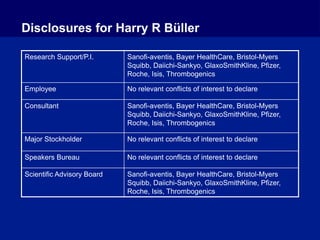
Disclosures for Harry R Büller
Research Support/P.I. Sanofi-aventis, Bayer HealthCare, Bristol-Myers
Squibb, Daiichi-Sankyo, GlaxoSmithKline, Pfizer,
Roche, Isis, Thrombogenics
Employee No relevant conflicts of interest to declare
Consultant Sanofi-aventis, Bayer HealthCare, Bristol-Myers
Squibb, Daiichi-Sankyo, GlaxoSmithKline, Pfizer,
Roche, Isis, Thrombogenics
Major Stockholder No relevant conflicts of interest to declare
Speakers Bureau No relevant conflicts of interest to declare
Scientific Advisory Board Sanofi-aventis, Bayer HealthCare, Bristol-Myers
Squibb, Daiichi-Sankyo, GlaxoSmithKline, Pfizer,
Roche, Isis, Thrombogenics
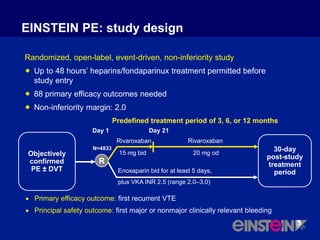
EINSTEIN PE: study design
Randomized, open-label, event-driven, non-inferiority study
 Up to 48 hours’ heparins/fondaparinux treatment permitted before
study entry
 88 primary efficacy outcomes needed
 Non-inferiority margin: 2.0
Predefined treatment period of 3, 6, or 12 months
15 mg bid
Rivaroxaban
Day 1 Day 21
Enoxaparin bid for at least 5 days,
plus VKA INR 2.5 (range 2.0–3.0)
20 mg od
N=4833
Rivaroxaban
R
Objectively
confirmed
PE ± DVT
30-day
post-study
treatment
period
 Primary efficacy outcome: first recurrent VTE
 Principal safety outcome: first major or nonmajor clinically relevant bleeding
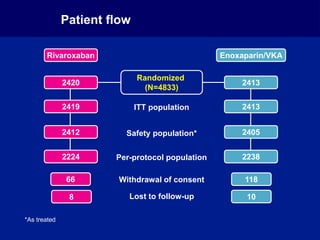
Patient flow
*As treated
Withdrawal of consent
Lost to follow-up
Safety population*
ITT population
Randomized
(N=4833)
Per-protocol population
66
8
2420
2419
2412
2224
Rivaroxaban
118
10
Enoxaparin/VKA
2413
2413
2405
2238
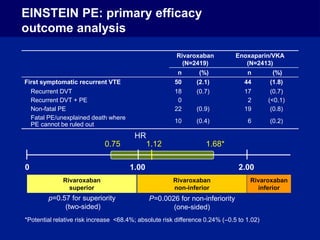
EINSTEIN PE: primary efficacy
outcome analysis
Rivaroxaban
(N=2419)
Enoxaparin/VKA
(N=2413)
n (%) n (%)
First symptomatic recurrent VTE 50 (2.1) 44 (1.8)
Recurrent DVT 18 (0.7) 17 (0.7)
Recurrent DVT + PE 0 2 (<0.1)
Non-fatal PE 22 (0.9) 19 (0.8)
Fatal PE/unexplained death where
PE cannot be ruled out
10 (0.4) 6 (0.2)
Rivaroxaban
superior
Rivaroxaban
non-inferior
Rivaroxaban
inferior
P=0.0026 for non-inferiority
(one-sided)
p=0.57 for superiority
(two-sided)
1.00
0 2.00
0.75 1.12 1.68*
*Potential relative risk increase <68.4%; absolute risk difference 0.24% (–0.5 to 1.02)
HR
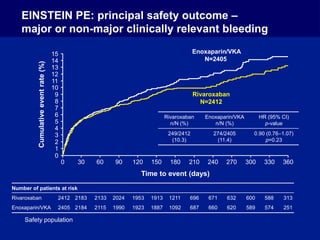
EINSTEIN PE: principal safety outcome –
major or non-major clinically relevant bleeding
Rivaroxaban
n/N (%)
Enoxaparin/VKA
n/N (%)
HR (95% CI)
p-value
249/2412
(10.3)
274/2405
(11.4)
0.90 (0.76–1.07)
p=0.23
Safety population
0 30 60 90 120 150 180 210 240 270 300 330 360
15
14
10
13
12
11
9
8
7
6
5
4
3
2
1
0
Number of patients at risk
Rivaroxaban 2412 2183 2133 2024 1953 1913 1211 696 671 632 600 588 313
Enoxaparin/VKA 2405 2184 2115 1990 1923 1887 1092 687 660 620 589 574 251
Time to event (days)
Rivaroxaban
N=2412
Enoxaparin/VKA
N=2405
Cumulative
event
rate
(%)
Safety population
3.0
2.5
2.0
1.5
1.0
0.0
0.5
0 30 60 90 120 150 180 210 240 270 300 330 360
Cumulative
event
rate
(%)
Time to event (days)
Rivaroxaban
N=2412
Enoxaparin/VKA
N=2405
Number of patients at risk
Rivaroxaban 2412 2281 2248 2156 2091 2063 1317 761 735 700 669 659 350
Enoxaparin/VKA 2405 2270 2224 2116 2063 2036 1176 746 719 680 658 642 278
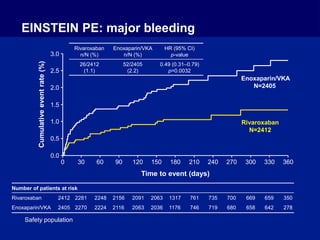
EINSTEIN PE: major bleeding
Rivaroxaban
n/N (%)
Enoxaparin/VKA
n/N (%)
HR (95% CI)
p-value
26/2412
(1.1)
52/2405
(2.2)
0.49 (0.31–0.79)
p=0.0032
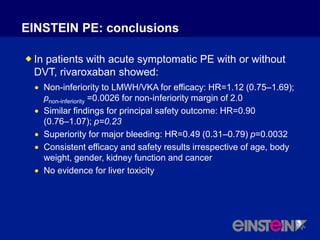
EINSTEIN PE: conclusions
 In patients with acute symptomatic PE with or without
DVT, rivaroxaban showed:
 Non-inferiority to LMWH/VKA for efficacy: HR=1.12 (0.75–1.69);
pnon-inferiority =0.0026 for non-inferiority margin of 2.0
 Similar findings for principal safety outcome: HR=0.90
(0.76–1.07); p=0.23
 Superiority for major bleeding: HR=0.49 (0.31–0.79) p=0.0032
 Consistent efficacy and safety results irrespective of age, body
weight, gender, kidney function and cancer
 No evidence for liver toxicity

Rivaroxaban alone; Buller_Einstein_PE.ppt

  • 1.
    Oral rivaroxaban alonefor the treatment of symptomatic pulmonary embolism: the EINSTEIN PE study Harry R Büller on behalf of the EINSTEIN Investigators
  • 2.
    Disclosures for HarryR Büller Research Support/P.I. Sanofi-aventis, Bayer HealthCare, Bristol-Myers Squibb, Daiichi-Sankyo, GlaxoSmithKline, Pfizer, Roche, Isis, Thrombogenics Employee No relevant conflicts of interest to declare Consultant Sanofi-aventis, Bayer HealthCare, Bristol-Myers Squibb, Daiichi-Sankyo, GlaxoSmithKline, Pfizer, Roche, Isis, Thrombogenics Major Stockholder No relevant conflicts of interest to declare Speakers Bureau No relevant conflicts of interest to declare Scientific Advisory Board Sanofi-aventis, Bayer HealthCare, Bristol-Myers Squibb, Daiichi-Sankyo, GlaxoSmithKline, Pfizer, Roche, Isis, Thrombogenics
  • 3.
    EINSTEIN PE: studydesign Randomized, open-label, event-driven, non-inferiority study  Up to 48 hours’ heparins/fondaparinux treatment permitted before study entry  88 primary efficacy outcomes needed  Non-inferiority margin: 2.0 Predefined treatment period of 3, 6, or 12 months 15 mg bid Rivaroxaban Day 1 Day 21 Enoxaparin bid for at least 5 days, plus VKA INR 2.5 (range 2.0–3.0) 20 mg od N=4833 Rivaroxaban R Objectively confirmed PE ± DVT 30-day post-study treatment period  Primary efficacy outcome: first recurrent VTE  Principal safety outcome: first major or nonmajor clinically relevant bleeding
  • 4.
    Patient flow *As treated Withdrawalof consent Lost to follow-up Safety population* ITT population Randomized (N=4833) Per-protocol population 66 8 2420 2419 2412 2224 Rivaroxaban 118 10 Enoxaparin/VKA 2413 2413 2405 2238
  • 5.
    EINSTEIN PE: primaryefficacy outcome analysis Rivaroxaban (N=2419) Enoxaparin/VKA (N=2413) n (%) n (%) First symptomatic recurrent VTE 50 (2.1) 44 (1.8) Recurrent DVT 18 (0.7) 17 (0.7) Recurrent DVT + PE 0 2 (<0.1) Non-fatal PE 22 (0.9) 19 (0.8) Fatal PE/unexplained death where PE cannot be ruled out 10 (0.4) 6 (0.2) Rivaroxaban superior Rivaroxaban non-inferior Rivaroxaban inferior P=0.0026 for non-inferiority (one-sided) p=0.57 for superiority (two-sided) 1.00 0 2.00 0.75 1.12 1.68* *Potential relative risk increase <68.4%; absolute risk difference 0.24% (–0.5 to 1.02) HR
  • 6.
    EINSTEIN PE: principalsafety outcome – major or non-major clinically relevant bleeding Rivaroxaban n/N (%) Enoxaparin/VKA n/N (%) HR (95% CI) p-value 249/2412 (10.3) 274/2405 (11.4) 0.90 (0.76–1.07) p=0.23 Safety population 0 30 60 90 120 150 180 210 240 270 300 330 360 15 14 10 13 12 11 9 8 7 6 5 4 3 2 1 0 Number of patients at risk Rivaroxaban 2412 2183 2133 2024 1953 1913 1211 696 671 632 600 588 313 Enoxaparin/VKA 2405 2184 2115 1990 1923 1887 1092 687 660 620 589 574 251 Time to event (days) Rivaroxaban N=2412 Enoxaparin/VKA N=2405 Cumulative event rate (%)
  • 7.
    Safety population 3.0 2.5 2.0 1.5 1.0 0.0 0.5 0 3060 90 120 150 180 210 240 270 300 330 360 Cumulative event rate (%) Time to event (days) Rivaroxaban N=2412 Enoxaparin/VKA N=2405 Number of patients at risk Rivaroxaban 2412 2281 2248 2156 2091 2063 1317 761 735 700 669 659 350 Enoxaparin/VKA 2405 2270 2224 2116 2063 2036 1176 746 719 680 658 642 278 EINSTEIN PE: major bleeding Rivaroxaban n/N (%) Enoxaparin/VKA n/N (%) HR (95% CI) p-value 26/2412 (1.1) 52/2405 (2.2) 0.49 (0.31–0.79) p=0.0032
  • 8.
    EINSTEIN PE: conclusions In patients with acute symptomatic PE with or without DVT, rivaroxaban showed:  Non-inferiority to LMWH/VKA for efficacy: HR=1.12 (0.75–1.69); pnon-inferiority =0.0026 for non-inferiority margin of 2.0  Similar findings for principal safety outcome: HR=0.90 (0.76–1.07); p=0.23  Superiority for major bleeding: HR=0.49 (0.31–0.79) p=0.0032  Consistent efficacy and safety results irrespective of age, body weight, gender, kidney function and cancer  No evidence for liver toxicity

Editor's Notes

  • #2 Rivaroxaban clinical development
  • #4 Rivaroxaban clinical development
  • #5 Rivaroxaban clinical development
  • #6 Rivaroxaban clinical development
  • #7 Rivaroxaban clinical development
  • #8 Rivaroxaban clinical development
  • #9 8