ORACLE TABLES
   Juri Guljajev
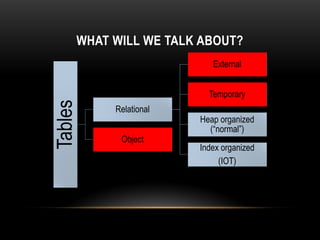
WHAT WILL WE TALK ABOUT?
                              External


                             Temporary
Tables
              Relational
                           Heap organized
                             (“normal”)
               Object
                           Index organized
                                (IOT)
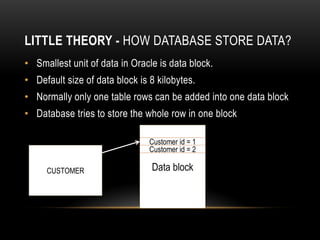
LITTLE THEORY - HOW DATABASE STORE DATA?
• Smallest unit of data in Oracle is data block.
• Default size of data block is 8 kilobytes.
• Normally only one table rows can be added into one data block
• Database tries to store the whole row in one block

                                Customer id = 1
                                Customer id = 2

     CUSTOMER                   Data block
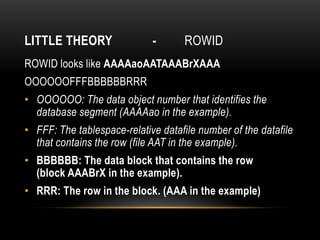
LITTLE THEORY                -      ROWID
ROWID looks like AAAAaoAATAAABrXAAA
OOOOOOFFFBBBBBBRRR
• OOOOOO: The data object number that identifies the
  database segment (AAAAao in the example).
• FFF: The tablespace-relative datafile number of the datafile
  that contains the row (file AAT in the example).
• BBBBBB: The data block that contains the row
  (block AAABrX in the example).
• RRR: The row in the block. (AAA in the example)
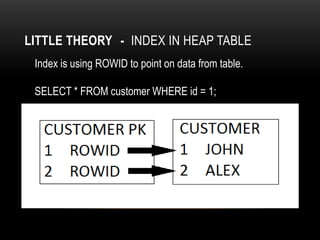
LITTLE THEORY - INDEX IN HEAP TABLE
 Index is using ROWID to point on data from table.

 SELECT * FROM customer WHERE id = 1;
HEAP ORGANISED             -       KEY FEATURES
• Unordered collection of rows
• Retrieval order is not guaranteed
• Rows are inserted where they fit best
• Generally better DML performance (in compare to IOT)
• Worse query performance by PK (in compare to IOT)
• Can be stored in table cluster
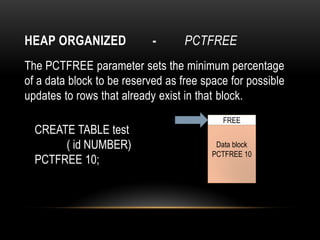
HEAP ORGANIZED              -      PCTFREE
The PCTFREE parameter sets the minimum percentage
of a data block to be reserved as free space for possible
updates to rows that already exist in that block.
                                            FREE
  CREATE TABLE test
       ( id NUMBER)                       Data block
                                         PCTFREE 10
  PCTFREE 10;
HEAP ORGANISED                -   PCTFREE
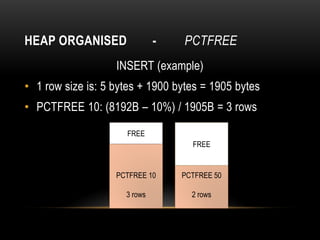
                   INSERT (example)
• 1 row size is: 5 bytes + 1900 bytes = 1905 bytes
• PCTFREE 10: (8192B – 10%) / 1905B = 3 rows

                     FREE
                                    FREE


                   PCTFREE 10     PCTFREE 50

                     3 rows         2 rows
HEAP ORGANISED                 -      PCTFREE
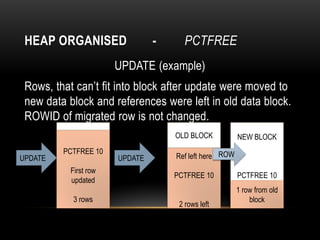
                       UPDATE (example)
 Rows, that can’t fit into block after update were moved to
 new data block and references were left in old data block.
 ROWID of migrated row is not changed.
                                    OLD BLOCK           NEW BLOCK
         PCTFREE 10
UPDATE                 UPDATE       Ref left here ROW
           First row
                                    PCTFREE 10          PCTFREE 10
           updated
                                                        1 row from old
            3 rows                                          block
                                     2 rows left
HEAP ORGANISED           -     PCTFREE
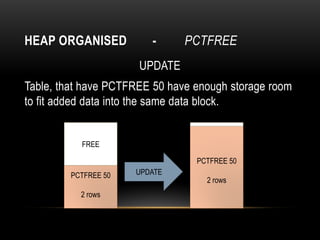
                      UPDATE
Table, that have PCTFREE 50 have enough storage room
to fit added data into the same data block.


           FREE

                                 PCTFREE 50
         PCTFREE 50   UPDATE
                                   2 rows
           2 rows
HEAP ORGANISED            -      PCTFREE
• Better query performance
• Better storage usage
• Use with caution (set PCTFREE 50, but rows are filled
  by 80% with insert)
HEAP/INDEX ORGANISED              -        PARTITIONING
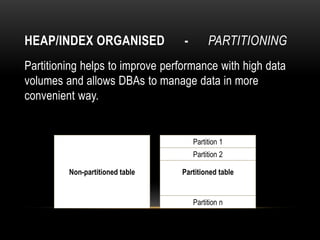
Partitioning helps to improve performance with high data
volumes and allows DBAs to manage data in more
convenient way.


                                      Partition 1
                                      Partition 2

         Non-partitioned table   Partitioned table


                                      Partition n
HEAP/INDEX ORGANISED               -    PARTITIONING
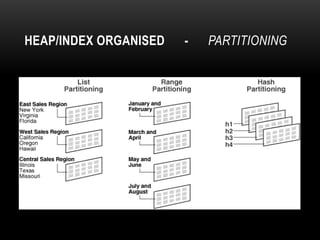
Table can be partitioned by
• Range (for historical data, often partitioned by date
  column)
• Hash (no obvious partitioning column)
• List (to group data specifically by some known values)


Range and List partitions may have subpartitions.
HEAP/INDEX ORGANISED   -   PARTITIONING
HEAP/INDEX ORGANISED                  -     PARTITIONING
Indexes on partitioned table can be global or local partitioned.
• Local
   • Maps on table partitions, so easier to maintain
   • Unique index can be local, but partitioning key must be
     part of index
• Global
   • Has own partitions definitions
   • Can be partitioned by range or hash
INDEX ORGANISED             -    KEY FEATURES
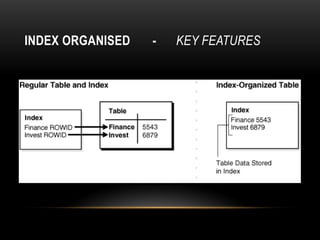
• Stored in a variation of a B-tree index structure
• Primary key stores all rows
• Fast access by primary key (specially range scan)
• DML performance might be worse (in compare to
  HEAP)
• Take less room on disk (no separate primary key
  storage required)
• Cannot be stored in table cluster
INDEX ORGANISED   -   KEY FEATURES
INDEX ORGANISED            -     KEY FEATURES
PROS
• Fast access by PK
• Less storage for the same amount of data
• Data is ordered by PK
CONS
• Slower DML
• Secondary index can be slower and take more storage in
  compare to index in HEAP table
TABLE CLUSTER
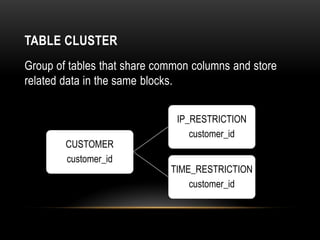
Group of tables that share common columns and store
related data in the same blocks.


                              IP_RESTRICTION
                                 customer_id
        CUSTOMER
        customer_id
                             TIME_RESTRICTION
                                 customer_id
TABLE CLUSTER
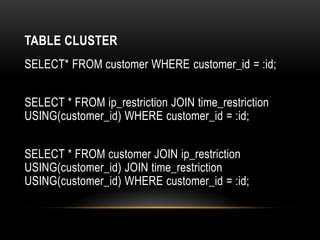
SELECT* FROM customer WHERE customer_id = :id;


SELECT * FROM ip_restriction JOIN time_restriction
USING(customer_id) WHERE customer_id = :id;


SELECT * FROM customer JOIN ip_restriction
USING(customer_id) JOIN time_restriction
USING(customer_id) WHERE customer_id = :id;
TABLE CLUSTER
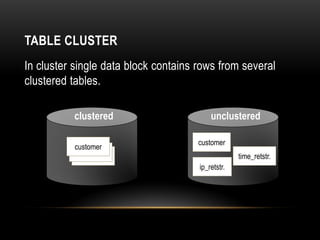
In cluster single data block contains rows from several
clustered tables.

          clustered                       unclustered

                                      customer
           customer
            customer
             customer                              time_retstr.
                                      ip_retstr.
TABLE CLUSTER
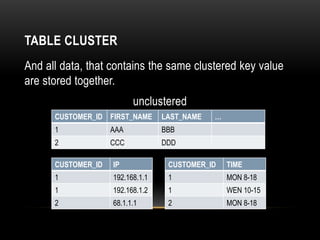
And all data, that contains the same clustered key value
are stored together.
                          unclustered
      CUSTOMER_ID FIRST_NAME      LAST_NAME   …
      1             AAA           BBB
      2             CCC           DDD

      CUSTOMER_ID   IP             CUSTOMER_ID    TIME
      1             192.168.1.1    1              MON 8-18
      1             192.168.1.2    1              WEN 10-15
      2             68.1.1.1       2              MON 8-18
TABLE CLUSTER
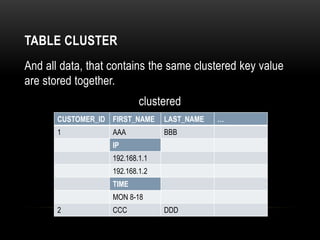
And all data, that contains the same clustered key value
are stored together.
                           clustered
       CUSTOMER_ID FIRST_NAME    LAST_NAME   …
       1           AAA           BBB
                   IP
                   192.168.1.1
                   192.168.1.2
                   TIME
                   MON 8-18
       2           CCC           DDD
TABLE CLUSTER
What you will get
• Disk I/O is reduced for joins of clustered tables.
• Access time improves for joins of clustered tables.
• Less storage is required to store related table and index data because
   the cluster key value is not stored repeatedly for each row.
But be careful (do not use when)
• The tables are frequently updated.
• The tables frequently require a full table scans.
• The tables require truncating.
TABLE CLUSTER
There are 2 types of clusters
Index cluster
• Data is co-located within a single block based on a common
  column index, so separate cluster index should be created
  before adding table into cluster
Hash cluster
• Data is co-located within a single block based on a hash
  key and a hash function (own hash function can be used)
TABLE CLUSTER
Index VS Hash clusters
• Hash is faster
• Hash take less storage
• For hash you should know number of hash keys
• Hash cluster size and keys number can’t be changed
• Hash cluster loads CPU more, than index cluster
Юра Гуляев. Oracle tables

Юра Гуляев. Oracle tables

  • 1.
    ORACLE TABLES Juri Guljajev
  • 2.
    WHAT WILL WETALK ABOUT? External Temporary Tables Relational Heap organized (“normal”) Object Index organized (IOT)
  • 3.
    LITTLE THEORY -HOW DATABASE STORE DATA? • Smallest unit of data in Oracle is data block. • Default size of data block is 8 kilobytes. • Normally only one table rows can be added into one data block • Database tries to store the whole row in one block Customer id = 1 Customer id = 2 CUSTOMER Data block
  • 4.
    LITTLE THEORY - ROWID ROWID looks like AAAAaoAATAAABrXAAA OOOOOOFFFBBBBBBRRR • OOOOOO: The data object number that identifies the database segment (AAAAao in the example). • FFF: The tablespace-relative datafile number of the datafile that contains the row (file AAT in the example). • BBBBBB: The data block that contains the row (block AAABrX in the example). • RRR: The row in the block. (AAA in the example)
  • 5.
    LITTLE THEORY -INDEX IN HEAP TABLE Index is using ROWID to point on data from table. SELECT * FROM customer WHERE id = 1;
  • 6.
    HEAP ORGANISED - KEY FEATURES • Unordered collection of rows • Retrieval order is not guaranteed • Rows are inserted where they fit best • Generally better DML performance (in compare to IOT) • Worse query performance by PK (in compare to IOT) • Can be stored in table cluster
  • 7.
    HEAP ORGANIZED - PCTFREE The PCTFREE parameter sets the minimum percentage of a data block to be reserved as free space for possible updates to rows that already exist in that block. FREE CREATE TABLE test ( id NUMBER) Data block PCTFREE 10 PCTFREE 10;
  • 8.
    HEAP ORGANISED - PCTFREE INSERT (example) • 1 row size is: 5 bytes + 1900 bytes = 1905 bytes • PCTFREE 10: (8192B – 10%) / 1905B = 3 rows FREE FREE PCTFREE 10 PCTFREE 50 3 rows 2 rows
  • 9.
    HEAP ORGANISED - PCTFREE UPDATE (example) Rows, that can’t fit into block after update were moved to new data block and references were left in old data block. ROWID of migrated row is not changed. OLD BLOCK NEW BLOCK PCTFREE 10 UPDATE UPDATE Ref left here ROW First row PCTFREE 10 PCTFREE 10 updated 1 row from old 3 rows block 2 rows left
  • 10.
    HEAP ORGANISED - PCTFREE UPDATE Table, that have PCTFREE 50 have enough storage room to fit added data into the same data block. FREE PCTFREE 50 PCTFREE 50 UPDATE 2 rows 2 rows
  • 11.
    HEAP ORGANISED - PCTFREE • Better query performance • Better storage usage • Use with caution (set PCTFREE 50, but rows are filled by 80% with insert)
  • 12.
    HEAP/INDEX ORGANISED - PARTITIONING Partitioning helps to improve performance with high data volumes and allows DBAs to manage data in more convenient way. Partition 1 Partition 2 Non-partitioned table Partitioned table Partition n
  • 13.
    HEAP/INDEX ORGANISED - PARTITIONING Table can be partitioned by • Range (for historical data, often partitioned by date column) • Hash (no obvious partitioning column) • List (to group data specifically by some known values) Range and List partitions may have subpartitions.
  • 14.
    HEAP/INDEX ORGANISED - PARTITIONING
  • 15.
    HEAP/INDEX ORGANISED - PARTITIONING Indexes on partitioned table can be global or local partitioned. • Local • Maps on table partitions, so easier to maintain • Unique index can be local, but partitioning key must be part of index • Global • Has own partitions definitions • Can be partitioned by range or hash
  • 16.
    INDEX ORGANISED - KEY FEATURES • Stored in a variation of a B-tree index structure • Primary key stores all rows • Fast access by primary key (specially range scan) • DML performance might be worse (in compare to HEAP) • Take less room on disk (no separate primary key storage required) • Cannot be stored in table cluster
  • 17.
    INDEX ORGANISED - KEY FEATURES
  • 18.
    INDEX ORGANISED - KEY FEATURES PROS • Fast access by PK • Less storage for the same amount of data • Data is ordered by PK CONS • Slower DML • Secondary index can be slower and take more storage in compare to index in HEAP table
  • 19.
    TABLE CLUSTER Group oftables that share common columns and store related data in the same blocks. IP_RESTRICTION customer_id CUSTOMER customer_id TIME_RESTRICTION customer_id
  • 20.
    TABLE CLUSTER SELECT* FROMcustomer WHERE customer_id = :id; SELECT * FROM ip_restriction JOIN time_restriction USING(customer_id) WHERE customer_id = :id; SELECT * FROM customer JOIN ip_restriction USING(customer_id) JOIN time_restriction USING(customer_id) WHERE customer_id = :id;
  • 21.
    TABLE CLUSTER In clustersingle data block contains rows from several clustered tables. clustered unclustered customer customer customer customer time_retstr. ip_retstr.
  • 22.
    TABLE CLUSTER And alldata, that contains the same clustered key value are stored together. unclustered CUSTOMER_ID FIRST_NAME LAST_NAME … 1 AAA BBB 2 CCC DDD CUSTOMER_ID IP CUSTOMER_ID TIME 1 192.168.1.1 1 MON 8-18 1 192.168.1.2 1 WEN 10-15 2 68.1.1.1 2 MON 8-18
  • 23.
    TABLE CLUSTER And alldata, that contains the same clustered key value are stored together. clustered CUSTOMER_ID FIRST_NAME LAST_NAME … 1 AAA BBB IP 192.168.1.1 192.168.1.2 TIME MON 8-18 2 CCC DDD
  • 24.
    TABLE CLUSTER What youwill get • Disk I/O is reduced for joins of clustered tables. • Access time improves for joins of clustered tables. • Less storage is required to store related table and index data because the cluster key value is not stored repeatedly for each row. But be careful (do not use when) • The tables are frequently updated. • The tables frequently require a full table scans. • The tables require truncating.
  • 25.
    TABLE CLUSTER There are2 types of clusters Index cluster • Data is co-located within a single block based on a common column index, so separate cluster index should be created before adding table into cluster Hash cluster • Data is co-located within a single block based on a hash key and a hash function (own hash function can be used)
  • 26.
    TABLE CLUSTER Index VSHash clusters • Hash is faster • Hash take less storage • For hash you should know number of hash keys • Hash cluster size and keys number can’t be changed • Hash cluster loads CPU more, than index cluster