Efficient Pagination Using MySQL
                   Surat Singh Bhati (surat@yahoo-inc.com)
                    Rick James (rjames@yahoo-inc.com)


                               Yahoo Inc


Percona Performance Conference 2009
Outline

  1. Overview
     –    Common pagination UI pattern
     – Sample table and typical solution using OFFSET
     – Techniques to avoid large OFFSET
     – Performance comparison
     – Concerns


                                         -2-
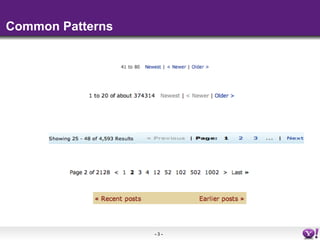
Common Patterns


                  -3-
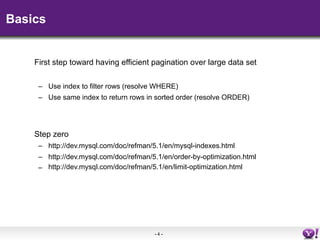
Basics


    First step toward having efficient pagination over large data set

     – Use index to filter rows (resolve WHERE)
     – Use same index to return rows in sorted order (resolve ORDER)


    Step zero
     – http://dev.mysql.com/doc/refman/5.1/en/mysql-indexes.html
     – http://dev.mysql.com/doc/refman/5.1/en/order-by-optimization.html
     – http://dev.mysql.com/doc/refman/5.1/en/limit-optimization.html


                                        -4-
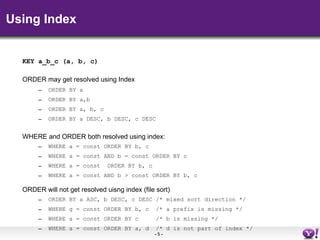
Using Index


  KEY a_b_c (a, b, c)

  ORDER may get resolved using Index
       –   ORDER BY a
       –   ORDER BY a,b
       –   ORDER BY a, b, c
       –   ORDER BY a DESC, b DESC, c DESC


  WHERE and ORDER both resolved using index:
       –   WHERE a = const ORDER BY b, c
       –   WHERE a = const AND b = const ORDER BY c
       –   WHERE a = const     ORDER BY b, c
       –   WHERE a = const AND b > const ORDER BY b, c

  ORDER will not get resolved uisng index (file sort)
       –   ORDER BY a ASC, b DESC, c DESC /* mixed sort direction */
       –   WHERE g = const ORDER BY b, c        /* a prefix is missing */
       –   WHERE a = const ORDER BY c           /* b is missing */
       –   WHERE a = const ORDER BY a, d        /* d is not part of index */
                                               -5-
Sample Schema
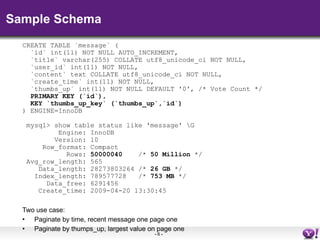
  CREATE TABLE `message` (
    `id` int(11) NOT NULL AUTO_INCREMENT,
    `title` varchar(255) COLLATE utf8_unicode_ci NOT NULL,
    `user_id` int(11) NOT NULL,
    `content` text COLLATE utf8_unicode_ci NOT NULL,
    `create_time` int(11) NOT NULL,
    `thumbs_up` int(11) NOT NULL DEFAULT '0', /* Vote Count */
    PRIMARY KEY (`id`),
    KEY `thumbs_up_key` (`thumbs_up`,`id`)
  ) ENGINE=InnoDB

   mysql> show table status like 'message' G
           Engine: InnoDB
          Version: 10
       Row_format: Compact
             Rows: 50000040    /* 50 Million */
   Avg_row_length: 565
      Data_length: 28273803264 /* 26 GB */
     Index_length: 789577728   /* 753 MB */
        Data_free: 6291456
      Create_time: 2009-04-20 13:30:45

  Two use case:
  • Paginate by time, recent message one page one
  • Paginate by thumps_up, largest value on page one
                                          -6-
Typical Query

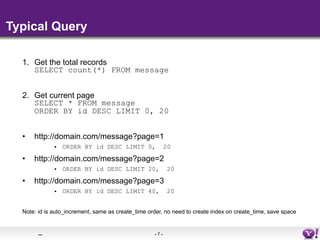
  1. Get the total records
     SELECT count(*) FROM message


  2. Get current page
     SELECT * FROM message
     ORDER BY id DESC LIMIT 0, 20


  •   http://domain.com/message?page=1
              • ORDER BY id DESC LIMIT 0,                 20

  •   http://domain.com/message?page=2
              • ORDER BY id DESC LIMIT 20,                 20

  •   http://domain.com/message?page=3
              • ORDER BY id DESC LIMIT 40,                 20


  Note: id is auto_increment, same as create_time order, no need to create index on create_time, save space


        –                                           -7-
Explain


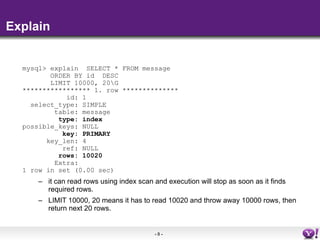
  mysql> explain SELECT * FROM message
         ORDER BY id DESC
         LIMIT 10000, 20G
  ***************** 1. row **************
             id: 1
    select_type: SIMPLE
          table: message
           type: index
  possible_keys: NULL
            key: PRIMARY
        key_len: 4
            ref: NULL
           rows: 10020
          Extra:
  1 row in set (0.00 sec)
     – it can read rows using index scan and execution will stop as soon as it finds
       required rows.
     – LIMIT 10000, 20 means it has to read 10020 and throw away 10000 rows, then
       return next 20 rows.


                                          -8-
Performance Implications

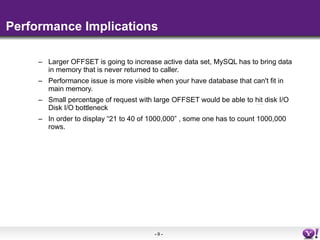
     – Larger OFFSET is going to increase active data set, MySQL has to bring data
       in memory that is never returned to caller.
     – Performance issue is more visible when your have database that can't fit in
       main memory.
     – Small percentage of request with large OFFSET would be able to hit disk I/O
       Disk I/O bottleneck
     – In order to display “21 to 40 of 1000,000” , some one has to count 1000,000
       rows.


                                         -9-
Simple Solution

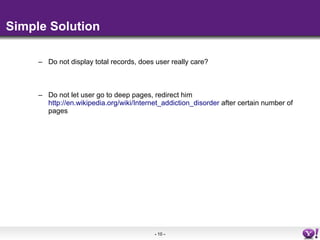
     – Do not display total records, does user really care?


     – Do not let user go to deep pages, redirect him
       http://en.wikipedia.org/wiki/Internet_addiction_disorder after certain number of
       pages


                                          - 10 -
Avoid Count(*)


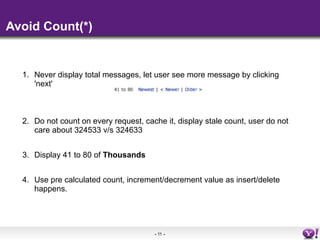
  1. Never display total messages, let user see more message by clicking
     'next'


  2. Do not count on every request, cache it, display stale count, user do not
     care about 324533 v/s 324633


  3. Display 41 to 80 of Thousands


  4. Use pre calculated count, increment/decrement value as insert/delete
     happens.


                                       - 11 -
Solution to avoid offset

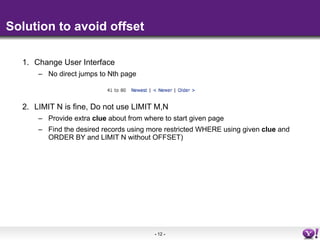
  1. Change User Interface
      – No direct jumps to Nth page


  2. LIMIT N is fine, Do not use LIMIT M,N
      – Provide extra clue about from where to start given page
      – Find the desired records using more restricted WHERE using given clue and
        ORDER BY and LIMIT N without OFFSET)


                                         - 12 -
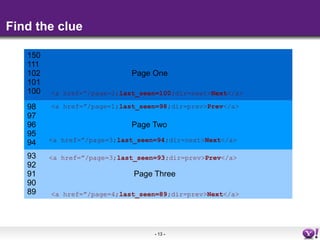
Find the clue

   150
   111
   102                       Page One
   101
   100   <a href=”/page=2;last_seen=100;dir=next>Next</a>

   98    <a href=”/page=1;last_seen=98;dir=prev>Prev</a>
   97
   96                        Page Two
   95
   94    <a href=”/page=3;last_seen=94;dir=next>Next</a>

   93    <a href=”/page=3;last_seen=93;dir=prev>Prev</a>
   92
   91                         Page Three
   90
   89    <a href=”/page=4;last_seen=89;dir=prev>Next</a>


                                   - 13 -
Solution using clue

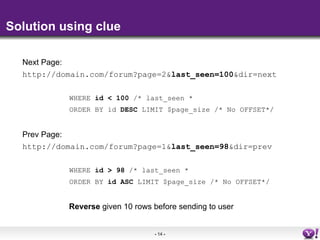
  Next Page:
  http://domain.com/forum?page=2&last_seen=100&dir=next

           WHERE id < 100 /* last_seen *
           ORDER BY id DESC LIMIT $page_size /* No OFFSET*/


  Prev Page:
  http://domain.com/forum?page=1&last_seen=98&dir=prev

           WHERE id > 98 /* last_seen *
           ORDER BY id ASC LIMIT $page_size /* No OFFSET*/


           Reverse given 10 rows before sending to user


                                 - 14 -
Explain

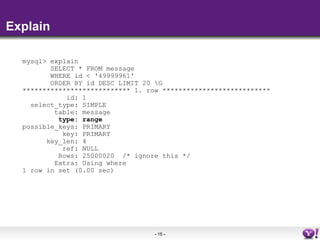
  mysql> explain
         SELECT * FROM message
         WHERE id < '49999961'
         ORDER BY id DESC LIMIT 20 G
  *************************** 1. row ***************************
             id: 1
    select_type: SIMPLE
          table: message
           type: range
  possible_keys: PRIMARY
            key: PRIMARY
        key_len: 4
            ref: NULL
           Rows: 25000020 /* ignore this */
          Extra: Using where
  1 row in set (0.00 sec)


                                   - 15 -
What about order by non unique values?


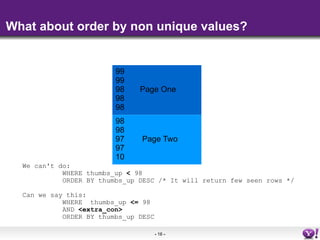
                         99
                         99
                         98    Page One
                         98
                         98
                         98
                         98
                         97    Page Two
                         97
                         10
  We can't do:
            WHERE thumbs_up < 98
            ORDER BY thumbs_up DESC /* It will return few seen rows */

  Can we say this:
            WHERE thumbs_up <= 98
            AND <extra_con>
            ORDER BY thumbs_up DESC

                                      - 16 -
Add more condition

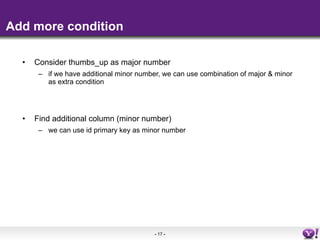
  •   Consider thumbs_up as major number
       – if we have additional minor number, we can use combination of major & minor
         as extra condition


  •   Find additional column (minor number)
       – we can use id primary key as minor number


                                          - 17 -
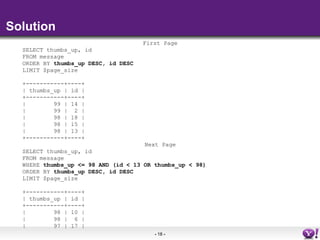
Solution
                                     First Page
  SELECT thumbs_up, id
  FROM message
  ORDER BY thumbs_up DESC, id DESC
  LIMIT $page_size

  +-----------+----+
  | thumbs_up | id |
  +-----------+----+
  |        99 | 14 |
  |        99 | 2 |
  |        98 | 18 |
  |        98 | 15 |
  |        98 | 13 |
  +-----------+----+
                                     Next Page
  SELECT thumbs_up, id
  FROM message
  WHERE thumbs_up <= 98 AND (id < 13 OR thumbs_up < 98)
  ORDER BY thumbs_up DESC, id DESC
  LIMIT $page_size

  +-----------+----+
  | thumbs_up | id |
  +-----------+----+
  |        98 | 10 |
  |        98 | 6 |
  |        97 | 17 |
                                        - 18 -
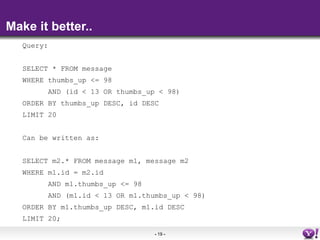
Make it better..
   Query:


   SELECT * FROM message
   WHERE thumbs_up <= 98
            AND (id < 13 OR thumbs_up < 98)
   ORDER BY thumbs_up DESC, id DESC
   LIMIT 20


   Can be written as:


   SELECT m2.* FROM message m1, message m2
   WHERE m1.id = m2.id
            AND m1.thumbs_up <= 98
            AND (m1.id < 13 OR m1.thumbs_up < 98)
   ORDER BY m1.thumbs_up DESC, m1.id DESC
   LIMIT 20;

                                     - 19 -
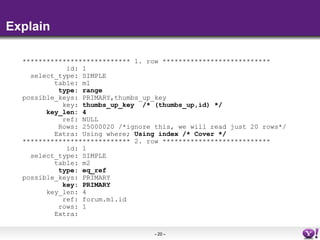
Explain

  *************************** 1. row ***************************
             id: 1
    select_type: SIMPLE
          table: m1
           type: range
  possible_keys: PRIMARY,thumbs_up_key
            key: thumbs_up_key /* (thumbs_up,id) */
        key_len: 4
            ref: NULL
           Rows: 25000020 /*ignore this, we will read just 20 rows*/
          Extra: Using where; Using index /* Cover */
  *************************** 2. row ***************************
             id: 1
    select_type: SIMPLE
          table: m2
           type: eq_ref
  possible_keys: PRIMARY
            key: PRIMARY
        key_len: 4
            ref: forum.m1.id
           rows: 1
          Extra:

                                   - 20 -
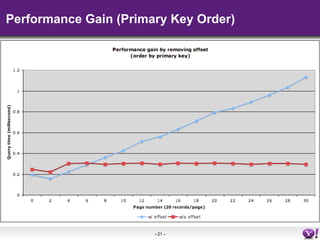
Performance Gain (Primary Key Order)


                       - 21 -
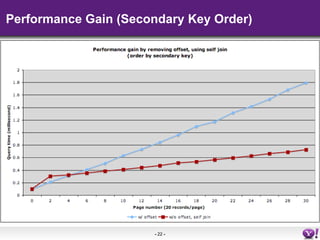
Performance Gain (Secondary Key Order)


                      - 22 -
Throughput Gain


 •   Throughput Gain while hitting first 30 pages:

      – Using LIMIT OFFSET, N
          • 600 query/sec


      – Using LIMIT N (no OFFSET)
          • 3.7k query/sec


                                        - 23 -
Bonus Point

  Product issue with LIMIT M, N


     User is reading a page, in the mean time some records may be added to
     previous page.


     Due to insert/delete pages records are going to move forward/backward
     as rolling window:
      – User is reading messages on 4th page
      – While he was reading, one new message posted (it would be there on page
        one), all pages are going to move one message to next page.
      – User Clicks on Page 5
      – One message from page got pushed forward on page 5, user has to read it
        again


  No such issue with news approach

                                        - 24 -
Drawback

  Search Engine Optimization Expert says:
  Let bot reach all you pages with fewer number of deep dive


  Two Solutions:
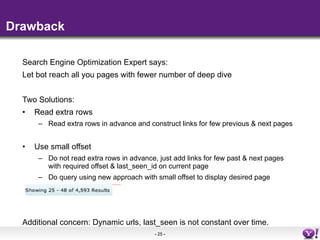
  •   Read extra rows
       – Read extra rows in advance and construct links for few previous & next pages


  •   Use small offset
       – Do not read extra rows in advance, just add links for few past & next pages
         with required offset & last_seen_id on current page
       – Do query using new approach with small offset to display desired page
       –
                             file:///Users/surat/Desktop/Picture%2043.png


  Additional concern: Dynamic urls, last_seen is not constant over time.
                                                                            - 25 -
Thanks


  - 26 -

Efficient Pagination Using MySQL

  • 1.
    Efficient Pagination UsingMySQL Surat Singh Bhati (surat@yahoo-inc.com) Rick James (rjames@yahoo-inc.com) Yahoo Inc Percona Performance Conference 2009
  • 2.
    Outline 1.Overview – Common pagination UI pattern – Sample table and typical solution using OFFSET – Techniques to avoid large OFFSET – Performance comparison – Concerns -2-
  • 3.
  • 4.
    Basics First step toward having efficient pagination over large data set – Use index to filter rows (resolve WHERE) – Use same index to return rows in sorted order (resolve ORDER) Step zero – http://dev.mysql.com/doc/refman/5.1/en/mysql-indexes.html – http://dev.mysql.com/doc/refman/5.1/en/order-by-optimization.html – http://dev.mysql.com/doc/refman/5.1/en/limit-optimization.html -4-
  • 5.
    Using Index KEY a_b_c (a, b, c) ORDER may get resolved using Index – ORDER BY a – ORDER BY a,b – ORDER BY a, b, c – ORDER BY a DESC, b DESC, c DESC WHERE and ORDER both resolved using index: – WHERE a = const ORDER BY b, c – WHERE a = const AND b = const ORDER BY c – WHERE a = const ORDER BY b, c – WHERE a = const AND b > const ORDER BY b, c ORDER will not get resolved uisng index (file sort) – ORDER BY a ASC, b DESC, c DESC /* mixed sort direction */ – WHERE g = const ORDER BY b, c /* a prefix is missing */ – WHERE a = const ORDER BY c /* b is missing */ – WHERE a = const ORDER BY a, d /* d is not part of index */ -5-
  • 6.
    Sample Schema CREATE TABLE `message` ( `id` int(11) NOT NULL AUTO_INCREMENT, `title` varchar(255) COLLATE utf8_unicode_ci NOT NULL, `user_id` int(11) NOT NULL, `content` text COLLATE utf8_unicode_ci NOT NULL, `create_time` int(11) NOT NULL, `thumbs_up` int(11) NOT NULL DEFAULT '0', /* Vote Count */ PRIMARY KEY (`id`), KEY `thumbs_up_key` (`thumbs_up`,`id`) ) ENGINE=InnoDB mysql> show table status like 'message' G Engine: InnoDB Version: 10 Row_format: Compact Rows: 50000040 /* 50 Million */ Avg_row_length: 565 Data_length: 28273803264 /* 26 GB */ Index_length: 789577728 /* 753 MB */ Data_free: 6291456 Create_time: 2009-04-20 13:30:45 Two use case: • Paginate by time, recent message one page one • Paginate by thumps_up, largest value on page one -6-
  • 7.
    Typical Query 1. Get the total records SELECT count(*) FROM message 2. Get current page SELECT * FROM message ORDER BY id DESC LIMIT 0, 20 • http://domain.com/message?page=1 • ORDER BY id DESC LIMIT 0, 20 • http://domain.com/message?page=2 • ORDER BY id DESC LIMIT 20, 20 • http://domain.com/message?page=3 • ORDER BY id DESC LIMIT 40, 20 Note: id is auto_increment, same as create_time order, no need to create index on create_time, save space – -7-
  • 8.
    Explain mysql>explain SELECT * FROM message ORDER BY id DESC LIMIT 10000, 20G ***************** 1. row ************** id: 1 select_type: SIMPLE table: message type: index possible_keys: NULL key: PRIMARY key_len: 4 ref: NULL rows: 10020 Extra: 1 row in set (0.00 sec) – it can read rows using index scan and execution will stop as soon as it finds required rows. – LIMIT 10000, 20 means it has to read 10020 and throw away 10000 rows, then return next 20 rows. -8-
  • 9.
    Performance Implications – Larger OFFSET is going to increase active data set, MySQL has to bring data in memory that is never returned to caller. – Performance issue is more visible when your have database that can't fit in main memory. – Small percentage of request with large OFFSET would be able to hit disk I/O Disk I/O bottleneck – In order to display “21 to 40 of 1000,000” , some one has to count 1000,000 rows. -9-
  • 10.
    Simple Solution – Do not display total records, does user really care? – Do not let user go to deep pages, redirect him http://en.wikipedia.org/wiki/Internet_addiction_disorder after certain number of pages - 10 -
  • 11.
    Avoid Count(*) 1. Never display total messages, let user see more message by clicking 'next' 2. Do not count on every request, cache it, display stale count, user do not care about 324533 v/s 324633 3. Display 41 to 80 of Thousands 4. Use pre calculated count, increment/decrement value as insert/delete happens. - 11 -
  • 12.
    Solution to avoidoffset 1. Change User Interface – No direct jumps to Nth page 2. LIMIT N is fine, Do not use LIMIT M,N – Provide extra clue about from where to start given page – Find the desired records using more restricted WHERE using given clue and ORDER BY and LIMIT N without OFFSET) - 12 -
  • 13.
    Find the clue 150 111 102 Page One 101 100 <a href=”/page=2;last_seen=100;dir=next>Next</a> 98 <a href=”/page=1;last_seen=98;dir=prev>Prev</a> 97 96 Page Two 95 94 <a href=”/page=3;last_seen=94;dir=next>Next</a> 93 <a href=”/page=3;last_seen=93;dir=prev>Prev</a> 92 91 Page Three 90 89 <a href=”/page=4;last_seen=89;dir=prev>Next</a> - 13 -
  • 14.
    Solution using clue Next Page: http://domain.com/forum?page=2&last_seen=100&dir=next WHERE id < 100 /* last_seen * ORDER BY id DESC LIMIT $page_size /* No OFFSET*/ Prev Page: http://domain.com/forum?page=1&last_seen=98&dir=prev WHERE id > 98 /* last_seen * ORDER BY id ASC LIMIT $page_size /* No OFFSET*/ Reverse given 10 rows before sending to user - 14 -
  • 15.
    Explain mysql>explain SELECT * FROM message WHERE id < '49999961' ORDER BY id DESC LIMIT 20 G *************************** 1. row *************************** id: 1 select_type: SIMPLE table: message type: range possible_keys: PRIMARY key: PRIMARY key_len: 4 ref: NULL Rows: 25000020 /* ignore this */ Extra: Using where 1 row in set (0.00 sec) - 15 -
  • 16.
    What about orderby non unique values? 99 99 98 Page One 98 98 98 98 97 Page Two 97 10 We can't do: WHERE thumbs_up < 98 ORDER BY thumbs_up DESC /* It will return few seen rows */ Can we say this: WHERE thumbs_up <= 98 AND <extra_con> ORDER BY thumbs_up DESC - 16 -
  • 17.
    Add more condition • Consider thumbs_up as major number – if we have additional minor number, we can use combination of major & minor as extra condition • Find additional column (minor number) – we can use id primary key as minor number - 17 -
  • 18.
    Solution First Page SELECT thumbs_up, id FROM message ORDER BY thumbs_up DESC, id DESC LIMIT $page_size +-----------+----+ | thumbs_up | id | +-----------+----+ | 99 | 14 | | 99 | 2 | | 98 | 18 | | 98 | 15 | | 98 | 13 | +-----------+----+ Next Page SELECT thumbs_up, id FROM message WHERE thumbs_up <= 98 AND (id < 13 OR thumbs_up < 98) ORDER BY thumbs_up DESC, id DESC LIMIT $page_size +-----------+----+ | thumbs_up | id | +-----------+----+ | 98 | 10 | | 98 | 6 | | 97 | 17 | - 18 -
  • 19.
    Make it better.. Query: SELECT * FROM message WHERE thumbs_up <= 98 AND (id < 13 OR thumbs_up < 98) ORDER BY thumbs_up DESC, id DESC LIMIT 20 Can be written as: SELECT m2.* FROM message m1, message m2 WHERE m1.id = m2.id AND m1.thumbs_up <= 98 AND (m1.id < 13 OR m1.thumbs_up < 98) ORDER BY m1.thumbs_up DESC, m1.id DESC LIMIT 20; - 19 -
  • 20.
    Explain ***************************1. row *************************** id: 1 select_type: SIMPLE table: m1 type: range possible_keys: PRIMARY,thumbs_up_key key: thumbs_up_key /* (thumbs_up,id) */ key_len: 4 ref: NULL Rows: 25000020 /*ignore this, we will read just 20 rows*/ Extra: Using where; Using index /* Cover */ *************************** 2. row *************************** id: 1 select_type: SIMPLE table: m2 type: eq_ref possible_keys: PRIMARY key: PRIMARY key_len: 4 ref: forum.m1.id rows: 1 Extra: - 20 -
  • 21.
    Performance Gain (PrimaryKey Order) - 21 -
  • 22.
    Performance Gain (SecondaryKey Order) - 22 -
  • 23.
    Throughput Gain • Throughput Gain while hitting first 30 pages: – Using LIMIT OFFSET, N • 600 query/sec – Using LIMIT N (no OFFSET) • 3.7k query/sec - 23 -
  • 24.
    Bonus Point Product issue with LIMIT M, N User is reading a page, in the mean time some records may be added to previous page. Due to insert/delete pages records are going to move forward/backward as rolling window: – User is reading messages on 4th page – While he was reading, one new message posted (it would be there on page one), all pages are going to move one message to next page. – User Clicks on Page 5 – One message from page got pushed forward on page 5, user has to read it again No such issue with news approach - 24 -
  • 25.
    Drawback SearchEngine Optimization Expert says: Let bot reach all you pages with fewer number of deep dive Two Solutions: • Read extra rows – Read extra rows in advance and construct links for few previous & next pages • Use small offset – Do not read extra rows in advance, just add links for few past & next pages with required offset & last_seen_id on current page – Do query using new approach with small offset to display desired page – file:///Users/surat/Desktop/Picture%2043.png Additional concern: Dynamic urls, last_seen is not constant over time. - 25 -
  • 26.