COMPARING
MONGODB SEARCH
WITH
RACLE SQL QUERIES
MongoDB Find & Aggregate vs
comparable Oracle SQL queries
Lucas Jellema
O
TOPICS
• Filter & Sort (find, sort)
• Aggregation ($group, $project, $match, $sort)
• Lookup & Outer Join ($lookup, $arrayElemAt)
• Facet Search ($facet, $bucket, $sortByCount)
• Update (findAndModify, forEach, save, update, upsert, $set, $unset)
• Date and Time operations
• Materialized View ($out)
• Nested documents/tables ($unwind, $reduce)
• Geospatial (ensureIndex, 2dsphere, $near, $geoNear)
• Text Search (createIndex, text, $text, $search)
• Stored Procedures (db.system.js.save, $where)
DATA SET
• HRM
• Collections emp and dept – JSON documents in MongoDB database
• Tables EMP and DEPT – relational records in Oracle Database
HRM DATA SET
JSON DOCUMENT COLLECTIONS EMP AND DEPT
HRM DATA SET
TABLES EMP AND DEPT
ALL SOURCES ARE AVAILABLE ON GITHUB
• https://github.com/lucasjellema/sig-nosql-mongodb
FIND THE NAMES OF ALL MANAGERS
db.emp.find
( {"JOB":"MANAGER"}
, {ENAME:1}
)
select ename
from emp
Where job = 'MANAGER'
FIND NAME AND SALARY OF SALESMEN ORDERED BY
SALARY FROM HIGH TO LOW
db.emp.find
( {"JOB":"SALESMAN"}
, { ENAME:1
, SAL:1}
)
.sort
( {'SAL':-1})
select ename
, sal
from emp
where job = 'SALESMAN'
order
by sal desc
FIND NAME AND SALARY OF TWO HIGHEST EARNING
SALESMEN – BEST PAID FIRST
db.emp.find
( {"JOB":"SALESMAN"}
, { ENAME:1
, SAL:1}
)
.sort
( {'SAL':-1})
.limit(2)
select ename
, sal
from emp
where job = 'SALESMAN'
order
by sal desc
FETCH FIRST 2 ROWS ONLY
FIND EMPLOYEES WITH ‘AR’ IN THEIR NAME – IN
ALPHABETICAL ORDER BY NAME
db.emp.find
( {"ENAME":{$regex: "AR"} }
, { ENAME:1
, SAL:1}
)
.sort
( {'ENAME':1})
select ename
, sal
from emp
where ename like '%AR%'
order
by ename
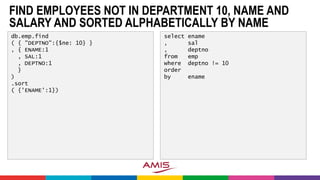
FIND EMPLOYEES NOT IN DEPARTMENT 10, NAME AND
SALARY AND SORTED ALPHABETICALLY BY NAME
db.emp.find
( { "DEPTNO":{$ne: 10} }
, { ENAME:1
, SAL:1
, DEPTNO:1
}
)
.sort
( {'ENAME':1})
select ename
, sal
, deptno
from emp
where deptno != 10
order
by ename
SET DATE TYPE PROPERTY STARTDATE DERIVED FROM
STRING TYPE PROPERTY HIREDATE
db.emp.find().forEach
( function (elem) {
elem.startdate =
new Date( "19“
+ elem.HIREDATE.substring(6)
+ "-"
+ elem.HIREDATE.substring(3,5)
+ "-"
+ elem.HIREDATE.substring(0,2)
);
db.emp.save(elem);
}
)
alter table emp
add (startdate date)
update emp
set startdate =
to_date( hiredate, 'DD-MM-RR')
FIND SALESMEN WITH A TOTAL INCOME HIGHER THAN 2000
-- use $where with embedded JavaScript
db.emp.find
( {"JOB":"SALESMAN"
, $where :
" this.SAL +
(this.COMM != null? this.COMM: 0)
> 2000"
}
)
select *
from emp
where sal + nvl(comm, 0) > 2000
CREATE STORED FUNCTION SALARY CAP TO RETURN MAX SALARY PER
JOB; USE SALARY CAP TO FIND EMPLOYEES EARNING OVER THEIR CAP
db.system.js.save({
"_id": "salaryCap",
"value": function(job) {
return job=='CLERK'?1000
:(job=='ANALYST'?3500
:(job=='SALESMAN'?2000
:(job=='MANAGER'?3000
:10000
)));
}
})
-- load function in current database
db.loadServerScripts();
db.emp.find(
{ $where : " this.SAL >
salaryCap(this.JOB)"}
, {ENAME:1, SAL:1, JOB:1})
create or replace
function salary_cap
(p_job in varchar2)
return number
is
begin
return
case p_job
when 'CLERK' then 1000
when 'ANALYST' then 3500
when 'SALESMAN' then 2000
when 'MANAGER' then 3000
else 10000
end;
end salary_cap;
select ename
, sal
, job
from emp
where sal > salary_cap( job)
SELECT NAME, STARTMONTH AND STARTYEAR FOR ALL
EMPLOYEES
db.emp.aggregate(
[{$project: {
"ENAME": 1,
"startmonth": { $month: "$startdate"},
"startyear": { $year: "$startdate"}
}
}
]
)
select ename
, extract (month from startdate)
as startmonth
, extract (year from startdate)
as startyear
from emp
TOTAL SALARY SUM, TOTAL NUMBER OF EMPLOYEES, THE
HIGHEST SALARY AND THE EARLIEST STARTDATE
db.emp.aggregate(
[{$group: {
_id: null,
total_salary_sum: { $sum: "$SAL" },
total_staff_count: { $sum: 1 },
max_sal: { $max: "$SAL" },
min_startdate: { $min: "$startdate" }
}
}
]
)
select sum(sal) total_salary_sum
, count(*) total_staff_count
, max(sal) max_sal
, min(startdate) min_startdate
from emp
TOTAL SALARY SUM, TOTAL NUMBER OF EMPLOYEES, THE HIGHEST
SALARY AND THE EARLIEST STARTDATE PER DEPARTMENT
db.emp.aggregate(
[{$group: {
_id: "$DEPTNO",
total_salary_sum: { $sum: "$SAL" },
total_staff_count: { $sum: 1 },
max_sal: { $max: "$SAL" },
min_startdate: { $min: "$startdate" }
}
}
]
)
select deptno
, extract (year from startdate)
hireyear
, sum(sal) total_salary_sum
, count(*) total_staff_count
, max(sal) max_sal
, min(startdate) min_startdate
from emp
group
by deptno
, extract (year from startdate)
TOTAL SALARY SUM, NUMBER OF EMPLOYEES, HIGHEST SALARY AND
EARLIEST STARTDATE PER DEPARTMENT AND HIREYEAR
WITH NUMBER OF EMPLOYEES TWO OR MORE
db.emp.aggregate(
[{$group: {
_id: { deptno: "$DEPTNO“
, hireyear :
{ $year: "$startdate"}
},
total_salary_sum: { $sum: "$SAL" },
total_staff_count: { $sum: 1 },
max_sal: { $max: "$SAL" },
min_startdate: { $min: "$startdate" }
}
}
,{$match: {
total_staff_count: { $gt: 1 }
}
}
]
)
select deptno
, extract (year from startdate)
hireyear
, sum(sal) total_salary_sum
, count(*) total_staff_count
, max(sal) max_sal
, min(startdate) min_startdate
from emp
having count(*) > 1
group
by deptno
, extract (year from startdate)
ALL EMPLOYEES WITH THEIR DEPARTMENT DETAILS (WHEN
AVAILABLE)
db.emp.aggregate(
[{$lookup: {
from:"dept",
localField:"DEPTNO",
foreignField:"deptno",
as:"dept"
}
,{$project: {
"EMPNO": 1,
"ENAME": 1,
"DEPT": { $arrayElemAt:["$dept", 0]}
}
}
]
)
select e.*
, d.*
from emp e
left outer join
dept d
on (e.deptno = d.deptno)
ALL DEPARTMENTS WITH A LIST OF THE NAMES OF THEIR EMPLOYEES
db.dept.aggregate(
[{$lookup: {
from:"emp",
localField:"deptno",
foreignField:"DEPTNO",
as:"emps"
}
}
,{$project: {
"deptno": 1,
"dname": 1,
"staff": {
$reduce: {
input: "$emps",
initialValue: "",
in: { $concat : ["$$value"
, ", "
,"$$this.ENAME"]
}
} // reduce
} // staff
} // project
}
])
select d.deptno, d.dname
, listagg( ename, ',')
within group (order by ename)
as "staff"
from dept d
left outer join
emp e
on (d.deptno = e.deptno)
group
by d.deptno
, d.dname
ALL EMPLOYEES WHO WORK IN NEW YORK
db.emp.aggregate(
[{$lookup: {
from:"dept",
localField:"DEPTNO",
foreignField:"deptno",
as:"dept"
}
,{$project: {
"EMPNO": 1,
"ENAME": 1,
"DEPT": { $arrayElemAt:["$dept", 0]}
}
}
, {$match: { "DEPT.loc" :"NEW YORK"} }
]
)
select e.*
, d.*
from emp e
left outer join
dept d
on (e.deptno = d.deptno)
where d.loc = 'NEW YORK'
EMPLOYEE NAMED KING
WITH ALL EMPLOYEES WHO WORK UNDER HER OR HIM
AND A NEAT LIST OF THE NAMES OF THESE SUBORDINATE STAFF
db.emp.aggregate(
[{$match: { ENAME: "KING"}}
,{$lookup: {
from:"emp",
localField:"EMPNO",
foreignField:"MGR",
as:"subordinates"
}
}
,{$project: {
"EMPNO": 1,
"ENAME": 1,
"subordinates": 1,
"staff": { $reduce: {
input: "$subordinates",
initialValue: "",
in: { $concat :
["$$value", ", ","$$this.ENAME"]
} //in
} // reduce
},
}
}
]
)
select e.*
, cursor( select *
from emp s
where s.mgr = e.empno
) subordinates
, ( select listagg( s.ename, ',')
within group
(order by ename)
from emp s
where s.mgr = e.empno
) as "staff"
from emp e
where e.ename = 'KING'
FACET AGGREGATION: # EMPLOYEES BY JOB, BY SALARY BUCKET, BY
DEPARTMENT AND BY STARTDATE (1)
db.emp.aggregate(
[{$facet: {
"categorizedByJob": [
{ $sortByCount: "$JOB" }
],
"categorizedBySalary": [
{$bucket: {
groupBy: "$SAL",
boundaries: [0, 1000, 2000 ,3000 ,10000 ],
default: "Other",
output: {
"count": { $sum: 1 },
"employees": { $push: "$ENAME" }
} // output
}// bucket
}
],
"categorizedByDepartment": [
{ $sortByCount: "$DEPTNO" }
],
"categorizedByHiredate(Auto)": [
{
$bucketAuto: {
groupBy: "$startdate",
buckets: 4
}
}
]
}
}
])
-- categorizedByJob
select job
, count(*) as "count"
from emp
group
by job
order
by "count" desc
-- categorizedByDepartment
select deptno
, count(*) as "count"
from emp
group
by deptno
order
by "count" desc
FACET AGGREGATION: # EMPLOYEES BY JOB, BY SALARY BUCKET, BY
DEPARTMENT AND BY STARTDATE (2)
db.emp.aggregate(
[{$facet: {
"categorizedByJob": [
{ $sortByCount: "$JOB" }
],
"categorizedBySalary": [
{$bucket: {
groupBy: "$SAL",
boundaries: [0, 1000, 2000 ,3000 ,10000 ],
default: "Other",
output: {
"count": { $sum: 1 },
"employees": { $push: "$ENAME" }
} // output
}// bucket
}
],
"categorizedByDepartment": [
{ $sortByCount: "$DEPTNO" }
],
"categorizedByHiredate(Auto)": [
{
$bucketAuto: {
groupBy: "$startdate",
buckets: 4
}
}
]
}
}
])
-- categorizedBySalary
with bucket_boundaries as
( select 10000 lower_boundary from dual
union all
select 2000 lower_boundary from dual
union all
select 3000 lower_boundary from dual
union all
select 10000 lower_boundary from dual
)
, buckets as
( select lower_boundary
, lead(lower_boundary) over
(order by lower_boundary)-1 upper_boundary
from bucket_boundaries
)
select lower_boundary
, count(*)
from emp
left outer join
buckets
on (sal between lower_boundary
and upper_boundary)
group
by lower_boundary
FACET AGGREGATION: # EMPLOYEES BY JOB, BY SALARY BUCKET, BY
DEPARTMENT AND BY STARTDATE (3)
db.emp.aggregate(
[{$facet: {
"categorizedByJob": [
{ $sortByCount: "$JOB" }
],
"categorizedBySalary": [
{$bucket: {
groupBy: "$SAL",
boundaries: [0, 1000, 2000 ,3000 ,10000 ],
default: "Other",
output: {
"count": { $sum: 1 },
"employees": { $push: "$ENAME" }
} // output
}// bucket
}
],
"categorizedByDepartment": [
{ $sortByCount: "$DEPTNO" }
],
"categorizedByHiredate(Auto)": [
{
$bucketAuto: {
groupBy: "$startdate",
buckets: 4
}
}
]
}
}
])
-- categorizedByHiredate
with tiled as
( select ename
, startdate
, ntile(4) over (order by startdate asc)
as size_bucket
from emp
)
select size_bucket
, count(*) as "count"
, listagg( ename, ',')
within group (order by startdate) employees
from tiled
group
by size_bucket
order
by size_bucket
CREATE MATERIALIZED COLLECTION FROM QUERY
DEPARTMENTS WITH NESTED EMPLOYEES
db.dept.aggregate(
[ {$lookup:
{
from:"emp",
localField:"deptno",
foreignField:"DEPTNO",
as:"emps"
}
}
, {$out: "departments"
}
]
)
create or replace type emp_t as object
( EMPNO NUMBER(4)
, ENAME VARCHAR2(10)
, JOB VARCHAR2(9)
, MGR NUMBER(4)
, SAL NUMBER(7,2)
, COMM NUMBER(7,2)
, STARTDATE DATE
)
create or replace type emp_tbl_t as table of emp_t
-- create materialized view
-- with nested table
create materialized view departments
BUILD IMMEDIATE
REFRESH FORCE
ON DEMAND
as
select deptno
, dname
, loc
, cast ( multiset ( select empno, ename, job
, mgr, sal, comm, hiredate
from emp e
where e.deptno = d.deptno
)
as emp_tbl_t) staff
from dept d
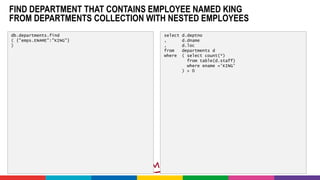
FIND DEPARTMENT THAT CONTAINS EMPLOYEE NAMED KING
FROM DEPARTMENTS COLLECTION WITH NESTED EMPLOYEES
db.departments.find
( {"emps.ENAME":"KING"}
)
select d.deptno
, d.dname
, d.loc
from departments d
where ( select count(*)
from table(d.staff)
where ename ='KING'
) > 0
ONLY FIND EMPLOYEE KING (AND NOT ALL EMPLOYEES IN THE DEPARTMENT)
FROM DEPARTMENTS COLLECTION WITH NESTED EMPLOYEES
db.departments.aggregate(
[
{$unwind: {path:"$emps"}}
, {$match: { "emps.ENAME": "KING"}}
, {$project: {
"EMPNO": "$emps.EMPNO",
"JOB": "$emps.JOB",
"ENAME": "$emps.ENAME",
"STARTDATE": "$emps.startdate",
"DNAME": 1
}
}
]
)
select d.deptno
, d.dname
, d.loc
, staff.*
from departments d
, table(d.staff) staff
where staff.ename = 'KING'
FIND NAMES OF ALL MANAGERS
FROM DEPARTMENTS COLLECTION WITH NESTED EMPLOYEES
db.departments.aggregate(
[
{$unwind: {path:"$emps"}}
, {$match: { "emps.JOB": "MANAGER"}}
, {$project: {
"ENAME": "$emps.ENAME",
}
}
]
)
select staff.ename
from departments d
, table(d.staff) staff
where staff.job = 'MANAGER'
FIND ALL EMPLOYEES WHO ARE NOT IN DEPARTMENT 10, WITH THEIR NAME
AND SALARY AND SORTED ALPHABETICALLY BY NAME
FROM DEPARTMENTS COLLECTION WITH NESTED EMPLOYEES
db.departments.aggregate(
[
{$match: { "DEPTNO": {$ne:10}}}
, {$unwind: {path:"$emps"}}
, {$project: {
"ENAME": "$emps.ENAME",
"SAL": "$emps.SAL",
"DEPTNO": 1,
}
}
, {$sort : {"ENAME":1}}
]
)
select staff.ename
, staff.sal
, d.deptno
from departments d
, table(d.staff) staff
where d.deptno != 10
order
by staff.ename
TOTAL SALARY SUM, TOTAL NUMBER OF EMPLOYEES, THE HIGHEST SALARY
AND THE EARLIEST STARTDATE, PER DEPARTMENT
FROM DEPARTMENTS COLLECTION WITH NESTED EMPLOYEES
db.departments.aggregate(
[
{$unwind: {path:"$emps"}}
, {$group:{ _id: '$deptno'
, total_salary_sum : {$sum: "$emps.SAL"}
, total_staff_count : {$sum: 1}
, max_sal : {$max: "$emps.SAL"}
, min_startdate : {$min: "$emps.startdate"}
}
}
]
)
select d.deptno
, sum(staff.sal) total_salary_sum
, count(staff.empno) total_staff_count
, max(staff.sal) max_sal
, min(staff.startdate) min_startdate
from departments d
, table(d.staff) staff
group
by d.deptno
ADDING GEO LOCATIONS AND CREATE GEO INDEX
db.dept.findAndModify({
query: { loc: "NEW YORK" },
update: { $set: { "location" : {
"type" : "Point",
"coordinates" : [ -73.9352, 40.7306 ]
}
} },
upsert: true
})
db.dept.findAndModify({
query: { loc: "DALLAS" },
update: { $set: { "location" : {
"type" : "Point",
"coordinates" : [ -96.8005, 32.7801 ]
}
} },
upsert: true
})
db.dept.findAndModify({
query: { loc: "BOSTON" },
update: { $set: { "location" : {
"type" : "Point",
"coordinates" : [ -71.0598, 42.3584 ]
}
} },
upsert: true
})
...
-- create spatial index
db.dept.ensureIndex( { location : "2dsphere" } );
-- add column geo_location to hold SDO_GEOMETRY
alter table dept
add (geo_location SDO_GEOMETRY)
-- add geo location to each department
update dept
set geo_location = SDO_GEOMETRY(2001, 8307,
SDO_POINT_TYPE (-73.935242, 40.730610,NULL)
, NULL, NULL)
where loc = 'NEW YORK'
update dept
set geo_location = SDO_GEOMETRY(2001, 8307,
SDO_POINT_TYPE (-96.8005, 32.7801,NULL), NULL, NULL)
where loc = 'DALLAS'
-- insert dimensional meta information for the spatial column
INSERT INTO USER_SDO_GEOM_METADATA
(TABLE_NAME, COLUMN_NAME, DIMINFO, SRID)
VALUES ('DEPT', 'GEO_LOCATION',
SDO_DIM_ARRAY
(SDO_DIM_ELEMENT('LONG', -180.0, 180.0, 0.5),
SDO_DIM_ELEMENT('LAT', -90.0, 90.0, 0.5)
),
8307
);
-- create spatial index
CREATE INDEX dept_spatial_idx
ON dept(geo_location)
INDEXTYPE IS mdsys.spatial_index;
FIND DEPARTMENTS WITHIN 500 KM FROM WASHINGTON DC
( [ -77.0364, 38.8951 ])
db.dept.find(
{
location : {
$near : {
$geometry : {
type : "Point" ,
coordinates : [ -77.0364, 38.8951 ]
},
$maxDistance : 500000
}
}
}
)
with d as
( SELECT loc
, SDO_GEOM.SDO_DISTANCE
( SDO_GEOMETRY(2001, 8307
, SDO_POINT_TYPE ( -77.0364, 38.8951,NULL)
, NULL, NULL
)
, geo_location
, 0.005
, 'unit=KM'
) distance
from dept
)
select d.*
from d
where d.distance < 500
ALL DEPARTMENTS, THE DISTANCE FOR EACH DEPARTMENT IN KILOMETER
FROM WASHINGTON DC, ORDERED BY THAT DISTANCE
db.dept.aggregate([
{ "$geoNear": {
"near": {
"type": "Point",
"coordinates": [ -77.0364, 38.8951 ]
},
"spherical": true,
"distanceField": "distanceFromTarget",
"distanceMultiplier": 0.001 // from meter to km
}}
, {$sort : {"distanceFromTarget":1}}
, {$project: {
_id: 0,
dname: 1,
loc: 1,
"distance from Washington DC":
{ $trunc : "$distanceFromTarget"},
}
}
])
with d as
( SELECT loc
, dname
, SDO_GEOM.SDO_DISTANCE
( SDO_GEOMETRY(2001, 8307
, SDO_POINT_TYPE ( -77.0364, 38.8951,NULL)
, NULL, NULL
)
, geo_location
, 0.005
, 'unit=KM'
) distance
from dept
)
select d.dname
, d.loc
, d.distance “distance from Washington DC”
from d
order
by d.distance
ADD BIOGRAPHIES TO EMPLOYEES (PREPARING FOR TEXT INDEX AND
SEARCH) AND CREATE TEXT INDEX
db.emp.findAndModify({
query: { ENAME: "KING" },
update: { $set: { "bio" : "Gerald Ford was born ...." }
},
upsert: true
})
db.emp.findAndModify({
query: { ENAME: "BLAKE" },
update: { $set: { "bio" : "Jamaican sprinter Yohan Blake
..." }
},
upsert: true
})
db.emp.findAndModify({
query: { ENAME: "FORD" },
update: { $set: { "bio" : "Harrison Ford is one of
...Han Solo." }
},
upsert: true
})
-- create text index, allowing use of text search
db.emp.createIndex(
{ ENAME:'text',
JOB:'text',
BIO:'text',
}
,{ weights: { ENAME:10, JOB:5, bio:1}
, name: 'employee_text_index'
}
)
update emp
set bio = q'[Gerald Ford was born ... in 2006.]'
where ename = 'KING‘
update emp
set bio = q'[Jamaican sprinter Yohan Blake holds
...]'
where ename = 'BLAKE'
-- create a multi column text index
exec ctx_ddl.create_preference
( 'my_mcds', 'multi_column_datastore' )
exec ctx_ddl.set_attribute
( 'my_mcds', 'columns', 'bio, ename, job' )
-- to support stemming
exec ctxsys.ctx_ddl.create_preference
('my_lexer','BASIC_LEXER');
exec ctxsys.ctx_ddl.set_attribute
('my_lexer','index_stems','1');
exec ctxsys.ctx_ddl.create_preference
('my_wordlist','BASIC_WORDLIST');
exec ctxsys.ctx_ddl.set_attribute
('my_wordlist','stemmer','ENGLISH');
create index emp_txt_idx on emp( ename )
indextype is ctxsys.context
parameters( 'datastore my_mcds WORDLIST my_wordlist
LEXER my_lexer' )
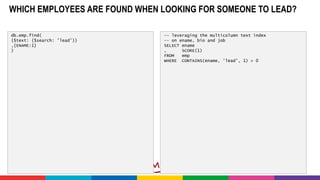
WHICH EMPLOYEES ARE FOUND WHEN LOOKING FOR SOMEONE TO LEAD?
db.emp.find(
{$text: {$search: 'lead'}}
,{ENAME:1}
)
-- leveraging the multicolumn text index
-- on ename, bio and job
SELECT ename
, SCORE(1)
FROM emp
WHERE CONTAINS(ename, 'lead', 1) > 0
TEXT SEARCH INCLUDING SCORING - APPLYING WEIGHT AND DERIVING
APPLICABILITY
db.emp.aggregate(
[{ $match: { $text: { $search: 'managing' } } }
,{ $project: {
_id:0,
ENAME: 1,
score: { $meta: 'textScore' } }
}
,{ $sort: {score:-1} }
]
)
-- leveraging stemming and the multicolumn text index
-- on ename, bio and job
SELECT ename
, SCORE(1) score
FROM emp
WHERE CONTAINS(ename, '$manage', 1) > 0
order
By score desc

Comparing 30 MongoDB operations with Oracle SQL statements

  • 1.
    COMPARING MONGODB SEARCH WITH RACLE SQLQUERIES MongoDB Find & Aggregate vs comparable Oracle SQL queries Lucas Jellema O
  • 2.
    TOPICS • Filter &Sort (find, sort) • Aggregation ($group, $project, $match, $sort) • Lookup & Outer Join ($lookup, $arrayElemAt) • Facet Search ($facet, $bucket, $sortByCount) • Update (findAndModify, forEach, save, update, upsert, $set, $unset) • Date and Time operations • Materialized View ($out) • Nested documents/tables ($unwind, $reduce) • Geospatial (ensureIndex, 2dsphere, $near, $geoNear) • Text Search (createIndex, text, $text, $search) • Stored Procedures (db.system.js.save, $where)
  • 3.
    DATA SET • HRM •Collections emp and dept – JSON documents in MongoDB database • Tables EMP and DEPT – relational records in Oracle Database
  • 4.
    HRM DATA SET JSONDOCUMENT COLLECTIONS EMP AND DEPT
  • 5.
    HRM DATA SET TABLESEMP AND DEPT
  • 6.
    ALL SOURCES AREAVAILABLE ON GITHUB • https://github.com/lucasjellema/sig-nosql-mongodb
  • 7.
    FIND THE NAMESOF ALL MANAGERS db.emp.find ( {"JOB":"MANAGER"} , {ENAME:1} ) select ename from emp Where job = 'MANAGER'
  • 8.
    FIND NAME ANDSALARY OF SALESMEN ORDERED BY SALARY FROM HIGH TO LOW db.emp.find ( {"JOB":"SALESMAN"} , { ENAME:1 , SAL:1} ) .sort ( {'SAL':-1}) select ename , sal from emp where job = 'SALESMAN' order by sal desc
  • 9.
    FIND NAME ANDSALARY OF TWO HIGHEST EARNING SALESMEN – BEST PAID FIRST db.emp.find ( {"JOB":"SALESMAN"} , { ENAME:1 , SAL:1} ) .sort ( {'SAL':-1}) .limit(2) select ename , sal from emp where job = 'SALESMAN' order by sal desc FETCH FIRST 2 ROWS ONLY
  • 10.
    FIND EMPLOYEES WITH‘AR’ IN THEIR NAME – IN ALPHABETICAL ORDER BY NAME db.emp.find ( {"ENAME":{$regex: "AR"} } , { ENAME:1 , SAL:1} ) .sort ( {'ENAME':1}) select ename , sal from emp where ename like '%AR%' order by ename
  • 11.
    FIND EMPLOYEES NOTIN DEPARTMENT 10, NAME AND SALARY AND SORTED ALPHABETICALLY BY NAME db.emp.find ( { "DEPTNO":{$ne: 10} } , { ENAME:1 , SAL:1 , DEPTNO:1 } ) .sort ( {'ENAME':1}) select ename , sal , deptno from emp where deptno != 10 order by ename
  • 12.
    SET DATE TYPEPROPERTY STARTDATE DERIVED FROM STRING TYPE PROPERTY HIREDATE db.emp.find().forEach ( function (elem) { elem.startdate = new Date( "19“ + elem.HIREDATE.substring(6) + "-" + elem.HIREDATE.substring(3,5) + "-" + elem.HIREDATE.substring(0,2) ); db.emp.save(elem); } ) alter table emp add (startdate date) update emp set startdate = to_date( hiredate, 'DD-MM-RR')
  • 13.
    FIND SALESMEN WITHA TOTAL INCOME HIGHER THAN 2000 -- use $where with embedded JavaScript db.emp.find ( {"JOB":"SALESMAN" , $where : " this.SAL + (this.COMM != null? this.COMM: 0) > 2000" } ) select * from emp where sal + nvl(comm, 0) > 2000
  • 14.
    CREATE STORED FUNCTIONSALARY CAP TO RETURN MAX SALARY PER JOB; USE SALARY CAP TO FIND EMPLOYEES EARNING OVER THEIR CAP db.system.js.save({ "_id": "salaryCap", "value": function(job) { return job=='CLERK'?1000 :(job=='ANALYST'?3500 :(job=='SALESMAN'?2000 :(job=='MANAGER'?3000 :10000 ))); } }) -- load function in current database db.loadServerScripts(); db.emp.find( { $where : " this.SAL > salaryCap(this.JOB)"} , {ENAME:1, SAL:1, JOB:1}) create or replace function salary_cap (p_job in varchar2) return number is begin return case p_job when 'CLERK' then 1000 when 'ANALYST' then 3500 when 'SALESMAN' then 2000 when 'MANAGER' then 3000 else 10000 end; end salary_cap; select ename , sal , job from emp where sal > salary_cap( job)
  • 15.
    SELECT NAME, STARTMONTHAND STARTYEAR FOR ALL EMPLOYEES db.emp.aggregate( [{$project: { "ENAME": 1, "startmonth": { $month: "$startdate"}, "startyear": { $year: "$startdate"} } } ] ) select ename , extract (month from startdate) as startmonth , extract (year from startdate) as startyear from emp
  • 16.
    TOTAL SALARY SUM,TOTAL NUMBER OF EMPLOYEES, THE HIGHEST SALARY AND THE EARLIEST STARTDATE db.emp.aggregate( [{$group: { _id: null, total_salary_sum: { $sum: "$SAL" }, total_staff_count: { $sum: 1 }, max_sal: { $max: "$SAL" }, min_startdate: { $min: "$startdate" } } } ] ) select sum(sal) total_salary_sum , count(*) total_staff_count , max(sal) max_sal , min(startdate) min_startdate from emp
  • 17.
    TOTAL SALARY SUM,TOTAL NUMBER OF EMPLOYEES, THE HIGHEST SALARY AND THE EARLIEST STARTDATE PER DEPARTMENT db.emp.aggregate( [{$group: { _id: "$DEPTNO", total_salary_sum: { $sum: "$SAL" }, total_staff_count: { $sum: 1 }, max_sal: { $max: "$SAL" }, min_startdate: { $min: "$startdate" } } } ] ) select deptno , extract (year from startdate) hireyear , sum(sal) total_salary_sum , count(*) total_staff_count , max(sal) max_sal , min(startdate) min_startdate from emp group by deptno , extract (year from startdate)
  • 18.
    TOTAL SALARY SUM,NUMBER OF EMPLOYEES, HIGHEST SALARY AND EARLIEST STARTDATE PER DEPARTMENT AND HIREYEAR WITH NUMBER OF EMPLOYEES TWO OR MORE db.emp.aggregate( [{$group: { _id: { deptno: "$DEPTNO“ , hireyear : { $year: "$startdate"} }, total_salary_sum: { $sum: "$SAL" }, total_staff_count: { $sum: 1 }, max_sal: { $max: "$SAL" }, min_startdate: { $min: "$startdate" } } } ,{$match: { total_staff_count: { $gt: 1 } } } ] ) select deptno , extract (year from startdate) hireyear , sum(sal) total_salary_sum , count(*) total_staff_count , max(sal) max_sal , min(startdate) min_startdate from emp having count(*) > 1 group by deptno , extract (year from startdate)
  • 19.
    ALL EMPLOYEES WITHTHEIR DEPARTMENT DETAILS (WHEN AVAILABLE) db.emp.aggregate( [{$lookup: { from:"dept", localField:"DEPTNO", foreignField:"deptno", as:"dept" } ,{$project: { "EMPNO": 1, "ENAME": 1, "DEPT": { $arrayElemAt:["$dept", 0]} } } ] ) select e.* , d.* from emp e left outer join dept d on (e.deptno = d.deptno)
  • 20.
    ALL DEPARTMENTS WITHA LIST OF THE NAMES OF THEIR EMPLOYEES db.dept.aggregate( [{$lookup: { from:"emp", localField:"deptno", foreignField:"DEPTNO", as:"emps" } } ,{$project: { "deptno": 1, "dname": 1, "staff": { $reduce: { input: "$emps", initialValue: "", in: { $concat : ["$$value" , ", " ,"$$this.ENAME"] } } // reduce } // staff } // project } ]) select d.deptno, d.dname , listagg( ename, ',') within group (order by ename) as "staff" from dept d left outer join emp e on (d.deptno = e.deptno) group by d.deptno , d.dname
  • 21.
    ALL EMPLOYEES WHOWORK IN NEW YORK db.emp.aggregate( [{$lookup: { from:"dept", localField:"DEPTNO", foreignField:"deptno", as:"dept" } ,{$project: { "EMPNO": 1, "ENAME": 1, "DEPT": { $arrayElemAt:["$dept", 0]} } } , {$match: { "DEPT.loc" :"NEW YORK"} } ] ) select e.* , d.* from emp e left outer join dept d on (e.deptno = d.deptno) where d.loc = 'NEW YORK'
  • 22.
    EMPLOYEE NAMED KING WITHALL EMPLOYEES WHO WORK UNDER HER OR HIM AND A NEAT LIST OF THE NAMES OF THESE SUBORDINATE STAFF db.emp.aggregate( [{$match: { ENAME: "KING"}} ,{$lookup: { from:"emp", localField:"EMPNO", foreignField:"MGR", as:"subordinates" } } ,{$project: { "EMPNO": 1, "ENAME": 1, "subordinates": 1, "staff": { $reduce: { input: "$subordinates", initialValue: "", in: { $concat : ["$$value", ", ","$$this.ENAME"] } //in } // reduce }, } } ] ) select e.* , cursor( select * from emp s where s.mgr = e.empno ) subordinates , ( select listagg( s.ename, ',') within group (order by ename) from emp s where s.mgr = e.empno ) as "staff" from emp e where e.ename = 'KING'
  • 23.
    FACET AGGREGATION: #EMPLOYEES BY JOB, BY SALARY BUCKET, BY DEPARTMENT AND BY STARTDATE (1) db.emp.aggregate( [{$facet: { "categorizedByJob": [ { $sortByCount: "$JOB" } ], "categorizedBySalary": [ {$bucket: { groupBy: "$SAL", boundaries: [0, 1000, 2000 ,3000 ,10000 ], default: "Other", output: { "count": { $sum: 1 }, "employees": { $push: "$ENAME" } } // output }// bucket } ], "categorizedByDepartment": [ { $sortByCount: "$DEPTNO" } ], "categorizedByHiredate(Auto)": [ { $bucketAuto: { groupBy: "$startdate", buckets: 4 } } ] } } ]) -- categorizedByJob select job , count(*) as "count" from emp group by job order by "count" desc -- categorizedByDepartment select deptno , count(*) as "count" from emp group by deptno order by "count" desc
  • 24.
    FACET AGGREGATION: #EMPLOYEES BY JOB, BY SALARY BUCKET, BY DEPARTMENT AND BY STARTDATE (2) db.emp.aggregate( [{$facet: { "categorizedByJob": [ { $sortByCount: "$JOB" } ], "categorizedBySalary": [ {$bucket: { groupBy: "$SAL", boundaries: [0, 1000, 2000 ,3000 ,10000 ], default: "Other", output: { "count": { $sum: 1 }, "employees": { $push: "$ENAME" } } // output }// bucket } ], "categorizedByDepartment": [ { $sortByCount: "$DEPTNO" } ], "categorizedByHiredate(Auto)": [ { $bucketAuto: { groupBy: "$startdate", buckets: 4 } } ] } } ]) -- categorizedBySalary with bucket_boundaries as ( select 10000 lower_boundary from dual union all select 2000 lower_boundary from dual union all select 3000 lower_boundary from dual union all select 10000 lower_boundary from dual ) , buckets as ( select lower_boundary , lead(lower_boundary) over (order by lower_boundary)-1 upper_boundary from bucket_boundaries ) select lower_boundary , count(*) from emp left outer join buckets on (sal between lower_boundary and upper_boundary) group by lower_boundary
  • 25.
    FACET AGGREGATION: #EMPLOYEES BY JOB, BY SALARY BUCKET, BY DEPARTMENT AND BY STARTDATE (3) db.emp.aggregate( [{$facet: { "categorizedByJob": [ { $sortByCount: "$JOB" } ], "categorizedBySalary": [ {$bucket: { groupBy: "$SAL", boundaries: [0, 1000, 2000 ,3000 ,10000 ], default: "Other", output: { "count": { $sum: 1 }, "employees": { $push: "$ENAME" } } // output }// bucket } ], "categorizedByDepartment": [ { $sortByCount: "$DEPTNO" } ], "categorizedByHiredate(Auto)": [ { $bucketAuto: { groupBy: "$startdate", buckets: 4 } } ] } } ]) -- categorizedByHiredate with tiled as ( select ename , startdate , ntile(4) over (order by startdate asc) as size_bucket from emp ) select size_bucket , count(*) as "count" , listagg( ename, ',') within group (order by startdate) employees from tiled group by size_bucket order by size_bucket
  • 26.
    CREATE MATERIALIZED COLLECTIONFROM QUERY DEPARTMENTS WITH NESTED EMPLOYEES db.dept.aggregate( [ {$lookup: { from:"emp", localField:"deptno", foreignField:"DEPTNO", as:"emps" } } , {$out: "departments" } ] ) create or replace type emp_t as object ( EMPNO NUMBER(4) , ENAME VARCHAR2(10) , JOB VARCHAR2(9) , MGR NUMBER(4) , SAL NUMBER(7,2) , COMM NUMBER(7,2) , STARTDATE DATE ) create or replace type emp_tbl_t as table of emp_t -- create materialized view -- with nested table create materialized view departments BUILD IMMEDIATE REFRESH FORCE ON DEMAND as select deptno , dname , loc , cast ( multiset ( select empno, ename, job , mgr, sal, comm, hiredate from emp e where e.deptno = d.deptno ) as emp_tbl_t) staff from dept d
  • 27.
    FIND DEPARTMENT THATCONTAINS EMPLOYEE NAMED KING FROM DEPARTMENTS COLLECTION WITH NESTED EMPLOYEES db.departments.find ( {"emps.ENAME":"KING"} ) select d.deptno , d.dname , d.loc from departments d where ( select count(*) from table(d.staff) where ename ='KING' ) > 0
  • 28.
    ONLY FIND EMPLOYEEKING (AND NOT ALL EMPLOYEES IN THE DEPARTMENT) FROM DEPARTMENTS COLLECTION WITH NESTED EMPLOYEES db.departments.aggregate( [ {$unwind: {path:"$emps"}} , {$match: { "emps.ENAME": "KING"}} , {$project: { "EMPNO": "$emps.EMPNO", "JOB": "$emps.JOB", "ENAME": "$emps.ENAME", "STARTDATE": "$emps.startdate", "DNAME": 1 } } ] ) select d.deptno , d.dname , d.loc , staff.* from departments d , table(d.staff) staff where staff.ename = 'KING'
  • 29.
    FIND NAMES OFALL MANAGERS FROM DEPARTMENTS COLLECTION WITH NESTED EMPLOYEES db.departments.aggregate( [ {$unwind: {path:"$emps"}} , {$match: { "emps.JOB": "MANAGER"}} , {$project: { "ENAME": "$emps.ENAME", } } ] ) select staff.ename from departments d , table(d.staff) staff where staff.job = 'MANAGER'
  • 30.
    FIND ALL EMPLOYEESWHO ARE NOT IN DEPARTMENT 10, WITH THEIR NAME AND SALARY AND SORTED ALPHABETICALLY BY NAME FROM DEPARTMENTS COLLECTION WITH NESTED EMPLOYEES db.departments.aggregate( [ {$match: { "DEPTNO": {$ne:10}}} , {$unwind: {path:"$emps"}} , {$project: { "ENAME": "$emps.ENAME", "SAL": "$emps.SAL", "DEPTNO": 1, } } , {$sort : {"ENAME":1}} ] ) select staff.ename , staff.sal , d.deptno from departments d , table(d.staff) staff where d.deptno != 10 order by staff.ename
  • 31.
    TOTAL SALARY SUM,TOTAL NUMBER OF EMPLOYEES, THE HIGHEST SALARY AND THE EARLIEST STARTDATE, PER DEPARTMENT FROM DEPARTMENTS COLLECTION WITH NESTED EMPLOYEES db.departments.aggregate( [ {$unwind: {path:"$emps"}} , {$group:{ _id: '$deptno' , total_salary_sum : {$sum: "$emps.SAL"} , total_staff_count : {$sum: 1} , max_sal : {$max: "$emps.SAL"} , min_startdate : {$min: "$emps.startdate"} } } ] ) select d.deptno , sum(staff.sal) total_salary_sum , count(staff.empno) total_staff_count , max(staff.sal) max_sal , min(staff.startdate) min_startdate from departments d , table(d.staff) staff group by d.deptno
  • 32.
    ADDING GEO LOCATIONSAND CREATE GEO INDEX db.dept.findAndModify({ query: { loc: "NEW YORK" }, update: { $set: { "location" : { "type" : "Point", "coordinates" : [ -73.9352, 40.7306 ] } } }, upsert: true }) db.dept.findAndModify({ query: { loc: "DALLAS" }, update: { $set: { "location" : { "type" : "Point", "coordinates" : [ -96.8005, 32.7801 ] } } }, upsert: true }) db.dept.findAndModify({ query: { loc: "BOSTON" }, update: { $set: { "location" : { "type" : "Point", "coordinates" : [ -71.0598, 42.3584 ] } } }, upsert: true }) ... -- create spatial index db.dept.ensureIndex( { location : "2dsphere" } ); -- add column geo_location to hold SDO_GEOMETRY alter table dept add (geo_location SDO_GEOMETRY) -- add geo location to each department update dept set geo_location = SDO_GEOMETRY(2001, 8307, SDO_POINT_TYPE (-73.935242, 40.730610,NULL) , NULL, NULL) where loc = 'NEW YORK' update dept set geo_location = SDO_GEOMETRY(2001, 8307, SDO_POINT_TYPE (-96.8005, 32.7801,NULL), NULL, NULL) where loc = 'DALLAS' -- insert dimensional meta information for the spatial column INSERT INTO USER_SDO_GEOM_METADATA (TABLE_NAME, COLUMN_NAME, DIMINFO, SRID) VALUES ('DEPT', 'GEO_LOCATION', SDO_DIM_ARRAY (SDO_DIM_ELEMENT('LONG', -180.0, 180.0, 0.5), SDO_DIM_ELEMENT('LAT', -90.0, 90.0, 0.5) ), 8307 ); -- create spatial index CREATE INDEX dept_spatial_idx ON dept(geo_location) INDEXTYPE IS mdsys.spatial_index;
  • 33.
    FIND DEPARTMENTS WITHIN500 KM FROM WASHINGTON DC ( [ -77.0364, 38.8951 ]) db.dept.find( { location : { $near : { $geometry : { type : "Point" , coordinates : [ -77.0364, 38.8951 ] }, $maxDistance : 500000 } } } ) with d as ( SELECT loc , SDO_GEOM.SDO_DISTANCE ( SDO_GEOMETRY(2001, 8307 , SDO_POINT_TYPE ( -77.0364, 38.8951,NULL) , NULL, NULL ) , geo_location , 0.005 , 'unit=KM' ) distance from dept ) select d.* from d where d.distance < 500
  • 34.
    ALL DEPARTMENTS, THEDISTANCE FOR EACH DEPARTMENT IN KILOMETER FROM WASHINGTON DC, ORDERED BY THAT DISTANCE db.dept.aggregate([ { "$geoNear": { "near": { "type": "Point", "coordinates": [ -77.0364, 38.8951 ] }, "spherical": true, "distanceField": "distanceFromTarget", "distanceMultiplier": 0.001 // from meter to km }} , {$sort : {"distanceFromTarget":1}} , {$project: { _id: 0, dname: 1, loc: 1, "distance from Washington DC": { $trunc : "$distanceFromTarget"}, } } ]) with d as ( SELECT loc , dname , SDO_GEOM.SDO_DISTANCE ( SDO_GEOMETRY(2001, 8307 , SDO_POINT_TYPE ( -77.0364, 38.8951,NULL) , NULL, NULL ) , geo_location , 0.005 , 'unit=KM' ) distance from dept ) select d.dname , d.loc , d.distance “distance from Washington DC” from d order by d.distance
  • 35.
    ADD BIOGRAPHIES TOEMPLOYEES (PREPARING FOR TEXT INDEX AND SEARCH) AND CREATE TEXT INDEX db.emp.findAndModify({ query: { ENAME: "KING" }, update: { $set: { "bio" : "Gerald Ford was born ...." } }, upsert: true }) db.emp.findAndModify({ query: { ENAME: "BLAKE" }, update: { $set: { "bio" : "Jamaican sprinter Yohan Blake ..." } }, upsert: true }) db.emp.findAndModify({ query: { ENAME: "FORD" }, update: { $set: { "bio" : "Harrison Ford is one of ...Han Solo." } }, upsert: true }) -- create text index, allowing use of text search db.emp.createIndex( { ENAME:'text', JOB:'text', BIO:'text', } ,{ weights: { ENAME:10, JOB:5, bio:1} , name: 'employee_text_index' } ) update emp set bio = q'[Gerald Ford was born ... in 2006.]' where ename = 'KING‘ update emp set bio = q'[Jamaican sprinter Yohan Blake holds ...]' where ename = 'BLAKE' -- create a multi column text index exec ctx_ddl.create_preference ( 'my_mcds', 'multi_column_datastore' ) exec ctx_ddl.set_attribute ( 'my_mcds', 'columns', 'bio, ename, job' ) -- to support stemming exec ctxsys.ctx_ddl.create_preference ('my_lexer','BASIC_LEXER'); exec ctxsys.ctx_ddl.set_attribute ('my_lexer','index_stems','1'); exec ctxsys.ctx_ddl.create_preference ('my_wordlist','BASIC_WORDLIST'); exec ctxsys.ctx_ddl.set_attribute ('my_wordlist','stemmer','ENGLISH'); create index emp_txt_idx on emp( ename ) indextype is ctxsys.context parameters( 'datastore my_mcds WORDLIST my_wordlist LEXER my_lexer' )
  • 36.
    WHICH EMPLOYEES AREFOUND WHEN LOOKING FOR SOMEONE TO LEAD? db.emp.find( {$text: {$search: 'lead'}} ,{ENAME:1} ) -- leveraging the multicolumn text index -- on ename, bio and job SELECT ename , SCORE(1) FROM emp WHERE CONTAINS(ename, 'lead', 1) > 0
  • 37.
    TEXT SEARCH INCLUDINGSCORING - APPLYING WEIGHT AND DERIVING APPLICABILITY db.emp.aggregate( [{ $match: { $text: { $search: 'managing' } } } ,{ $project: { _id:0, ENAME: 1, score: { $meta: 'textScore' } } } ,{ $sort: {score:-1} } ] ) -- leveraging stemming and the multicolumn text index -- on ename, bio and job SELECT ename , SCORE(1) score FROM emp WHERE CONTAINS(ename, '$manage', 1) > 0 order By score desc