
PL/SQL shouldn't be
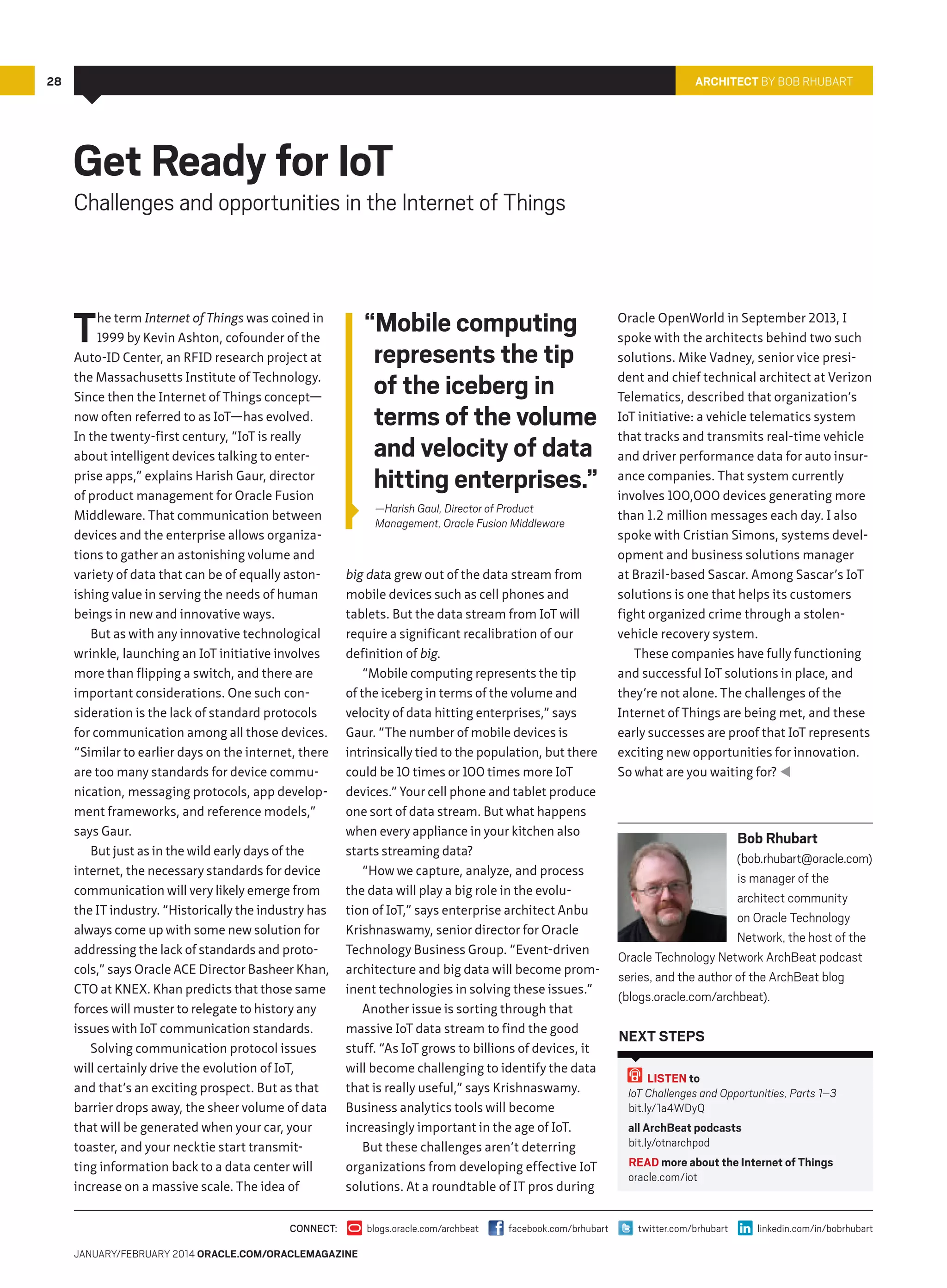
ROCKET SCIENCE
go skyhigh...

Oracle development made easy!
We think Oracle development should be like taking a walk in the park.
Easy development is the key to saving time and money. That’s why
we created the PL/SQL Developer tool. As simple as 3, 2, 1!
www.allroundautomations.com/plsqldev
JANUARY/FEBRUARY 2014

Get Ready for IoT Challenges and opportunities in
the Internet of Things / 21 Speed Mobile Quickly
deploy line-of-business mobile business intelligence
apps with Oracle Business Intelligence Mobile App
Designer / 45 Hide from Prying Eyes Use Data
Redaction in Oracle Database 12c to hide sensitive
data automatically / 49 On Oracle Database 12c,
Part 3 Our technologist improves partitions, adapts
query plans, and optimizes statistics gathering / 57
Survival for the Database Technologist Five
steps to help you sort through the information
about information management / 63

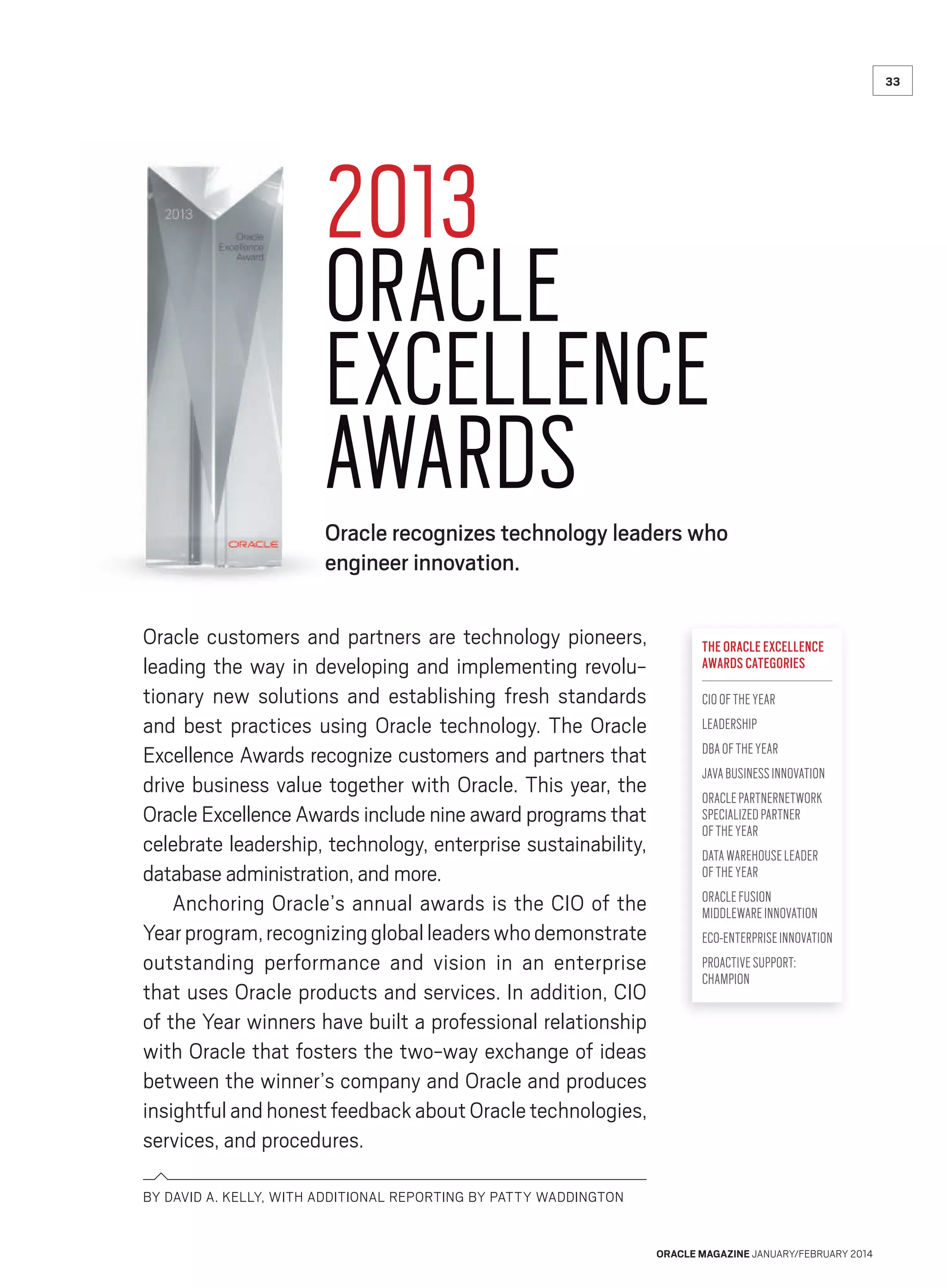
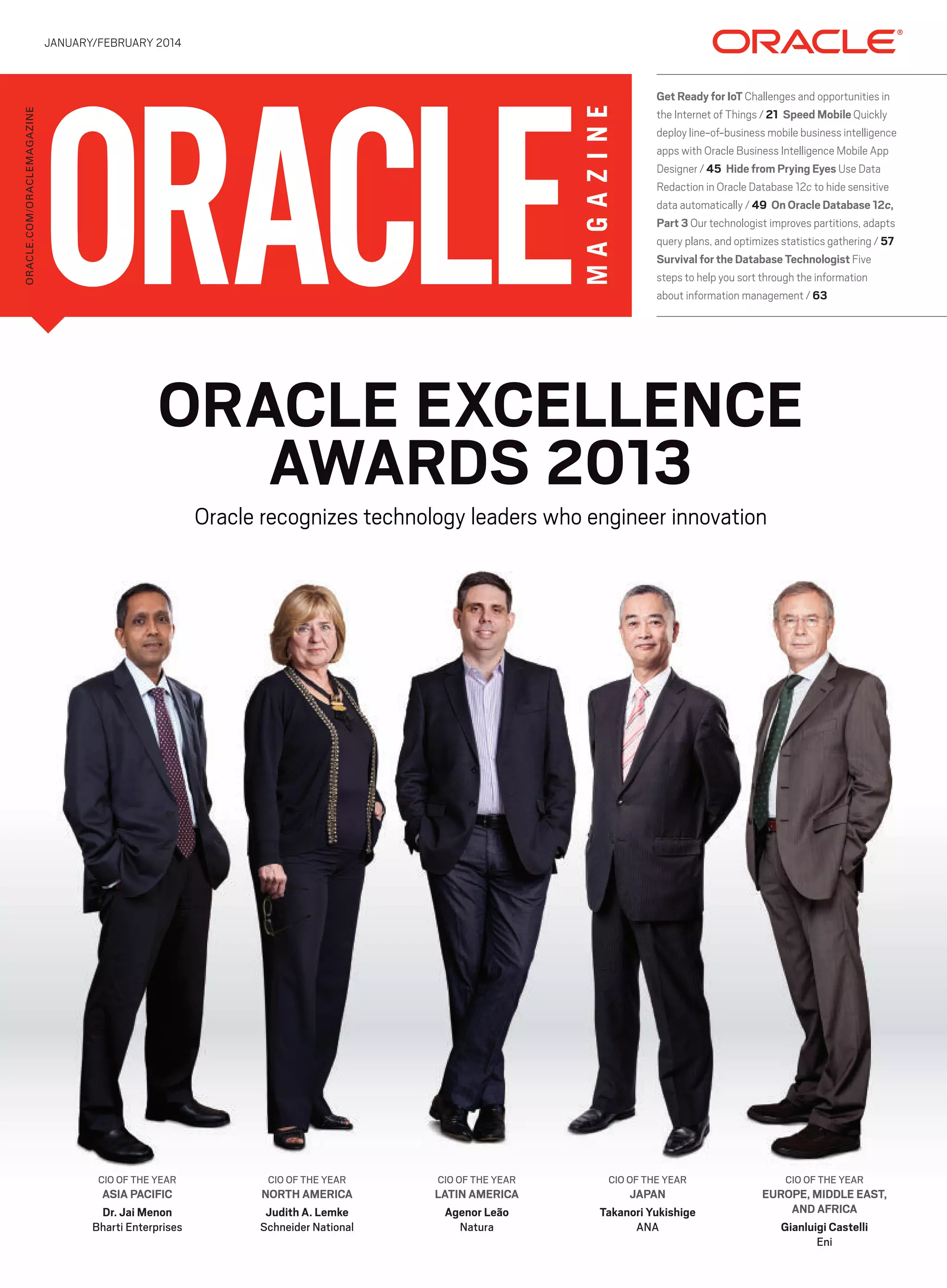
ORACLE EXCELLENCE
AWARDS 2013
Oracle recognizes technology leaders who engineer innovation

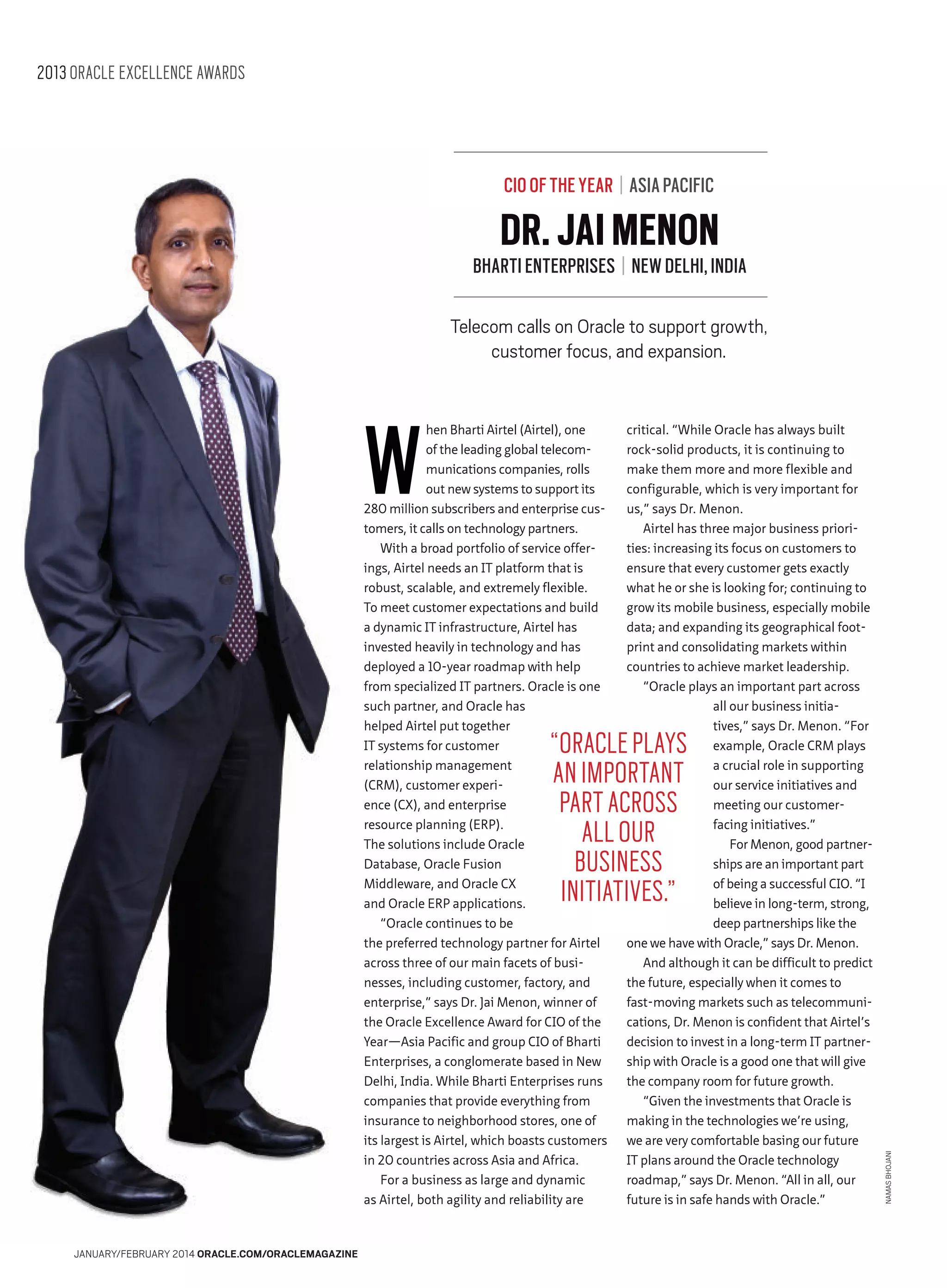
CIO OF THE YEAR

ASIA PACIFIC
Dr. Jai Menon
Bharti Enterprises

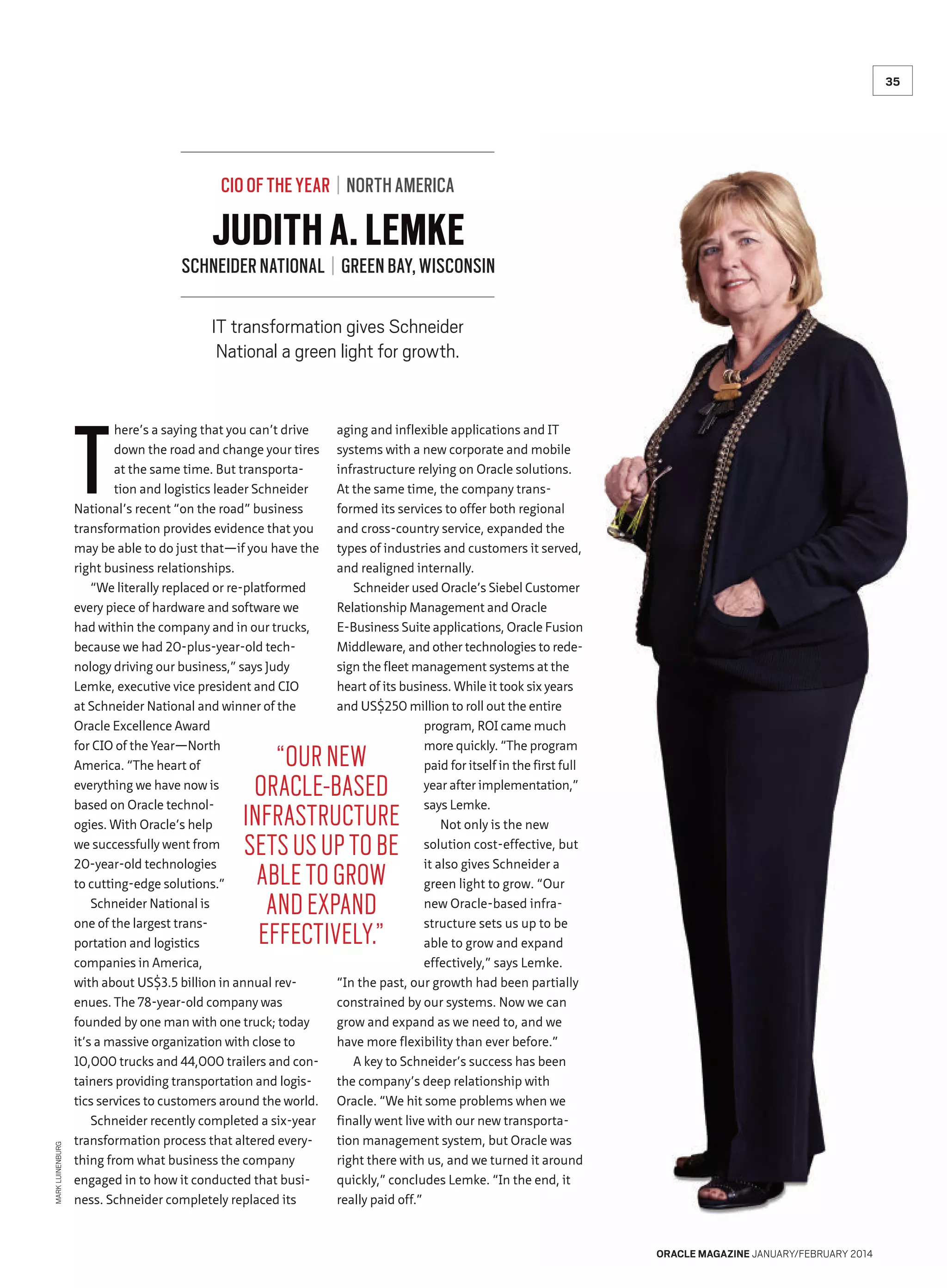
CIO OF THE YEAR

NORTH AMERICA
Judith A. Lemke
Schneider National

CIO OF THE YEAR

LATIN AMERICA
Agenor Leão
Natura

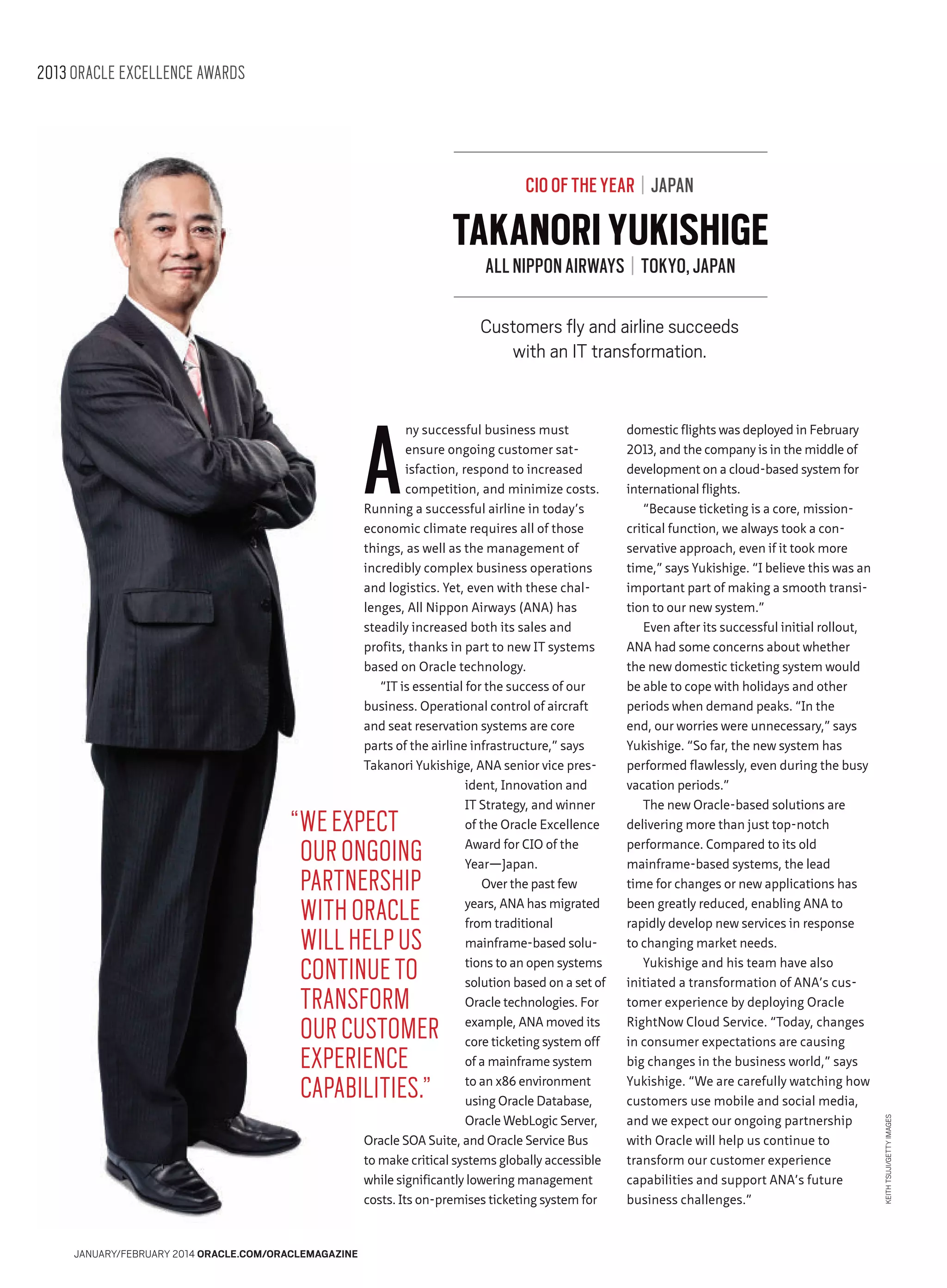
CIO OF THE YEAR

JAPAN
Takanori Yukishige
ANA

CIO OF THE YEAR

EUROPE, MIDDLE EAST,
AND AFRICA
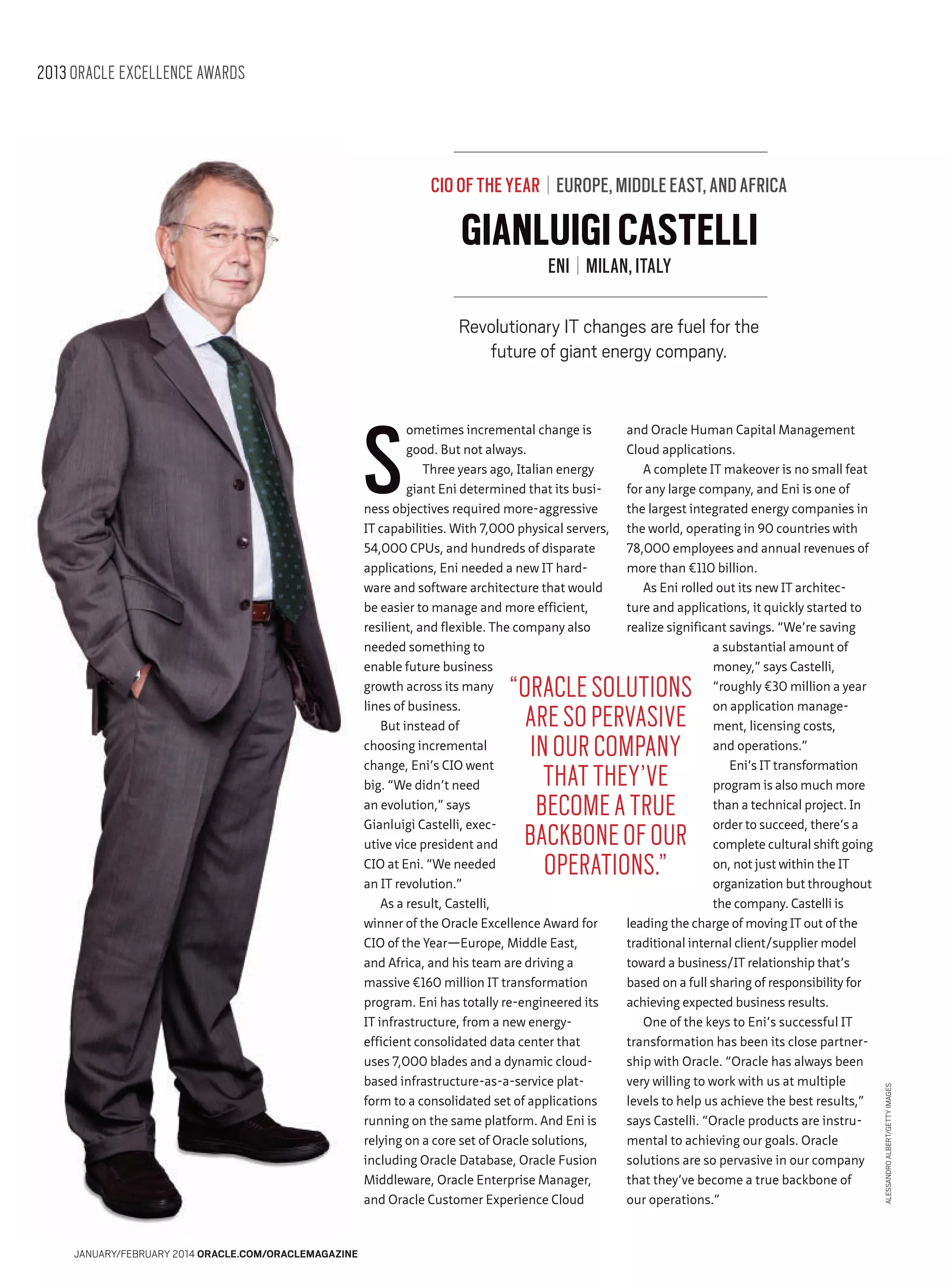
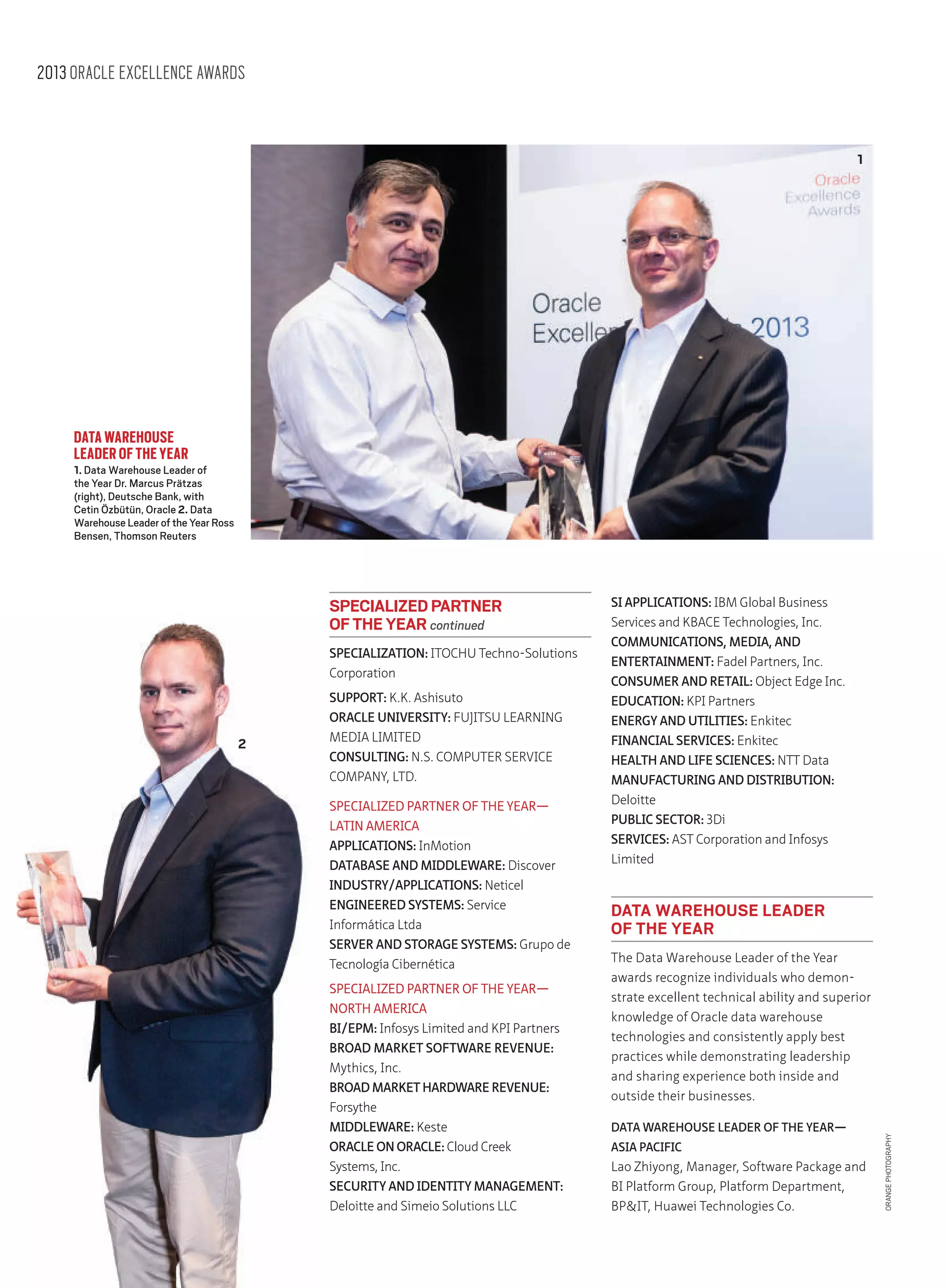
Gianluigi Castelli
Eni
2

VOLUME XXVIII - ISSUE 1

CONTENTS

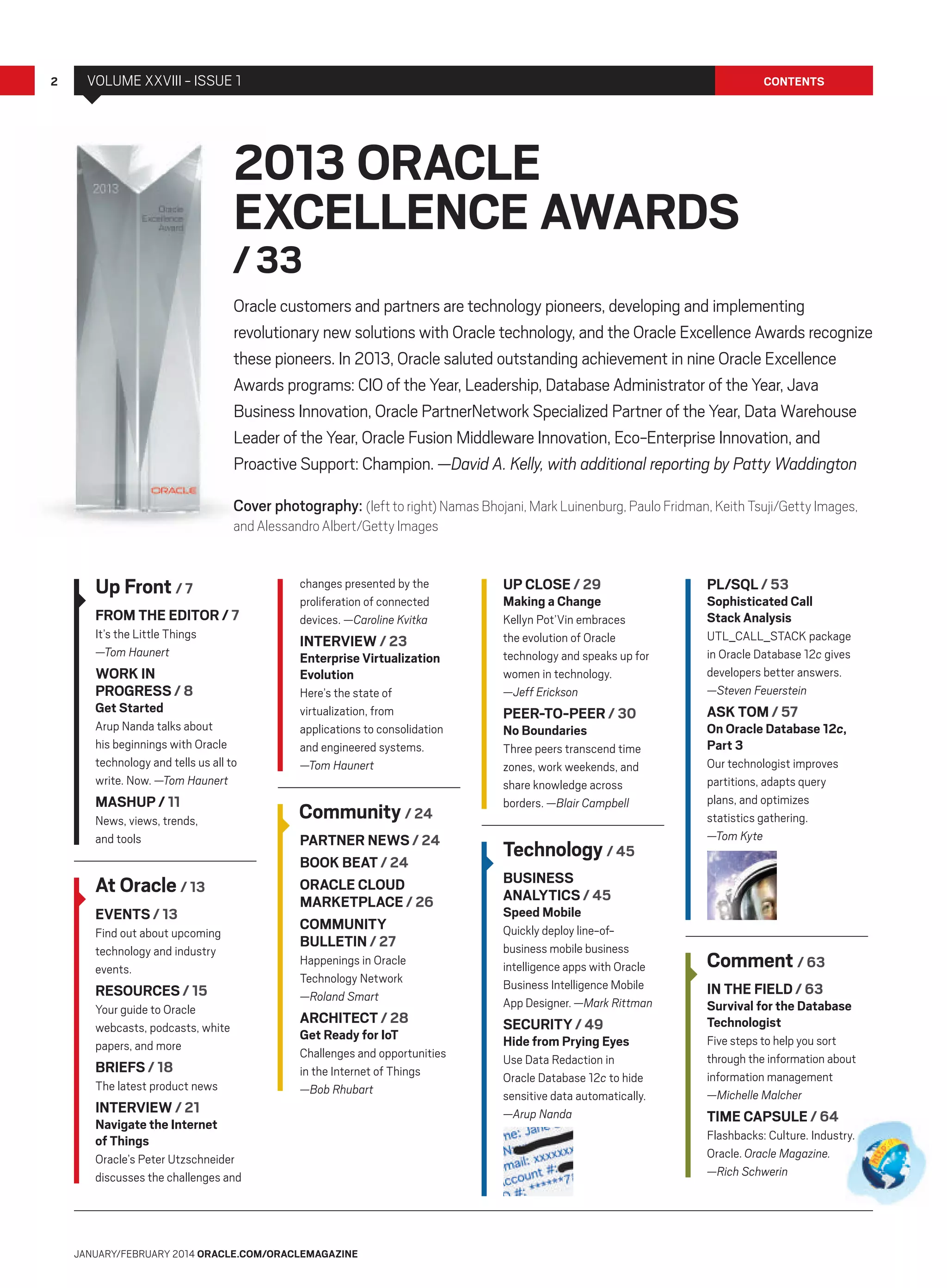
2013 ORACLE
EXCELLENCE AWARDS
/ 33

Oracle customers and partners are technology pioneers, developing and implementing
revolutionary new solutions with Oracle technology, and the Oracle Excellence Awards recognize
these pioneers. In 2013, Oracle saluted outstanding achievement in nine Oracle Excellence
Awards programs: CIO of the Year, Leadership, Database Administrator of the Year, Java
Business Innovation, Oracle PartnerNetwork Specialized Partner of the Year, Data Warehouse
Leader of the Year, Oracle Fusion Middleware Innovation, Eco-Enterprise Innovation, and
Proactive Support: Champion. —David A. Kelly, with additional reporting by Patty Waddington
Cover photography: (left to right) Namas Bhojani, Mark Luinenburg, Paulo Fridman, Keith Tsuji/Getty Images,
and Alessandro Albert/Getty Images

Up Front / 7
FROM THE EDITOR / 7
It’s the Little Things
—Tom Haunert

WORK IN
PROGRESS / 8
Get Started

Arup Nanda talks about
his beginnings with Oracle
technology and tells us all to
write. Now. —Tom Haunert

MASHUP / 11
News, views, trends,
and tools

At Oracle / 13
EVENTS / 13
Find out about upcoming
technology and industry
events.

RESOURCES / 15
Your guide to Oracle
webcasts, podcasts, white
papers, and more

BRIEFS / 18
The latest product news

INTERVIEW / 21

changes presented by the
proliferation of connected
devices. —Caroline Kvitka

INTERVIEW / 23

Enterprise Virtualization
Evolution
Here’s the state of
virtualization, from
applications to consolidation
and engineered systems.
—Tom Haunert

Community / 24
PARTNER NEWS / 24
BOOK BEAT / 24
ORACLE CLOUD
MARKETPLACE / 26
COMMUNITY
BULLETIN / 27
Happenings in Oracle
Technology Network
—Roland Smart

ARCHITECT / 28
Get Ready for IoT

Challenges and opportunities
in the Internet of Things
—Bob Rhubart

Navigate the Internet
of Things
Oracle’s Peter Utzschneider
discusses the challenges and

JANUARY/FEBRUARY 2014 ORACLE.COM/ORACLEMAGAZINE

UP CLOSE / 29

PL/SQL / 53

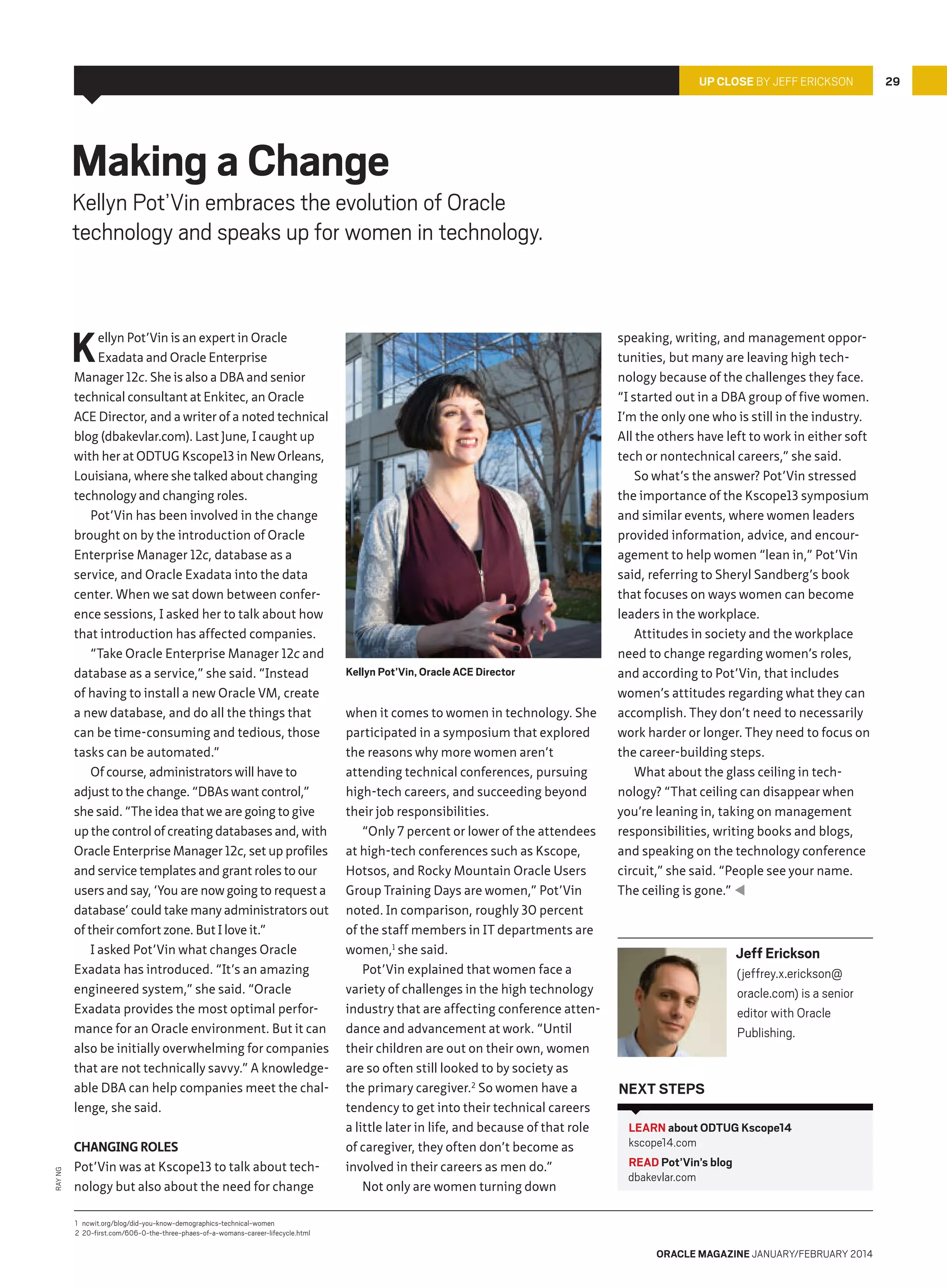
Kellyn Pot’Vin embraces
the evolution of Oracle
technology and speaks up for
women in technology.
—Jeff Erickson

UTL_CALL_STACK package
in Oracle Database 12c gives
developers better answers.
—Steven Feuerstein

Making a Change

PEER-TO-PEER / 30
No Boundaries

Three peers transcend time
zones, work weekends, and
share knowledge across
borders. —Blair Campbell

Technology / 45

Sophisticated Call
Stack Analysis

ASK TOM / 57

On Oracle Database 12c,
Part 3
Our technologist improves
partitions, adapts query
plans, and optimizes
statistics gathering.
—Tom Kyte

BUSINESS
ANALYTICS / 45
Speed Mobile

Quickly deploy line-ofbusiness mobile business
intelligence apps with Oracle
Business Intelligence Mobile
App Designer. —Mark Rittman

SECURITY / 49

Hide from Prying Eyes
Use Data Redaction in
Oracle Database 12c to hide
sensitive data automatically.
—Arup Nanda

Comment / 63
IN THE FIELD / 63

Survival for the Database
Technologist
Five steps to help you sort
through the information about
information management
—Michelle Malcher

TIME CAPSULE / 64
Flashbacks: Culture. Industry.
Oracle. Oracle Magazine.
—Rich Schwerin
Expect More

ROWTH CONNECTIONS DEPTH
FLEXIBILITY TRANSFORMATION
PERFORMANCE IMPACT ALI
IO BREAKTHROUGHS INSPIRATION
Deloitte & Oracle
Today, everything in your business is connected. But are you
prepared to use those connections to drive better results?
With the combination of Deloitte’s business insights and
Oracle’s deep technology capabilities, you can.

To fnd out how, scan
here to contact us.

As used in this document, “Deloitte” means Deloitte LLP and its subsidiaries.
Please see www.deloitte.com/us/aboutfor a detailed description of the legal
structure of Deloitte LLP and its subsidiaries. Certain services may not be
available to attest clients under the rules and regulations of public accounting.
Copyright © 2013 Deloitte Development LLC. All rights reserved.
Member of Deloitte Touche Tohmatsu Limited
4

Editorial
Editor in Chief Tom Haunert tom.haunert@oracle.com
Managing Editor Jan Rogers jan.rogers@oracle.com
Senior Editor Caroline Kvitka caroline.kvitka@oracle.com
Associate Editor  Patty Waddington
Contributing Editor and Writer  Blair Campbell
Technology Advisor  Tom Kyte
Contributors  Marta Bright, Jeff Erickson, Fred Sandsmark, Rich Schwerin, Leslie Steere
DESIGN
Senior Creative Director  Francisco G Delgadillo
Senior Design Director  Suemi Lam
Design Director  Richard Merchán
Contributing Designers  Jaime Ferrand, Arianna Pucherelli
Production Designers  Sheila Brennan, Kathy Cygnarowicz
Publishing
Vice President Jeff Spicer jeff.spicer@oracle.com
Publisher Jennifer Hamilton jennifer.hamilton@oracle.com +1.650.506.3794
Associate Publisher and Audience Development Director Karin Kinnear karin.kinnear@oracle.com +1.650.506.1985
Advertising sales
President, Sprocket Media Kyle Walkenhorst kyle@sprocketmedia.com +1.323.340.8585
Western and Central US, LAD, and Canada, Sprocket Media Tom Cometa thomas.cometa@sbcglobal.net +1.510.339.2403
Eastern US and EMEA/APAC, Sprocket Media Mark Makinney mark.makinney@sprocketmedia.com +1.805.709.4745
Advertising Sales Assistant, Sprocket Media Cindy Elhaj cindy@sprocketmedia.com +1.626.396.9400, x201
Mailing-List Rentals  Contact your sales representative.
Editorial Board
Ian Abramson, Karen Cannell, Andrew Clarke, Chris Claterbos, Karthika Devi, Kimberly Floss, Kent Graziano,
Taqi Hasan, Tony Jambu, Tony Jedlinski, Ari Kaplan, Val Kavi, John King, Steve Lemme, Carol McGury,
Sumit Sengupta, Jonathan Vincenzo, Dan Vlamis

Subscription Information
Subscriptions are complimentary for qualified individuals who complete the form found at
oracle.com/oraclemagazine. For change of address, mail in label with the new address to:
Oracle Magazine, P.O. Box 1263, Skokie, IL 60076-8263.
Magazine Customer Service
oracle@halldata.com  Fax +1.847.763.9638  Phone +1.847.763.9635

Resources
Oracle Products
+1.800.367.8674 (US/Canada)
Oracle Services
+1.888.283.0591
Oracle Press Books
oraclepressbooks.com

Privacy
Oracle Publishing allows sharing of its mailing list with selected third parties. If you prefer that your
mailing address or e-mail address not be included in this program, contact Customer Service at
oracle@halldata.com.
Copyright © 2014, Oracle and/or its affiliates. All Rights Reserved. No part of this publication may be reprinted or other­wise reproduced without permission from the editors. ORACLE MAGAZINE IS PROVIDED ON
AN “AS IS” BASIS. ORACLE EXPRESSLY DISCLAIMS ALL WARRANTIES, WHETHER EXPRESS OR IMPLIED. IN NO EVENT SHALL ORACLE BE LIABLE FOR ANY DAMAGES OF ANY KIND ARISING FROM YOUR
USE OF OR RELIANCE ON ANY INFORMATION PROVIDED HEREIN. The information is intended to outline our general product direction. It is intended for information purposes only, and may not be incorporated into
any contract. It is not a commitment to deliver any material, code, or functionality, and should not be relied upon in making purchasing decisions. The development, release, and timing of any features or functionality
described for Oracle’s products remains at the sole discretion of Oracle. Oracle and Java are registered trademarks of Oracle and/or its affiliates. Other names may be trademarks of their respective owners.
Oracle Magazine (ISSN 1065-3171) is published bimonthly with a free subscription price by: Oracle, 500 Oracle Parkway, MS OPL-3C, Redwood City, CA 94065-1600. Periodicals Postage Paid at Redwood City,
CA, and additional mailing offices. • POSTMASTER: Send address changes to: Oracle Magazine, P.O. Box 1263, Skokie, IL 60076-8263.

Printed by Brown Printing

January/February 2014 Oracle.com/oraclemagazine
Select
Specialized
Partners
130+ Oracle Product
Specializations
Skills Certified by
Independent Testing
Successful Implementations
Confrmed by Customers

5,000 Partners with 260,000 Specialists

oracle.com/specialized

Copyright © 2013, Oracle and/or its affiliates. All rights reserved. Oracle and Java are registered trademarks of Oracle and/or its affiliates.
Other names may be trademarks of their respective owners.
From The Editor

It’s the Little Things

The Internet of Things puts the big in big data.

T

he internet has always been about connecting things. Today more things—
more internet-enabled devices—are
connecting to the internet in more ways
and for more reasons, and estimates for
device growth are big—really big. And more
internet-enabled devices means big data
gets even bigger.

Next Steps
WATCH the Mark Hurd Big Data and
Analytics keynote
bit.ly/1aCFRoM
LEARN more about
Oracle’s Internet of Things solutions
oracle.com/iot
Oracle and big data
oracle.com/bigdata

Send Mail to the Editors
Send your opinions about what you read in Oracle
Magazine, and suggestions for possible technical
articles, to opubedit_us@oracle.com. You can
also follow our @oraclemagazine Twitter feed or
join us on Facebook at bit.ly/orclmagfb.
Letters may be edited for length and clarity and
may be published in any medium. We consider
any communications we receive publishable.

CONNECT:

bit.ly/aVgo69

bit.ly/orclmagfb

Big Billions
In the early days of the internet, workstations
and desktop PCs connected to servers via a
wired internet. Later, internet connections
were made from smaller and more-mobile
devices, but regardless of the thing making
a connection, internet-communicated
information was for the people using those
internet-enabled devices.
Enter the Internet of Things (IoT). The
term is a new and evolving one, but at its
core, IoT is about the variety, mobility, and
ubiquity of internet-connected devices as
well as an addition to who or what is communicating on the internet. Machine-tomachine (M2M) communication—where
devices such as sensors and actuators
communicate directly with other internetenabled devices—is a big part of IoT.
Recent internet-enabled device growth
has been driven by smartphone and
tablet adoption. But as M2M devices for
telematics, home automation (thermostat,
lighting, security, appliances, and so on),
health/fitness, and more get connected,
these small devices will become the big
driver in this area.
Estimates put the number of devices
connected to the internet today at more
than 9 billion. And as noted in this issue’s
“Navigating the Internet of Things” intertwitter.com/oraclemagazine

view with Peter Utzschneider, vice president
of product management for Java at Oracle,
analysts predict upwards of 50 billion
devices connected to the internet by 2020,
generating zettabytes of data each day.
Regardless of daily data volume and the
size of each data point, business leaders
will still need to see how their M2M communication is working, how it can provide
better customer service, and how it can
save more time and money, among other
things. IT departments will then be called
upon to provide business analytics on these
massive data stores and generate results
that lead to business benefits.
Big Help
There’s good news about what IT can do to
help businesses manage—and take advantage of—the explosive growth in devices
and data, however.
In his Oracle OpenWorld 2013 keynote
address (available on demand at bit.ly/
1aCFRoM), Oracle President Mark Hurd
addressed this issue, and he interviewed
Oracle customers who are dealing with big
data challenges today and succeeding with
Oracle solutions. In the same keynote,
Oracle Executive Vice President Thomas
Kurian talked about current and future
Oracle big data and analytics solutions—
including Oracle Database, Oracle NoSQL
Database, Oracle Business Analytics,
Oracle Big Data Appliance, and Oracle
Exalytics—and about different ways to
use those solutions to analyze and benefit
from big data.
Tom Haunert, Editor in Chief
tom.haunert@oracle.com

linkd.in/orclmag
oracle magazine January/February 2014

7
8

Work in Progress By Tom Haunert

Get Started

Arup Nanda talks about his beginnings with Oracle
technology and tells us all to write. Now.

rup Nanda is an Oracle DBA,
the materialized views.
author, speaker, mentor, and
In addition to that, we
frequent contributor to Oracle
used Oracle Virtual Private
Magazine. Nanda recently sat
Database. In fact, the very
down with Oracle Magazine
first article I wrote for Oracle
Editor in Chief Tom Haunert to
Magazine was about Oracle
talk about how he got his start
Virtual Private Database—
with Oracle technology, where
about what I used in that
Oracle technology has taken him,
project. That project got the
and what technology he plans
attention of Oracle Magazine
to start on next. The following is
editors at that time, and one
an excerpt from that interview.
thing led to another, and I was
Listen to the full podcast at
selected for the award.
oracle.com/magcasts.
Oracle Magazine: How did
writing about Oracle technology
you get started with Oracle
start for you, and where has it
technology?
taken you?
Nanda: It was an accident, actu- Oracle DBA, author, and speaker Arup Nanda in Bangalore, India, before going to
Nanda: Well, the first article I
Hyderabad to speak at an All India Oracle Users Group conference
ally. I have an undergraduate
wrote for New York Oracle Users
degree in engineering. After
Group—that was my home
that, I went to a business school to pursue
project you were working on when you won
Oracle user group—was about 12 years ago.
my MBA, and after that, I joined a consulthat award.
I was very hesitant and apprehensive about
tancy company, where we were developing
Nanda: I got my first Oracle Magazine
writing something in a public paper.
software for a bank. And because I came
award in 2003. I was working on Oracle8i
Remember, in those days there were
from a business background, I was put
at that time, and that particular project was no blogs. You had to send your article to
in charge of design of the application for
very interesting.
somebody for review, approval, and so on,
foreign exchange. I was the only one who
We were building a tool to identify misto be published. So I put an article together,
understood credits and debits on the whole takes or patterns of mistakes in a medical
and the response from readers was pheteam of engineers. As we were developing
claims system. The database was the
nomenal, so I was very encouraged to write
and designing, I was a DBA, developer,
key component of the system, and I was
something else. About two years later, I
designer, and client support person all
designing the database component, along
wrote for Oracle Magazine, and I’ve been
rolled into one.
with a team of other engineers who were
writing since then. So far, I have written
After about six months, I must have
doing the front end.
about 500 published articles, not counting
been doing something right there because
The challenge was not the database size
blogs and other content.
people came to me for advice, and I got a
itself but the response time, which had to
Oracle Magazine: Other than articles, what
reputation for knowing what I was doing.
be less than one second to make everything
types of Oracle technology content have
And after a year, I kind of fell in love with the possible. We had to use materialized views
you written?
product—Oracle Database—and I decided
to make sure that people could access the
Nanda: I have coauthored five books on
to stick with it. And 18 years later, I’m still
system very quickly. We also had to add
Oracle technology. Everything from Oracle
working with it.
more and more providers and data as well.
Recovery Manager [Oracle RMAN] to secuOracle Magazine: You won your first Oracle
So I used Oracle Partitioning heavily to
rity to PL/SQL and more.
Magazine award several years ago. Tell us
make sure that we continued to add proIn addition, I have presented about
about your Oracle career to that point, and
viders, as well as time elements, and at the
300 sessions about Oracle technology
tell us something about the specific task or
same time, not recompute the old data in
in 22 countries. I also deliver something

January/February 2014 Oracle.com/oraclemagazine

Namas Bhojani

A
What does 1 hour of downtime
cost your business?
RETAIL

HOSPITALITY

> $9,774.80

> $1,544.80

per hour

per hour
INSURANCE

BANKING

> $5,220.80

per hour

> $14,836.80

MEDIA

per hour

> $4,789.60

per hour

*Reference: Schneider Electric White Paper #52 (assuming 40 employees)

Wake up your network!

Protect switches and routers
with APC by Schneider Electric
Smart-UPS battery backup.

24/7/365 network uptime
Today, protecting your business network is more critical than ever.
APC™ by Schneider Electric Smart-UPS™ uninterruptible power
supplies eliminate costly downtime by providing reliable, networkgrade power over a wide range of utility conditions. They keep
employees connected to business-critical applications whether
they are in house, at a co-location facility, or in the cloud. The
Smart-UPS family offers tower, rack, and convertible form factors
to deliver flexibility for any environment. And Schneider Electric
installation services make deployment a breeze! Trusted by millions
worldwide, Smart-UPS backup units are the intelligent choice!
Avoid costly power problems by keeping your IT equipment and
data safe and available with network-grade power conditioning.
Reduce operating and maintenance costs with a patented green
operating mode for high efficiency and intelligent battery management
that prolongs life and alerts you well in advance of replacement.
Save time with easy and convenient remote accessibility, safe operating
system shutdown, and innovative energy management.
Achieve smarter productivity by tailoring a variety of settings, including
switched outlet control, to your application needs via the intuitive LCD
interface or software.
Gain the peace of mind that comes with full equipment compatibility and
25 years of reliability from the industry leader.

Business-wise, Future-driven.™
How Monitoring Systems Reduce
Human Error in Distributed Server
Rooms and Remote Wiring Closets
White Paper 103
Revision 0

by Dennis Bouley

> Executive summary

Contents

Reduce human-error downtime, too!
Get guidance in our FREE white paper!

Visit www.apc.com/promo Key Code e718u Call 888-289-APCC x6581
©2013 Schneider Electric. All Rights Reserved. Schneider Electric, APC, Smart-UPS, and Business-wise, Future-driven are trademarks owned by
Schneider Electric Industries SAS or its affiliated companies. All other trademarks are the property of their respective owners.
www.schneider-electric.com • 998-1209030_GMA-US
10

work in progress

called the Oracle Celebrity Seminar Series,
where I design my own two-day tutorials or
courses, and I go and present them in different parts of the world.
I also speak and mentor a lot of DBAs and
developers about Oracle technology, again
for different user groups around the world.
Oracle Magazine: How do you keep up with
the latest releases, identify the key features,
and get to work writing and speaking about
those features?
Nanda: Well, the first thing is that I have
participated in all of the Oracle Database
beta programs since Oracle9i Database. So
that gives me early access to new features.
Second, being a practicing DBA, and also
being a mentor and a very deep participant
in the Oracle user group community, I know
what people are doing and thinking and what
challenges they’re facing. So that gives me
an idea for what to look for in a new release.
In fact, in addition to participating in
the beta program, I also generate a lot of
requests for Oracle product managers to
include new Oracle Database features. Being
a practicing DBA, I face the same problems
most users face, and I try to see how a new
feature solves a problem or changes it.
Oracle Magazine: You wrote some of the
earliest technical “how to” articles on Oracle
Exadata, Oracle’s first engineered system.
What led you to do that?
Nanda: When Oracle Exadata was first introduced, there was a lot of criticism, such as,
“Oh, this is a unicorn. This is one of a kind.
Things will be very difficult if you don’t go
for training,” and so on.
At that time, my company also acquired
Oracle Exadata. And one of the reasons we
got it was really simple: We wanted to continue our investment in Oracle technology,
the knowledgebase, and the user community. We didn’t want to retrain people, and
at the same time, we wanted to make sure
that we got the best performance possible.
Oracle Exadata gives you much better performance, but without requiring that you
change a single line of code.
So when my company got Oracle Exadata,
I got the machine, and I got the manuals
that came from Oracle. I wanted to prove
the point to everybody that it doesn’t take
too much effort to become a master of

Being a practicing DBA, I face the same
problems most users face, and I try to see how
a new feature solves a problem or changes it.
that technology. Because at the end of the
day, it’s specialized Oracle hardware and
software that does certain things in a much
better way, but that’s it. There’s nothing
esoteric or challenging about it.
I wrote articles about Oracle Exadata for
Oracle Technology Network (oracle.com/
technetwork) and Oracle Magazine. I wanted
to show everybody that I don’t work for
Oracle; I’m a regular user, just like anybody
else; and I don’t have any special access
to any Oracle executives or technology or
code. So as a regular user, using the Oracle
Exadata technology, I could write content
that is useful to a lot of users.
That should speak volumes about how
easy it is to use the Oracle Exadata product.
Oracle Magazine: Where can people see your
presentations and follow you?
Nanda: One way is my blog, arup.blogspot
.com. I try to publish at least three or four
blog posts in a month, and sometimes more.
And whenever I present something, I also
post the content—unless it is copyrighted—
on the blog, so people can download it.
I also tweet (from @arupnanda) when I
have something new. So those are the two
ways to get information.
And my e-mail is pretty public—if you
do a search, you’ll find it. I try to respond
to people, but at the end of the day, I also
work for a living, so sometimes I don’t get
time to respond to everybody. But when I
can, I certainly do.
Oracle Magazine: What kind of advice or
suggestions do you have for budding, intermediate, or advanced Oracle technologists
who have thought about writing, speaking,
training, and so on, but haven’t started on
that journey yet?
Nanda: My first and last advice would be:
start writing something—anything, anything at all—and don’t wait for something
to happen. We, as human beings, are programmed to disseminate our ideas, to collaborate with other humans. We collaborate,
and that’s how we have survived. So the art

January/February 2014 Oracle.com/oraclemagazine

of collaboration, the instinct to collaborate
and spread ideas, is in our genes.
Don’t suppress it. Just start acting and
delivering on that, and you’ll be surprised
that there are a lot of people out there
hungry for ideas. And if you think your
story is not good enough or not important
enough, you’re wrong. Almost everything
has an interesting element. There must
be somebody out there who has faced the
same problem, or is facing the problem
right now. And your blog or your article or
your presentation could be a boon to the
person facing that problem.
When I first started, about 10 or 15 years
ago, the blog concept wasn’t there. The only
way to collaborate was using a conference
or an article or a magazine. Today, you have
plenty of ways to do it. So I suggest start
writing a blog. Blogs are free; you can write
anything you want; you don’t have to get
approval. And if you feel that you don’t have
something interesting to talk about, again,
you’re wrong. Start something that you think
is important. You will be surprised to find
out that somebody will like it.
And that will encourage you to go further
and further and further. Again, start something. Start today.
Oracle Magazine: Arup, what’s your next
technology?
Nanda: The thing I’m pretty excited about
today is big data. Big data is becoming
important because businesses now see
the value of it. Value drives demand, and
the affordability and value of big data are
coming together. Big data is a new thing for
me, and I’m training myself to be an expert
in that area. 

Next Steps
LISTEN to the podcast
oracle.com/magcasts
FOLLOW Nanda
arup.blogspot.com
@arupnanda
MashUp

News. Views. Trends. Tools.

11

PRIVACY APPS

Are privacy worries affecting how you use your mobile device? These apps will help
keep things private in public.

Data Guard

Lock down selected
pictures, contacts,
and notes—but not
your whole device—
with Data Guard. The
app logs attempts to
get into your stuff,
and snaps a photo of
who’s trying to break
in. US$0.99 (iPhone).
bit.ly/1as8LEv

Privacy Filter

Private WiFi

Prying eyes looking at
your screen? Privacy
Filter blocks side
views—even on new
larger screens—and
can also darken the
screen for discreet
nighttime viewing.
US$1.99 (Android).
bit.ly/HbbxqL

This app gives your
mobile device a
personal VPN at
any WiFi hotspot,
even unsecured
ones. Private WiFi
also masks your IP
address and location.
Free with a three-day
trial, then US$10
per month or less
(iPhone; Android
under development).
privatewifi.com

Funbers

Want a second
phone number—
but not a second
phone—for online
forms, selling stuff
online, or even online
dating? Get a Funber
to send and receive
calls and texts. Free
with a three-day trial,
then US$10–$15
per month (iPhone,
Android).
funbers.com

“When companies launch
innovation initiatives,
they typically allot almost
all of their time and
energy to . . . the thrilling
hunt for the breakthrough
idea. The real innovation
challenge . . . lies in a
long, hard journey—from
imagination to impact.”
—Vijay Govindarajan and Chris Trimble,
authors of Beyond the Idea (St. Martin’s
Press, 2013)

Execs Fear

BYOD

I Fold

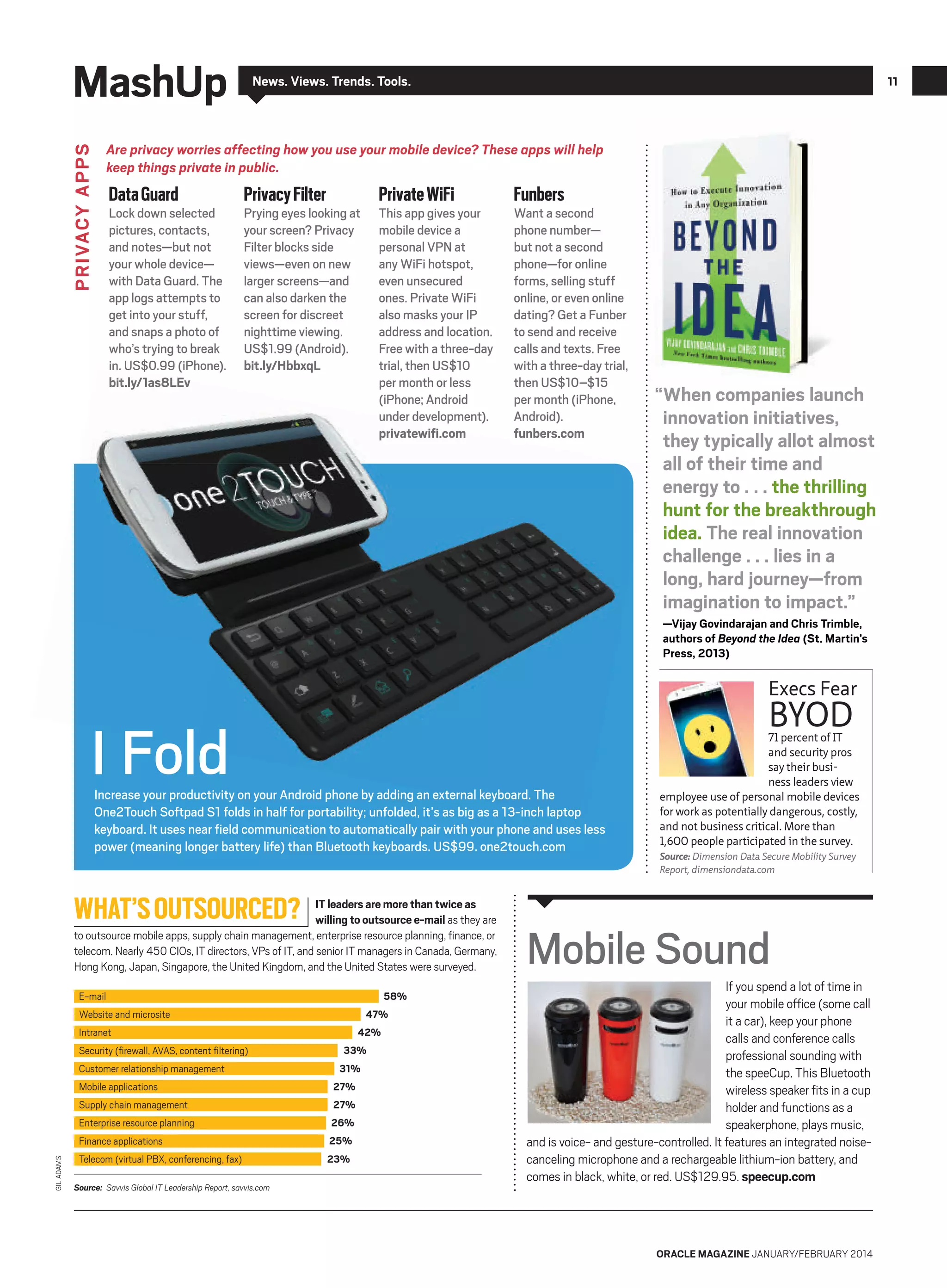
Increase your productivity on your Android phone by adding an external keyboard. The
One2Touch Softpad S1 folds in half for portability; unfolded, it’s as big as a 13-inch laptop
keyboard. It uses near field communication to automatically pair with your phone and uses less
power (meaning longer battery life) than Bluetooth keyboards. US$99. one2touch.com

WHAT’S OUTSOURCED?

IT leaders are more than twice as
willing to outsource e-mail as they are
to outsource mobile apps, supply chain management, enterprise resource planning, finance, or
telecom. Nearly 450 CIOs, IT directors, VPs of IT, and senior IT managers in Canada, Germany,
Hong Kong, Japan, Singapore, the United Kingdom, and the United States were surveyed.
58%

E-mail

47%

Website and microsite

42%

Intranet
Security (firewall, AVAS, content filtering)
Customer relationship management
Mobile applications

33%
31%
27%

Supply chain management

27%

Enterprise resource planning

26%

GIL ADAMS

Finance applications

25%

Telecom (virtual PBX, conferencing, fax)

23%

Source: Savvis Global IT Leadership Report, savvis.com

71 percent of IT
and security pros
say their business leaders view
employee use of personal mobile devices
for work as potentially dangerous, costly,
and not business critical. More than
1,600 people participated in the survey.
Source: Dimension Data Secure Mobility Survey
Report, dimensiondata.com

Mobile Sound
If you spend a lot of time in
your mobile office (some call
it a car), keep your phone
calls and conference calls
professional sounding with
the speeCup. This Bluetooth
wireless speaker fits in a cup
holder and functions as a
speakerphone, plays music,
and is voice- and gesture-controlled. It features an integrated noisecanceling microphone and a rechargeable lithium-ion battery, and
comes in black, white, or red. US$129.95. speecup.com

ORACLE MAGAZINE JANUARY/FEBRUARY 2014
ADVERTISING SUPPLEMENT

PARTNER CASE STUDY

Speeding Up Time to
Value in Project Management
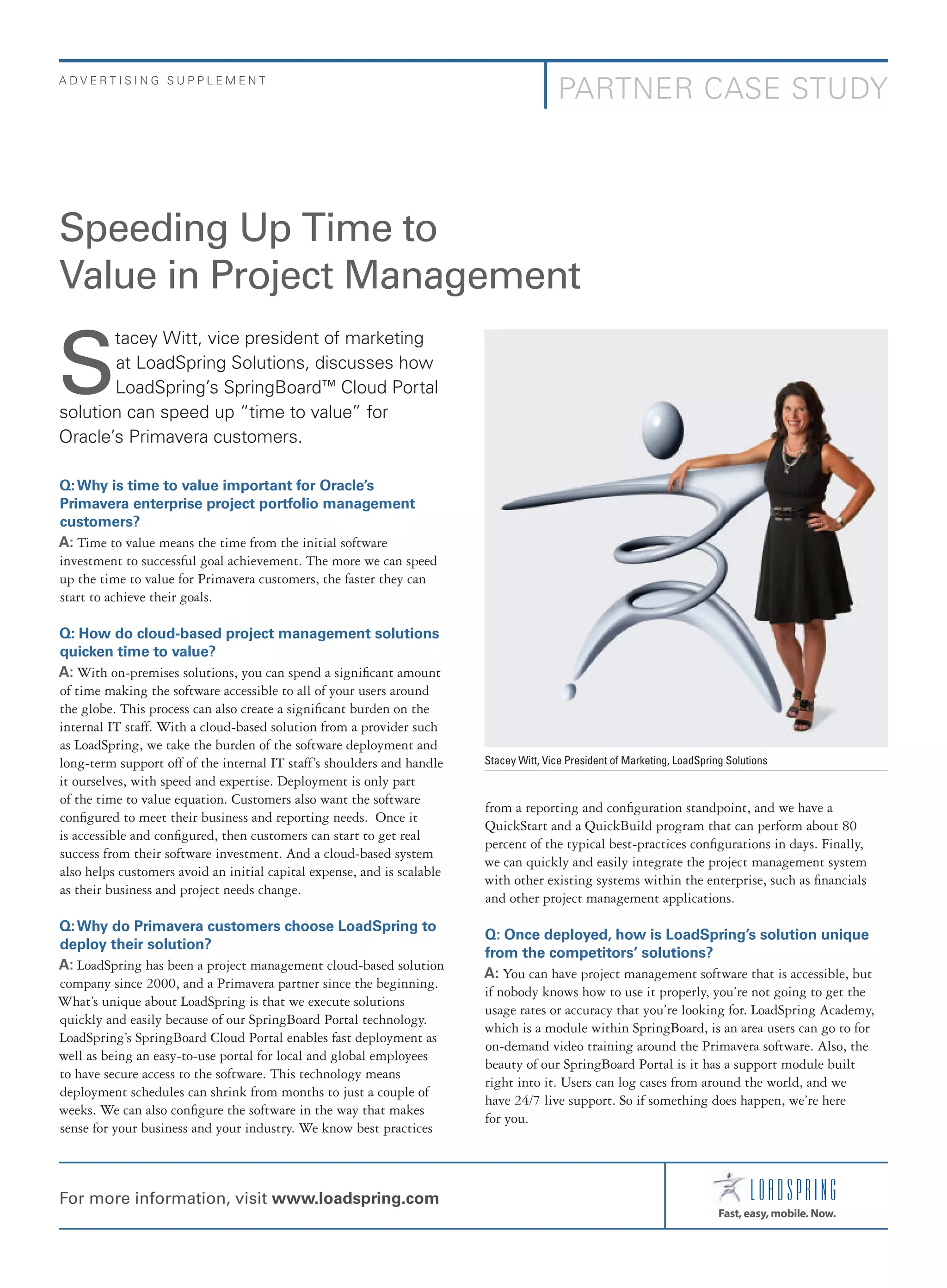
tacey Witt, vice president of marketing
at LoadSpring Solutions, discusses how
LoadSpring’s SpringBoard™ Cloud Portal
solution can speed up “time to value” for
Oracle’s Primavera customers.

S

Q: Why is time to value important for Oracle’s
Primavera enterprise project portfolio management
customers?
A: Time to value means the time from the initial software
investment to successful goal achievement. The more we can speed
up the time to value for Primavera customers, the faster they can
start to achieve their goals.
Q: How do cloud-based project management solutions
quicken time to value?
A: With on-premises solutions, you can spend a signifcant amount
of time making the software accessible to all of your users around
the globe. This process can also create a signifcant burden on the
internal IT staff. With a cloud-based solution from a provider such
as LoadSpring, we take the burden of the software deployment and
long-term support off of the internal IT staff’s shoulders and handle
it ourselves, with speed and expertise. Deployment is only part
of the time to value equation. Customers also want the software
confgured to meet their business and reporting needs. Once it
is accessible and confgured, then customers can start to get real
success from their software investment. And a cloud-based system
also helps customers avoid an initial capital expense, and is scalable
as their business and project needs change.
Q: Why do Primavera customers choose LoadSpring to
deploy their solution?
A: LoadSpring has been a project management cloud-based solution
company since 2000, and a Primavera partner since the beginning.
What’s unique about LoadSpring is that we execute solutions
quickly and easily because of our SpringBoard Portal technology.
LoadSpring’s SpringBoard Cloud Portal enables fast deployment as
well as being an easy-to-use portal for local and global employees
to have secure access to the software. This technology means
deployment schedules can shrink from months to just a couple of
weeks. We can also confgure the software in the way that makes
sense for your business and your industry. We know best practices

For more information, visit www.loadspring.com

Stacey Witt, Vice President of Marketing, LoadSpring Solutions

from a reporting and confguration standpoint, and we have a
QuickStart and a QuickBuild program that can perform about 80
percent of the typical best-practices confgurations in days. Finally,
we can quickly and easily integrate the project management system
with other existing systems within the enterprise, such as fnancials
and other project management applications.
Q: Once deployed, how is LoadSpring’s solution unique
from the competitors’ solutions?
A: You can have project management software that is accessible, but
if nobody knows how to use it properly, you’re not going to get the
usage rates or accuracy that you’re looking for. LoadSpring Academy,
which is a module within SpringBoard, is an area users can go to for
on-demand video training around the Primavera software. Also, the
beauty of our SpringBoard Portal is it has a support module built
right into it. Users can log cases from around the world, and we
have 24/7 live support. So if something does happen, we’re here
for you.
Events

Technology Events

Conferences and sessions to help you stay
on the cutting edge

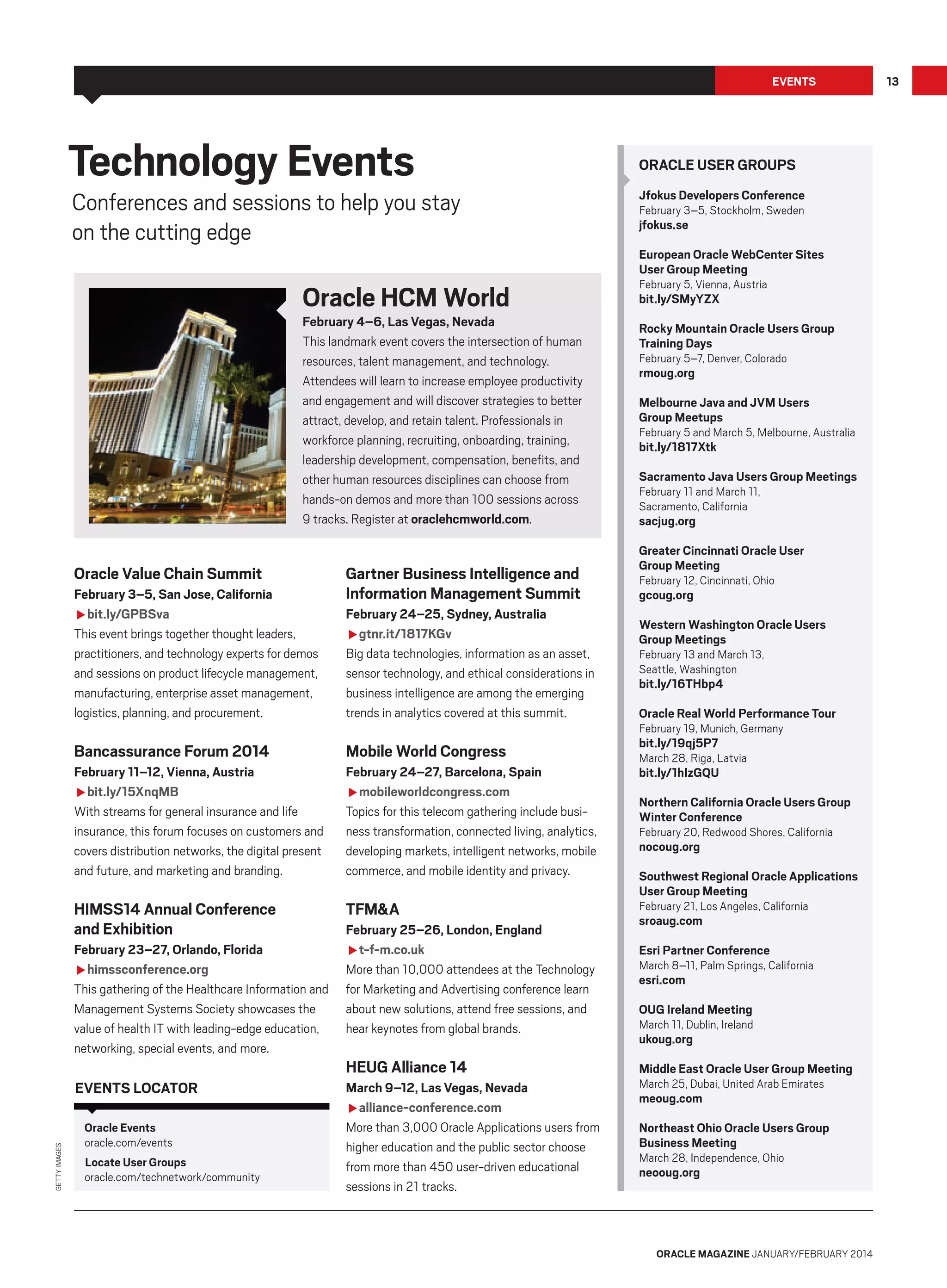
Oracle HCM World

February 4–6, Las Vegas, Nevada
This landmark event covers the intersection of human
resources, talent management, and technology.
Attendees will learn to increase employee productivity
and engagement and will discover strategies to better
attract, develop, and retain talent. Professionals in
workforce planning, recruiting, onboarding, training,
leadership development, compensation, benefits, and
other human resources disciplines can choose from
hands-on demos and more than 100 sessions across
9 tracks. Register at oraclehcmworld.com.

Oracle Value Chain Summit
February 3–5, San Jose, California
fbit.ly/GPBSva
This event brings together thought leaders,
practitioners, and technology experts for demos
and sessions on product lifecycle management,
manufacturing, enterprise asset management,
logistics, planning, and procurement.

Gartner Business Intelligence and
Information Management Summit
February 24–25, Sydney, Australia
fgtnr.it/1817KGv
Big data technologies, information as an asset,
sensor technology, and ethical considerations in
business intelligence are among the emerging
trends in analytics covered at this summit.

Oracle User Groups
Jfokus Developers Conference
February 3–5, Stockholm, Sweden

jfokus.se

European Oracle WebCenter Sites
User Group Meeting
February 5, Vienna, Austria

bit.ly/SMyYZX

Rocky Mountain Oracle Users Group
Training Days
February 5–7, Denver, Colorado

rmoug.org

Melbourne Java and JVM Users
Group Meetups

February 5 and March 5, Melbourne, Australia

bit.ly/1817Xtk

Sacramento Java Users Group Meetings
February 11 and March 11,
Sacramento, California

sacjug.org

Greater Cincinnati Oracle User
Group Meeting
February 12, Cincinnati, Ohio

gcoug.org

Western Washington Oracle Users
Group Meetings
February 13 and March 13,
Seattle, Washington

bit.ly/16THbp4

Oracle Real World Performance Tour
February 19, Munich, Germany

Bancassurance Forum 2014

Mobile World Congress

bit.ly/19qj5P7

February 11–12, Vienna, Austria
fbit.ly/15XnqMB
With streams for general insurance and life
insurance, this forum focuses on customers and
covers distribution networks, the digital present
and future, and marketing and branding.

February 24–27, Barcelona, Spain
fmobileworldcongress.com
Topics for this telecom gathering include business transformation, connected living, analytics,
developing markets, intelligent networks, mobile
commerce, and mobile identity and privacy.

bit.ly/1hIzGQU

HIMSS14 Annual Conference
and Exhibition

TFM&A

February 23–27, Orlando, Florida
fhimssconference.org
This gathering of the Healthcare Information and
Management Systems Society showcases the
value of health IT with leading-edge education,
networking, special events, and more.

Getty Images

Events locator
Oracle Events
oracle.com/events
Locate User Groups
oracle.com/technetwork/community

February 25–26, London, England
ft-f-m.co.uk
More than 10,000 attendees at the Technology
for Marketing and Advertising conference learn
about new solutions, attend free sessions, and
hear keynotes from global brands.

HEUG Alliance 14
March 9–12, Las Vegas, Nevada
falliance-conference.com
More than 3,000 Oracle Applications users from
higher education and the public sector choose
from more than 450 user-driven educational
sessions in 21 tracks.

March 28, Riga, Latvia

Northern California Oracle Users Group
Winter Conference
February 20, Redwood Shores, California

nocoug.org

Southwest Regional Oracle Applications
User Group Meeting
February 21, Los Angeles, California

sroaug.com

Esri Partner Conference

March 8–11, Palm Springs, California

esri.com

OUG Ireland Meeting

March 11, Dublin, Ireland

ukoug.org

Middle East Oracle User Group Meeting
March 25, Dubai, United Arab Emirates

meoug.com

Northeast Ohio Oracle Users Group
Business Meeting
March 28, Independence, Ohio

neooug.org

oracle magazine January/february 2014

13
3G

9:41 AM

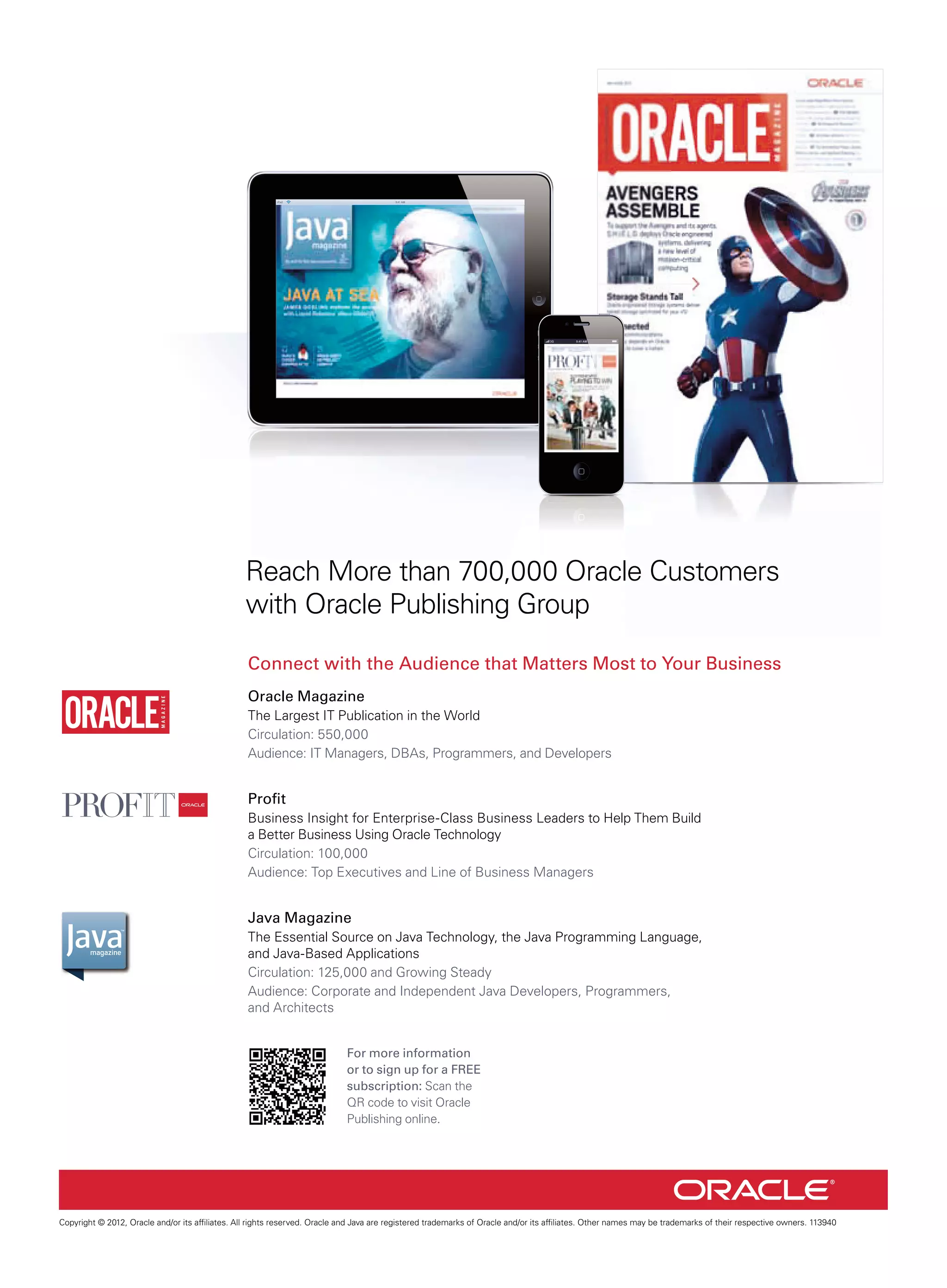
Reach More than 700,000 Oracle Customers
with Oracle Publishing Group
Connect with the Audience that Matters Most to Your Business
Oracle Magazine
The Largest IT Publication in the World
Circulation: 550,000
Audience: IT Managers, DBAs, Programmers, and Developers

Proft
Business Insight for Enterprise-Class Business Leaders to Help Them Build
a Better Business Using Oracle Technology
Circulation: 100,000
Audience: Top Executives and Line of Business Managers

Java Magazine
The Essential Source on Java Technology, the Java Programming Language,
and Java-Based Applications
Circulation: 125,000 and Growing Steady
Audience: Corporate and Independent Java Developers, Programmers,
and Architects
For more information
or to sign up for a FREE
subscription: Scan the
QR code to visit Oracle
Publishing online.

Copyright © 2012, Oracle and/or its affliates. All rights reserved. Oracle and Java are registered trademarks of Oracle and/or its affliates. Other names may be trademarks of their respective owners. 113940
Resources

What’s New at Oracle

The latest videos, podcasts, blogs, and more

Webcasts
“Your Blueprint to Database as a Service”
fbit.ly/1gqSXIO
Hear from analysts and experts how companies
are beginning to transform themselves with
database as a service.
“Switch from Red Hat to Oracle Linux
in Minutes”
fbit.ly/19kJVdf
Discover the why and how of switching to Oracle
Linux and industry-leading Linux management
and high-availability tools.
“Introducing Oracle’s Highest-Performing
System: The M6 Big Memory Machine”
fbit.ly/1c0C4lA
Learn what game-changing benefits in-memory
computing brings to business-critical databases
and applications.
“What’s New: Features and Workflows in
MySQL Enterprise Backup 3.9”
fbit.ly/16xJ1cT
Learn how to back up remotely, how to back up
and restore to create replicas, and how to use
backup for moving very large tables.
“Developing JavaScript Applications for
Node.js with MySQL and NoSQL”
fbit.ly/1bcmySz
Get started building highly scalable, event-driven
web, mobile, and social applications.

Videos
Oracle OpenWorld Highlights
fbit.ly/XpYdSI
Watch keynote and highlight videos plus general
sessions and executive interviews from Oracle
OpenWorld 2013, MySQL Connect, JavaOne, and
executive and Oracle Partner conferences.
Oracle Platinum Services: Success with
Engineered Systems
fbit.ly/1hCGfVk
Accenture Global Head of Database Management
Julian Dontcheff discusses Accenture’s investment in and commitment to Oracle engineered
systems and Oracle Platinum Services.
The Internet of Things:
Managing the Complexity
fbit.ly/19ca3pR
Prepare to manage the complexity of the Internet
of Things, from sensors and big data to gateways,
security, the data center, and the cloud.

Demos
Real-Time MySQL Performance and
Availability Monitoring
fbit.ly/GNDMMA
Learn how to manage the overall performance and
health of your MySQL servers.
Remotely Monitor MySQL in the Cloud
fbit.ly/1c0FPaq
Discover how to remotely monitor MySQL servers
in the cloud without remote agents.

“Tuning MySQL: The Fundamentals,
Updated for MySQL 5.6”
fbit.ly/GH0LbA
Walk through the basics of tuning your product’s
embedded or bundled MySQL database for
higher performance.

Securing Oracle Database 12c
fbit.ly/15oimhC
Register for a complimentary e-book and learn
about Oracle Database security from the experts.

“Launch Webcast: Introducing Oracle
Integration Products”
fbit.ly/17Xikyg
Watch Oracle integration experts introduce Oracle
Data Integrator 12c and Oracle GoldenGate 12c.

The Heroes Among Us
fbit.ly/1hCHG5W
Read profiles of five real-world IT heroes who
demonstrate their value to their organizations and
the industry at large.

E-Books

Engineered for Extreme Performance
fbit.ly/17gf5yC
Download a quick-reference guide to Oracle’s
engineered systems that includes customer
videos and information on what each
system does.
Oracle SPARC M6-32 Server: Highest
Performance and Best Reliability, Availability,
and Serviceability in a Single Server
fbit.ly/1ancmWa
Learn how to manage mission-critical
enterprise applications with Oracle’s SPARC
M6-32 server.
Superior Performance for Better
Business Results
fbit.ly/19Agwh7
Complex, aging, and poorly integrated IT
infrastructures impede productivity. Learn
how to get better business results. Discover
the power of running Oracle applications on
Oracle systems.

White Papers
“Optimizing Oracle Database Performance
on Oracle Linux with Flash”
fbit.ly/1cwv6Y7
Discover how to deploy Oracle’s Sun Flash
Accelerator hardware on Oracle Linux with Oracle
Database’s Smart Flash Cache component.
“MySQL Workbench: Database Design.
Development. Administration. Migration.”
fbit.ly/GNGfH9
Find out why MySQL Workbench can be an
indispensable aid to managing the complex data
management infrastructure of a dynamic and
growing business.
“The Advantages of Oracle Coherence on
Oracle Exalogic”
fbit.ly/17XnXfY
Read an overview of Oracle Coherence and
Oracle Exalogic Elastic Cloud and learn how to
use them together.

oracle magazine January/february 2014

15
16

Resources

overHEARD

“The SPARC M6-32 server and Oracle SuperCluster M6-32
fundamentally change data center economics. With our big
memory machines you can run huge databases and applications in memory to accelerate performance 10 or 20 times
and experience mainframe-like reliability without paying the
high premiums built into other vendors’ high-end systems.”
—John Fowler, Executive Vice President of Systems at Oracle, in “Introducing Oracle’s HighestPerforming System: The M6 Big Memory Machine” (bit.ly/1c0C4lA)

“Oracle’s Internet of Things Platform for a
Connected World”
fbit.ly/18v9NBc
With more than 50 billion connected, intelligent devices expected by 2025, businesses are
seeking ways to manage the data they’ll produce
to unlock real business value.
“Consolidation Using the High-End SPARC
M6-32 Server”
fbit.ly/194UeBf
Learn why Oracle’s new SPARC M6-32 server
is an ideal consolidation platform, combining
the scalability, manageability, and high availability needed for deploying many missioncritical applications.

systems with the latest SPARC servers.

Resource Centers
Oracle’s SPARC M6-32: The Next
Generation of Oracle’s SPARC Servers
fbit.ly/1hCKpwd
Discover how Oracle’s new SPARC M6-32 server
can help you improve remote access service,
accelerate business processing, and reduce cost.
Oracle Systems: The Best Platform for
Oracle Database 12c
fbit.ly/1gr1jjI
Find out why Oracle Database 12c running on
Oracle Solaris 11—and Oracle’s SPARC servers—
is faster, smarter, and more scalable than ever.

“Mission-Critical C/C++/COBOL
Applications with Oracle Exalogic and
Oracle Tuxedo”
fbit.ly/17ggWn7
Discover native capabilities to maximize
throughput, minimize latency, and drive higher
availability through clustering.

Oracle Systems: The Best Platform
for Oracle’s PeopleSoft Human Capital
Management
fbit.ly/1anfZLT
Learn how to increase productivity by running
Oracle’s PeopleSoft solutions on Oracle systems.

New Oracle WebLogic Server and Oracle
Database Integration White Papers
fbit.ly/1bcuseL
Oracle WebLogic Server’s Active GridLink for RAC
feature provides intelligent integration between
the server and Oracle Database. These white
papers provide use cases, technical insights, and
value propositions about this integration as well as
detailed content on Oracle customer NEC.

“Oracle’s SPARC M6-32 Quick Overview”
fbit.ly/19Ajn9I
Hear Oracle product management describe the
key features and benefits of Oracle’s SPARC
M6-32 server.

Games
Oracle’s SPARC Runner Interactive Game
fbit.ly/1anfgu7
Help the SPARC Runner accelerate performance,
increase speed, and consolidate multiple legacy

Podcasts

“Camping with Mobile Business
Intelligence”
fbit.ly/GNIdXO
Learn how mobile business intelligence can go
anywhere you go, even camping.
“Nick Wagner and Robert Freeman on
Oracle GoldenGate”
fbit.ly/1g0ohjO

January/february 2014 Oracle.com/oraclemagazine

Oracle GoldenGate Director of Product
Management Nick Wagner and Oracle Master
Principal Database Expert Robert Freeman
discuss Oracle GoldenGate.

Oracle University
Oracle Database 12c Training Now Available
fbit.ly/15VRxDX
Explore training and certification for Oracle
Database 12c.
Oracle Cloud Overview
fbit.ly/1cwzLJC
Experts from Oracle present the essential concepts of cloud computing and introduce the key
Oracle services for the cloud.
Oracle Big Data Overview
fbit.ly/19kZh1b
Discover the key products in Oracle’s big data
platform and learn their business implications.
Oracle WebLogic Server Training
fbit.ly/16eCm9b
Learn how to leverage the world’s #1 application server.

web locator
Oracle Blog Center
oracle.com/blogs
Oracle Consulting
oracle.com/consulting
Oracle Events and Webcasts
oracle.com/events
Oracle Newsletters
oracle.com/newsletters
Oracle Podcast Center
oracle.com/podcasts
Oracle University
bit.ly/ouoramag
Oracle on Facebook
facebook.com/oracle
Oracle on Google+
bit.ly/LdGiM0
Oracle on LinkedIn
linkedin.com/company/oracle
Oracle on Twitter
twitter.com/oracle
Oracle Support
oracle.com/support
My Oracle Support
myoraclesupport.com
My Oracle Support Communities
communities.oracle.com
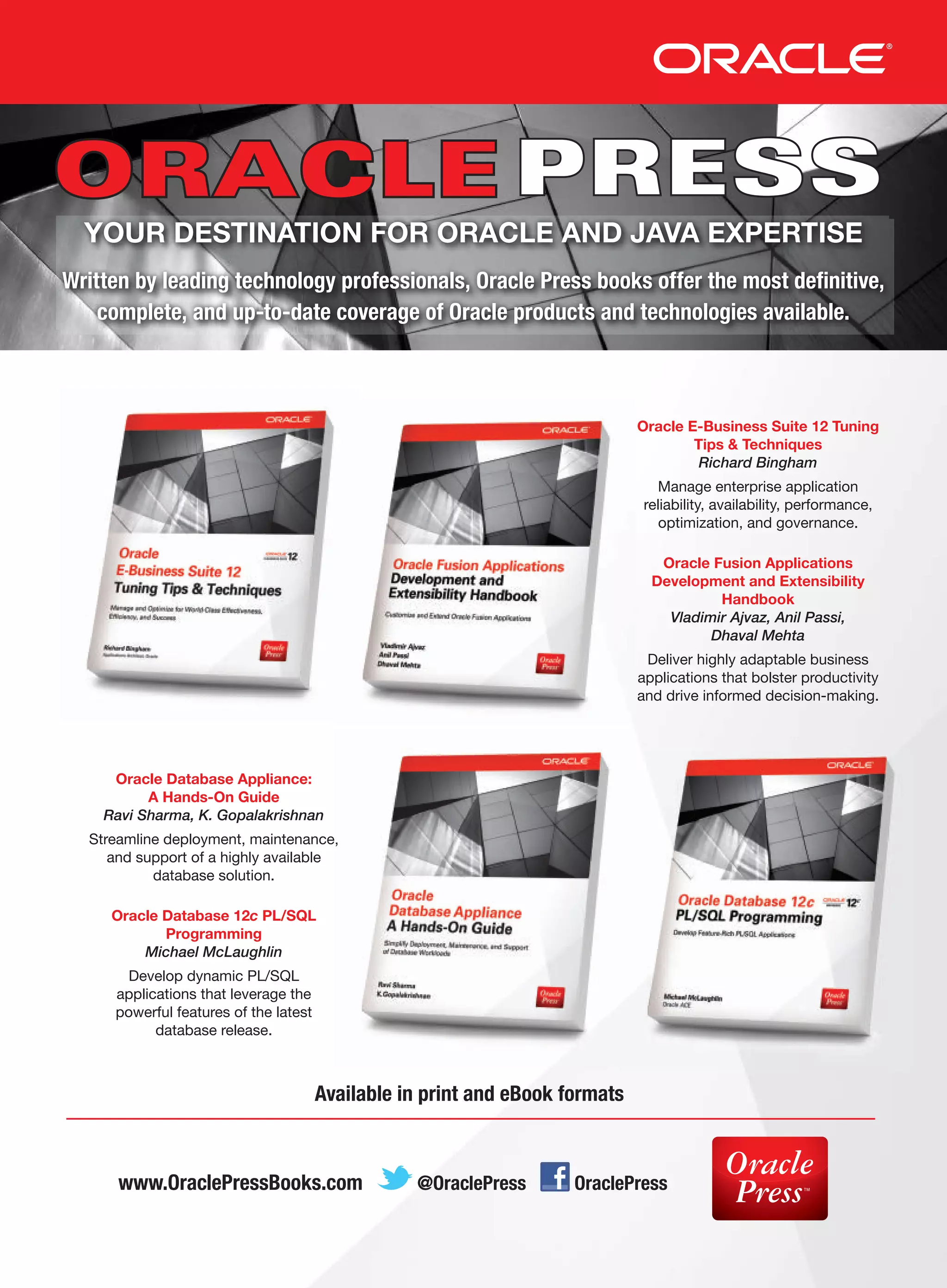
YOUR DESTINATION FOR ORACLE AND JAVA EXPERTISE
Written by leading technology professionals, Oracle Press books offer the most definitive,
complete, and up-to-date coverage of Oracle products and technologies available.

Oracle E-Business Suite 12 Tuning
Tips  Techniques
Richard Bingham
Manage enterprise application
reliability, availability, performance,
optimization, and governance.
Oracle Fusion Applications
Development and Extensibility
Handbook
Vladimir Ajvaz, Anil Passi,
Dhaval Mehta
Deliver highly adaptable business
applications that bolster productivity
and drive informed decision-making.

Oracle Database Appliance:
A Hands-On Guide
Ravi Sharma, K. Gopalakrishnan
Streamline deployment, maintenance,
and support of a highly available
database solution.
Oracle Database 12c PL/SQL
Programming
Michael McLaughlin
Develop dynamic PL/SQL
applications that leverage the
powerful features of the latest
database release.

Available in print and eBook formats

www.OraclePressBooks.com

@OraclePress

OraclePress
Product Resources

Tutorial
Creating a Web Form by Using
Business Process Composer

This tutorial shows you how to use the
Business Process Composer feature
of Oracle Unified Business Process
Management Suite to create a web form
user interface for a human task and how to
create two simple web form rules to make
the form a dynamic user interface.
fbit.ly/19kletp

ARTICLES
“SOA and User Interfaces”

In this article, which is part of the
Industrial SOA article series, learn
how to overcome the challenges to
developing user interfaces in a serviceoriented architecture.
fbit.ly/1cawSeg

“Coherence*Web: Sharing an
httpSession Among Applications
in Different Oracle WebLogic
Clusters”

Coherence*Web permits a full session
offload so Oracle WebLogic instances
can be focused on processing Oracle
WebLogic requests. This article introduces an easy approach to extend
Coherence*Web to enable session sharing.
fbit.ly/17qABV2

FEATURED DOWNLOADS
Oracle Database 12c

Get the latest Oracle Database release.
fbit.ly/16F79XC

Oracle SQL Developer 4.0 Early
Adopter 3

This free IDE simplifies Oracle Database
management and application development.
fbit.ly/1inq6n1

Oracle Database 12c Multitenant
Self-Service Provisioning
Application (Beta)

This beta application provides DBAs and
developers with a way to get familiar with
pluggable databases.
fbit.ly/1a97kdP

Oracle Data Integration Portfolio

Oracle GoldenGate 12c and Oracle Data
Integrator 12c offer real-time data integration, transactional change data capture,
high-performance batch loads, and more.
fbit.ly/1clvmKm
fbit.ly/16fmktF

Oracle Updates Its Data Integration Portfolio
Oracle has unveiled major updates to its
data integration portfolio with the release
of Oracle Data Integrator 12c and Oracle
GoldenGate 12c. Oracle Data Integrator 12c
delivers next-generation extract, transform,
and load (ETL) technology that improves
performance and reduces data integration costs—even across heterogeneous
systems. Oracle GoldenGate 12c provides
real-time data integration, transactional
data replication, and data comparison
across heterogeneous systems. These products help improve performance, increase
productivity, and simplify deployment while
providing organizations with solutions that
can easily keep pace with new data-oriented
technology trends such as cloud computing,
big data analytics, real-time business intelligence, and continuous data availability.
Tight integration between Oracle Data
Integrator 12c and
Oracle GoldenGate
12c and other
Oracle technologies, such as Oracle
Database 12c and
Oracle Applications,

provides a number of benefits for organizations. For example, the combination of Oracle Data Integrator 12c, Oracle
GoldenGate 12c, and Oracle Database 12c
provides a strong foundation for private
cloud deployments. In addition, tight integration with Oracle Applications delivers
real-time data for reporting, zero-downtime
migration, and improved application performance and availability.
“The management and utilization of
data is becoming increasingly complex, as
the number and diversity of datasources
organizations interact with continues to
grow,” says Brad Adelberg, vice president of
development at Oracle. “With Oracle Data
Integrator 12c and Oracle GoldenGate 12c,
Oracle is in a unique position to help drive
standardization across enterprises using
our new products for not only traditional
uses of ETL and business intelligence/
data warehousing, but also for new and
emerging styles of integration such as realtime replication, data services and federation, big data and business analytics, and
cloud deployments.”
bit.ly/1cawsEE

Oracle Implements W3C’s Standard for Data Provenance
To help organizations better assess whether
data and sources can be trusted, Oracle
has implemented the World Wide Web
Consortium (W3C) Provenance standard
(PROV) in the latest release of Oracle
Advanced Controls. W3C is an international
community that develops open standards
to ensure the long-term growth of the web.
The PROV family of documents (with W3C
recommendations) defines a model to enable
the interoperable interchange of provenance
information in heterogeneous environments.
Oracle Advanced Controls enables organizations to improve their bottom lines and
reduce operational risk without slowing
down their businesses, helping to prevent
financial leakage and strengthen control.
By using a standardized approach to data
provenance in Oracle Advanced Controls,
Oracle is enabling customers and partners
to quickly and easily create, integrate, and
connect advanced control solutions with
multiple heterogeneous on-premises and

January/February 2014 Oracle.com/oraclemagazine

cloud-based enterprise resource planning
systems. Implementing the W3C PROV
standard also allows Oracle to streamline
implementations by allowing companies to
reduce the need for customizations.
“To help organizations efficiently
and effectively manage ever-increasing
amounts of data, Oracle is committed
to open standards that support both onpremises and cloud-based integrations,”
says Chris Leone, group vice president of
applications development at Oracle. “The
implementation of the W3C Provenance
standard with Oracle Advanced Controls
further demonstrates this commitment.
By virtually eliminating time-consuming
and costly customizations that are typically
involved with the provenance of information, the implementation enables customers and partners to quickly and easily
integrate and connect advanced control
solutions with heterogeneous systems.”
bit.ly/1hgWix2

Lindy Groening

18
BRIEFS

Oracle VM VirtualBox 4.3 Delivers Virtual Multitouch UI

Oracle Buys Compendium

Available now, Oracle VM VirtualBox 4.3
introduces a virtual multitouch user interface, supports additional devices and platforms, and provides enhanced networking
capabilities, enabling developers to virtualize modern post-PC-era operating system
features while maintaining compatibility
with legacy operating systems.
This release
builds on previous
releases with
support for the
latest Microsoft,
Apple, Linux, and
Oracle Solaris oper-

Oracle has acquired Compendium, a
cloud-based content marketing provider
that helps companies plan, produce, and
deliver content across multiple channels
throughout their customers’ lifecycle.
Compendium’s content marketing solution complements Oracle Eloqua Marketing
Cloud Service, which is a part of Oracle’s
customer experience solution.
“As customers increasingly access information through online and mobile channels,
the buying process is shifting from salesdriven to marketing-driven. Now more than
ever, marketers are challenged to deliver
relevant and engaging content across multiple channels and throughout the customer
lifecycle,” says Thomas Kurian, executive vice
president of product development at Oracle.
“By adding Compendium’s content marketing
platform to Oracle Eloqua Marketing Cloud
Service, customers
will be able to capture
more prospects,
improve the customer
experience, and drive
top-line revenue.”
bit.ly/HnOsSF

ating systems, new virtual devices, and
improved networking functionality.
“Building and testing modern applications requires developers to run everything from legacy environments to the
latest Linux and Windows desktop and
tablet operating systems with 3-D effects
and multitouch interfaces,” says Wim
Coekaerts, senior vice president of Linux
and virtualization at Oracle. “Oracle VM
VirtualBox 4.3 adds an innovative way to
operate multitouch interfaces on a desktop
PC, making it easier for users to operate
their virtual machines.”
bit.ly/1ayLTY9

Oracle Buys BigMachines
Oracle has entered into an agreement to
acquire BigMachines, a cloud-based configure, price, and quote (CPQ) solution
provider. BigMachines’ CPQ Cloud accelerates the conversion of sales opportunities into revenue by automating the sales
order process with guided selling, dynamic
pricing, and an easy-to-use workflow
approval process—accessible anywhere, on
any device.
In combination with Oracle’s enterprisegrade cloud solutions, including marketing,
sales, social, commerce, and service
clouds, Oracle and BigMachines will create
an end-to-end “smarter selling” cloud
solution with the goal of increasing sales

personnel productivity, customer satisfaction, and revenue.
“The fundamental goals of smarter
selling are to provide sales teams with the
information, access, and insights they need
to maximize revenue opportunities and
execute on all phases of the sales cycle,”
says Thomas Kurian, executive vice president of product development at Oracle. “By
adding BigMachines’ CPQ Cloud to the
Oracle Cloud, companies will be able to drive
more revenue and increase customer satisfaction with a seamlessly integrated process
across marketing and sales, pricing and
quoting, and fulfillment and service.”
bit.ly/19LrYUI

LINDY GROENING

Oracle Unveils New x86 Servers
Designed for high performance, reliability,
and eco-responsibility, Oracle’s Sun Server
X4-2 and Sun Server X4-2L offer the versatility to address cluster computing and virtualization as well as the full spectrum of enterprise applications. These new x86 servers
demonstrate Oracle’s continued strategy
of designing x86 offerings that are specifically engineered to serve as a foundation for
Oracle software for standalone systems as
well as within Oracle engineered systems.
“Oracle’s x86 servers are designed and
optimized at each level of hardware and
firmware to be the most reliable, highestperformance systems for running Oracle
software,” says Ali Alasti, senior vice presi-

dent of hardware development at Oracle.
“With comprehensive management and virtualization built in, Oracle’s new x86 servers
are ideal for a broad range of enterprise
applications as standalone servers, while
also providing building blocks for many
Oracle engineered systems.”
bit.ly/IM0mSE

NetBeans IDE 7.4 Enhances Web
and Mobile App Development
The latest release of NetBeans IDE, a free,
open source integrated development environment (IDE), includes enhanced HTML5
and JavaScript development features and
browser integration with existing and new
Java Platform, Enterprise Edition (Java EE)
and PHP applications.
NetBeans IDE enables developers to
rapidly create web, enterprise, desktop, and
mobile applications for PHP, C/C++, and the
Java and HTML5 platforms. NetBeans IDE 7.4
also provides developer support for working
with JDK 8 Developer Preview builds.
“The NetBeans team continues to bring
advanced new user-interface capabilities
to the Java community,” says Chris Tonas,
vice president of application development
tools at Oracle. “NetBeans IDE 7.4 takes this
further with innovative HTML5 capabilities,
browser integration, and support for the
JDK 8 Developer Preview builds.”
netbeans.org

ORACLE MAGAZINE JANUARY/FEBRUARY 2014

19
Partner
Excellence!
2013 Specialized Partner Award Winners—Global

Applications

Engineered Systems

Database and
Middleware

Industries

Server and Storage
Systems

Specialized. Recognized. Preferred.

partner.oracle.com

Copyright © 2013, Oracle and/or its affiliates. All rights reserved. Oracle and Java are registered trademarks of Oracle and/or its affiliates.
Other names may be trademarks of their respective owners.
INTERVIEW BY CAROLINE KVITKA

Navigate the Internet
of Things

Oracle’s Peter Utzschneider discusses the challenges and
opportunities from this new disruptive technology.

DAVE BRADLEY

A

nalysts predict upwards of 50 billion
devices will be connected to the
internet by 2020, generating zettabytes
of data each day—a phenomenon called
the Internet of Things (IoT). Oracle
Magazine’s Caroline Kvitka sat down with
Peter Utzschneider, vice president of
product management for Java at Oracle, to
discuss IoT challenges, opportunities, and
development. The following is an excerpt
from that interview. Listen to the full
interview at oracle.com/magcasts.
Oracle Magazine: What is IoT, and how does
it relate to machine-to-machine, or M2M?
Utzschneider: The Internet of Things is a
term used to describe the next wave of innovation that our industry is going through.
Traditionally, we have thought primarily of
humans connecting to the internet, but IoT is
really the next step, where “things” are also
connecting to the internet and to each other.
M2M describes part of IoT, which is
machine-to-machine communication.
Oracle Magazine: What challenges do IoT
and the massive amount of data being generated by these devices present?
Utzschneider: IoT brings a number of
challenges. First, there are infrastructural
challenges. All these devices will have to be
connected, which means the networks to
support them have to be able to support that
new load. Each of these devices will be producing a lot of high-volume, low-value data.
Some of these devices will generate very
small pieces of data, but there will be lots of
pieces. The industry will have to cope with
that new volume of big data and be able to
manage it from the devices up through gateways all the way back to the enterprise.
Second, once we have that data, what are
we going to do with it? This opens up a whole
new opportunity for us to continue to drive

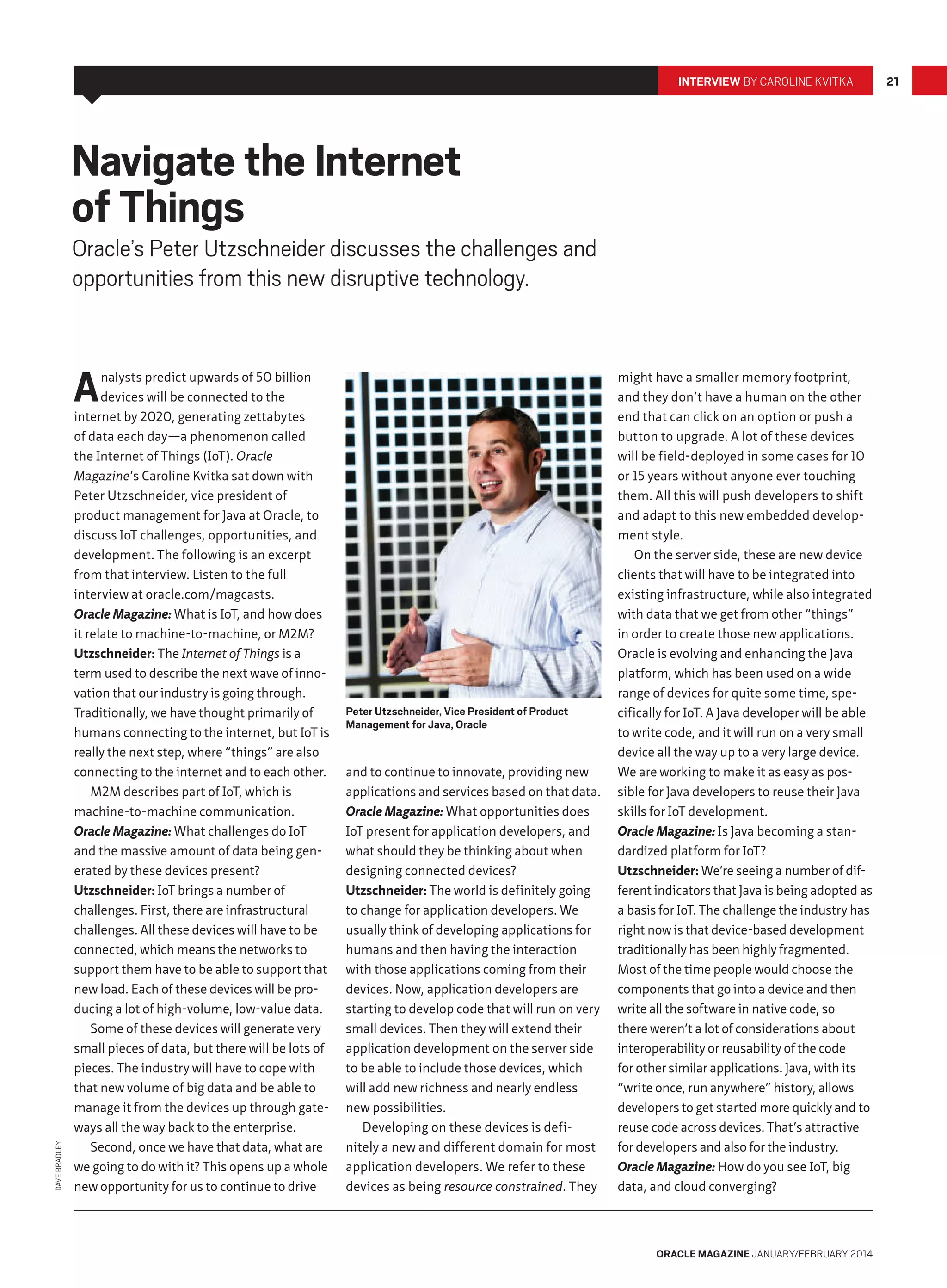
Peter Utzschneider, Vice President of Product
Management for Java, Oracle

and to continue to innovate, providing new
applications and services based on that data.
Oracle Magazine: What opportunities does
IoT present for application developers, and
what should they be thinking about when
designing connected devices?
Utzschneider: The world is definitely going
to change for application developers. We
usually think of developing applications for
humans and then having the interaction
with those applications coming from their
devices. Now, application developers are
starting to develop code that will run on very
small devices. Then they will extend their
application development on the server side
to be able to include those devices, which
will add new richness and nearly endless
new possibilities.
Developing on these devices is definitely a new and different domain for most
application developers. We refer to these
devices as being resource constrained. They

might have a smaller memory footprint,
and they don’t have a human on the other
end that can click on an option or push a
button to upgrade. A lot of these devices
will be field-deployed in some cases for 10
or 15 years without anyone ever touching
them. All this will push developers to shift
and adapt to this new embedded development style.
On the server side, these are new device
clients that will have to be integrated into
existing infrastructure, while also integrated
with data that we get from other “things”
in order to create those new applications.
Oracle is evolving and enhancing the Java
platform, which has been used on a wide
range of devices for quite some time, specifically for IoT. A Java developer will be able
to write code, and it will run on a very small
device all the way up to a very large device.
We are working to make it as easy as possible for Java developers to reuse their Java
skills for IoT development.
Oracle Magazine: Is Java becoming a standardized platform for IoT?
Utzschneider: We’re seeing a number of different indicators that Java is being adopted as
a basis for IoT. The challenge the industry has
right now is that device-based development
traditionally has been highly fragmented.
Most of the time people would choose the
components that go into a device and then
write all the software in native code, so
there weren’t a lot of considerations about
interoperability or reusability of the code
for other similar applications. Java, with its
“write once, run anywhere” history, allows
developers to get started more quickly and to
reuse code across devices. That’s attractive
for developers and also for the industry.
Oracle Magazine: How do you see IoT, big
data, and cloud converging?

ORACLE MAGAZINE JANUARY/FEBRUARY 2014

21
22

Interview

Utzschneider: We now have several major
developments happening in our industry:
cloud, big data, social, mobile, and IoT.
It’s going to take a tremendous amount of
orchestration and coordination across the
industry to make sure we’re able to harness
all those trends at the same time.
Take mobility. With innovation in
smartphones and tablets, we can easily do
e-commerce and connect to our social apps
from these devices. With IoT, mobile device
use is going to expand significantly. These
same devices are becoming the ultimate
remote controls for us to connect and control
the physical environment around us. For
example, with home automation, I can use
my phone to turn the lights and the alarm
system off and on, to look at energy consumption, and to manage home entertainment—whether I’m there or not.
As far as cloud, it becomes an enabling
technology for IoT. For a lot of organizations,
adding devices and the huge amount of
data they generate to their existing infrastructures or their back-end systems simply
won’t scale, and they will need to rethink
how those infrastructures are set up. They
will look to cloud service providers to make
that happen for them.
Oracle Magazine: Besides home automation,
what are other emerging markets for IoT?
Utzschneider: IoT will affect every business.
We’re seeing early adoption in healthcare,
including lifestyle health devices, patient
monitoring, and home healthcare or telehealth. Another big area is telematics—the
automotive industry is already connecting
vehicles so that manufacturers can remotely
monitor and support their vehicles. It is also
a way for them to collect data on vehicles
out there in the real world, which they then
put into further design and innovation.
Telematics also applies to fleet management and logistics, managing things such
as delivery vehicles to make sure they are
running efficiently, and rental car companies, so they can push in-vehicle service
offers or information to enable you to book a
hotel or dinner reservations from the car.
Industrial automation is another category, especially in the area of manufacturing
and process automation. All this technology
will enable companies to pull more data off

“We have thought primarily of humans
connecting to the internet, but IoT is really the
next step, where ‘things’ are also connecting.”
—Peter Utzschneider, Vice President of Product Management for Java, Oracle
of machinery that’s in factories in order to
get a better idea of what’s happening on the
factory floor.
Oracle Magazine: What is Oracle doing in
terms of IoT beyond Java?
Utzschneider: Oracle provides a complete
data management and analysis solution
across sensors, devices, data centers, and
applications. Oracle’s enterprise solutions
provide a wide array of data management
capabilities uniquely suited to IoT: with
Oracle big data solutions, massive amounts
of M2M data can be stored for the highest
performance at the lowest cost with Oracle
Exadata or Oracle Database Appliance.
Enterprises can gain real-time visibility into
this data with Oracle Business Intelligence,
Oracle Exalytics, Oracle Event Processing,
and Oracle business and industry applications. Not only do we have very rich backend infrastructure to help the industry cope
with a lot of those data volumes, but we also
have a lot of technology that can push intelligence out to the new world of edge devices
and enable customers to better filter,
manage, and transform the data along the
way before it reaches the back end. This data
adds tremendous value to businesses.
Oracle is building an Internet of Things
platform, which takes into consideration all
the things on the device side around device
lifecycle management with security of the
applications on the devices—as well as tying
them back to back-end infrastructure in
order to better enable our customers to take
their existing infrastructure investments
and extend them. Oracle is in a great position to combine our history and technology
on the back end with everything that we
are now doing on the device side and then
innovate on top of it specifically for the huge
opportunity offered by IoT.
Oracle Magazine: What does Oracle’s IoT
strategy mean for customers and partners,
including device makers and solution and
service providers?

January/February 2014 Oracle.com/oraclemagazine

Utzschneider: Oracle is taking a holistic
view of IoT. We work closely with many of
the various players in the IoT value chain—
from the silicon chip designer and the chip
maker whose chip goes into an IoT module
to the device manufacturer, the solution
provider, the systems integrator, the service
provider, and onto the enterprise customer.
Oracle leadership is making sure that we are
investing in all points of the value chain, such
that when the smart devices come to market,
we’ve taken care to ensure that they can easily
be service-enabled. We believe the devices,
in order to play in IoT, will have to be more
service-oriented so that they can evolve over
time and provide more value, more new services over time. We’re working closely with all
the partners in the ecosystem and the value
chain to make sure the devices can do that—
while at the same time working with our
system integration partners and customers
so they can prepare back-end systems to be
able to support all these devices and build the
advanced services and new applications that
will become available with IoT.
This should provide everyone in the
value chain with opportunity and a way to
reduce costs. I think the combination is
very powerful and a real game changer. 

Caroline Kvitka is a
senior editor with Oracle
Magazine and the editor
in chief of Java Magazine.

Next Steps
LEARN more about the Internet of Things
oracle.com/iot
LISTEN to the podcast
oracle.com/magcasts
WATCH the video, The Internet of Things:
Managing the Complexity
bit.ly/16j20ax
Interview by Tom Haunert

Enterprise Virtualization
Evolution

Here’s the state of virtualization, from applications to
consolidation and engineered systems.

Bob Adler

I

n August 2013, Oracle’s virtualization
solution portfolio expanded to include
Oracle Virtual Compute Appliance,
an engineered system for application
virtualization. Wim Coekaerts, senior vice
president of Linux and virtualization at
Oracle, sat down with Tom Haunert, editor
in chief of Oracle Magazine, to talk about
the past, present, and future of enterprise
virtualization and Oracle virtualization
solutions. The following is an excerpt from
that interview. Listen to the full interview
at oracle.com/magcasts.
Oracle Magazine: Most Oracle Magazine
readers are familiar with the term virtual
machine [VM], but what is the origin of
enterprise virtualization, and how is it
defined today?
Coekaerts: When you look at enterprise
virtualization, it started first on the mainframe, then on UNIX vendor systems, and
then on x86 systems. Today many enterprise workloads are being virtualized to
help with consolidation of applications and
operating systems.
While many applications have been virtualized, in most cases it has been Windows
applications (on x86 systems) in smaller
environments. But there has been a trend in
the last few years to start virtualizing enterprise applications such as Oracle Database
and Oracle Fusion Middleware.
Oracle Magazine: What are the most significant Oracle enterprise virtualization products and solutions?
Coekaerts: We launched Oracle VM in 2007
on x86 to make sure that when customers
virtualize Oracle products, we—Oracle—
can say, “Look, this is completely certified.
It’s tested. You get everything from us, and
you know that we can support this thing
top to bottom.”

Wim Coekaerts, Senior Vice President, Linux
and Virtualization, Oracle

With the Sun acquisition, we got SPARC
systems and the SPARC hypervisor [Logical
Domains, or LDoms], which we renamed
Oracle VM Server for SPARC. Oracle VM
Server for SPARC is a very powerful hypervisor that has been used for many years on
the SPARC T-Series systems. And now it
also supports the SPARC M-Series.
We also have Oracle Solaris Zones, which
is an isolation technology where you have one
operating system running, but you can create
zones within that operating system that make
it look as if you are on a different hardware
platform or virtualized hardware platform.
The advantage of Oracle Solaris Zones is
that there is no real virtualization overhead
because there’s nothing virtualized.
Most recently, we announced Oracle
Virtual Compute Appliance, an x86-based
appliance that uses Oracle VM.
Oracle Magazine: What are the key technologies in Oracle Virtual Compute Appliance?

Coekaerts: Oracle Virtual Compute Appliance
integrates storage, servers, management
nodes, compute nodes, built-in InfiniBand
switches, and two Oracle fabric managers.
The base rack comes with two compute
nodes, but you can go up to 25 compute
nodes in a box. Everything in the rack is
prewired for you. You plug in the power
and network cables and power on one of
the management nodes. The management
node automatically powers on all the other
nodes and provisions the entire system.
After about 45 minutes, you can log in to
the compute appliance and start creating
virtual machines.
Oracle Magazine: What types of use cases
do you see for Oracle Virtual Compute
Appliance?
Coekaerts: One use case is that it is really
easy for companies to ship a system to a
remote location where you might not have
people there to maintain it.
Another use case is consolidation.
Suppose you have a whole bunch of database servers, some middle-tier servers,
some third-party applications, and maybe
even some Windows VMs, and the hardware is getting to end of life. Oracle Virtual
Compute Appliance makes it very easy
to take the applications on all of these
machines and consolidate everything into
one big rack where you have high availability
automatically, right out of the box. 

Next Steps
LEARN more about Oracle virtualization
solutions
oracle.com/virtualization
LISTEN to all Oracle Magazine
Feature Casts
oracle.com/magcasts

oracle magazine January/February 2014

23
24

Book Beat
Expert Consolidation in
Oracle Database 12c
By Martin Bach
Apress
apress.com
Learn how to reduce
data management costs
and increase data center
efficiency with Expert
Consolidation in Oracle Database 12c.
The book guides you through planning
and implementing a consolidated Oracle
Database installation using many of the
new features in Oracle Database 12c. You’ll
learn to identify candidates for consolidation and to recognize instances that are
best left as standalone databases. Author
Martin Bach, an Oracle Certified Master,
also covers working with clustered systems
and Oracle Automatic Storage Management
in a consolidated environment. In addition,
he discusses using the Oracle Enterprise
Manager Cloud Control feature of Oracle
Enterprise Manager 12c as a monitoring
and management dashboard. Bach’s focus
is driving readers toward a cost-effective
environment that is efficient in both technology and human resources.

Oracle Database 12c Performance
Tuning Recipes
By Sam Alapati, Darl Kuhn,
and Bill Padfield
Apress
apress.com
Oracle Database 12c
Performance Tuning
Recipes is a ready reference for database administrators in need of
immediate help with performance issues
relating to Oracle Database 12c. The book
takes an example-based approach, wherein
each chapter covers a specific problem
domain. Each chapter includes recipes for
how to perform common tasks in that chapter’s domain. Solutions in the recipes are
backed by clear explanations of background
and theory. If you have a performancerelated task, you’re likely to find a recipe
and a solution for it here.

Oracle Database 12c New Features
By Robert Freeman
Oracle Press
oraclepressbooks.com
Learn how to maximize
the new capabilities of
Oracle Database 12c.
Author and Oracle ACE
Robert Freeman provides essential information to get you up and running quickly
on Oracle Database 12c. The book offers
commentary from Oracle Database expert

JANUARY/FEBRUARY 2014 ORACLE.COM/ORACLEMAGAZINE

and Oracle Magazine columnist Tom Kyte,
with additional contributions by Oracle
Database experts Eric Yen and Scott Black.
It features detailed coverage of upgrading to
Oracle Database 12c; architectural changes;
performance improvements; and new features for backup and recovery, administration, data warehousing, and information
lifecycle management.

Oracle NoSQL Database
By Maqsood Alam, Aalok
Muley, Chaitanya Kadaru,
and Ashok Joshi
Oracle Press
oraclepressbooks.com
Written by members
of the Oracle NoSQL
Database product development team, this
book is an authoritative primer for Oracle’s
big data software stack. Learn how to use
Oracle NoSQL Database to store big data
in low-cost, low-impact, highly scalable
and available data stores. Gain a realworld understanding of how Oracle NoSQL
Database integrates with Oracle’s other
big data solutions, with coverage of Oracle
NoSQL Database architecture, installation,
configuration, application development,
administration, security, and more. The
book features actual use cases of Oracle
NoSQL Database, emphasizing the success
stories and the business problems solved.

Oracle Essentials, 5th Edition
By Rick Greenwald, Robert
Stackowiak, and Jonathan
Stern
O’Reilly Media
oreilly.com
This book distills an
enormous amount of
information about Oracle Database 12c
into one volume. Ideal for novice and
experienced DBAs, developers, managers,
and users, Oracle Essentials walks you
through technologies and features in Oracle
Database 12c. Complete with illustrations
and hints, this fifth edition provides a onestop overview of Oracle Database 12c. The
book begins with an introduction to Oracle
Database and the evolution of the relational
database, a summary of key features, and
the role of Oracle Fusion Middleware.
Other topics include core concepts in the
architecture of Oracle Database, including
pluggable databases, installation, data
structures and datatypes, managing an
Oracle database, security options, basic
principles of multiuser concurrency, transaction processing, backup and recovery,
cloud, and more.

Look for other Oracle books at bit.ly/NjG3KM.

Partners Earn Oracle Exadata
Optimized and Oracle Exalogic
Optimized Status
Three Oracle partners have earned Oracle
Exadata Optimized and Oracle Exalogic
Optimized status for solutions that have
been tested and tuned with Oracle Exadata
Database Machine and Oracle Exalogic
Elastic Cloud.
Atos Worldgrid, an international subsidiary of Atos and an Oracle Platinum
Partner, earned Oracle Exadata Optimized
and Oracle Exalogic Optimized status for
Atos Smart Grid Suite (ASGS). ASGS enables
energy and utilities companies to operate
smarter energy grids. ASGS can process the
daily collection of 60 million utility meters
in hours.
Temenos, an Oracle Gold Partner providing solutions to the financial services
industry, announced that Temenos T24
(Java) Release 13 achieved Oracle Exadata
Optimized and Oracle Exalogic Optimized
status. Temenos T24 helps customers
achieve scalable, secure, high-performance
banking capabilities.
Triple Point Technology, an Oracle Gold
Partner, earned Oracle Exadata Optimized
and Oracle Exalogic Optimized status
for Commodity XL, its trading and risk
management solution. Commodity XL
analyzes data generated by daily commodities operations.
atos.net
temenos.com
tpt.com

Partners Earn Gold Membership
Two Oracle partners have achieved Gold
membership in Oracle PartnerNetwork.
Acuity Cloud Solutions, a cloud-based
application support and services consultancy with a focus on talent management
systems, reported that Oracle Gold Partner
status will help it better serve its Oracle
Taleo Enterprise Cloud Service client base.
BASH Technologies earned Oracle
Gold Partner status for its commitment
to design, deliver, and support smartphone- and tablet-based access to Oracle’s
PeopleSoft solutions.
acuitycloudsolutions.com
bashconsulting.co
PARTNER NEWS

Two Oracle Partners Earn
Platinum Status

Apex IT Earns Oracle PartnerNetwork Specialization for Oracle Fusion
Customer Relationship Management

Two Oracle partners have earned Platinum
membership in Oracle PartnerNetwork.
Platinum status can be achieved by having
any combination of five qualifying specializations, Oracle Exastack Ready applications,
or Oracle Validated Integrations.
Cervello, a professional services
and solutions provider, earned Oracle
Platinum Partner status for its experience in consulting, implementation, and
support services in enterprise performance management, data management,
and business intelligence.
JMR Infotech, which provides end-to-end
banking solutions and technology services,
achieved Oracle Platinum Partner status
as well as all available specializations for
delivering Oracle Financial Services solutions, including the Oracle FLEXCUBE suite
of products and Oracle Financial Services
analytical applications.
mycervello.com
jmrinfotech.com

Apex IT, an Oracle Platinum Partner, has
earned Oracle PartnerNetwork Specialized
status for Oracle
Fusion Customer
Relationship
Management.
The company has
completed more
than 1,000 cus-

MphasiS Announces Application
Upgrade Solution
MphasiS, an Oracle Gold Partner, announced
MphasiS Upgrade and Transformation
Services (MUSTS), a solution to help organizations upgrade to the latest versions
of Oracle E-Business Suite and Oracle’s
PeopleSoft applications. MUSTS ensures
compliance and minimal downtime during
the migration through holistic assessment
questionnaires, evaluation templates,
testing, accelerators, and ongoing support.
mphasis.com

GIL ADAMS

ConSol*CM Earns Oracle Exadata
Ready, Oracle Exalogic Ready, and
Oracle Linux Ready Status
ConSol* Consulting  Solutions Software
GmbH, an Oracle Gold Partner, reported that
ConSol*CM Version 6 has achieved Oracle
Exadata Ready, Oracle Exalogic Ready, and
Oracle Linux Ready status. ConSol*CM is a
workflow management system that maps,
controls, and tracks tasks and processes in
organizations of all sizes and industries.
consol.com

tomer engagements worldwide and has
worked with multiple companies on their
Oracle Fusion implementations. To earn
Specialized status, Apex IT passed tests on
common customer relationship management configurations, lead and opportunity
management, territory management, quota
management, and forecasting.
apexit.com

1Spatial Management Suite and Radius Studio Achieve Oracle Exadata
Ready, Oracle Exalogic Ready Status
1Spatial Group, an Oracle Gold Partner,
announced that 1Spatial Management
Suite Version 1.0 and Radius Studio
Version 2.3 have achieved Oracle Exadata
Ready and Oracle Exalogic Ready status,
demonstrating that the two products are

supported on Oracle Exadata Database
Machine, Oracle Exalogic Elastic Cloud, and
Oracle Linux. 1Spatial provides foundation
technology for spatial data management
and processing solutions.
1spatial.com

Two Partners Earn Oracle Exadata Ready, Oracle Exalogic Ready, and
Oracle SuperCluster Ready Status
The following two
Oracle partners have
earned Oracle Exadata
Ready, Oracle Exalogic
Ready, and Oracle
SuperCluster Ready
status for their solutions
that have been tested
and tuned with those
engineered systems:

• Diasoft, for FLEXTERA Version 7.0, a
product for financial businesses that covers
back-office and core banking operations
• LABVANTAGE Solutions, for LABVANTAGE
6, a laboratory information management
system of configurable, off-the-shelf
solutions for laboratory research, development, and quality management
diasoft.com
labvantage.com

CS Achieves Oracle Exadata Ready, Oracle SuperCluster Ready Status
CS, an Oracle Platinum Partner, said its
Automated Banking System B2 3.22.0.0
has achieved Oracle Exadata Ready and
Oracle SuperCluster Ready status, demonstrating that the system is supported on
Oracle Exadata Database Machine, Oracle

SuperCluster, and Oracle Solaris 11. CS
provides an integrated solution for banks
and insurance companies that includes
software, support, deployment, custom
development, and training services.
csltd.com.ua

Volante Suite Earns Oracle Exalogic Optimized, Oracle Exadata Ready,
and Oracle SuperCluster Ready Status
Volante Technologies, an Oracle Gold Partner,
has announced that Volante Suite 4.0
has been tested and tuned with Oracle
Exalogic Elastic Cloud and is supported on
Oracle Exadata Database Machine, Oracle
SuperCluster, Oracle Solaris 11, Oracle

Linux, and Oracle VM 3. Volante Suite is a
model-driven code generator that helps
financial industry organizations manage
the message formats, standards, and protocols of financial transactions.
volantetech.com

ORACLE MAGAZINE JANUARY/FEBRUARY 2014

25
Partner News

CherryRoad Technologies
Announces Public Sector
Cloud Solution
CherryRoad Technologies, a public sector
systems integrator and Oracle Platinum
Partner, has developed a public sector cloud
solution powered by Oracle Applications and
Oracle’s engineered systems. CherryRoad’s
subscription-based solution addresses infrastructure, methodologies, internal controls, and processes
for K–12, higher education, and state and
local governments.
cherryroad.com

Oracle Exadata Ready Program
Attracts Oracle Partners
Five Oracle Gold Partners have earned Oracle
Exadata Ready status for their solutions.
BPC Banking Technologies said that its
SmartVista e-payment solution achieved
the status after validation on an Exadata
Database Machine X2-2 Quarter Rack and on
Oracle’s SPARC T4-1 server.
DATALAN, a.s. reported that DATALAN
Digital City, its solution for operating
municipalities, achieved Oracle Exadata
Ready status.
Pattern Matched Technologies (PMT) said
Amethyst (R2) and Emerald (R5) achieved
Oracle Exadata Ready status. PMT provides
solutions for transaction processing, financial switching, distribution, prepaid services,
billing, and mobile banking.
Truven Health Analytics announced that
the Truven Health Advantage Suite healthcare data and analytics platform Version 5
achieved Oracle Exadata Ready status. The
suite integrates and organizes information to
support decision-making.
UNIT4 TETA announced that ERP TETA
Constellation, a set of integrated IT systems
for managing personnel, finance, logistics,
manufacturing, customer relationships,
and business intelligence, achieved Oracle
Exadata Ready status.
bpcbt.com
datalan.sk
patternmatched.com
truvenhealth.com
unit4teta.pl

January/February 2014 Oracle.com/oraclemagazine

Oracle Cloud Marketplace
To meet the growing demand for business
applications that leverage cloud, mobile,
and social technologies, and to create new
opportunities for its partners, Oracle has
introduced the Oracle Cloud Marketplace.
More than 100 applications developed by
Oracle partners and leveraging Oracle Cloud
platform services and Oracle software-asa-service (SaaS) applications are available
to browse, evaluate, and buy. They include
CallidusCloud Sales Performance
Management solutions, developed by
Oracle Gold Partner Callidus Software and
integrated with Oracle Sales Cloud. The
integration gives sales representatives
visibility into performance, revenue, and
compensation metrics directly from within
Oracle Sales Cloud, without the need to
navigate to other systems.
CardConnect Payment Gateway, which
enables PCI-compliant transactions from
credit, debit, gift, and prepaid cards, created
by Oracle Gold Partner CardConnect. It
allows users of Oracle Cloud Marketplace to
accept transactions from customers’ credit,
debit, gift, and prepaid cards, protect sensitive customer data, and reduce transaction
costs through interchange optimization.
DBSync, a solution for cloud replication
and integration for customer relationship
management and enterprise resource planning data, made by Oracle Gold Partner
DBSync. DBSync provides data replication
and application integration for customer
relationship management, accounting, and
data integration activities.
DocuSign, a secure electronic signature
solution created by Oracle Gold Partner
DocuSign, which specializes in electronic
signature transaction management.
DocuSign helps customers close business
anywhere, decrease costs, and enhance
customer satisfaction.
EASYProcess, an enterprise development platform that enables Oracle Sales
Cloud data to be brought into SharePoint,
developed by Oracle Gold Partner K-Rise
Systems. K-Rise Systems provides supply
chain, human capital management, and
e-commerce applications.
Expensify, an expense reporting solution
that integrates with Oracle Sales Cloud,
made by Oracle Gold Partner Expensify.
Users of Expensify and Oracle Sales Cloud
can automatically import company card
transactions; capture mileage, time, and
other reimbursable/billable expenses; code

expenses with Oracle tasks, sales accounts,
and opportunities; centrally manage users;
and create and submit expense reports
from any smartphone or tablet directly to
Oracle Sales Cloud.
QAS for Oracle Sales Cloud, an address
verification solution created by Oracle
Gold Partner Experian QAS. The interactive
address verification solution connects at
the point of capture to help standardize
and verify US and Canadian addresses in
real time, while the contact is still engaged,
providing an opportunity to ensure that an
accurate address is captured each time.
ReadyTalk, a solution for promoting, managing, and executing webinars in Oracle
Marketing Cloud, developed by Oracle Gold
Partner ReadyTalk. ReadyTalk’s premeeting,
in-meeting, and postmeeting tools help
customers increase attendance and automatically capture behavioral data.
TeamSupport, a customer support suite
for collaboration between support team
members and others, developed by Oracle
Silver Partner TeamSupport. TeamSupport
solutions available in the Oracle Cloud
Marketplace include channel management,
lead generation, data quality, reporting and
productivity tools, quoting, contract management, forecasting, sales incentives, and
compensation management.
ToutApp, a real-time e-mail/presentation
tracking and predictive analytics solution
for sales teams, developed by Oracle Gold
Partner ToutApp. ToutApp provides cloudbased sales communications software.
Xactly Incent, which integrates sales
performance management and CRM solutions, made by Oracle Gold Partner Xactly
Corporation. Xactly’s cloud-based solutions
enable the design, management, and optimization of incentive programs.
cloud.oracle.com
calliduscloud.com
cardconnect.com
mydbsync.com
docusign.com
krisesystems.com
expensify.com
qas.com
readytalk.com
teamsupport.com
toutapp.com
xactlycorp.com

Gil Adams

26
Community Bulletin

Happenings in Oracle Technology Network

BY ROLAND SMART

An Architectural Record: Subscribe to the
New ArchBeat YouTube Channel
Solution architects are taking part in a
new conversation platform: the ArchBeat
YouTube channel, which features indepth discussions with Oracle community
leaders and subject matter experts focusing on middleware, business intelligence,
enterprise management, and other topics
of interest to architects and those who
aspire to that role.
You’ll find all of these video chats,
hosted by Oracle Technology Network
(OTN) Architect Community Manager
Bob Rhubart, at bit.ly/ArchBeatVideos.
If you’re interested in doing an ArchBeat
interview (virtually or in person), connect
with Rhubart via social: post a comment
on the YouTube channel or tweet
@OTNArchBeat.

POWERING THE INTERNET OF THINGS:
DOWNLOAD JAVA ME TODAY

Oracle at SXSW Interactive

Billions of mobile devices, microcontrollers, sensors,
and gateways make up the nervous system of
modern enterprise communications. And billions
of these embedded objects and their applications
depend on the same foundation: Java.
Java Platform, Micro Edition (Java ME) provides
a complete environment for applications running
on mobile and embedded. Java ME includes robust
security, built-in network protocols, and base configurations that support a wide range of devices and
business use cases—everything from home automation systems and energy smart meters to industrial
controllers and set-top boxes.

OTN will be giving a feature presentation at SXSW Interactive this March.
The team is excited to be sharing
the stage with a number of inspiring
sw
speakers, including leading technologists and engineers from NASA, the
MIT Media Lab, and IDEO.
OTN’s talk will explore how language design affects technology adoption and enterprise collaboration. If you’re a software maker, chances
are that you’ve thought about key behind-the-scenes factors such
as resource management and structural partitioning. However, the
actual customer experience is just as important: your front-end
design and the language you choose to weave into your interfaces
will make or break your products and technologies.
Get a sneak peek at the presentation slides, notes, and resources
at bit.ly/otnslides.

w

s

Download the most-recent Java ME binaries and software
development kits at bit.ly/DownloadJavaME.

I-HUA CHEN, GIL ADAMS

Two Oracle Systems Experts Have a Friendly Debate
Renato Ribeiro, director of SPARC
product management at Oracle, and
Michael Palmeter, senior director of
Oracle Solaris product management,
enjoy a good duel. In a new video
series, OTN Systems Community
Manager Rick Ramsey poses two
questions to them: Is the hardware

or software more important to
system performance? And, Is horizontal or vertical scalability better?
As you might guess, there is no
one right answer to these questions.
If anything, Ribeiro and Palmeter’s
insights make it clear that integration and context are everything in IT:

software and hardware design must
occur in concert, and designing for
the highest levels of scalability is a
matter of understanding your own
organization’s unique IT challenges.
Watch the interviews at bitly/
SystemsDebate1 and bit.ly/
SystemsDebate2.

Roland Smart is vice president of social and community marketing at Oracle.

ORACLE MAGAZINE JANUARY/FEBRUARY 2014

27
28

Architect By Bob Rhubart

Get Ready for IoT

Challenges and opportunities in the Internet of Things

T

he term Internet of Things was coined in
1999 by Kevin Ashton, cofounder of the
Auto-ID Center, an RFID research project at
the Massachusetts Institute of Technology.
Since then the Internet of Things concept—
now often referred to as IoT—has evolved.
In the twenty-first century, “IoT is really
about intelligent devices talking to enterprise apps,” explains Harish Gaur, director
of product management for Oracle Fusion
Middleware. That communication between
devices and the enterprise allows organizations to gather an astonishing volume and
variety of data that can be of equally astonishing value in serving the needs of human
beings in new and innovative ways.
But as with any innovative technological
wrinkle, launching an IoT initiative involves
more than flipping a switch, and there are
important considerations. One such consideration is the lack of standard protocols
for communication among all those devices.
“Similar to earlier days on the internet, there
are too many standards for device communication, messaging protocols, app development frameworks, and reference models,”
says Gaur.
But just as in the wild early days of the
internet, the necessary standards for device
communication will very likely emerge from
the IT industry. “Historically the industry has
always come up with some new solution for
addressing the lack of standards and protocols,” says Oracle ACE Director Basheer Khan,
CTO at KNEX. Khan predicts that those same
forces will muster to relegate to history any
issues with IoT communication standards.
Solving communication protocol issues
will certainly drive the evolution of IoT,
and that’s an exciting prospect. But as that
barrier drops away, the sheer volume of data
that will be generated when your car, your
toaster, and your necktie start transmitting information back to a data center will
increase on a massive scale. The idea of

“Mobile computing
represents the tip
of the iceberg in
terms of the volume
and velocity of data
hitting enterprises.”
—Harish Gaul, Director of Product
Management, Oracle Fusion Middleware

big data grew out of the data stream from
mobile devices such as cell phones and
tablets. But the data stream from IoT will
require a significant recalibration of our
definition of big.
“Mobile computing represents the tip
of the iceberg in terms of the volume and
velocity of data hitting enterprises,” says
Gaur. “The number of mobile devices is
intrinsically tied to the population, but there
could be 10 times or 100 times more IoT
devices.” Your cell phone and tablet produce
one sort of data stream. But what happens
when every appliance in your kitchen also
starts streaming data?
“How we capture, analyze, and process
the data will play a big role in the evolution of IoT,” says enterprise architect Anbu
Krishnaswamy, senior director for Oracle
Technology Business Group. “Event-driven
architecture and big data will become prominent technologies in solving these issues.”
Another issue is sorting through that
massive IoT data stream to find the good
stuff. “As IoT grows to billions of devices, it
will become challenging to identify the data
that is really useful,” says Krishnaswamy.
Business analytics tools will become
increasingly important in the age of IoT.
But these challenges aren’t deterring
organizations from developing effective IoT
solutions. At a roundtable of IT pros during

CONNECT:
January/February 2014 Oracle.com/oraclemagazine

blogs.oracle.com/archbeat

facebook.com/brhubart

Oracle OpenWorld in September 2013, I
spoke with the architects behind two such
solutions. Mike Vadney, senior vice president and chief technical architect at Verizon
Telematics, described that organization’s
IoT initiative: a vehicle telematics system
that tracks and transmits real-time vehicle
and driver performance data for auto insurance companies. That system currently
involves 100,000 devices generating more
than 1.2 million messages each day. I also
spoke with Cristian Simons, systems development and business solutions manager
at Brazil-based Sascar. Among Sascar’s IoT
solutions is one that helps its customers
fight organized crime through a stolenvehicle recovery system.
These companies have fully functioning
and successful IoT solutions in place, and
they’re not alone. The challenges of the
Internet of Things are being met, and these
early successes are proof that IoT represents
exciting new opportunities for innovation.
So what are you waiting for? 

Bob Rhubart
(bob.rhubart@oracle.com)
is manager of the
architect community
on Oracle Technology
Network, the host of the
Oracle Technology Network ArchBeat podcast
series, and the author of the ArchBeat blog
(blogs.oracle.com/archbeat).

Next Steps
LISTEN to
IoT Challenges and Opportunities, Parts 1–3
bit.ly/1a4WDyQ
all ArchBeat podcasts
bit.ly/otnarchpod
READ more about the Internet of Things
oracle.com/iot

twitter.com/brhubart

linkedin.com/in/bobrhubart
Up Close By Jeff Erickson

Making a Change

Kellyn Pot’Vin embraces the evolution of Oracle
technology and speaks up for women in technology.

K

Ray Ng

ellyn Pot’Vin is an expert in Oracle
Exadata and Oracle Enterprise
Manager 12c. She is also a DBA and senior
technical consultant at Enkitec, an Oracle
ACE Director, and a writer of a noted technical
blog (dbakevlar.com). Last June, I caught up
with her at ODTUG Kscope13 in New Orleans,
Louisiana, where she talked about changing
technology and changing roles.
Pot’Vin has been involved in the change
brought on by the introduction of Oracle
Enterprise Manager 12c, database as a
service, and Oracle Exadata into the data
center. When we sat down between conference sessions, I asked her to talk about how
that introduction has affected companies.
“Take Oracle Enterprise Manager 12c and
database as a service,” she said. “Instead
of having to install a new Oracle VM, create
a new database, and do all the things that
can be time-consuming and tedious, those
tasks can be automated.”
Of course, administrators will have to
adjust to the change. “DBAs want control,”
she said. “The idea that we are going to give
up the control of creating databases and, with
Oracle Enterprise Manager 12c, set up profiles
and service templates and grant roles to our
users and say, ‘You are now going to request a
database’ could take many administrators out
of their comfort zone. But I love it.”
I asked Pot’Vin what changes Oracle
Exadata has introduced. “It’s an amazing
engineered system,” she said. “Oracle
Exadata provides the most optimal performance for an Oracle environment. But it can
also be initially overwhelming for companies
that are not technically savvy.” A knowledgeable DBA can help companies meet the challenge, she said.
Changing Roles
Pot’Vin was at Kscope13 to talk about technology but also about the need for change

Kellyn Pot’Vin, Oracle ACE Director

when it comes to women in technology. She
participated in a symposium that explored
the reasons why more women aren’t
attending technical conferences, pursuing
high-tech careers, and succeeding beyond
their job responsibilities.
“Only 7 percent or lower of the attendees
at high-tech conferences such as Kscope,
Hotsos, and Rocky Mountain Oracle Users
Group Training Days are women,” Pot’Vin
noted. In comparison, roughly 30 percent
of the staff members in IT departments are
women,1 she said.
Pot’Vin explained that women face a
variety of challenges in the high technology
industry that are affecting conference attendance and advancement at work. “Until
their children are out on their own, women
are so often still looked to by society as
the primary caregiver.2 So women have a
tendency to get into their technical careers
a little later in life, and because of that role
of caregiver, they often don’t become as
involved in their careers as men do.”
Not only are women turning down

speaking, writing, and management opportunities, but many are leaving high technology because of the challenges they face.
“I started out in a DBA group of five women.
I’m the only one who is still in the industry.
All the others have left to work in either soft
tech or nontechnical careers,” she said.
So what’s the answer? Pot’Vin stressed
the importance of the Kscope13 symposium
and similar events, where women leaders
provided information, advice, and encouragement to help women “lean in,” Pot’Vin
said, referring to Sheryl Sandberg’s book
that focuses on ways women can become
leaders in the workplace.
Attitudes in society and the workplace
need to change regarding women’s roles,
and according to Pot’Vin, that includes
women’s attitudes regarding what they can
accomplish. They don’t need to necessarily
work harder or longer. They need to focus on
the career-building steps.
What about the glass ceiling in technology? “That ceiling can disappear when
you’re leaning in, taking on management
responsibilities, writing books and blogs,
and speaking on the technology conference
circuit,” she said. “People see your name.
The ceiling is gone.” 

Jeff Erickson
(jeffrey.x.erickson@
oracle.com) is a senior
editor with Oracle
Publishing.

Next Steps
LEARN about ODTUG Kscope14
kscope14.com
READ Pot’Vin’s blog
dbakevlar.com

1	 ncwit.org/blog/did-you-know-demographics-technical-women
2	20-first.com/606-0-the-three-phaes-of-a-womans-career-lifecycle.html

oracle magazine January/february 2014

29
30

Peer-To-Peer by Blair Campbell

No Boundaries

Three peers transcend time zones, work weekends, and share knowledge across borders.

Michel Schildmeijer

Company: Qualogy, an international firm
specializing in Oracle and Java technologies
Job title/description: Oracle Fusion Middleware
architect, responsible for advising potential
Qualogy customers about Oracle Fusion
Middleware solutions
Location: Rijswijk, the Netherlands
Oracle credentials: Oracle Certified
Professional (Oracle Database 10g), with
15 years of experience using Oracle products

How did you get started in IT? I was working
in a hospital pharmacy that had a poorly
functioning medication system built on
MUMPS, UNIX, and a SQL-like file database.
I educated myself by reading the books that
had been delivered with the system and
learned to solve issues and errors, maintain
the database, and enhance programming.
What technologies have most changed your
life? Oracle Tuxedo and Oracle WebLogic
Server. In 2000 I began working for a bank
on the foreign exchange market that was
involved in an international effort to build a
time-zone-free settlement system called CLS.
I helped build that system using BEA Tuxedo
6.5 [now Oracle Tuxedo] and BEA Jolt [now
Oracle Tuxedo Jolt]. The system was running
on Sun Java System Web Server [now Oracle
iPlanet Web Server], but later we migrated to
BEA WebLogic Server 6 [now Oracle WebLogic
Server], which I worked with for many years.
What’s your go-to Oracle reference book?
Oracle WebLogic Server 12c: Distinctive
Recipes (Architecture, Development and
Administration), by Frank Munz [munz 
more, 2013].

Alexandre Borges

Company: Various Oracle University partners, as
well as Symantec and the International Council of
Electronic Commerce Consultants (EC-Council)
Job title/description: Instructor, teaching
multiple courses about Oracle solutions for
Oracle University partners, in addition to teaching
at Symantec and EC-Council
Location: São Paulo, Brazil
Oracle credentials: Nearly two dozen
certifications including Oracle Certified
Professional (MySQL 5.0 Developer, MySQL 5.0
Database Administrator) and Oracle Certified
Expert (MySQL 5.1 Cluster Database
Administrator), with 13 years of experience
using Oracle products

What’s your favorite tool on the job? Kali
Linux, the penetration-testing framework
formerly known as BackTrack. In my opinion,
everyone working in IT should learn more
about security.
Which features and options in Oracle
Database do you find most valuable?
The best feature is Oracle RMAN [Oracle
Recovery Manager], and the best options are
Oracle Real Application Clusters and Oracle
Active Data Guard. They bring me one very
important thing: security. All my clients are
looking for performance on their Oracle
databases, but they always want to be
certain that they won’t lose their data.
What advice do you have about how to
get into web, database, or application
development? Study every single day.
You should never give up your dreams.
Buy an Oracle Press book, make your test
environment, and start to study it. Someday
the right people will appreciate your efforts.

Koji Shinkubo

Company: Insight Technology, a firm focused on
database performance and security
Job title/description: Database evangelist,
developing and doing research on Oracle
Database–related management tools and highperformance hardware, while also providing
professional database consulting services
Location: Tokyo, Japan
Length of time using Oracle products: More
than 15 years

What’s your favorite tool on the job? I use
only the open tools that come with Oracle’s
operating systems. I like using them to debug,
write programs, and make presentations.
These tools make me platform- and
hardware-independent—I don’t have any
trouble if the environment suddenly changes,
and I don’t have to worry about where to work.
How are you using social media in your
work? To connect and communicate with
people from around the world whom I’ve
met at Independent Oracle Users Group
[IOUG] and Japan Oracle User Group
[JPOUG] events, as well as at Oracle
OpenWorld. It’s amazing how so many
people are open with their thoughts and
want to share their knowledge. I don’t feel
the borders between countries or languages
anymore, thanks to social media.
What’s your favorite Oracle user group?
Actually, I have two: IOUG and JPOUG. IOUG
sessions are so fascinating that I always
forget about the time. And JPOUG is the only
Japanese-language Oracle user group—and
it’s the only place where I can ask any workrelated question that comes up. 

Learn more about the Oracle ACE program at oracle.com/technetwork/community/oracle-ace.
january/february 2014 Oracle.com/oraclemagazine
Optimize
Your Apps
for Engineered Systems
“Customers get powerful technology with low TCO.”
—Sage

“Allows us to compete and win against larger ISVs.”
—IBIS

“It means easy implementation, fast time to market.”
—Sterci, a Bottomline Technologies Company

Recognized by Oracle. Preferred by Customers.

oracle.com/partners/goto/exastack

Copyright © 2013, Oracle and/or its affiliates. All rights reserved. Oracle and Java are registered trademarks of Oracle and/or its affiliates.
Other names may be trademarks of their respective owners.
TOGETHER ORACLE AND
NATIONAL GEOGRAPHIC EDUCATION ARE

Leading the Way
in Ocean Education
and Marine Research

National Geographic Education supports the
mission of the National Geographic Society to
inspire people to care about the planet by
creating compelling educational materials for
young people and the adults who teach them.
NG Education provides unique learning
experiences to educators and advocates for
improved education in geography, the
environmental sciences, and other disciplines
that are critical to understanding our world.
With support from Oracle, National Geographic
Education is engaged in a major project to
develop teacher leaders in marine ecology and
create materials about ocean science and
geography for students, families, the ocean
recreation community, and the general public.

Support our work today.
Visit nationalgeographic.org/education.

National Geographic is a 501(c)(3) organization. PHOTOGRAPH BY ENRIC SALA
33

2013
ORACLE
EXCELLENCE
AWARDS

Oracle recognizes technology leaders who
engineer innovation.
Oracle customers and partners are technology pioneers,
leading the way in developing and implementing revolutionary new solutions and establishing fresh standards
and best practices using Oracle technology. The Oracle
Excellence Awards recognize customers and partners that
drive business value together with Oracle. This year, the
Oracle Excellence Awards include nine award programs that
celebrate leadership, technology, enterprise sustainability,
database administration, and more.
Anchoring Oracle’s annual awards is the CIO of the
Year program, recognizing global leaders who demonstrate
outstanding performance and vision in an enterprise
that uses Oracle products and services. In addition, CIO
of the Year winners have built a professional relationship
with Oracle that fosters the two-way exchange of ideas
between the winner’s company and Oracle and produces
insightful and honest feedback about Oracle technologies,
services, and procedures.

THE ORACLE EXCELLENCE
AWARDS CATEGORIES
CIO OF THE YEAR
LEADERSHIP
DBA OF THE YEAR
JAVA BUSINESS INNOVATION
ORACLE PARTNERNETWORK
SPECIALIZED PARTNER
OF THE YEAR
DATA WAREHOUSE LEADER
OF THE YEAR
ORACLE FUSION
MIDDLEWARE INNOVATION
ECO-ENTERPRISE INNOVATION
PROACTIVE SUPPORT:
CHAMPION

BY DAVID A. KELLY, WITH ADDITIONAL REPORTING BY PATTY WADDINGTON

ORACLE MAGAZINE JANUARY/FEBRUARY 2014
2013 ORACLE EXCELLENCE AWARDS

CIO OF THE YEAR | JAPAN

TAKANORI YUKISHIGE
ALL NIPPON AIRWAYS | TOKYO, JAPAN

A

ny successful business must
ensure ongoing customer satisfaction, respond to increased
competition, and minimize costs.
Running a successful airline in today’s
economic climate requires all of those
things, as well as the management of
incredibly complex business operations
and logistics. Yet, even with these challenges, All Nippon Airways (ANA) has
steadily increased both its sales and
profits, thanks in part to new IT systems
based on Oracle technology.
“IT is essential for the success of our
business. Operational control of aircraft
and seat reservation systems are core
parts of the airline infrastructure,” says
Takanori Yukishige, ANA senior vice president, Innovation and
IT Strategy, and winner
of the Oracle Excellence
Award for CIO of the
Year—Japan.
Over the past few
years, ANA has migrated
from traditional
mainframe-based solutions to an open systems
solution based on a set of
Oracle technologies. For
example, ANA moved its
core ticketing system off
of a mainframe system
to an x86 environment
using Oracle Database,
Oracle WebLogic Server,
Oracle SOA Suite, and Oracle Service Bus
to make critical systems globally accessible
while significantly lowering management
costs. Its on-premises ticketing system for

“WE EXPECT
OUR ONGOING
PARTNERSHIP
WITH ORACLE
WILL HELP US
CONTINUE TO
TRANSFORM
OUR CUSTOMER
EXPERIENCE
CAPABILITIES.”

JANUARY/FEBRUARY 2014 ORACLE.COM/ORACLEMAGAZINE

domestic flights was deployed in February
2013, and the company is in the middle of
development on a cloud-based system for
international flights.
“Because ticketing is a core, missioncritical function, we always took a conservative approach, even if it took more
time,” says Yukishige. “I believe this was an
important part of making a smooth transition to our new system.”
Even after its successful initial rollout,
ANA had some concerns about whether
the new domestic ticketing system would
be able to cope with holidays and other
periods when demand peaks. “In the
end, our worries were unnecessary,” says
Yukishige. “So far, the new system has
performed flawlessly, even during the busy
vacation periods.”
The new Oracle-based solutions are
delivering more than just top-notch
performance. Compared to its old
mainframe-based systems, the lead
time for changes or new applications has
been greatly reduced, enabling ANA to
rapidly develop new services in response
to changing market needs.
Yukishige and his team have also
initiated a transformation of ANA’s customer experience by deploying Oracle
RightNow Cloud Service. “Today, changes
in consumer expectations are causing
big changes in the business world,” says
Yukishige. “We are carefully watching how
customers use mobile and social media,
and we expect our ongoing partnership
with Oracle will help us continue to
transform our customer experience
capabilities and support ANA’s future
business challenges.”

KEITH TSUJI/GETTY IMAGES

Customers fly and airline succeeds
with an IT transformation.
35

CIO OF THE YEAR | NORTH AMERICA

JUDITH A. LEMKE

SCHNEIDER NATIONAL | GREEN BAY, WISCONSIN
IT transformation gives Schneider
National a green light for growth.

T

here’s a saying that you can’t drive
down the road and change your tires
at the same time. But transportation and logistics leader Schneider
National’s recent “on the road” business
transformation provides evidence that you
may be able to do just that—if you have the
right business relationships.
“We literally replaced or re-platformed
every piece of hardware and software we
had within the company and in our trucks,
because we had 20-plus-year-old technology driving our business,” says Judy
Lemke, executive vice president and CIO
at Schneider National and winner of the
Oracle Excellence Award
for CIO of the Year—North
America. “The heart of
everything we have now is
based on Oracle technologies. With Oracle’s help
we successfully went from
20-year-old technologies
to cutting-edge solutions.”
Schneider National is
one of the largest transportation and logistics
companies in America,
with about US$3.5 billion in annual revenues. The 78-year-old company was
founded by one man with one truck; today
it’s a massive organization with close to
10,000 trucks and 44,000 trailers and containers providing transportation and logistics services to customers around the world.
Schneider recently completed a six-year
transformation process that altered everything from what business the company
engaged in to how it conducted that business. Schneider completely replaced its

aging and inflexible applications and IT
systems with a new corporate and mobile
infrastructure relying on Oracle solutions.
At the same time, the company transformed its services to offer both regional
and cross-country service, expanded the
types of industries and customers it served,
and realigned internally.
Schneider used Oracle’s Siebel Customer
Relationship Management and Oracle
E-Business Suite applications, Oracle Fusion
Middleware, and other technologies to redesign the fleet management systems at the
heart of its business. While it took six years
and US$250 million to roll out the entire
program, ROI came much
more quickly. “The program
paid for itself in the first full
year after implementation,”
says Lemke.
Not only is the new
solution cost-effective, but
it also gives Schneider a
green light to grow. “Our
new Oracle-based infrastructure sets us up to be
able to grow and expand
effectively,” says Lemke.
“In the past, our growth had been partially
constrained by our systems. Now we can
grow and expand as we need to, and we
have more flexibility than ever before.”
A key to Schneider’s success has been
the company’s deep relationship with
Oracle. “We hit some problems when we
finally went live with our new transportation management system, but Oracle was
right there with us, and we turned it around
quickly,” concludes Lemke. “In the end, it
really paid off.”

MARK LUINENBURG

“OUR NEW
ORACLE-BASED
INFRASTRUCTURE
SETS US UP TO BE
ABLE TO GROW
AND EXPAND
EFFECTIVELY.”

ORACLE MAGAZINE JANUARY/FEBRUARY 2014
2013 ORACLE EXCELLENCE AWARDS

CIO OF THE YEAR | ASIA PACIFIC

DR. JAI MENON

BHARTI ENTERPRISES | NEW DELHI, INDIA
Telecom calls on Oracle to support growth,
customer focus, and expansion.

W

hen Bharti Airtel (Airtel), one
of the leading global telecommunications companies, rolls
out new systems to support its
280 million subscribers and enterprise customers, it calls on technology partners.
With a broad portfolio of service offerings, Airtel needs an IT platform that is
robust, scalable, and extremely flexible.
To meet customer expectations and build
a dynamic IT infrastructure, Airtel has
invested heavily in technology and has
deployed a 10-year roadmap with help
from specialized IT partners. Oracle is one
such partner, and Oracle has
helped Airtel put together
IT systems for customer
relationship management
(CRM), customer experience (CX), and enterprise
resource planning (ERP).
The solutions include Oracle
Database, Oracle Fusion
Middleware, and Oracle CX
and Oracle ERP applications.
“Oracle continues to be
the preferred technology partner for Airtel
across three of our main facets of businesses, including customer, factory, and
enterprise,” says Dr. Jai Menon, winner of
the Oracle Excellence Award for CIO of the
Year—Asia Pacific and group CIO of Bharti
Enterprises, a conglomerate based in New
Delhi, India. While Bharti Enterprises runs
companies that provide everything from
insurance to neighborhood stores, one of
its largest is Airtel, which boasts customers
in 20 countries across Asia and Africa.
For a business as large and dynamic
as Airtel, both agility and reliability are

critical. “While Oracle has always built
rock-solid products, it is continuing to
make them more and more flexible and
configurable, which is very important for
us,” says Dr. Menon.
Airtel has three major business priorities: increasing its focus on customers to
ensure that every customer gets exactly
what he or she is looking for; continuing to
grow its mobile business, especially mobile
data; and expanding its geographical footprint and consolidating markets within
countries to achieve market leadership.
“Oracle plays an important part across
all our business initiatives,” says Dr. Menon. “For
example, Oracle CRM plays
a crucial role in supporting
our service initiatives and
meeting our customerfacing initiatives.”
For Menon, good partnerships are an important part
of being a successful CIO. “I
believe in long-term, strong,
deep partnerships like the
one we have with Oracle,” says Dr. Menon.
And although it can be difficult to predict
the future, especially when it comes to
fast-moving markets such as telecommunications, Dr. Menon is confident that Airtel’s
decision to invest in a long-term IT partnership with Oracle is a good one that will give
the company room for future growth.
“Given the investments that Oracle is
making in the technologies we’re using,
we are very comfortable basing our future
IT plans around the Oracle technology
roadmap,” says Dr. Menon. “All in all, our
future is in safe hands with Oracle.”

JANUARY/FEBRUARY 2014 ORACLE.COM/ORACLEMAGAZINE

NAMAS BHOJANI

“ORACLE PLAYS
AN IMPORTANT
PART ACROSS
ALL OUR
BUSINESS
INITIATIVES.”
37

CIO OF THE YEAR | LATIN AMERICA

AGENOR LEÃO
NATURA | CAJAMAR, BRAZIL

Technology enables growth in relationships
and business for personal-care company.

W

ith revenues of more than US$3.2
billion, Brazil’s Natura cosmetics
and personal care company
knows how to grow a business.
But when it came time to create a more
flexible IT infrastructure that could support
future growth, Natura turned to Oracle.
“Oracle solutions provide us with
greater agility as well as the scalability
we need to accommodate our business growth,” says Agenor Leão, Digital
Technologies vice president at Natura and
winner of the Oracle Excellence Award for
CIO of the Year—Latin America.
Natura is the largest
manufacturer of cosmetics, toiletries, and
beauty products in Brazil
and a leader in direct
selling. The company has
almost 7,000 employees,
as well as more than 1.5
million consultants who
sell the company’s products to consumers.
As Natura grows, it
needs to raise productivity, enable innovation, and continue to evolve its level of
service. The company sees the intelligent
use of technology as the way to achieve
those business objectives.
“Our business is based on the relationships between our consultants and
customers,” says Leão. “That’s why the
evolution of our business is being driven by
the use of technology to connect people,
allowing us to understand the relationships
of our consultants and customers and
deliver innovative products and services.”
To do that, Natura is using a wide

variety of Oracle hardware and software, including Oracle Exadata, Oracle
Exalogic, Oracle SOA Suite, Oracle
Unified Business Process Management
Suite, Oracle Database, and Oracle
WebCenter and Oracle ATG Web
Commerce applications.
“Oracle technology plays an
important role in our structural initiatives,” says Leão. “Oracle products give
us the speed we need to lead with solutions that increase business value.”
For example, using Oracle technologies, Natura was able to roll out new
social and commerce
solutions quickly.
“Oracle WebCenter Sites
and Oracle ATG Web
Commerce in the cloud
made it possible for us to
quickly launch new relationship and e-commerce
portals,” says Leão. “We
know we can trust Oracle
products to help power
Natura’s business
growth and transformation. Oracle products enable us to deliver agile, robust,
reliable, and scalable IT solutions for
the business.”
For Natura, the right solutions are
a blend of technology and service.
“Oracle solutions are a good fit for
our business not only because of
their architecture, scalability,
stability, and sturdiness, but
also because they provide
both on-premises and SaaS
[software-as-a-service]
options,” says Leão.

PAULO FRIDMAN

“THE EVOLUTION
OF OUR BUSINESS
IS BEING DRIVEN
BY THE USE OF
TECHNOLOGY TO
CONNECT PEOPLE.”

ORACLE MAGAZINE JANUARY/FEBRUARY 2014
2013 ORACLE EXCELLENCE AWARDS

CIO OF THE YEAR | EUROPE, MIDDLE EAST, AND AFRICA

GIANLUIGI CASTELLI
ENI | MILAN, ITALY

Revolutionary IT changes are fuel for the
future of giant energy company.

S

ometimes incremental change is
good. But not always.
Three years ago, Italian energy
giant Eni determined that its business objectives required more-aggressive
IT capabilities. With 7,000 physical servers,
54,000 CPUs, and hundreds of disparate
applications, Eni needed a new IT hardware and software architecture that would
be easier to manage and more efficient,
resilient, and flexible. The company also
needed something to
enable future business
growth across its many
lines of business.
But instead of
choosing incremental
change, Eni’s CIO went
big. “We didn’t need
an evolution,” says
Gianluigi Castelli, executive vice president and
CIO at Eni. “We needed
an IT revolution.”
As a result, Castelli,
winner of the Oracle Excellence Award for
CIO of the Year—Europe, Middle East,
and Africa, and his team are driving a
massive €160 million IT transformation
program. Eni has totally re-engineered its
IT infrastructure, from a new energyefficient consolidated data center that
uses 7,000 blades and a dynamic cloudbased infrastructure-as-a-service platform to a consolidated set of applications
running on the same platform. And Eni is
relying on a core set of Oracle solutions,
including Oracle Database, Oracle Fusion
Middleware, Oracle Enterprise Manager,
and Oracle Customer Experience Cloud

and Oracle Human Capital Management
Cloud applications.
A complete IT makeover is no small feat
for any large company, and Eni is one of
the largest integrated energy companies in
the world, operating in 90 countries with
78,000 employees and annual revenues of
more than €110 billion.
As Eni rolled out its new IT architecture and applications, it quickly started to
realize significant savings. “We’re saving
a substantial amount of
money,” says Castelli,
“roughly €30 million a year
on application management, licensing costs,
and operations.”
Eni’s IT transformation
program is also much more
than a technical project. In
order to succeed, there’s a
complete cultural shift going
on, not just within the IT
organization but throughout
the company. Castelli is
leading the charge of moving IT out of the
traditional internal client/supplier model
toward a business/IT relationship that’s
based on a full sharing of responsibility for
achieving expected business results.
One of the keys to Eni’s successful IT
transformation has been its close partnership with Oracle. “Oracle has always been
very willing to work with us at multiple
levels to help us achieve the best results,”
says Castelli. “Oracle products are instrumental to achieving our goals. Oracle
solutions are so pervasive in our company
that they’ve become a true backbone of
our operations.”

JANUARY/FEBRUARY 2014 ORACLE.COM/ORACLEMAGAZINE

ALESSANDRO ALBERT/GETTY IMAGES

“ORACLE SOLUTIONS
ARE SO PERVASIVE
IN OUR COMPANY
THAT THEY’VE
BECOME A TRUE
BACKBONE OF OUR
OPERATIONS.”
39

LEADERSHIP

1

The leadership awards honor the achievements of chief financial officers, chief human
resources officers, chief marketing officers,
and chief operating officers in the categories
of finance, human capital management, marketing, and value chain management.
LEADERSHIP: FINANCE—ASIA PACIFIC

Gary Lennon, Executive General Manager,
Finance, National Australia Bank
LEADERSHIP: FINANCE—EUROPE,
MIDDLE EAST, AND AFRICA

Ian Winham, Executive Vice President,
Chief Financial Officer, and Chief Information
Officer, Ricoh Europe
LEADERSHIP: FINANCE—LATIN AMERICA

Otto Kroboth, Chief Financial Officer,
Grupo Fármacos Especializados

LEADERSHIP

LEADERSHIP: FINANCE—NORTH AMERICA

John Stephens, Senior Executive Vice President
and Chief Financial Officer, ATT
LEADERSHIP: HUMAN CAPITAL MANAGEMENT—
ASIA PACIFIC

TAN Seng Chai, Group Chief Corporate Officer,
CapitaLand Limited
LEADERSHIP: HUMAN CAPITAL MANAGEMENT—
EUROPE, MIDDLE EAST, AND AFRICA

Olivier Ruthardt, Group Vice President
of Human Resources, MAIF
LEADERSHIP: HUMAN CAPITAL MANAGEMENT—
LATIN AMERICA

Jose Marcio, Vice President, Queiroz Galvão
Oil and Gas

2

1. Finance winners from around
the world with Oracle Chairman
of the Board Jeff Henley (left
to right): David Fodor, National
Australia Bank (receiving the
award for Gary Lennon); John
Stephens, ATT; Jeff Henley,
Oracle; Ian Winham, Ricoh
Europe; Otto Kroboth,
Grupo Fármacos Especializados
2. Finance—North America
winner John Stephens, ATT
3. Finance—Latin America
winners with Javier Cordero,
president, Oracle Mexico (left
to right): Agustin Lomelli, Grupo
Fármacos Especializados;
Otto Kroboth, Grupo Fármacos
Especializados; Javier Cordero,
Oracle; Ernesto Alcocer, Grupo
Fármacos Especializados;
Ruben Agüero, Grupo Fármacos
Especializados

LEADERSHIP: HUMAN CAPITAL MANAGEMENT—
NORTH AMERICA

Frederick S. Koury, Senior Vice President, Pentair
LEADERSHIP: VALUE CHAIN MANAGEMENT—
ASIA PACIFIC

Edward Yu, Associate Vice President, ZyXEL
LEADERSHIP: VALUE CHAIN MANAGEMENT—
EUROPE, MIDDLE EAST, AND AFRICA

ORANGE PHOTOGRAPHY

Mike A. Johnston, Global IT Program Manager,
Supply Chain Management, Cummins
Turbo Technologies
LEADERSHIP: VALUE CHAIN MANAGEMENT—
NORTH AMERICA

Thomas Crowe, Chief Supply Chain Officer,
PL Developments

3

ORACLE MAGAZINE JANUARY/FEBRUARY 2014
2013 ORACLE EXCELLENCE AWARDS

LEADERSHIP continued

1

LEADERSHIP: MARKETING—EUROPE,
MIDDLE EAST, AND AFRICA

David Dorling, Head of Global Marketing,
Swiss Post Solutions
LEADERSHIP: MARKETING—NORTH AMERICA

Michael Williams, Vice President Global
Field Marketing, McAfee

2

DBA OF THE YEAR
The DBA of the Year awards honor individuals
who demonstrate technical ability with and superior knowledge of Oracle Database and Oracle’s
engineered systems within their organizations.

DBA OF THE YEAR

1. DBA of the Year winner William
S. Callahan, CCC Information
Services 2. DBA of the Year
winner Awad El-Sidiq,
ADNOC Distribution

DBA OF THE YEAR—ASIA PACIFIC

Park Kweon, Senior Manager, Shinhan Card
DBA OF THE YEAR—EUROPE, MIDDLE EAST,
AND AFRICA

Awad El-Sidiq, Senior Database Administrator,
ADNOC Distribution

JAVA BUSINESS INNOVATION

DBA OF THE YEAR—AMERICAS

3. Java Business Innovation
winner Guilherme Spina, V2COM
(right),with Chris Baker, Oracle

William S. Callahan, Director, Products and
Technology, CCC Information Services

3

JAVA BUSINESS INNOVATION
The Java Business Innovation award recognizes
achievement using the Oracle Java Embedded
platform to drive innovation within business
or product development.
Guilherme Spina, Chief Executive
Officer,V2COM

SPECIALIZED PARTNER
OF THE YEAR

SPECIALIZED PARTNER OF THE YEAR—
ASIA PACIFIC
APAC PARTNER OF THE YEAR: Youngwoo
Digital Co., Ltd.
APPLICATIONS: Accenture APAC
DATABASE: Youngwoo Digital Co., Ltd.
ENGINEERED SYSTEMS: Neusoft Corporation
INDUSTRY: Infosys Limited (Finacle)
JANUARY/FEBRUARY 2014 ORACLE.COM/ORACLEMAGAZINE

ORANGE PHOTOGRAPHY

The Specialized Partner of the Year awards
recognize Oracle PartnerNetwork partners
for their commitment to delivering innovative,
specialized solutions and services based
on Oracle hardware and software.
41

MIDDLEWARE: TimeGate Co., Ltd.
SERVER AND STORAGE SYSTEMS: United
Electronics Co., Ltd.
VALUE ADDED DISTRIBUTOR: ECS
Holdings Limited

1

SPECIALIZED PARTNER OF THE YEAR—
EUROPE, MIDDLE EAST, AND AFRICA
APPLICATIONS: Capgemini
DATABASE AND MIDDLEWARE: Everis
ENGINEERED SYSTEMS: TAS SpA
INDUSTRY: Soft Alliances and Resources
ORACLE CLOUD: Accenture AG
SERVER AND STORAGE SYSTEMS: SCC Plc
SPECIALIZED PARTNER OF THE YEAR—
GLOBAL
APPLICATIONS: Accenture
DATABASE AND MIDDLEWARE: NEC
Corporation
ENGINEERED SYSTEMS: Cloud Creek
Systems, Inc.
INDUSTRY: Deloitte
SERVER AND STORAGE SYSTEMS: SCC Plc

2

SPECIALIZED PARTNER OF THE YEAR—
JAPAN
INDUSTRY: NEC Corporation
JAPAN PARTNER OF THE YEAR: FUJITSU LIMITED
ENGINEERED SYSTEMS: FUJITSU LIMITED
APPLICATIONS: TIS Inc.

ORANGE PHOTOGRAPHY

DATABASE AND MIDDLEWARE: NEC
Corporation
SERVER AND STORAGE SYSTEMS: ITOCHU
Techno-Solutions Corporation
ENTERPRISE PERFORMANCE MANAGEMENT:
TIS Inc.
ENTERPRISE MANAGER: NS Solutions
Corporation
SECURITY AND DATA INTEGRATION: ITOCHU
Techno-Solutions Corporation
ORACLE EXADATA: ITOCHU Techno-Solutions
Corporation
ORACLE EXALOGIC: NTT DATA INTELLILINK
CORPORATION
ORACLE EXALYTICS: FUJITSU LIMITED
ORACLE DATABASE APPLIANCE: K.K. Ashisuto
LINUX: FUJITSU LIMITED
APPLICATIONS INNOVATION: IBM Japan, Ltd.
SYSTEMS INNOVATION: Hitachi, Ltd.
SUPPORT QUALITY: NEC Corporation
VALUE ADDED DISTRIBUTOR: SoftBank BB
Corporation
INDEPENDENT SOFTWARE VENDOR: Toshiba
Solutions Corporation

3

SPECIALIZED PARTNER OF THE YEAR

1. Representatives of Specialized Partner of the Year Cloud Creek Systems, Inc., with Oracle
executives (left to right): Matt Mills, Oracle; Bryan Colville, Cloud Creek Systems; Jeff Henley,
Oracle; Rhos Dyke, Cloud Creek Systems; Thomas LaRocca, Oracle 2. Representatives of
Specialized Partner of the Year KBACE Technologies, Inc., with Oracle executives (left to right):
Terri Hall, Oracle; Bhaskar Reddy, John Faherty, and Nicole Mores, KBACE; Jeff Henley, Oracle;
Ravi Mamgain, KBACE; Joanne Olsen, Oracle; Stephanie Edward-Scholes and Bill Keenan,
KBACE; 3. Representatives of Specialized Partner of the Year Keste with Oracle executives
(left to right): Matt Mills, Oracle; Srihari Nadathur and Vince Casarez, Keste; Jeff Henley,
Oracle; Howard Moore, Keste; Thomas LaRocca, Oracle; Sri Ayyeppen and Ken Judd, Keste

ORACLE MAGAZINE JANUARY/FEBRUARY 2014
2013 ORACLE EXCELLENCE AWARDS

1

DATA WAREHOUSE
LEADER OF THE YEAR

1. Data Warehouse Leader of
the Year Dr. Marcus Prätzas
(right), Deutsche Bank, with
Cetin Özbütün, Oracle 2. Data
Warehouse Leader of the Year Ross
Bensen, Thomson Reuters

SPECIALIZATION: ITOCHU Techno-Solutions
Corporation

2

SUPPORT: K.K. Ashisuto
ORACLE UNIVERSITY: FUJITSU LEARNING
MEDIA LIMITED
CONSULTING: N.S. COMPUTER SERVICE
COMPANY, LTD.
SPECIALIZED PARTNER OF THE YEAR—
LATIN AMERICA
APPLICATIONS: InMotion
DATABASE AND MIDDLEWARE: Discover
INDUSTRY/APPLICATIONS: Neticel
ENGINEERED SYSTEMS: Service
Informática Ltda
SERVER AND STORAGE SYSTEMS: Grupo de
Tecnología Cibernética
SPECIALIZED PARTNER OF THE YEAR—
NORTH AMERICA
BI/EPM: Infosys Limited and KPI Partners
BROAD MARKET SOFTWARE REVENUE:
Mythics, Inc.
BROAD MARKET HARDWARE REVENUE:
Forsythe
MIDDLEWARE: Keste
ORACLE ON ORACLE: Cloud Creek
Systems, Inc.
SECURITY AND IDENTITY MANAGEMENT:
Deloitte and Simeio Solutions LLC

SI APPLICATIONS: IBM Global Business
Services and KBACE Technologies, Inc.
COMMUNICATIONS, MEDIA, AND
ENTERTAINMENT: Fadel Partners, Inc.
CONSUMER AND RETAIL: Object Edge Inc.
EDUCATION: KPI Partners
ENERGY AND UTILITIES: Enkitec
FINANCIAL SERVICES: Enkitec
HEALTH AND LIFE SCIENCES: NTT Data
MANUFACTURING AND DISTRIBUTION:
Deloitte
PUBLIC SECTOR: 3Di
SERVICES: AST Corporation and Infosys
Limited

DATA WAREHOUSE LEADER
OF THE YEAR
The Data Warehouse Leader of the Year
awards recognize individuals who demonstrate excellent technical ability and superior
knowledge of Oracle data warehouse
technologies and consistently apply best
practices while demonstrating leadership
and sharing experience both inside and
outside their businesses.
DATA WAREHOUSE LEADER OF THE YEAR—
ASIA PACIFIC

Lao Zhiyong, Manager, Software Package and
BI Platform Group, Platform Department,
BPIT, Huawei Technologies Co.

ORANGE PHOTOGRAPHY

SPECIALIZED PARTNER
OF THE YEAR continued
43

DATA WAREHOUSE LEADER OF THE YEAR—
EUROPE, MIDDLE EAST, AND AFRICA

Dr. Marcus Prätzas, Head of Technical Assurance
for Global Technology Production, Deutsche Bank

1

DATA WAREHOUSE LEADER OF THE YEAR—
NORTH AMERICA

Ross Bensen, Head of Business Intelligence
Architecture, Thomson Reuters

ORACLE FUSION MIDDLEWARE
INNOVATION
The Oracle Fusion Middleware Innovation
awards honor Oracle customers for their cuttingedge solutions using Oracle Fusion Middleware.
Winners are selected based on the uniqueness
of their business case, business benefits, level
of impact relative to the size of the organization,
complexity and magnitude of implementation,
and the originality of their architecture.

2

BUSINESS ANALYTICS (ORACLE BI, ORACLE EPM,
ORACLE EXALYTICS)

SITA
WellPoint
ORACLE APPLICATION DEVELOPMENT
FRAMEWORK AND ORACLE FUSION
DEVELOPMENT

Infotech
Schneider National, Inc.
ORACLE CLOUD APPLICATION FOUNDATION

NTT DOCOMO
Pegasus
Telefónica

3

ORACLE DATA INTEGRATION

Royal Bank of Scotland
The Yalumba Wine Company
ORACLE EXALOGIC ELASTIC CLOUD

NTT Communications
University of Melbourne
ORACLE IDENTITY MANAGEMENT

ANZ Banking Group
Putnam Investments
SERVICE-ORIENTED ARCHITECTURE AND

ORANGE PHOTOGRAPHY

BUSINESS PROCESS MANAGEMENT

Sicredi
Telefónica Movistar Mexico
Wyndham Exchange  Rentals
ORACLE WEBCENTER

Choice Hotels
Statoil Fuel  Retail

ORACLE FUSION MIDDLEWARE INNOVATION

1. Winners of the Oracle Fusion Middleware Innovation: Oracle Application Development
Framework award 2. Winners of the Oracle Fusion Middleware Innovation: Oracle WebCenter
award 3. Winners of the Oracle Fusion Middleware Innovation: Business Analytics (Oracle BI,
Oracle EPM, Oracle Exalytics) award

ORACLE MAGAZINE JANUARY/FEBRUARY 2014
2013 ORACLE EXCELLENCE AWARDS

1

ECO-ENTERPRISE INNOVATION
The Eco-Enterprise Innovation awards honor
customers for their use of Oracle products to
take an environmental lead, as well as to reduce
costs and improve business efficiencies using
green business practices. Partners that help
winning customers with their sustainability
initiatives are also honored.
CUSTOMERS AWARDED 2013 ECO-ENTERPRISE
INNOVATION AWARDS:

ECO-ENTERPRISE
INNOVATION

1. Winners of the EcoEnterprise Innovation
Award and their partners
with Oracle executives (left
to right): Kirby Miner, Trex
Company; Umang Nahata,
Evolutionary System Arabia
Fz LLC; Alamro, Mohammed
Mansour; Al Buthi, Fahad
Mohammed, National Guard
Health Affairs; Henry Hon,
Telstra International Group;
Florin Guma, University
of Salzburg; Jon Chorley,
Oracle; Lance Fisher, SThree;
Robert Kaplan, Walmart;
Christopher Lofgren,
Schneider National, Inc.;
Jürgen Errijgers, i4BI
2. Chief Sustainability
Officer winner Robert
Kaplan, Walmart (left),
with Jeff Henley, Chairman
of the Board, Oracle

2

Centennial Coal
Indaver nv
Korea Enterprise Data
National Guard Health Affairs
Schneider National, Inc.
SThree
Telstra International Group
Trex Company
University of Salzburg
Walmart
Yeoncheon County Office
PARTNERS AWARDED 2013 ECO-ENTERPRISE
INNOVATION AWARDS:

CSS International, Inc.
Daesang Information Technology
Evolutionary System Arabia Fz LLC
i4BI
Infosys Limited
Knowledge Global
Solutions for Retails Brands Limited
Sysgen
CHIEF SUSTAINABILITY OFFICER

Robert Kaplan, Director, Product Sustainability,
Walmart

PROACTIVE SUPPORT: CHAMPION
The Proactive Support Individual Champion
awards honor Oracle customers or partners
for driving the proactive adoption of tools and
resources within their own or their
customers’ companies.
PROACTIVE SUPPORT: INDIVIDUAL CHAMPIONS

NEXT STEPS
3

PROACTIVE SUPPORT: CHAMPION
3. Proactive Support Champion winner
Kashif Manzoor, Raqmiyat LLC

JANUARY/FEBRUARY 2014 ORACLE.COM/ORACLEMAGAZINE

MEET the winners
oracle.com/us/corporate/awards

ORANGE PHOTOGRAPHY

Kashif Manzoor, Project Manager, ERP,
Raqmiyat LLC
Mikko Pulli, Support Manager, BSC,
Vaisala Oyi
Middleware Developer

BUSINESS ANALYTICS by Mark Rittman

Oracle Business Intelligence Mobile App Designer

Speed Mobile

Quickly deploy line-of-business mobile business
intelligence apps with Oracle Business Intelligence Mobile
App Designer.

O

racle Business Intelligence Mobile
App Designer enables organizations
to quickly deploy HTML5-compliant mobile
apps that work with most modern mobile
devices, including Apple iOS, Android,
and BlackBerry tablets and phones. Part
of Oracle Business Intelligence Enterprise
Edition 11g and enabled through the
11.1.1.7.1 patch set for Oracle Business
Intelligence, Oracle Business Intelligence
Mobile App Designer is particularly suited
to creating line-of-business (LOB) applications because it offers complete control of
the layout, navigation, and content of the
app with a thin-client layout editor.
This article walks you through creating
your first mobile business intelligence
(BI) app with Oracle Business Intelligence
Mobile App Designer and the Oracle
Business Intelligence Enterprise Edition
11.1.1.7.1 Sample Application (V309 R2),
which can be downloaded from Oracle
Technology Network at bit.ly/1feX0qb. The
designer and the sample app are delivered together as an Oracle VM VirtualBox
image, and you’ll use these tools to create
an Oracle Business Intelligence Mobile
LOB app for a fictitious product marketing
manager who needs to quickly see sales
and other activity for the brands and products he manages on his mobile device.
Creating an Initial Business
Intelligence Mobile App
To create your first Oracle Business
Intelligence Mobile app, first download the
Oracle Business Intelligence Enterprise
Edition 11.1.1.7.1 sample application (V309
R2), unzip the files, and import them into
your Oracle VM VirtualBox environment.
Then follow these steps:
1.	 Ensure that the Oracle VM VirtualBox
SampleApp V309 R2 virtual machine has

been started and that Oracle Database,
Oracle WebLogic Server, and the services required to run Oracle Business
Intelligence Enterprise Edition 11g are
running. Navigate to the toolbar at
the top of the desktop, and click the
Firefox web browser icon to open a new
browser window.
2.	 When the web browser opens, enter
http:/
/localhost:9704/analytics
as the web address and click Enter to
navigate to the local Oracle Business
Intelligence website. On the login
page, use the username and password
Prodney/Admin123 and click Sign In to
display the home page.
3.	 To start creating your mobile app, select
New - Mobile App from the application
menu. A wizard appears that enables
you to select the mobile device type your
app will target and the datasource it will
use. When prompted, select Tablet as
the device type and BI Subject Area as
the datasource type and ensure that A –
Sample Sales is selected as the subject
area for your datasource. Then click Save
and, when prompted, navigate to the
Shared Folders-Mobile App Designer

catalog folder, name your app Product
Manager Brief, and click OK to save the
initial app definition to the Presentation
Services catalog.
4.	 The mobile app you’ll now create will
include a title page and a set of subsequent pages that contain charts, tables,
and other visualization components. The
app should now be open for editing, with
the title page already created for you
and a default cover image you can use
or replace with one of your own. For this
example, leave the default image in place
but double-click the page name field and
change the page name to Welcome!, as
shown in Figure 1.
Then, on the same page, scroll
down and locate the page title and
subtitle text, double-click each in turn,
and change them to Product Manager
Brief and Powered by Oracle
BI, respectively.
5.	 Now you’ll start creating the pages to
contain the app’s content, with the
first one enabling the user to navigate
up and down within the product hierarchy, showing graphs and tables for
products and product groupings the

Figure 1: Editing the title page name

oracle magazine January/february 2014

45
46

BUSINESS ANALYTICS

user selects. To create this page, ensure
that the Insert tab is selected in the
Oracle Business Intelligence Mobile
App Designer ribbon toolbar and then
select Page - Navigation Page. When
prompted, select Products - P3 LOB as
the column to group by and Summation
of Facts - Base Facts - 1 – Revenue
as the measure to display alongside the
product LOB names. When the selections are complete, click OK to close the
dialog box and display the new page,
ready for editing.
6.	 With the new page open for editing, in
the same way you did with the title page,
change the page name from Page 2 to
Brands and Products. Then navigate
to the top left corner of the page editor,
where you will see a navigation area
with P3 LOB as the title and two tiles
underneath it: P3 LOB on one side and
1 – Revenue on the other. Using the Data
Source panel on the far left of the page,
drag and drop the Products - P2 Product
Type data item onto the Drop Here tile
immediately below the P3 LOB tile in
the page editor, as shown in Figure 2, to
define the navigation path for that page.
7.	 Now that you have defined the navigation path, you can add app components
to the right side of the page. When the
user navigates through the product
hierarchy on the left side of the page, the
components on the right side will automatically filter the product group the
user has selected.
With the Insert tab selected, start by
dragging and dropping a Chart component into the top left cell in the layout
grid, so that the default vertical bar chart
is added to the layout grid, ready for you
to configure. To create a bar chart that
displays the total revenue for all production within the selection, use the following settings:
Chart
Type:

Bar - Vertical Bar (default)

Value:

Facts - Base Facts - 1 – Revenue

Label:

Products - P1 Product

8.	 Now drag and drop another chart component into the top right cell in the
layout grid, using the following settings:

Figure 2: Defining the navigation path for the app page

Figure 3: Filtering the rows displayed in the table
Chart
Type:

Line - Vertical Line

Value:

Facts - Base Facts - 1 – Revenue

Series:

Products - P2 Product Type

Label:

Time - T03 Per Name Qtr

9.	 For the bottom left cell in the layout
grid, add a table of the top five bestselling products within the selected
product group. With the Insert tab
selected, drag and drop a Table component into this cell and then drop the
Products - P1 Product data item onto
the table so that it is left-aligned within
the table. Then drag and drop the Facts
- Base Facts - 1 – Revenue data item
onto the table next to it on the right, so

January/february 2014 Oracle.com/oraclemagazine

that the revenue for each product
is displayed.
Next, filter the list so that only the
top five products by revenue are displayed. To do this, click the whole Table
component so that it is selected and
then click Filter on the ribbon menu, as
shown in Figure 3.
In the Filter dialog box, which
appears, select the following values
to return just the top five products
by revenue:
Data
Field:

1 – Revenue

Operator:

is in top

Value:

5
47

Click OK to close the dialog box.
To ensure that the table’s contents fit
within the available space on the mobile
app page, click each of the columns and
column headers within the Table component to select them and then use the Font
setting on the ribbon menu to change
each element’s font size to 10 points.
To clean up the column headings and
set the column number format, click
the two table column headers in turn
and edit P1 Product to read Product
and 1 – Revenue to read Revenue.
Finally, click the column containing the
revenue measure, select Currency as
the Data Formatting value, and repeat
this for the total cell at the bottom of
the column.
10.	Finally, put an image from the product
catalog into the bottom right cell in the
layout grid, to show how these mobile
apps can display text, images, and other
content relevant to the application. To
add an image, ensure that the Insert tab
is selected in the ribbon menu and click
in the bottom right cell to select it. Then
click Image in the menu and drag it into
the empty cell. Enter the following URL
at the Insert an Image prompt:
http:/
/localhost:9704/analytics/
saw.dll?downloadfilePath=
%2Fshared%2F3.%20Analysis
%20and%20Dashboards
%2FResources Uploaded in Webcat
%2FProducts_image.
jpg
Note that this image URL refers to
a JPG file contained in the SampleApp
Presentation Services Catalog, used
elsewhere in the demonstration dashboards. You can upload your own image
if you prefer or reference an image file
accessible to your Oracle Business
Intelligence server.
When the selections and the edits are
complete, click Save to save the app definition to the SampleApp Presentation
Services Catalog. You’re now at the point
where you can preview your app before
publishing it to the SampleApp Mobile
Apps Store Apps Library, where your
users can subscribe to it.

Figure 4: Previewing your mobile app

Figure 5: Viewing the app as listed in the Apps Library

11.	 To preview the app, click Preview (above
the ribbon menu). You can then work
with a preview of the app in your web
browser, using the menu button at the
top left of the page to switch between
the cover page and the page containing
your BI components, and use the navigation elements on the second page to
move up and down within the product
hierarchy, as shown in Figure 4.
Now that you’ve created your mobile
app, you can append additional pages with
features such as tile and pivot table components and additional navigation components such as accordion menus and links
to subpages. SampleApp V309 R2, which
comes with several example mobile apps
already installed and ready to be subscribed
to, is accessible from your web browser at
http:/
/localhost:9704/mobile/appstore.

If you’ve already looked at the example
apps on the SampleApp Mobile Apps Store
Apps Library, you might be wondering how
to get your new app listed alongside all the
others in the Apps Library section, ready to
be subscribed to and accessed by end users.
To do this, you have to publish the app, and
in this next set of steps, you’ll do just that.
Publishing Your App to the Mobile
App Store
When your app is ready to be made available
for your end users to use, you can publish it
to the app store by following these steps:
1.	 Ensure that you are still logged in to the
Oracle Business Intelligence website,
open your app for editing again, and
confirm that the Oracle Business
Intelligence Mobile App Designer layout
editor is displaying your app in edit mode.

oracle magazine January/february 2014
48

BUSINESS ANALYTICS

2. Click the Publish button, at the top of the
screen. The Publish App dialog box will
then appear.
3. On the Sign-In page, leave Local as the
default value and click Next. On the Enter
Attributes page, click Browse to navigate
to and select the following file—
/home/oracle/obiee/user_projects/
domains/bifoundation_domain/
servers/bi_server1/tmp/
_WL_user/
analytics_11.1.1/7dezjl/war/res/sk_blafp/
login/logoncubes.jpg
—and click Next.
4. The dialog box should then display the
message “Your app is valid. Click Publish
to publish your app to the Apps Library.”
When the message appears, click Publish
and then click View. You should see your
new mobile app displayed in the Apps
Library, as shown in Figure 5.

Congratulations! You have just created
and published your first mobile BI app,
using Oracle Business Intelligence Mobile
App Designer.
CONCLUSION
Oracle Business Intelligence Mobile App
Designer complements Oracle Business
Intelligence’s other mobile BI tools, providing a drag-and-drop environment for
creating rich, interactive mobile apps that
can be viewed by any HTML5-compliant
mobile device.
To learn more about Oracle Business
Intelligence Mobile App Designer, view
documentation including User’s Guide for
Oracle Business Intelligence Mobile App
Designer 11g Release 1 (11.1.1), watch videos
on how to create a mobile BI app and use
key designer features, explore tutorials,
review collateral, and interact with social
media, go to bit.ly/1cI0RdI. t

Mark Rittman is an
Oracle ACE Director and
cofounder of Rittman
Mead, an Oracle Gold
Partner based in the UK,
with offices in the US,
India, and Australia. Rittman has worked with
Oracle’s business intelligence, data integration,
and data warehousing products for more than
15 years, and he writes for the Rittman Mead
blog at rittmanmead.com/blog.
NEXT STEPS
READ more about
Oracle Business Intelligence Mobile
App Designer
bit.ly/1cI0RdI
DOWNLOAD
Oracle Business Intelligence Enterprise
Edition 11.1.1.7.1 Sample Application
(V309 R2)
bit.ly/1feX0qb

Polar Bears International
is a trusted voice focused
on funding scientific research
for the survival of this
magnificent animal.
Polar Bears International
also funds educational
programs that are inspiring
people to reduce their
carbon emissions.
Conservation through Research and Education

www.polarbearsinternational.org

Help Us Help the Polar Bear
Photo © RC BuChanan

JANUARY/FEBRUARY 2014 ORACLE.COM/ORACLEMAGAZINE
DBA

Security by Arup Nanda

Oracle Database 12c

Hide from Prying Eyes

Use Data Redaction in Oracle Database 12c to hide
sensitive data automatically.

J

ohn, the lead DBA at Acme Bank, is
listening patiently to the visitors in
his office today. To comply with several
mandates and regulations, the bank must
make sure that some types of data—such
as Social Security numbers and the date of
the last withdrawal—in Acme’s database
tables are altered to hide their true values
from all visitors. This masking must be
done at the database level—not by the
user interface tools that are pulling the
data. (Masking data to protect it from
prying eyes is called redaction.) Jill, the
lead developer at Acme Bank, emphasizes
an important requirement: the data must
remain intact in the database tables; it is
only the displayed information that must
be redacted. Further, she adds, the application user accounts must show the real
account information without redaction
when account holders pull it.
Traditionally, meeting this redaction
requirement has meant creating views on
tables and assigning privileges to users
on the views, not on the actual database
tables. Although the view approach works
for redaction, it is complex, error-prone,
and subject to performance issues. Jill asks
if there is a simple and fast mechanism for
setting up redaction.
Yes, there is, John informs her, with
Oracle Advanced Security’s Data Redaction
feature in Oracle Database 12c.

The Requirements
Jill explains that all of the bank’s data is
stored in the TSBS schema, named after the
application (Total Standard Banking System).
A table named SAVINGS stores the details of
the savings accounts. She shows everyone
the structure of the SAVINGS table:
Name

Null?

Type

— — — — — — — — — — ——————— —————————————————
—————————

ACCNO

NUMBER

ACCNAME

VARCHAR2(20)

ID_NO

VARCHAR2(9)

LAST_DEP_DT

DATE

FOLIOID

NUMBER

EMAIL

VARCHAR2(200)

When the TSBS user selects data from
the SAVINGS table, the results display with
the values intact—but when any other user
selects data from the table, Jill continues, the
data must be masked, as shown in Table 1.
Jill explains that these redaction
requirements have traditionally been met
in two ways:
1.	 The developers put the data masking
code in the application. This makes
applications complex to develop and difficult to manage, and—even worse—the
logic of redactions, being in the application code, may be inconsistent across
different applications, making this
approach highly undesirable to Jill.

Description and Redaction Requirement

ID_NO

National ID number, such as the Social Security number in the US. Replace each of the first five
characters of the column with a * and show only the last four characters. (Example: for 123456789,
show *****6789.)

LAST_DEP_DT

Date of last deposit. Show only day and month, and replace the year with 1900. (Example: for Jan 14,
2013, show Jan 14, 1900.

FOLIOID
I-Hua Chen

Column

ID of the folio where the account is located. Replace the number with any random number.

EMAIL

E-mail address of the account holder. Replace the e-mail address before the @ sign with four x’s, and
keep the domain name. (Example: for john.smith@proligence.com, show xxxx@proligence.com.)

Table 1: Redaction requirements for Acme Bank’s SAVINGS table

2.	 The DBAs create a view—called
VW_SAVINGS, for example—on the
SAVINGS table. Inside the view, the
DBAs change the column values, grant
necessary privileges to the appropriate
users for this view, and create a public
synonym called SAVINGS that points
to the VW_SAVINGS view instead of
the SAVINGS table. This way, when
users select from the SAVINGS object,
they are actually selecting from the
VW_SAVINGS view instead of the
SAVINGS table. Because the view performs the appropriate masking of the
data, the users see the redacted values
only, regardless of the application they
connect from, solving the inconsistentlogic problem of the application coding
redaction approach.
However, developers want to
insert, update, and delete table data
as well. A statement such as insert
into savings actually references the
VW_SAVINGS view, so the statement
fails, because data can’t be inserted
into the derived columns of the view.
The only option for changing data while
using the view is to use INSTEAD OF
triggers, which actually update the table
behind the scenes. This makes application development complex and prone to
mistakes, and Jill does not want to use
that technique either.
Redaction
Have no worries, John assures her. Acme can
use Data Redaction in Oracle Database 12c
to accomplish her objectives easily. The
feature enables Acme to define a set of
rules on what data can be redacted in a
specific table, plus how and when. This set
of rules is called a redaction policy, or just
a policy for short. The supplied PL/SQL
package, DBMS_REDACT, includes all the

oracle magazine January/february 2014

49
50

Security

functionality for creating and maintaining
policies on a table.
To set up a demonstration, John uses
the setup.sql script, located in the Oraclehosted online version of this article, at
bit.ly/1g5wgeA. John then uses the code
shown in Listing 1 to set up a redaction
policy on the SAVINGS table.
The DBMS_REDACT.add_policy procedure enables John to add the policy on a
table with some basic parameters, including
•	object_schema: the owner of the table—
TSBS in this case.
•	object_name: the table name—
SAVINGS in this case—on which the policy
is defined.
•	policy_name: the name of the policy—
Savings_Redaction in this case—used to
refer to the policy later.
•	column_name: the name of the
column—ID_NO in this case—that is to
be redacted.
•	expression: a parameter that enables
John to specify a condition that returns
either true or false. The redaction is
performed only if the condition is true.
The expression SYS_CONTEXT(‘USERENV’,
‘CURRENT_USER’!= ‘TSBS’) will return
true for all users except TSBS, so the
column will be redacted for all users except
TSBS—exactly what Jill wants. John can
place any expression here, as long as it
returns true or false.
John explains the redaction mechanism,
by referring to the line numbers in Listing 1.
In line 8, he sets the extent of the redaction on the ID_NO column, which is partial
(DBMS_REDACT.PARTIAL)—only a part of
the value is to be redacted, not the entire
value. (If he had wanted to redact the
entire value, he would have used DBMS_
REDACT.FULL here.)
Line 9 shows the redaction formats.
There are five masking parameters, separated by commas, John explains. The first—
VVVVVVVVV—is the input value; it is the
actual value stored in the ID_NO column.
In this case, each V represents a number.
The second value—VVVVVVVVV—shows
what to display. The third value, which in
this case is *, shows the value to use in place
of the redacted value. Because Jill wants
to show * for the redacted values, John

Code Listing 1: Redaction setup
1
2
3
4
5
6
7
8
9
10
11
12
13
14
15
16
17
18
19
20
21
22
23
24
25
26
27
28
29
30
31
32
33
34
35
36
37
38
39
40
41

begin
dbms_redact.add_policy (
object_schema = 'TSBS',
object_name = 'SAVINGS',
policy_name = 'Savings_Redaction',
expression = 'USER!=''TSBS''',
column_name = 'ID_NO',
function_type = dbms_redact.partial,
function_parameters
= 'VVVVVVVVV,VVVVVVVVV,*,1,5'
);
-- subsequent columns will need to be added
dbms_redact.alter_policy (
object_schema = 'TSBS',
object_name = 'SAVINGS',
policy_name = 'Savings_Redaction',
action = dbms_redact.add_COLUMN,
column_name = 'FOLIOID',
function_type = dbms_redact.random
);
dbms_redact.alter_policy (
object_schema = 'TSBS',
object_name = 'SAVINGS',
policy_name = 'Savings_Redaction',
action = dbms_redact.add_COLUMN,
column_name = 'LAST_DEP_DT',
function_type = dbms_redact.partial,
function_parameters
= 'MDy1900'
);
dbms_redact.alter_policy (
object_schema = 'TSBS',
object_name = 'SAVINGS',
policy_name = 'Savings_Redaction',
action = dbms_redact.add_COLUMN,
column_name = 'EMAIL',
function_type = dbms_redact.regexp,
regexp_pattern = dbms_redact.re_pattern_email_address,
regexp_replace_string = dbms_redact.re_redact_email_name,
regexp_position = dbms_redact.re_beginning,
regexp_occurrence = dbms_redact.re_all
);
end;

Code Listing 2: Selection by the APP user
SQL conn app/app
SQL select * from tsbs.savings;
ACCNO
————
———
101
102
103

ACCNAME
——————————————
John Smith
Jane Smith
Jane Doe

ID_NO
———————
——————
*****6789
*****7890
*****8901

LAST_DEP_DT
— — — ——— ————
— — — —— —
21-SEP-00
20-SEP-00
19-SEP-00

uses that character here. The fourth value
indicates the position in the input value
where the redaction should start, which,
in this case is 1—meaning that the redaction should start in the first position. The
fifth and final value shows the number of
characters to be redacted from the starting

January/february 2014 Oracle.com/oraclemagazine

FOLIOID
——————— —
——
3434562
3452092
4529012

EMAIL
——————————————————————— —
— ———
xxxx@proligence.com
xxxx@proligence.com
xxxx@proligence.com

position. Because Jill wants to redact the
first five numbers, John uses 5 here. With
this setting, if the input value is 123456789,
the redaction will be between the first and
fifth positions, inclusive, and * will be used
to mask actual values, so the final redacted
value will be *****6789.
51

But ID_NO is not the only column Acme
needs to redact. To add the other columns
to the redaction policy, John alters the
policy by executing another procedure
in the DBMS_REDACT package—alter_
policy—shown in line 12 of Listing 1. The
action parameter in line 16 specifies the
type of alteration—add_column—and
line 17 specifies the column that needs to
be added to the policy—FOLIOID. Because
the FOLIOID column should be completely
redacted with random values, the next
parameter—function_type—in line 18,
specifies dbms_redact.random.
John adds the other columns to the
policy in the same way. For the LAST_DEP_
DT column, where only the year needs to
be redacted, he sets the function_type
parameter to dbms_redact.partial
in line 26 of Listing 1. In line 27, he sets
the function_parameters value to
MDy1900. The use of uppercase M and D
means that the month/day component of
the date value should remain unaltered
during redaction. The use of the lowercase
y means that the year should be redacted
and that the number immediately following that y—1900—is the value substituted for the actual value. The net effect of
the parameter is that the date and month
in the LAST_DEP_DT column value remain
the same and the year is replaced everywhere with 1900.
The redaction requirement for the
EMAIL column is a bit more complex. The
redaction policy must detect a pattern
in the value and redact only part of it. In
this case, the policy must redact only the
portion before the @ sign and leave the
rest intact. Jill worries that it might require
complex coding. On the contrary, John
explains, it is quite easy with the built-in
functions for regular expressions, which are
designed for partial matching. In Listing 1,
line 35, he sets the function_type
parameter to a constant named dbms_
redact.regexp, which instructs the
redaction package to use regular expressions. The redaction package includes
some predefined templates for different
types of values, including e-mail addresses.
In line 36, he specifies that EMAIL column
values are in e-mail address format. In line

Code Listing 3: Selection by the TSBS user
SQL conn tsbs/tsbs
SQL select * from tsbs.savings;
ACCNO
————
———
101
102
103

ACCNAME
——————————————
John Smith
Jane Smith
Jane Doe

ID_NO
———————
——————
123456789
234567890
345678901

LAST_DEP_DT
— — — ——— ————
— — — —— —
21-SEP-13
20-SEP-13
19-SEP-13

FOLIOID
——————— —
——
1234567
2345678
3456789

EMAIL
——————————————————————————————— — —
— — ——
john.smith@proligence.com
jane.smith@proligence.com
jane.doe@proligence.com

Code Listing 4: Effect of redaction on update
SQL select id_no, FOLIOID from tsbs.savings where accno=101;
ID_NO
FOLIOID
— — — — — — — — ———————————
——————
——
*****6789
7420987
SQL update tsbs.savings set FOLIOID = 500 where id_no='123456789';
1 row updated.
SQL select id_no, FOLIOID from tsbs.savings where accno=101;
ID_NO
FOLIOID
— — — — — — — — ———————————
——————
——
*****6789
7590112

37, he specifies replacement of the name
portion—the part before the @ sign. It’s
that simple to include the appropriate
parameters, he explains, and the dbms_
redact package does the rest.
Testing
After John executes the code in Listing 1,
the Savings_Redaction redaction policy
on the SAVINGS table is now active on
the ID_NO, LAST_DEP_DT, FOLIOID, and
EMAIL columns. To test the redaction,
Jill logs in to an application that connects
as the APP user, and she selects from the
SAVINGS table, as shown in Listing 2. Jill
compares the results with her original
requirements in Table 1 and pronounces
them completely compliant. To complete
the test, she logs in as the schema owner—
TSBS—and selects from the SAVINGS table
in the application. The results, shown
in Listing 3, display the original values
without redaction.
Protection Mechanisms
There is a small issue with this redaction
policy, Jill opines. The application is using

the APP user to connect to the database.
It needs to update, insert into, and delete
from the table as well as select from it. If
the data is masked, the APP user will not be
able match exact values. For example, she
continues, after a folio shuffling, suppose
the APP user wants to set the FOLIOID of
the account of the customer with ID_NO
123456789 to 9876 but, due to redaction,
the APP user can’t see the exact value of
either the ID_NO or FOLIOID columns. The
applications would have to be modified to
change the predicate or use different user
IDs—neither of which is a palatable option
for Jill, who wants a better, more workable
solution from John.
That’s simple, John answers. Redaction
protects data from being visible for examination, but it does not prevent application
logic. Data Redaction, he explains, does
not change the underlying data in the
database; it redacts the data only when
it is displayed. To demonstrate, he performs a simple update as the APP user, as
shown in Listing 4. He also selects the data
before and after the update. The update
works perfectly without any issues, but

oracle magazine January/february 2014
52

Security

the displayed data is redacted in all cases.
What this means, John clarifies, is that the
application needs no change whatsoever
to enable redaction. Jill is greatly relieved
to hear that.
Jack, another developer, is concerned
that when a user creates another table
by selecting data from the SAVINGS table,
whose data is redacted—and, in some
cases, replaced by completely random
values—the new table may contain wrong
data and create confusion among users,
which is quite a serious issue. John
assures him that that will not be the case
and demonstrates:
SQL create table my_savings as
select * from tsbs.savings;
create table my_savings as select *
from tsbs.savings
*
ERROR at line 1:

Arup Nanda (arup@

ORA-28081: Insufficient privileges the command references a redacted
object.

The realm of protection is not just for the
table, John explains. If the APP user creates
a view on the SAVINGS table, the view will
also contain the redacted data.
Conclusion
Using the Data Redaction feature in Oracle
Database 12c, Acme can add policies to
tables to mask data in any column to a
desired format quickly and easily. Acme
does not need to change any existing application code to enable the redaction, and
UPDATE, INSERT, and DELETE operations
continue to work as before for authorized
users. And, most importantly, Acme does
not need to create, use, and maintain views.
Everyone is satisfied with the solution,
and the meeting is adjourned. 

proligence.com) has
been an Oracle DBA
since 1993, handling
all aspects of database
administration, from
performance tuning to security and disaster
recovery. He was Oracle Magazine’s DBA of the
Year in 2003 and received an Oracle Excellence
Award for Technologist of the Year in 2012.

Next Steps
READ Oracle-hosted online article content
bit.ly/1g5wgeA
READ more about DBMS_REDACT
bit.ly/1dfnk2A
LEARN more about
Oracle Database security
oracle.com/us/products/database/security
DOWNLOAD
Oracle Database 12c
bit.ly/1czAk2I

Go where the
conversation lives.
Connect with Oracle Magazine on your favorite social
channel and be a part of our growing community.

Join Us.

OracleMagazine

Oracle Magazine

@OracleMagazine

Print. Digital. Mobile.

Copyright © 2013, Oracle and/or its affiliates. All rights reserved. Oracle and Java are registered trademarks of Oracle and/or its affiliates. Other names may be trademarks
of their respective owners.

January/february 2014 Oracle.com/oraclemagazine
Database Application Developer

PL/SQL By Steven Feuerstein

Oracle Database 12c

Sophisticated Call Stack
Analysis

UTL_CALL_STACK package in Oracle Database 12c
gives developers better answers.

T

his third and last article on new
PL/SQL features in Oracle Database 12c
Release 1 focuses on the new UTL_CALL_
STACK package.

•	If you simply want the name of the most
recently executed subprogram, you
will have to parse the string. This is not
hard to do, but it’s more code that you

Call Stacks, Error Stacks, and
Error Backtraces
Prior to Oracle Database 12c, Oracle Database
offered several DBMS_UTILITY functions
to answer key questions programmers ask
as they develop, debug, and maintain their
code, and the functions have been extremely
helpful. There is, however, always room
for improvement, and that is why Oracle
Database 12c added UTL_CALL_STACK.
Before I dive into UTL_CALL_STACK,
here’s a refresher on the three DBMS_
UTILITY functions that are reimagined by
the new UTL_CALL_STACK package.
DBMS_UTILITY.FORMAT_CALL_STACK.
Introduced in Oracle7, the DBMS_UTILITY
.FORMAT_CALL_STACK built-in function
returns a formatted string that shows the
execution call stack: the sequence of invocations of procedures or functions that led to
the point at which the function was called. In
other words, this function answers the question, “How did I get here?”
Listing 1 demonstrates the DBMS_
UTILITY.FORMAT_CALL_STACK function
and what the formatted string looks like.
This is very helpful information for
tracing and error logging, but there are
some drawbacks to using the DBMS_
UTILITY.FORMAT_CALL_STACK function
and the string it returns:
•	If you call a subprogram in a package, the
formatted call stack will show only the
package name, not the subprogram name
and certainly not the names of nested
subprograms defined within that packaged subprogram.

Listing 1: Demonstration of the DBMS_UTILITY.FORMAT_CALL_STACK function

have to write and maintain.
•	The object handle value is, for all practical
purposes, “noise.” PL/SQL developers—
outside of Oracle, at least—never use it.

SQL
2
3
4
5
6

CREATE OR REPLACE PROCEDURE proc1
IS
BEGIN
DBMS_OUTPUT.put_line (DBMS_UTILITY.format_call_stack);
END;
/

SQL
2
3
4
5

CREATE OR REPLACE PACKAGE pkg1
IS
PROCEDURE proc2;
END pkg1;
/

SQL
2
3
4
5
6
7
8
9

CREATE OR REPLACE PACKAGE BODY pkg1
IS
PROCEDURE proc2
IS
BEGIN
proc1;
END;
END pkg1;
/

SQL
2
3
4
5
6
7
8
9
10
11

CREATE OR REPLACE PROCEDURE proc3
IS
BEGIN
FOR indx IN 1 .. 1000
LOOP
NULL;
END LOOP;
pkg1.proc2;
END;
/

SQL BEGIN
2
proc3;
3 END;
4 /
— — — — PL/SQL Call Stack — — — —
———
———
object handle
line number
000007FF7EA83240
4
000007FF7E9CC3B0
6
000007FF7EA0A3B0
9
000007FF7EA07C00
2

object name
procedure HR.PROC1
package body HR.PKG1
procedure HR.PROC3
anonymous block

oracle magazine January/february 2014

53
54

PL/SQL

DBMS_UTILITY.FORMAT_ERROR_STACK.
Also introduced in Oracle7, the DBMS_
UTILITY.FORMAT_ERROR_STACK builtin function, like SQLERRM, returns the
message associated with the current error
(the value returned by SQLCODE).
The DBMS_UTILITY.FORMAT_ERROR_
STACK function differs from SQLERRM in
two ways:
•	It can return an error message as long as
1,899 characters, thereby avoiding (or
at least making extremely unlikely) truncation issues when the error stack gets
long. (SQLERRM truncates at only
510 characters.)
•	You cannot pass an error code number
to this function, and it cannot be used to
return the message for an error code.
As a rule, you should call this function
inside your exception handler and then
store the error stack in your error log for
later analysis.
DBMS_UTILITY.FORMAT_ERROR_
BACKTRACE. Introduced in Oracle
Database 10g, the DBMS_UTILITY
.FORMAT_ERROR_BACKTRACE built-in
function returns a formatted string that
displays a stack of programs and line
numbers tracing back to the line on which
the error was originally raised.
This function closed a significant gap in
PL/SQL functionality. In Oracle9i Database
and earlier releases, once you handled
an exception inside your PL/SQL block,
you were unable to determine the line on
which the error had occurred (perhaps
the most important piece of information
for developers).
If you did want to see this information,
you had to allow the exception to go unhandled, at which point the full error backtrace
was displayed on the screen or was otherwise presented to the user.
DBMS_UTILITY.FORMAT_ERROR_
BACKTRACE generates extremely useful
information. I suggest that whenever
you handle an error, you call the DBMS_
UTILITY.FORMAT_ERROR_BACKTRACE
function and write the trace to your error
log table. It will aid greatly in resolving the
cause of the error.
Yet, as with the DBMS_UTILITY
.FORMAT_CALL_STACK function, the key

information (the name of the subprogram
and the number of the line on which the
error was raised) is buried in the formatted
trace string. And, even worse, you do not
see the name of the subprogram within the
package in which the error occurred.
All of these drawbacks are addressed by
the new-in-Oracle Database 12c UTL_CALL_
STACK package.

The New UTL_CALL_STACK Package
The UTL_CALL_STACK package provides
information about currently executing
sub­ rograms. Although the package name
p
sounds as though it only provides information about the execution call stack, it also
offers access to the error stack and error
backtrace data.
Each stack contains depths (locations),

Listing 2: The format_call_stack_12c procedure calls UTL_CALL_STACK subprograms
SQL
2
3
4
5
6
7
8
9
10
11
12
13
14
15
16
17
18
19
20
21
22
23
24
25
26
27
28
29

CREATE OR REPLACE PROCEDURE format_call_stack_12c
IS
BEGIN
DBMS_OUTPUT.put_line (
'LexDepth Depth LineNo Name');
DBMS_OUTPUT.put_line (
'-------- ----- ------ ----');
FOR the_depth IN REVERSE 1 ..
utl_call_stack.dynamic_depth ()
LOOP
DBMS_OUTPUT.put_line (
RPAD (
utl_call_stack.lexical_depth (
the_depth),
9)
|| RPAD (the_depth, 5)
|| RPAD (
TO_CHAR (
utl_call_stack.unit_line (
the_depth),
'99'),
8)
|| utl_call_stack.concatenate_subprogram (
utl_call_stack.subprogram (
the_depth)));
END LOOP;
END;
/

Name

Description

BACKTRACE_DEPTH

Returns the number of backtrace items in the backtrace

BACKTRACE_LINE

Returns the line number of the unit at the specified backtrace depth

BACKTRACE_UNIT

Returns the name of the unit at the specified backtrace depth

CONCATENATE_SUBPROGRAM

Returns a concatenated form of a unit-qualified name

DYNAMIC_DEPTH

Returns the number of subprograms in the call stack, including SQL, Java, and other
non-PL/SQL contexts invoked along the way—for example, if A calls B calls C calls B, this
stack, written as a line with dynamic depths underneath it, will look like this:
ABCB
4321

ERROR_DEPTH

Returns the number of errors in the call stack

ERROR_MSG

Returns the error message of the error at the specified error depth

ERROR_NUMBER

Returns the error number of the error at the specified error depth

LEXICAL_DEPTH

Returns the lexical nesting level of the subprogram at the specified dynamic depth

OWNER

Returns the owner name of the unit of the subprogram at the specified dynamic depth

UNIT_LINE

Returns the line number of the unit of the subprogram at the specified dynamic depth

SUBPROGRAM

Returns the unit-qualified name of the subprogram at the specified dynamic depth

Table 1: The UTL_CALL_STACK package subprograms

January/february 2014 Oracle.com/oraclemagazine
55

and you can ask for the information at a
certain depth in each of the three types of
stacks made available through the package.
This means that you no longer have to parse
the formatted strings to find the specific
information you need.
One of the greatest improvements of
UTL_CALL_STACK over DBMS_UTILITY
.FORMAT_CALL_STACK is that you can
obtain a unit-qualified name, which concatenates the unit name, all lexical parents of
the subprogram, and the subprogram name.
This additional information is not available,
however, for the error backtrace. Table 1
includes a list and descriptions of the subprograms in the UTL_CALL_STACK package.

Let’s look first at how you can use
UTL_CALL_STACK to emulate the DBMS_
UTILITY.FORMAT_CALL_STACK function
and display the complete call stack. To do
this, you must iterate through the entries
in the stack, identified by their depth. The
format_call_stack_12c procedure in Listing 2
does precisely this.
Here are the key UTL_CALL_STACK
package subprogram calls in Listing 2:
•	Lines 9 and 10 set up the numeric FOR loop
and use the DYNAMIC_DEPTH function to
start from the last entry in the stack and go
in reverse back to the first entry in the stack.
•	Line 14 calls the LEXICAL_DEPTH function to
display the depth in the stack of each entry.

Listing 3: The pkg.do_stuff procedure calls the format_call_stack_12c procedure
SQL
2
3
4
5

CREATE OR REPLACE PACKAGE pkg
IS
PROCEDURE do_stuff;
END;
/

SQL
2
3
4
5
6
7
8
9
10
11
12
13
14
15
16
17
18
19
20
21
22
23
24

CREATE OR REPLACE PACKAGE BODY pkg
IS
PROCEDURE do_stuff
IS
PROCEDURE np1
IS
PROCEDURE np2
IS
PROCEDURE np3
IS
BEGIN
format_call_stack_12c;
END;
BEGIN
np3;
END;
BEGIN
np2;
END;
BEGIN
np1;
END;
END;
/

SQL BEGIN
2
pkg.do_stuff;
3 END;
4 /
LexDepth
——————
—————
0
1
2
3
4
0

Depth
————
———
6
5
4
3
2
1

LineNo
————
————
2
21
18
15
12
12

Name
———————————————————
———————————————————
__anonymous_block
PKG.DO_STUFF
PKG.DO_STUFF.NP1
PKG.DO_STUFF.NP1.NP2
PKG.DO_STUFF.NP1.NP2.NP3
FORMAT_CALL_STACK_12C

Answer to Last Issue’s Challenge
The PL/SQL Challenge question in last
issue’s “SQL in PL/SQL Enhancements”
article focused on enhancements for executing SQL from PL/SQL in Oracle Database 12c.
The quiz demonstrated the new DBMS_SQL
.return_result procedure, and all three
choices were correct!

•	Lines 20 and 21 call UNIT_LINE to get the
line number of the program unit.
•	Lines 24 and 25 first call SUBPROGRAM
to get the entry in the stack at the current
depth. CONCATENATE_SUBPROGRAM
then obtains the fully qualified name of
that subprogram.
I then use the format_call_stack_12c
procedure (in Listing 2) in the pkg.do_stuff
procedure and execute that procedure, as
shown in Listing 3.
Next I use the UTL_CALL_STACK package
to show the name of the program unit and
the line number in that unit where the
current exception was raised. In Listing 4,
I create and execute a function named
BACKTRACE_TO that “hides” the calls to the
UTL_CALL_STACK subprograms. In each
call to BACKTRACE_UNIT and BACKTRACE_
LINE, I pass the value returned by the
ERROR_DEPTH function.
Note that the depth value for the error
backtrace is different from the depth value
for the call stack. With the call stack, 1 is
the top of the stack (the currently executing
subprogram). With the error backtrace, the
location in my code where the error was
raised is found at ERROR_DEPTH, not 1.
With UTL_CALL_STACK there is no longer
any need to parse the complete backtrace
string, as would be necessary with DBMS_
UTILITY.FORMAT_ERROR_BACKTRACE.
Instead, I can very surgically find, display,
and/or log the key information I need.
Here are some things to keep in mind
about UTL_CALL_STACK:
•	Compiler optimizations can change lexical,
dynamic, and backtrace depth, because
the optimization process can mean that
subprogram invocations are skipped.
•	UTL_CALL_STACK is not supported past
remote procedure call boundaries. For
example, if proc1 calls remote procedure
remoteproc2, remoteproc2 will not be able

oracle magazine January/february 2014
56

PL/SQL

to obtain information about proc1 by using
UTL_CALL_STACK.
•	Lexical unit information is not exposed
through UTL_CALL_STACK. Instead, you

can use PL/SQL conditional compilation to
obtain that information.
UTL_CALL_STACK is a very handy utility,
but for real-world use, you will likely need

Listing 4: The backtrace_to function calls UTL_CALL_STACK subprograms
SQL
2
3
4
5
6
7
8
9
10
11
12
13

CREATE OR REPLACE FUNCTION backtrace_to
RETURN VARCHAR2
IS
BEGIN
RETURN
utl_call_stack.backtrace_unit (
utl_call_stack.error_depth)
|| ' line '
||
utl_call_stack.backtrace_line (
utl_call_stack.error_depth);
END;
/

SQL
2
3
4
5
6

CREATE OR REPLACE PACKAGE pkg1
IS
PROCEDURE proc1;
PROCEDURE proc2;
END;
/

SQL
2
3
4
5
6
7
8
9
10
11
12
13
14
15
16
17
18
19
20
21
22

CREATE OR REPLACE PACKAGE BODY pkg1
IS
PROCEDURE proc1
IS
PROCEDURE nested_in_proc1
IS
BEGIN
RAISE VALUE_ERROR;
END;
BEGIN
nested_in_proc1;
END;

SQL
2
3
4
5
6

CREATE OR REPLACE PROCEDURE proc3
IS
BEGIN
pkg1.proc2;
END;
/

SQL
2
3
4
5
6
7
8

BEGIN
proc3;
EXCEPTION
WHEN OTHERS
THEN
DBMS_OUTPUT.put_line (backtrace_to);
END;
/

PROCEDURE proc2
IS
BEGIN
proc1;
EXCEPTION
WHEN OTHERS THEN RAISE NO_DATA_FOUND;
END;
END pkg1;
/

HR.PKG1 line 19

January/february 2014 Oracle.com/oraclemagazine

to build some utilities of your own around
this package’s subprograms. I have built a
helper package with utilities I think you’ll
find helpful. You can find this code in the
12c_utl_call_stack_helper.sql and 12c_utl_
call_stack_helper_demo.sql files, available
at bit.ly/1icuIfy.
The Oracle-hosted online version of
this article at bit.ly/1ayMI37 includes this
issue’s PL/SQL Challenge question.
Better Diagnostics, Better
Programming
The three DBMS_UTILITY functions
(DBMS_UTILITY.FORMAT_CALL_STACK,
DBMS_UTILITY.FORMAT_ERROR_STACK,
and DBMS_UTILITY.FORMAT_ERROR_
BACKTRACE) have been crucial aids in
diagnosing and resolving problems in
PL/SQL code. The UTL_CALL_STACK
package recognizes the importance of
this data and takes a big step forward in
giving PL/SQL developers access to more
in-depth and useful information. 

Steven Feuerstein
(steven.feuerstein@
software.dell.com) is
Dell’s PL/SQL evangelist.
He is an Oracle ACE
Director; a widely read
author; and creator of the PL/SQL Challenge,
a quiz site for Oracle technologists. More
information is available at plsqlchallenge.com.

Next Steps
READ Oracle-hosted online article content
bit.ly/1ayMI37
READ more Feuerstein
bit.ly/omagplsql
DOWNLOAD
Oracle Database 12c
bit.ly/fherki
Steven Feuerstein’s demo.zip SQL files
toadworld.com/sf
TEST your PL/SQL knowledge
plsqlchallenge.com
LEARN more about
Oracle Database 12c
oracle.com/database
PL/SQL
oracle.com/technetwork/database/features/plsql
Database Application Developer and DBA

Ask Tom by Tom Kyte

Oracle Database 12c

On Oracle Database 12c,
Part 3

Our technologist improves partitions, adapts query plans,
and optimizes statistics gathering.

U

I-Hua Chen

sually I take three or four user-submitted
questions from the past two months and
answer them here in each Ask Tom column.
The last two and next two columns, however,
take a look at some key Oracle Database 12c
features. These features are all part of the “12
Things About Oracle Database 12c” presentation I gave at Oracle OpenWorld 2012 in San
Francisco. (You can find the slides for that
presentation on asktom.oracle.com on the
Files tab). The first three Oracle Database 12c
features I looked at in the initial article were
improved defaults, bigger datatypes, and
top-n queries. In the last issue, I discussed a
new row-pattern-matching clause and how
undo for temporary tables has changed in
Oracle Database 12c. In this issue, I cover
some partitioning improvements, adaptive
execution plans, and enhanced statistics.

Partitioning Improvements
Partitioning was first introduced in Oracle8
Database, back in 1997. In the last 16 years,
many new partitioning capabilities have been
added, and Oracle Database 12c adds quite
a few more. I’ll take a look at five new Oracle
Database 12c partitioning capabilities here.
If you are unfamiliar with partitioning and
the terms associated with it, I suggest that
you first read “Partition Decisions,” by Arup
Nanda, at bit.ly/H9fhZL. That article provides
a great overview of partitioning for those who
do not work with it day to day.
The first new Oracle Database 12c partitioning capability is asynchronous global
index maintenance. A global index is an index
on a partitioned table that is partitioned with
different rules than the table it is defined on.
For example, suppose you have an ORDERS
table that is range-partitioned by a date
column, ORDER_DATE. You might want an
index on a column in that ORDERS table, such

as CUSTOMER_NAME, and the CUSTOMER_
NAME index would likely be a global index,
either on a single partition or partitioned by
range or hash on CUSTOMER_NAME. If you
dropped the oldest ORDERS table partition
in Oracle Database 11g Release 2 and before,
the global index either became immediately
unusable (and required a rebuild before it
could be used) or had to be maintained during
execution of the DROP partition command.
But if you maintained the index, execution
of the DROP partition command could take
hours instead of completing immediately.
In Oracle Database 12c, you get the
best of both worlds: the DROP partition
command executes immediately—the
index will not be maintained during the
DROP operation (the index entries pointing
to the dropped partition will remain in the
global index) but will remain usable. After
the DROP partition command finishes
executing, all scans of the global index will
ignore the entries that point to the dropped
(or truncated) partition. Later on, as a separate transaction, the index can be cleaned
up, the deleted “orphaned” index entries
can be removed, and the space can be
reclaimed. This process can either be manually invoked by the DBA or can be automated
to run as a job during a normal maintenance
window. In any case, the dropping or truncation of a partition completes immediately,
the index is always available for use, and the
maintenance of the index is deferred.
Another new partitioning capability is the
use of reference partitioning on tables that
employ interval partitioning. Both reference
and interval partitioning were introduced in
Oracle Database 11g (see “More Partitioning
Choices,” by Arup Nanda, at bit.ly/1d4YzZo,
for a description of interval and reference partitioning), but you could not use

them simultaneously. Oracle Database 12c
removes that restriction.
For example, let’s say you have an
ORDERS table such as
SQL create table orders
2

(

3

order#

4

order_date

number primary key,
date,

5

data

varchar2(3)

6

)

7

enable row movement

8

partition by range(order_date)

9

interval (numtodsinterval(1,
'day')
)

10
11

(partition p0 values less than
(to_date(
'01jan-2013'
,
'dd-mon-yyyy')
)

12

)

13

/

Table created.

In Oracle Database 12c, you can now
create a child table (LINE_ITEMS) that references the partitioning scheme of the parent
table (ORDERS) successfully:
SQL create table line_items
2

( order#

3

line#

number not null,
number,

4

data

varchar2(3)
,

5

constraint c1_pk
primary key(order#,line#)
,

6

constraint c1_fk_p
foreign key(order#)
references orders

7
8
9

on delete cascade
)
enable row movement

10

partition by reference(c1_fk_p)

11

/

Table created.

oracle magazine January/february 2014

57
58

ASK TOM

The parent/child connection leads me
to another new partitioning capability: the
ability to do CASCADE DROP and TRUNCATE
operations on parent/child tables.
In the past, if you truncated a partition in
(or droppred it from) the ORDERS table, you
had to truncate the corresponding partition in
(or drop it from) the child table first, meaning
that you had to truncate/drop the table partitions of all child tables and work your way up
the chain of referential integrity constraints,
all the way up to the parent. This involved
multiple independent SQL statements,
and each statement committed itself. That
made the truncation/dropping of partitions
somewhat error-prone in a parent/child hierarchy—and unnecessarily hard. (It also introduced short periods of logical inconsistency.)
In Oracle Database 12c, you can accomplish a CASCADE DROP or TRUNCATE in a
single command. For example, I add some
data to the ORDERS and LINE_ITEMS tables
and look up the parent table’s partition:
SQL insert into
orders(order#,order_date,data)
2

values ( 1, to_date(
'15-mar-2013' ) 'xxx' );
,

alter table orders truncate partition
SYS_P853
*
ERROR at line 1:

I can now swap the ORDERS and
ORDERS_TMP data and LINE_ITEMS
and LINE_ITEMS_TMP data in a single
command, using the new CASCADE option:

ORA-02266: unique/primary keys in table
referenced by enabled foreign keys

SQL alter table orders
2

The truncation fails, because there is
some child data referencing the data that
is about to be truncated. If I apply the new
CASCADE option—

exchange partition p0

3

with table orders_tmp

4

cascade;

Table altered.
SQL select * from orders;

SQL alter table orders truncate
partition SYS_P853 cascade;
Table truncated.

ORDER#

ORDER_DAT DAT

———————
———————

— — — ———— — —
— — — ——— — —

100

—the truncate will succeed and, in fact,
will truncate not only the parent but the
child partition as well. (Note that to ensure
that data is not removed unintentionally,
the cascading functionality requires the
foreign key constraint to be defined as
ON DELETE CASCADE.) A similar option
exists for exchanging partitions. You can
now exchange partitions in a full parent/
child hierarchy of table partitions in a single
command. For example, I load some staging
tables with data, as shown in Listing 1.

31-DEC-12

abc

SQL select * from line_items;
ORDER#

LINE#

DAT

———————
———————

— — — — —— —
— — — — —— —

——
——

100

1

def

So, instead of having to use multiple
independent data definition language (DDL)
statements, you can now exchange partitions in a single atomic DDL statement.
Next in the area of partitioning improve-

1 row created.

Code Listing 1: Loading staging tables in preparation for partition exchange
SQL insert into
line_items(order#,line#,data)
2

values ( 1, 1, 'yyy' );

1 row created.
SQL commit;
Commit complete.
SQL select partition_name
2

from user_tab_partitions

3

where table_name = 'ORDERS'

4

and partition_name like 'S%'
;

PARTITION_NAME
——————————
——————————

SYS_P853

You can see that there is a link between the
parent and child partitions when I attempt to
truncate the parent table partition:
SQL alter table orders truncate
partition SYS_P853;

January/february 2014 Oracle.com/oraclemagazine

SQL create table orders_tmp
2 (
3
order#
number primary key,
4
order_date date,
5
data
varchar2(3)
6 );
Table created.
SQL create table line_items_tmp
2 ( order#
number not null,
3
line#
number,
4
data
varchar2(3),
5
constraint c1_tmp_pk primary key(order#,line#),
6
constraint c1_tmp_fk_p foreign key(order#) references orders_tmp
7
on delete cascade
8 );
Table created.
SQL insert into orders_tmp (order#,order_date,data)
2 values (100,to_date(‘31-dec-2012','dd-mon-yyyy'),'abc');
1 row created.
SQL insert into line_items_tmp (order#,line#,data)
2 values (100,1,'def');
1 row created.
SQL commit;
Commit complete.
59

ments in Oracle Database 12c is the ability
to perform multiple partition operations in
a single DDL statement. This enables you to
split a partition into multiple partitions or
merge many partitions into a single partition in a single DDL statement. Previously,
if you wanted to split a single partition
into four partitions, you had to execute
three split statements. That involved a
lot of reading and rereading, writing, and
rewriting of data. Now those multiple partition operations can be achieved in a single
atomic DDL statement.
Last in the area of partitioning improvements is the ability to move a partition

Adaptive Joins

in an online fashion with the new ALTER
TABLE MOVE PARTITION command. This
command also transparently maintains
global indexes, providing 100 percent data
availability without any downtime.
For detailed information on these new
capabilities, see Oracle Database VLDB and
Partitioning Guide 12c Release 1 (12.1), at
bit.ly/16hT8El.
Adaptive Query Plans
Adaptive query plans in Oracle Database 12c
are plans that can “change their mind”
while they are executing. For example, the
optimizer might believe that using a

Excerpted from “What’s New in 12c: Adaptive Joins,” by Maria Colgan

The goal of adaptive plans is to avoid catastrophic behavior of bad plans on
first execution. If we detect during execution that the optimizer’s cardinality
estimates were wrong, some plan choices can be changed on the fly to better
options. Although we can’t completely change a plan during execution, there
are certain local decisions, such as the join method, that can be changed. In
this post, I’ll introduce the concepts and terminology related to adaptive plans
and then go through an example in detail.
Concepts and Terminology
An adaptive plan enables certain decisions in a plan to be postponed until
runtime, in case runtime conditions are different from optimizer assumptions. For the purposes of explaining the concepts, I will consider a plan for a
simple two-table join, where the join method is adapted. The diagram below
shows the two options for this plan.
NESTED LOOPS PLAN

hash join plan

NESTED LOOPS

hash join

TABLE ACCESS T1

nested loops join is the best way to join
two tables, based on the number of rows
it estimates the tables will produce. But
runtime reveals that the driving table
chosen by the optimizer returns many
more rows than anticipated. In Oracle
Database 12c, the query plan can now
adapt, change, and switch from a nested
loops join to a hash join.
Oracle’s Maria Colgan, known to some as
the “optimizer lady,” wrote up a nice post
on the Oracle Optimizer blog—“What’s New
in 12c: Adaptive Joins”—at bit.ly/17OAWgO.
The “Adaptive Joins” sidebar presented here
is an excerpt from that post.

INDEX ACCESS I_T2

table access t1

table access t2

An adaptive plan consists of a default plan, which is the plan that the optimizer picks, based on the current statistics, as well as alternatives to various
portions of the default plan. In my example join, let’s assume that the nested
loops plan is the default and that the alternative is the hash join. Each alternative portion of a plan is referred to as a subplan. A subplan is a set of related
operations in a plan. In the diagram, the subplan on the left consists of the
nested loops operation and the index scan; the alternative subplan on the
right consists of the hash join and the table scan. For each decision that can be
adapted, the plan contains two or more alternative subplans. During execution, one of those alternatives is chosen, in a process called adaptive plan
resolution. Adaptive plan resolution occurs on the first execution of a plan;
once the plan is resolved, future executions will use the same plan.
To resolve the plan, statistics are collected at various points during
execution. The statistics collected during one part of execution are used
to resolve parts of the plan that run later. For instance, statistics can be
collected during the scan of table T1, and based on those statistics, we can
choose the right join method for the join between T1 and T2. The statistics
are collected with a “statistics collector.” Because the join of T1 to T2 and
the scan of T1 would typically be pipelined, buffering is required in order to
collect the statistics, resolve the choice of join method, and then perform
the join. Some plan decisions can be adapted without row buffering, but
adaptive joins require a buffering statistics collector.

The optimizer determines what statistics are to be collected and how the
plan should be resolved for different values of the statistics. The optimizer
computes an inflection point, which is the value of the statistics where the two
plan choices are equally good. For instance, if the nested loops join is optimal
when the scan of T1 produces fewer than 10 rows and the hash join is optimal
when the scan of T1 produces more than 10 rows, the inflection point for these
two plans is 10. The optimizer computes this value and configures a buffering
statistics collector to buffer and count as many as 10 rows. If at least 10 rows
are produced by the scan, the join method is resolved to the hash join; otherwise, it is resolved to the nested loops join.
The plan that is chosen by resolution is referred to as the final plan.
The plan the optimizer expects to be chosen (based on its estimates) is the
default plan. The physical plan, which actually contains all the operations
from all the subplan options, is referred to as the full plan. As the plan is
resolved, the plan hash value changes to indicate the new choice of plan.
The plan displayed by our plan display APIs (in DBMS_XPLAN) changes as
the plan is resolved. At any given point, some plan decisions may have been
resolved whereas others have not. For the unresolved plan choices, the
plan display APIs show the plan that is expected by the optimizer (based
on its estimates).
When EXPLAIN PLAN generates a query plan, none of the adaptive subplans have been resolved, so we see the default plan when displaying the plan
through DBMS_XPLAN.DISPLAY. For example, if the optimizer thinks the
nested loops join plan is best, EXPLAIN PLAN and DBMS_XPLAN.DISPLAY will
display the nested loops join plan as shown below.
—————————————————————————————
————————————————————————————
| Id | Operation

| Name

| Rows | Bytes |

—————————————————————————————
————————————————————————————
| 0
| 1
| 2
| *3

| SELECT STATEMENT
| NESTED LOOPS
|
TABLE ACCESS FULL
|
INDEX UNIQUE SCAN

|
|
| T1
| T2_PK

|
20 |
|
20 |
| 10000 |
|
1 |

280 |
280 |
107K|
3 |

—————————————————————————————
————————————————————————————

Suppose the plan resolves during execution to a hash join instead. Then the
plan displayed by DBMS_XPLAN.DISPLAY_CURSOR will show the final plan,
containing the hash join with a full table scan.
—————————————————————————————
————————————————————————————
| Id | Operation

| Name

| Rows | Bytes |

—————————————————————————————
————————————————————————————
| 0 | SELECT STATEMENT
| *1 | HASH JOIN
| 2 |
TABLE ACCESS FULL
| 3 |
TABLE ACCESS FULL

|
|
| T1
| T2

|
|
|
20 |
| 10000 |
|
20 |

|
280 |
107K|
60 |

—————————————————————————————
————————————————————————————

To see the complete post on the Oracle Optimimizer blog, go to bitly/17OAWgO.

oracle magazine January/february 2014
60

ASK TOM

For more information on adaptive
query plans, you can watch a video that
describes and then demonstrates it at
bit.ly/19gtDS4. You can also read about it
in Oracle Database SQL Tuning Guide 12c
Release 1 (12.1), at bit.ly/H9iJn2.
Statistics Improvements
There are many enhancements to statistics
in Oracle Database 12c. Two I’ll be talking
about here are statistics generation during
data loads (online statistics gathering) and
session private statistics for global temporary tables.
Online statistics gathering. Since Oracle
Database 10g, statistics have been automatically generated on indexes whenever you
create or rebuild them. (There is no need to
gather index statistics in your reporting/
warehouse database if you rebuild or create
indexes immediately after a data load!) You
can easily observe this behavior in the following example (the STAGE table is just a
copy of the ALL_OBJECTS view):

So the query against USER_INDEXES
shows that the index has valid statistics.
What is new in Oracle Database 12c is that
statistics will be automatically gathered on
the table as well, if the segment being loaded
into is empty (just created or truncated) to
begin with. In this example, my table was
empty during my data load, so the table
itself will now have basic statistics gathered:
SQL select num_rows, last_analyzed
2
3

from user_tables
where table_name = 'T'
;

NUM_ROWS
———————
———————

87814

LAST_ANALYZED
——————————
—————————

—————————————————————————
————————————————————————

OPTIMIZER STATISTICS GATHERING

from stage

Table created.
SQL create index t_idx on t(object_id);
Index created.
SQL alter index t_idx unusable;
Index altered.
SQL insert /*+ append */ into t
2
3

select *
from stage;

87814 rows created.
SQL alter index t_idx rebuild;
Index altered.
SQL select num_rows, last_analyzed
2
3

from user_indexes
where index_name = 'T_IDX'
;

3

from user_tab_histograms
where table_name = 'T'

4

and column_name = 'OWNER'
;

———————
———————

2
…

TABLE ACCESS FULL STAGE …

where 1=0;

2

…

select *

5

Now the database knows that I use the
OWNER column in WHERE clauses, so the
next time it gathers statistics by using the
default METHOD_OPT setting, it will inspect
the OWNER column to see if it is a candidate
for new histogram generation. In this case, it
will be, because the OWNER column contains
skewed data values: the SYS user owns many
objects, whereas SCOTT owns very few. I’ll
start the process of gathering statistics by
verifying that there are just basic column statistics on the OWNER column:

COUNT(*)

Row Source Operation

as

4

11

SQL select count(*)

Furthermore, if I look at the generated
query plan for the load, I see a new step in
Oracle Database 12c:

SQL create table t
3

———————
———————

26-SEP-13

LOAD AS SELECT
2

COUNT(*)

The new step—OPTIMIZER STATISTICS
GATHERING—shows that statistics were
generated during this load. I have all the
basic statistics on this table, but I won’t
have nondefault statistics such as histograms. This is because the creation of a histogram requires additional scans of the data
and online statistics gathering was implemented to have minimal impact, if any,
on the data load. Fortunately, I can easily
gather just the histograms without having
to regenerate the basic statistics I’ve already
generated. I’ll start by priming the column
usage information. (See the “Why Does
My Plan Change?” section of “On Joins and
Query Plans” at bit.ly/PQnpPB for details on
what column usage information is.) I can do
this by running a few representative queries
that reference columns in the predicate I
anticipate using in my real queries. Here’s
one example:

And then I’ll gather statistics by using the
GATHER AUTO option. This will fill in only
the missing bits of statistics and will not
generate the statistics I already have:
SQL begin
2

dbms_stats.gather_table_stats

3

( user, 'T'
,

4

OPTIONS = 'GATHER AUTO' );

5

end;

6

/

PL/SQL procedure successfully completed.

And I can now verify that histograms have
been generated for the OWNER column:
SQL select count(*)
2
3
4

from user_tab_histograms
where table_name = 'T'
and column_name = 'OWNER'
;

COUNT(*)
———————
———————

22
NUM_ROWS
———————
———————

87814

LAST_ANALYZED

SQL select count(*)

——————————
—————————

2

26-SEP-13

3

January/february 2014 Oracle.com/oraclemagazine

from t
where owner = 'SCOTT'
;

Now that you know about online statistics gathering for tables as well as indexes in
61

Oracle Database 12c, you will want to review
your statistics gathering methods as you
upgrade. You might not have to gather statistics anymore on some tables!
For more details on online statistics
gathering in Oracle Database 12c, you can
watch the Oracle Database 12c: Enhanced
Optimizer Statistics with Tom Kyte video at
youtu.be/AW6pT_RwGdc.
Session private statistics for global temporary tables. The last new capability I want to
discuss in this issue’s column is the ability
to have statistics on global temporary
tables that exist only for the session that
generates them. Maintaining representative statistics on global temporary tables
has been difficult, to say the least, because
every session—even every transaction, in
many cases—sees a completely different
set of data from every other session or
transaction, and getting statistics that
convey to the optimizer what the data looks
like is problematic. Every session and transaction is different.
Enter session private statistics for these
temporary tables. By default, each session
in Oracle Database 12c will have its own set
of statistics on global temporary tables,
enabling the optimizer to correctly estimate
cardinalities and derive the correct plan.
To demonstrate this, I’ll generate a global
temporary table that will subsequently be
used in an “in” clause in a query. In this
example, the application running against
the database will put some number of rows
into the global temporary table and then use
that data in a WHERE clause to retrieve data
from some other table. The issue that commonly arises is that sometimes a session
will put in a few rows and some other
session will put a large number of rows into
the same global temporary table. I would
like to have two different plans for these
different cases, but if the optimizer sees
only one set of statistics—one that represents only one or the other case above—I’ll
get just one plan. This is the problem that
session private statistics is trying to solve.
I start by creating a global temporary
table and a table to query against:
SQL create
2

global temporary

SQL create table t

3

table gtt

4

( x int )

2

as

5

on commit delete rows

3

select *

6

/

4

Table created.

from stage;

Table created.

Code Listing 2: Using global temporary table and session private statistics
SQL select *
2
from t
3
where object_id in
4
(select x from gtt);
— — — — — — — — — — — — — — — — — — — — — — — — — — — — — — — — — — — — — — — — — — — — — — — — — — — — — — — — — ——
——————————————————————————————————————————————————————————
| Id | Operation
| Name | Rows | Bytes | Cost (%CPU)| Time
|
— — — — — — — — — — — — — — — — — — — — — — — — — — — — — — — — — — — — — — — — — — — — — — — — — — — — — — — — — ——
——————————————————————————————————————————————————————————
| 0 | SELECT STATEMENT
|
|
5 |
550 |
5
(0)| 00:00:01 |
| 1 | NESTED LOOPS
|
|
|
|
|
|
| 2 |
NESTED LOOPS
|
|
5 |
550 |
5
(0)| 00:00:01 |
| 3 |
SORT UNIQUE
|
|
5 |
15 |
2
(0)| 00:00:01 |
| 4 |
TABLE ACCESS FULL
| GTT |
5 |
15 |
2
(0)| 00:00:01 |
|* 5 |
INDEX UNIQUE SCAN
| T_PK |
1 |
|
0
(0)| 00:00:01 |
| 6 |
TABLE ACCESS BY INDEX ROWID| T
|
1 |
107 |
1
(0)| 00:00:01 |
— — — — — — — — — — — — — — — — — — — — — — — — — — — — — — — — — — — — — — — — — — — — — — — — — — — — — — — — — ——
——————————————————————————————————————————————————————————
Predicate Information (identified by operation id):
———————————————————————————————————————
——————————————————————————————————————
5 - access(OBJECT_ID=X)
Note
————
———
- this is an adaptive plan
- Global temporary table session private statistics used

Code Listing 3: In another session, loading different data and using another plan
SQL connect /
Connected.
SQL insert into gtt
2 select object_id
3
from stage;
87813 rows created.
SQL select *
2
from t
3
where object_id in
4
(select x from gtt);
— — — — — — — — — — — — — — — — — — — — — — — — — — — — — — — — — — — — — — — — — — — — — — — — — — — — — — — — ——
— — — — — — — — — — — — — — — — — — — — — — — — — — — — — — — — — — — — — — — — — — — — — — — — — — — — — — — ——
| Id | Operation
| Name | Rows | Bytes | Cost (%CPU)| Time
|
— — — — — — — — — — — — — — — — — — — — — — — — — — — — — — — — — — — — — — — — — — — — — — — — — — — — — — — — ——
— — — — — — — — — — — — — — — — — — — — — — — — — — — — — — — — — — — — — — — — — — — — — — — — — — — — — — — ——
|
0 | SELECT STATEMENT
|
| 87813 |
10M|
924
(1)| 00:00:01 |
|* 1 | HASH JOIN
|
| 87813 |
10M|
924
(1)| 00:00:01 |
|
2 |
SORT UNIQUE
|
|
104K| 1331K|
40
(3)| 00:00:01 |
|
3 |
TABLE ACCESS FULL| GTT |
104K| 1331K|
40
(3)| 00:00:01 |
|
4 |
TABLE ACCESS FULL | T
| 87813 | 9175K|
384
(1)| 00:00:01 |
— — — — — — — — — — — — — — — — — — — — — — — — — — — — — — — — — — — — — — — — — — — — — — — — — — — — — — — — ——
— — — — — — — — — — — — — — — — — — — — — — — — — — — — — — — — — — — — — — — — — — — — — — — — — — — — — — — ——
Predicate Information (identified by operation id):
———————————————————————————————————————
——————————————————————————————————————
1 - access(OBJECT_ID=X)
Note
————
———
- dynamic statistics used: dynamic sampling (level=2)
- this is an adaptive plan

oracle magazine January/february 2014
62

ASK TOM

SQL alter table t
2

SQL begin

add constraint

2

3

t_pk primary key

3

4

(object_id);

4

end;

5

/

Table altered.

dbms_stats.gather_table_stats
( user, 'GTT' );

PL/SQL procedure successfully completed.

Now I load some data into my global temporary table and see what statistics exist:

SQL select scope, num_rows
2

SQL insert into gtt
2

from user_tab_statistics

3

where table_name = 'GTT'
;

select object_id

3
4

from t
where rownum = 5;

5 rows created.

SCOPE

NUM_ROWS

—————— ———————
—————
——————

SHARED
SESSION

5

SQL select scope, num_rows
2

from user_tab_statistics

3

where table_name = 'GTT'
;

SCOPE

NUM_ROWS

—————— ———————
—————
——————

SHARED

There are no statistics yet, so I gather them:

Now I can see that there are session statistics for this global temporary table. They
are not “shared”; they are private to this
session, and I can see that they accurately
represent the data I loaded into the table.
I use my global temporary table in a
query as shown in Listing 2, and the optimizer comes up with the best plan, based on

Code Listing 4: Setting statistics directly and seeing session private statistics used
SQL begin
2
dbms_stats.set_table_stats
3
( user, 'GTT', numrows = 300 );
4 end;
5 /
PL/SQL procedure successfully completed.
SQL set autotrace traceonly explain
SQL select *
2
from t
3
where object_id in
4
(select x from gtt);
— — — — — — — — — — — — — — — — — — — — — — — — — — — — — — — — — — — — — — — — — — — — — — — — — — — — — — — — — ——
——————————————————————————————————————————————————————————
| Id | Operation
| Name | Rows | Bytes | Cost (%CPU)| Time
|
— — — — — — — — — — — — — — — — — — — — — — — — — — — — — — — — — — — — — — — — — — — — — — — — — — — — — — — — — ——
——————————————————————————————————————————————————————————
| 0 | SELECT STATEMENT
|
|
9 | 1080 |
38
(0)| 00:00:01 |
| 1 | NESTED LOOPS
|
|
|
|
|
|
| 2 |
NESTED LOOPS
|
|
9 | 1080 |
38
(0)| 00:00:01 |
| 3 |
SORT UNIQUE
|
| 300 | 3900 |
29
(0)| 00:00:01 |
| 4 |
TABLE ACCESS FULL
| GTT | 300 | 3900 |
29
(0)| 00:00:01 |
|* 5 |
INDEX UNIQUE SCAN
| T_PK |
1 |
|
0
(0)| 00:00:01 |
| 6 |
TABLE ACCESS BY INDEX ROWID| T
|
1 |
107 |
1
(0)| 00:00:01 |
— — — — — — — — — — — — — — — — — — — — — — — — — — — — — — — — — — — — — — — — — — — — — — — — — — — — — — — — — ——
——————————————————————————————————————————————————————————

valid, representative statistics.
I go into another session, load the global
temporary table with entirely different data,
run a query, and see the result in Listing 3.
In this new session, the optimizer found
no statistics and hence used dynamic sampling to fill them in. Because there were many
more than five rows in the temporary table
this time, a different, better plan was chosen.
This also demonstrated that the statistics
from the first session “disappeared”—they
were private to that session.
So, you’ve seen two methods—gathering
statistics and dynamic sampling—that
provide the optimizer with representative
statistics. A third approach is to set the
statistics directly. Suppose a developer just
did an insert and knows how much data
was loaded. That person could just give the
optimizer this information. For example, I
just loaded 300 rows into the global temporary table and set the statistics as shown in
Listing 4. The optimizer uses the statistics I
added to optimize the query, resulting in a
different plan once again.
For more information on all the new
optimizer features and more, see Oracle
Database New Features Guide 12c Release 1
(12.1), at bit.ly/GUZUnQ. 

Tom Kyte is a database
evangelist in Oracle’s
Server Technologies
division and has worked
for Oracle since 1993. He
is the author of Expert
Oracle Database Architecture (Apress, 2005,
2010) and Effective Oracle by Design (Oracle
Press, 2003), among other books.

Next Steps

Predicate Information (identified by operation id):
———————————————————————————————————————
——————————————————————————————————————
5 - access(OBJECT_ID=X)

ASK Tom
Tom Kyte answers your most difficult technology
questions. Highlights from that forum appear in
this column.
asktom.oracle.com
FOLLOW Tom on Twitter
@OracleAskTom

Note
————
———
- this is an adaptive plan
- Global temporary table session private statistics used

DOWNLOAD Oracle Database 12c
bit.ly/epBiUG
LEARN more about Oracle Database 12c
oracle.com/database

January/february 2014 Oracle.com/oraclemagazine
In the Field by Michelle Malcher

Survival for the Database
Technologist

Five steps to help you sort through the information about
information management

T

he exciting part of being a database
technologist is the data: the amount of
new information being thrown your way and
new ways to support and manage the data.
The challenging part of that role is also the
data: the amount of new information being
thrown your way and new ways to support
and manage the data. Just a few years ago,
you were worried about storing terabytes
of data; then it was petabytes; and now it’s
zettabytes! And it’s not just the amount of
data being stored in the databases that is
growing but the amount of information you
receive as managers of these environments
that’s worrisome. You are bombarded with
so much information about best practices,
faster hardware solutions, and highavailability options that it can seem as if
the amount of information you have to sort
through about how to work with your database environment is larger than the amount
of information in your databases. How is
anyone managing database architecture
supposed to survive all of the new information about managing information?
Because information is coming with overwhelming velocity, here are five basic things
to consider as part of your own information
management process.
1.	 Develop trusted sources. Just as you do for
a database upgrade, gather information
from trusted sources as a first step. This
gathering might even require a step back
to develop some trusted sources. Sources
can include people who have already been
there and done that as well as experts
on the subject. User groups, such as the
Independent Oracle Users Group (IOUG),
are an excellent source of information
about managing information. There are
experts on a variety of topics in the user
group community, and networking within

Even a busy database
administrator needs
to make time to
develop new skills.
user groups offers the opportunity to
discuss your issues with others who have
implemented similar solutions or have
looked at the same issues. Developing
a few trusted sources allows you to get
needed information without having to pull
in a volume of information that you can’t
possibly sort through.
2.	 Test before tackling. Just as when you
roll out something new in your database
environment, testing is also a part of the
managing-information-about-managinginformation process. Pull in information
from experts, test some of the suggested
solutions, and verify that the results sync
up with what is being said.
3.	 Educate yourself. As another part of the
information-gathering process, make it
a priority to read an article or attend a
webinar once a week about a topic that
is relevant for a current issue as well as
something that is an up-and-coming
topic. Even a busy database administrator
needs to make time to develop new skills.
4.	 Develop a checklist. The next step in
the information-gathering process is to
develop a checklist. I have checklists for
setting up a database environment, adding
monitoring and maintenance jobs, setting
up security, and applying patches and
managing changes. In considering the
process of gathering new information, your
checklist should include business issues,
hot topics, new things to learn, things to

ignore, and trusted sources of information. Each company has its own issues and
focus areas, so you should also be prepared to anticipate additional needs and
look for new information areas to develop.
5.	Expand your knowledgebase. Information
is out there about Oracle Database 12c’s
new features, storage, hardware, engineered systems, performance tuning, and
high availability for the database environment. Add these topics to your information management checklist, review your
current sources, and verify the solution
information by testing it and comparing
the results with those of other users or
people in your network.
To survive as a database technologist,
you need some filters on new information.
So develop your trusted sources, but keep
learning—it’s important to stay current and
to keep developing better ways to support
your database environments. 

Michelle Malcher
(michelle_malcher@ioug
.org) is president of IOUG.
She is an Oracle ACE
Director with more than
15 years of experience
in database development, security, design, and
administration. Malcher is a coauthor of Oracle
Database 12c: Install, Configure  Maintain
Like a Professional (Oracle Press, 2013) and
Securing Oracle Database 12c: A Technical
Primer (Oracle Press, 2013).

Next Steps
JOIN IOUG
ioug.org
LEARN more about Oracle Database 12c
oracle.com/database

oracle magazine January/february 2014

63
64

Time Capsule

Flashbacks: Culture. Industry. Oracle. Oracle Magazine.

BY RICH SCHWERIN

1957 Punched Cards
Fortran on

1979

To run scientific and engineering applications written
in IBM’s Fortran, programmers used punched cards to
describe instructions in the program, represented by the
presence or absence of holes in predefined positions. Do
not fold, spindle, or mutilate—you’ll crash your app.

VisiCalc
As a Harvard Business
School student, Dan
Bricklin codeveloped
VisiCalc, the first electronic
spreadsheet for home and
office use. Wait, you mean
my Apple II isn’t just for
playing Castle Wolfenstein
and Lode Runner?

1987

Oracle’s
Applications
Division

1983

Cold War Killer App

Oracle creates the Oracle Applica–
tions division, initially with seven
employees. The first two applications
to roll out are Oracle General Ledger
and Oracle Purchasing.

“A strange game. The only
winning move is not to
play. How about a nice
game of chess?”
—US military supercomputer WOPR
(War Operation Plan Response)
to young hacker David Lightman
(Matthew Broderick), who unwittingly
launched a nuclear war simulation
application in War Games (MGM)

2013

Cloud Apps
Announced during Oracle
OpenWorld 2013, 10 new
subscription-based, enterprisegrade application services further
expand the Oracle Cloud.

1995

Oracle announces Oracle
Internet Commerce Server
and Oracle EDI Gateway,
delivering integrated internet
access as part of its applications suite. iApps, anyone?

2012

Apps on Oracle
Exadata
By consolidating business applications
with Oracle Exadata, organizations are
simplifying their information technology;
lowering costs; and improving system performance, scalability, and reliability.

JANUARY/FEBRUARY 2014 ORACLE.COM/ORACLEMAGAZINE

From spreadsheets and word processors to databases, analytics,
and beyond, there’s a galaxy of
YOUR TURN
applications out there to choose
from. What is your killer enterprise app? And why?
Visit Facebook/OracleMagazine and let us know.
bit.ly/orclmagfb

ARNOLD REINHOLD; GIL ADAMS

The Internet
Changes
Everything
Oracle Cloud
Applications
HCM
Human Capital
Recruiting
Talent

CRM
Sales
Service
Marketing

ERP
Financials
Procurement
Projects
Supply Chain

More Enterprise SaaS Applications
Than Any Other Cloud Services Provider

Copyright © 2013, Oracle and/or its affiliates. All rights reserved. Oracle and Java are registered trademarks of Oracle and/or its affiliates.

Oracle Magazine 2014 Enero-Febrero

  • 1.
    PL/SQL shouldn't be ROCKETSCIENCE go skyhigh... Oracle development made easy! We think Oracle development should be like taking a walk in the park. Easy development is the key to saving time and money. That’s why we created the PL/SQL Developer tool. As simple as 3, 2, 1! www.allroundautomations.com/plsqldev
  • 2.
    JANUARY/FEBRUARY 2014 Get Readyfor IoT Challenges and opportunities in the Internet of Things / 21 Speed Mobile Quickly deploy line-of-business mobile business intelligence apps with Oracle Business Intelligence Mobile App Designer / 45 Hide from Prying Eyes Use Data Redaction in Oracle Database 12c to hide sensitive data automatically / 49 On Oracle Database 12c, Part 3 Our technologist improves partitions, adapts query plans, and optimizes statistics gathering / 57 Survival for the Database Technologist Five steps to help you sort through the information about information management / 63 ORACLE EXCELLENCE AWARDS 2013 Oracle recognizes technology leaders who engineer innovation CIO OF THE YEAR ASIA PACIFIC Dr. Jai Menon Bharti Enterprises CIO OF THE YEAR NORTH AMERICA Judith A. Lemke Schneider National CIO OF THE YEAR LATIN AMERICA Agenor Leão Natura CIO OF THE YEAR JAPAN Takanori Yukishige ANA CIO OF THE YEAR EUROPE, MIDDLE EAST, AND AFRICA Gianluigi Castelli Eni
  • 5.
    2 VOLUME XXVIII -ISSUE 1 CONTENTS 2013 ORACLE EXCELLENCE AWARDS / 33 Oracle customers and partners are technology pioneers, developing and implementing revolutionary new solutions with Oracle technology, and the Oracle Excellence Awards recognize these pioneers. In 2013, Oracle saluted outstanding achievement in nine Oracle Excellence Awards programs: CIO of the Year, Leadership, Database Administrator of the Year, Java Business Innovation, Oracle PartnerNetwork Specialized Partner of the Year, Data Warehouse Leader of the Year, Oracle Fusion Middleware Innovation, Eco-Enterprise Innovation, and Proactive Support: Champion. —David A. Kelly, with additional reporting by Patty Waddington Cover photography: (left to right) Namas Bhojani, Mark Luinenburg, Paulo Fridman, Keith Tsuji/Getty Images, and Alessandro Albert/Getty Images Up Front / 7 FROM THE EDITOR / 7 It’s the Little Things —Tom Haunert WORK IN PROGRESS / 8 Get Started Arup Nanda talks about his beginnings with Oracle technology and tells us all to write. Now. —Tom Haunert MASHUP / 11 News, views, trends, and tools At Oracle / 13 EVENTS / 13 Find out about upcoming technology and industry events. RESOURCES / 15 Your guide to Oracle webcasts, podcasts, white papers, and more BRIEFS / 18 The latest product news INTERVIEW / 21 changes presented by the proliferation of connected devices. —Caroline Kvitka INTERVIEW / 23 Enterprise Virtualization Evolution Here’s the state of virtualization, from applications to consolidation and engineered systems. —Tom Haunert Community / 24 PARTNER NEWS / 24 BOOK BEAT / 24 ORACLE CLOUD MARKETPLACE / 26 COMMUNITY BULLETIN / 27 Happenings in Oracle Technology Network —Roland Smart ARCHITECT / 28 Get Ready for IoT Challenges and opportunities in the Internet of Things —Bob Rhubart Navigate the Internet of Things Oracle’s Peter Utzschneider discusses the challenges and JANUARY/FEBRUARY 2014 ORACLE.COM/ORACLEMAGAZINE UP CLOSE / 29 PL/SQL / 53 Kellyn Pot’Vin embraces the evolution of Oracle technology and speaks up for women in technology. —Jeff Erickson UTL_CALL_STACK package in Oracle Database 12c gives developers better answers. —Steven Feuerstein Making a Change PEER-TO-PEER / 30 No Boundaries Three peers transcend time zones, work weekends, and share knowledge across borders. —Blair Campbell Technology / 45 Sophisticated Call Stack Analysis ASK TOM / 57 On Oracle Database 12c, Part 3 Our technologist improves partitions, adapts query plans, and optimizes statistics gathering. —Tom Kyte BUSINESS ANALYTICS / 45 Speed Mobile Quickly deploy line-ofbusiness mobile business intelligence apps with Oracle Business Intelligence Mobile App Designer. —Mark Rittman SECURITY / 49 Hide from Prying Eyes Use Data Redaction in Oracle Database 12c to hide sensitive data automatically. —Arup Nanda Comment / 63 IN THE FIELD / 63 Survival for the Database Technologist Five steps to help you sort through the information about information management —Michelle Malcher TIME CAPSULE / 64 Flashbacks: Culture. Industry. Oracle. Oracle Magazine. —Rich Schwerin
  • 6.
    Expect More ROWTH CONNECTIONSDEPTH FLEXIBILITY TRANSFORMATION PERFORMANCE IMPACT ALI IO BREAKTHROUGHS INSPIRATION Deloitte & Oracle Today, everything in your business is connected. But are you prepared to use those connections to drive better results? With the combination of Deloitte’s business insights and Oracle’s deep technology capabilities, you can. To fnd out how, scan here to contact us. As used in this document, “Deloitte” means Deloitte LLP and its subsidiaries. Please see www.deloitte.com/us/aboutfor a detailed description of the legal structure of Deloitte LLP and its subsidiaries. Certain services may not be available to attest clients under the rules and regulations of public accounting. Copyright © 2013 Deloitte Development LLC. All rights reserved. Member of Deloitte Touche Tohmatsu Limited
  • 7.
    4 Editorial Editor in Chief TomHaunert tom.haunert@oracle.com Managing Editor Jan Rogers jan.rogers@oracle.com Senior Editor Caroline Kvitka caroline.kvitka@oracle.com Associate Editor  Patty Waddington Contributing Editor and Writer  Blair Campbell Technology Advisor  Tom Kyte Contributors  Marta Bright, Jeff Erickson, Fred Sandsmark, Rich Schwerin, Leslie Steere DESIGN Senior Creative Director  Francisco G Delgadillo Senior Design Director  Suemi Lam Design Director  Richard Merchán Contributing Designers  Jaime Ferrand, Arianna Pucherelli Production Designers  Sheila Brennan, Kathy Cygnarowicz Publishing Vice President Jeff Spicer jeff.spicer@oracle.com Publisher Jennifer Hamilton jennifer.hamilton@oracle.com +1.650.506.3794 Associate Publisher and Audience Development Director Karin Kinnear karin.kinnear@oracle.com +1.650.506.1985 Advertising sales President, Sprocket Media Kyle Walkenhorst kyle@sprocketmedia.com +1.323.340.8585 Western and Central US, LAD, and Canada, Sprocket Media Tom Cometa thomas.cometa@sbcglobal.net +1.510.339.2403 Eastern US and EMEA/APAC, Sprocket Media Mark Makinney mark.makinney@sprocketmedia.com +1.805.709.4745 Advertising Sales Assistant, Sprocket Media Cindy Elhaj cindy@sprocketmedia.com +1.626.396.9400, x201 Mailing-List Rentals  Contact your sales representative. Editorial Board Ian Abramson, Karen Cannell, Andrew Clarke, Chris Claterbos, Karthika Devi, Kimberly Floss, Kent Graziano, Taqi Hasan, Tony Jambu, Tony Jedlinski, Ari Kaplan, Val Kavi, John King, Steve Lemme, Carol McGury, Sumit Sengupta, Jonathan Vincenzo, Dan Vlamis Subscription Information Subscriptions are complimentary for qualified individuals who complete the form found at oracle.com/oraclemagazine. For change of address, mail in label with the new address to: Oracle Magazine, P.O. Box 1263, Skokie, IL 60076-8263. Magazine Customer Service oracle@halldata.com  Fax +1.847.763.9638  Phone +1.847.763.9635 Resources Oracle Products +1.800.367.8674 (US/Canada) Oracle Services +1.888.283.0591 Oracle Press Books oraclepressbooks.com Privacy Oracle Publishing allows sharing of its mailing list with selected third parties. If you prefer that your mailing address or e-mail address not be included in this program, contact Customer Service at oracle@halldata.com. Copyright © 2014, Oracle and/or its affiliates. All Rights Reserved. No part of this publication may be reprinted or other­wise reproduced without permission from the editors. ORACLE MAGAZINE IS PROVIDED ON AN “AS IS” BASIS. ORACLE EXPRESSLY DISCLAIMS ALL WARRANTIES, WHETHER EXPRESS OR IMPLIED. IN NO EVENT SHALL ORACLE BE LIABLE FOR ANY DAMAGES OF ANY KIND ARISING FROM YOUR USE OF OR RELIANCE ON ANY INFORMATION PROVIDED HEREIN. The information is intended to outline our general product direction. It is intended for information purposes only, and may not be incorporated into any contract. It is not a commitment to deliver any material, code, or functionality, and should not be relied upon in making purchasing decisions. The development, release, and timing of any features or functionality described for Oracle’s products remains at the sole discretion of Oracle. Oracle and Java are registered trademarks of Oracle and/or its affiliates. Other names may be trademarks of their respective owners. Oracle Magazine (ISSN 1065-3171) is published bimonthly with a free subscription price by: Oracle, 500 Oracle Parkway, MS OPL-3C, Redwood City, CA 94065-1600. Periodicals Postage Paid at Redwood City, CA, and additional mailing offices. • POSTMASTER: Send address changes to: Oracle Magazine, P.O. Box 1263, Skokie, IL 60076-8263. Printed by Brown Printing January/February 2014 Oracle.com/oraclemagazine
  • 9.
    Select Specialized Partners 130+ Oracle Product Specializations SkillsCertified by Independent Testing Successful Implementations Confrmed by Customers 5,000 Partners with 260,000 Specialists oracle.com/specialized Copyright © 2013, Oracle and/or its affiliates. All rights reserved. Oracle and Java are registered trademarks of Oracle and/or its affiliates. Other names may be trademarks of their respective owners.
  • 10.
    From The Editor It’sthe Little Things The Internet of Things puts the big in big data. T he internet has always been about connecting things. Today more things— more internet-enabled devices—are connecting to the internet in more ways and for more reasons, and estimates for device growth are big—really big. And more internet-enabled devices means big data gets even bigger. Next Steps WATCH the Mark Hurd Big Data and Analytics keynote bit.ly/1aCFRoM LEARN more about Oracle’s Internet of Things solutions oracle.com/iot Oracle and big data oracle.com/bigdata Send Mail to the Editors Send your opinions about what you read in Oracle Magazine, and suggestions for possible technical articles, to opubedit_us@oracle.com. You can also follow our @oraclemagazine Twitter feed or join us on Facebook at bit.ly/orclmagfb. Letters may be edited for length and clarity and may be published in any medium. We consider any communications we receive publishable. CONNECT: bit.ly/aVgo69 bit.ly/orclmagfb Big Billions In the early days of the internet, workstations and desktop PCs connected to servers via a wired internet. Later, internet connections were made from smaller and more-mobile devices, but regardless of the thing making a connection, internet-communicated information was for the people using those internet-enabled devices. Enter the Internet of Things (IoT). The term is a new and evolving one, but at its core, IoT is about the variety, mobility, and ubiquity of internet-connected devices as well as an addition to who or what is communicating on the internet. Machine-tomachine (M2M) communication—where devices such as sensors and actuators communicate directly with other internetenabled devices—is a big part of IoT. Recent internet-enabled device growth has been driven by smartphone and tablet adoption. But as M2M devices for telematics, home automation (thermostat, lighting, security, appliances, and so on), health/fitness, and more get connected, these small devices will become the big driver in this area. Estimates put the number of devices connected to the internet today at more than 9 billion. And as noted in this issue’s “Navigating the Internet of Things” intertwitter.com/oraclemagazine view with Peter Utzschneider, vice president of product management for Java at Oracle, analysts predict upwards of 50 billion devices connected to the internet by 2020, generating zettabytes of data each day. Regardless of daily data volume and the size of each data point, business leaders will still need to see how their M2M communication is working, how it can provide better customer service, and how it can save more time and money, among other things. IT departments will then be called upon to provide business analytics on these massive data stores and generate results that lead to business benefits. Big Help There’s good news about what IT can do to help businesses manage—and take advantage of—the explosive growth in devices and data, however. In his Oracle OpenWorld 2013 keynote address (available on demand at bit.ly/ 1aCFRoM), Oracle President Mark Hurd addressed this issue, and he interviewed Oracle customers who are dealing with big data challenges today and succeeding with Oracle solutions. In the same keynote, Oracle Executive Vice President Thomas Kurian talked about current and future Oracle big data and analytics solutions— including Oracle Database, Oracle NoSQL Database, Oracle Business Analytics, Oracle Big Data Appliance, and Oracle Exalytics—and about different ways to use those solutions to analyze and benefit from big data. Tom Haunert, Editor in Chief tom.haunert@oracle.com linkd.in/orclmag oracle magazine January/February 2014 7
  • 11.
    8 Work in ProgressBy Tom Haunert Get Started Arup Nanda talks about his beginnings with Oracle technology and tells us all to write. Now. rup Nanda is an Oracle DBA, the materialized views. author, speaker, mentor, and In addition to that, we frequent contributor to Oracle used Oracle Virtual Private Magazine. Nanda recently sat Database. In fact, the very down with Oracle Magazine first article I wrote for Oracle Editor in Chief Tom Haunert to Magazine was about Oracle talk about how he got his start Virtual Private Database— with Oracle technology, where about what I used in that Oracle technology has taken him, project. That project got the and what technology he plans attention of Oracle Magazine to start on next. The following is editors at that time, and one an excerpt from that interview. thing led to another, and I was Listen to the full podcast at selected for the award. oracle.com/magcasts. Oracle Magazine: How did Oracle Magazine: How did writing about Oracle technology you get started with Oracle start for you, and where has it technology? taken you? Nanda: It was an accident, actu- Oracle DBA, author, and speaker Arup Nanda in Bangalore, India, before going to Nanda: Well, the first article I Hyderabad to speak at an All India Oracle Users Group conference ally. I have an undergraduate wrote for New York Oracle Users degree in engineering. After Group—that was my home that, I went to a business school to pursue project you were working on when you won Oracle user group—was about 12 years ago. my MBA, and after that, I joined a consulthat award. I was very hesitant and apprehensive about tancy company, where we were developing Nanda: I got my first Oracle Magazine writing something in a public paper. software for a bank. And because I came award in 2003. I was working on Oracle8i Remember, in those days there were from a business background, I was put at that time, and that particular project was no blogs. You had to send your article to in charge of design of the application for very interesting. somebody for review, approval, and so on, foreign exchange. I was the only one who We were building a tool to identify misto be published. So I put an article together, understood credits and debits on the whole takes or patterns of mistakes in a medical and the response from readers was pheteam of engineers. As we were developing claims system. The database was the nomenal, so I was very encouraged to write and designing, I was a DBA, developer, key component of the system, and I was something else. About two years later, I designer, and client support person all designing the database component, along wrote for Oracle Magazine, and I’ve been rolled into one. with a team of other engineers who were writing since then. So far, I have written After about six months, I must have doing the front end. about 500 published articles, not counting been doing something right there because The challenge was not the database size blogs and other content. people came to me for advice, and I got a itself but the response time, which had to Oracle Magazine: Other than articles, what reputation for knowing what I was doing. be less than one second to make everything types of Oracle technology content have And after a year, I kind of fell in love with the possible. We had to use materialized views you written? product—Oracle Database—and I decided to make sure that people could access the Nanda: I have coauthored five books on to stick with it. And 18 years later, I’m still system very quickly. We also had to add Oracle technology. Everything from Oracle working with it. more and more providers and data as well. Recovery Manager [Oracle RMAN] to secuOracle Magazine: You won your first Oracle So I used Oracle Partitioning heavily to rity to PL/SQL and more. Magazine award several years ago. Tell us make sure that we continued to add proIn addition, I have presented about about your Oracle career to that point, and viders, as well as time elements, and at the 300 sessions about Oracle technology tell us something about the specific task or same time, not recompute the old data in in 22 countries. I also deliver something January/February 2014 Oracle.com/oraclemagazine Namas Bhojani A
  • 12.
    What does 1hour of downtime cost your business? RETAIL HOSPITALITY > $9,774.80 > $1,544.80 per hour per hour INSURANCE BANKING > $5,220.80 per hour > $14,836.80 MEDIA per hour > $4,789.60 per hour *Reference: Schneider Electric White Paper #52 (assuming 40 employees) Wake up your network! Protect switches and routers with APC by Schneider Electric Smart-UPS battery backup. 24/7/365 network uptime Today, protecting your business network is more critical than ever. APC™ by Schneider Electric Smart-UPS™ uninterruptible power supplies eliminate costly downtime by providing reliable, networkgrade power over a wide range of utility conditions. They keep employees connected to business-critical applications whether they are in house, at a co-location facility, or in the cloud. The Smart-UPS family offers tower, rack, and convertible form factors to deliver flexibility for any environment. And Schneider Electric installation services make deployment a breeze! Trusted by millions worldwide, Smart-UPS backup units are the intelligent choice! Avoid costly power problems by keeping your IT equipment and data safe and available with network-grade power conditioning. Reduce operating and maintenance costs with a patented green operating mode for high efficiency and intelligent battery management that prolongs life and alerts you well in advance of replacement. Save time with easy and convenient remote accessibility, safe operating system shutdown, and innovative energy management. Achieve smarter productivity by tailoring a variety of settings, including switched outlet control, to your application needs via the intuitive LCD interface or software. Gain the peace of mind that comes with full equipment compatibility and 25 years of reliability from the industry leader. Business-wise, Future-driven.™ How Monitoring Systems Reduce Human Error in Distributed Server Rooms and Remote Wiring Closets White Paper 103 Revision 0 by Dennis Bouley > Executive summary Contents Reduce human-error downtime, too! Get guidance in our FREE white paper! Visit www.apc.com/promo Key Code e718u Call 888-289-APCC x6581 ©2013 Schneider Electric. All Rights Reserved. Schneider Electric, APC, Smart-UPS, and Business-wise, Future-driven are trademarks owned by Schneider Electric Industries SAS or its affiliated companies. All other trademarks are the property of their respective owners. www.schneider-electric.com • 998-1209030_GMA-US
  • 13.
    10 work in progress calledthe Oracle Celebrity Seminar Series, where I design my own two-day tutorials or courses, and I go and present them in different parts of the world. I also speak and mentor a lot of DBAs and developers about Oracle technology, again for different user groups around the world. Oracle Magazine: How do you keep up with the latest releases, identify the key features, and get to work writing and speaking about those features? Nanda: Well, the first thing is that I have participated in all of the Oracle Database beta programs since Oracle9i Database. So that gives me early access to new features. Second, being a practicing DBA, and also being a mentor and a very deep participant in the Oracle user group community, I know what people are doing and thinking and what challenges they’re facing. So that gives me an idea for what to look for in a new release. In fact, in addition to participating in the beta program, I also generate a lot of requests for Oracle product managers to include new Oracle Database features. Being a practicing DBA, I face the same problems most users face, and I try to see how a new feature solves a problem or changes it. Oracle Magazine: You wrote some of the earliest technical “how to” articles on Oracle Exadata, Oracle’s first engineered system. What led you to do that? Nanda: When Oracle Exadata was first introduced, there was a lot of criticism, such as, “Oh, this is a unicorn. This is one of a kind. Things will be very difficult if you don’t go for training,” and so on. At that time, my company also acquired Oracle Exadata. And one of the reasons we got it was really simple: We wanted to continue our investment in Oracle technology, the knowledgebase, and the user community. We didn’t want to retrain people, and at the same time, we wanted to make sure that we got the best performance possible. Oracle Exadata gives you much better performance, but without requiring that you change a single line of code. So when my company got Oracle Exadata, I got the machine, and I got the manuals that came from Oracle. I wanted to prove the point to everybody that it doesn’t take too much effort to become a master of Being a practicing DBA, I face the same problems most users face, and I try to see how a new feature solves a problem or changes it. that technology. Because at the end of the day, it’s specialized Oracle hardware and software that does certain things in a much better way, but that’s it. There’s nothing esoteric or challenging about it. I wrote articles about Oracle Exadata for Oracle Technology Network (oracle.com/ technetwork) and Oracle Magazine. I wanted to show everybody that I don’t work for Oracle; I’m a regular user, just like anybody else; and I don’t have any special access to any Oracle executives or technology or code. So as a regular user, using the Oracle Exadata technology, I could write content that is useful to a lot of users. That should speak volumes about how easy it is to use the Oracle Exadata product. Oracle Magazine: Where can people see your presentations and follow you? Nanda: One way is my blog, arup.blogspot .com. I try to publish at least three or four blog posts in a month, and sometimes more. And whenever I present something, I also post the content—unless it is copyrighted— on the blog, so people can download it. I also tweet (from @arupnanda) when I have something new. So those are the two ways to get information. And my e-mail is pretty public—if you do a search, you’ll find it. I try to respond to people, but at the end of the day, I also work for a living, so sometimes I don’t get time to respond to everybody. But when I can, I certainly do. Oracle Magazine: What kind of advice or suggestions do you have for budding, intermediate, or advanced Oracle technologists who have thought about writing, speaking, training, and so on, but haven’t started on that journey yet? Nanda: My first and last advice would be: start writing something—anything, anything at all—and don’t wait for something to happen. We, as human beings, are programmed to disseminate our ideas, to collaborate with other humans. We collaborate, and that’s how we have survived. So the art January/February 2014 Oracle.com/oraclemagazine of collaboration, the instinct to collaborate and spread ideas, is in our genes. Don’t suppress it. Just start acting and delivering on that, and you’ll be surprised that there are a lot of people out there hungry for ideas. And if you think your story is not good enough or not important enough, you’re wrong. Almost everything has an interesting element. There must be somebody out there who has faced the same problem, or is facing the problem right now. And your blog or your article or your presentation could be a boon to the person facing that problem. When I first started, about 10 or 15 years ago, the blog concept wasn’t there. The only way to collaborate was using a conference or an article or a magazine. Today, you have plenty of ways to do it. So I suggest start writing a blog. Blogs are free; you can write anything you want; you don’t have to get approval. And if you feel that you don’t have something interesting to talk about, again, you’re wrong. Start something that you think is important. You will be surprised to find out that somebody will like it. And that will encourage you to go further and further and further. Again, start something. Start today. Oracle Magazine: Arup, what’s your next technology? Nanda: The thing I’m pretty excited about today is big data. Big data is becoming important because businesses now see the value of it. Value drives demand, and the affordability and value of big data are coming together. Big data is a new thing for me, and I’m training myself to be an expert in that area.  Next Steps LISTEN to the podcast oracle.com/magcasts FOLLOW Nanda arup.blogspot.com @arupnanda
  • 14.
    MashUp News. Views. Trends.Tools. 11 PRIVACY APPS Are privacy worries affecting how you use your mobile device? These apps will help keep things private in public. Data Guard Lock down selected pictures, contacts, and notes—but not your whole device— with Data Guard. The app logs attempts to get into your stuff, and snaps a photo of who’s trying to break in. US$0.99 (iPhone). bit.ly/1as8LEv Privacy Filter Private WiFi Prying eyes looking at your screen? Privacy Filter blocks side views—even on new larger screens—and can also darken the screen for discreet nighttime viewing. US$1.99 (Android). bit.ly/HbbxqL This app gives your mobile device a personal VPN at any WiFi hotspot, even unsecured ones. Private WiFi also masks your IP address and location. Free with a three-day trial, then US$10 per month or less (iPhone; Android under development). privatewifi.com Funbers Want a second phone number— but not a second phone—for online forms, selling stuff online, or even online dating? Get a Funber to send and receive calls and texts. Free with a three-day trial, then US$10–$15 per month (iPhone, Android). funbers.com “When companies launch innovation initiatives, they typically allot almost all of their time and energy to . . . the thrilling hunt for the breakthrough idea. The real innovation challenge . . . lies in a long, hard journey—from imagination to impact.” —Vijay Govindarajan and Chris Trimble, authors of Beyond the Idea (St. Martin’s Press, 2013) Execs Fear BYOD I Fold Increase your productivity on your Android phone by adding an external keyboard. The One2Touch Softpad S1 folds in half for portability; unfolded, it’s as big as a 13-inch laptop keyboard. It uses near field communication to automatically pair with your phone and uses less power (meaning longer battery life) than Bluetooth keyboards. US$99. one2touch.com WHAT’S OUTSOURCED? IT leaders are more than twice as willing to outsource e-mail as they are to outsource mobile apps, supply chain management, enterprise resource planning, finance, or telecom. Nearly 450 CIOs, IT directors, VPs of IT, and senior IT managers in Canada, Germany, Hong Kong, Japan, Singapore, the United Kingdom, and the United States were surveyed. 58% E-mail 47% Website and microsite 42% Intranet Security (firewall, AVAS, content filtering) Customer relationship management Mobile applications 33% 31% 27% Supply chain management 27% Enterprise resource planning 26% GIL ADAMS Finance applications 25% Telecom (virtual PBX, conferencing, fax) 23% Source: Savvis Global IT Leadership Report, savvis.com 71 percent of IT and security pros say their business leaders view employee use of personal mobile devices for work as potentially dangerous, costly, and not business critical. More than 1,600 people participated in the survey. Source: Dimension Data Secure Mobility Survey Report, dimensiondata.com Mobile Sound If you spend a lot of time in your mobile office (some call it a car), keep your phone calls and conference calls professional sounding with the speeCup. This Bluetooth wireless speaker fits in a cup holder and functions as a speakerphone, plays music, and is voice- and gesture-controlled. It features an integrated noisecanceling microphone and a rechargeable lithium-ion battery, and comes in black, white, or red. US$129.95. speecup.com ORACLE MAGAZINE JANUARY/FEBRUARY 2014
  • 15.
    ADVERTISING SUPPLEMENT PARTNER CASESTUDY Speeding Up Time to Value in Project Management tacey Witt, vice president of marketing at LoadSpring Solutions, discusses how LoadSpring’s SpringBoard™ Cloud Portal solution can speed up “time to value” for Oracle’s Primavera customers. S Q: Why is time to value important for Oracle’s Primavera enterprise project portfolio management customers? A: Time to value means the time from the initial software investment to successful goal achievement. The more we can speed up the time to value for Primavera customers, the faster they can start to achieve their goals. Q: How do cloud-based project management solutions quicken time to value? A: With on-premises solutions, you can spend a signifcant amount of time making the software accessible to all of your users around the globe. This process can also create a signifcant burden on the internal IT staff. With a cloud-based solution from a provider such as LoadSpring, we take the burden of the software deployment and long-term support off of the internal IT staff’s shoulders and handle it ourselves, with speed and expertise. Deployment is only part of the time to value equation. Customers also want the software confgured to meet their business and reporting needs. Once it is accessible and confgured, then customers can start to get real success from their software investment. And a cloud-based system also helps customers avoid an initial capital expense, and is scalable as their business and project needs change. Q: Why do Primavera customers choose LoadSpring to deploy their solution? A: LoadSpring has been a project management cloud-based solution company since 2000, and a Primavera partner since the beginning. What’s unique about LoadSpring is that we execute solutions quickly and easily because of our SpringBoard Portal technology. LoadSpring’s SpringBoard Cloud Portal enables fast deployment as well as being an easy-to-use portal for local and global employees to have secure access to the software. This technology means deployment schedules can shrink from months to just a couple of weeks. We can also confgure the software in the way that makes sense for your business and your industry. We know best practices For more information, visit www.loadspring.com Stacey Witt, Vice President of Marketing, LoadSpring Solutions from a reporting and confguration standpoint, and we have a QuickStart and a QuickBuild program that can perform about 80 percent of the typical best-practices confgurations in days. Finally, we can quickly and easily integrate the project management system with other existing systems within the enterprise, such as fnancials and other project management applications. Q: Once deployed, how is LoadSpring’s solution unique from the competitors’ solutions? A: You can have project management software that is accessible, but if nobody knows how to use it properly, you’re not going to get the usage rates or accuracy that you’re looking for. LoadSpring Academy, which is a module within SpringBoard, is an area users can go to for on-demand video training around the Primavera software. Also, the beauty of our SpringBoard Portal is it has a support module built right into it. Users can log cases from around the world, and we have 24/7 live support. So if something does happen, we’re here for you.
  • 16.
    Events Technology Events Conferences andsessions to help you stay on the cutting edge Oracle HCM World February 4–6, Las Vegas, Nevada This landmark event covers the intersection of human resources, talent management, and technology. Attendees will learn to increase employee productivity and engagement and will discover strategies to better attract, develop, and retain talent. Professionals in workforce planning, recruiting, onboarding, training, leadership development, compensation, benefits, and other human resources disciplines can choose from hands-on demos and more than 100 sessions across 9 tracks. Register at oraclehcmworld.com. Oracle Value Chain Summit February 3–5, San Jose, California fbit.ly/GPBSva This event brings together thought leaders, practitioners, and technology experts for demos and sessions on product lifecycle management, manufacturing, enterprise asset management, logistics, planning, and procurement. Gartner Business Intelligence and Information Management Summit February 24–25, Sydney, Australia fgtnr.it/1817KGv Big data technologies, information as an asset, sensor technology, and ethical considerations in business intelligence are among the emerging trends in analytics covered at this summit. Oracle User Groups Jfokus Developers Conference February 3–5, Stockholm, Sweden jfokus.se European Oracle WebCenter Sites User Group Meeting February 5, Vienna, Austria bit.ly/SMyYZX Rocky Mountain Oracle Users Group Training Days February 5–7, Denver, Colorado rmoug.org Melbourne Java and JVM Users Group Meetups February 5 and March 5, Melbourne, Australia bit.ly/1817Xtk Sacramento Java Users Group Meetings February 11 and March 11, Sacramento, California sacjug.org Greater Cincinnati Oracle User Group Meeting February 12, Cincinnati, Ohio gcoug.org Western Washington Oracle Users Group Meetings February 13 and March 13, Seattle, Washington bit.ly/16THbp4 Oracle Real World Performance Tour February 19, Munich, Germany Bancassurance Forum 2014 Mobile World Congress bit.ly/19qj5P7 February 11–12, Vienna, Austria fbit.ly/15XnqMB With streams for general insurance and life insurance, this forum focuses on customers and covers distribution networks, the digital present and future, and marketing and branding. February 24–27, Barcelona, Spain fmobileworldcongress.com Topics for this telecom gathering include business transformation, connected living, analytics, developing markets, intelligent networks, mobile commerce, and mobile identity and privacy. bit.ly/1hIzGQU HIMSS14 Annual Conference and Exhibition TFM&A February 23–27, Orlando, Florida fhimssconference.org This gathering of the Healthcare Information and Management Systems Society showcases the value of health IT with leading-edge education, networking, special events, and more. Getty Images Events locator Oracle Events oracle.com/events Locate User Groups oracle.com/technetwork/community February 25–26, London, England ft-f-m.co.uk More than 10,000 attendees at the Technology for Marketing and Advertising conference learn about new solutions, attend free sessions, and hear keynotes from global brands. HEUG Alliance 14 March 9–12, Las Vegas, Nevada falliance-conference.com More than 3,000 Oracle Applications users from higher education and the public sector choose from more than 450 user-driven educational sessions in 21 tracks. March 28, Riga, Latvia Northern California Oracle Users Group Winter Conference February 20, Redwood Shores, California nocoug.org Southwest Regional Oracle Applications User Group Meeting February 21, Los Angeles, California sroaug.com Esri Partner Conference March 8–11, Palm Springs, California esri.com OUG Ireland Meeting March 11, Dublin, Ireland ukoug.org Middle East Oracle User Group Meeting March 25, Dubai, United Arab Emirates meoug.com Northeast Ohio Oracle Users Group Business Meeting March 28, Independence, Ohio neooug.org oracle magazine January/february 2014 13
  • 17.
    3G 9:41 AM Reach Morethan 700,000 Oracle Customers with Oracle Publishing Group Connect with the Audience that Matters Most to Your Business Oracle Magazine The Largest IT Publication in the World Circulation: 550,000 Audience: IT Managers, DBAs, Programmers, and Developers Proft Business Insight for Enterprise-Class Business Leaders to Help Them Build a Better Business Using Oracle Technology Circulation: 100,000 Audience: Top Executives and Line of Business Managers Java Magazine The Essential Source on Java Technology, the Java Programming Language, and Java-Based Applications Circulation: 125,000 and Growing Steady Audience: Corporate and Independent Java Developers, Programmers, and Architects For more information or to sign up for a FREE subscription: Scan the QR code to visit Oracle Publishing online. Copyright © 2012, Oracle and/or its affliates. All rights reserved. Oracle and Java are registered trademarks of Oracle and/or its affliates. Other names may be trademarks of their respective owners. 113940
  • 18.
    Resources What’s New atOracle The latest videos, podcasts, blogs, and more Webcasts “Your Blueprint to Database as a Service” fbit.ly/1gqSXIO Hear from analysts and experts how companies are beginning to transform themselves with database as a service. “Switch from Red Hat to Oracle Linux in Minutes” fbit.ly/19kJVdf Discover the why and how of switching to Oracle Linux and industry-leading Linux management and high-availability tools. “Introducing Oracle’s Highest-Performing System: The M6 Big Memory Machine” fbit.ly/1c0C4lA Learn what game-changing benefits in-memory computing brings to business-critical databases and applications. “What’s New: Features and Workflows in MySQL Enterprise Backup 3.9” fbit.ly/16xJ1cT Learn how to back up remotely, how to back up and restore to create replicas, and how to use backup for moving very large tables. “Developing JavaScript Applications for Node.js with MySQL and NoSQL” fbit.ly/1bcmySz Get started building highly scalable, event-driven web, mobile, and social applications. Videos Oracle OpenWorld Highlights fbit.ly/XpYdSI Watch keynote and highlight videos plus general sessions and executive interviews from Oracle OpenWorld 2013, MySQL Connect, JavaOne, and executive and Oracle Partner conferences. Oracle Platinum Services: Success with Engineered Systems fbit.ly/1hCGfVk Accenture Global Head of Database Management Julian Dontcheff discusses Accenture’s investment in and commitment to Oracle engineered systems and Oracle Platinum Services. The Internet of Things: Managing the Complexity fbit.ly/19ca3pR Prepare to manage the complexity of the Internet of Things, from sensors and big data to gateways, security, the data center, and the cloud. Demos Real-Time MySQL Performance and Availability Monitoring fbit.ly/GNDMMA Learn how to manage the overall performance and health of your MySQL servers. Remotely Monitor MySQL in the Cloud fbit.ly/1c0FPaq Discover how to remotely monitor MySQL servers in the cloud without remote agents. “Tuning MySQL: The Fundamentals, Updated for MySQL 5.6” fbit.ly/GH0LbA Walk through the basics of tuning your product’s embedded or bundled MySQL database for higher performance. Securing Oracle Database 12c fbit.ly/15oimhC Register for a complimentary e-book and learn about Oracle Database security from the experts. “Launch Webcast: Introducing Oracle Integration Products” fbit.ly/17Xikyg Watch Oracle integration experts introduce Oracle Data Integrator 12c and Oracle GoldenGate 12c. The Heroes Among Us fbit.ly/1hCHG5W Read profiles of five real-world IT heroes who demonstrate their value to their organizations and the industry at large. E-Books Engineered for Extreme Performance fbit.ly/17gf5yC Download a quick-reference guide to Oracle’s engineered systems that includes customer videos and information on what each system does. Oracle SPARC M6-32 Server: Highest Performance and Best Reliability, Availability, and Serviceability in a Single Server fbit.ly/1ancmWa Learn how to manage mission-critical enterprise applications with Oracle’s SPARC M6-32 server. Superior Performance for Better Business Results fbit.ly/19Agwh7 Complex, aging, and poorly integrated IT infrastructures impede productivity. Learn how to get better business results. Discover the power of running Oracle applications on Oracle systems. White Papers “Optimizing Oracle Database Performance on Oracle Linux with Flash” fbit.ly/1cwv6Y7 Discover how to deploy Oracle’s Sun Flash Accelerator hardware on Oracle Linux with Oracle Database’s Smart Flash Cache component. “MySQL Workbench: Database Design. Development. Administration. Migration.” fbit.ly/GNGfH9 Find out why MySQL Workbench can be an indispensable aid to managing the complex data management infrastructure of a dynamic and growing business. “The Advantages of Oracle Coherence on Oracle Exalogic” fbit.ly/17XnXfY Read an overview of Oracle Coherence and Oracle Exalogic Elastic Cloud and learn how to use them together. oracle magazine January/february 2014 15
  • 19.
    16 Resources overHEARD “The SPARC M6-32server and Oracle SuperCluster M6-32 fundamentally change data center economics. With our big memory machines you can run huge databases and applications in memory to accelerate performance 10 or 20 times and experience mainframe-like reliability without paying the high premiums built into other vendors’ high-end systems.” —John Fowler, Executive Vice President of Systems at Oracle, in “Introducing Oracle’s HighestPerforming System: The M6 Big Memory Machine” (bit.ly/1c0C4lA) “Oracle’s Internet of Things Platform for a Connected World” fbit.ly/18v9NBc With more than 50 billion connected, intelligent devices expected by 2025, businesses are seeking ways to manage the data they’ll produce to unlock real business value. “Consolidation Using the High-End SPARC M6-32 Server” fbit.ly/194UeBf Learn why Oracle’s new SPARC M6-32 server is an ideal consolidation platform, combining the scalability, manageability, and high availability needed for deploying many missioncritical applications. systems with the latest SPARC servers. Resource Centers Oracle’s SPARC M6-32: The Next Generation of Oracle’s SPARC Servers fbit.ly/1hCKpwd Discover how Oracle’s new SPARC M6-32 server can help you improve remote access service, accelerate business processing, and reduce cost. Oracle Systems: The Best Platform for Oracle Database 12c fbit.ly/1gr1jjI Find out why Oracle Database 12c running on Oracle Solaris 11—and Oracle’s SPARC servers— is faster, smarter, and more scalable than ever. “Mission-Critical C/C++/COBOL Applications with Oracle Exalogic and Oracle Tuxedo” fbit.ly/17ggWn7 Discover native capabilities to maximize throughput, minimize latency, and drive higher availability through clustering. Oracle Systems: The Best Platform for Oracle’s PeopleSoft Human Capital Management fbit.ly/1anfZLT Learn how to increase productivity by running Oracle’s PeopleSoft solutions on Oracle systems. New Oracle WebLogic Server and Oracle Database Integration White Papers fbit.ly/1bcuseL Oracle WebLogic Server’s Active GridLink for RAC feature provides intelligent integration between the server and Oracle Database. These white papers provide use cases, technical insights, and value propositions about this integration as well as detailed content on Oracle customer NEC. “Oracle’s SPARC M6-32 Quick Overview” fbit.ly/19Ajn9I Hear Oracle product management describe the key features and benefits of Oracle’s SPARC M6-32 server. Games Oracle’s SPARC Runner Interactive Game fbit.ly/1anfgu7 Help the SPARC Runner accelerate performance, increase speed, and consolidate multiple legacy Podcasts “Camping with Mobile Business Intelligence” fbit.ly/GNIdXO Learn how mobile business intelligence can go anywhere you go, even camping. “Nick Wagner and Robert Freeman on Oracle GoldenGate” fbit.ly/1g0ohjO January/february 2014 Oracle.com/oraclemagazine Oracle GoldenGate Director of Product Management Nick Wagner and Oracle Master Principal Database Expert Robert Freeman discuss Oracle GoldenGate. Oracle University Oracle Database 12c Training Now Available fbit.ly/15VRxDX Explore training and certification for Oracle Database 12c. Oracle Cloud Overview fbit.ly/1cwzLJC Experts from Oracle present the essential concepts of cloud computing and introduce the key Oracle services for the cloud. Oracle Big Data Overview fbit.ly/19kZh1b Discover the key products in Oracle’s big data platform and learn their business implications. Oracle WebLogic Server Training fbit.ly/16eCm9b Learn how to leverage the world’s #1 application server. web locator Oracle Blog Center oracle.com/blogs Oracle Consulting oracle.com/consulting Oracle Events and Webcasts oracle.com/events Oracle Newsletters oracle.com/newsletters Oracle Podcast Center oracle.com/podcasts Oracle University bit.ly/ouoramag Oracle on Facebook facebook.com/oracle Oracle on Google+ bit.ly/LdGiM0 Oracle on LinkedIn linkedin.com/company/oracle Oracle on Twitter twitter.com/oracle Oracle Support oracle.com/support My Oracle Support myoraclesupport.com My Oracle Support Communities communities.oracle.com
  • 20.
    YOUR DESTINATION FORORACLE AND JAVA EXPERTISE Written by leading technology professionals, Oracle Press books offer the most definitive, complete, and up-to-date coverage of Oracle products and technologies available. Oracle E-Business Suite 12 Tuning Tips Techniques Richard Bingham Manage enterprise application reliability, availability, performance, optimization, and governance. Oracle Fusion Applications Development and Extensibility Handbook Vladimir Ajvaz, Anil Passi, Dhaval Mehta Deliver highly adaptable business applications that bolster productivity and drive informed decision-making. Oracle Database Appliance: A Hands-On Guide Ravi Sharma, K. Gopalakrishnan Streamline deployment, maintenance, and support of a highly available database solution. Oracle Database 12c PL/SQL Programming Michael McLaughlin Develop dynamic PL/SQL applications that leverage the powerful features of the latest database release. Available in print and eBook formats www.OraclePressBooks.com @OraclePress OraclePress
  • 21.
    Product Resources Tutorial Creating aWeb Form by Using Business Process Composer This tutorial shows you how to use the Business Process Composer feature of Oracle Unified Business Process Management Suite to create a web form user interface for a human task and how to create two simple web form rules to make the form a dynamic user interface. fbit.ly/19kletp ARTICLES “SOA and User Interfaces” In this article, which is part of the Industrial SOA article series, learn how to overcome the challenges to developing user interfaces in a serviceoriented architecture. fbit.ly/1cawSeg “Coherence*Web: Sharing an httpSession Among Applications in Different Oracle WebLogic Clusters” Coherence*Web permits a full session offload so Oracle WebLogic instances can be focused on processing Oracle WebLogic requests. This article introduces an easy approach to extend Coherence*Web to enable session sharing. fbit.ly/17qABV2 FEATURED DOWNLOADS Oracle Database 12c Get the latest Oracle Database release. fbit.ly/16F79XC Oracle SQL Developer 4.0 Early Adopter 3 This free IDE simplifies Oracle Database management and application development. fbit.ly/1inq6n1 Oracle Database 12c Multitenant Self-Service Provisioning Application (Beta) This beta application provides DBAs and developers with a way to get familiar with pluggable databases. fbit.ly/1a97kdP Oracle Data Integration Portfolio Oracle GoldenGate 12c and Oracle Data Integrator 12c offer real-time data integration, transactional change data capture, high-performance batch loads, and more. fbit.ly/1clvmKm fbit.ly/16fmktF Oracle Updates Its Data Integration Portfolio Oracle has unveiled major updates to its data integration portfolio with the release of Oracle Data Integrator 12c and Oracle GoldenGate 12c. Oracle Data Integrator 12c delivers next-generation extract, transform, and load (ETL) technology that improves performance and reduces data integration costs—even across heterogeneous systems. Oracle GoldenGate 12c provides real-time data integration, transactional data replication, and data comparison across heterogeneous systems. These products help improve performance, increase productivity, and simplify deployment while providing organizations with solutions that can easily keep pace with new data-oriented technology trends such as cloud computing, big data analytics, real-time business intelligence, and continuous data availability. Tight integration between Oracle Data Integrator 12c and Oracle GoldenGate 12c and other Oracle technologies, such as Oracle Database 12c and Oracle Applications, provides a number of benefits for organizations. For example, the combination of Oracle Data Integrator 12c, Oracle GoldenGate 12c, and Oracle Database 12c provides a strong foundation for private cloud deployments. In addition, tight integration with Oracle Applications delivers real-time data for reporting, zero-downtime migration, and improved application performance and availability. “The management and utilization of data is becoming increasingly complex, as the number and diversity of datasources organizations interact with continues to grow,” says Brad Adelberg, vice president of development at Oracle. “With Oracle Data Integrator 12c and Oracle GoldenGate 12c, Oracle is in a unique position to help drive standardization across enterprises using our new products for not only traditional uses of ETL and business intelligence/ data warehousing, but also for new and emerging styles of integration such as realtime replication, data services and federation, big data and business analytics, and cloud deployments.” bit.ly/1cawsEE Oracle Implements W3C’s Standard for Data Provenance To help organizations better assess whether data and sources can be trusted, Oracle has implemented the World Wide Web Consortium (W3C) Provenance standard (PROV) in the latest release of Oracle Advanced Controls. W3C is an international community that develops open standards to ensure the long-term growth of the web. The PROV family of documents (with W3C recommendations) defines a model to enable the interoperable interchange of provenance information in heterogeneous environments. Oracle Advanced Controls enables organizations to improve their bottom lines and reduce operational risk without slowing down their businesses, helping to prevent financial leakage and strengthen control. By using a standardized approach to data provenance in Oracle Advanced Controls, Oracle is enabling customers and partners to quickly and easily create, integrate, and connect advanced control solutions with multiple heterogeneous on-premises and January/February 2014 Oracle.com/oraclemagazine cloud-based enterprise resource planning systems. Implementing the W3C PROV standard also allows Oracle to streamline implementations by allowing companies to reduce the need for customizations. “To help organizations efficiently and effectively manage ever-increasing amounts of data, Oracle is committed to open standards that support both onpremises and cloud-based integrations,” says Chris Leone, group vice president of applications development at Oracle. “The implementation of the W3C Provenance standard with Oracle Advanced Controls further demonstrates this commitment. By virtually eliminating time-consuming and costly customizations that are typically involved with the provenance of information, the implementation enables customers and partners to quickly and easily integrate and connect advanced control solutions with heterogeneous systems.” bit.ly/1hgWix2 Lindy Groening 18
  • 22.
    BRIEFS Oracle VM VirtualBox4.3 Delivers Virtual Multitouch UI Oracle Buys Compendium Available now, Oracle VM VirtualBox 4.3 introduces a virtual multitouch user interface, supports additional devices and platforms, and provides enhanced networking capabilities, enabling developers to virtualize modern post-PC-era operating system features while maintaining compatibility with legacy operating systems. This release builds on previous releases with support for the latest Microsoft, Apple, Linux, and Oracle Solaris oper- Oracle has acquired Compendium, a cloud-based content marketing provider that helps companies plan, produce, and deliver content across multiple channels throughout their customers’ lifecycle. Compendium’s content marketing solution complements Oracle Eloqua Marketing Cloud Service, which is a part of Oracle’s customer experience solution. “As customers increasingly access information through online and mobile channels, the buying process is shifting from salesdriven to marketing-driven. Now more than ever, marketers are challenged to deliver relevant and engaging content across multiple channels and throughout the customer lifecycle,” says Thomas Kurian, executive vice president of product development at Oracle. “By adding Compendium’s content marketing platform to Oracle Eloqua Marketing Cloud Service, customers will be able to capture more prospects, improve the customer experience, and drive top-line revenue.” bit.ly/HnOsSF ating systems, new virtual devices, and improved networking functionality. “Building and testing modern applications requires developers to run everything from legacy environments to the latest Linux and Windows desktop and tablet operating systems with 3-D effects and multitouch interfaces,” says Wim Coekaerts, senior vice president of Linux and virtualization at Oracle. “Oracle VM VirtualBox 4.3 adds an innovative way to operate multitouch interfaces on a desktop PC, making it easier for users to operate their virtual machines.” bit.ly/1ayLTY9 Oracle Buys BigMachines Oracle has entered into an agreement to acquire BigMachines, a cloud-based configure, price, and quote (CPQ) solution provider. BigMachines’ CPQ Cloud accelerates the conversion of sales opportunities into revenue by automating the sales order process with guided selling, dynamic pricing, and an easy-to-use workflow approval process—accessible anywhere, on any device. In combination with Oracle’s enterprisegrade cloud solutions, including marketing, sales, social, commerce, and service clouds, Oracle and BigMachines will create an end-to-end “smarter selling” cloud solution with the goal of increasing sales personnel productivity, customer satisfaction, and revenue. “The fundamental goals of smarter selling are to provide sales teams with the information, access, and insights they need to maximize revenue opportunities and execute on all phases of the sales cycle,” says Thomas Kurian, executive vice president of product development at Oracle. “By adding BigMachines’ CPQ Cloud to the Oracle Cloud, companies will be able to drive more revenue and increase customer satisfaction with a seamlessly integrated process across marketing and sales, pricing and quoting, and fulfillment and service.” bit.ly/19LrYUI LINDY GROENING Oracle Unveils New x86 Servers Designed for high performance, reliability, and eco-responsibility, Oracle’s Sun Server X4-2 and Sun Server X4-2L offer the versatility to address cluster computing and virtualization as well as the full spectrum of enterprise applications. These new x86 servers demonstrate Oracle’s continued strategy of designing x86 offerings that are specifically engineered to serve as a foundation for Oracle software for standalone systems as well as within Oracle engineered systems. “Oracle’s x86 servers are designed and optimized at each level of hardware and firmware to be the most reliable, highestperformance systems for running Oracle software,” says Ali Alasti, senior vice presi- dent of hardware development at Oracle. “With comprehensive management and virtualization built in, Oracle’s new x86 servers are ideal for a broad range of enterprise applications as standalone servers, while also providing building blocks for many Oracle engineered systems.” bit.ly/IM0mSE NetBeans IDE 7.4 Enhances Web and Mobile App Development The latest release of NetBeans IDE, a free, open source integrated development environment (IDE), includes enhanced HTML5 and JavaScript development features and browser integration with existing and new Java Platform, Enterprise Edition (Java EE) and PHP applications. NetBeans IDE enables developers to rapidly create web, enterprise, desktop, and mobile applications for PHP, C/C++, and the Java and HTML5 platforms. NetBeans IDE 7.4 also provides developer support for working with JDK 8 Developer Preview builds. “The NetBeans team continues to bring advanced new user-interface capabilities to the Java community,” says Chris Tonas, vice president of application development tools at Oracle. “NetBeans IDE 7.4 takes this further with innovative HTML5 capabilities, browser integration, and support for the JDK 8 Developer Preview builds.” netbeans.org ORACLE MAGAZINE JANUARY/FEBRUARY 2014 19
  • 23.
    Partner Excellence! 2013 Specialized PartnerAward Winners—Global Applications Engineered Systems Database and Middleware Industries Server and Storage Systems Specialized. Recognized. Preferred. partner.oracle.com Copyright © 2013, Oracle and/or its affiliates. All rights reserved. Oracle and Java are registered trademarks of Oracle and/or its affiliates. Other names may be trademarks of their respective owners.
  • 24.
    INTERVIEW BY CAROLINEKVITKA Navigate the Internet of Things Oracle’s Peter Utzschneider discusses the challenges and opportunities from this new disruptive technology. DAVE BRADLEY A nalysts predict upwards of 50 billion devices will be connected to the internet by 2020, generating zettabytes of data each day—a phenomenon called the Internet of Things (IoT). Oracle Magazine’s Caroline Kvitka sat down with Peter Utzschneider, vice president of product management for Java at Oracle, to discuss IoT challenges, opportunities, and development. The following is an excerpt from that interview. Listen to the full interview at oracle.com/magcasts. Oracle Magazine: What is IoT, and how does it relate to machine-to-machine, or M2M? Utzschneider: The Internet of Things is a term used to describe the next wave of innovation that our industry is going through. Traditionally, we have thought primarily of humans connecting to the internet, but IoT is really the next step, where “things” are also connecting to the internet and to each other. M2M describes part of IoT, which is machine-to-machine communication. Oracle Magazine: What challenges do IoT and the massive amount of data being generated by these devices present? Utzschneider: IoT brings a number of challenges. First, there are infrastructural challenges. All these devices will have to be connected, which means the networks to support them have to be able to support that new load. Each of these devices will be producing a lot of high-volume, low-value data. Some of these devices will generate very small pieces of data, but there will be lots of pieces. The industry will have to cope with that new volume of big data and be able to manage it from the devices up through gateways all the way back to the enterprise. Second, once we have that data, what are we going to do with it? This opens up a whole new opportunity for us to continue to drive Peter Utzschneider, Vice President of Product Management for Java, Oracle and to continue to innovate, providing new applications and services based on that data. Oracle Magazine: What opportunities does IoT present for application developers, and what should they be thinking about when designing connected devices? Utzschneider: The world is definitely going to change for application developers. We usually think of developing applications for humans and then having the interaction with those applications coming from their devices. Now, application developers are starting to develop code that will run on very small devices. Then they will extend their application development on the server side to be able to include those devices, which will add new richness and nearly endless new possibilities. Developing on these devices is definitely a new and different domain for most application developers. We refer to these devices as being resource constrained. They might have a smaller memory footprint, and they don’t have a human on the other end that can click on an option or push a button to upgrade. A lot of these devices will be field-deployed in some cases for 10 or 15 years without anyone ever touching them. All this will push developers to shift and adapt to this new embedded development style. On the server side, these are new device clients that will have to be integrated into existing infrastructure, while also integrated with data that we get from other “things” in order to create those new applications. Oracle is evolving and enhancing the Java platform, which has been used on a wide range of devices for quite some time, specifically for IoT. A Java developer will be able to write code, and it will run on a very small device all the way up to a very large device. We are working to make it as easy as possible for Java developers to reuse their Java skills for IoT development. Oracle Magazine: Is Java becoming a standardized platform for IoT? Utzschneider: We’re seeing a number of different indicators that Java is being adopted as a basis for IoT. The challenge the industry has right now is that device-based development traditionally has been highly fragmented. Most of the time people would choose the components that go into a device and then write all the software in native code, so there weren’t a lot of considerations about interoperability or reusability of the code for other similar applications. Java, with its “write once, run anywhere” history, allows developers to get started more quickly and to reuse code across devices. That’s attractive for developers and also for the industry. Oracle Magazine: How do you see IoT, big data, and cloud converging? ORACLE MAGAZINE JANUARY/FEBRUARY 2014 21
  • 25.
    22 Interview Utzschneider: We nowhave several major developments happening in our industry: cloud, big data, social, mobile, and IoT. It’s going to take a tremendous amount of orchestration and coordination across the industry to make sure we’re able to harness all those trends at the same time. Take mobility. With innovation in smartphones and tablets, we can easily do e-commerce and connect to our social apps from these devices. With IoT, mobile device use is going to expand significantly. These same devices are becoming the ultimate remote controls for us to connect and control the physical environment around us. For example, with home automation, I can use my phone to turn the lights and the alarm system off and on, to look at energy consumption, and to manage home entertainment—whether I’m there or not. As far as cloud, it becomes an enabling technology for IoT. For a lot of organizations, adding devices and the huge amount of data they generate to their existing infrastructures or their back-end systems simply won’t scale, and they will need to rethink how those infrastructures are set up. They will look to cloud service providers to make that happen for them. Oracle Magazine: Besides home automation, what are other emerging markets for IoT? Utzschneider: IoT will affect every business. We’re seeing early adoption in healthcare, including lifestyle health devices, patient monitoring, and home healthcare or telehealth. Another big area is telematics—the automotive industry is already connecting vehicles so that manufacturers can remotely monitor and support their vehicles. It is also a way for them to collect data on vehicles out there in the real world, which they then put into further design and innovation. Telematics also applies to fleet management and logistics, managing things such as delivery vehicles to make sure they are running efficiently, and rental car companies, so they can push in-vehicle service offers or information to enable you to book a hotel or dinner reservations from the car. Industrial automation is another category, especially in the area of manufacturing and process automation. All this technology will enable companies to pull more data off “We have thought primarily of humans connecting to the internet, but IoT is really the next step, where ‘things’ are also connecting.” —Peter Utzschneider, Vice President of Product Management for Java, Oracle of machinery that’s in factories in order to get a better idea of what’s happening on the factory floor. Oracle Magazine: What is Oracle doing in terms of IoT beyond Java? Utzschneider: Oracle provides a complete data management and analysis solution across sensors, devices, data centers, and applications. Oracle’s enterprise solutions provide a wide array of data management capabilities uniquely suited to IoT: with Oracle big data solutions, massive amounts of M2M data can be stored for the highest performance at the lowest cost with Oracle Exadata or Oracle Database Appliance. Enterprises can gain real-time visibility into this data with Oracle Business Intelligence, Oracle Exalytics, Oracle Event Processing, and Oracle business and industry applications. Not only do we have very rich backend infrastructure to help the industry cope with a lot of those data volumes, but we also have a lot of technology that can push intelligence out to the new world of edge devices and enable customers to better filter, manage, and transform the data along the way before it reaches the back end. This data adds tremendous value to businesses. Oracle is building an Internet of Things platform, which takes into consideration all the things on the device side around device lifecycle management with security of the applications on the devices—as well as tying them back to back-end infrastructure in order to better enable our customers to take their existing infrastructure investments and extend them. Oracle is in a great position to combine our history and technology on the back end with everything that we are now doing on the device side and then innovate on top of it specifically for the huge opportunity offered by IoT. Oracle Magazine: What does Oracle’s IoT strategy mean for customers and partners, including device makers and solution and service providers? January/February 2014 Oracle.com/oraclemagazine Utzschneider: Oracle is taking a holistic view of IoT. We work closely with many of the various players in the IoT value chain— from the silicon chip designer and the chip maker whose chip goes into an IoT module to the device manufacturer, the solution provider, the systems integrator, the service provider, and onto the enterprise customer. Oracle leadership is making sure that we are investing in all points of the value chain, such that when the smart devices come to market, we’ve taken care to ensure that they can easily be service-enabled. We believe the devices, in order to play in IoT, will have to be more service-oriented so that they can evolve over time and provide more value, more new services over time. We’re working closely with all the partners in the ecosystem and the value chain to make sure the devices can do that— while at the same time working with our system integration partners and customers so they can prepare back-end systems to be able to support all these devices and build the advanced services and new applications that will become available with IoT. This should provide everyone in the value chain with opportunity and a way to reduce costs. I think the combination is very powerful and a real game changer.  Caroline Kvitka is a senior editor with Oracle Magazine and the editor in chief of Java Magazine. Next Steps LEARN more about the Internet of Things oracle.com/iot LISTEN to the podcast oracle.com/magcasts WATCH the video, The Internet of Things: Managing the Complexity bit.ly/16j20ax
  • 26.
    Interview by TomHaunert Enterprise Virtualization Evolution Here’s the state of virtualization, from applications to consolidation and engineered systems. Bob Adler I n August 2013, Oracle’s virtualization solution portfolio expanded to include Oracle Virtual Compute Appliance, an engineered system for application virtualization. Wim Coekaerts, senior vice president of Linux and virtualization at Oracle, sat down with Tom Haunert, editor in chief of Oracle Magazine, to talk about the past, present, and future of enterprise virtualization and Oracle virtualization solutions. The following is an excerpt from that interview. Listen to the full interview at oracle.com/magcasts. Oracle Magazine: Most Oracle Magazine readers are familiar with the term virtual machine [VM], but what is the origin of enterprise virtualization, and how is it defined today? Coekaerts: When you look at enterprise virtualization, it started first on the mainframe, then on UNIX vendor systems, and then on x86 systems. Today many enterprise workloads are being virtualized to help with consolidation of applications and operating systems. While many applications have been virtualized, in most cases it has been Windows applications (on x86 systems) in smaller environments. But there has been a trend in the last few years to start virtualizing enterprise applications such as Oracle Database and Oracle Fusion Middleware. Oracle Magazine: What are the most significant Oracle enterprise virtualization products and solutions? Coekaerts: We launched Oracle VM in 2007 on x86 to make sure that when customers virtualize Oracle products, we—Oracle— can say, “Look, this is completely certified. It’s tested. You get everything from us, and you know that we can support this thing top to bottom.” Wim Coekaerts, Senior Vice President, Linux and Virtualization, Oracle With the Sun acquisition, we got SPARC systems and the SPARC hypervisor [Logical Domains, or LDoms], which we renamed Oracle VM Server for SPARC. Oracle VM Server for SPARC is a very powerful hypervisor that has been used for many years on the SPARC T-Series systems. And now it also supports the SPARC M-Series. We also have Oracle Solaris Zones, which is an isolation technology where you have one operating system running, but you can create zones within that operating system that make it look as if you are on a different hardware platform or virtualized hardware platform. The advantage of Oracle Solaris Zones is that there is no real virtualization overhead because there’s nothing virtualized. Most recently, we announced Oracle Virtual Compute Appliance, an x86-based appliance that uses Oracle VM. Oracle Magazine: What are the key technologies in Oracle Virtual Compute Appliance? Coekaerts: Oracle Virtual Compute Appliance integrates storage, servers, management nodes, compute nodes, built-in InfiniBand switches, and two Oracle fabric managers. The base rack comes with two compute nodes, but you can go up to 25 compute nodes in a box. Everything in the rack is prewired for you. You plug in the power and network cables and power on one of the management nodes. The management node automatically powers on all the other nodes and provisions the entire system. After about 45 minutes, you can log in to the compute appliance and start creating virtual machines. Oracle Magazine: What types of use cases do you see for Oracle Virtual Compute Appliance? Coekaerts: One use case is that it is really easy for companies to ship a system to a remote location where you might not have people there to maintain it. Another use case is consolidation. Suppose you have a whole bunch of database servers, some middle-tier servers, some third-party applications, and maybe even some Windows VMs, and the hardware is getting to end of life. Oracle Virtual Compute Appliance makes it very easy to take the applications on all of these machines and consolidate everything into one big rack where you have high availability automatically, right out of the box.  Next Steps LEARN more about Oracle virtualization solutions oracle.com/virtualization LISTEN to all Oracle Magazine Feature Casts oracle.com/magcasts oracle magazine January/February 2014 23
  • 27.
    24 Book Beat Expert Consolidationin Oracle Database 12c By Martin Bach Apress apress.com Learn how to reduce data management costs and increase data center efficiency with Expert Consolidation in Oracle Database 12c. The book guides you through planning and implementing a consolidated Oracle Database installation using many of the new features in Oracle Database 12c. You’ll learn to identify candidates for consolidation and to recognize instances that are best left as standalone databases. Author Martin Bach, an Oracle Certified Master, also covers working with clustered systems and Oracle Automatic Storage Management in a consolidated environment. In addition, he discusses using the Oracle Enterprise Manager Cloud Control feature of Oracle Enterprise Manager 12c as a monitoring and management dashboard. Bach’s focus is driving readers toward a cost-effective environment that is efficient in both technology and human resources. Oracle Database 12c Performance Tuning Recipes By Sam Alapati, Darl Kuhn, and Bill Padfield Apress apress.com Oracle Database 12c Performance Tuning Recipes is a ready reference for database administrators in need of immediate help with performance issues relating to Oracle Database 12c. The book takes an example-based approach, wherein each chapter covers a specific problem domain. Each chapter includes recipes for how to perform common tasks in that chapter’s domain. Solutions in the recipes are backed by clear explanations of background and theory. If you have a performancerelated task, you’re likely to find a recipe and a solution for it here. Oracle Database 12c New Features By Robert Freeman Oracle Press oraclepressbooks.com Learn how to maximize the new capabilities of Oracle Database 12c. Author and Oracle ACE Robert Freeman provides essential information to get you up and running quickly on Oracle Database 12c. The book offers commentary from Oracle Database expert JANUARY/FEBRUARY 2014 ORACLE.COM/ORACLEMAGAZINE and Oracle Magazine columnist Tom Kyte, with additional contributions by Oracle Database experts Eric Yen and Scott Black. It features detailed coverage of upgrading to Oracle Database 12c; architectural changes; performance improvements; and new features for backup and recovery, administration, data warehousing, and information lifecycle management. Oracle NoSQL Database By Maqsood Alam, Aalok Muley, Chaitanya Kadaru, and Ashok Joshi Oracle Press oraclepressbooks.com Written by members of the Oracle NoSQL Database product development team, this book is an authoritative primer for Oracle’s big data software stack. Learn how to use Oracle NoSQL Database to store big data in low-cost, low-impact, highly scalable and available data stores. Gain a realworld understanding of how Oracle NoSQL Database integrates with Oracle’s other big data solutions, with coverage of Oracle NoSQL Database architecture, installation, configuration, application development, administration, security, and more. The book features actual use cases of Oracle NoSQL Database, emphasizing the success stories and the business problems solved. Oracle Essentials, 5th Edition By Rick Greenwald, Robert Stackowiak, and Jonathan Stern O’Reilly Media oreilly.com This book distills an enormous amount of information about Oracle Database 12c into one volume. Ideal for novice and experienced DBAs, developers, managers, and users, Oracle Essentials walks you through technologies and features in Oracle Database 12c. Complete with illustrations and hints, this fifth edition provides a onestop overview of Oracle Database 12c. The book begins with an introduction to Oracle Database and the evolution of the relational database, a summary of key features, and the role of Oracle Fusion Middleware. Other topics include core concepts in the architecture of Oracle Database, including pluggable databases, installation, data structures and datatypes, managing an Oracle database, security options, basic principles of multiuser concurrency, transaction processing, backup and recovery, cloud, and more. Look for other Oracle books at bit.ly/NjG3KM. Partners Earn Oracle Exadata Optimized and Oracle Exalogic Optimized Status Three Oracle partners have earned Oracle Exadata Optimized and Oracle Exalogic Optimized status for solutions that have been tested and tuned with Oracle Exadata Database Machine and Oracle Exalogic Elastic Cloud. Atos Worldgrid, an international subsidiary of Atos and an Oracle Platinum Partner, earned Oracle Exadata Optimized and Oracle Exalogic Optimized status for Atos Smart Grid Suite (ASGS). ASGS enables energy and utilities companies to operate smarter energy grids. ASGS can process the daily collection of 60 million utility meters in hours. Temenos, an Oracle Gold Partner providing solutions to the financial services industry, announced that Temenos T24 (Java) Release 13 achieved Oracle Exadata Optimized and Oracle Exalogic Optimized status. Temenos T24 helps customers achieve scalable, secure, high-performance banking capabilities. Triple Point Technology, an Oracle Gold Partner, earned Oracle Exadata Optimized and Oracle Exalogic Optimized status for Commodity XL, its trading and risk management solution. Commodity XL analyzes data generated by daily commodities operations. atos.net temenos.com tpt.com Partners Earn Gold Membership Two Oracle partners have achieved Gold membership in Oracle PartnerNetwork. Acuity Cloud Solutions, a cloud-based application support and services consultancy with a focus on talent management systems, reported that Oracle Gold Partner status will help it better serve its Oracle Taleo Enterprise Cloud Service client base. BASH Technologies earned Oracle Gold Partner status for its commitment to design, deliver, and support smartphone- and tablet-based access to Oracle’s PeopleSoft solutions. acuitycloudsolutions.com bashconsulting.co
  • 28.
    PARTNER NEWS Two OraclePartners Earn Platinum Status Apex IT Earns Oracle PartnerNetwork Specialization for Oracle Fusion Customer Relationship Management Two Oracle partners have earned Platinum membership in Oracle PartnerNetwork. Platinum status can be achieved by having any combination of five qualifying specializations, Oracle Exastack Ready applications, or Oracle Validated Integrations. Cervello, a professional services and solutions provider, earned Oracle Platinum Partner status for its experience in consulting, implementation, and support services in enterprise performance management, data management, and business intelligence. JMR Infotech, which provides end-to-end banking solutions and technology services, achieved Oracle Platinum Partner status as well as all available specializations for delivering Oracle Financial Services solutions, including the Oracle FLEXCUBE suite of products and Oracle Financial Services analytical applications. mycervello.com jmrinfotech.com Apex IT, an Oracle Platinum Partner, has earned Oracle PartnerNetwork Specialized status for Oracle Fusion Customer Relationship Management. The company has completed more than 1,000 cus- MphasiS Announces Application Upgrade Solution MphasiS, an Oracle Gold Partner, announced MphasiS Upgrade and Transformation Services (MUSTS), a solution to help organizations upgrade to the latest versions of Oracle E-Business Suite and Oracle’s PeopleSoft applications. MUSTS ensures compliance and minimal downtime during the migration through holistic assessment questionnaires, evaluation templates, testing, accelerators, and ongoing support. mphasis.com GIL ADAMS ConSol*CM Earns Oracle Exadata Ready, Oracle Exalogic Ready, and Oracle Linux Ready Status ConSol* Consulting Solutions Software GmbH, an Oracle Gold Partner, reported that ConSol*CM Version 6 has achieved Oracle Exadata Ready, Oracle Exalogic Ready, and Oracle Linux Ready status. ConSol*CM is a workflow management system that maps, controls, and tracks tasks and processes in organizations of all sizes and industries. consol.com tomer engagements worldwide and has worked with multiple companies on their Oracle Fusion implementations. To earn Specialized status, Apex IT passed tests on common customer relationship management configurations, lead and opportunity management, territory management, quota management, and forecasting. apexit.com 1Spatial Management Suite and Radius Studio Achieve Oracle Exadata Ready, Oracle Exalogic Ready Status 1Spatial Group, an Oracle Gold Partner, announced that 1Spatial Management Suite Version 1.0 and Radius Studio Version 2.3 have achieved Oracle Exadata Ready and Oracle Exalogic Ready status, demonstrating that the two products are supported on Oracle Exadata Database Machine, Oracle Exalogic Elastic Cloud, and Oracle Linux. 1Spatial provides foundation technology for spatial data management and processing solutions. 1spatial.com Two Partners Earn Oracle Exadata Ready, Oracle Exalogic Ready, and Oracle SuperCluster Ready Status The following two Oracle partners have earned Oracle Exadata Ready, Oracle Exalogic Ready, and Oracle SuperCluster Ready status for their solutions that have been tested and tuned with those engineered systems: • Diasoft, for FLEXTERA Version 7.0, a product for financial businesses that covers back-office and core banking operations • LABVANTAGE Solutions, for LABVANTAGE 6, a laboratory information management system of configurable, off-the-shelf solutions for laboratory research, development, and quality management diasoft.com labvantage.com CS Achieves Oracle Exadata Ready, Oracle SuperCluster Ready Status CS, an Oracle Platinum Partner, said its Automated Banking System B2 3.22.0.0 has achieved Oracle Exadata Ready and Oracle SuperCluster Ready status, demonstrating that the system is supported on Oracle Exadata Database Machine, Oracle SuperCluster, and Oracle Solaris 11. CS provides an integrated solution for banks and insurance companies that includes software, support, deployment, custom development, and training services. csltd.com.ua Volante Suite Earns Oracle Exalogic Optimized, Oracle Exadata Ready, and Oracle SuperCluster Ready Status Volante Technologies, an Oracle Gold Partner, has announced that Volante Suite 4.0 has been tested and tuned with Oracle Exalogic Elastic Cloud and is supported on Oracle Exadata Database Machine, Oracle SuperCluster, Oracle Solaris 11, Oracle Linux, and Oracle VM 3. Volante Suite is a model-driven code generator that helps financial industry organizations manage the message formats, standards, and protocols of financial transactions. volantetech.com ORACLE MAGAZINE JANUARY/FEBRUARY 2014 25
  • 29.
    Partner News CherryRoad Technologies AnnouncesPublic Sector Cloud Solution CherryRoad Technologies, a public sector systems integrator and Oracle Platinum Partner, has developed a public sector cloud solution powered by Oracle Applications and Oracle’s engineered systems. CherryRoad’s subscription-based solution addresses infrastructure, methodologies, internal controls, and processes for K–12, higher education, and state and local governments. cherryroad.com Oracle Exadata Ready Program Attracts Oracle Partners Five Oracle Gold Partners have earned Oracle Exadata Ready status for their solutions. BPC Banking Technologies said that its SmartVista e-payment solution achieved the status after validation on an Exadata Database Machine X2-2 Quarter Rack and on Oracle’s SPARC T4-1 server. DATALAN, a.s. reported that DATALAN Digital City, its solution for operating municipalities, achieved Oracle Exadata Ready status. Pattern Matched Technologies (PMT) said Amethyst (R2) and Emerald (R5) achieved Oracle Exadata Ready status. PMT provides solutions for transaction processing, financial switching, distribution, prepaid services, billing, and mobile banking. Truven Health Analytics announced that the Truven Health Advantage Suite healthcare data and analytics platform Version 5 achieved Oracle Exadata Ready status. The suite integrates and organizes information to support decision-making. UNIT4 TETA announced that ERP TETA Constellation, a set of integrated IT systems for managing personnel, finance, logistics, manufacturing, customer relationships, and business intelligence, achieved Oracle Exadata Ready status. bpcbt.com datalan.sk patternmatched.com truvenhealth.com unit4teta.pl January/February 2014 Oracle.com/oraclemagazine Oracle Cloud Marketplace To meet the growing demand for business applications that leverage cloud, mobile, and social technologies, and to create new opportunities for its partners, Oracle has introduced the Oracle Cloud Marketplace. More than 100 applications developed by Oracle partners and leveraging Oracle Cloud platform services and Oracle software-asa-service (SaaS) applications are available to browse, evaluate, and buy. They include CallidusCloud Sales Performance Management solutions, developed by Oracle Gold Partner Callidus Software and integrated with Oracle Sales Cloud. The integration gives sales representatives visibility into performance, revenue, and compensation metrics directly from within Oracle Sales Cloud, without the need to navigate to other systems. CardConnect Payment Gateway, which enables PCI-compliant transactions from credit, debit, gift, and prepaid cards, created by Oracle Gold Partner CardConnect. It allows users of Oracle Cloud Marketplace to accept transactions from customers’ credit, debit, gift, and prepaid cards, protect sensitive customer data, and reduce transaction costs through interchange optimization. DBSync, a solution for cloud replication and integration for customer relationship management and enterprise resource planning data, made by Oracle Gold Partner DBSync. DBSync provides data replication and application integration for customer relationship management, accounting, and data integration activities. DocuSign, a secure electronic signature solution created by Oracle Gold Partner DocuSign, which specializes in electronic signature transaction management. DocuSign helps customers close business anywhere, decrease costs, and enhance customer satisfaction. EASYProcess, an enterprise development platform that enables Oracle Sales Cloud data to be brought into SharePoint, developed by Oracle Gold Partner K-Rise Systems. K-Rise Systems provides supply chain, human capital management, and e-commerce applications. Expensify, an expense reporting solution that integrates with Oracle Sales Cloud, made by Oracle Gold Partner Expensify. Users of Expensify and Oracle Sales Cloud can automatically import company card transactions; capture mileage, time, and other reimbursable/billable expenses; code expenses with Oracle tasks, sales accounts, and opportunities; centrally manage users; and create and submit expense reports from any smartphone or tablet directly to Oracle Sales Cloud. QAS for Oracle Sales Cloud, an address verification solution created by Oracle Gold Partner Experian QAS. The interactive address verification solution connects at the point of capture to help standardize and verify US and Canadian addresses in real time, while the contact is still engaged, providing an opportunity to ensure that an accurate address is captured each time. ReadyTalk, a solution for promoting, managing, and executing webinars in Oracle Marketing Cloud, developed by Oracle Gold Partner ReadyTalk. ReadyTalk’s premeeting, in-meeting, and postmeeting tools help customers increase attendance and automatically capture behavioral data. TeamSupport, a customer support suite for collaboration between support team members and others, developed by Oracle Silver Partner TeamSupport. TeamSupport solutions available in the Oracle Cloud Marketplace include channel management, lead generation, data quality, reporting and productivity tools, quoting, contract management, forecasting, sales incentives, and compensation management. ToutApp, a real-time e-mail/presentation tracking and predictive analytics solution for sales teams, developed by Oracle Gold Partner ToutApp. ToutApp provides cloudbased sales communications software. Xactly Incent, which integrates sales performance management and CRM solutions, made by Oracle Gold Partner Xactly Corporation. Xactly’s cloud-based solutions enable the design, management, and optimization of incentive programs. cloud.oracle.com calliduscloud.com cardconnect.com mydbsync.com docusign.com krisesystems.com expensify.com qas.com readytalk.com teamsupport.com toutapp.com xactlycorp.com Gil Adams 26
  • 30.
    Community Bulletin Happenings inOracle Technology Network BY ROLAND SMART An Architectural Record: Subscribe to the New ArchBeat YouTube Channel Solution architects are taking part in a new conversation platform: the ArchBeat YouTube channel, which features indepth discussions with Oracle community leaders and subject matter experts focusing on middleware, business intelligence, enterprise management, and other topics of interest to architects and those who aspire to that role. You’ll find all of these video chats, hosted by Oracle Technology Network (OTN) Architect Community Manager Bob Rhubart, at bit.ly/ArchBeatVideos. If you’re interested in doing an ArchBeat interview (virtually or in person), connect with Rhubart via social: post a comment on the YouTube channel or tweet @OTNArchBeat. POWERING THE INTERNET OF THINGS: DOWNLOAD JAVA ME TODAY Oracle at SXSW Interactive Billions of mobile devices, microcontrollers, sensors, and gateways make up the nervous system of modern enterprise communications. And billions of these embedded objects and their applications depend on the same foundation: Java. Java Platform, Micro Edition (Java ME) provides a complete environment for applications running on mobile and embedded. Java ME includes robust security, built-in network protocols, and base configurations that support a wide range of devices and business use cases—everything from home automation systems and energy smart meters to industrial controllers and set-top boxes. OTN will be giving a feature presentation at SXSW Interactive this March. The team is excited to be sharing the stage with a number of inspiring sw speakers, including leading technologists and engineers from NASA, the MIT Media Lab, and IDEO. OTN’s talk will explore how language design affects technology adoption and enterprise collaboration. If you’re a software maker, chances are that you’ve thought about key behind-the-scenes factors such as resource management and structural partitioning. However, the actual customer experience is just as important: your front-end design and the language you choose to weave into your interfaces will make or break your products and technologies. Get a sneak peek at the presentation slides, notes, and resources at bit.ly/otnslides. w s Download the most-recent Java ME binaries and software development kits at bit.ly/DownloadJavaME. I-HUA CHEN, GIL ADAMS Two Oracle Systems Experts Have a Friendly Debate Renato Ribeiro, director of SPARC product management at Oracle, and Michael Palmeter, senior director of Oracle Solaris product management, enjoy a good duel. In a new video series, OTN Systems Community Manager Rick Ramsey poses two questions to them: Is the hardware or software more important to system performance? And, Is horizontal or vertical scalability better? As you might guess, there is no one right answer to these questions. If anything, Ribeiro and Palmeter’s insights make it clear that integration and context are everything in IT: software and hardware design must occur in concert, and designing for the highest levels of scalability is a matter of understanding your own organization’s unique IT challenges. Watch the interviews at bitly/ SystemsDebate1 and bit.ly/ SystemsDebate2. Roland Smart is vice president of social and community marketing at Oracle. ORACLE MAGAZINE JANUARY/FEBRUARY 2014 27
  • 31.
    28 Architect By BobRhubart Get Ready for IoT Challenges and opportunities in the Internet of Things T he term Internet of Things was coined in 1999 by Kevin Ashton, cofounder of the Auto-ID Center, an RFID research project at the Massachusetts Institute of Technology. Since then the Internet of Things concept— now often referred to as IoT—has evolved. In the twenty-first century, “IoT is really about intelligent devices talking to enterprise apps,” explains Harish Gaur, director of product management for Oracle Fusion Middleware. That communication between devices and the enterprise allows organizations to gather an astonishing volume and variety of data that can be of equally astonishing value in serving the needs of human beings in new and innovative ways. But as with any innovative technological wrinkle, launching an IoT initiative involves more than flipping a switch, and there are important considerations. One such consideration is the lack of standard protocols for communication among all those devices. “Similar to earlier days on the internet, there are too many standards for device communication, messaging protocols, app development frameworks, and reference models,” says Gaur. But just as in the wild early days of the internet, the necessary standards for device communication will very likely emerge from the IT industry. “Historically the industry has always come up with some new solution for addressing the lack of standards and protocols,” says Oracle ACE Director Basheer Khan, CTO at KNEX. Khan predicts that those same forces will muster to relegate to history any issues with IoT communication standards. Solving communication protocol issues will certainly drive the evolution of IoT, and that’s an exciting prospect. But as that barrier drops away, the sheer volume of data that will be generated when your car, your toaster, and your necktie start transmitting information back to a data center will increase on a massive scale. The idea of “Mobile computing represents the tip of the iceberg in terms of the volume and velocity of data hitting enterprises.” —Harish Gaul, Director of Product Management, Oracle Fusion Middleware big data grew out of the data stream from mobile devices such as cell phones and tablets. But the data stream from IoT will require a significant recalibration of our definition of big. “Mobile computing represents the tip of the iceberg in terms of the volume and velocity of data hitting enterprises,” says Gaur. “The number of mobile devices is intrinsically tied to the population, but there could be 10 times or 100 times more IoT devices.” Your cell phone and tablet produce one sort of data stream. But what happens when every appliance in your kitchen also starts streaming data? “How we capture, analyze, and process the data will play a big role in the evolution of IoT,” says enterprise architect Anbu Krishnaswamy, senior director for Oracle Technology Business Group. “Event-driven architecture and big data will become prominent technologies in solving these issues.” Another issue is sorting through that massive IoT data stream to find the good stuff. “As IoT grows to billions of devices, it will become challenging to identify the data that is really useful,” says Krishnaswamy. Business analytics tools will become increasingly important in the age of IoT. But these challenges aren’t deterring organizations from developing effective IoT solutions. At a roundtable of IT pros during CONNECT: January/February 2014 Oracle.com/oraclemagazine blogs.oracle.com/archbeat facebook.com/brhubart Oracle OpenWorld in September 2013, I spoke with the architects behind two such solutions. Mike Vadney, senior vice president and chief technical architect at Verizon Telematics, described that organization’s IoT initiative: a vehicle telematics system that tracks and transmits real-time vehicle and driver performance data for auto insurance companies. That system currently involves 100,000 devices generating more than 1.2 million messages each day. I also spoke with Cristian Simons, systems development and business solutions manager at Brazil-based Sascar. Among Sascar’s IoT solutions is one that helps its customers fight organized crime through a stolenvehicle recovery system. These companies have fully functioning and successful IoT solutions in place, and they’re not alone. The challenges of the Internet of Things are being met, and these early successes are proof that IoT represents exciting new opportunities for innovation. So what are you waiting for?  Bob Rhubart (bob.rhubart@oracle.com) is manager of the architect community on Oracle Technology Network, the host of the Oracle Technology Network ArchBeat podcast series, and the author of the ArchBeat blog (blogs.oracle.com/archbeat). Next Steps LISTEN to IoT Challenges and Opportunities, Parts 1–3 bit.ly/1a4WDyQ all ArchBeat podcasts bit.ly/otnarchpod READ more about the Internet of Things oracle.com/iot twitter.com/brhubart linkedin.com/in/bobrhubart
  • 32.
    Up Close ByJeff Erickson Making a Change Kellyn Pot’Vin embraces the evolution of Oracle technology and speaks up for women in technology. K Ray Ng ellyn Pot’Vin is an expert in Oracle Exadata and Oracle Enterprise Manager 12c. She is also a DBA and senior technical consultant at Enkitec, an Oracle ACE Director, and a writer of a noted technical blog (dbakevlar.com). Last June, I caught up with her at ODTUG Kscope13 in New Orleans, Louisiana, where she talked about changing technology and changing roles. Pot’Vin has been involved in the change brought on by the introduction of Oracle Enterprise Manager 12c, database as a service, and Oracle Exadata into the data center. When we sat down between conference sessions, I asked her to talk about how that introduction has affected companies. “Take Oracle Enterprise Manager 12c and database as a service,” she said. “Instead of having to install a new Oracle VM, create a new database, and do all the things that can be time-consuming and tedious, those tasks can be automated.” Of course, administrators will have to adjust to the change. “DBAs want control,” she said. “The idea that we are going to give up the control of creating databases and, with Oracle Enterprise Manager 12c, set up profiles and service templates and grant roles to our users and say, ‘You are now going to request a database’ could take many administrators out of their comfort zone. But I love it.” I asked Pot’Vin what changes Oracle Exadata has introduced. “It’s an amazing engineered system,” she said. “Oracle Exadata provides the most optimal performance for an Oracle environment. But it can also be initially overwhelming for companies that are not technically savvy.” A knowledgeable DBA can help companies meet the challenge, she said. Changing Roles Pot’Vin was at Kscope13 to talk about technology but also about the need for change Kellyn Pot’Vin, Oracle ACE Director when it comes to women in technology. She participated in a symposium that explored the reasons why more women aren’t attending technical conferences, pursuing high-tech careers, and succeeding beyond their job responsibilities. “Only 7 percent or lower of the attendees at high-tech conferences such as Kscope, Hotsos, and Rocky Mountain Oracle Users Group Training Days are women,” Pot’Vin noted. In comparison, roughly 30 percent of the staff members in IT departments are women,1 she said. Pot’Vin explained that women face a variety of challenges in the high technology industry that are affecting conference attendance and advancement at work. “Until their children are out on their own, women are so often still looked to by society as the primary caregiver.2 So women have a tendency to get into their technical careers a little later in life, and because of that role of caregiver, they often don’t become as involved in their careers as men do.” Not only are women turning down speaking, writing, and management opportunities, but many are leaving high technology because of the challenges they face. “I started out in a DBA group of five women. I’m the only one who is still in the industry. All the others have left to work in either soft tech or nontechnical careers,” she said. So what’s the answer? Pot’Vin stressed the importance of the Kscope13 symposium and similar events, where women leaders provided information, advice, and encouragement to help women “lean in,” Pot’Vin said, referring to Sheryl Sandberg’s book that focuses on ways women can become leaders in the workplace. Attitudes in society and the workplace need to change regarding women’s roles, and according to Pot’Vin, that includes women’s attitudes regarding what they can accomplish. They don’t need to necessarily work harder or longer. They need to focus on the career-building steps. What about the glass ceiling in technology? “That ceiling can disappear when you’re leaning in, taking on management responsibilities, writing books and blogs, and speaking on the technology conference circuit,” she said. “People see your name. The ceiling is gone.”  Jeff Erickson (jeffrey.x.erickson@ oracle.com) is a senior editor with Oracle Publishing. Next Steps LEARN about ODTUG Kscope14 kscope14.com READ Pot’Vin’s blog dbakevlar.com 1 ncwit.org/blog/did-you-know-demographics-technical-women 2 20-first.com/606-0-the-three-phaes-of-a-womans-career-lifecycle.html oracle magazine January/february 2014 29
  • 33.
    30 Peer-To-Peer by BlairCampbell No Boundaries Three peers transcend time zones, work weekends, and share knowledge across borders. Michel Schildmeijer Company: Qualogy, an international firm specializing in Oracle and Java technologies Job title/description: Oracle Fusion Middleware architect, responsible for advising potential Qualogy customers about Oracle Fusion Middleware solutions Location: Rijswijk, the Netherlands Oracle credentials: Oracle Certified Professional (Oracle Database 10g), with 15 years of experience using Oracle products How did you get started in IT? I was working in a hospital pharmacy that had a poorly functioning medication system built on MUMPS, UNIX, and a SQL-like file database. I educated myself by reading the books that had been delivered with the system and learned to solve issues and errors, maintain the database, and enhance programming. What technologies have most changed your life? Oracle Tuxedo and Oracle WebLogic Server. In 2000 I began working for a bank on the foreign exchange market that was involved in an international effort to build a time-zone-free settlement system called CLS. I helped build that system using BEA Tuxedo 6.5 [now Oracle Tuxedo] and BEA Jolt [now Oracle Tuxedo Jolt]. The system was running on Sun Java System Web Server [now Oracle iPlanet Web Server], but later we migrated to BEA WebLogic Server 6 [now Oracle WebLogic Server], which I worked with for many years. What’s your go-to Oracle reference book? Oracle WebLogic Server 12c: Distinctive Recipes (Architecture, Development and Administration), by Frank Munz [munz more, 2013]. Alexandre Borges Company: Various Oracle University partners, as well as Symantec and the International Council of Electronic Commerce Consultants (EC-Council) Job title/description: Instructor, teaching multiple courses about Oracle solutions for Oracle University partners, in addition to teaching at Symantec and EC-Council Location: São Paulo, Brazil Oracle credentials: Nearly two dozen certifications including Oracle Certified Professional (MySQL 5.0 Developer, MySQL 5.0 Database Administrator) and Oracle Certified Expert (MySQL 5.1 Cluster Database Administrator), with 13 years of experience using Oracle products What’s your favorite tool on the job? Kali Linux, the penetration-testing framework formerly known as BackTrack. In my opinion, everyone working in IT should learn more about security. Which features and options in Oracle Database do you find most valuable? The best feature is Oracle RMAN [Oracle Recovery Manager], and the best options are Oracle Real Application Clusters and Oracle Active Data Guard. They bring me one very important thing: security. All my clients are looking for performance on their Oracle databases, but they always want to be certain that they won’t lose their data. What advice do you have about how to get into web, database, or application development? Study every single day. You should never give up your dreams. Buy an Oracle Press book, make your test environment, and start to study it. Someday the right people will appreciate your efforts. Koji Shinkubo Company: Insight Technology, a firm focused on database performance and security Job title/description: Database evangelist, developing and doing research on Oracle Database–related management tools and highperformance hardware, while also providing professional database consulting services Location: Tokyo, Japan Length of time using Oracle products: More than 15 years What’s your favorite tool on the job? I use only the open tools that come with Oracle’s operating systems. I like using them to debug, write programs, and make presentations. These tools make me platform- and hardware-independent—I don’t have any trouble if the environment suddenly changes, and I don’t have to worry about where to work. How are you using social media in your work? To connect and communicate with people from around the world whom I’ve met at Independent Oracle Users Group [IOUG] and Japan Oracle User Group [JPOUG] events, as well as at Oracle OpenWorld. It’s amazing how so many people are open with their thoughts and want to share their knowledge. I don’t feel the borders between countries or languages anymore, thanks to social media. What’s your favorite Oracle user group? Actually, I have two: IOUG and JPOUG. IOUG sessions are so fascinating that I always forget about the time. And JPOUG is the only Japanese-language Oracle user group—and it’s the only place where I can ask any workrelated question that comes up.  Learn more about the Oracle ACE program at oracle.com/technetwork/community/oracle-ace. january/february 2014 Oracle.com/oraclemagazine
  • 34.
    Optimize Your Apps for EngineeredSystems “Customers get powerful technology with low TCO.” —Sage “Allows us to compete and win against larger ISVs.” —IBIS “It means easy implementation, fast time to market.” —Sterci, a Bottomline Technologies Company Recognized by Oracle. Preferred by Customers. oracle.com/partners/goto/exastack Copyright © 2013, Oracle and/or its affiliates. All rights reserved. Oracle and Java are registered trademarks of Oracle and/or its affiliates. Other names may be trademarks of their respective owners.
  • 35.
    TOGETHER ORACLE AND NATIONALGEOGRAPHIC EDUCATION ARE Leading the Way in Ocean Education and Marine Research National Geographic Education supports the mission of the National Geographic Society to inspire people to care about the planet by creating compelling educational materials for young people and the adults who teach them. NG Education provides unique learning experiences to educators and advocates for improved education in geography, the environmental sciences, and other disciplines that are critical to understanding our world. With support from Oracle, National Geographic Education is engaged in a major project to develop teacher leaders in marine ecology and create materials about ocean science and geography for students, families, the ocean recreation community, and the general public. Support our work today. Visit nationalgeographic.org/education. National Geographic is a 501(c)(3) organization. PHOTOGRAPH BY ENRIC SALA
  • 36.
    33 2013 ORACLE EXCELLENCE AWARDS Oracle recognizes technologyleaders who engineer innovation. Oracle customers and partners are technology pioneers, leading the way in developing and implementing revolutionary new solutions and establishing fresh standards and best practices using Oracle technology. The Oracle Excellence Awards recognize customers and partners that drive business value together with Oracle. This year, the Oracle Excellence Awards include nine award programs that celebrate leadership, technology, enterprise sustainability, database administration, and more. Anchoring Oracle’s annual awards is the CIO of the Year program, recognizing global leaders who demonstrate outstanding performance and vision in an enterprise that uses Oracle products and services. In addition, CIO of the Year winners have built a professional relationship with Oracle that fosters the two-way exchange of ideas between the winner’s company and Oracle and produces insightful and honest feedback about Oracle technologies, services, and procedures. THE ORACLE EXCELLENCE AWARDS CATEGORIES CIO OF THE YEAR LEADERSHIP DBA OF THE YEAR JAVA BUSINESS INNOVATION ORACLE PARTNERNETWORK SPECIALIZED PARTNER OF THE YEAR DATA WAREHOUSE LEADER OF THE YEAR ORACLE FUSION MIDDLEWARE INNOVATION ECO-ENTERPRISE INNOVATION PROACTIVE SUPPORT: CHAMPION BY DAVID A. KELLY, WITH ADDITIONAL REPORTING BY PATTY WADDINGTON ORACLE MAGAZINE JANUARY/FEBRUARY 2014
  • 37.
    2013 ORACLE EXCELLENCEAWARDS CIO OF THE YEAR | JAPAN TAKANORI YUKISHIGE ALL NIPPON AIRWAYS | TOKYO, JAPAN A ny successful business must ensure ongoing customer satisfaction, respond to increased competition, and minimize costs. Running a successful airline in today’s economic climate requires all of those things, as well as the management of incredibly complex business operations and logistics. Yet, even with these challenges, All Nippon Airways (ANA) has steadily increased both its sales and profits, thanks in part to new IT systems based on Oracle technology. “IT is essential for the success of our business. Operational control of aircraft and seat reservation systems are core parts of the airline infrastructure,” says Takanori Yukishige, ANA senior vice president, Innovation and IT Strategy, and winner of the Oracle Excellence Award for CIO of the Year—Japan. Over the past few years, ANA has migrated from traditional mainframe-based solutions to an open systems solution based on a set of Oracle technologies. For example, ANA moved its core ticketing system off of a mainframe system to an x86 environment using Oracle Database, Oracle WebLogic Server, Oracle SOA Suite, and Oracle Service Bus to make critical systems globally accessible while significantly lowering management costs. Its on-premises ticketing system for “WE EXPECT OUR ONGOING PARTNERSHIP WITH ORACLE WILL HELP US CONTINUE TO TRANSFORM OUR CUSTOMER EXPERIENCE CAPABILITIES.” JANUARY/FEBRUARY 2014 ORACLE.COM/ORACLEMAGAZINE domestic flights was deployed in February 2013, and the company is in the middle of development on a cloud-based system for international flights. “Because ticketing is a core, missioncritical function, we always took a conservative approach, even if it took more time,” says Yukishige. “I believe this was an important part of making a smooth transition to our new system.” Even after its successful initial rollout, ANA had some concerns about whether the new domestic ticketing system would be able to cope with holidays and other periods when demand peaks. “In the end, our worries were unnecessary,” says Yukishige. “So far, the new system has performed flawlessly, even during the busy vacation periods.” The new Oracle-based solutions are delivering more than just top-notch performance. Compared to its old mainframe-based systems, the lead time for changes or new applications has been greatly reduced, enabling ANA to rapidly develop new services in response to changing market needs. Yukishige and his team have also initiated a transformation of ANA’s customer experience by deploying Oracle RightNow Cloud Service. “Today, changes in consumer expectations are causing big changes in the business world,” says Yukishige. “We are carefully watching how customers use mobile and social media, and we expect our ongoing partnership with Oracle will help us continue to transform our customer experience capabilities and support ANA’s future business challenges.” KEITH TSUJI/GETTY IMAGES Customers fly and airline succeeds with an IT transformation.
  • 38.
    35 CIO OF THEYEAR | NORTH AMERICA JUDITH A. LEMKE SCHNEIDER NATIONAL | GREEN BAY, WISCONSIN IT transformation gives Schneider National a green light for growth. T here’s a saying that you can’t drive down the road and change your tires at the same time. But transportation and logistics leader Schneider National’s recent “on the road” business transformation provides evidence that you may be able to do just that—if you have the right business relationships. “We literally replaced or re-platformed every piece of hardware and software we had within the company and in our trucks, because we had 20-plus-year-old technology driving our business,” says Judy Lemke, executive vice president and CIO at Schneider National and winner of the Oracle Excellence Award for CIO of the Year—North America. “The heart of everything we have now is based on Oracle technologies. With Oracle’s help we successfully went from 20-year-old technologies to cutting-edge solutions.” Schneider National is one of the largest transportation and logistics companies in America, with about US$3.5 billion in annual revenues. The 78-year-old company was founded by one man with one truck; today it’s a massive organization with close to 10,000 trucks and 44,000 trailers and containers providing transportation and logistics services to customers around the world. Schneider recently completed a six-year transformation process that altered everything from what business the company engaged in to how it conducted that business. Schneider completely replaced its aging and inflexible applications and IT systems with a new corporate and mobile infrastructure relying on Oracle solutions. At the same time, the company transformed its services to offer both regional and cross-country service, expanded the types of industries and customers it served, and realigned internally. Schneider used Oracle’s Siebel Customer Relationship Management and Oracle E-Business Suite applications, Oracle Fusion Middleware, and other technologies to redesign the fleet management systems at the heart of its business. While it took six years and US$250 million to roll out the entire program, ROI came much more quickly. “The program paid for itself in the first full year after implementation,” says Lemke. Not only is the new solution cost-effective, but it also gives Schneider a green light to grow. “Our new Oracle-based infrastructure sets us up to be able to grow and expand effectively,” says Lemke. “In the past, our growth had been partially constrained by our systems. Now we can grow and expand as we need to, and we have more flexibility than ever before.” A key to Schneider’s success has been the company’s deep relationship with Oracle. “We hit some problems when we finally went live with our new transportation management system, but Oracle was right there with us, and we turned it around quickly,” concludes Lemke. “In the end, it really paid off.” MARK LUINENBURG “OUR NEW ORACLE-BASED INFRASTRUCTURE SETS US UP TO BE ABLE TO GROW AND EXPAND EFFECTIVELY.” ORACLE MAGAZINE JANUARY/FEBRUARY 2014
  • 39.
    2013 ORACLE EXCELLENCEAWARDS CIO OF THE YEAR | ASIA PACIFIC DR. JAI MENON BHARTI ENTERPRISES | NEW DELHI, INDIA Telecom calls on Oracle to support growth, customer focus, and expansion. W hen Bharti Airtel (Airtel), one of the leading global telecommunications companies, rolls out new systems to support its 280 million subscribers and enterprise customers, it calls on technology partners. With a broad portfolio of service offerings, Airtel needs an IT platform that is robust, scalable, and extremely flexible. To meet customer expectations and build a dynamic IT infrastructure, Airtel has invested heavily in technology and has deployed a 10-year roadmap with help from specialized IT partners. Oracle is one such partner, and Oracle has helped Airtel put together IT systems for customer relationship management (CRM), customer experience (CX), and enterprise resource planning (ERP). The solutions include Oracle Database, Oracle Fusion Middleware, and Oracle CX and Oracle ERP applications. “Oracle continues to be the preferred technology partner for Airtel across three of our main facets of businesses, including customer, factory, and enterprise,” says Dr. Jai Menon, winner of the Oracle Excellence Award for CIO of the Year—Asia Pacific and group CIO of Bharti Enterprises, a conglomerate based in New Delhi, India. While Bharti Enterprises runs companies that provide everything from insurance to neighborhood stores, one of its largest is Airtel, which boasts customers in 20 countries across Asia and Africa. For a business as large and dynamic as Airtel, both agility and reliability are critical. “While Oracle has always built rock-solid products, it is continuing to make them more and more flexible and configurable, which is very important for us,” says Dr. Menon. Airtel has three major business priorities: increasing its focus on customers to ensure that every customer gets exactly what he or she is looking for; continuing to grow its mobile business, especially mobile data; and expanding its geographical footprint and consolidating markets within countries to achieve market leadership. “Oracle plays an important part across all our business initiatives,” says Dr. Menon. “For example, Oracle CRM plays a crucial role in supporting our service initiatives and meeting our customerfacing initiatives.” For Menon, good partnerships are an important part of being a successful CIO. “I believe in long-term, strong, deep partnerships like the one we have with Oracle,” says Dr. Menon. And although it can be difficult to predict the future, especially when it comes to fast-moving markets such as telecommunications, Dr. Menon is confident that Airtel’s decision to invest in a long-term IT partnership with Oracle is a good one that will give the company room for future growth. “Given the investments that Oracle is making in the technologies we’re using, we are very comfortable basing our future IT plans around the Oracle technology roadmap,” says Dr. Menon. “All in all, our future is in safe hands with Oracle.” JANUARY/FEBRUARY 2014 ORACLE.COM/ORACLEMAGAZINE NAMAS BHOJANI “ORACLE PLAYS AN IMPORTANT PART ACROSS ALL OUR BUSINESS INITIATIVES.”
  • 40.
    37 CIO OF THEYEAR | LATIN AMERICA AGENOR LEÃO NATURA | CAJAMAR, BRAZIL Technology enables growth in relationships and business for personal-care company. W ith revenues of more than US$3.2 billion, Brazil’s Natura cosmetics and personal care company knows how to grow a business. But when it came time to create a more flexible IT infrastructure that could support future growth, Natura turned to Oracle. “Oracle solutions provide us with greater agility as well as the scalability we need to accommodate our business growth,” says Agenor Leão, Digital Technologies vice president at Natura and winner of the Oracle Excellence Award for CIO of the Year—Latin America. Natura is the largest manufacturer of cosmetics, toiletries, and beauty products in Brazil and a leader in direct selling. The company has almost 7,000 employees, as well as more than 1.5 million consultants who sell the company’s products to consumers. As Natura grows, it needs to raise productivity, enable innovation, and continue to evolve its level of service. The company sees the intelligent use of technology as the way to achieve those business objectives. “Our business is based on the relationships between our consultants and customers,” says Leão. “That’s why the evolution of our business is being driven by the use of technology to connect people, allowing us to understand the relationships of our consultants and customers and deliver innovative products and services.” To do that, Natura is using a wide variety of Oracle hardware and software, including Oracle Exadata, Oracle Exalogic, Oracle SOA Suite, Oracle Unified Business Process Management Suite, Oracle Database, and Oracle WebCenter and Oracle ATG Web Commerce applications. “Oracle technology plays an important role in our structural initiatives,” says Leão. “Oracle products give us the speed we need to lead with solutions that increase business value.” For example, using Oracle technologies, Natura was able to roll out new social and commerce solutions quickly. “Oracle WebCenter Sites and Oracle ATG Web Commerce in the cloud made it possible for us to quickly launch new relationship and e-commerce portals,” says Leão. “We know we can trust Oracle products to help power Natura’s business growth and transformation. Oracle products enable us to deliver agile, robust, reliable, and scalable IT solutions for the business.” For Natura, the right solutions are a blend of technology and service. “Oracle solutions are a good fit for our business not only because of their architecture, scalability, stability, and sturdiness, but also because they provide both on-premises and SaaS [software-as-a-service] options,” says Leão. PAULO FRIDMAN “THE EVOLUTION OF OUR BUSINESS IS BEING DRIVEN BY THE USE OF TECHNOLOGY TO CONNECT PEOPLE.” ORACLE MAGAZINE JANUARY/FEBRUARY 2014
  • 41.
    2013 ORACLE EXCELLENCEAWARDS CIO OF THE YEAR | EUROPE, MIDDLE EAST, AND AFRICA GIANLUIGI CASTELLI ENI | MILAN, ITALY Revolutionary IT changes are fuel for the future of giant energy company. S ometimes incremental change is good. But not always. Three years ago, Italian energy giant Eni determined that its business objectives required more-aggressive IT capabilities. With 7,000 physical servers, 54,000 CPUs, and hundreds of disparate applications, Eni needed a new IT hardware and software architecture that would be easier to manage and more efficient, resilient, and flexible. The company also needed something to enable future business growth across its many lines of business. But instead of choosing incremental change, Eni’s CIO went big. “We didn’t need an evolution,” says Gianluigi Castelli, executive vice president and CIO at Eni. “We needed an IT revolution.” As a result, Castelli, winner of the Oracle Excellence Award for CIO of the Year—Europe, Middle East, and Africa, and his team are driving a massive €160 million IT transformation program. Eni has totally re-engineered its IT infrastructure, from a new energyefficient consolidated data center that uses 7,000 blades and a dynamic cloudbased infrastructure-as-a-service platform to a consolidated set of applications running on the same platform. And Eni is relying on a core set of Oracle solutions, including Oracle Database, Oracle Fusion Middleware, Oracle Enterprise Manager, and Oracle Customer Experience Cloud and Oracle Human Capital Management Cloud applications. A complete IT makeover is no small feat for any large company, and Eni is one of the largest integrated energy companies in the world, operating in 90 countries with 78,000 employees and annual revenues of more than €110 billion. As Eni rolled out its new IT architecture and applications, it quickly started to realize significant savings. “We’re saving a substantial amount of money,” says Castelli, “roughly €30 million a year on application management, licensing costs, and operations.” Eni’s IT transformation program is also much more than a technical project. In order to succeed, there’s a complete cultural shift going on, not just within the IT organization but throughout the company. Castelli is leading the charge of moving IT out of the traditional internal client/supplier model toward a business/IT relationship that’s based on a full sharing of responsibility for achieving expected business results. One of the keys to Eni’s successful IT transformation has been its close partnership with Oracle. “Oracle has always been very willing to work with us at multiple levels to help us achieve the best results,” says Castelli. “Oracle products are instrumental to achieving our goals. Oracle solutions are so pervasive in our company that they’ve become a true backbone of our operations.” JANUARY/FEBRUARY 2014 ORACLE.COM/ORACLEMAGAZINE ALESSANDRO ALBERT/GETTY IMAGES “ORACLE SOLUTIONS ARE SO PERVASIVE IN OUR COMPANY THAT THEY’VE BECOME A TRUE BACKBONE OF OUR OPERATIONS.”
  • 42.
    39 LEADERSHIP 1 The leadership awardshonor the achievements of chief financial officers, chief human resources officers, chief marketing officers, and chief operating officers in the categories of finance, human capital management, marketing, and value chain management. LEADERSHIP: FINANCE—ASIA PACIFIC Gary Lennon, Executive General Manager, Finance, National Australia Bank LEADERSHIP: FINANCE—EUROPE, MIDDLE EAST, AND AFRICA Ian Winham, Executive Vice President, Chief Financial Officer, and Chief Information Officer, Ricoh Europe LEADERSHIP: FINANCE—LATIN AMERICA Otto Kroboth, Chief Financial Officer, Grupo Fármacos Especializados LEADERSHIP LEADERSHIP: FINANCE—NORTH AMERICA John Stephens, Senior Executive Vice President and Chief Financial Officer, ATT LEADERSHIP: HUMAN CAPITAL MANAGEMENT— ASIA PACIFIC TAN Seng Chai, Group Chief Corporate Officer, CapitaLand Limited LEADERSHIP: HUMAN CAPITAL MANAGEMENT— EUROPE, MIDDLE EAST, AND AFRICA Olivier Ruthardt, Group Vice President of Human Resources, MAIF LEADERSHIP: HUMAN CAPITAL MANAGEMENT— LATIN AMERICA Jose Marcio, Vice President, Queiroz Galvão Oil and Gas 2 1. Finance winners from around the world with Oracle Chairman of the Board Jeff Henley (left to right): David Fodor, National Australia Bank (receiving the award for Gary Lennon); John Stephens, ATT; Jeff Henley, Oracle; Ian Winham, Ricoh Europe; Otto Kroboth, Grupo Fármacos Especializados 2. Finance—North America winner John Stephens, ATT 3. Finance—Latin America winners with Javier Cordero, president, Oracle Mexico (left to right): Agustin Lomelli, Grupo Fármacos Especializados; Otto Kroboth, Grupo Fármacos Especializados; Javier Cordero, Oracle; Ernesto Alcocer, Grupo Fármacos Especializados; Ruben Agüero, Grupo Fármacos Especializados LEADERSHIP: HUMAN CAPITAL MANAGEMENT— NORTH AMERICA Frederick S. Koury, Senior Vice President, Pentair LEADERSHIP: VALUE CHAIN MANAGEMENT— ASIA PACIFIC Edward Yu, Associate Vice President, ZyXEL LEADERSHIP: VALUE CHAIN MANAGEMENT— EUROPE, MIDDLE EAST, AND AFRICA ORANGE PHOTOGRAPHY Mike A. Johnston, Global IT Program Manager, Supply Chain Management, Cummins Turbo Technologies LEADERSHIP: VALUE CHAIN MANAGEMENT— NORTH AMERICA Thomas Crowe, Chief Supply Chain Officer, PL Developments 3 ORACLE MAGAZINE JANUARY/FEBRUARY 2014
  • 43.
    2013 ORACLE EXCELLENCEAWARDS LEADERSHIP continued 1 LEADERSHIP: MARKETING—EUROPE, MIDDLE EAST, AND AFRICA David Dorling, Head of Global Marketing, Swiss Post Solutions LEADERSHIP: MARKETING—NORTH AMERICA Michael Williams, Vice President Global Field Marketing, McAfee 2 DBA OF THE YEAR The DBA of the Year awards honor individuals who demonstrate technical ability with and superior knowledge of Oracle Database and Oracle’s engineered systems within their organizations. DBA OF THE YEAR 1. DBA of the Year winner William S. Callahan, CCC Information Services 2. DBA of the Year winner Awad El-Sidiq, ADNOC Distribution DBA OF THE YEAR—ASIA PACIFIC Park Kweon, Senior Manager, Shinhan Card DBA OF THE YEAR—EUROPE, MIDDLE EAST, AND AFRICA Awad El-Sidiq, Senior Database Administrator, ADNOC Distribution JAVA BUSINESS INNOVATION DBA OF THE YEAR—AMERICAS 3. Java Business Innovation winner Guilherme Spina, V2COM (right),with Chris Baker, Oracle William S. Callahan, Director, Products and Technology, CCC Information Services 3 JAVA BUSINESS INNOVATION The Java Business Innovation award recognizes achievement using the Oracle Java Embedded platform to drive innovation within business or product development. Guilherme Spina, Chief Executive Officer,V2COM SPECIALIZED PARTNER OF THE YEAR SPECIALIZED PARTNER OF THE YEAR— ASIA PACIFIC APAC PARTNER OF THE YEAR: Youngwoo Digital Co., Ltd. APPLICATIONS: Accenture APAC DATABASE: Youngwoo Digital Co., Ltd. ENGINEERED SYSTEMS: Neusoft Corporation INDUSTRY: Infosys Limited (Finacle) JANUARY/FEBRUARY 2014 ORACLE.COM/ORACLEMAGAZINE ORANGE PHOTOGRAPHY The Specialized Partner of the Year awards recognize Oracle PartnerNetwork partners for their commitment to delivering innovative, specialized solutions and services based on Oracle hardware and software.
  • 44.
    41 MIDDLEWARE: TimeGate Co.,Ltd. SERVER AND STORAGE SYSTEMS: United Electronics Co., Ltd. VALUE ADDED DISTRIBUTOR: ECS Holdings Limited 1 SPECIALIZED PARTNER OF THE YEAR— EUROPE, MIDDLE EAST, AND AFRICA APPLICATIONS: Capgemini DATABASE AND MIDDLEWARE: Everis ENGINEERED SYSTEMS: TAS SpA INDUSTRY: Soft Alliances and Resources ORACLE CLOUD: Accenture AG SERVER AND STORAGE SYSTEMS: SCC Plc SPECIALIZED PARTNER OF THE YEAR— GLOBAL APPLICATIONS: Accenture DATABASE AND MIDDLEWARE: NEC Corporation ENGINEERED SYSTEMS: Cloud Creek Systems, Inc. INDUSTRY: Deloitte SERVER AND STORAGE SYSTEMS: SCC Plc 2 SPECIALIZED PARTNER OF THE YEAR— JAPAN INDUSTRY: NEC Corporation JAPAN PARTNER OF THE YEAR: FUJITSU LIMITED ENGINEERED SYSTEMS: FUJITSU LIMITED APPLICATIONS: TIS Inc. ORANGE PHOTOGRAPHY DATABASE AND MIDDLEWARE: NEC Corporation SERVER AND STORAGE SYSTEMS: ITOCHU Techno-Solutions Corporation ENTERPRISE PERFORMANCE MANAGEMENT: TIS Inc. ENTERPRISE MANAGER: NS Solutions Corporation SECURITY AND DATA INTEGRATION: ITOCHU Techno-Solutions Corporation ORACLE EXADATA: ITOCHU Techno-Solutions Corporation ORACLE EXALOGIC: NTT DATA INTELLILINK CORPORATION ORACLE EXALYTICS: FUJITSU LIMITED ORACLE DATABASE APPLIANCE: K.K. Ashisuto LINUX: FUJITSU LIMITED APPLICATIONS INNOVATION: IBM Japan, Ltd. SYSTEMS INNOVATION: Hitachi, Ltd. SUPPORT QUALITY: NEC Corporation VALUE ADDED DISTRIBUTOR: SoftBank BB Corporation INDEPENDENT SOFTWARE VENDOR: Toshiba Solutions Corporation 3 SPECIALIZED PARTNER OF THE YEAR 1. Representatives of Specialized Partner of the Year Cloud Creek Systems, Inc., with Oracle executives (left to right): Matt Mills, Oracle; Bryan Colville, Cloud Creek Systems; Jeff Henley, Oracle; Rhos Dyke, Cloud Creek Systems; Thomas LaRocca, Oracle 2. Representatives of Specialized Partner of the Year KBACE Technologies, Inc., with Oracle executives (left to right): Terri Hall, Oracle; Bhaskar Reddy, John Faherty, and Nicole Mores, KBACE; Jeff Henley, Oracle; Ravi Mamgain, KBACE; Joanne Olsen, Oracle; Stephanie Edward-Scholes and Bill Keenan, KBACE; 3. Representatives of Specialized Partner of the Year Keste with Oracle executives (left to right): Matt Mills, Oracle; Srihari Nadathur and Vince Casarez, Keste; Jeff Henley, Oracle; Howard Moore, Keste; Thomas LaRocca, Oracle; Sri Ayyeppen and Ken Judd, Keste ORACLE MAGAZINE JANUARY/FEBRUARY 2014
  • 45.
    2013 ORACLE EXCELLENCEAWARDS 1 DATA WAREHOUSE LEADER OF THE YEAR 1. Data Warehouse Leader of the Year Dr. Marcus Prätzas (right), Deutsche Bank, with Cetin Özbütün, Oracle 2. Data Warehouse Leader of the Year Ross Bensen, Thomson Reuters SPECIALIZATION: ITOCHU Techno-Solutions Corporation 2 SUPPORT: K.K. Ashisuto ORACLE UNIVERSITY: FUJITSU LEARNING MEDIA LIMITED CONSULTING: N.S. COMPUTER SERVICE COMPANY, LTD. SPECIALIZED PARTNER OF THE YEAR— LATIN AMERICA APPLICATIONS: InMotion DATABASE AND MIDDLEWARE: Discover INDUSTRY/APPLICATIONS: Neticel ENGINEERED SYSTEMS: Service Informática Ltda SERVER AND STORAGE SYSTEMS: Grupo de Tecnología Cibernética SPECIALIZED PARTNER OF THE YEAR— NORTH AMERICA BI/EPM: Infosys Limited and KPI Partners BROAD MARKET SOFTWARE REVENUE: Mythics, Inc. BROAD MARKET HARDWARE REVENUE: Forsythe MIDDLEWARE: Keste ORACLE ON ORACLE: Cloud Creek Systems, Inc. SECURITY AND IDENTITY MANAGEMENT: Deloitte and Simeio Solutions LLC SI APPLICATIONS: IBM Global Business Services and KBACE Technologies, Inc. COMMUNICATIONS, MEDIA, AND ENTERTAINMENT: Fadel Partners, Inc. CONSUMER AND RETAIL: Object Edge Inc. EDUCATION: KPI Partners ENERGY AND UTILITIES: Enkitec FINANCIAL SERVICES: Enkitec HEALTH AND LIFE SCIENCES: NTT Data MANUFACTURING AND DISTRIBUTION: Deloitte PUBLIC SECTOR: 3Di SERVICES: AST Corporation and Infosys Limited DATA WAREHOUSE LEADER OF THE YEAR The Data Warehouse Leader of the Year awards recognize individuals who demonstrate excellent technical ability and superior knowledge of Oracle data warehouse technologies and consistently apply best practices while demonstrating leadership and sharing experience both inside and outside their businesses. DATA WAREHOUSE LEADER OF THE YEAR— ASIA PACIFIC Lao Zhiyong, Manager, Software Package and BI Platform Group, Platform Department, BPIT, Huawei Technologies Co. ORANGE PHOTOGRAPHY SPECIALIZED PARTNER OF THE YEAR continued
  • 46.
    43 DATA WAREHOUSE LEADEROF THE YEAR— EUROPE, MIDDLE EAST, AND AFRICA Dr. Marcus Prätzas, Head of Technical Assurance for Global Technology Production, Deutsche Bank 1 DATA WAREHOUSE LEADER OF THE YEAR— NORTH AMERICA Ross Bensen, Head of Business Intelligence Architecture, Thomson Reuters ORACLE FUSION MIDDLEWARE INNOVATION The Oracle Fusion Middleware Innovation awards honor Oracle customers for their cuttingedge solutions using Oracle Fusion Middleware. Winners are selected based on the uniqueness of their business case, business benefits, level of impact relative to the size of the organization, complexity and magnitude of implementation, and the originality of their architecture. 2 BUSINESS ANALYTICS (ORACLE BI, ORACLE EPM, ORACLE EXALYTICS) SITA WellPoint ORACLE APPLICATION DEVELOPMENT FRAMEWORK AND ORACLE FUSION DEVELOPMENT Infotech Schneider National, Inc. ORACLE CLOUD APPLICATION FOUNDATION NTT DOCOMO Pegasus Telefónica 3 ORACLE DATA INTEGRATION Royal Bank of Scotland The Yalumba Wine Company ORACLE EXALOGIC ELASTIC CLOUD NTT Communications University of Melbourne ORACLE IDENTITY MANAGEMENT ANZ Banking Group Putnam Investments SERVICE-ORIENTED ARCHITECTURE AND ORANGE PHOTOGRAPHY BUSINESS PROCESS MANAGEMENT Sicredi Telefónica Movistar Mexico Wyndham Exchange Rentals ORACLE WEBCENTER Choice Hotels Statoil Fuel Retail ORACLE FUSION MIDDLEWARE INNOVATION 1. Winners of the Oracle Fusion Middleware Innovation: Oracle Application Development Framework award 2. Winners of the Oracle Fusion Middleware Innovation: Oracle WebCenter award 3. Winners of the Oracle Fusion Middleware Innovation: Business Analytics (Oracle BI, Oracle EPM, Oracle Exalytics) award ORACLE MAGAZINE JANUARY/FEBRUARY 2014
  • 47.
    2013 ORACLE EXCELLENCEAWARDS 1 ECO-ENTERPRISE INNOVATION The Eco-Enterprise Innovation awards honor customers for their use of Oracle products to take an environmental lead, as well as to reduce costs and improve business efficiencies using green business practices. Partners that help winning customers with their sustainability initiatives are also honored. CUSTOMERS AWARDED 2013 ECO-ENTERPRISE INNOVATION AWARDS: ECO-ENTERPRISE INNOVATION 1. Winners of the EcoEnterprise Innovation Award and their partners with Oracle executives (left to right): Kirby Miner, Trex Company; Umang Nahata, Evolutionary System Arabia Fz LLC; Alamro, Mohammed Mansour; Al Buthi, Fahad Mohammed, National Guard Health Affairs; Henry Hon, Telstra International Group; Florin Guma, University of Salzburg; Jon Chorley, Oracle; Lance Fisher, SThree; Robert Kaplan, Walmart; Christopher Lofgren, Schneider National, Inc.; Jürgen Errijgers, i4BI 2. Chief Sustainability Officer winner Robert Kaplan, Walmart (left), with Jeff Henley, Chairman of the Board, Oracle 2 Centennial Coal Indaver nv Korea Enterprise Data National Guard Health Affairs Schneider National, Inc. SThree Telstra International Group Trex Company University of Salzburg Walmart Yeoncheon County Office PARTNERS AWARDED 2013 ECO-ENTERPRISE INNOVATION AWARDS: CSS International, Inc. Daesang Information Technology Evolutionary System Arabia Fz LLC i4BI Infosys Limited Knowledge Global Solutions for Retails Brands Limited Sysgen CHIEF SUSTAINABILITY OFFICER Robert Kaplan, Director, Product Sustainability, Walmart PROACTIVE SUPPORT: CHAMPION The Proactive Support Individual Champion awards honor Oracle customers or partners for driving the proactive adoption of tools and resources within their own or their customers’ companies. PROACTIVE SUPPORT: INDIVIDUAL CHAMPIONS NEXT STEPS 3 PROACTIVE SUPPORT: CHAMPION 3. Proactive Support Champion winner Kashif Manzoor, Raqmiyat LLC JANUARY/FEBRUARY 2014 ORACLE.COM/ORACLEMAGAZINE MEET the winners oracle.com/us/corporate/awards ORANGE PHOTOGRAPHY Kashif Manzoor, Project Manager, ERP, Raqmiyat LLC Mikko Pulli, Support Manager, BSC, Vaisala Oyi
  • 48.
    Middleware Developer BUSINESS ANALYTICSby Mark Rittman Oracle Business Intelligence Mobile App Designer Speed Mobile Quickly deploy line-of-business mobile business intelligence apps with Oracle Business Intelligence Mobile App Designer. O racle Business Intelligence Mobile App Designer enables organizations to quickly deploy HTML5-compliant mobile apps that work with most modern mobile devices, including Apple iOS, Android, and BlackBerry tablets and phones. Part of Oracle Business Intelligence Enterprise Edition 11g and enabled through the 11.1.1.7.1 patch set for Oracle Business Intelligence, Oracle Business Intelligence Mobile App Designer is particularly suited to creating line-of-business (LOB) applications because it offers complete control of the layout, navigation, and content of the app with a thin-client layout editor. This article walks you through creating your first mobile business intelligence (BI) app with Oracle Business Intelligence Mobile App Designer and the Oracle Business Intelligence Enterprise Edition 11.1.1.7.1 Sample Application (V309 R2), which can be downloaded from Oracle Technology Network at bit.ly/1feX0qb. The designer and the sample app are delivered together as an Oracle VM VirtualBox image, and you’ll use these tools to create an Oracle Business Intelligence Mobile LOB app for a fictitious product marketing manager who needs to quickly see sales and other activity for the brands and products he manages on his mobile device. Creating an Initial Business Intelligence Mobile App To create your first Oracle Business Intelligence Mobile app, first download the Oracle Business Intelligence Enterprise Edition 11.1.1.7.1 sample application (V309 R2), unzip the files, and import them into your Oracle VM VirtualBox environment. Then follow these steps: 1. Ensure that the Oracle VM VirtualBox SampleApp V309 R2 virtual machine has been started and that Oracle Database, Oracle WebLogic Server, and the services required to run Oracle Business Intelligence Enterprise Edition 11g are running. Navigate to the toolbar at the top of the desktop, and click the Firefox web browser icon to open a new browser window. 2. When the web browser opens, enter http:/ /localhost:9704/analytics as the web address and click Enter to navigate to the local Oracle Business Intelligence website. On the login page, use the username and password Prodney/Admin123 and click Sign In to display the home page. 3. To start creating your mobile app, select New - Mobile App from the application menu. A wizard appears that enables you to select the mobile device type your app will target and the datasource it will use. When prompted, select Tablet as the device type and BI Subject Area as the datasource type and ensure that A – Sample Sales is selected as the subject area for your datasource. Then click Save and, when prompted, navigate to the Shared Folders-Mobile App Designer catalog folder, name your app Product Manager Brief, and click OK to save the initial app definition to the Presentation Services catalog. 4. The mobile app you’ll now create will include a title page and a set of subsequent pages that contain charts, tables, and other visualization components. The app should now be open for editing, with the title page already created for you and a default cover image you can use or replace with one of your own. For this example, leave the default image in place but double-click the page name field and change the page name to Welcome!, as shown in Figure 1. Then, on the same page, scroll down and locate the page title and subtitle text, double-click each in turn, and change them to Product Manager Brief and Powered by Oracle BI, respectively. 5. Now you’ll start creating the pages to contain the app’s content, with the first one enabling the user to navigate up and down within the product hierarchy, showing graphs and tables for products and product groupings the Figure 1: Editing the title page name oracle magazine January/february 2014 45
  • 49.
    46 BUSINESS ANALYTICS user selects.To create this page, ensure that the Insert tab is selected in the Oracle Business Intelligence Mobile App Designer ribbon toolbar and then select Page - Navigation Page. When prompted, select Products - P3 LOB as the column to group by and Summation of Facts - Base Facts - 1 – Revenue as the measure to display alongside the product LOB names. When the selections are complete, click OK to close the dialog box and display the new page, ready for editing. 6. With the new page open for editing, in the same way you did with the title page, change the page name from Page 2 to Brands and Products. Then navigate to the top left corner of the page editor, where you will see a navigation area with P3 LOB as the title and two tiles underneath it: P3 LOB on one side and 1 – Revenue on the other. Using the Data Source panel on the far left of the page, drag and drop the Products - P2 Product Type data item onto the Drop Here tile immediately below the P3 LOB tile in the page editor, as shown in Figure 2, to define the navigation path for that page. 7. Now that you have defined the navigation path, you can add app components to the right side of the page. When the user navigates through the product hierarchy on the left side of the page, the components on the right side will automatically filter the product group the user has selected. With the Insert tab selected, start by dragging and dropping a Chart component into the top left cell in the layout grid, so that the default vertical bar chart is added to the layout grid, ready for you to configure. To create a bar chart that displays the total revenue for all production within the selection, use the following settings: Chart Type: Bar - Vertical Bar (default) Value: Facts - Base Facts - 1 – Revenue Label: Products - P1 Product 8. Now drag and drop another chart component into the top right cell in the layout grid, using the following settings: Figure 2: Defining the navigation path for the app page Figure 3: Filtering the rows displayed in the table Chart Type: Line - Vertical Line Value: Facts - Base Facts - 1 – Revenue Series: Products - P2 Product Type Label: Time - T03 Per Name Qtr 9. For the bottom left cell in the layout grid, add a table of the top five bestselling products within the selected product group. With the Insert tab selected, drag and drop a Table component into this cell and then drop the Products - P1 Product data item onto the table so that it is left-aligned within the table. Then drag and drop the Facts - Base Facts - 1 – Revenue data item onto the table next to it on the right, so January/february 2014 Oracle.com/oraclemagazine that the revenue for each product is displayed. Next, filter the list so that only the top five products by revenue are displayed. To do this, click the whole Table component so that it is selected and then click Filter on the ribbon menu, as shown in Figure 3. In the Filter dialog box, which appears, select the following values to return just the top five products by revenue: Data Field: 1 – Revenue Operator: is in top Value: 5
  • 50.
    47 Click OK toclose the dialog box. To ensure that the table’s contents fit within the available space on the mobile app page, click each of the columns and column headers within the Table component to select them and then use the Font setting on the ribbon menu to change each element’s font size to 10 points. To clean up the column headings and set the column number format, click the two table column headers in turn and edit P1 Product to read Product and 1 – Revenue to read Revenue. Finally, click the column containing the revenue measure, select Currency as the Data Formatting value, and repeat this for the total cell at the bottom of the column. 10. Finally, put an image from the product catalog into the bottom right cell in the layout grid, to show how these mobile apps can display text, images, and other content relevant to the application. To add an image, ensure that the Insert tab is selected in the ribbon menu and click in the bottom right cell to select it. Then click Image in the menu and drag it into the empty cell. Enter the following URL at the Insert an Image prompt: http:/ /localhost:9704/analytics/ saw.dll?downloadfilePath= %2Fshared%2F3.%20Analysis %20and%20Dashboards %2FResources Uploaded in Webcat %2FProducts_image. jpg Note that this image URL refers to a JPG file contained in the SampleApp Presentation Services Catalog, used elsewhere in the demonstration dashboards. You can upload your own image if you prefer or reference an image file accessible to your Oracle Business Intelligence server. When the selections and the edits are complete, click Save to save the app definition to the SampleApp Presentation Services Catalog. You’re now at the point where you can preview your app before publishing it to the SampleApp Mobile Apps Store Apps Library, where your users can subscribe to it. Figure 4: Previewing your mobile app Figure 5: Viewing the app as listed in the Apps Library 11. To preview the app, click Preview (above the ribbon menu). You can then work with a preview of the app in your web browser, using the menu button at the top left of the page to switch between the cover page and the page containing your BI components, and use the navigation elements on the second page to move up and down within the product hierarchy, as shown in Figure 4. Now that you’ve created your mobile app, you can append additional pages with features such as tile and pivot table components and additional navigation components such as accordion menus and links to subpages. SampleApp V309 R2, which comes with several example mobile apps already installed and ready to be subscribed to, is accessible from your web browser at http:/ /localhost:9704/mobile/appstore. If you’ve already looked at the example apps on the SampleApp Mobile Apps Store Apps Library, you might be wondering how to get your new app listed alongside all the others in the Apps Library section, ready to be subscribed to and accessed by end users. To do this, you have to publish the app, and in this next set of steps, you’ll do just that. Publishing Your App to the Mobile App Store When your app is ready to be made available for your end users to use, you can publish it to the app store by following these steps: 1. Ensure that you are still logged in to the Oracle Business Intelligence website, open your app for editing again, and confirm that the Oracle Business Intelligence Mobile App Designer layout editor is displaying your app in edit mode. oracle magazine January/february 2014
  • 51.
    48 BUSINESS ANALYTICS 2. Clickthe Publish button, at the top of the screen. The Publish App dialog box will then appear. 3. On the Sign-In page, leave Local as the default value and click Next. On the Enter Attributes page, click Browse to navigate to and select the following file— /home/oracle/obiee/user_projects/ domains/bifoundation_domain/ servers/bi_server1/tmp/ _WL_user/ analytics_11.1.1/7dezjl/war/res/sk_blafp/ login/logoncubes.jpg —and click Next. 4. The dialog box should then display the message “Your app is valid. Click Publish to publish your app to the Apps Library.” When the message appears, click Publish and then click View. You should see your new mobile app displayed in the Apps Library, as shown in Figure 5. Congratulations! You have just created and published your first mobile BI app, using Oracle Business Intelligence Mobile App Designer. CONCLUSION Oracle Business Intelligence Mobile App Designer complements Oracle Business Intelligence’s other mobile BI tools, providing a drag-and-drop environment for creating rich, interactive mobile apps that can be viewed by any HTML5-compliant mobile device. To learn more about Oracle Business Intelligence Mobile App Designer, view documentation including User’s Guide for Oracle Business Intelligence Mobile App Designer 11g Release 1 (11.1.1), watch videos on how to create a mobile BI app and use key designer features, explore tutorials, review collateral, and interact with social media, go to bit.ly/1cI0RdI. t Mark Rittman is an Oracle ACE Director and cofounder of Rittman Mead, an Oracle Gold Partner based in the UK, with offices in the US, India, and Australia. Rittman has worked with Oracle’s business intelligence, data integration, and data warehousing products for more than 15 years, and he writes for the Rittman Mead blog at rittmanmead.com/blog. NEXT STEPS READ more about Oracle Business Intelligence Mobile App Designer bit.ly/1cI0RdI DOWNLOAD Oracle Business Intelligence Enterprise Edition 11.1.1.7.1 Sample Application (V309 R2) bit.ly/1feX0qb Polar Bears International is a trusted voice focused on funding scientific research for the survival of this magnificent animal. Polar Bears International also funds educational programs that are inspiring people to reduce their carbon emissions. Conservation through Research and Education www.polarbearsinternational.org Help Us Help the Polar Bear Photo © RC BuChanan JANUARY/FEBRUARY 2014 ORACLE.COM/ORACLEMAGAZINE
  • 52.
    DBA Security by ArupNanda Oracle Database 12c Hide from Prying Eyes Use Data Redaction in Oracle Database 12c to hide sensitive data automatically. J ohn, the lead DBA at Acme Bank, is listening patiently to the visitors in his office today. To comply with several mandates and regulations, the bank must make sure that some types of data—such as Social Security numbers and the date of the last withdrawal—in Acme’s database tables are altered to hide their true values from all visitors. This masking must be done at the database level—not by the user interface tools that are pulling the data. (Masking data to protect it from prying eyes is called redaction.) Jill, the lead developer at Acme Bank, emphasizes an important requirement: the data must remain intact in the database tables; it is only the displayed information that must be redacted. Further, she adds, the application user accounts must show the real account information without redaction when account holders pull it. Traditionally, meeting this redaction requirement has meant creating views on tables and assigning privileges to users on the views, not on the actual database tables. Although the view approach works for redaction, it is complex, error-prone, and subject to performance issues. Jill asks if there is a simple and fast mechanism for setting up redaction. Yes, there is, John informs her, with Oracle Advanced Security’s Data Redaction feature in Oracle Database 12c. The Requirements Jill explains that all of the bank’s data is stored in the TSBS schema, named after the application (Total Standard Banking System). A table named SAVINGS stores the details of the savings accounts. She shows everyone the structure of the SAVINGS table: Name Null? Type — — — — — — — — — — ——————— ————————————————— ————————— ACCNO NUMBER ACCNAME VARCHAR2(20) ID_NO VARCHAR2(9) LAST_DEP_DT DATE FOLIOID NUMBER EMAIL VARCHAR2(200) When the TSBS user selects data from the SAVINGS table, the results display with the values intact—but when any other user selects data from the table, Jill continues, the data must be masked, as shown in Table 1. Jill explains that these redaction requirements have traditionally been met in two ways: 1. The developers put the data masking code in the application. This makes applications complex to develop and difficult to manage, and—even worse—the logic of redactions, being in the application code, may be inconsistent across different applications, making this approach highly undesirable to Jill. Description and Redaction Requirement ID_NO National ID number, such as the Social Security number in the US. Replace each of the first five characters of the column with a * and show only the last four characters. (Example: for 123456789, show *****6789.) LAST_DEP_DT Date of last deposit. Show only day and month, and replace the year with 1900. (Example: for Jan 14, 2013, show Jan 14, 1900. FOLIOID I-Hua Chen Column ID of the folio where the account is located. Replace the number with any random number. EMAIL E-mail address of the account holder. Replace the e-mail address before the @ sign with four x’s, and keep the domain name. (Example: for john.smith@proligence.com, show xxxx@proligence.com.) Table 1: Redaction requirements for Acme Bank’s SAVINGS table 2. The DBAs create a view—called VW_SAVINGS, for example—on the SAVINGS table. Inside the view, the DBAs change the column values, grant necessary privileges to the appropriate users for this view, and create a public synonym called SAVINGS that points to the VW_SAVINGS view instead of the SAVINGS table. This way, when users select from the SAVINGS object, they are actually selecting from the VW_SAVINGS view instead of the SAVINGS table. Because the view performs the appropriate masking of the data, the users see the redacted values only, regardless of the application they connect from, solving the inconsistentlogic problem of the application coding redaction approach. However, developers want to insert, update, and delete table data as well. A statement such as insert into savings actually references the VW_SAVINGS view, so the statement fails, because data can’t be inserted into the derived columns of the view. The only option for changing data while using the view is to use INSTEAD OF triggers, which actually update the table behind the scenes. This makes application development complex and prone to mistakes, and Jill does not want to use that technique either. Redaction Have no worries, John assures her. Acme can use Data Redaction in Oracle Database 12c to accomplish her objectives easily. The feature enables Acme to define a set of rules on what data can be redacted in a specific table, plus how and when. This set of rules is called a redaction policy, or just a policy for short. The supplied PL/SQL package, DBMS_REDACT, includes all the oracle magazine January/february 2014 49
  • 53.
    50 Security functionality for creatingand maintaining policies on a table. To set up a demonstration, John uses the setup.sql script, located in the Oraclehosted online version of this article, at bit.ly/1g5wgeA. John then uses the code shown in Listing 1 to set up a redaction policy on the SAVINGS table. The DBMS_REDACT.add_policy procedure enables John to add the policy on a table with some basic parameters, including • object_schema: the owner of the table— TSBS in this case. • object_name: the table name— SAVINGS in this case—on which the policy is defined. • policy_name: the name of the policy— Savings_Redaction in this case—used to refer to the policy later. • column_name: the name of the column—ID_NO in this case—that is to be redacted. • expression: a parameter that enables John to specify a condition that returns either true or false. The redaction is performed only if the condition is true. The expression SYS_CONTEXT(‘USERENV’, ‘CURRENT_USER’!= ‘TSBS’) will return true for all users except TSBS, so the column will be redacted for all users except TSBS—exactly what Jill wants. John can place any expression here, as long as it returns true or false. John explains the redaction mechanism, by referring to the line numbers in Listing 1. In line 8, he sets the extent of the redaction on the ID_NO column, which is partial (DBMS_REDACT.PARTIAL)—only a part of the value is to be redacted, not the entire value. (If he had wanted to redact the entire value, he would have used DBMS_ REDACT.FULL here.) Line 9 shows the redaction formats. There are five masking parameters, separated by commas, John explains. The first— VVVVVVVVV—is the input value; it is the actual value stored in the ID_NO column. In this case, each V represents a number. The second value—VVVVVVVVV—shows what to display. The third value, which in this case is *, shows the value to use in place of the redacted value. Because Jill wants to show * for the redacted values, John Code Listing 1: Redaction setup 1 2 3 4 5 6 7 8 9 10 11 12 13 14 15 16 17 18 19 20 21 22 23 24 25 26 27 28 29 30 31 32 33 34 35 36 37 38 39 40 41 begin dbms_redact.add_policy ( object_schema = 'TSBS', object_name = 'SAVINGS', policy_name = 'Savings_Redaction', expression = 'USER!=''TSBS''', column_name = 'ID_NO', function_type = dbms_redact.partial, function_parameters = 'VVVVVVVVV,VVVVVVVVV,*,1,5' ); -- subsequent columns will need to be added dbms_redact.alter_policy ( object_schema = 'TSBS', object_name = 'SAVINGS', policy_name = 'Savings_Redaction', action = dbms_redact.add_COLUMN, column_name = 'FOLIOID', function_type = dbms_redact.random ); dbms_redact.alter_policy ( object_schema = 'TSBS', object_name = 'SAVINGS', policy_name = 'Savings_Redaction', action = dbms_redact.add_COLUMN, column_name = 'LAST_DEP_DT', function_type = dbms_redact.partial, function_parameters = 'MDy1900' ); dbms_redact.alter_policy ( object_schema = 'TSBS', object_name = 'SAVINGS', policy_name = 'Savings_Redaction', action = dbms_redact.add_COLUMN, column_name = 'EMAIL', function_type = dbms_redact.regexp, regexp_pattern = dbms_redact.re_pattern_email_address, regexp_replace_string = dbms_redact.re_redact_email_name, regexp_position = dbms_redact.re_beginning, regexp_occurrence = dbms_redact.re_all ); end; Code Listing 2: Selection by the APP user SQL conn app/app SQL select * from tsbs.savings; ACCNO ———— ——— 101 102 103 ACCNAME —————————————— John Smith Jane Smith Jane Doe ID_NO ——————— —————— *****6789 *****7890 *****8901 LAST_DEP_DT — — — ——— ———— — — — —— — 21-SEP-00 20-SEP-00 19-SEP-00 uses that character here. The fourth value indicates the position in the input value where the redaction should start, which, in this case is 1—meaning that the redaction should start in the first position. The fifth and final value shows the number of characters to be redacted from the starting January/february 2014 Oracle.com/oraclemagazine FOLIOID ——————— — —— 3434562 3452092 4529012 EMAIL ——————————————————————— — — ——— xxxx@proligence.com xxxx@proligence.com xxxx@proligence.com position. Because Jill wants to redact the first five numbers, John uses 5 here. With this setting, if the input value is 123456789, the redaction will be between the first and fifth positions, inclusive, and * will be used to mask actual values, so the final redacted value will be *****6789.
  • 54.
    51 But ID_NO isnot the only column Acme needs to redact. To add the other columns to the redaction policy, John alters the policy by executing another procedure in the DBMS_REDACT package—alter_ policy—shown in line 12 of Listing 1. The action parameter in line 16 specifies the type of alteration—add_column—and line 17 specifies the column that needs to be added to the policy—FOLIOID. Because the FOLIOID column should be completely redacted with random values, the next parameter—function_type—in line 18, specifies dbms_redact.random. John adds the other columns to the policy in the same way. For the LAST_DEP_ DT column, where only the year needs to be redacted, he sets the function_type parameter to dbms_redact.partial in line 26 of Listing 1. In line 27, he sets the function_parameters value to MDy1900. The use of uppercase M and D means that the month/day component of the date value should remain unaltered during redaction. The use of the lowercase y means that the year should be redacted and that the number immediately following that y—1900—is the value substituted for the actual value. The net effect of the parameter is that the date and month in the LAST_DEP_DT column value remain the same and the year is replaced everywhere with 1900. The redaction requirement for the EMAIL column is a bit more complex. The redaction policy must detect a pattern in the value and redact only part of it. In this case, the policy must redact only the portion before the @ sign and leave the rest intact. Jill worries that it might require complex coding. On the contrary, John explains, it is quite easy with the built-in functions for regular expressions, which are designed for partial matching. In Listing 1, line 35, he sets the function_type parameter to a constant named dbms_ redact.regexp, which instructs the redaction package to use regular expressions. The redaction package includes some predefined templates for different types of values, including e-mail addresses. In line 36, he specifies that EMAIL column values are in e-mail address format. In line Code Listing 3: Selection by the TSBS user SQL conn tsbs/tsbs SQL select * from tsbs.savings; ACCNO ———— ——— 101 102 103 ACCNAME —————————————— John Smith Jane Smith Jane Doe ID_NO ——————— —————— 123456789 234567890 345678901 LAST_DEP_DT — — — ——— ———— — — — —— — 21-SEP-13 20-SEP-13 19-SEP-13 FOLIOID ——————— — —— 1234567 2345678 3456789 EMAIL ——————————————————————————————— — — — — —— john.smith@proligence.com jane.smith@proligence.com jane.doe@proligence.com Code Listing 4: Effect of redaction on update SQL select id_no, FOLIOID from tsbs.savings where accno=101; ID_NO FOLIOID — — — — — — — — ——————————— —————— —— *****6789 7420987 SQL update tsbs.savings set FOLIOID = 500 where id_no='123456789'; 1 row updated. SQL select id_no, FOLIOID from tsbs.savings where accno=101; ID_NO FOLIOID — — — — — — — — ——————————— —————— —— *****6789 7590112 37, he specifies replacement of the name portion—the part before the @ sign. It’s that simple to include the appropriate parameters, he explains, and the dbms_ redact package does the rest. Testing After John executes the code in Listing 1, the Savings_Redaction redaction policy on the SAVINGS table is now active on the ID_NO, LAST_DEP_DT, FOLIOID, and EMAIL columns. To test the redaction, Jill logs in to an application that connects as the APP user, and she selects from the SAVINGS table, as shown in Listing 2. Jill compares the results with her original requirements in Table 1 and pronounces them completely compliant. To complete the test, she logs in as the schema owner— TSBS—and selects from the SAVINGS table in the application. The results, shown in Listing 3, display the original values without redaction. Protection Mechanisms There is a small issue with this redaction policy, Jill opines. The application is using the APP user to connect to the database. It needs to update, insert into, and delete from the table as well as select from it. If the data is masked, the APP user will not be able match exact values. For example, she continues, after a folio shuffling, suppose the APP user wants to set the FOLIOID of the account of the customer with ID_NO 123456789 to 9876 but, due to redaction, the APP user can’t see the exact value of either the ID_NO or FOLIOID columns. The applications would have to be modified to change the predicate or use different user IDs—neither of which is a palatable option for Jill, who wants a better, more workable solution from John. That’s simple, John answers. Redaction protects data from being visible for examination, but it does not prevent application logic. Data Redaction, he explains, does not change the underlying data in the database; it redacts the data only when it is displayed. To demonstrate, he performs a simple update as the APP user, as shown in Listing 4. He also selects the data before and after the update. The update works perfectly without any issues, but oracle magazine January/february 2014
  • 55.
    52 Security the displayed datais redacted in all cases. What this means, John clarifies, is that the application needs no change whatsoever to enable redaction. Jill is greatly relieved to hear that. Jack, another developer, is concerned that when a user creates another table by selecting data from the SAVINGS table, whose data is redacted—and, in some cases, replaced by completely random values—the new table may contain wrong data and create confusion among users, which is quite a serious issue. John assures him that that will not be the case and demonstrates: SQL create table my_savings as select * from tsbs.savings; create table my_savings as select * from tsbs.savings * ERROR at line 1: Arup Nanda (arup@ ORA-28081: Insufficient privileges the command references a redacted object. The realm of protection is not just for the table, John explains. If the APP user creates a view on the SAVINGS table, the view will also contain the redacted data. Conclusion Using the Data Redaction feature in Oracle Database 12c, Acme can add policies to tables to mask data in any column to a desired format quickly and easily. Acme does not need to change any existing application code to enable the redaction, and UPDATE, INSERT, and DELETE operations continue to work as before for authorized users. And, most importantly, Acme does not need to create, use, and maintain views. Everyone is satisfied with the solution, and the meeting is adjourned.  proligence.com) has been an Oracle DBA since 1993, handling all aspects of database administration, from performance tuning to security and disaster recovery. He was Oracle Magazine’s DBA of the Year in 2003 and received an Oracle Excellence Award for Technologist of the Year in 2012. Next Steps READ Oracle-hosted online article content bit.ly/1g5wgeA READ more about DBMS_REDACT bit.ly/1dfnk2A LEARN more about Oracle Database security oracle.com/us/products/database/security DOWNLOAD Oracle Database 12c bit.ly/1czAk2I Go where the conversation lives. Connect with Oracle Magazine on your favorite social channel and be a part of our growing community. Join Us. OracleMagazine Oracle Magazine @OracleMagazine Print. Digital. Mobile. Copyright © 2013, Oracle and/or its affiliates. All rights reserved. Oracle and Java are registered trademarks of Oracle and/or its affiliates. Other names may be trademarks of their respective owners. January/february 2014 Oracle.com/oraclemagazine
  • 56.
    Database Application Developer PL/SQLBy Steven Feuerstein Oracle Database 12c Sophisticated Call Stack Analysis UTL_CALL_STACK package in Oracle Database 12c gives developers better answers. T his third and last article on new PL/SQL features in Oracle Database 12c Release 1 focuses on the new UTL_CALL_ STACK package. • If you simply want the name of the most recently executed subprogram, you will have to parse the string. This is not hard to do, but it’s more code that you Call Stacks, Error Stacks, and Error Backtraces Prior to Oracle Database 12c, Oracle Database offered several DBMS_UTILITY functions to answer key questions programmers ask as they develop, debug, and maintain their code, and the functions have been extremely helpful. There is, however, always room for improvement, and that is why Oracle Database 12c added UTL_CALL_STACK. Before I dive into UTL_CALL_STACK, here’s a refresher on the three DBMS_ UTILITY functions that are reimagined by the new UTL_CALL_STACK package. DBMS_UTILITY.FORMAT_CALL_STACK. Introduced in Oracle7, the DBMS_UTILITY .FORMAT_CALL_STACK built-in function returns a formatted string that shows the execution call stack: the sequence of invocations of procedures or functions that led to the point at which the function was called. In other words, this function answers the question, “How did I get here?” Listing 1 demonstrates the DBMS_ UTILITY.FORMAT_CALL_STACK function and what the formatted string looks like. This is very helpful information for tracing and error logging, but there are some drawbacks to using the DBMS_ UTILITY.FORMAT_CALL_STACK function and the string it returns: • If you call a subprogram in a package, the formatted call stack will show only the package name, not the subprogram name and certainly not the names of nested subprograms defined within that packaged subprogram. Listing 1: Demonstration of the DBMS_UTILITY.FORMAT_CALL_STACK function have to write and maintain. • The object handle value is, for all practical purposes, “noise.” PL/SQL developers— outside of Oracle, at least—never use it. SQL 2 3 4 5 6 CREATE OR REPLACE PROCEDURE proc1 IS BEGIN DBMS_OUTPUT.put_line (DBMS_UTILITY.format_call_stack); END; / SQL 2 3 4 5 CREATE OR REPLACE PACKAGE pkg1 IS PROCEDURE proc2; END pkg1; / SQL 2 3 4 5 6 7 8 9 CREATE OR REPLACE PACKAGE BODY pkg1 IS PROCEDURE proc2 IS BEGIN proc1; END; END pkg1; / SQL 2 3 4 5 6 7 8 9 10 11 CREATE OR REPLACE PROCEDURE proc3 IS BEGIN FOR indx IN 1 .. 1000 LOOP NULL; END LOOP; pkg1.proc2; END; / SQL BEGIN 2 proc3; 3 END; 4 / — — — — PL/SQL Call Stack — — — — ——— ——— object handle line number 000007FF7EA83240 4 000007FF7E9CC3B0 6 000007FF7EA0A3B0 9 000007FF7EA07C00 2 object name procedure HR.PROC1 package body HR.PKG1 procedure HR.PROC3 anonymous block oracle magazine January/february 2014 53
  • 57.
    54 PL/SQL DBMS_UTILITY.FORMAT_ERROR_STACK. Also introduced inOracle7, the DBMS_ UTILITY.FORMAT_ERROR_STACK builtin function, like SQLERRM, returns the message associated with the current error (the value returned by SQLCODE). The DBMS_UTILITY.FORMAT_ERROR_ STACK function differs from SQLERRM in two ways: • It can return an error message as long as 1,899 characters, thereby avoiding (or at least making extremely unlikely) truncation issues when the error stack gets long. (SQLERRM truncates at only 510 characters.) • You cannot pass an error code number to this function, and it cannot be used to return the message for an error code. As a rule, you should call this function inside your exception handler and then store the error stack in your error log for later analysis. DBMS_UTILITY.FORMAT_ERROR_ BACKTRACE. Introduced in Oracle Database 10g, the DBMS_UTILITY .FORMAT_ERROR_BACKTRACE built-in function returns a formatted string that displays a stack of programs and line numbers tracing back to the line on which the error was originally raised. This function closed a significant gap in PL/SQL functionality. In Oracle9i Database and earlier releases, once you handled an exception inside your PL/SQL block, you were unable to determine the line on which the error had occurred (perhaps the most important piece of information for developers). If you did want to see this information, you had to allow the exception to go unhandled, at which point the full error backtrace was displayed on the screen or was otherwise presented to the user. DBMS_UTILITY.FORMAT_ERROR_ BACKTRACE generates extremely useful information. I suggest that whenever you handle an error, you call the DBMS_ UTILITY.FORMAT_ERROR_BACKTRACE function and write the trace to your error log table. It will aid greatly in resolving the cause of the error. Yet, as with the DBMS_UTILITY .FORMAT_CALL_STACK function, the key information (the name of the subprogram and the number of the line on which the error was raised) is buried in the formatted trace string. And, even worse, you do not see the name of the subprogram within the package in which the error occurred. All of these drawbacks are addressed by the new-in-Oracle Database 12c UTL_CALL_ STACK package. The New UTL_CALL_STACK Package The UTL_CALL_STACK package provides information about currently executing sub­ rograms. Although the package name p sounds as though it only provides information about the execution call stack, it also offers access to the error stack and error backtrace data. Each stack contains depths (locations), Listing 2: The format_call_stack_12c procedure calls UTL_CALL_STACK subprograms SQL 2 3 4 5 6 7 8 9 10 11 12 13 14 15 16 17 18 19 20 21 22 23 24 25 26 27 28 29 CREATE OR REPLACE PROCEDURE format_call_stack_12c IS BEGIN DBMS_OUTPUT.put_line ( 'LexDepth Depth LineNo Name'); DBMS_OUTPUT.put_line ( '-------- ----- ------ ----'); FOR the_depth IN REVERSE 1 .. utl_call_stack.dynamic_depth () LOOP DBMS_OUTPUT.put_line ( RPAD ( utl_call_stack.lexical_depth ( the_depth), 9) || RPAD (the_depth, 5) || RPAD ( TO_CHAR ( utl_call_stack.unit_line ( the_depth), '99'), 8) || utl_call_stack.concatenate_subprogram ( utl_call_stack.subprogram ( the_depth))); END LOOP; END; / Name Description BACKTRACE_DEPTH Returns the number of backtrace items in the backtrace BACKTRACE_LINE Returns the line number of the unit at the specified backtrace depth BACKTRACE_UNIT Returns the name of the unit at the specified backtrace depth CONCATENATE_SUBPROGRAM Returns a concatenated form of a unit-qualified name DYNAMIC_DEPTH Returns the number of subprograms in the call stack, including SQL, Java, and other non-PL/SQL contexts invoked along the way—for example, if A calls B calls C calls B, this stack, written as a line with dynamic depths underneath it, will look like this: ABCB 4321 ERROR_DEPTH Returns the number of errors in the call stack ERROR_MSG Returns the error message of the error at the specified error depth ERROR_NUMBER Returns the error number of the error at the specified error depth LEXICAL_DEPTH Returns the lexical nesting level of the subprogram at the specified dynamic depth OWNER Returns the owner name of the unit of the subprogram at the specified dynamic depth UNIT_LINE Returns the line number of the unit of the subprogram at the specified dynamic depth SUBPROGRAM Returns the unit-qualified name of the subprogram at the specified dynamic depth Table 1: The UTL_CALL_STACK package subprograms January/february 2014 Oracle.com/oraclemagazine
  • 58.
    55 and you canask for the information at a certain depth in each of the three types of stacks made available through the package. This means that you no longer have to parse the formatted strings to find the specific information you need. One of the greatest improvements of UTL_CALL_STACK over DBMS_UTILITY .FORMAT_CALL_STACK is that you can obtain a unit-qualified name, which concatenates the unit name, all lexical parents of the subprogram, and the subprogram name. This additional information is not available, however, for the error backtrace. Table 1 includes a list and descriptions of the subprograms in the UTL_CALL_STACK package. Let’s look first at how you can use UTL_CALL_STACK to emulate the DBMS_ UTILITY.FORMAT_CALL_STACK function and display the complete call stack. To do this, you must iterate through the entries in the stack, identified by their depth. The format_call_stack_12c procedure in Listing 2 does precisely this. Here are the key UTL_CALL_STACK package subprogram calls in Listing 2: • Lines 9 and 10 set up the numeric FOR loop and use the DYNAMIC_DEPTH function to start from the last entry in the stack and go in reverse back to the first entry in the stack. • Line 14 calls the LEXICAL_DEPTH function to display the depth in the stack of each entry. Listing 3: The pkg.do_stuff procedure calls the format_call_stack_12c procedure SQL 2 3 4 5 CREATE OR REPLACE PACKAGE pkg IS PROCEDURE do_stuff; END; / SQL 2 3 4 5 6 7 8 9 10 11 12 13 14 15 16 17 18 19 20 21 22 23 24 CREATE OR REPLACE PACKAGE BODY pkg IS PROCEDURE do_stuff IS PROCEDURE np1 IS PROCEDURE np2 IS PROCEDURE np3 IS BEGIN format_call_stack_12c; END; BEGIN np3; END; BEGIN np2; END; BEGIN np1; END; END; / SQL BEGIN 2 pkg.do_stuff; 3 END; 4 / LexDepth —————— ————— 0 1 2 3 4 0 Depth ———— ——— 6 5 4 3 2 1 LineNo ———— ———— 2 21 18 15 12 12 Name ——————————————————— ——————————————————— __anonymous_block PKG.DO_STUFF PKG.DO_STUFF.NP1 PKG.DO_STUFF.NP1.NP2 PKG.DO_STUFF.NP1.NP2.NP3 FORMAT_CALL_STACK_12C Answer to Last Issue’s Challenge The PL/SQL Challenge question in last issue’s “SQL in PL/SQL Enhancements” article focused on enhancements for executing SQL from PL/SQL in Oracle Database 12c. The quiz demonstrated the new DBMS_SQL .return_result procedure, and all three choices were correct! • Lines 20 and 21 call UNIT_LINE to get the line number of the program unit. • Lines 24 and 25 first call SUBPROGRAM to get the entry in the stack at the current depth. CONCATENATE_SUBPROGRAM then obtains the fully qualified name of that subprogram. I then use the format_call_stack_12c procedure (in Listing 2) in the pkg.do_stuff procedure and execute that procedure, as shown in Listing 3. Next I use the UTL_CALL_STACK package to show the name of the program unit and the line number in that unit where the current exception was raised. In Listing 4, I create and execute a function named BACKTRACE_TO that “hides” the calls to the UTL_CALL_STACK subprograms. In each call to BACKTRACE_UNIT and BACKTRACE_ LINE, I pass the value returned by the ERROR_DEPTH function. Note that the depth value for the error backtrace is different from the depth value for the call stack. With the call stack, 1 is the top of the stack (the currently executing subprogram). With the error backtrace, the location in my code where the error was raised is found at ERROR_DEPTH, not 1. With UTL_CALL_STACK there is no longer any need to parse the complete backtrace string, as would be necessary with DBMS_ UTILITY.FORMAT_ERROR_BACKTRACE. Instead, I can very surgically find, display, and/or log the key information I need. Here are some things to keep in mind about UTL_CALL_STACK: • Compiler optimizations can change lexical, dynamic, and backtrace depth, because the optimization process can mean that subprogram invocations are skipped. • UTL_CALL_STACK is not supported past remote procedure call boundaries. For example, if proc1 calls remote procedure remoteproc2, remoteproc2 will not be able oracle magazine January/february 2014
  • 59.
    56 PL/SQL to obtain informationabout proc1 by using UTL_CALL_STACK. • Lexical unit information is not exposed through UTL_CALL_STACK. Instead, you can use PL/SQL conditional compilation to obtain that information. UTL_CALL_STACK is a very handy utility, but for real-world use, you will likely need Listing 4: The backtrace_to function calls UTL_CALL_STACK subprograms SQL 2 3 4 5 6 7 8 9 10 11 12 13 CREATE OR REPLACE FUNCTION backtrace_to RETURN VARCHAR2 IS BEGIN RETURN utl_call_stack.backtrace_unit ( utl_call_stack.error_depth) || ' line ' || utl_call_stack.backtrace_line ( utl_call_stack.error_depth); END; / SQL 2 3 4 5 6 CREATE OR REPLACE PACKAGE pkg1 IS PROCEDURE proc1; PROCEDURE proc2; END; / SQL 2 3 4 5 6 7 8 9 10 11 12 13 14 15 16 17 18 19 20 21 22 CREATE OR REPLACE PACKAGE BODY pkg1 IS PROCEDURE proc1 IS PROCEDURE nested_in_proc1 IS BEGIN RAISE VALUE_ERROR; END; BEGIN nested_in_proc1; END; SQL 2 3 4 5 6 CREATE OR REPLACE PROCEDURE proc3 IS BEGIN pkg1.proc2; END; / SQL 2 3 4 5 6 7 8 BEGIN proc3; EXCEPTION WHEN OTHERS THEN DBMS_OUTPUT.put_line (backtrace_to); END; / PROCEDURE proc2 IS BEGIN proc1; EXCEPTION WHEN OTHERS THEN RAISE NO_DATA_FOUND; END; END pkg1; / HR.PKG1 line 19 January/february 2014 Oracle.com/oraclemagazine to build some utilities of your own around this package’s subprograms. I have built a helper package with utilities I think you’ll find helpful. You can find this code in the 12c_utl_call_stack_helper.sql and 12c_utl_ call_stack_helper_demo.sql files, available at bit.ly/1icuIfy. The Oracle-hosted online version of this article at bit.ly/1ayMI37 includes this issue’s PL/SQL Challenge question. Better Diagnostics, Better Programming The three DBMS_UTILITY functions (DBMS_UTILITY.FORMAT_CALL_STACK, DBMS_UTILITY.FORMAT_ERROR_STACK, and DBMS_UTILITY.FORMAT_ERROR_ BACKTRACE) have been crucial aids in diagnosing and resolving problems in PL/SQL code. The UTL_CALL_STACK package recognizes the importance of this data and takes a big step forward in giving PL/SQL developers access to more in-depth and useful information.  Steven Feuerstein (steven.feuerstein@ software.dell.com) is Dell’s PL/SQL evangelist. He is an Oracle ACE Director; a widely read author; and creator of the PL/SQL Challenge, a quiz site for Oracle technologists. More information is available at plsqlchallenge.com. Next Steps READ Oracle-hosted online article content bit.ly/1ayMI37 READ more Feuerstein bit.ly/omagplsql DOWNLOAD Oracle Database 12c bit.ly/fherki Steven Feuerstein’s demo.zip SQL files toadworld.com/sf TEST your PL/SQL knowledge plsqlchallenge.com LEARN more about Oracle Database 12c oracle.com/database PL/SQL oracle.com/technetwork/database/features/plsql
  • 60.
    Database Application Developerand DBA Ask Tom by Tom Kyte Oracle Database 12c On Oracle Database 12c, Part 3 Our technologist improves partitions, adapts query plans, and optimizes statistics gathering. U I-Hua Chen sually I take three or four user-submitted questions from the past two months and answer them here in each Ask Tom column. The last two and next two columns, however, take a look at some key Oracle Database 12c features. These features are all part of the “12 Things About Oracle Database 12c” presentation I gave at Oracle OpenWorld 2012 in San Francisco. (You can find the slides for that presentation on asktom.oracle.com on the Files tab). The first three Oracle Database 12c features I looked at in the initial article were improved defaults, bigger datatypes, and top-n queries. In the last issue, I discussed a new row-pattern-matching clause and how undo for temporary tables has changed in Oracle Database 12c. In this issue, I cover some partitioning improvements, adaptive execution plans, and enhanced statistics. Partitioning Improvements Partitioning was first introduced in Oracle8 Database, back in 1997. In the last 16 years, many new partitioning capabilities have been added, and Oracle Database 12c adds quite a few more. I’ll take a look at five new Oracle Database 12c partitioning capabilities here. If you are unfamiliar with partitioning and the terms associated with it, I suggest that you first read “Partition Decisions,” by Arup Nanda, at bit.ly/H9fhZL. That article provides a great overview of partitioning for those who do not work with it day to day. The first new Oracle Database 12c partitioning capability is asynchronous global index maintenance. A global index is an index on a partitioned table that is partitioned with different rules than the table it is defined on. For example, suppose you have an ORDERS table that is range-partitioned by a date column, ORDER_DATE. You might want an index on a column in that ORDERS table, such as CUSTOMER_NAME, and the CUSTOMER_ NAME index would likely be a global index, either on a single partition or partitioned by range or hash on CUSTOMER_NAME. If you dropped the oldest ORDERS table partition in Oracle Database 11g Release 2 and before, the global index either became immediately unusable (and required a rebuild before it could be used) or had to be maintained during execution of the DROP partition command. But if you maintained the index, execution of the DROP partition command could take hours instead of completing immediately. In Oracle Database 12c, you get the best of both worlds: the DROP partition command executes immediately—the index will not be maintained during the DROP operation (the index entries pointing to the dropped partition will remain in the global index) but will remain usable. After the DROP partition command finishes executing, all scans of the global index will ignore the entries that point to the dropped (or truncated) partition. Later on, as a separate transaction, the index can be cleaned up, the deleted “orphaned” index entries can be removed, and the space can be reclaimed. This process can either be manually invoked by the DBA or can be automated to run as a job during a normal maintenance window. In any case, the dropping or truncation of a partition completes immediately, the index is always available for use, and the maintenance of the index is deferred. Another new partitioning capability is the use of reference partitioning on tables that employ interval partitioning. Both reference and interval partitioning were introduced in Oracle Database 11g (see “More Partitioning Choices,” by Arup Nanda, at bit.ly/1d4YzZo, for a description of interval and reference partitioning), but you could not use them simultaneously. Oracle Database 12c removes that restriction. For example, let’s say you have an ORDERS table such as SQL create table orders 2 ( 3 order# 4 order_date number primary key, date, 5 data varchar2(3) 6 ) 7 enable row movement 8 partition by range(order_date) 9 interval (numtodsinterval(1, 'day') ) 10 11 (partition p0 values less than (to_date( '01jan-2013' , 'dd-mon-yyyy') ) 12 ) 13 / Table created. In Oracle Database 12c, you can now create a child table (LINE_ITEMS) that references the partitioning scheme of the parent table (ORDERS) successfully: SQL create table line_items 2 ( order# 3 line# number not null, number, 4 data varchar2(3) , 5 constraint c1_pk primary key(order#,line#) , 6 constraint c1_fk_p foreign key(order#) references orders 7 8 9 on delete cascade ) enable row movement 10 partition by reference(c1_fk_p) 11 / Table created. oracle magazine January/february 2014 57
  • 61.
    58 ASK TOM The parent/childconnection leads me to another new partitioning capability: the ability to do CASCADE DROP and TRUNCATE operations on parent/child tables. In the past, if you truncated a partition in (or droppred it from) the ORDERS table, you had to truncate the corresponding partition in (or drop it from) the child table first, meaning that you had to truncate/drop the table partitions of all child tables and work your way up the chain of referential integrity constraints, all the way up to the parent. This involved multiple independent SQL statements, and each statement committed itself. That made the truncation/dropping of partitions somewhat error-prone in a parent/child hierarchy—and unnecessarily hard. (It also introduced short periods of logical inconsistency.) In Oracle Database 12c, you can accomplish a CASCADE DROP or TRUNCATE in a single command. For example, I add some data to the ORDERS and LINE_ITEMS tables and look up the parent table’s partition: SQL insert into orders(order#,order_date,data) 2 values ( 1, to_date( '15-mar-2013' ) 'xxx' ); , alter table orders truncate partition SYS_P853 * ERROR at line 1: I can now swap the ORDERS and ORDERS_TMP data and LINE_ITEMS and LINE_ITEMS_TMP data in a single command, using the new CASCADE option: ORA-02266: unique/primary keys in table referenced by enabled foreign keys SQL alter table orders 2 The truncation fails, because there is some child data referencing the data that is about to be truncated. If I apply the new CASCADE option— exchange partition p0 3 with table orders_tmp 4 cascade; Table altered. SQL select * from orders; SQL alter table orders truncate partition SYS_P853 cascade; Table truncated. ORDER# ORDER_DAT DAT ——————— ——————— — — — ———— — — — — — ——— — — 100 —the truncate will succeed and, in fact, will truncate not only the parent but the child partition as well. (Note that to ensure that data is not removed unintentionally, the cascading functionality requires the foreign key constraint to be defined as ON DELETE CASCADE.) A similar option exists for exchanging partitions. You can now exchange partitions in a full parent/ child hierarchy of table partitions in a single command. For example, I load some staging tables with data, as shown in Listing 1. 31-DEC-12 abc SQL select * from line_items; ORDER# LINE# DAT ——————— ——————— — — — — —— — — — — — —— — —— —— 100 1 def So, instead of having to use multiple independent data definition language (DDL) statements, you can now exchange partitions in a single atomic DDL statement. Next in the area of partitioning improve- 1 row created. Code Listing 1: Loading staging tables in preparation for partition exchange SQL insert into line_items(order#,line#,data) 2 values ( 1, 1, 'yyy' ); 1 row created. SQL commit; Commit complete. SQL select partition_name 2 from user_tab_partitions 3 where table_name = 'ORDERS' 4 and partition_name like 'S%' ; PARTITION_NAME —————————— —————————— SYS_P853 You can see that there is a link between the parent and child partitions when I attempt to truncate the parent table partition: SQL alter table orders truncate partition SYS_P853; January/february 2014 Oracle.com/oraclemagazine SQL create table orders_tmp 2 ( 3 order# number primary key, 4 order_date date, 5 data varchar2(3) 6 ); Table created. SQL create table line_items_tmp 2 ( order# number not null, 3 line# number, 4 data varchar2(3), 5 constraint c1_tmp_pk primary key(order#,line#), 6 constraint c1_tmp_fk_p foreign key(order#) references orders_tmp 7 on delete cascade 8 ); Table created. SQL insert into orders_tmp (order#,order_date,data) 2 values (100,to_date(‘31-dec-2012','dd-mon-yyyy'),'abc'); 1 row created. SQL insert into line_items_tmp (order#,line#,data) 2 values (100,1,'def'); 1 row created. SQL commit; Commit complete.
  • 62.
    59 ments in OracleDatabase 12c is the ability to perform multiple partition operations in a single DDL statement. This enables you to split a partition into multiple partitions or merge many partitions into a single partition in a single DDL statement. Previously, if you wanted to split a single partition into four partitions, you had to execute three split statements. That involved a lot of reading and rereading, writing, and rewriting of data. Now those multiple partition operations can be achieved in a single atomic DDL statement. Last in the area of partitioning improvements is the ability to move a partition Adaptive Joins in an online fashion with the new ALTER TABLE MOVE PARTITION command. This command also transparently maintains global indexes, providing 100 percent data availability without any downtime. For detailed information on these new capabilities, see Oracle Database VLDB and Partitioning Guide 12c Release 1 (12.1), at bit.ly/16hT8El. Adaptive Query Plans Adaptive query plans in Oracle Database 12c are plans that can “change their mind” while they are executing. For example, the optimizer might believe that using a Excerpted from “What’s New in 12c: Adaptive Joins,” by Maria Colgan The goal of adaptive plans is to avoid catastrophic behavior of bad plans on first execution. If we detect during execution that the optimizer’s cardinality estimates were wrong, some plan choices can be changed on the fly to better options. Although we can’t completely change a plan during execution, there are certain local decisions, such as the join method, that can be changed. In this post, I’ll introduce the concepts and terminology related to adaptive plans and then go through an example in detail. Concepts and Terminology An adaptive plan enables certain decisions in a plan to be postponed until runtime, in case runtime conditions are different from optimizer assumptions. For the purposes of explaining the concepts, I will consider a plan for a simple two-table join, where the join method is adapted. The diagram below shows the two options for this plan. NESTED LOOPS PLAN hash join plan NESTED LOOPS hash join TABLE ACCESS T1 nested loops join is the best way to join two tables, based on the number of rows it estimates the tables will produce. But runtime reveals that the driving table chosen by the optimizer returns many more rows than anticipated. In Oracle Database 12c, the query plan can now adapt, change, and switch from a nested loops join to a hash join. Oracle’s Maria Colgan, known to some as the “optimizer lady,” wrote up a nice post on the Oracle Optimizer blog—“What’s New in 12c: Adaptive Joins”—at bit.ly/17OAWgO. The “Adaptive Joins” sidebar presented here is an excerpt from that post. INDEX ACCESS I_T2 table access t1 table access t2 An adaptive plan consists of a default plan, which is the plan that the optimizer picks, based on the current statistics, as well as alternatives to various portions of the default plan. In my example join, let’s assume that the nested loops plan is the default and that the alternative is the hash join. Each alternative portion of a plan is referred to as a subplan. A subplan is a set of related operations in a plan. In the diagram, the subplan on the left consists of the nested loops operation and the index scan; the alternative subplan on the right consists of the hash join and the table scan. For each decision that can be adapted, the plan contains two or more alternative subplans. During execution, one of those alternatives is chosen, in a process called adaptive plan resolution. Adaptive plan resolution occurs on the first execution of a plan; once the plan is resolved, future executions will use the same plan. To resolve the plan, statistics are collected at various points during execution. The statistics collected during one part of execution are used to resolve parts of the plan that run later. For instance, statistics can be collected during the scan of table T1, and based on those statistics, we can choose the right join method for the join between T1 and T2. The statistics are collected with a “statistics collector.” Because the join of T1 to T2 and the scan of T1 would typically be pipelined, buffering is required in order to collect the statistics, resolve the choice of join method, and then perform the join. Some plan decisions can be adapted without row buffering, but adaptive joins require a buffering statistics collector. The optimizer determines what statistics are to be collected and how the plan should be resolved for different values of the statistics. The optimizer computes an inflection point, which is the value of the statistics where the two plan choices are equally good. For instance, if the nested loops join is optimal when the scan of T1 produces fewer than 10 rows and the hash join is optimal when the scan of T1 produces more than 10 rows, the inflection point for these two plans is 10. The optimizer computes this value and configures a buffering statistics collector to buffer and count as many as 10 rows. If at least 10 rows are produced by the scan, the join method is resolved to the hash join; otherwise, it is resolved to the nested loops join. The plan that is chosen by resolution is referred to as the final plan. The plan the optimizer expects to be chosen (based on its estimates) is the default plan. The physical plan, which actually contains all the operations from all the subplan options, is referred to as the full plan. As the plan is resolved, the plan hash value changes to indicate the new choice of plan. The plan displayed by our plan display APIs (in DBMS_XPLAN) changes as the plan is resolved. At any given point, some plan decisions may have been resolved whereas others have not. For the unresolved plan choices, the plan display APIs show the plan that is expected by the optimizer (based on its estimates). When EXPLAIN PLAN generates a query plan, none of the adaptive subplans have been resolved, so we see the default plan when displaying the plan through DBMS_XPLAN.DISPLAY. For example, if the optimizer thinks the nested loops join plan is best, EXPLAIN PLAN and DBMS_XPLAN.DISPLAY will display the nested loops join plan as shown below. ————————————————————————————— ———————————————————————————— | Id | Operation | Name | Rows | Bytes | ————————————————————————————— ———————————————————————————— | 0 | 1 | 2 | *3 | SELECT STATEMENT | NESTED LOOPS | TABLE ACCESS FULL | INDEX UNIQUE SCAN | | | T1 | T2_PK | 20 | | 20 | | 10000 | | 1 | 280 | 280 | 107K| 3 | ————————————————————————————— ———————————————————————————— Suppose the plan resolves during execution to a hash join instead. Then the plan displayed by DBMS_XPLAN.DISPLAY_CURSOR will show the final plan, containing the hash join with a full table scan. ————————————————————————————— ———————————————————————————— | Id | Operation | Name | Rows | Bytes | ————————————————————————————— ———————————————————————————— | 0 | SELECT STATEMENT | *1 | HASH JOIN | 2 | TABLE ACCESS FULL | 3 | TABLE ACCESS FULL | | | T1 | T2 | | | 20 | | 10000 | | 20 | | 280 | 107K| 60 | ————————————————————————————— ———————————————————————————— To see the complete post on the Oracle Optimimizer blog, go to bitly/17OAWgO. oracle magazine January/february 2014
  • 63.
    60 ASK TOM For moreinformation on adaptive query plans, you can watch a video that describes and then demonstrates it at bit.ly/19gtDS4. You can also read about it in Oracle Database SQL Tuning Guide 12c Release 1 (12.1), at bit.ly/H9iJn2. Statistics Improvements There are many enhancements to statistics in Oracle Database 12c. Two I’ll be talking about here are statistics generation during data loads (online statistics gathering) and session private statistics for global temporary tables. Online statistics gathering. Since Oracle Database 10g, statistics have been automatically generated on indexes whenever you create or rebuild them. (There is no need to gather index statistics in your reporting/ warehouse database if you rebuild or create indexes immediately after a data load!) You can easily observe this behavior in the following example (the STAGE table is just a copy of the ALL_OBJECTS view): So the query against USER_INDEXES shows that the index has valid statistics. What is new in Oracle Database 12c is that statistics will be automatically gathered on the table as well, if the segment being loaded into is empty (just created or truncated) to begin with. In this example, my table was empty during my data load, so the table itself will now have basic statistics gathered: SQL select num_rows, last_analyzed 2 3 from user_tables where table_name = 'T' ; NUM_ROWS ——————— ——————— 87814 LAST_ANALYZED —————————— ————————— ————————————————————————— ———————————————————————— OPTIMIZER STATISTICS GATHERING from stage Table created. SQL create index t_idx on t(object_id); Index created. SQL alter index t_idx unusable; Index altered. SQL insert /*+ append */ into t 2 3 select * from stage; 87814 rows created. SQL alter index t_idx rebuild; Index altered. SQL select num_rows, last_analyzed 2 3 from user_indexes where index_name = 'T_IDX' ; 3 from user_tab_histograms where table_name = 'T' 4 and column_name = 'OWNER' ; ——————— ——————— 2 … TABLE ACCESS FULL STAGE … where 1=0; 2 … select * 5 Now the database knows that I use the OWNER column in WHERE clauses, so the next time it gathers statistics by using the default METHOD_OPT setting, it will inspect the OWNER column to see if it is a candidate for new histogram generation. In this case, it will be, because the OWNER column contains skewed data values: the SYS user owns many objects, whereas SCOTT owns very few. I’ll start the process of gathering statistics by verifying that there are just basic column statistics on the OWNER column: COUNT(*) Row Source Operation as 4 11 SQL select count(*) Furthermore, if I look at the generated query plan for the load, I see a new step in Oracle Database 12c: SQL create table t 3 ——————— ——————— 26-SEP-13 LOAD AS SELECT 2 COUNT(*) The new step—OPTIMIZER STATISTICS GATHERING—shows that statistics were generated during this load. I have all the basic statistics on this table, but I won’t have nondefault statistics such as histograms. This is because the creation of a histogram requires additional scans of the data and online statistics gathering was implemented to have minimal impact, if any, on the data load. Fortunately, I can easily gather just the histograms without having to regenerate the basic statistics I’ve already generated. I’ll start by priming the column usage information. (See the “Why Does My Plan Change?” section of “On Joins and Query Plans” at bit.ly/PQnpPB for details on what column usage information is.) I can do this by running a few representative queries that reference columns in the predicate I anticipate using in my real queries. Here’s one example: And then I’ll gather statistics by using the GATHER AUTO option. This will fill in only the missing bits of statistics and will not generate the statistics I already have: SQL begin 2 dbms_stats.gather_table_stats 3 ( user, 'T' , 4 OPTIONS = 'GATHER AUTO' ); 5 end; 6 / PL/SQL procedure successfully completed. And I can now verify that histograms have been generated for the OWNER column: SQL select count(*) 2 3 4 from user_tab_histograms where table_name = 'T' and column_name = 'OWNER' ; COUNT(*) ——————— ——————— 22 NUM_ROWS ——————— ——————— 87814 LAST_ANALYZED SQL select count(*) —————————— ————————— 2 26-SEP-13 3 January/february 2014 Oracle.com/oraclemagazine from t where owner = 'SCOTT' ; Now that you know about online statistics gathering for tables as well as indexes in
  • 64.
    61 Oracle Database 12c,you will want to review your statistics gathering methods as you upgrade. You might not have to gather statistics anymore on some tables! For more details on online statistics gathering in Oracle Database 12c, you can watch the Oracle Database 12c: Enhanced Optimizer Statistics with Tom Kyte video at youtu.be/AW6pT_RwGdc. Session private statistics for global temporary tables. The last new capability I want to discuss in this issue’s column is the ability to have statistics on global temporary tables that exist only for the session that generates them. Maintaining representative statistics on global temporary tables has been difficult, to say the least, because every session—even every transaction, in many cases—sees a completely different set of data from every other session or transaction, and getting statistics that convey to the optimizer what the data looks like is problematic. Every session and transaction is different. Enter session private statistics for these temporary tables. By default, each session in Oracle Database 12c will have its own set of statistics on global temporary tables, enabling the optimizer to correctly estimate cardinalities and derive the correct plan. To demonstrate this, I’ll generate a global temporary table that will subsequently be used in an “in” clause in a query. In this example, the application running against the database will put some number of rows into the global temporary table and then use that data in a WHERE clause to retrieve data from some other table. The issue that commonly arises is that sometimes a session will put in a few rows and some other session will put a large number of rows into the same global temporary table. I would like to have two different plans for these different cases, but if the optimizer sees only one set of statistics—one that represents only one or the other case above—I’ll get just one plan. This is the problem that session private statistics is trying to solve. I start by creating a global temporary table and a table to query against: SQL create 2 global temporary SQL create table t 3 table gtt 4 ( x int ) 2 as 5 on commit delete rows 3 select * 6 / 4 Table created. from stage; Table created. Code Listing 2: Using global temporary table and session private statistics SQL select * 2 from t 3 where object_id in 4 (select x from gtt); — — — — — — — — — — — — — — — — — — — — — — — — — — — — — — — — — — — — — — — — — — — — — — — — — — — — — — — — — —— —————————————————————————————————————————————————————————— | Id | Operation | Name | Rows | Bytes | Cost (%CPU)| Time | — — — — — — — — — — — — — — — — — — — — — — — — — — — — — — — — — — — — — — — — — — — — — — — — — — — — — — — — — —— —————————————————————————————————————————————————————————— | 0 | SELECT STATEMENT | | 5 | 550 | 5 (0)| 00:00:01 | | 1 | NESTED LOOPS | | | | | | | 2 | NESTED LOOPS | | 5 | 550 | 5 (0)| 00:00:01 | | 3 | SORT UNIQUE | | 5 | 15 | 2 (0)| 00:00:01 | | 4 | TABLE ACCESS FULL | GTT | 5 | 15 | 2 (0)| 00:00:01 | |* 5 | INDEX UNIQUE SCAN | T_PK | 1 | | 0 (0)| 00:00:01 | | 6 | TABLE ACCESS BY INDEX ROWID| T | 1 | 107 | 1 (0)| 00:00:01 | — — — — — — — — — — — — — — — — — — — — — — — — — — — — — — — — — — — — — — — — — — — — — — — — — — — — — — — — — —— —————————————————————————————————————————————————————————— Predicate Information (identified by operation id): ——————————————————————————————————————— —————————————————————————————————————— 5 - access(OBJECT_ID=X) Note ———— ——— - this is an adaptive plan - Global temporary table session private statistics used Code Listing 3: In another session, loading different data and using another plan SQL connect / Connected. SQL insert into gtt 2 select object_id 3 from stage; 87813 rows created. SQL select * 2 from t 3 where object_id in 4 (select x from gtt); — — — — — — — — — — — — — — — — — — — — — — — — — — — — — — — — — — — — — — — — — — — — — — — — — — — — — — — — —— — — — — — — — — — — — — — — — — — — — — — — — — — — — — — — — — — — — — — — — — — — — — — — — — — — — — — — — —— | Id | Operation | Name | Rows | Bytes | Cost (%CPU)| Time | — — — — — — — — — — — — — — — — — — — — — — — — — — — — — — — — — — — — — — — — — — — — — — — — — — — — — — — — —— — — — — — — — — — — — — — — — — — — — — — — — — — — — — — — — — — — — — — — — — — — — — — — — — — — — — — — — —— | 0 | SELECT STATEMENT | | 87813 | 10M| 924 (1)| 00:00:01 | |* 1 | HASH JOIN | | 87813 | 10M| 924 (1)| 00:00:01 | | 2 | SORT UNIQUE | | 104K| 1331K| 40 (3)| 00:00:01 | | 3 | TABLE ACCESS FULL| GTT | 104K| 1331K| 40 (3)| 00:00:01 | | 4 | TABLE ACCESS FULL | T | 87813 | 9175K| 384 (1)| 00:00:01 | — — — — — — — — — — — — — — — — — — — — — — — — — — — — — — — — — — — — — — — — — — — — — — — — — — — — — — — — —— — — — — — — — — — — — — — — — — — — — — — — — — — — — — — — — — — — — — — — — — — — — — — — — — — — — — — — — —— Predicate Information (identified by operation id): ——————————————————————————————————————— —————————————————————————————————————— 1 - access(OBJECT_ID=X) Note ———— ——— - dynamic statistics used: dynamic sampling (level=2) - this is an adaptive plan oracle magazine January/february 2014
  • 65.
    62 ASK TOM SQL altertable t 2 SQL begin add constraint 2 3 t_pk primary key 3 4 (object_id); 4 end; 5 / Table altered. dbms_stats.gather_table_stats ( user, 'GTT' ); PL/SQL procedure successfully completed. Now I load some data into my global temporary table and see what statistics exist: SQL select scope, num_rows 2 SQL insert into gtt 2 from user_tab_statistics 3 where table_name = 'GTT' ; select object_id 3 4 from t where rownum = 5; 5 rows created. SCOPE NUM_ROWS —————— ——————— ————— —————— SHARED SESSION 5 SQL select scope, num_rows 2 from user_tab_statistics 3 where table_name = 'GTT' ; SCOPE NUM_ROWS —————— ——————— ————— —————— SHARED There are no statistics yet, so I gather them: Now I can see that there are session statistics for this global temporary table. They are not “shared”; they are private to this session, and I can see that they accurately represent the data I loaded into the table. I use my global temporary table in a query as shown in Listing 2, and the optimizer comes up with the best plan, based on Code Listing 4: Setting statistics directly and seeing session private statistics used SQL begin 2 dbms_stats.set_table_stats 3 ( user, 'GTT', numrows = 300 ); 4 end; 5 / PL/SQL procedure successfully completed. SQL set autotrace traceonly explain SQL select * 2 from t 3 where object_id in 4 (select x from gtt); — — — — — — — — — — — — — — — — — — — — — — — — — — — — — — — — — — — — — — — — — — — — — — — — — — — — — — — — — —— —————————————————————————————————————————————————————————— | Id | Operation | Name | Rows | Bytes | Cost (%CPU)| Time | — — — — — — — — — — — — — — — — — — — — — — — — — — — — — — — — — — — — — — — — — — — — — — — — — — — — — — — — — —— —————————————————————————————————————————————————————————— | 0 | SELECT STATEMENT | | 9 | 1080 | 38 (0)| 00:00:01 | | 1 | NESTED LOOPS | | | | | | | 2 | NESTED LOOPS | | 9 | 1080 | 38 (0)| 00:00:01 | | 3 | SORT UNIQUE | | 300 | 3900 | 29 (0)| 00:00:01 | | 4 | TABLE ACCESS FULL | GTT | 300 | 3900 | 29 (0)| 00:00:01 | |* 5 | INDEX UNIQUE SCAN | T_PK | 1 | | 0 (0)| 00:00:01 | | 6 | TABLE ACCESS BY INDEX ROWID| T | 1 | 107 | 1 (0)| 00:00:01 | — — — — — — — — — — — — — — — — — — — — — — — — — — — — — — — — — — — — — — — — — — — — — — — — — — — — — — — — — —— —————————————————————————————————————————————————————————— valid, representative statistics. I go into another session, load the global temporary table with entirely different data, run a query, and see the result in Listing 3. In this new session, the optimizer found no statistics and hence used dynamic sampling to fill them in. Because there were many more than five rows in the temporary table this time, a different, better plan was chosen. This also demonstrated that the statistics from the first session “disappeared”—they were private to that session. So, you’ve seen two methods—gathering statistics and dynamic sampling—that provide the optimizer with representative statistics. A third approach is to set the statistics directly. Suppose a developer just did an insert and knows how much data was loaded. That person could just give the optimizer this information. For example, I just loaded 300 rows into the global temporary table and set the statistics as shown in Listing 4. The optimizer uses the statistics I added to optimize the query, resulting in a different plan once again. For more information on all the new optimizer features and more, see Oracle Database New Features Guide 12c Release 1 (12.1), at bit.ly/GUZUnQ.  Tom Kyte is a database evangelist in Oracle’s Server Technologies division and has worked for Oracle since 1993. He is the author of Expert Oracle Database Architecture (Apress, 2005, 2010) and Effective Oracle by Design (Oracle Press, 2003), among other books. Next Steps Predicate Information (identified by operation id): ——————————————————————————————————————— —————————————————————————————————————— 5 - access(OBJECT_ID=X) ASK Tom Tom Kyte answers your most difficult technology questions. Highlights from that forum appear in this column. asktom.oracle.com FOLLOW Tom on Twitter @OracleAskTom Note ———— ——— - this is an adaptive plan - Global temporary table session private statistics used DOWNLOAD Oracle Database 12c bit.ly/epBiUG LEARN more about Oracle Database 12c oracle.com/database January/february 2014 Oracle.com/oraclemagazine
  • 66.
    In the Fieldby Michelle Malcher Survival for the Database Technologist Five steps to help you sort through the information about information management T he exciting part of being a database technologist is the data: the amount of new information being thrown your way and new ways to support and manage the data. The challenging part of that role is also the data: the amount of new information being thrown your way and new ways to support and manage the data. Just a few years ago, you were worried about storing terabytes of data; then it was petabytes; and now it’s zettabytes! And it’s not just the amount of data being stored in the databases that is growing but the amount of information you receive as managers of these environments that’s worrisome. You are bombarded with so much information about best practices, faster hardware solutions, and highavailability options that it can seem as if the amount of information you have to sort through about how to work with your database environment is larger than the amount of information in your databases. How is anyone managing database architecture supposed to survive all of the new information about managing information? Because information is coming with overwhelming velocity, here are five basic things to consider as part of your own information management process. 1. Develop trusted sources. Just as you do for a database upgrade, gather information from trusted sources as a first step. This gathering might even require a step back to develop some trusted sources. Sources can include people who have already been there and done that as well as experts on the subject. User groups, such as the Independent Oracle Users Group (IOUG), are an excellent source of information about managing information. There are experts on a variety of topics in the user group community, and networking within Even a busy database administrator needs to make time to develop new skills. user groups offers the opportunity to discuss your issues with others who have implemented similar solutions or have looked at the same issues. Developing a few trusted sources allows you to get needed information without having to pull in a volume of information that you can’t possibly sort through. 2. Test before tackling. Just as when you roll out something new in your database environment, testing is also a part of the managing-information-about-managinginformation process. Pull in information from experts, test some of the suggested solutions, and verify that the results sync up with what is being said. 3. Educate yourself. As another part of the information-gathering process, make it a priority to read an article or attend a webinar once a week about a topic that is relevant for a current issue as well as something that is an up-and-coming topic. Even a busy database administrator needs to make time to develop new skills. 4. Develop a checklist. The next step in the information-gathering process is to develop a checklist. I have checklists for setting up a database environment, adding monitoring and maintenance jobs, setting up security, and applying patches and managing changes. In considering the process of gathering new information, your checklist should include business issues, hot topics, new things to learn, things to ignore, and trusted sources of information. Each company has its own issues and focus areas, so you should also be prepared to anticipate additional needs and look for new information areas to develop. 5. Expand your knowledgebase. Information is out there about Oracle Database 12c’s new features, storage, hardware, engineered systems, performance tuning, and high availability for the database environment. Add these topics to your information management checklist, review your current sources, and verify the solution information by testing it and comparing the results with those of other users or people in your network. To survive as a database technologist, you need some filters on new information. So develop your trusted sources, but keep learning—it’s important to stay current and to keep developing better ways to support your database environments.  Michelle Malcher (michelle_malcher@ioug .org) is president of IOUG. She is an Oracle ACE Director with more than 15 years of experience in database development, security, design, and administration. Malcher is a coauthor of Oracle Database 12c: Install, Configure Maintain Like a Professional (Oracle Press, 2013) and Securing Oracle Database 12c: A Technical Primer (Oracle Press, 2013). Next Steps JOIN IOUG ioug.org LEARN more about Oracle Database 12c oracle.com/database oracle magazine January/february 2014 63
  • 67.
    64 Time Capsule Flashbacks: Culture.Industry. Oracle. Oracle Magazine. BY RICH SCHWERIN 1957 Punched Cards Fortran on 1979 To run scientific and engineering applications written in IBM’s Fortran, programmers used punched cards to describe instructions in the program, represented by the presence or absence of holes in predefined positions. Do not fold, spindle, or mutilate—you’ll crash your app. VisiCalc As a Harvard Business School student, Dan Bricklin codeveloped VisiCalc, the first electronic spreadsheet for home and office use. Wait, you mean my Apple II isn’t just for playing Castle Wolfenstein and Lode Runner? 1987 Oracle’s Applications Division 1983 Cold War Killer App Oracle creates the Oracle Applica– tions division, initially with seven employees. The first two applications to roll out are Oracle General Ledger and Oracle Purchasing. “A strange game. The only winning move is not to play. How about a nice game of chess?” —US military supercomputer WOPR (War Operation Plan Response) to young hacker David Lightman (Matthew Broderick), who unwittingly launched a nuclear war simulation application in War Games (MGM) 2013 Cloud Apps Announced during Oracle OpenWorld 2013, 10 new subscription-based, enterprisegrade application services further expand the Oracle Cloud. 1995 Oracle announces Oracle Internet Commerce Server and Oracle EDI Gateway, delivering integrated internet access as part of its applications suite. iApps, anyone? 2012 Apps on Oracle Exadata By consolidating business applications with Oracle Exadata, organizations are simplifying their information technology; lowering costs; and improving system performance, scalability, and reliability. JANUARY/FEBRUARY 2014 ORACLE.COM/ORACLEMAGAZINE From spreadsheets and word processors to databases, analytics, and beyond, there’s a galaxy of YOUR TURN applications out there to choose from. What is your killer enterprise app? And why? Visit Facebook/OracleMagazine and let us know. bit.ly/orclmagfb ARNOLD REINHOLD; GIL ADAMS The Internet Changes Everything
  • 68.
    Oracle Cloud Applications HCM Human Capital Recruiting Talent CRM Sales Service Marketing ERP Financials Procurement Projects SupplyChain More Enterprise SaaS Applications Than Any Other Cloud Services Provider Copyright © 2013, Oracle and/or its affiliates. All rights reserved. Oracle and Java are registered trademarks of Oracle and/or its affiliates.