Free
TECH
EDITION
TURN OVER FOR
BUSINESS
APPS
#PTK
P A S S T H E K N O W L E D G E
FORMERLY ORACLE SCENE
AN INDEPENDENT
PUBLICATION NOT
AFFILIATED WITH
THE ORACLE
CORPORATION
WINTER 2019/20 | ISSUE 72
WWW.UKOUG.ORG
and easy!
Starting out with Oracle’s Autonomous Database –
and how to get the most from it without paying a penny
OPENWORLD 2019
5 important tech take-aways
from San Francisco
MASTERING
THE CLOUD
From on-premise
to Oracle Fusion:
the lessons learned
at a UK university
PREPARING A
PLATFORM ON
DEMAND
How to boost
Oracle FMW
with Ansible
Join the Business Apps
community next June for the
latest updates and
insights from leading Oracle
experts. Find out more at
ukoug.org/bax
15 - 16 June 2020, Oval Cricket Ground
APPS TECH
E-BUSINESS SUITE
PEOPLESOFT
JD EDWARDS
HYPERION
CLOUD HCM
CLOUD ERP
CLOUD EPM
CLOUD INNOVATION
Forget Apps19,
we’ve reinvented the
Applications Conference.
Say hello to BAX.
14
TechEdition
#PTK
Online
#PTK
IN THIS ISSUE
11
Highlights from
OpenWorld 2019
In case you couldn’t make it
to Oracle’s flagship event…
14
First steps with
Autonomous
How to get started with Oracle’s
self-driving cloud database – plus
making the most of ’Always Free’
18
Mastering the cloud
…at Staffordshire University:
Part 2 of their journey to Fusion
22
Delivering a platform
on demand
How to boost Oracle Fusion
Middleware with Ansible
26
‘But that worked
yesterday!’
The finer points of self-testing
using utPLSQL
PLUS
05
Me & the UKOUG
Meet board Member
Advocate Neil Chandler
06
News Etc & Events
RIP Mark Hurd, Cloud
Free Tier, plus our 2020
gatherings for your diary
08
Speaker of the Year
Who were the top presenters
at UKOUG events in 2019?
Flip over to the Business Apps
side of this issue to find out
how the new breed of IT
leaders are using technology to
drive maximum value in their
organisations (page 16) – plus
even more on what matters
in the world of business
and technology.
View this latest issue
online and access the
archive of Oracle Scene
editions here:
www.ukoug.org/ptk
COVER STORY
11
#PTK 03
FLIP
OVER
FOR BUSINESS
APPS!
#PTK 05
#PTK: Pass The Knowledge
© UK Oracle User Group Ltd
The views stated in #PTK are the views of
the author and not those of the UK
Oracle User Group Ltd. We do not make
any warranty for the accuracy of any
published information and the UK Oracle
User Group will assume no responsibility
or liability regarding the use of such
information. All articles are published on
the understanding that copyright
remains with the individual authors. The
UK Oracle User Group reserves the right,
however, to reproduce an article, in
whole or in part, in any other user group
publication. The reproduction of this
publication by any third party, in whole
or in part, is strictly prohibited without
the express written consent of the UK
Oracle User Group.
Oracle is a registered trademark of
Oracle Corporation and/or its affiliates,
used under licence. This publication is
an independent publication, not
affiliated or otherwise associated with
Oracle Corporation. The opinions,
statements, positions
and views stated
herein are those of the author(s) or
publisher and are not intended to be the
opinions, statements, positions, or views
of Oracle Corporation.
#PTK: PASS THE KNOWLEDGE
EDITORIAL TEAM
Editor
James Lawrence
james.lawrence@topdogcomms.co.uk
Art Director
Peter Allen
peter@peterallendesign.co.uk
Consulting Editor
Martin Widlake
UKOUG contact
Tania Huntington
tania.huntington@ukoug.org
Advertising
Kerry Stuart
kerry.stuart@ukoug.org
Membership
Jordan Osborne
jordan.osborne@ukoug.org
UKOUG governance
A full listing of Board members,
along with details of how the user
group is governed, can be found
at: ukoug.org/meettheteam
UKOUG office
19-23 High St,
Kingston upon Thames,
London KT1 1LL
Tel: +44 (0)20 8545 9670
info@ukoug.org
www.ukoug.org
Produced by
Top Dog Communications Ltd
Tel: +44 (0)7913 045917
james.lawrence@topdogcomms.co.uk
www.topdogcomms.co.uk
Designed by Peter Allen Design
peter@peterallendesign.co.uk
www.peterallendesign.co.uk
With best wishes for a successful and prosperous new year,
James Lawrence
Editor
#PTK
About the Editor
James Lawrence is a
professional multi-media
journalist and editor
who has been covering
business and technology
for more than a decade.
04 #PTK www.ukoug.org
One of the most striking announcements
at Oracle OpenWorld this year was the
launch of its Always Free Cloud Tier.
Larry Ellison himself has promised that
this will remain completely gratis, forever,
which is a genuinely bold move that may
well help Oracle to grow its foothold in
the cloud market and be of real value
to a wide range of users.
However, perhaps more significant,
was the buzz around Autonomous
Database itself, with its promise of taking a lot of the grunt work out of
provisioning and running databases in the cloud, thus freeing up time
and resources for more rewarding tasks.
This is yet another way in which advances in digital technology – from
Oracle and elsewhere – are allowing tech experts to increase their value
to the organisations in which they work: instead of spending time doing
boring, repetitive tasks, Autonomous should allow them to focus on
activities that help their businesses to grow and flourish – such as
identifying and provisioning innovative new technology, establishing
better data management and analysis or creating improved processes.
Turn to our cover story (‘First steps with Oracle Database Autonomous
Transaction Processing’, page 14) to find out more about Autonomous,
what it can do – and advice on how to get started in nine easy steps.
Elsewhere in this issue, we have a round-up of some key tech highlights
from OpenWorld 2019 (page 11), plus a useful look at lessons learned from
a migration to Oracle Cloud at a leading UK university (page 18).
I hope all these articles will, as ever, help you to maximise the value of
the Oracle technology you deploy.
I would also encourage you to flip over and take a look at the Business
Apps side of the magazine – especially if increasing the value of IT to your
organisation is high on your agenda. Our feature on the role of the modern
IT leader (‘The right stuff’, page 16) should help you to do just that.
Finally, I’d like to take this opportunity to say how proud I am to be taking
over as Editor of #PTK, having worked closely on this magazine’s relaunch
during 2019. I’d like to thank my predecessor, Andy Nellis, for his smart
thinking and clear vision during his time in the role. And even greater
thanks goes to every UKOUG member who has contributed to the magazine
or shared feedback so far – it’s all valuable and will help us to make the 2020
editions even better for the whole community. If you have any comments,
ideas or criticisms, please drop me a line at editor@ukoug.org.
Welcometothenewissueof
PassTheKnowledge
ME UKOUG
&the
Right from the first event I attended,
25 years ago, I could see the advantage
of the UKOUG community – and especially
the networking aspect. When you’re
interacting with your peers and learning
from them, you’re listening to people talk
about problems that you haven’t faced yet
but might face in the future. So you get to
understand where they went wrong and
how avoid it, and it lets you implement
best practices based upon their
experiences. The other thing is that you
get to interact not just with your peers but
also with Oracle product managers and the
executives. So you learn what’s new, what’s
coming down the line, what’s going to help
you improve your businesses and increase
your return on investment for the products.
Being a member gives you a voice. Any
individual company, unless they’re huge,
tends to be ignored, but when you’ve got a
user group the way we have, the collective
voice tends to get listened to. And Oracle
does listen to both the positives and
the negatives that we transmit to them
from the membership. It’s a really great
interaction that you might not otherwise
get, especially if you’re from one of the
relatively smaller companies.
Neil Chandler is a
Member Advocate on the
UKOUG board. Here, he
explains how he’s helping
the group to adapt and
move forward
Joining the board seemed like a natural
progression for me. I’ve gone from
attendee to volunteer – to special interest
group (SIG) chair, to conference speaker,
then to conference lead and now to
Member Advocate on the board. I decided
to do it because I could see that the world
was changing and we also needed to bring
change to the UKOUG. It seemed like the
right time to take up the baton and try to
bring a fresh approach to the board to see
if we can move the group forward.
I’ve been on the board since March 2018
and we’ve changed a lot in that time. One
thing I’m really proud of is that we’ve
consolidated our SIGs into summits to
provide an improved member experience.
It can be hard for our members to get time
out of the office, so when they do manage
to, you need to give them as good an
experience as you possibly can – and
I think the summits do that. We’ve split
our large joint conference into a much
more focused set of offerings in relation
to each area in the UKOUG: JD Edwards,
Applications and Tech. We’re also looking
Being involved
broadens your
horizons… and it’s
important to have
fun at the same time
to increase the amount of online
content – more webinars, for example.
And we’re re-engaging with the volunteer
communities by trying to give them some
additional focus. Plus we’re also reacting
to changes at Oracle itself, because as the
company transforms, grows and moves its
focus, we’ve got to move along with it.
You’ll notice at our events that the people
having the most fun are the volunteers.
By volunteering, you get so much more out
of it than you put in. Being involved with
the organisation exposes you to a wide
range of products and technologies that
you might not come across in your day job,
and that broadens your horizons. But it’s
also important that we have fun at the same
time. Learning’s great, but learning while
you’re enjoying yourself is even better!
Neil Chandler is an independent
Oracle consultant who has been working
in IT for three decades. Turn to page 5
in the Business Apps section to read a
point of view from our other Member
Advocate, Linda Barker.
TECH | VOLUNTEERING
NEWS ETC...
06 #PTK www.ukoug.org
When Oracle co-CEO Mark Hurd
died in October at the age of 62,
the tributes poured in quickly
(see right). They came from
friends, colleagues and rivals,
demonstrating the huge amount
of respect he commanded, both
within Oracle and elsewhere.
Hurd was a undisputed giant
of the tech industry, who had
served successfully as President
and then joint Chief Executive
since moving to Oracle in 2010.
Prior to that, he spent five years
as CEO of HP and, before that,
had performed a similar role
at NCR, where he started his
career 25 years previously.
Safra Catz, who was Hurd’s
co-Chief Executive, has now
taken over as sole CEO of Oracle
while a successor is sought.
MarkHurd,
1957-2019 Larry Ellison, founder
and CTO, Oracle:
“Oracle has lost a
brilliant and beloved
leader who personally
touched the lives of so
many of us… All of us
will miss Mark's keen
mind and rare ability to
analyse, simplify and
solve problems quickly.
Some of us will miss
his friendship and
mentorship. I will miss
his kindness and sense
of humour.”
Marc Benioff,
CEO, Salesforce
“I’m so sad to hear of
the passing of Mark
Hurd. He was always
very kind to me and I
always enjoyed seeing
him at the Warriors
[basketball matches].”
John Chambers,
former CEO of Cisco:
“We lost an iconic
leader in high-tech…
Having known Mark
Hurd as a peer and
a competitor, I have
tremendous respect
for him and the
differences he has
made in the industry.
Mark will be missed.”
Bill McDermott, until
recently CEO of SAP:
“He was a self-made
success in the industry
and presided over
mega accomplishments.
While we competed
vigorously in the
market, we enjoyed
professional respect.”
Martin Widlake,
President, UKOUG
“Mark was a driving force
behind Oracle's cloud
strategy and a great
friend to Larry Ellison.
I'm sure he will miss Mark
on both a personal and
professional level.”
‘WE LOST AN ICONIC LEADER IN HIGH-TECH’
If you want to find out
more about the skills you
need to ensure tech adds
maximum value to your
organisation, flip over to
the Business Apps half of
this issue, where we take a
close look at the evolving
role of the IT leader (page
16). You can also see the
results of the UKOUG
Partner of the Year Awards
(page 10), and find out
more about some of the
biggest issues currently
facing business and
technology.
One of the most talked-
about announcements at
Oracle OpenWorld this year
was the launch of the Cloud
Free Tier. Most commentators
believe the company has
made this radical step in
order to give its relatively
small foothold in the cloud
market a boost in the
enterprise sphere, and also
to hook in users from a
young age who many not
have previously considered
Oracle as an option.
While other cloud
providers, such as Amazon,
Microsoft and Google, also
offer free cloud trials and
ORACLE LAUNCH
CLOUD FREE TIER
TURNOVERTO
BUSINESSAPPS…
limited levels of continued
free usage, Oracle claims
that its offering goes way
beyond its competitors’.
Perhaps the most
attractive element of the
‘Always Free’ offering is the
option to have two Oracle
Autonomous Databases, with
tools like Oracle Application
Express (APEX) and Oracle
SQL Developer, as well as
two OCI compute VMs, block
storage devices, object
storage and back-up storage.
Whether Oracle’s tactic
will work remains to be seen,
but in the meantime, there’s
nothing to stop everyone
following the advice Larry
Ellison gave at the end of
his presentation – risk-free.
“Open your laptop and give
it a try,” he said. You can
also turn to pages 11 and 14
in this issue to see some
expert analysis and advice
on how to get started
with Autonomous.
Details of the full offering
from Oracle are here:
www.oracle.com/cloud/free
UKOUG EVENTS
We have an exciting line-up of events coming in 2020: they’re a perfect
opportunity to network with Oracle experts, hear from users facing the
same challenges as you – and also a chance to have some fun!
27 FEBRUARY
Public Sector
Forum
(Birmingham)
More forums coming soon –
explore our online calendar
for more dates
3 JUNE
Technology
Summit
(Birmingham)
8 OCTOBER
Partner of the
Year Awards
(London)
12-13 MARCH
OUG Ireland
(Dublin)
15-16 JUNE
Business
Applications
Exchange
(The Oval,
London)
12 NOVEMBER
Apps Summit
(Location TBC)
29 NOVEMBER -
2 DECEMBER
Techfest20
(Location TBC)
26 MARCH
Higher Education
Forum
(London)
More forums coming soon –
explore our online calendar
for more dates
23 SEPTEMBER
Licence
Management
(Location TBC)
MAY (DATE TBC)
OUG Scotland
(Glasgow)
29 SEPTEMBER
Technology
Summit
(Leeds)
FIND
OUT MORE
For all the latest information on
UKOUG events, and to book
your place, visit our website:
www.ukoug.org/
events2020
UKOUG WEBINARS
We’re also planning more
Webinars in 2020, on a wide
range of topics relevant to
both our Tech and Apps
communities. To stay
up-to-date on what’s coming,
go to: www.ukoug.org/
events2020
TECH | 2020 EVENTS
#PTK 07
Thebest
speakers
The following awards are for those who
received the highest feedback ratings at
last year’s Tech18 conference.
BestNewOracle
Speaker
Winner: Roy Swonger
Subject: Understanding the
New Oracle Database Release
& Patching Model
BestNewOverseas
Speaker
Winner: Amarnath Kothapalli
Subject: Introduction to Machine
Learning with Oracle DV
BestNewUKSpeaker
Winner: Amy Grange
Subject: Robotic Process Automation
BestOracleSpeaker
Winner: Tammy Bednar
Subject: How the Oracle Database
Appliance Built-in Security Features
can Help to Accelerate the Adoption
of Regulations and Compliance
Thebest
judgingscores
These awards are for the speakers with
the highest scores given to their abstracts
by the conference paper judges and
conference committee during
the Tech18 planning process.
HighestOracle
JudgingScore
Winner: Shakeeb Rahman
Subject: The Most Amazing
Universal Theme Yet
HighestOverseas
JudgingScore
Winner: Sten Vesterli
Subject: Blazingly Fast Application
Development – With Visual Builder
Cloud Service
BestOverseasSpeaker
Winner: Roel Hartman
Subject: Benefits of Developing
APEX Applications on the Exadata
Express Cloud Service
BestUKSpeaker
Winner: Robin Moffat
Subject: Embrace the Anarchy
(REDUX): Apache Kafka’s Role
in Modern Data Architectures
TheOracle
SceneAward
This award is for the Oracle Scene
magazine article that members spent
most time reading in total in our online
edition. (In case you’re new to the
UKOUG, Oracle Scene is the name
we used to give to #PTK.)
MostReadArticlein
Oracle Scene2018
Winner: Simon Greenwood
Subject: Stick = Oracle Forms,
Twist = APEX
Thinkyoucan
doittoo?
Want to speak at a future
UKOUG event and share
your Oracle knowledge?
Then submit your ideas
for your presentation here:
www.ukoug.org/
contentsubmission
If you’re selected for next
year’s Techfest, you’ll be
automatically entered for our
Speaker of the Year Awards.
To find out more about the
upcoming UKOUG schedule
for 2020, take a look at our
online events page:
www.ukoug.org/events2020.
HighestUK
JudgingScore
Winner: Antony Heljula
Subject: Autonomous Machine
Learning – Data Science for Everyone
W
e’re proud to
announce the
winners of the
UKOUG Tech
Speaker of the
Year Awards 2019. As ever,
the standard was high, and
those who have landed a
trophy should be proud.
These awards,
sponsored by Oracle
Groundbreakers, are
important to us as we
08 #PTK www.ukoug.org
TECH | SPEAKER OF THE YEAR
Andthewinnersare…
know how much hard
work goes into putting
together an engaging
presentation – and without
our speakers, our events
would not be possible.
So, congratulations to all
the winners – and thank
you, from everyone at the
UKOUG, to every single
person who spoke at one
of our events in 2019.
The trophies are being
given out on Monday
2 December at the Welcome
session of Techfest19.
The Speaker of the
Year Awards for our
Apps community will be
announced at our exciting
Business Applications
Event in June 2020. For
more information on
this, and to book, go to:
www.ukoug.org/bax.
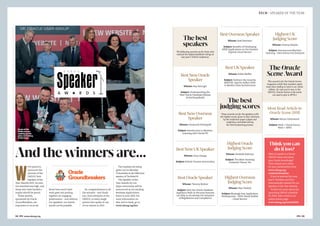
Someofthe
2018winners
soakingupthe
gloryandtaking
tothestage
#PTK 09
By Biju Thomas
#PTK 11
TECH | OOW 2019
This is a welcome
announcement and
I think there will be
a lot of developers and
administrators making
use of this tier. If you do
not have an Oracle Cloud
account, you still need to
sign up for the 30-day
Cloud Trial and create
your account.
When creating new
instances in OCI, you can
indicate that you want to
use the Always Free tier.
The Always Free resources
are available as long as
you want, with no time
constraints – subject only
to the capacity limits noted.
When your 30-day trial
period for the expanded
set of services ends,
you can continue using
Always Free services
with no interruption.
Here’s a list of the
Always Free services:
DATABASES
Autonomous Transaction
Processing or Autonomous
Data Warehouse
2 databases in total, each
with 1 OCPU and 20GB storage
Autonomous Databases
include APEX for web-based
app development, SQL
Developer Web for database
development and SQL
Notebooks for Machine
Learning
COMPUTE
2 virtual machines with 1/8
OCPU and 1GB memory each
STORAGE
2 block volumes, 100GB total
10GB object storage
0GB archive storage
LOAD BALANCER
1 instance,
10Mbps bandwidth
MONITORING
500 million ingestion
datapoints, 1 billion retrieval
datapoints
NOTIFICATIONS
1 million delivery options
per month, 1,000 emails sent
per month
OUTBOUND DATA
TRANSFER
10TB per month
There are no SLAs
associated with the
Always Free tier – but what
else would you expect?
You can find out more
information about
Always Free here: www.
oracle.com/cloud/free/
And turn to page 14 in this
issue of #PTK to find out how
to get started.
Highlights
from Oracle
OpenWorld 2019
Asever,thisyear’sOracle
festinSanFranciscowas
packedwithahugearrayof
announcements.Ifyouweren’t
abletobethere,here’sahandy
round-upofsomeofthekey
technologyhighlights
1 ALWAYS FREE GEN 2 CLOUD
The5bestthings
aboutbeinga
UKOUGmember
We polled our members to find out what they love most about
the UKOUG. Here are the five most common reasons
they gave for joining the group:
Here are the best ways to make the most of your membership:
If you’re not a member
and would like to join – and benefit
from all of the above and more –
or if you’ve already joined and
want to get more from your
membership, visit our website
which is full of information, ideas
and knowledge-sharing from
Oracle users like you:
www.ukoug.org
Tonetwork
withotherusers
andOracleexperts
Tokeep
up-to-datewith
Oracleinformation
–froman
independentvoice
Todevelopand
raisetheir
professionalprofile
Tofindsolutions
toOracle-related
problems
Toconnect
withOraclepartners
#PTK 13
TECH | OOW 2019
12 #PTK www.ukoug.org
ABOUT THE AUTHOR
Biju Thomas is Principal
Solutions Architect at OneNeck.
He is an Oracle ACE Director and
has more than 20 years of Oracle
development and database
management experience.
2 DATABASE SUPPORT AND ROADMAP
Oracle database non-
container architecture has
been depreciated since the
Oracle 12.2 version. From
Oracle 20c onwards, only
the container architecture
will be supported. The
non-container databases
are not supported in 20c.
Since a new version is
coming out every year,
Oracle’s release roadmap
introduced two types of
annual releases. Interim
releases (20c, 21c) are
supported for two (or three)
years – with only premium
support and no extended
support. Long-term
releases (19c, 22c) have four
years of premium support
and two or more years of
extended support.
If you’re running the
11.x or 12.x release of
databases, consider
upgrading to 19c. This is
the long-term support
release of the 12.x family
and has premium support
until March 2023 and
extended support (for
additional cost) until March
2026. Unless 20c and 21c
has a feature that you must
absolutely have, there is no
reason to upgrade to 20c or
21c because those releases
are short-lived. So, if you
upgrade to 19c now, you
have until 2022/2023 to
upgrade to 22c.
E-Business Suite
announced its support on
Oracle Database 19c, with
container architecture.
With non-container
databases going away,
another welcome
announcement is the
ability to create three PDBs
in a container database
without paying for
additional multi-tenant
licences. For more
information on this, see:
https://docs.oracle.com/en/
database/oracle/oracle-
database/19/dblic/
Licensing-Information.
html#GUID-0F9EB85D-
4610-4EDF-89C2-
4916A0E7AC87
Three PDBs are included
in all editions of Oracle
Database 19c and higher.
This announcement would
make many organisations
consider moving to the
CDB architecture. If you
create four or more PDBs
within one container
database, you will need a
multi-tenant licence. CDB
has many administration
benefits. For more on this,
see: https://docs.oracle.
com/en/database/oracle/
oracle-database/19/cncpt/
introduction-to-oracle-
database.html#GUID-
AB84D6C9-4BBE-4D36-
992F-2BB85739329F
3 AUTONOMOUS LINUX
AND O.S. MANAGEMENT SERVICE
Hot on the heels of the
Autonomous Database
comes the autonomous
operating system.
Oracle Autonomous
Linux does the following
automagically:
Automatic provisioning
Automatic scaling
Automatic tuning
Automatic online
patching and updating
Automatic security
monitoring and
remediation
To find out more on this,
take a look at: www.
oracle.com/cloud/
compute/autonomous-
linux.html
Autonomous Linux
uses the Ksplice
technology to apply
patches while the
system is running.
It is 100% compatible
with IBM RedHat, thus
customers can migrate
their RHEL workloads
to Oracle Autonomous
Linux without any
modification. It is
included free with
Oracle Cloud.
OS Management
Service, via the Oracle
Cloud Infrastructure
console or APIs, and
resource governance
policies, enables you to
automate capabilities
that will execute
common management
tasks for Linux systems,
including patch and
package management,
security and compliance
reporting, and
configuration
management.
4 PARTNERSHIP WITH
VMWARE AND MICROSOFT
There were a few key
announcements about
the Oracle OCI & Microsoft
Azure partnership. More
data centres will have this
connectivity in 2020, and
it was great to know that
the latency between apps
running on Azure VM
and Database on OCI
is around 4ms.
I saw a demo of how
to create the interconnect
between Azure and OCI. It
looks straightforward and
easy – from either side.
Oracle Apps (EBS, JDE,
etc) will be certified when
run on Azure in a cross-
cloud configuration.
The partnership
roadmap includes:
Connecting to Oracle DB
via OCI Interconnect
Integration with
Active Directory
Distributed logging using
managed ELK on Azure
Caching using Coherence
cluster
The partnership with
VMWare was a surprise,
but a very welcome
announcement. It will help
customers easily migrate
VMware vSphere
workloads to Oracle’s
Generation 2 Cloud
Infrastructure (expect
it to go live in Q4 of 2019).
With this, Oracle
becomes a partner in the
VMware Cloud Provider
Program and the Oracle
Cloud VMware Solution
will be sold by Oracle and
its partners.
The solution will
be based on VMware
Cloud Foundation and
will deliver a full stack
software-defined data
centre (SDDC) including
VMware vSphere, NSX,
and vSAN. Oracle will also
provide technical support
for its software running in
VMware environments in
customer on-premise data
centres and Oracle-certified
cloud environments. You
can find out more here:
www.oracle.com/corporate/
press release/oow19-oracle-
and-vmware-091619.html
And there was one further
announcement related
to partnerships: Oracle
Marketplace will soon
have an option to pay
for third-party product
licences that are sold on
Marketplace, using Oracle
Universal Credits. This will
consolidate billing for the
customer, which includes
Oracle services plus
third-party services.
5 AN EMPHASIS ON
MACHINE LEARNING AND ANALYTICS
Oracle Autonomous
Database and Oracle
Autonomous Linux
use advanced machine
learning (ML) and
autonomous capabilities,
which Oracle claims will
deliver cost savings,
security and availability,
and free up critical IT
resources to tackle
more strategic
initiatives. The system
delivers automated
patching, updates and
tuning without human
intervention. ML is key
in all Oracle innovations.
Oracle is also
developing several
products where end-
users can benefit from
machine learning
algorithms without
knowing too much about
the ML internals or data
complications. The
Oracle Machine Learning
notebook and Oracle
Analytics Cloud are
poised to be great
analytics tools for
the business.
The AutoML product,
which is coming soon,
is very exciting. AutoML
helps to automatically
build and compare
machine learning
models.
Here are a few
highlights from the
presentation given by
Charlie Berger, Senior
Director of Product
Management, Machine
Learning, AI and
Cognitive Analytics
at Oracle:
AUTO MODEL SELECTION
Identify in-database
algorithm that achieves
highest model quality
Find best model faster
than with exhaustive search
AUTO TUNE
HYPERPARAMETERS
Significantly improve
model accuracy
Avoid manual or
exhaustive search
techniques
AUTO FEATURE
SELECTION
Reduce the number of
features by identifying
most predictive
Improve performance
and accuracy
You can download the
presentation from here:
tinyurl.com/y3ygmxml
Dedicated VM Hosts:
Single tenant, never
share hardware with
another customer. Pay
only for the dedicated
VM host, no additional
charge for the VMs
running on it.
Cloud Shell: Simple
browser-based terminal
access, available from
the OCI console.
Elastic Instances:
Flexible compute
instances giving true
elasticity. Customer will
be able to pick the
number of cores and
memory. No downtime
required when scaling
cores or memory.
Instance Resize:
Change instance shape
(4 core VM to 8 core
VM), instance family
(Intel to AMD) and
change fault domain
without losing any
configuration.
Oracle Maximum
Security Zone where
security is not a
choice, but always on.
Resources launched
in this zone will be on
dedicated infrastructure
with the highest levels
of data encryption and
network security.
Zero Downtime
Migration: Simple
database migration to
Oracle Cloud leveraging
Oracle MAA best
practices. This tool will
also have the option to
migrate from OCI-
Classic to OCI-Gen2.
AND A
FEW MORE
HIGHLIGHTS…
Here’s a round-up
of some other items
that caught my
interest (many are
not available now,
but in the roadmap
for Q4 of 2019 and
Q1 of 2020)…
OCI Application
Performance
Monitoring: Allowing
OCI and on-premises
customers to monitor
enterprise applications
and diagnose
application problems.
Availability of
Microsoft SQL Server
on OCI: MS SQL licence
provided by OCI.
Oracle Data Safe: A
unified control centre for
Oracle Databases which
helps you understand the
sensitivity of your data,
evaluate risks to data,
mask sensitive data,
implement and monitor
security controls, assess
user security, monitor
user activity, and address
data security compliance
requirements.
Oracle MySQL
service: Self-managed
MySQL Enterprise
Edition on Oracle
Cloud Infrastructure.
Exadata X8M: The
industry’s first database
machine with integrated
persistent memory and
RoCE, delivers 2.5X
performance increase
and 10X lower latency.
The compute cloud performance
14 #PTK www.ukoug.org
By Rita Nuñez
10-S E C O N D S U M M A R Y
Oracle’s Autonomous
Database takes a huge
amount of effort out of
getting started as a lot
of the work is done for
you automatically – it
can literally take just
five minutes.
There is an Always
Free version – it’s
available for students,
developers, and
enterprise prototypes
for an unlimited time.
The database is
optimised for online
transactional
processing (OLTP)
applications such as
e-commerce, order
entry, retail sales,
human resources
and financial
transaction systems.
#PTK 15
TECH | AUTONOMOUS DATABASE
What is Oracle Database Autonomous Transaction
Processing?
It’s a kind of database cloud service that Oracle provides. It only
runs in the cloud, so is not a product – you can’t download it.
Why all the fuss?
This Database is ‘autonomous’ – which means it’s ‘self-driving’.
That means you don’t have to install the database software, you
don’t have to configure the instance, you don’t have to update
it, you don’t have to patch it, you don’t have to tune the
instance, you don’t have to manage the storage, and you don’t
have to think about availability.
It’s self-securing, which means Oracle protects the database
from external and internal attacks. It’s self-protecting, which
means Oracle protects against hardware and software failures,
site failures and data corruption. When you create an Oracle
Autonomous Database, Oracle creates a High Availability
Database, so it’s an RAC Database with Active Data Guard.
Oracle also automatically back up the database every day.
Oracle provides the Oracle Autonomous Database service
that does all these tasks for you.
Which database release is used?
This database is an Oracle Database 18c (at the moment, but
soon will be 19c) and is an Enterprise Edition. The Autonomous
Transaction Processing is optimised for online transactional
processing (OLTP) applications such as e-commerce, order entry,
retail sales, human resources and financial transaction
systems, among others.
How easy is it to set up a database using this?
With this service, you can create your database in less than
five minutes and very easily. Each Oracle Database Autonomous
Transaction Processing includes APEX and SQL Developer
Web, and there are drivers to connect from many developers’
languages: Java, Python, Node.js, .Net, Visual Studio. Also, you
can connect from Oracle Tools: SQL Developer, SQLPLUS, SQL
Loader, SQLcl and Data Pump. The connection from Client is
encrypted so you must download a Client Credential (Wallet).
Is it really true that there’s a free version?
Larry Ellison announced the Oracle Cloud Free Tier at Oracle
OpenWorld in September. So, it’s possible to get Oracle
Autonomous Database for free and test it. Go to oracle.com/free
to get set up your Oracle Always Free account. This includes
two Oracle Autonomous Databases, two Oracle Cloud
Infrastructure Compute VMs; Block, Object, and Archive
Storage; Load Balancer and Data Egress; Monitoring and
Notifications and more. These services will remain free
for students, developers, and enterprise prototypes for an
unlimited time. Also, you have 30 days’ free trial with US$300
in credits to try other services.
For more details, go to my blog and see how to create an Oracle
Always Free account: http://bit.ly/AlwaysFreeAccount.
And turn over now to find out how to get started…
Here’s how to get started with
Oracle’s self-driving cloud
database – and yes, there really
is an‘Always Free’option
First steps
with Oracle
Database
Autonomous
Transaction
Processing
#PTK 17
TECH | AUTONOMOUS DATABASE
16 #PTK www.ukoug.org
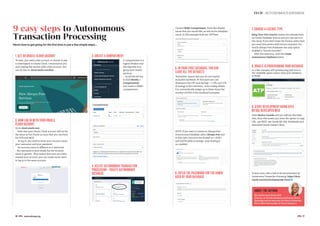
1. GET AN ORACLE CLOUD ACCOUNT
To start, you need a free account or choose to pay
a subscription in Oracle Cloud. I recommend you
start testing this service with a free account. You
can do this at: cloud.oracle.com/free.
2. NOW LOG IN WITH YOUR ORACLE
CLOUD ACCOUNT
Go to cloud.oracle.com.
Note that your Oracle Cloud account will not be
the same as the Oracle account that you can have
for OTN and MOS.
To log in, you need to enter your account name,
your username and your password.
An account name is different to a username
– the username is your email, but the account
name is generic. That means that once you have
created your account, you can create more users
to log in to the same account.
3. CREATE A COMPARTMENT
A compartment is a
logical division and
the objective is to
group your Oracle
services.
Scroll the left bar
to find Identity >
Compartments
and create a DEMO
compartment.
9 easy steps to Autonomous
Transaction Processing
Here’s how to get going for the first time in just a few simple steps…
4. SELECT AUTONOMOUS TRANSACTION
PROCESSING – CREATE AUTONOMOUS
DATABASE 6. ENTER THE PASSWORD FOR THE ADMIN
USER OF YOUR DATABASE
5. IN YOUR FIRST DATABASE, YOU CAN
LEAVE ALL THE DEFAULTS
‘Serverless’ means that you do not require
exclusive hardware. At this point you can
dimension the CPU and Storage – 1 CPU and 1TB
of storage is the minimum. Auto scaling allows
it to automatically assign up to three times the
number of CPUs if the workload increases.
NOTE: If you want to create an Always Free
Autonomous Database, select Always Free and
in this case, resources are limited to 1 OCPU
and 0,02TB (20G) of storage. Auto Scaling is
un-enabled.
7. CHOOSE A LICENCE TYPE
Bring Your Own Licence means you already have
an Oracle Database licence and you can use it in
the cloud. If you don’t have the licence, select that
you need this service with licence included. For
Oracle Always Free Databases the only option
enabled is ‘license included’.
After this selection, click the Create
Autonomous Database button.
8. ORACLE IS PROVISIONING YOUR DATABASE
In a few minutes, ATP provisioning will turn to
the ‘available’ green colour. Now your database
is ready!
9. START DEVELOPMENT USING APEX
OR SQL DEVELOPER WEB
Click Service Console and you will see the links.
Also, from this screen you have the option to copy
URL, use REST, use Oracle ML SQL Notebooks and
download Oracle Instant Client.
To learn more, take a look at the documentation for
Autonomous Transaction Processing: https://docs.
oracle.com/en/cloud/paas/atp-cloud
Choose DEMO Compartment. Enter the display
name that you would like, as well as the database
name. In this example both are ‘ATPTest’.
ABOUT THE AUTHOR
Rita Nuñez is an Oracle ACE
Director, an Oracle Database and Oracle Cloud
Specialist and an instructor for Oracle University.
She is CEO and Founder of Tecnix Solutions.
18 #PTK www.ukoug.org
By Richard Lumsden
10-S E C O N D S U M M A R Y
Keen to leverage
the data-driven
intelligence built
into Oracle cloud
applications, the
university finance
team used Namos
Solutions to help them
move to Oracle Fusion.
Bumps along the
road included the
transition from
a development
environment to
a production
environment,
automating tax
calculations on POs
and matching security
cyphers from the
Oracle Supplier
Network to the
Justransform
production
environment – but
these were resolved.
Lessons included the
importance of fully
understanding the
business processes,
double-checking
the configuration
– and aligning with
all third parties.
#PTK 19
TECH | CLOUD MIGRATION
B
ased in Stoke-on Trent, with operations in
Stafford, Shrewsbury and more recently
London, Staffordshire University is known as
the ‘connected university’, with its emphasis
on putting students first. With a strong
underlying set of values – typified by the
#ProudToBeStaffs hashtag – the university has
improved its performance in all of the major
UK higher education league tables over the
last few years, achieved TEF Gold (the highest
award for teaching excellence) this year and was
recognised in the international league tables for the first
time in 2018. As a civic university, the institution has
strong connections within the city and region, as well as
nationally and globally, working with employers, SMEs and
other significant partners, and has played an important
role in the development of degree apprenticeships in the
public sector in England in the last three years.
How appropriate, then, that the finance team at the
university are connecting with the digital cloud world and
moving to Oracle Fusion, which they did with the help of a
team from Namos Solutions. The finance team are keen to
get on board with the modern best practices and data-
driven intelligence built into the Oracle cloud applications.
In my last instalment (see Issue 69), the project was
approaching the User Acceptance Test (UAT) phase and
the team were working to close out Systems Integration
Testing. The main core functionality was working well,
and the University Finance team had been given access
to the Systems Integration Test (SIT) environment to
encourage them to get familiar with the new screens
and to have the first ‘touch and feel’ of the system.
SIT testing was still ongoing, however, as some of
the integrations were proving hard to crack and it was
becoming apparent that some of them would not be ready
for the start of UAT. In particular, the Recurring Payments
interface was proving to be a real challenge and the
process had to be completely redesigned. The recurring
payments process is where credit card transactions are
presented to a payment platform and an attempt made to
take the funds from the credit cards. The existing process
had a design flaw that meant that the majority of
transactions being sent to the payment platform were
erroring and had no chance of being processed as they
did not contain the complete set of information.
We wanted to improve this situation and to be able
to only send transactions which would be processed
successfully by the payment platform, but the code
required to produce the correct set of transactions was
more complex than expected. That, together with the fact
that the resources required to design the new process were
deployed resolving other AR issues, meant that we had to
move some of the project milestone dates. The start of
UAT and also the go-live date had to be moved back to
accommodate the delay on the integrations.
I don’t think I need to explain the difficult conversations
Inthesecondinstalmentofthisjourneyto
OracleFusion,wetakealookatthelessons
learnedfromgettingconnected
University: Part II
Mastering the cloud
at Staffordshire
Preparation for
the production
environment build is
absolutely key and must
be rigorously checked
#PTK 21
TECH | CLOUD MIGRATION
20 #PTK www.ukoug.org
ABOUT THE AUTHOR
Richard Lumsden is Portfolio Director at
Namos Solutions, an Oracle Platinum Partner
and Cloud Excellence Implementer (CEI)
specialising in the implementation and
support of ERP, EPM and HCM solutions.
that resulted from this but, as a team, we worked through
the facts and data and came up with a plan with new
dates that everyone was comfortable with.
TESTING, TESTING…
Once everything was in place for UAT, the testing ran
pretty smoothly. Defects were raised and fixed in a timely
fashion and in the words of one of the team “we tested
it to death”. We got to the point where the university
team were ready to go, and we headed into cutover.
Acknowledgement should go to the university finance
team in that not only do they know their data well, they
also know their processes. They were instrumental in
building the cutover plan and advising realistic dates for
each of the tasks.
For Oracle Cloud ERP implementations, the approved
strategy is that the build of the production environment
is a build from scratch using the configuration templates
created over the course of the project. From an audit
perspective this is not ideal and leads to some interesting
conversations with your customer along the lines of, “So
we’ve tested the UAT environment and are happy with
that – but now you’ve built a completely new one for
production – how do we know they are the same?”
At this stage Oracle do not allow you to copy a
development environment into the production
environment. There are tools to do configuration
comparisons, but they do involve a significant amount
of technical effort to set up and this is not typically built
into the project plan. There must be a better way to avoid
this concern, but I have not found one yet.
So, the production environment was built and the first
major cutover task was to load the customers and get the
customer interface from the SITS system up and running
to de-risk the go-live weekend. In the first instalment, I
raised the issue of the person type customer load template
which has 18 separate tabs. Hats off to the university team
as this duly arrived on time and was successfully loaded
into the system.
This really was a Herculean effort from a number of
parties, and it is testament to the work on previous
migrations during the project that this process ran so
smoothly. On future university projects we have revised
our approach to this customer load and now recommend
using an interface for this as the data preparation required
is much simpler.
So, when you want to arrange a copy of one
environment (POD) to another – a P2T or Production to
Test or a T2T Test to Test – you need to provide at least
three weeks’ notice. While this is good news for Oracle in
terms of resource planning, it’s a nightmare for the project
team to specify an exact date when the environment is
ready for copying.
Also, there is no method for copying a development
environment onto the production environment. This
forces you to plan in a production environment build
with all the inherent risks that brings with regard to the
potential for human error and timing issues in terms of
which module gets configured first. Let’s not forget that
the customer has signed off the UAT environment and
now you have built a completely new one which is not
the one that was tested.
Preparation for this production environment build is
absolutely key, and the build must be rigorously checked to
confirm that it is an exact copy of UAT. Endless rounds of
smoke testing are required in order to be as certain as you
can that everything is in good shape.
Another nagging issue that was bubbling away was that,
during SIT, we had identified a potential problem with
dunning letters – whereby multiple dunning letters, rather
than the single letter that was expected, were being
produced for customers who had multiple sites. A severity
one Service Request was duly raised with Oracle, and this
was identified as a bug and a potential showstopper for
go-live. The SR was escalated using the standard Oracle
process and a planned delivery date was provided which
was shortly before go-live.
This was good news in that we would get the fix before
go-live, but it was not a perfect situation. It would leave
us with a support environment that would be out of step
with the production environment at go-live and we would
therefore not necessarily be able to recreate production
issues in the development environment in order to be
able to fix them.
To mitigate against this, we worked with Oracle to find
a solution and found that we could have the production
environment release done at the same time as the
support environment release. The view was that, as
the date for the fix was just before go-live and prior to
the first time that the dunning process would be run
in production, we would be able to perform testing in
the support environment to confirm that the fix had
worked prior to having to use the new code in anger
in production.
There was, of course, a slight risk that the new code
would impact the production processes, but we were given
assurance that the code fix was local to dunning letters
and would not impact anything else.
PREPARING FOR GO-LIVE
In order to have the production and development
environment releases synchronised, we had to move to the
weekly release cadence, and this would allow us to get our
fix ahead of the scheduled quarterly release. This involved
several phone calls and business case justifications, but
everything was nicely lined up for go-live.
Oracle kept us informed of progress but the release date
for our fix kept slipping… And finally, it slipped past the
go-live date for the project. Thankfully, the University team
were flexible enough to be able not to run the dunning
process until it got resolved.
The fix eventually arrived, however, was tested
successfully and the university are now using it as part
of their business-as-usual, but we did make a go/no-go
decision based on the original delivery date for the fix.
In my view, Oracle need to be aware of these types of
situations and the potential impacts of not hitting their
delivery dates. In other circumstances we would have had
to abort the go-live at a very late stage with all the painful
consequences of that for all concerned.
So, the production environment was built and data
migration is in full flow. Next in line were the open
purchase orders. The load went in 100% – great news…
But the tax was not calculating correctly. A check on the
configuration revealed that the tax had not been set to
auto-calculate. There was no way to do a bulk reset.
A brief SR conversation with Oracle ended up in a
statement that a data fix would not be provided as the
Oracle functionality had worked correctly. The only way
around this was to set the auto-calculate flag and to
‘touch’ each purchase order in the system manually to
force an update. This meant assembling a team of
consultants to work through a weekend to update
the 1,400 purchase orders.
An eager crew was duly put together, provided with
a list and asked to go into each purchase order to trigger
the tax update. By the end of the weekend, the purchase
orders were done and the university team confirmed
that everything looked good. Crisis averted – but it
does highlight the need to check the configuration
fully prior to loading any data.
ALL SYSTEMS GO!
Finally, it’s cutover day. All the endpoints are pointing
in the right direction, suppliers are loaded and the first
purchase orders are being sent out. But they don’t arrive!
When checking the logs, there is a security cipher issue
where the ciphers on the Oracle Supplier Network (OSuN)
don’t match those on the Justransform production
environment so the purchase orders can’t get through.
Luckily, the UAT Justransform environment is still able to
use the ‘out of date’ security ciphers which are being used
by OSuN, and we are able to hop the purchase orders
through Justransform UAT and through to Justransform
production, so order is restored. This does mean that
the Justransform UAT environment is temporarily in
a production state and can’t be brought down for
maintenance until the issue is resolved. Oracle have now
updated the security ciphers on OSuN and so this issue
has been fixed, but it did mean a late night to get the
routing secured and working perfectly.
The university is now live on Financials and have
mastered that part of the cloud. So, what next? The
university is continuing to push the boundaries with its
progressive digital cloud strategy and recently opened
the Digital Institute London.
It was a pleasure working with such a knowledgeable
team. They are a credit to their organisation and are
capable of surmounting any challenge that is put in front
of them. The wonders of PBCS await!
THE LESSONS LEARNED:
The pursuit of a quality solution is paramount.
Don’t compromise by just doing a straight
lift-and-shift exercise.
Make sure that you understand the business
processes being implemented. It may take a bit
longer, but your customer will appreciate the
process improvement in the long run.
Check your configuration, re-check it and then
check it again. The extra time taken will benefit
everyone in the long run.
Make sure that the third parties you are working
with are aligned in terms of having their UAT
environment configured the same as production.
This will avoid the unexpected go-live issues we
came across in terms of security ciphers.
22 #PTK www.ukoug.org
10-S E C O N D S U M M A R Y
RedHat Ansible
is a powerful
automation tool.
It was designed to
control operating
systems and
configurations using
Python, YAML and
Jinja2 templates.
There are plenty of
CI/CD systems that
provide Ansible
connectors and
allow you to execute
Ansible playbooks.
By using Ansible
it is possible to:
install, configure
and start the whole
set of Oracle Fusion
Middleware
products in hours;
make sure that all
the products are
patched and
hardened; ensure
that all servers
and domains
have consistent
configuration
and setup.
#PTK 23
TECH | ANSIBLE FOR ORACLE FMW
By Michael Mikhailidi
Boosting Oracle Fusion
Middleware with Ansible: how
one project was handled using
this powerful automation tool
– plus some lessons learned
Delivering
a platform
on demand
A
lmost as soon as I joined Attain LLC, and started
my career in the Federal Services division, I was
assigned to two projects with one of our largest
clients. Many large institutions have multiple
contractor companies, with well-defined terms
and boundaries. If you multiply that by very
formalised communications and security-driven
environments, you can imagine the challenges we had
during the project implementation. Additionally, there
were the challenges of environment-configuration in
production, public-facing applications and outdated
architecture design. All those factors meant we had to
meet the following challenges:
Minimise production-ready platform delivery time
Eliminate any discrepancies in the configurations
from host to product
Have a fully documented environment
Track all the configuration changes
Follow DevOps principles as much as possible
Use open source or existing products.
Attain partners with major software vendors and the
project team chose Ansible as an automation tool for
the Oracle Fusion Middleware platform delivery. It started
as a new generation environment, based on the latest
OFM 12.2.1.3 products. Initially, I wasn’t sure if Ansible
was the right fit for Oracle Fusion Middleware, but even
the half-way delivery was so promising that we started
to expand coverage to the existing production product
set as well.
Now, when our Operations and Support team are
adopting our techniques and scripts to monitor and
control the other environments, I can share my new
experience and show you why Ansible is a good fit
for most of the Oracle Fusion Middleware-related
activities. But first, I’ll introduce Ansible and define
some terminology.
MEET ANSIBLE
Ansible started as an open source project and even if
you see RedHat all over the place, the core part of the
framework is still open source. We aren’t using Ansible
Tower in our project, so I’ll keep it out of scope. (For more
information on Ansible, go to their website, ansible.com.)
To start using Ansible all you need is:
An Ansible controller – practically any 64-bit Linux and
installed Ansible software, configuration, installed
modules, and plugins
Setup your SSH keys on targets; Ansible uses key-based
authentication to access remote hosts.
An inventory file to let your controller know how to find
your target hosts
Basic knowledge of YAML (Yet Another Markup
Language)
That’s right: you don’t need to install agents or have
anything but Python 2.5+ on targets.
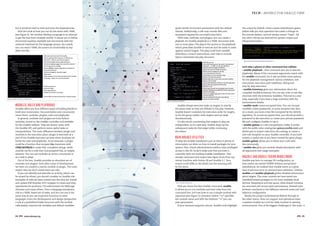
ANSIBLE INVENTORY AND YAML
Ansible supports multiple inventory formats from none
(you always have access to thelocalhost target) to dynamic
inventories where a list of targets created by some
program code. Inventory documentation gives you all the
examples in two structured formats: INI and YAML. Let’s
take a look at the sample inventory (see Figure 1).
It describes 10 targets, where:
Single entry servers are soahost1 and osbhost1
Machines ohshost1 and ohshost2 under [webtier] section
are members of the group webtier.
The next group portal contains six machines through
the range. You can access those hosts individually as
wcphost1, wcphost2 … wcphost6.
Ansible implicitly adds group all with all the targets
in the inventory.
Now, while you have targets and group of targets defined,
you can manage targets at once, using ad hoc commands
or playbooks. So far, you don’t see anything unusual:
technically any orchestration tool provides similar ability
– maybe not as easy, but comparable. However, it also
allows you to define variables for groups and targets. On
our sample hosts in the portal group have two variables
each: ms_port and secured. Variables in this group have the
same value for each target, but they are different for the
webtier group – you may already notice that listen_port has
different values.
This is where Ansible gets really powerful: you can create
an OHS configuration playbook and refer to the variable
listen_port. At runtime, Ansible compiles the actual execution
environment and uses the right value for the target.
Inventory in INI format is well suited for the simple
environments and a few predefined variables. You can still
define groups and subgroups, host and group variables,
#PTK 25
TECH | ANSIBLE FOR ORACLE FMW
24 #PTK www.ukoug.org
but it would be hard to read and trace the dependencies.
Now let’s look at how you can do the same with YAML
(see Figure 2). Yet Another Markup Language is an attempt
to get the best from multiple worlds. It allows you to define
structured machine-readable text documents with the
minimal overhead for the language syntax. As a result,
you can read a YAML document as comfortably as any
plain text file.
MODULES, ROLES AND PLAYBOOKS
Ansible offers you four different types of building blocks to
build your automation. Documentation and community
name them: modules, plugins, roles and playbooks.
In general, modules and plugins are local Python
modules, stored on the Ansible controller and available
for the Ansible utilities. They are atomic units, with
the Ansible API, and perform some useful tasks or
manipulations. The main difference between plugin and
modules is the execution place: plugin is executed as a
part of the Ansible execution process when modules are
bricks for roles and playbooks. As an example, a plugin
could be a function that escapes rn characters with
CHR(13)CHR(10) to make SQL–compliant strings, while
module can be a code that runs prepared SQL on targets
systems. You can use modules as ad hoc commands or
as a task in plays.
Out of the box, Ansible provides an abundant set of
modules and plugins. Even after a year of development,
we have not created a custom module or plugin. The main
reason why we don’t create them are roles.
If you can identify and describe an activity, which can
be reused by others, you should consider an Ansible role.
Examples of roles we have created over the time are: Install
and update JDK binaries, RCU wrapper to create and drop
repositories for products, TLS enforcement for WebLogic
domains and many others. Form a language standpoint,
role is a YAML-based set of tasks, and you can use it the
same way as you use imported functions in other
languages. From the development and design perspective,
a role is a predefined folder structure with the module
calls (tasks), internal role variables and default variables
(quite similar to function parameters with the default
values). Additionally, a role may contain files and
templates required for successful execution.
With roles, modules, and plugins, you can create a
playbook. An Ansible playbook is a YAML document with
one or more plays. The play is the section in the playbook
which prescribes Ansible to execute and list tasks in order
against named targets. The play could have variable
definitions, connect instructions, and roles to include.
Figure 3 illustrates the play structure:
Ansible always executes tasks on targets in exactly
the same order as they are defined in the play. However,
Ansible doesn’t maintain the execution order for targets,
so for the group webtier, both targets execute tasks
simultaneously.
It’s also worth mentioning that targets in play are
independent, so if a task fails, Ansible drops all the
subsequent tasks for this target while continuing
the others.
MAIN ANSIBLE UTILITIES
I’ll skip the Ansible installation part as there is plenty of
information out there on how to install packages for your
system. Plus, Oracle administrators seldom have privileged
access to the OS. So let’s make sure that you have a
controller with the working Ansible installation. This
sample command and output (see Figure 4) are from my
virtual machine with Fedora 28 and Ansible 2.7. Your
output could differ in the detail, but the meaning will
be the same.
Now you know the first Ansible command: ansible.
It allows you to run modules and even roles from the
command line. Let’s see how to run a simple module with
argument (see Figure 5): command. Switch “–m” specifies
the module name and with the attribute “–a” you can
pass parameters.
If your terminal supports colours, Ansible tools highlight
the output by default. Green means everything is green;
yellow tells you that operation has made a change on
the remote system, and red always means “Oops”. All
the other colours are reserved for system output and
debug information.
Let’s take a glance at other command line utilities:
ansible-playbook – that command you use to execute
playbooks. Many of the command arguments match with
the ansible command, but it also provides extra options
for the playbook management: syntax validation, test
executions, execution path validation, debug and
step-by-step execution.
ansible-inventory gives you information about the
compiled Ansible inventory. You can see a list or tree-like
structure with the inventory variables. This tool is a real
help, especially if you have a large inventory with the
environment details.
ansible-vault covers encrypted data. You can encrypt
variables, inline passwords, or some sensitive text data.
As a result, you have a text file encrypted by the AES256
algorithm. To access encrypted data, you should provide a
password at the execution or create your private password
file and configure Ansible to use it.
ansible-galaxy is a role manipulation utility. It works
with the public roles catalog (see galaxy.ansible.com) and
allows you to import roles from the catalog, or create a
new role template on your Ansible controller. If you have
written a useful role or you have created the great plugin,
ansible-galaxy allows you to share your code with
the community.
ansible-doc gives you module details description with
all arguments and usage examples.
ANSIBLE AND ORACLE FUSION MIDDLEWARE
Ansible was born to manage OS configuration, so
even before we started OFMW delivery and product
installations, we realised that Ansible saves us a great
deal of precious time on environment validation. Utilities
ansible and ansible-playbook gather detailed information
about targets. The main controls we have tested are:
installed/missed packages on the host; available block
devices, filesystems and free space; what shared volumes
are mounted and mount point permissions, firewall rules
between machines in the different network zones and load
balancer configuration.
Slowly, the project achievements filtered through to
the other teams. Now our support and operations team
considers Ansible as a tool for daily routines in existing
environments. One of the biggest challenges is ‘the main
#PTK 27
TECH | ANSIBLE FOR ORACLE FMW
26 #PTK www.ukoug.org
ABOUT THE AUTHOR
Michael Mikhailidi is a Senior Leader
Specialist, Federal Services at Attain LLC.
He has worked with Oracle technology
products for decades. He is also on the
Oracle OEM customer advisory board.
switch’ – the environment-wide start/stop procedure.
In-product and cross-product dependencies, cache
activations and intermittent service calls all push the
manual start and validation beyond two hours – with
Ansible, we hope to fit the whole process into one hour.
We had to perform some environment-related playbooks
ad roles. The biggest one is related to security limitations.
We didn’t get all the required Python packages to support
Ansible standard certificate modules. I have created a new
role on top of ubiquitous OpenSSL. As of now, it covers all
needs in the certificate and keystores management. The
latest implementation smart enough to request a new
certificate for each target collects all of them from the
remote machines and sends a rich-formatted email with
the attached archive.
Even before we started a simple search through the
Ansible Galaxy, our worst suspicions were confirmed:
Ansible with Python/YAML and Oracle Fusion Middleware
with Java/XML are from different planets. The public
repository holds roughly 21,000 roles, where only about
400 are related to Oracle, and only 18 mention WebLogic.
Most of the roles in the public repository are simple Java
installers or wrappers for the WebLogic scripting language.
Quick code checking in the public GitHub repos
confirmed this: without deep customisation, the
primary technique for the Oracle technology stack is the
orchestrated calls of template and shell modules. Of course,
we use other modules and plugins, but only as a target
preparation to perform shell script run. Even with such a
limitation, Ansible is much more productive than any of
the scripting techniques I have used before, and there
are many reasons why.
As a language YAML is quite clean and even if you can’t
read it as naturally as promised, it’s still easier to read
than any other shell scripts. Modular by nature, Ansible
decomposes large automation scenarios into well-isolated
roles and modules. We can create, modify and test the
role code changed without touching the whole repository.
As a result, the automation scenario could be quite
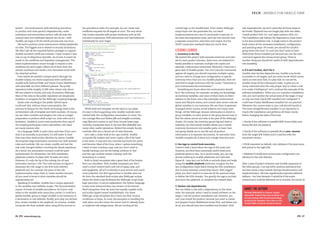
sophisticated. For illustration: the SOA installation
playbook contains 16 plays with 24 tasks and roles.
However, it’s only the tip of the iceberg; the all task
estimation reaches 1,700. The code excerpt on Figure 6
illustrates the role usage in the SOA Suite delivery
playbook and, for contrast, the piece of the role
implementation steps. Now, to create another domain,
all you need to know is what variables should be
appropriately set.
Speaking of variables: Ansible has a unique approach
to the variables and visibility scopes. The documentation
names 16 levels of variable precedence. So if your code
refers to the variable with name fmw_version, it could be a
global variable, group or target variable in the inventory or
a declaration in role defaults. Finally, your play can declare
fmw_version variable in the playbook. At runtime, Ansible
computes the final variable value using all the sources in
the precedence order. For example, we can create new
certificate requests for all targets at once. The very same
role creates requests with proper attributes such as full
and short hostnames, DNS alternatives and load balancers
individually for each target.
While shell and template are the stars in our plays,
it’s easy to find supporting crew. Ansible modules were
created with the configuration automation in mind. You
can manage files and folders (file and tempfile modules),
copy files and content to and from remote hosts (copy
module), manipulate lines in the text files (lineinfile) and
many other useful operations. Behind the simple facade,
modules offer you a decent set of extra features.
Let’s take a closer look at the copy module. Ansible
computes file hashes and never copies a file if the hash
is the same. It may save you minutes and hours for patch
and binaries. Most of the time, when I update something,
I want to have a backup copy; now you don’t need to
handle backups, just set the backup attribute to ‘yes’
and the copy module creates a backup with the
timestamp in a name.
Built-in Jinja2 templates take a great deal of the burden
from our shoulders. With Ansible templates you don’t
need a mind-twisted shell code full of regexp, grep, and
awk spaghettis. All of it is already at your service and much
more powerful. Our first approaches to Ansible were not
far from the standard shell scripts plus WebLogic scripts,
where the shell script facilitates the WebLogic script main
logic execution. It has an explanation: the Python language
is way more advanced than any version of the Bourne
Shell interpreter. Now we have two equally capable tools,
and scales tipped toward Ansible/Jinja2. Our latest
WebLogic script templates don’t have any flow control,
conditions or loops. At most, the exception is handling the
calls when you shut down the server and it’s already down
or duplicate role assignments. We are moving all the
control logic to the Ansible level. If the classic WebLogic
script loops over the parameter list, our latest
implementations are a list of commands to execute. In
the ideal decomposition state, each list item should have
a separate connection, execution and output, but the
WLST connection overhead takes too much time.
LESSONS LEARNED
1. Inventory is the key
We started this project with separate inventory and roles
set for each product domain. Quite soon, we realised it’s
barely possible to maintain multiple role copies and
separate, rudimentary inventories. Moreover, I have lost a
great deal of Ansible power. You can’t execute commands
against all targets, you should maintain multiple copies,
and you need to change your configuration or specify
inventory every time you run Ansible playbooks. Now we
switched to single inventory with the motto: “Inventory is
your environment documentation.”
Everything you know about the environment should
be in the inventory. For example, we keep our knowledge
as inventory variables, and most of them have no direct
relation to the hosts. Just a few examples: environment
name and lifecycle status, and current data centre code are
global variables in our inventory. We use them to generate
managed server names, email subjects and many other
things. All the WebLogic domain information is stored in
group variables, so every server in the group knows how to
find the admin server and who is the part of the WebLogic
cluster. Of course, the inventory grows big and hard to
maintain, but fortunately Ansible allows you to break
inventory documents into smaller parts, so basic host
and group details are in one file and all product
information is in separate documents. At execution time,
Ansible compiles all of them into a single data structure.
2. Use tags to control book execution
I haven’t said a word about the tags in the main text.
However, you find them extremely useful when your
playbook grows in size. As in social media, you can tag
almost anything in Ansible playbooks and roles (see
Figure 6). Later you can include or exclude plays and tasks
using the ansible-playbook attributes. Imagine the few
last configuration steps failed during the SOA installation
due to some network connectivity issues. With tagged
plays, you don’t need to re-execute all the previous steps
to deliver the SOA domain. You specify the tags to include
and rerun the playbook, to complete the missed steps.
3. Declare role dependencies
You can define a role with a dependency on the other
roles. For example, when I need to install software on the
target, I call the product installation role. However, you
can’t just install the product, because you need to install
and prepare Fusion Middleware home first, and before you
do so, you should have Java installed and fortified. With
role dependencies, we don’t prescribe all those steps in
the books. Playbook has one single play with two tasks:
‘install product SOA 12c’ and ‘patch product SOA 12c’.
The installation role follows the dependency chain down
to the Java installation role. A single entry in the product
book covers all the necessary installation, configuration
and patching steps. Of course, you should be mindful
going down this road. I’m sure you don’t want to have
WebCenter Portal installed just because you run the start
command against the wrong server group. There is
another thing you should be careful of with dependencies:
role durability.
4. If it ain’t broken, don’t fix it
Ansible roles declare dependencies, Ansible runs books
in parallel on all targets, and you never know which server
starts an execution first; if a play fails on one server,
Ansible drops all the subsequent tasks. It gives you so
many unknowns that the only proper way to create a role
is to make it bulletproof. Let’s continue the example of the
software installation. When you run a product installation
role, you can’t predict the actual state of the target. It may
or may not have Oracle JDK installed and configured. It
could have Fusion Middleware installed but not patched.
Whatever the current state is, your role should handle it.
The most straightforward installer in our repository is
Oracle JDK installation and performs all these checks
before changing the state of the host:
Checks if the software is installed (JDK home folder and
binary file Java are present)
Checks if the software is operable (Runs java –version
from the target JDK folder) and it matches with the
requested version
If JDK requested as default, role validates if the Java home
link points to the right JDK
Validates if certificates and security configuration are
identical to the role defaults.
After a year of project evolution and Ansible expansion to
the other groups, I can say (with cautious optimism) that
we have made a step towards DevOps transformation and
implementation. We have significantly improved platform
delivery – but how fantastic it would be if the entire
environment could be delivered not in months, but hours.
28 #PTK www.ukoug.org
By Samuel Nitsche
10-S E C O N D S U M M A R Y
Automated self-tests
are a fundamental part
of application and
web development
nowadays, to the
point where it’s hard
to imagine modern
software development
without them. Yet they
are still surprisingly
uncommon in the
database.
This article shows how
easy it is to start
developing self-tests in
Oracle with utPLSQL
version 3 (https://
utplsql.org).
We also take a look
at the many benefits
these tests can bring
to your project and
your software.
…or whyyou should test
with utPLSQL. Here, we take a
detailed look at how to get started
#PTK 29
TECH | utPLSQL
T
he lament in the headline might be very familiar to most
developers and even more painfully to quite a few users.
“What happened between yesterday and today to cause
my application to break? And why did it have to be
reported by my user?”
After some contemplation, we remember a small
change we made yesterday, shortly before leaving for home.
The customer asked for a new column in the View v_starwars_
characters which we added on the fly. Nothing special, but
very urgent, and it seemed so simple: just a new field with
information about the movies in which the Star Wars characters
appear (see the table below). 
ID NAME EPISODES
1 Darth Vader 3,4,5,6
2 Luke Skywalker 4,5,6,7,8
3 Rey 7,8
 
This is very simple create or replace view. Of course
  1) update_name
      ORA-01732: Data manipulation operation not
legal on this view
      ORA-06512: in «SITHDB.UT_V_STARWARS_
CHARACTERS», line 10
      ORA-06512: in line 6
Finished in ,002346 seconds
1 tests, 0 failed, 1 errored, 0 disabled, 0
warning(s)
As expected the test fails and utPLSQL even provides the
complete stack trace.
 It’s also noteworthy that we don’t get a “failed” but an
“errored” test in the final test run summary. The test caused an
ORA-exception, which the framework caught and documented
for us. If we had more tests, those would nonetheless be run.
Now we can address the essential problem and re-create
the lost instead-of trigger (for demonstration without any
functionality first):
create or replace trigger save_v_starwars_
characters
  instead of update on v_starwars_characters
  for each row
  begin
    null;
  end;
 
If we now re-run our test-suite, we get a slightly different result: 
call ut.run();
View: V_STARWARS_CHARACTERS
  Update character-name via view [,409 sec]
(FAILED - 1)
 
Failures:
 
  1) update_name
      Actual: ‹Test-Char› (varchar2) was
expected to equal: ‹Darth utPLSQL’ (varchar2)
      at «SITHDB.UT_V_STARWARS_CHARACTERS.
UPDATE_NAME», line 14 ut.expect(l_actual_name).
to_equal(‘Darth utPLSQL’);
 
 
Finished in ,41099 seconds
1 tests, 1 failed, 0 errored, 0 disabled, 0
warning(s)
The test is still failing, but this time it’s our expectation that caused
the failure and not an ORA-exception. The failure report also
tells us very specifically what went wrong and in which line the
expectation failed.
Now we implement the trigger completely and run our test-
suite again:
create or replace trigger save_v_starwars_
characters
  instead of update on v_starwars_characters
  for each row
  begin
    update star_wars_characters
      set name = :new.name
      where id = :new.id;
  end;
/
 
call ut.run();
View: V_STARWARS_CHARACTERS
  Update character-name via view [,004 sec]
we tested afterwards via select if the new column shows the
expected results. But if we now try to change the name of a
character, we get the following database error:
„ORA-01733: virtual column not allowed here"
Maybe you already guessed it, maybe you experienced this
special behaviour by the Oracle database yourself: whenever you
replace a view, the belonging instead-of trigger is lost. A small,
simple change, with big and annoying consequences.
How could we have prevented this error? “Better testing” is an
obvious answer and it won’t take long until we get to checklists
and standardised test protocols to be sure that every important
aspect of our application is tested, after every change.
 That’s the point where automated self-tests become interest-
ing, because they are exactly that: a number of narrowly defined,
standardised checks of a certain functionality — for example,
whether updating a specific column of a view is possible.
We can create such a test with straight standard PL/SQL like this:
declare
  l_name varchar2(2000);
begin
  update v_starwars_characters set name =
‘Anakin Skywalker’ where id = 1;
  select name into l_name
    from v_starwars_characters where id = 1;
  if ( l_name <> ‘Anakin Skywalker’) then
    raise_application_error(-20000, ‘Update did
not work!’);
  end if;
end;
 We could now save this block as a script and run it after every
update. However, this would become pretty confusing and
tedious with a growing number of tests, which is why it’s helpful
to use utPLSQL. The free, actively maintained open source
framework can take a lot of work out of our hands.
 
INSTALLING utPLSQL
To use utPLSQL it has to be installed into the database first.
To do this you can download the latest release version from
GitHub (https://github.com/utPLSQL/utPLSQL/releases/latest).
You can find some prepared scripts in the folder “source“ to
smoothly install utPLSQL:
“install_headlesss.sql” to do a default-installation into
schema “ut3” with public synonyms (run as sys-user)
“install.sql” to install it into a different schema (no
sys-user needed). In that case you need to grant access to the
utPLSQL functions by running one of the following scripts:
“create_synonyms_and_grants_for_public.sql”
for all users
“create_user_grants.sql” and “create_user_
synonyms.sql” for a specific user
A detailed installation guideline can be found at: http://utplsql.org/
utPLSQL/latest/userguide/install.htmlor infolderdocs/userguide/
install.html of the downloaded ZIP archive.
 
A FIRST TEST WITH utPLSQL
While most PL/SQL developers are used to the procedural model
and rely heavily on packages, utPLSQL uses the object-oriented
possibilities of the Oracle database and provides a “fluent” API.
It might look odd at first, but you will get used to it quickly and
probably come to love it.
utPLSQL provides some very helpful public methods after its
installation, first of all the so-called “expectations” (see Figure 1).
Figure 1: utPLSQL
Expectations.
For PL/SQL, the
object-oriented,
“fluent” syntax might
be a bit unfamiliar
The second key part of the framework is the “annotations” with
which we can turn regular PL/SQL packages into test-suites. This
is a utPLSQL test-suite header with annotations %suite und
%test – these are getting parsed and interpreted by the
framework, but only in the package-headers:
create or replace package ut_v_starwars_charac-
ters as
  -- %suite(View: V_STARWARS_CHARACTERS)
  -- %test(Update character-name via view)
  procedure update_name;
end;
 Here, %suite is the only annotation that is absolutely necessary.
It tells utPLSQL that the package is in fact a test-suite. With %test
we mark the subsequent procedure as a test, which we can now
implement inside the package body as usual:
create or replace package body ut_v_starwars_
characters as
  procedure update_name
  as
    l_actual_name v_starwars_characters.name%-
type;
  begin
    -- Arrange: Setup test-data
    insert into star_wars_characters (id, name)
values (-1, ‘Test-Char’);
    -- Act: Do the actual update
    update v_starwars_characters set name =
‘Darth utPLSQL’ where id = -1;
    -- Assert: Check the output
    select name into l_actual_name from
v_starwars_characters where id = -1;
    ut.expect(l_actual_name).to_equal(‘Darth
utPLSQL’);
  end;
end;
In a similar way to the standard PL/SQL example, we execute an
update on the view. Afterwards we select the column we just
updated and compare the result with our expected value via
utPLSQL-expectation.
 One problem we face in a test scenario is that we don’t know
exactly which data might exist in our current database state.
Therefore, we initially make sure we have data to update. In our
example, we use a little trick to avoid collisions with eventually
existing data: most primary keys are INTEGERs, but if the related
Sequence or Identity starts with 1, we can just use negative IDs
for our test data.
Now we can run the test with the ut.run-method. Here’s the
result of the unit-test:
 set serveroutput on
call ut.run(‘ut_v_starwars_characters’);
View: V_STARWARS_CHARACTERS
  Update character-name via view [,002 sec]
(FAILED - 1)
 
Failures:
“But that
worked
yesterday!”
TECH | utPLSQL
30 #PTK www.ukoug.org
ABOUT THE
AUTHOR
Samuel Nitsche is a
software-developer
for Smart Enterprise
Solutions and an
Oracle ACE with
nearly 20 years of
experience. He
writes regularly
about database
development
and is part of the
core development
team of utPLSQL.
You can read his
blog here: 
cleandatabase.
wordpress.com
Finished in ,005951 seconds
1 tests, 0 failed, 0 errored, 0 disabled, 0
warning(s)
Our view works as expected – and the next time we lose the
trigger, we will notice it.
 
BENEFITS OF AUTOMATED TESTS
As you’re reading this article, the probability is very high that you
don’t need to be convinced about the advantages of automated
tests. But I still want to list some of the benefits automated tests
provide in various ways:
Automated tests are “change detectors” which warn us about
changed functionality (no matter if these changes are intended
or – like in our example – unintended)
They are transportable and can be run (almost costless) on
different systems
If they are implemented to confirm bug fixes, they prevent
known errors from reappearing
They can serve as a confirmation for agreed-upon
requirements of the software
 These benefits are valid for all kinds of automated tests. When we
assume tests that are written by the developers themselves like in
this example, there are even some more benefits:
The creation of tests can help to shift the focus from the
how to the what and to look at a functionality from different
perspectives
Well-written tests can serve as code example and documen-
tation for how to use a certain functionality or what it is meant
to do
Self-tests encourage the creation of “simpler” programming
constructs, because they are easier to test. This has a positive
impact on the maintainability of the code.
 
From my point of view, the most important advantage of a solid,
automated test base, however, is that it creates the preconditions
to improve our own code continuously and confidently in order to
do continuous refactoring.
 
ANOTHER TEST AND MORE ANNOTATIONS
We already secured one functionality of our view, but the new
column, in particular, contains logic of significant complexity. That
makes it worthwhile securing the behaviour via an automated self-
test – especially if we expect the functionality or implementation
to change in future.
We define another test and also use a new utPLSQL annotation:
create or replace package ut_v_starwars_
characters as
  -- %suite(View: V_STARWARS_CHARACTERS)
  -- %beforeall
  procedure setup_test_data;
  -- %test(Update character-name via view)
  procedure update_name;
  -- %test(View returns correct list of
episodes)
  procedure return_list_of_episodes;
end;
The procedure following the %beforeall-annotation is run once
per test-suite, before all of its tests.
utPLSQL provides a variety of annotations which allow you to
decouple setup and cleanup from the actual test:
• %beforeall
• %beforeeach
• %beforetest
• %aftertest
• %aftereach
• %afterall
The benefit of this annotation is revealed when we look at the
implementation:
create or replace package body ut_v_starwars_
characters as
  function get_view_row
    return v_starwars_characters%rowtype
  as
    l_result v_starwars_characters%rowtype;
  begin
    select * into l_result
      from v_starwars_characters
      where id = -1;
    return l_result;
  end;
  procedure setup_test_data
  as
  begin
    insert into star_wars_characters (id, name)
values (-1, ‘Test-Char’);
    insert into appearance_in_episode
(character_fk, episode_no)
      values ( -1, 3 );
    insert into appearance_in_episode
(character_fk, episode_no)
      values ( -1, 5 );
  end;
  procedure update_name
  as
  begin
    update v_starwars_characters set name =
‘Darth utPLSQL’ where id = -1;
    ut.expect(get_view_row().name)
      .to_equal(‘Darth utPLSQL’);
  end;
  procedure return_list_of_episodes
  as
  begin
    ut.expect(get_view_row().episodes)
      .to_equal(‘3,5’);
  end;
end;
Now setup_test_data creates the situation we need to
execute both tests: one entry in the table star_wars_
characters and two entries in the table appearance_in_
episode. These tables are the source of the view we want to test.
The tests themselves are pretty easy to read and understand
– to increase the readability we added the helper function get_
view_row() which returns the complete view-row. To do the
check we once again use the to_equal expectation.
 Maybe you’ve been wondering what happens to the test
data we create?
 utPLSQL works with savepoints and rollbacks when
operating in standard mode. Before each suite and before each
test a savepoint is created to which the session is rolled back after
finishing the test or suite. That means that all the data changes we
do, including our test data, are automatically undone at the end of
a test run (see Figure 2).
Figure 2: Succession
and savepoints of
the test-suite
It also means that we can’t test functions in this mode which
contain transaction control like commit and rollback or DDL.
To secure these scenarios with utPLSQL tests we add the
annotation %rollback(manual) right below %suite. Of
course, we need to take care to clean up any changes ourselves
now (for example via a %afterall method).
 For all situations that don’t require transaction control or DDL,
however, the rollback-mechanism provides a huge simplification
of cleanup.
SECURING EDGE CASES
What we tested and secured so far are the ways in which we
expect our application to be normally used. But what happens if
we have a Star Wars character who doesn’t appear in any of the
movies – for example the quite popular Ahsoka Tano from the
Clone Wars series?
It’s important to think beyond the usual use cases, beyond what
we expect or want the user to do. The chances are high that users
will use our application in ways we wouldn’t normally expect.
Let’s write another test for the characters without a movie
appearance then:
-- Package-Header
…
-- %test(View returns row but empty list of
episodes when character has no appearance)
procedure return_empty_list_of_episodes;
…
-- Package-Body
…
procedure return_empty_list_of_episodes
as
begin
  delete from appearance_in_episode where
character_fk = -1;
  ut.expect(get_view_row().episodes)
    .to_be_null();
end;
…
If this test is run successfully, we proved two things at once:
Even if a character doesn’t appear in the movies, the view
returns a row (otherwise a NO_DATA_FOUND exception would
be thrown)
The value of column EPISODES is NULL in that case.
We could go on and test whether the view-row still returns the
expected name and not NULL. This shows a dilemma we face
when writing automated self-tests.
HOW MANY TESTS ARE ENOUGH?
How far should we go with testing? Should we secure every little
eventuality with a test – in our case, for example, that inserts are
not allowed or that the name cannot be changed to a name that
already exists? This is something only you can answer, because
only you know the circumstances and risks of your project and
your database application. However, the following questions
can be helpful when making a decision:
How severe are the consequences when a certain
functionality doesn’t behave as expected?
How likely is it that a certain case happens (e.g. a table-
constraint is removed by accident and therefore multiple
entries with the same name would become possible)?
How likely is the code of this functionality to be changed
and how often will it happen?
How difficult or costly is it to test with an automated self-test?
Software development is often about compromises and it’s
exactly the same with creating automated tests. Whether and to
what extent they are valuable depends a lot on your goals, your
development process, your company and project circumstances.
 Even a few tests which secure existing behaviour on a relatively
high level can be very beneficial and sufficient for some projects.
If you develop software which is to be maintained, extended
and improved over years, a more detailed base of unit tests that
allows continuous refactoring of your code will provide additional
value and improve your development velocity and quality.
Mytip:Start small and experiment. Every time an error occurs or
gets reported you have to analyse and try to reproduce it. You can
usually do this in a way that can be used as a test setup. When the
error is found and fixed, you already have an automated test that
prevents this error from happening again.
 Every beginning is hard, just keep going! Experiment and
observe what helps you. It’s often not the big steps that bring
sustainable change, but the small, steady ones that become part
of the daily routine.
MORE INFORMATION AND TOOLS
You can find a lot of information
around utPLSQL in the Resources
section of utplsql.org:
https://utplsql.org/resources
Meanwhile there is also a
comprehensive number of tools
around utPLSQL:
SQLDeveloper Plugin: https://
www.salvis.com/blog/2019/07/06/
running-utplsql-tests-in-sql-devel-
oper/
Command-line interface: https://
github.com/utPLSQL/utPLSQL-cli
Maven-Plugin: https://github.com/
utPLSQL/utPLSQL-maven-plugin
Demo-Project incl. CI/CD integra-
tion in Travis: https://github.com/
utPLSQL/utPLSQL-demo-project
All code examples including
setup can be found here: http://
bit.ly/sithdb-aber-das-hat-gestern-
noch-funktioniert 

PTK Issue 72: Delivering a Platform on Demand

  • 1.
    Free TECH EDITION TURN OVER FOR BUSINESS APPS #PTK PA S S T H E K N O W L E D G E FORMERLY ORACLE SCENE AN INDEPENDENT PUBLICATION NOT AFFILIATED WITH THE ORACLE CORPORATION WINTER 2019/20 | ISSUE 72 WWW.UKOUG.ORG and easy! Starting out with Oracle’s Autonomous Database – and how to get the most from it without paying a penny OPENWORLD 2019 5 important tech take-aways from San Francisco MASTERING THE CLOUD From on-premise to Oracle Fusion: the lessons learned at a UK university PREPARING A PLATFORM ON DEMAND How to boost Oracle FMW with Ansible
  • 2.
    Join the BusinessApps community next June for the latest updates and insights from leading Oracle experts. Find out more at ukoug.org/bax 15 - 16 June 2020, Oval Cricket Ground APPS TECH E-BUSINESS SUITE PEOPLESOFT JD EDWARDS HYPERION CLOUD HCM CLOUD ERP CLOUD EPM CLOUD INNOVATION Forget Apps19, we’ve reinvented the Applications Conference. Say hello to BAX. 14 TechEdition #PTK Online #PTK IN THIS ISSUE 11 Highlights from OpenWorld 2019 In case you couldn’t make it to Oracle’s flagship event… 14 First steps with Autonomous How to get started with Oracle’s self-driving cloud database – plus making the most of ’Always Free’ 18 Mastering the cloud …at Staffordshire University: Part 2 of their journey to Fusion 22 Delivering a platform on demand How to boost Oracle Fusion Middleware with Ansible 26 ‘But that worked yesterday!’ The finer points of self-testing using utPLSQL PLUS 05 Me & the UKOUG Meet board Member Advocate Neil Chandler 06 News Etc & Events RIP Mark Hurd, Cloud Free Tier, plus our 2020 gatherings for your diary 08 Speaker of the Year Who were the top presenters at UKOUG events in 2019? Flip over to the Business Apps side of this issue to find out how the new breed of IT leaders are using technology to drive maximum value in their organisations (page 16) – plus even more on what matters in the world of business and technology. View this latest issue online and access the archive of Oracle Scene editions here: www.ukoug.org/ptk COVER STORY 11 #PTK 03 FLIP OVER FOR BUSINESS APPS!
  • 3.
    #PTK 05 #PTK: PassThe Knowledge © UK Oracle User Group Ltd The views stated in #PTK are the views of the author and not those of the UK Oracle User Group Ltd. We do not make any warranty for the accuracy of any published information and the UK Oracle User Group will assume no responsibility or liability regarding the use of such information. All articles are published on the understanding that copyright remains with the individual authors. The UK Oracle User Group reserves the right, however, to reproduce an article, in whole or in part, in any other user group publication. The reproduction of this publication by any third party, in whole or in part, is strictly prohibited without the express written consent of the UK Oracle User Group. Oracle is a registered trademark of Oracle Corporation and/or its affiliates, used under licence. This publication is an independent publication, not affiliated or otherwise associated with Oracle Corporation. The opinions, statements, positions
and views stated herein are those of the author(s) or publisher and are not intended to be the opinions, statements, positions, or views of Oracle Corporation. #PTK: PASS THE KNOWLEDGE EDITORIAL TEAM Editor James Lawrence james.lawrence@topdogcomms.co.uk Art Director Peter Allen peter@peterallendesign.co.uk Consulting Editor Martin Widlake UKOUG contact Tania Huntington tania.huntington@ukoug.org Advertising Kerry Stuart kerry.stuart@ukoug.org Membership Jordan Osborne jordan.osborne@ukoug.org UKOUG governance A full listing of Board members, along with details of how the user group is governed, can be found at: ukoug.org/meettheteam UKOUG office 19-23 High St, Kingston upon Thames, London KT1 1LL Tel: +44 (0)20 8545 9670 info@ukoug.org www.ukoug.org Produced by Top Dog Communications Ltd Tel: +44 (0)7913 045917 james.lawrence@topdogcomms.co.uk www.topdogcomms.co.uk Designed by Peter Allen Design peter@peterallendesign.co.uk www.peterallendesign.co.uk With best wishes for a successful and prosperous new year, James Lawrence Editor #PTK About the Editor James Lawrence is a professional multi-media journalist and editor who has been covering business and technology for more than a decade. 04 #PTK www.ukoug.org One of the most striking announcements at Oracle OpenWorld this year was the launch of its Always Free Cloud Tier. Larry Ellison himself has promised that this will remain completely gratis, forever, which is a genuinely bold move that may well help Oracle to grow its foothold in the cloud market and be of real value to a wide range of users. However, perhaps more significant, was the buzz around Autonomous Database itself, with its promise of taking a lot of the grunt work out of provisioning and running databases in the cloud, thus freeing up time and resources for more rewarding tasks. This is yet another way in which advances in digital technology – from Oracle and elsewhere – are allowing tech experts to increase their value to the organisations in which they work: instead of spending time doing boring, repetitive tasks, Autonomous should allow them to focus on activities that help their businesses to grow and flourish – such as identifying and provisioning innovative new technology, establishing better data management and analysis or creating improved processes. Turn to our cover story (‘First steps with Oracle Database Autonomous Transaction Processing’, page 14) to find out more about Autonomous, what it can do – and advice on how to get started in nine easy steps. Elsewhere in this issue, we have a round-up of some key tech highlights from OpenWorld 2019 (page 11), plus a useful look at lessons learned from a migration to Oracle Cloud at a leading UK university (page 18). I hope all these articles will, as ever, help you to maximise the value of the Oracle technology you deploy. I would also encourage you to flip over and take a look at the Business Apps side of the magazine – especially if increasing the value of IT to your organisation is high on your agenda. Our feature on the role of the modern IT leader (‘The right stuff’, page 16) should help you to do just that. Finally, I’d like to take this opportunity to say how proud I am to be taking over as Editor of #PTK, having worked closely on this magazine’s relaunch during 2019. I’d like to thank my predecessor, Andy Nellis, for his smart thinking and clear vision during his time in the role. And even greater thanks goes to every UKOUG member who has contributed to the magazine or shared feedback so far – it’s all valuable and will help us to make the 2020 editions even better for the whole community. If you have any comments, ideas or criticisms, please drop me a line at editor@ukoug.org. Welcometothenewissueof PassTheKnowledge ME UKOUG &the Right from the first event I attended, 25 years ago, I could see the advantage of the UKOUG community – and especially the networking aspect. When you’re interacting with your peers and learning from them, you’re listening to people talk about problems that you haven’t faced yet but might face in the future. So you get to understand where they went wrong and how avoid it, and it lets you implement best practices based upon their experiences. The other thing is that you get to interact not just with your peers but also with Oracle product managers and the executives. So you learn what’s new, what’s coming down the line, what’s going to help you improve your businesses and increase your return on investment for the products. Being a member gives you a voice. Any individual company, unless they’re huge, tends to be ignored, but when you’ve got a user group the way we have, the collective voice tends to get listened to. And Oracle does listen to both the positives and the negatives that we transmit to them from the membership. It’s a really great interaction that you might not otherwise get, especially if you’re from one of the relatively smaller companies. Neil Chandler is a Member Advocate on the UKOUG board. Here, he explains how he’s helping the group to adapt and move forward Joining the board seemed like a natural progression for me. I’ve gone from attendee to volunteer – to special interest group (SIG) chair, to conference speaker, then to conference lead and now to Member Advocate on the board. I decided to do it because I could see that the world was changing and we also needed to bring change to the UKOUG. It seemed like the right time to take up the baton and try to bring a fresh approach to the board to see if we can move the group forward. I’ve been on the board since March 2018 and we’ve changed a lot in that time. One thing I’m really proud of is that we’ve consolidated our SIGs into summits to provide an improved member experience. It can be hard for our members to get time out of the office, so when they do manage to, you need to give them as good an experience as you possibly can – and I think the summits do that. We’ve split our large joint conference into a much more focused set of offerings in relation to each area in the UKOUG: JD Edwards, Applications and Tech. We’re also looking Being involved broadens your horizons… and it’s important to have fun at the same time to increase the amount of online content – more webinars, for example. And we’re re-engaging with the volunteer communities by trying to give them some additional focus. Plus we’re also reacting to changes at Oracle itself, because as the company transforms, grows and moves its focus, we’ve got to move along with it. You’ll notice at our events that the people having the most fun are the volunteers. By volunteering, you get so much more out of it than you put in. Being involved with the organisation exposes you to a wide range of products and technologies that you might not come across in your day job, and that broadens your horizons. But it’s also important that we have fun at the same time. Learning’s great, but learning while you’re enjoying yourself is even better! Neil Chandler is an independent Oracle consultant who has been working in IT for three decades. Turn to page 5 in the Business Apps section to read a point of view from our other Member Advocate, Linda Barker. TECH | VOLUNTEERING
  • 4.
    NEWS ETC... 06 #PTKwww.ukoug.org When Oracle co-CEO Mark Hurd died in October at the age of 62, the tributes poured in quickly (see right). They came from friends, colleagues and rivals, demonstrating the huge amount of respect he commanded, both within Oracle and elsewhere. Hurd was a undisputed giant of the tech industry, who had served successfully as President and then joint Chief Executive since moving to Oracle in 2010. Prior to that, he spent five years as CEO of HP and, before that, had performed a similar role at NCR, where he started his career 25 years previously. Safra Catz, who was Hurd’s co-Chief Executive, has now taken over as sole CEO of Oracle while a successor is sought. MarkHurd, 1957-2019 Larry Ellison, founder and CTO, Oracle: “Oracle has lost a brilliant and beloved leader who personally touched the lives of so many of us… All of us will miss Mark's keen mind and rare ability to analyse, simplify and solve problems quickly. Some of us will miss his friendship and mentorship. I will miss his kindness and sense of humour.” Marc Benioff, CEO, Salesforce “I’m so sad to hear of the passing of Mark Hurd. He was always very kind to me and I always enjoyed seeing him at the Warriors [basketball matches].” John Chambers, former CEO of Cisco: “We lost an iconic leader in high-tech… Having known Mark Hurd as a peer and a competitor, I have tremendous respect for him and the differences he has made in the industry. Mark will be missed.” Bill McDermott, until recently CEO of SAP: “He was a self-made success in the industry and presided over mega accomplishments. While we competed vigorously in the market, we enjoyed professional respect.” Martin Widlake, President, UKOUG “Mark was a driving force behind Oracle's cloud strategy and a great friend to Larry Ellison. I'm sure he will miss Mark on both a personal and professional level.” ‘WE LOST AN ICONIC LEADER IN HIGH-TECH’ If you want to find out more about the skills you need to ensure tech adds maximum value to your organisation, flip over to the Business Apps half of this issue, where we take a close look at the evolving role of the IT leader (page 16). You can also see the results of the UKOUG Partner of the Year Awards (page 10), and find out more about some of the biggest issues currently facing business and technology. One of the most talked- about announcements at Oracle OpenWorld this year was the launch of the Cloud Free Tier. Most commentators believe the company has made this radical step in order to give its relatively small foothold in the cloud market a boost in the enterprise sphere, and also to hook in users from a young age who many not have previously considered Oracle as an option. While other cloud providers, such as Amazon, Microsoft and Google, also offer free cloud trials and ORACLE LAUNCH CLOUD FREE TIER TURNOVERTO BUSINESSAPPS… limited levels of continued free usage, Oracle claims that its offering goes way beyond its competitors’. Perhaps the most attractive element of the ‘Always Free’ offering is the option to have two Oracle Autonomous Databases, with tools like Oracle Application Express (APEX) and Oracle SQL Developer, as well as two OCI compute VMs, block storage devices, object storage and back-up storage. Whether Oracle’s tactic will work remains to be seen, but in the meantime, there’s nothing to stop everyone following the advice Larry Ellison gave at the end of his presentation – risk-free. “Open your laptop and give it a try,” he said. You can also turn to pages 11 and 14 in this issue to see some expert analysis and advice on how to get started with Autonomous. Details of the full offering from Oracle are here: www.oracle.com/cloud/free UKOUG EVENTS We have an exciting line-up of events coming in 2020: they’re a perfect opportunity to network with Oracle experts, hear from users facing the same challenges as you – and also a chance to have some fun! 27 FEBRUARY Public Sector Forum (Birmingham) More forums coming soon – explore our online calendar for more dates 3 JUNE Technology Summit (Birmingham) 8 OCTOBER Partner of the Year Awards (London) 12-13 MARCH OUG Ireland (Dublin) 15-16 JUNE Business Applications Exchange (The Oval, London) 12 NOVEMBER Apps Summit (Location TBC) 29 NOVEMBER - 2 DECEMBER Techfest20 (Location TBC) 26 MARCH Higher Education Forum (London) More forums coming soon – explore our online calendar for more dates 23 SEPTEMBER Licence Management (Location TBC) MAY (DATE TBC) OUG Scotland (Glasgow) 29 SEPTEMBER Technology Summit (Leeds) FIND OUT MORE For all the latest information on UKOUG events, and to book your place, visit our website: www.ukoug.org/ events2020 UKOUG WEBINARS We’re also planning more Webinars in 2020, on a wide range of topics relevant to both our Tech and Apps communities. To stay up-to-date on what’s coming, go to: www.ukoug.org/ events2020 TECH | 2020 EVENTS #PTK 07
  • 5.
    Thebest speakers The following awardsare for those who received the highest feedback ratings at last year’s Tech18 conference. BestNewOracle Speaker Winner: Roy Swonger Subject: Understanding the New Oracle Database Release & Patching Model BestNewOverseas Speaker Winner: Amarnath Kothapalli Subject: Introduction to Machine Learning with Oracle DV BestNewUKSpeaker Winner: Amy Grange Subject: Robotic Process Automation BestOracleSpeaker Winner: Tammy Bednar Subject: How the Oracle Database Appliance Built-in Security Features can Help to Accelerate the Adoption of Regulations and Compliance Thebest judgingscores These awards are for the speakers with the highest scores given to their abstracts by the conference paper judges and conference committee during the Tech18 planning process. HighestOracle JudgingScore Winner: Shakeeb Rahman Subject: The Most Amazing Universal Theme Yet HighestOverseas JudgingScore Winner: Sten Vesterli Subject: Blazingly Fast Application Development – With Visual Builder Cloud Service BestOverseasSpeaker Winner: Roel Hartman Subject: Benefits of Developing APEX Applications on the Exadata Express Cloud Service BestUKSpeaker Winner: Robin Moffat Subject: Embrace the Anarchy (REDUX): Apache Kafka’s Role in Modern Data Architectures TheOracle SceneAward This award is for the Oracle Scene magazine article that members spent most time reading in total in our online edition. (In case you’re new to the UKOUG, Oracle Scene is the name we used to give to #PTK.) MostReadArticlein Oracle Scene2018 Winner: Simon Greenwood Subject: Stick = Oracle Forms, Twist = APEX Thinkyoucan doittoo? Want to speak at a future UKOUG event and share your Oracle knowledge? Then submit your ideas for your presentation here: www.ukoug.org/ contentsubmission If you’re selected for next year’s Techfest, you’ll be automatically entered for our Speaker of the Year Awards. To find out more about the upcoming UKOUG schedule for 2020, take a look at our online events page: www.ukoug.org/events2020. HighestUK JudgingScore Winner: Antony Heljula Subject: Autonomous Machine Learning – Data Science for Everyone W e’re proud to announce the winners of the UKOUG Tech Speaker of the Year Awards 2019. As ever, the standard was high, and those who have landed a trophy should be proud. These awards, sponsored by Oracle Groundbreakers, are important to us as we 08 #PTK www.ukoug.org TECH | SPEAKER OF THE YEAR Andthewinnersare… know how much hard work goes into putting together an engaging presentation – and without our speakers, our events would not be possible. So, congratulations to all the winners – and thank you, from everyone at the UKOUG, to every single person who spoke at one of our events in 2019. The trophies are being given out on Monday 2 December at the Welcome session of Techfest19. The Speaker of the Year Awards for our Apps community will be announced at our exciting Business Applications Event in June 2020. For more information on this, and to book, go to: www.ukoug.org/bax. Someofthe 2018winners soakingupthe gloryandtaking tothestage #PTK 09
  • 6.
    By Biju Thomas #PTK11 TECH | OOW 2019 This is a welcome announcement and I think there will be a lot of developers and administrators making use of this tier. If you do not have an Oracle Cloud account, you still need to sign up for the 30-day Cloud Trial and create your account. When creating new instances in OCI, you can indicate that you want to use the Always Free tier. The Always Free resources are available as long as you want, with no time constraints – subject only to the capacity limits noted. When your 30-day trial period for the expanded set of services ends, you can continue using Always Free services with no interruption. Here’s a list of the Always Free services: DATABASES Autonomous Transaction Processing or Autonomous Data Warehouse 2 databases in total, each with 1 OCPU and 20GB storage Autonomous Databases include APEX for web-based app development, SQL Developer Web for database development and SQL Notebooks for Machine Learning COMPUTE 2 virtual machines with 1/8 OCPU and 1GB memory each STORAGE 2 block volumes, 100GB total 10GB object storage 0GB archive storage LOAD BALANCER 1 instance, 10Mbps bandwidth MONITORING 500 million ingestion datapoints, 1 billion retrieval datapoints NOTIFICATIONS 1 million delivery options per month, 1,000 emails sent per month OUTBOUND DATA TRANSFER 10TB per month There are no SLAs associated with the Always Free tier – but what else would you expect? You can find out more information about Always Free here: www. oracle.com/cloud/free/ And turn to page 14 in this issue of #PTK to find out how to get started. Highlights from Oracle OpenWorld 2019 Asever,thisyear’sOracle festinSanFranciscowas packedwithahugearrayof announcements.Ifyouweren’t abletobethere,here’sahandy round-upofsomeofthekey technologyhighlights 1 ALWAYS FREE GEN 2 CLOUD The5bestthings aboutbeinga UKOUGmember We polled our members to find out what they love most about the UKOUG. Here are the five most common reasons they gave for joining the group: Here are the best ways to make the most of your membership: If you’re not a member and would like to join – and benefit from all of the above and more – or if you’ve already joined and want to get more from your membership, visit our website which is full of information, ideas and knowledge-sharing from Oracle users like you: www.ukoug.org Tonetwork withotherusers andOracleexperts Tokeep up-to-datewith Oracleinformation –froman independentvoice Todevelopand raisetheir professionalprofile Tofindsolutions toOracle-related problems Toconnect withOraclepartners
  • 7.
    #PTK 13 TECH |OOW 2019 12 #PTK www.ukoug.org ABOUT THE AUTHOR Biju Thomas is Principal Solutions Architect at OneNeck. He is an Oracle ACE Director and has more than 20 years of Oracle development and database management experience. 2 DATABASE SUPPORT AND ROADMAP Oracle database non- container architecture has been depreciated since the Oracle 12.2 version. From Oracle 20c onwards, only the container architecture will be supported. The non-container databases are not supported in 20c. Since a new version is coming out every year, Oracle’s release roadmap introduced two types of annual releases. Interim releases (20c, 21c) are supported for two (or three) years – with only premium support and no extended support. Long-term releases (19c, 22c) have four years of premium support and two or more years of extended support. If you’re running the 11.x or 12.x release of databases, consider upgrading to 19c. This is the long-term support release of the 12.x family and has premium support until March 2023 and extended support (for additional cost) until March 2026. Unless 20c and 21c has a feature that you must absolutely have, there is no reason to upgrade to 20c or 21c because those releases are short-lived. So, if you upgrade to 19c now, you have until 2022/2023 to upgrade to 22c. E-Business Suite announced its support on Oracle Database 19c, with container architecture. With non-container databases going away, another welcome announcement is the ability to create three PDBs in a container database without paying for additional multi-tenant licences. For more information on this, see: https://docs.oracle.com/en/ database/oracle/oracle- database/19/dblic/ Licensing-Information. html#GUID-0F9EB85D- 4610-4EDF-89C2- 4916A0E7AC87 Three PDBs are included in all editions of Oracle Database 19c and higher. This announcement would make many organisations consider moving to the CDB architecture. If you create four or more PDBs within one container database, you will need a multi-tenant licence. CDB has many administration benefits. For more on this, see: https://docs.oracle. com/en/database/oracle/ oracle-database/19/cncpt/ introduction-to-oracle- database.html#GUID- AB84D6C9-4BBE-4D36- 992F-2BB85739329F 3 AUTONOMOUS LINUX AND O.S. MANAGEMENT SERVICE Hot on the heels of the Autonomous Database comes the autonomous operating system. Oracle Autonomous Linux does the following automagically: Automatic provisioning Automatic scaling Automatic tuning Automatic online patching and updating Automatic security monitoring and remediation To find out more on this, take a look at: www. oracle.com/cloud/ compute/autonomous- linux.html Autonomous Linux uses the Ksplice technology to apply patches while the system is running. It is 100% compatible with IBM RedHat, thus customers can migrate their RHEL workloads to Oracle Autonomous Linux without any modification. It is included free with Oracle Cloud. OS Management Service, via the Oracle Cloud Infrastructure console or APIs, and resource governance policies, enables you to automate capabilities that will execute common management tasks for Linux systems, including patch and package management, security and compliance reporting, and configuration management. 4 PARTNERSHIP WITH VMWARE AND MICROSOFT There were a few key announcements about the Oracle OCI & Microsoft Azure partnership. More data centres will have this connectivity in 2020, and it was great to know that the latency between apps running on Azure VM and Database on OCI is around 4ms. I saw a demo of how to create the interconnect between Azure and OCI. It looks straightforward and easy – from either side. Oracle Apps (EBS, JDE, etc) will be certified when run on Azure in a cross- cloud configuration. The partnership roadmap includes: Connecting to Oracle DB via OCI Interconnect Integration with Active Directory Distributed logging using managed ELK on Azure Caching using Coherence cluster The partnership with VMWare was a surprise, but a very welcome announcement. It will help customers easily migrate VMware vSphere workloads to Oracle’s Generation 2 Cloud Infrastructure (expect it to go live in Q4 of 2019). With this, Oracle becomes a partner in the VMware Cloud Provider Program and the Oracle Cloud VMware Solution will be sold by Oracle and its partners. The solution will be based on VMware Cloud Foundation and will deliver a full stack software-defined data centre (SDDC) including VMware vSphere, NSX, and vSAN. Oracle will also provide technical support for its software running in VMware environments in customer on-premise data centres and Oracle-certified cloud environments. You can find out more here: www.oracle.com/corporate/ press release/oow19-oracle- and-vmware-091619.html And there was one further announcement related to partnerships: Oracle Marketplace will soon have an option to pay for third-party product licences that are sold on Marketplace, using Oracle Universal Credits. This will consolidate billing for the customer, which includes Oracle services plus third-party services. 5 AN EMPHASIS ON MACHINE LEARNING AND ANALYTICS Oracle Autonomous Database and Oracle Autonomous Linux use advanced machine learning (ML) and autonomous capabilities, which Oracle claims will deliver cost savings, security and availability, and free up critical IT resources to tackle more strategic initiatives. The system delivers automated patching, updates and tuning without human intervention. ML is key in all Oracle innovations. Oracle is also developing several products where end- users can benefit from machine learning algorithms without knowing too much about the ML internals or data complications. The Oracle Machine Learning notebook and Oracle Analytics Cloud are poised to be great analytics tools for the business. The AutoML product, which is coming soon, is very exciting. AutoML helps to automatically build and compare machine learning models. Here are a few highlights from the presentation given by Charlie Berger, Senior Director of Product Management, Machine Learning, AI and Cognitive Analytics at Oracle: AUTO MODEL SELECTION Identify in-database algorithm that achieves highest model quality Find best model faster than with exhaustive search AUTO TUNE HYPERPARAMETERS Significantly improve model accuracy Avoid manual or exhaustive search techniques AUTO FEATURE SELECTION Reduce the number of features by identifying most predictive Improve performance and accuracy You can download the presentation from here: tinyurl.com/y3ygmxml Dedicated VM Hosts: Single tenant, never share hardware with another customer. Pay only for the dedicated VM host, no additional charge for the VMs running on it. Cloud Shell: Simple browser-based terminal access, available from the OCI console. Elastic Instances: Flexible compute instances giving true elasticity. Customer will be able to pick the number of cores and memory. No downtime required when scaling cores or memory. Instance Resize: Change instance shape (4 core VM to 8 core VM), instance family (Intel to AMD) and change fault domain without losing any configuration. Oracle Maximum Security Zone where security is not a choice, but always on. Resources launched in this zone will be on dedicated infrastructure with the highest levels of data encryption and network security. Zero Downtime Migration: Simple database migration to Oracle Cloud leveraging Oracle MAA best practices. This tool will also have the option to migrate from OCI- Classic to OCI-Gen2. AND A FEW MORE HIGHLIGHTS… Here’s a round-up of some other items that caught my interest (many are not available now, but in the roadmap for Q4 of 2019 and Q1 of 2020)… OCI Application Performance Monitoring: Allowing OCI and on-premises customers to monitor enterprise applications and diagnose application problems. Availability of Microsoft SQL Server on OCI: MS SQL licence provided by OCI. Oracle Data Safe: A unified control centre for Oracle Databases which helps you understand the sensitivity of your data, evaluate risks to data, mask sensitive data, implement and monitor security controls, assess user security, monitor user activity, and address data security compliance requirements. Oracle MySQL service: Self-managed MySQL Enterprise Edition on Oracle Cloud Infrastructure. Exadata X8M: The industry’s first database machine with integrated persistent memory and RoCE, delivers 2.5X performance increase and 10X lower latency.
  • 8.
    The compute cloudperformance 14 #PTK www.ukoug.org By Rita Nuñez 10-S E C O N D S U M M A R Y Oracle’s Autonomous Database takes a huge amount of effort out of getting started as a lot of the work is done for you automatically – it can literally take just five minutes. There is an Always Free version – it’s available for students, developers, and enterprise prototypes for an unlimited time. The database is optimised for online transactional processing (OLTP) applications such as e-commerce, order entry, retail sales, human resources and financial transaction systems. #PTK 15 TECH | AUTONOMOUS DATABASE What is Oracle Database Autonomous Transaction Processing? It’s a kind of database cloud service that Oracle provides. It only runs in the cloud, so is not a product – you can’t download it. Why all the fuss? This Database is ‘autonomous’ – which means it’s ‘self-driving’. That means you don’t have to install the database software, you don’t have to configure the instance, you don’t have to update it, you don’t have to patch it, you don’t have to tune the instance, you don’t have to manage the storage, and you don’t have to think about availability. It’s self-securing, which means Oracle protects the database from external and internal attacks. It’s self-protecting, which means Oracle protects against hardware and software failures, site failures and data corruption. When you create an Oracle Autonomous Database, Oracle creates a High Availability Database, so it’s an RAC Database with Active Data Guard. Oracle also automatically back up the database every day. Oracle provides the Oracle Autonomous Database service that does all these tasks for you. Which database release is used? This database is an Oracle Database 18c (at the moment, but soon will be 19c) and is an Enterprise Edition. The Autonomous Transaction Processing is optimised for online transactional processing (OLTP) applications such as e-commerce, order entry, retail sales, human resources and financial transaction systems, among others. How easy is it to set up a database using this? With this service, you can create your database in less than five minutes and very easily. Each Oracle Database Autonomous Transaction Processing includes APEX and SQL Developer Web, and there are drivers to connect from many developers’ languages: Java, Python, Node.js, .Net, Visual Studio. Also, you can connect from Oracle Tools: SQL Developer, SQLPLUS, SQL Loader, SQLcl and Data Pump. The connection from Client is encrypted so you must download a Client Credential (Wallet). Is it really true that there’s a free version? Larry Ellison announced the Oracle Cloud Free Tier at Oracle OpenWorld in September. So, it’s possible to get Oracle Autonomous Database for free and test it. Go to oracle.com/free to get set up your Oracle Always Free account. This includes two Oracle Autonomous Databases, two Oracle Cloud Infrastructure Compute VMs; Block, Object, and Archive Storage; Load Balancer and Data Egress; Monitoring and Notifications and more. These services will remain free for students, developers, and enterprise prototypes for an unlimited time. Also, you have 30 days’ free trial with US$300 in credits to try other services. For more details, go to my blog and see how to create an Oracle Always Free account: http://bit.ly/AlwaysFreeAccount. And turn over now to find out how to get started… Here’s how to get started with Oracle’s self-driving cloud database – and yes, there really is an‘Always Free’option First steps with Oracle Database Autonomous Transaction Processing
  • 9.
    #PTK 17 TECH |AUTONOMOUS DATABASE 16 #PTK www.ukoug.org 1. GET AN ORACLE CLOUD ACCOUNT To start, you need a free account or choose to pay a subscription in Oracle Cloud. I recommend you start testing this service with a free account. You can do this at: cloud.oracle.com/free. 2. NOW LOG IN WITH YOUR ORACLE CLOUD ACCOUNT Go to cloud.oracle.com. Note that your Oracle Cloud account will not be the same as the Oracle account that you can have for OTN and MOS. To log in, you need to enter your account name, your username and your password. An account name is different to a username – the username is your email, but the account name is generic. That means that once you have created your account, you can create more users to log in to the same account. 3. CREATE A COMPARTMENT A compartment is a logical division and the objective is to group your Oracle services. Scroll the left bar to find Identity > Compartments and create a DEMO compartment. 9 easy steps to Autonomous Transaction Processing Here’s how to get going for the first time in just a few simple steps… 4. SELECT AUTONOMOUS TRANSACTION PROCESSING – CREATE AUTONOMOUS DATABASE 6. ENTER THE PASSWORD FOR THE ADMIN USER OF YOUR DATABASE 5. IN YOUR FIRST DATABASE, YOU CAN LEAVE ALL THE DEFAULTS ‘Serverless’ means that you do not require exclusive hardware. At this point you can dimension the CPU and Storage – 1 CPU and 1TB of storage is the minimum. Auto scaling allows it to automatically assign up to three times the number of CPUs if the workload increases. NOTE: If you want to create an Always Free Autonomous Database, select Always Free and in this case, resources are limited to 1 OCPU and 0,02TB (20G) of storage. Auto Scaling is un-enabled. 7. CHOOSE A LICENCE TYPE Bring Your Own Licence means you already have an Oracle Database licence and you can use it in the cloud. If you don’t have the licence, select that you need this service with licence included. For Oracle Always Free Databases the only option enabled is ‘license included’. After this selection, click the Create Autonomous Database button. 8. ORACLE IS PROVISIONING YOUR DATABASE In a few minutes, ATP provisioning will turn to the ‘available’ green colour. Now your database is ready! 9. START DEVELOPMENT USING APEX OR SQL DEVELOPER WEB Click Service Console and you will see the links. Also, from this screen you have the option to copy URL, use REST, use Oracle ML SQL Notebooks and download Oracle Instant Client. To learn more, take a look at the documentation for Autonomous Transaction Processing: https://docs. oracle.com/en/cloud/paas/atp-cloud Choose DEMO Compartment. Enter the display name that you would like, as well as the database name. In this example both are ‘ATPTest’. ABOUT THE AUTHOR Rita Nuñez is an Oracle ACE Director, an Oracle Database and Oracle Cloud Specialist and an instructor for Oracle University. She is CEO and Founder of Tecnix Solutions.
  • 10.
    18 #PTK www.ukoug.org ByRichard Lumsden 10-S E C O N D S U M M A R Y Keen to leverage the data-driven intelligence built into Oracle cloud applications, the university finance team used Namos Solutions to help them move to Oracle Fusion. Bumps along the road included the transition from a development environment to a production environment, automating tax calculations on POs and matching security cyphers from the Oracle Supplier Network to the Justransform production environment – but these were resolved. Lessons included the importance of fully understanding the business processes, double-checking the configuration – and aligning with all third parties. #PTK 19 TECH | CLOUD MIGRATION B ased in Stoke-on Trent, with operations in Stafford, Shrewsbury and more recently London, Staffordshire University is known as the ‘connected university’, with its emphasis on putting students first. With a strong underlying set of values – typified by the #ProudToBeStaffs hashtag – the university has improved its performance in all of the major UK higher education league tables over the last few years, achieved TEF Gold (the highest award for teaching excellence) this year and was recognised in the international league tables for the first time in 2018. As a civic university, the institution has strong connections within the city and region, as well as nationally and globally, working with employers, SMEs and other significant partners, and has played an important role in the development of degree apprenticeships in the public sector in England in the last three years. How appropriate, then, that the finance team at the university are connecting with the digital cloud world and moving to Oracle Fusion, which they did with the help of a team from Namos Solutions. The finance team are keen to get on board with the modern best practices and data- driven intelligence built into the Oracle cloud applications. In my last instalment (see Issue 69), the project was approaching the User Acceptance Test (UAT) phase and the team were working to close out Systems Integration Testing. The main core functionality was working well, and the University Finance team had been given access to the Systems Integration Test (SIT) environment to encourage them to get familiar with the new screens and to have the first ‘touch and feel’ of the system. SIT testing was still ongoing, however, as some of the integrations were proving hard to crack and it was becoming apparent that some of them would not be ready for the start of UAT. In particular, the Recurring Payments interface was proving to be a real challenge and the process had to be completely redesigned. The recurring payments process is where credit card transactions are presented to a payment platform and an attempt made to take the funds from the credit cards. The existing process had a design flaw that meant that the majority of transactions being sent to the payment platform were erroring and had no chance of being processed as they did not contain the complete set of information. We wanted to improve this situation and to be able to only send transactions which would be processed successfully by the payment platform, but the code required to produce the correct set of transactions was more complex than expected. That, together with the fact that the resources required to design the new process were deployed resolving other AR issues, meant that we had to move some of the project milestone dates. The start of UAT and also the go-live date had to be moved back to accommodate the delay on the integrations. I don’t think I need to explain the difficult conversations Inthesecondinstalmentofthisjourneyto OracleFusion,wetakealookatthelessons learnedfromgettingconnected University: Part II Mastering the cloud at Staffordshire
  • 11.
    Preparation for the production environmentbuild is absolutely key and must be rigorously checked #PTK 21 TECH | CLOUD MIGRATION 20 #PTK www.ukoug.org ABOUT THE AUTHOR Richard Lumsden is Portfolio Director at Namos Solutions, an Oracle Platinum Partner and Cloud Excellence Implementer (CEI) specialising in the implementation and support of ERP, EPM and HCM solutions. that resulted from this but, as a team, we worked through the facts and data and came up with a plan with new dates that everyone was comfortable with. TESTING, TESTING… Once everything was in place for UAT, the testing ran pretty smoothly. Defects were raised and fixed in a timely fashion and in the words of one of the team “we tested it to death”. We got to the point where the university team were ready to go, and we headed into cutover. Acknowledgement should go to the university finance team in that not only do they know their data well, they also know their processes. They were instrumental in building the cutover plan and advising realistic dates for each of the tasks. For Oracle Cloud ERP implementations, the approved strategy is that the build of the production environment is a build from scratch using the configuration templates created over the course of the project. From an audit perspective this is not ideal and leads to some interesting conversations with your customer along the lines of, “So we’ve tested the UAT environment and are happy with that – but now you’ve built a completely new one for production – how do we know they are the same?” At this stage Oracle do not allow you to copy a development environment into the production environment. There are tools to do configuration comparisons, but they do involve a significant amount of technical effort to set up and this is not typically built into the project plan. There must be a better way to avoid this concern, but I have not found one yet. So, the production environment was built and the first major cutover task was to load the customers and get the customer interface from the SITS system up and running to de-risk the go-live weekend. In the first instalment, I raised the issue of the person type customer load template which has 18 separate tabs. Hats off to the university team as this duly arrived on time and was successfully loaded into the system. This really was a Herculean effort from a number of parties, and it is testament to the work on previous migrations during the project that this process ran so smoothly. On future university projects we have revised our approach to this customer load and now recommend using an interface for this as the data preparation required is much simpler. So, when you want to arrange a copy of one environment (POD) to another – a P2T or Production to Test or a T2T Test to Test – you need to provide at least three weeks’ notice. While this is good news for Oracle in terms of resource planning, it’s a nightmare for the project team to specify an exact date when the environment is ready for copying. Also, there is no method for copying a development environment onto the production environment. This forces you to plan in a production environment build with all the inherent risks that brings with regard to the potential for human error and timing issues in terms of which module gets configured first. Let’s not forget that the customer has signed off the UAT environment and now you have built a completely new one which is not the one that was tested. Preparation for this production environment build is absolutely key, and the build must be rigorously checked to confirm that it is an exact copy of UAT. Endless rounds of smoke testing are required in order to be as certain as you can that everything is in good shape. Another nagging issue that was bubbling away was that, during SIT, we had identified a potential problem with dunning letters – whereby multiple dunning letters, rather than the single letter that was expected, were being produced for customers who had multiple sites. A severity one Service Request was duly raised with Oracle, and this was identified as a bug and a potential showstopper for go-live. The SR was escalated using the standard Oracle process and a planned delivery date was provided which was shortly before go-live. This was good news in that we would get the fix before go-live, but it was not a perfect situation. It would leave us with a support environment that would be out of step with the production environment at go-live and we would therefore not necessarily be able to recreate production issues in the development environment in order to be able to fix them. To mitigate against this, we worked with Oracle to find a solution and found that we could have the production environment release done at the same time as the support environment release. The view was that, as the date for the fix was just before go-live and prior to the first time that the dunning process would be run in production, we would be able to perform testing in the support environment to confirm that the fix had worked prior to having to use the new code in anger in production. There was, of course, a slight risk that the new code would impact the production processes, but we were given assurance that the code fix was local to dunning letters and would not impact anything else. PREPARING FOR GO-LIVE In order to have the production and development environment releases synchronised, we had to move to the weekly release cadence, and this would allow us to get our fix ahead of the scheduled quarterly release. This involved several phone calls and business case justifications, but everything was nicely lined up for go-live. Oracle kept us informed of progress but the release date for our fix kept slipping… And finally, it slipped past the go-live date for the project. Thankfully, the University team were flexible enough to be able not to run the dunning process until it got resolved. The fix eventually arrived, however, was tested successfully and the university are now using it as part of their business-as-usual, but we did make a go/no-go decision based on the original delivery date for the fix. In my view, Oracle need to be aware of these types of situations and the potential impacts of not hitting their delivery dates. In other circumstances we would have had to abort the go-live at a very late stage with all the painful consequences of that for all concerned. So, the production environment was built and data migration is in full flow. Next in line were the open purchase orders. The load went in 100% – great news… But the tax was not calculating correctly. A check on the configuration revealed that the tax had not been set to auto-calculate. There was no way to do a bulk reset. A brief SR conversation with Oracle ended up in a statement that a data fix would not be provided as the Oracle functionality had worked correctly. The only way around this was to set the auto-calculate flag and to ‘touch’ each purchase order in the system manually to force an update. This meant assembling a team of consultants to work through a weekend to update the 1,400 purchase orders. An eager crew was duly put together, provided with a list and asked to go into each purchase order to trigger the tax update. By the end of the weekend, the purchase orders were done and the university team confirmed that everything looked good. Crisis averted – but it does highlight the need to check the configuration fully prior to loading any data. ALL SYSTEMS GO! Finally, it’s cutover day. All the endpoints are pointing in the right direction, suppliers are loaded and the first purchase orders are being sent out. But they don’t arrive! When checking the logs, there is a security cipher issue where the ciphers on the Oracle Supplier Network (OSuN) don’t match those on the Justransform production environment so the purchase orders can’t get through. Luckily, the UAT Justransform environment is still able to use the ‘out of date’ security ciphers which are being used by OSuN, and we are able to hop the purchase orders through Justransform UAT and through to Justransform production, so order is restored. This does mean that the Justransform UAT environment is temporarily in a production state and can’t be brought down for maintenance until the issue is resolved. Oracle have now updated the security ciphers on OSuN and so this issue has been fixed, but it did mean a late night to get the routing secured and working perfectly. The university is now live on Financials and have mastered that part of the cloud. So, what next? The university is continuing to push the boundaries with its progressive digital cloud strategy and recently opened the Digital Institute London. It was a pleasure working with such a knowledgeable team. They are a credit to their organisation and are capable of surmounting any challenge that is put in front of them. The wonders of PBCS await! THE LESSONS LEARNED: The pursuit of a quality solution is paramount. Don’t compromise by just doing a straight lift-and-shift exercise. Make sure that you understand the business processes being implemented. It may take a bit longer, but your customer will appreciate the process improvement in the long run. Check your configuration, re-check it and then check it again. The extra time taken will benefit everyone in the long run. Make sure that the third parties you are working with are aligned in terms of having their UAT environment configured the same as production. This will avoid the unexpected go-live issues we came across in terms of security ciphers.
  • 12.
    22 #PTK www.ukoug.org 10-SE C O N D S U M M A R Y RedHat Ansible is a powerful automation tool. It was designed to control operating systems and configurations using Python, YAML and Jinja2 templates. There are plenty of CI/CD systems that provide Ansible connectors and allow you to execute Ansible playbooks. By using Ansible it is possible to: install, configure and start the whole set of Oracle Fusion Middleware products in hours; make sure that all the products are patched and hardened; ensure that all servers and domains have consistent configuration and setup. #PTK 23 TECH | ANSIBLE FOR ORACLE FMW By Michael Mikhailidi Boosting Oracle Fusion Middleware with Ansible: how one project was handled using this powerful automation tool – plus some lessons learned Delivering a platform on demand A lmost as soon as I joined Attain LLC, and started my career in the Federal Services division, I was assigned to two projects with one of our largest clients. Many large institutions have multiple contractor companies, with well-defined terms and boundaries. If you multiply that by very formalised communications and security-driven environments, you can imagine the challenges we had during the project implementation. Additionally, there were the challenges of environment-configuration in production, public-facing applications and outdated architecture design. All those factors meant we had to meet the following challenges: Minimise production-ready platform delivery time Eliminate any discrepancies in the configurations from host to product Have a fully documented environment Track all the configuration changes Follow DevOps principles as much as possible Use open source or existing products. Attain partners with major software vendors and the project team chose Ansible as an automation tool for the Oracle Fusion Middleware platform delivery. It started as a new generation environment, based on the latest OFM 12.2.1.3 products. Initially, I wasn’t sure if Ansible was the right fit for Oracle Fusion Middleware, but even the half-way delivery was so promising that we started to expand coverage to the existing production product set as well. Now, when our Operations and Support team are adopting our techniques and scripts to monitor and control the other environments, I can share my new experience and show you why Ansible is a good fit for most of the Oracle Fusion Middleware-related activities. But first, I’ll introduce Ansible and define some terminology. MEET ANSIBLE Ansible started as an open source project and even if you see RedHat all over the place, the core part of the framework is still open source. We aren’t using Ansible Tower in our project, so I’ll keep it out of scope. (For more information on Ansible, go to their website, ansible.com.) To start using Ansible all you need is: An Ansible controller – practically any 64-bit Linux and installed Ansible software, configuration, installed modules, and plugins Setup your SSH keys on targets; Ansible uses key-based authentication to access remote hosts. An inventory file to let your controller know how to find your target hosts Basic knowledge of YAML (Yet Another Markup Language) That’s right: you don’t need to install agents or have anything but Python 2.5+ on targets. ANSIBLE INVENTORY AND YAML Ansible supports multiple inventory formats from none (you always have access to thelocalhost target) to dynamic inventories where a list of targets created by some program code. Inventory documentation gives you all the examples in two structured formats: INI and YAML. Let’s take a look at the sample inventory (see Figure 1). It describes 10 targets, where: Single entry servers are soahost1 and osbhost1 Machines ohshost1 and ohshost2 under [webtier] section are members of the group webtier. The next group portal contains six machines through the range. You can access those hosts individually as wcphost1, wcphost2 … wcphost6. Ansible implicitly adds group all with all the targets in the inventory. Now, while you have targets and group of targets defined, you can manage targets at once, using ad hoc commands or playbooks. So far, you don’t see anything unusual: technically any orchestration tool provides similar ability – maybe not as easy, but comparable. However, it also allows you to define variables for groups and targets. On our sample hosts in the portal group have two variables each: ms_port and secured. Variables in this group have the same value for each target, but they are different for the webtier group – you may already notice that listen_port has different values. This is where Ansible gets really powerful: you can create an OHS configuration playbook and refer to the variable listen_port. At runtime, Ansible compiles the actual execution environment and uses the right value for the target. Inventory in INI format is well suited for the simple environments and a few predefined variables. You can still define groups and subgroups, host and group variables,
  • 13.
    #PTK 25 TECH |ANSIBLE FOR ORACLE FMW 24 #PTK www.ukoug.org but it would be hard to read and trace the dependencies. Now let’s look at how you can do the same with YAML (see Figure 2). Yet Another Markup Language is an attempt to get the best from multiple worlds. It allows you to define structured machine-readable text documents with the minimal overhead for the language syntax. As a result, you can read a YAML document as comfortably as any plain text file. MODULES, ROLES AND PLAYBOOKS Ansible offers you four different types of building blocks to build your automation. Documentation and community name them: modules, plugins, roles and playbooks. In general, modules and plugins are local Python modules, stored on the Ansible controller and available for the Ansible utilities. They are atomic units, with the Ansible API, and perform some useful tasks or manipulations. The main difference between plugin and modules is the execution place: plugin is executed as a part of the Ansible execution process when modules are bricks for roles and playbooks. As an example, a plugin could be a function that escapes rn characters with CHR(13)CHR(10) to make SQL–compliant strings, while module can be a code that runs prepared SQL on targets systems. You can use modules as ad hoc commands or as a task in plays. Out of the box, Ansible provides an abundant set of modules and plugins. Even after a year of development, we have not created a custom module or plugin. The main reason why we don’t create them are roles. If you can identify and describe an activity, which can be reused by others, you should consider an Ansible role. Examples of roles we have created over the time are: Install and update JDK binaries, RCU wrapper to create and drop repositories for products, TLS enforcement for WebLogic domains and many others. Form a language standpoint, role is a YAML-based set of tasks, and you can use it the same way as you use imported functions in other languages. From the development and design perspective, a role is a predefined folder structure with the module calls (tasks), internal role variables and default variables (quite similar to function parameters with the default values). Additionally, a role may contain files and templates required for successful execution. With roles, modules, and plugins, you can create a playbook. An Ansible playbook is a YAML document with one or more plays. The play is the section in the playbook which prescribes Ansible to execute and list tasks in order against named targets. The play could have variable definitions, connect instructions, and roles to include. Figure 3 illustrates the play structure: Ansible always executes tasks on targets in exactly the same order as they are defined in the play. However, Ansible doesn’t maintain the execution order for targets, so for the group webtier, both targets execute tasks simultaneously. It’s also worth mentioning that targets in play are independent, so if a task fails, Ansible drops all the subsequent tasks for this target while continuing the others. MAIN ANSIBLE UTILITIES I’ll skip the Ansible installation part as there is plenty of information out there on how to install packages for your system. Plus, Oracle administrators seldom have privileged access to the OS. So let’s make sure that you have a controller with the working Ansible installation. This sample command and output (see Figure 4) are from my virtual machine with Fedora 28 and Ansible 2.7. Your output could differ in the detail, but the meaning will be the same. Now you know the first Ansible command: ansible. It allows you to run modules and even roles from the command line. Let’s see how to run a simple module with argument (see Figure 5): command. Switch “–m” specifies the module name and with the attribute “–a” you can pass parameters. If your terminal supports colours, Ansible tools highlight the output by default. Green means everything is green; yellow tells you that operation has made a change on the remote system, and red always means “Oops”. All the other colours are reserved for system output and debug information. Let’s take a glance at other command line utilities: ansible-playbook – that command you use to execute playbooks. Many of the command arguments match with the ansible command, but it also provides extra options for the playbook management: syntax validation, test executions, execution path validation, debug and step-by-step execution. ansible-inventory gives you information about the compiled Ansible inventory. You can see a list or tree-like structure with the inventory variables. This tool is a real help, especially if you have a large inventory with the environment details. ansible-vault covers encrypted data. You can encrypt variables, inline passwords, or some sensitive text data. As a result, you have a text file encrypted by the AES256 algorithm. To access encrypted data, you should provide a password at the execution or create your private password file and configure Ansible to use it. ansible-galaxy is a role manipulation utility. It works with the public roles catalog (see galaxy.ansible.com) and allows you to import roles from the catalog, or create a new role template on your Ansible controller. If you have written a useful role or you have created the great plugin, ansible-galaxy allows you to share your code with the community. ansible-doc gives you module details description with all arguments and usage examples. ANSIBLE AND ORACLE FUSION MIDDLEWARE Ansible was born to manage OS configuration, so even before we started OFMW delivery and product installations, we realised that Ansible saves us a great deal of precious time on environment validation. Utilities ansible and ansible-playbook gather detailed information about targets. The main controls we have tested are: installed/missed packages on the host; available block devices, filesystems and free space; what shared volumes are mounted and mount point permissions, firewall rules between machines in the different network zones and load balancer configuration. Slowly, the project achievements filtered through to the other teams. Now our support and operations team considers Ansible as a tool for daily routines in existing environments. One of the biggest challenges is ‘the main
  • 14.
    #PTK 27 TECH |ANSIBLE FOR ORACLE FMW 26 #PTK www.ukoug.org ABOUT THE AUTHOR Michael Mikhailidi is a Senior Leader Specialist, Federal Services at Attain LLC. He has worked with Oracle technology products for decades. He is also on the Oracle OEM customer advisory board. switch’ – the environment-wide start/stop procedure. In-product and cross-product dependencies, cache activations and intermittent service calls all push the manual start and validation beyond two hours – with Ansible, we hope to fit the whole process into one hour. We had to perform some environment-related playbooks ad roles. The biggest one is related to security limitations. We didn’t get all the required Python packages to support Ansible standard certificate modules. I have created a new role on top of ubiquitous OpenSSL. As of now, it covers all needs in the certificate and keystores management. The latest implementation smart enough to request a new certificate for each target collects all of them from the remote machines and sends a rich-formatted email with the attached archive. Even before we started a simple search through the Ansible Galaxy, our worst suspicions were confirmed: Ansible with Python/YAML and Oracle Fusion Middleware with Java/XML are from different planets. The public repository holds roughly 21,000 roles, where only about 400 are related to Oracle, and only 18 mention WebLogic. Most of the roles in the public repository are simple Java installers or wrappers for the WebLogic scripting language. Quick code checking in the public GitHub repos confirmed this: without deep customisation, the primary technique for the Oracle technology stack is the orchestrated calls of template and shell modules. Of course, we use other modules and plugins, but only as a target preparation to perform shell script run. Even with such a limitation, Ansible is much more productive than any of the scripting techniques I have used before, and there are many reasons why. As a language YAML is quite clean and even if you can’t read it as naturally as promised, it’s still easier to read than any other shell scripts. Modular by nature, Ansible decomposes large automation scenarios into well-isolated roles and modules. We can create, modify and test the role code changed without touching the whole repository. As a result, the automation scenario could be quite sophisticated. For illustration: the SOA installation playbook contains 16 plays with 24 tasks and roles. However, it’s only the tip of the iceberg; the all task estimation reaches 1,700. The code excerpt on Figure 6 illustrates the role usage in the SOA Suite delivery playbook and, for contrast, the piece of the role implementation steps. Now, to create another domain, all you need to know is what variables should be appropriately set. Speaking of variables: Ansible has a unique approach to the variables and visibility scopes. The documentation names 16 levels of variable precedence. So if your code refers to the variable with name fmw_version, it could be a global variable, group or target variable in the inventory or a declaration in role defaults. Finally, your play can declare fmw_version variable in the playbook. At runtime, Ansible computes the final variable value using all the sources in the precedence order. For example, we can create new certificate requests for all targets at once. The very same role creates requests with proper attributes such as full and short hostnames, DNS alternatives and load balancers individually for each target. While shell and template are the stars in our plays, it’s easy to find supporting crew. Ansible modules were created with the configuration automation in mind. You can manage files and folders (file and tempfile modules), copy files and content to and from remote hosts (copy module), manipulate lines in the text files (lineinfile) and many other useful operations. Behind the simple facade, modules offer you a decent set of extra features. Let’s take a closer look at the copy module. Ansible computes file hashes and never copies a file if the hash is the same. It may save you minutes and hours for patch and binaries. Most of the time, when I update something, I want to have a backup copy; now you don’t need to handle backups, just set the backup attribute to ‘yes’ and the copy module creates a backup with the timestamp in a name. Built-in Jinja2 templates take a great deal of the burden from our shoulders. With Ansible templates you don’t need a mind-twisted shell code full of regexp, grep, and awk spaghettis. All of it is already at your service and much more powerful. Our first approaches to Ansible were not far from the standard shell scripts plus WebLogic scripts, where the shell script facilitates the WebLogic script main logic execution. It has an explanation: the Python language is way more advanced than any version of the Bourne Shell interpreter. Now we have two equally capable tools, and scales tipped toward Ansible/Jinja2. Our latest WebLogic script templates don’t have any flow control, conditions or loops. At most, the exception is handling the calls when you shut down the server and it’s already down or duplicate role assignments. We are moving all the control logic to the Ansible level. If the classic WebLogic script loops over the parameter list, our latest implementations are a list of commands to execute. In the ideal decomposition state, each list item should have a separate connection, execution and output, but the WLST connection overhead takes too much time. LESSONS LEARNED 1. Inventory is the key We started this project with separate inventory and roles set for each product domain. Quite soon, we realised it’s barely possible to maintain multiple role copies and separate, rudimentary inventories. Moreover, I have lost a great deal of Ansible power. You can’t execute commands against all targets, you should maintain multiple copies, and you need to change your configuration or specify inventory every time you run Ansible playbooks. Now we switched to single inventory with the motto: “Inventory is your environment documentation.” Everything you know about the environment should be in the inventory. For example, we keep our knowledge as inventory variables, and most of them have no direct relation to the hosts. Just a few examples: environment name and lifecycle status, and current data centre code are global variables in our inventory. We use them to generate managed server names, email subjects and many other things. All the WebLogic domain information is stored in group variables, so every server in the group knows how to find the admin server and who is the part of the WebLogic cluster. Of course, the inventory grows big and hard to maintain, but fortunately Ansible allows you to break inventory documents into smaller parts, so basic host and group details are in one file and all product information is in separate documents. At execution time, Ansible compiles all of them into a single data structure. 2. Use tags to control book execution I haven’t said a word about the tags in the main text. However, you find them extremely useful when your playbook grows in size. As in social media, you can tag almost anything in Ansible playbooks and roles (see Figure 6). Later you can include or exclude plays and tasks using the ansible-playbook attributes. Imagine the few last configuration steps failed during the SOA installation due to some network connectivity issues. With tagged plays, you don’t need to re-execute all the previous steps to deliver the SOA domain. You specify the tags to include and rerun the playbook, to complete the missed steps. 3. Declare role dependencies You can define a role with a dependency on the other roles. For example, when I need to install software on the target, I call the product installation role. However, you can’t just install the product, because you need to install and prepare Fusion Middleware home first, and before you do so, you should have Java installed and fortified. With role dependencies, we don’t prescribe all those steps in the books. Playbook has one single play with two tasks: ‘install product SOA 12c’ and ‘patch product SOA 12c’. The installation role follows the dependency chain down to the Java installation role. A single entry in the product book covers all the necessary installation, configuration and patching steps. Of course, you should be mindful going down this road. I’m sure you don’t want to have WebCenter Portal installed just because you run the start command against the wrong server group. There is another thing you should be careful of with dependencies: role durability. 4. If it ain’t broken, don’t fix it Ansible roles declare dependencies, Ansible runs books in parallel on all targets, and you never know which server starts an execution first; if a play fails on one server, Ansible drops all the subsequent tasks. It gives you so many unknowns that the only proper way to create a role is to make it bulletproof. Let’s continue the example of the software installation. When you run a product installation role, you can’t predict the actual state of the target. It may or may not have Oracle JDK installed and configured. It could have Fusion Middleware installed but not patched. Whatever the current state is, your role should handle it. The most straightforward installer in our repository is Oracle JDK installation and performs all these checks before changing the state of the host: Checks if the software is installed (JDK home folder and binary file Java are present) Checks if the software is operable (Runs java –version from the target JDK folder) and it matches with the requested version If JDK requested as default, role validates if the Java home link points to the right JDK Validates if certificates and security configuration are identical to the role defaults. After a year of project evolution and Ansible expansion to the other groups, I can say (with cautious optimism) that we have made a step towards DevOps transformation and implementation. We have significantly improved platform delivery – but how fantastic it would be if the entire environment could be delivered not in months, but hours.
  • 15.
    28 #PTK www.ukoug.org BySamuel Nitsche 10-S E C O N D S U M M A R Y Automated self-tests are a fundamental part of application and web development nowadays, to the point where it’s hard to imagine modern software development without them. Yet they are still surprisingly uncommon in the database. This article shows how easy it is to start developing self-tests in Oracle with utPLSQL version 3 (https:// utplsql.org). We also take a look at the many benefits these tests can bring to your project and your software. …or whyyou should test with utPLSQL. Here, we take a detailed look at how to get started #PTK 29 TECH | utPLSQL T he lament in the headline might be very familiar to most developers and even more painfully to quite a few users. “What happened between yesterday and today to cause my application to break? And why did it have to be reported by my user?” After some contemplation, we remember a small change we made yesterday, shortly before leaving for home. The customer asked for a new column in the View v_starwars_ characters which we added on the fly. Nothing special, but very urgent, and it seemed so simple: just a new field with information about the movies in which the Star Wars characters appear (see the table below).  ID NAME EPISODES 1 Darth Vader 3,4,5,6 2 Luke Skywalker 4,5,6,7,8 3 Rey 7,8   This is very simple create or replace view. Of course   1) update_name       ORA-01732: Data manipulation operation not legal on this view       ORA-06512: in «SITHDB.UT_V_STARWARS_ CHARACTERS», line 10       ORA-06512: in line 6 Finished in ,002346 seconds 1 tests, 0 failed, 1 errored, 0 disabled, 0 warning(s) As expected the test fails and utPLSQL even provides the complete stack trace.  It’s also noteworthy that we don’t get a “failed” but an “errored” test in the final test run summary. The test caused an ORA-exception, which the framework caught and documented for us. If we had more tests, those would nonetheless be run. Now we can address the essential problem and re-create the lost instead-of trigger (for demonstration without any functionality first): create or replace trigger save_v_starwars_ characters   instead of update on v_starwars_characters   for each row   begin     null;   end;   If we now re-run our test-suite, we get a slightly different result:  call ut.run(); View: V_STARWARS_CHARACTERS   Update character-name via view [,409 sec] (FAILED - 1)   Failures:     1) update_name       Actual: ‹Test-Char› (varchar2) was expected to equal: ‹Darth utPLSQL’ (varchar2)       at «SITHDB.UT_V_STARWARS_CHARACTERS. UPDATE_NAME», line 14 ut.expect(l_actual_name). to_equal(‘Darth utPLSQL’);     Finished in ,41099 seconds 1 tests, 1 failed, 0 errored, 0 disabled, 0 warning(s) The test is still failing, but this time it’s our expectation that caused the failure and not an ORA-exception. The failure report also tells us very specifically what went wrong and in which line the expectation failed. Now we implement the trigger completely and run our test- suite again: create or replace trigger save_v_starwars_ characters   instead of update on v_starwars_characters   for each row   begin     update star_wars_characters       set name = :new.name       where id = :new.id;   end; /   call ut.run(); View: V_STARWARS_CHARACTERS   Update character-name via view [,004 sec] we tested afterwards via select if the new column shows the expected results. But if we now try to change the name of a character, we get the following database error: „ORA-01733: virtual column not allowed here" Maybe you already guessed it, maybe you experienced this special behaviour by the Oracle database yourself: whenever you replace a view, the belonging instead-of trigger is lost. A small, simple change, with big and annoying consequences. How could we have prevented this error? “Better testing” is an obvious answer and it won’t take long until we get to checklists and standardised test protocols to be sure that every important aspect of our application is tested, after every change.  That’s the point where automated self-tests become interest- ing, because they are exactly that: a number of narrowly defined, standardised checks of a certain functionality — for example, whether updating a specific column of a view is possible. We can create such a test with straight standard PL/SQL like this: declare   l_name varchar2(2000); begin   update v_starwars_characters set name = ‘Anakin Skywalker’ where id = 1;   select name into l_name     from v_starwars_characters where id = 1;   if ( l_name <> ‘Anakin Skywalker’) then     raise_application_error(-20000, ‘Update did not work!’);   end if; end;  We could now save this block as a script and run it after every update. However, this would become pretty confusing and tedious with a growing number of tests, which is why it’s helpful to use utPLSQL. The free, actively maintained open source framework can take a lot of work out of our hands.   INSTALLING utPLSQL To use utPLSQL it has to be installed into the database first. To do this you can download the latest release version from GitHub (https://github.com/utPLSQL/utPLSQL/releases/latest). You can find some prepared scripts in the folder “source“ to smoothly install utPLSQL: “install_headlesss.sql” to do a default-installation into schema “ut3” with public synonyms (run as sys-user) “install.sql” to install it into a different schema (no sys-user needed). In that case you need to grant access to the utPLSQL functions by running one of the following scripts: “create_synonyms_and_grants_for_public.sql” for all users “create_user_grants.sql” and “create_user_ synonyms.sql” for a specific user A detailed installation guideline can be found at: http://utplsql.org/ utPLSQL/latest/userguide/install.htmlor infolderdocs/userguide/ install.html of the downloaded ZIP archive.   A FIRST TEST WITH utPLSQL While most PL/SQL developers are used to the procedural model and rely heavily on packages, utPLSQL uses the object-oriented possibilities of the Oracle database and provides a “fluent” API. It might look odd at first, but you will get used to it quickly and probably come to love it. utPLSQL provides some very helpful public methods after its installation, first of all the so-called “expectations” (see Figure 1). Figure 1: utPLSQL Expectations. For PL/SQL, the object-oriented, “fluent” syntax might be a bit unfamiliar The second key part of the framework is the “annotations” with which we can turn regular PL/SQL packages into test-suites. This is a utPLSQL test-suite header with annotations %suite und %test – these are getting parsed and interpreted by the framework, but only in the package-headers: create or replace package ut_v_starwars_charac- ters as   -- %suite(View: V_STARWARS_CHARACTERS)   -- %test(Update character-name via view)   procedure update_name; end;  Here, %suite is the only annotation that is absolutely necessary. It tells utPLSQL that the package is in fact a test-suite. With %test we mark the subsequent procedure as a test, which we can now implement inside the package body as usual: create or replace package body ut_v_starwars_ characters as   procedure update_name   as     l_actual_name v_starwars_characters.name%- type;   begin     -- Arrange: Setup test-data     insert into star_wars_characters (id, name) values (-1, ‘Test-Char’);     -- Act: Do the actual update     update v_starwars_characters set name = ‘Darth utPLSQL’ where id = -1;     -- Assert: Check the output     select name into l_actual_name from v_starwars_characters where id = -1;     ut.expect(l_actual_name).to_equal(‘Darth utPLSQL’);   end; end; In a similar way to the standard PL/SQL example, we execute an update on the view. Afterwards we select the column we just updated and compare the result with our expected value via utPLSQL-expectation.  One problem we face in a test scenario is that we don’t know exactly which data might exist in our current database state. Therefore, we initially make sure we have data to update. In our example, we use a little trick to avoid collisions with eventually existing data: most primary keys are INTEGERs, but if the related Sequence or Identity starts with 1, we can just use negative IDs for our test data. Now we can run the test with the ut.run-method. Here’s the result of the unit-test:  set serveroutput on call ut.run(‘ut_v_starwars_characters’); View: V_STARWARS_CHARACTERS   Update character-name via view [,002 sec] (FAILED - 1)   Failures: “But that worked yesterday!”
  • 16.
    TECH | utPLSQL 30#PTK www.ukoug.org ABOUT THE AUTHOR Samuel Nitsche is a software-developer for Smart Enterprise Solutions and an Oracle ACE with nearly 20 years of experience. He writes regularly about database development and is part of the core development team of utPLSQL. You can read his blog here:  cleandatabase. wordpress.com Finished in ,005951 seconds 1 tests, 0 failed, 0 errored, 0 disabled, 0 warning(s) Our view works as expected – and the next time we lose the trigger, we will notice it.   BENEFITS OF AUTOMATED TESTS As you’re reading this article, the probability is very high that you don’t need to be convinced about the advantages of automated tests. But I still want to list some of the benefits automated tests provide in various ways: Automated tests are “change detectors” which warn us about changed functionality (no matter if these changes are intended or – like in our example – unintended) They are transportable and can be run (almost costless) on different systems If they are implemented to confirm bug fixes, they prevent known errors from reappearing They can serve as a confirmation for agreed-upon requirements of the software  These benefits are valid for all kinds of automated tests. When we assume tests that are written by the developers themselves like in this example, there are even some more benefits: The creation of tests can help to shift the focus from the how to the what and to look at a functionality from different perspectives Well-written tests can serve as code example and documen- tation for how to use a certain functionality or what it is meant to do Self-tests encourage the creation of “simpler” programming constructs, because they are easier to test. This has a positive impact on the maintainability of the code.   From my point of view, the most important advantage of a solid, automated test base, however, is that it creates the preconditions to improve our own code continuously and confidently in order to do continuous refactoring.   ANOTHER TEST AND MORE ANNOTATIONS We already secured one functionality of our view, but the new column, in particular, contains logic of significant complexity. That makes it worthwhile securing the behaviour via an automated self- test – especially if we expect the functionality or implementation to change in future. We define another test and also use a new utPLSQL annotation: create or replace package ut_v_starwars_ characters as   -- %suite(View: V_STARWARS_CHARACTERS)   -- %beforeall   procedure setup_test_data;   -- %test(Update character-name via view)   procedure update_name;   -- %test(View returns correct list of episodes)   procedure return_list_of_episodes; end; The procedure following the %beforeall-annotation is run once per test-suite, before all of its tests. utPLSQL provides a variety of annotations which allow you to decouple setup and cleanup from the actual test: • %beforeall • %beforeeach • %beforetest • %aftertest • %aftereach • %afterall The benefit of this annotation is revealed when we look at the implementation: create or replace package body ut_v_starwars_ characters as   function get_view_row     return v_starwars_characters%rowtype   as     l_result v_starwars_characters%rowtype;   begin     select * into l_result       from v_starwars_characters       where id = -1;     return l_result;   end;   procedure setup_test_data   as   begin     insert into star_wars_characters (id, name) values (-1, ‘Test-Char’);     insert into appearance_in_episode (character_fk, episode_no)       values ( -1, 3 );     insert into appearance_in_episode (character_fk, episode_no)       values ( -1, 5 );   end;   procedure update_name   as   begin     update v_starwars_characters set name = ‘Darth utPLSQL’ where id = -1;     ut.expect(get_view_row().name)       .to_equal(‘Darth utPLSQL’);   end;   procedure return_list_of_episodes   as   begin     ut.expect(get_view_row().episodes)       .to_equal(‘3,5’);   end; end; Now setup_test_data creates the situation we need to execute both tests: one entry in the table star_wars_ characters and two entries in the table appearance_in_ episode. These tables are the source of the view we want to test. The tests themselves are pretty easy to read and understand – to increase the readability we added the helper function get_ view_row() which returns the complete view-row. To do the check we once again use the to_equal expectation.  Maybe you’ve been wondering what happens to the test data we create?  utPLSQL works with savepoints and rollbacks when operating in standard mode. Before each suite and before each test a savepoint is created to which the session is rolled back after finishing the test or suite. That means that all the data changes we do, including our test data, are automatically undone at the end of a test run (see Figure 2). Figure 2: Succession and savepoints of the test-suite It also means that we can’t test functions in this mode which contain transaction control like commit and rollback or DDL. To secure these scenarios with utPLSQL tests we add the annotation %rollback(manual) right below %suite. Of course, we need to take care to clean up any changes ourselves now (for example via a %afterall method).  For all situations that don’t require transaction control or DDL, however, the rollback-mechanism provides a huge simplification of cleanup. SECURING EDGE CASES What we tested and secured so far are the ways in which we expect our application to be normally used. But what happens if we have a Star Wars character who doesn’t appear in any of the movies – for example the quite popular Ahsoka Tano from the Clone Wars series? It’s important to think beyond the usual use cases, beyond what we expect or want the user to do. The chances are high that users will use our application in ways we wouldn’t normally expect. Let’s write another test for the characters without a movie appearance then: -- Package-Header … -- %test(View returns row but empty list of episodes when character has no appearance) procedure return_empty_list_of_episodes; … -- Package-Body … procedure return_empty_list_of_episodes as begin   delete from appearance_in_episode where character_fk = -1;   ut.expect(get_view_row().episodes)     .to_be_null(); end; … If this test is run successfully, we proved two things at once: Even if a character doesn’t appear in the movies, the view returns a row (otherwise a NO_DATA_FOUND exception would be thrown) The value of column EPISODES is NULL in that case. We could go on and test whether the view-row still returns the expected name and not NULL. This shows a dilemma we face when writing automated self-tests. HOW MANY TESTS ARE ENOUGH? How far should we go with testing? Should we secure every little eventuality with a test – in our case, for example, that inserts are not allowed or that the name cannot be changed to a name that already exists? This is something only you can answer, because only you know the circumstances and risks of your project and your database application. However, the following questions can be helpful when making a decision: How severe are the consequences when a certain functionality doesn’t behave as expected? How likely is it that a certain case happens (e.g. a table- constraint is removed by accident and therefore multiple entries with the same name would become possible)? How likely is the code of this functionality to be changed and how often will it happen? How difficult or costly is it to test with an automated self-test? Software development is often about compromises and it’s exactly the same with creating automated tests. Whether and to what extent they are valuable depends a lot on your goals, your development process, your company and project circumstances.  Even a few tests which secure existing behaviour on a relatively high level can be very beneficial and sufficient for some projects. If you develop software which is to be maintained, extended and improved over years, a more detailed base of unit tests that allows continuous refactoring of your code will provide additional value and improve your development velocity and quality. Mytip:Start small and experiment. Every time an error occurs or gets reported you have to analyse and try to reproduce it. You can usually do this in a way that can be used as a test setup. When the error is found and fixed, you already have an automated test that prevents this error from happening again.  Every beginning is hard, just keep going! Experiment and observe what helps you. It’s often not the big steps that bring sustainable change, but the small, steady ones that become part of the daily routine. MORE INFORMATION AND TOOLS You can find a lot of information around utPLSQL in the Resources section of utplsql.org: https://utplsql.org/resources Meanwhile there is also a comprehensive number of tools around utPLSQL: SQLDeveloper Plugin: https:// www.salvis.com/blog/2019/07/06/ running-utplsql-tests-in-sql-devel- oper/ Command-line interface: https:// github.com/utPLSQL/utPLSQL-cli Maven-Plugin: https://github.com/ utPLSQL/utPLSQL-maven-plugin Demo-Project incl. CI/CD integra- tion in Travis: https://github.com/ utPLSQL/utPLSQL-demo-project All code examples including setup can be found here: http:// bit.ly/sithdb-aber-das-hat-gestern- noch-funktioniert