WHAT: A resume is a short, concise
document that states relevant
information regarding your
education, skills, experiences,
accomplishments, and job-related
interests. Your resume is a self-
marketing tool (to get the IV)
WHY: The purpose of the resume is
to effectively communicate your
assets in writing to an employer.
Why Your Online Presence Will Replace Your Resume – Dan Schawbel, Contributor to Forbes Magazine
 Keep your resume to one page in length.
 Does your resume fill the page?
 Only list qualifications relevant to the
position you are seeking.
 Is your resume visually appealing?
 Are your margins no smaller than ½ inch and
no larger than 1 inch?
 Is your resume is easy to scan?
 Does your resume use a consistent
format?
 Is your font size consistent?
 Is your use of bold & italics consistent?
 Did you use consistent spacing?
format?
 Is your font size consistent?
 Is your use of bold & italics consistent?
 Did you use consistent spacing?
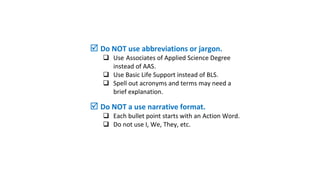
 Do NOT use abbreviations or jargon.
 Use Associates of Applied Science Degree
instead of AAS.
 Use Basic Life Support instead of BLS.
 Spell out acronyms and terms may need a
brief explanation.
 Do NOT a use narrative format.
 Each bullet point starts with an Action Word.
 Do not use I, We, They, etc.
Examples:
• GREAT EXAMPLE: Looking for a long term full time job where I can
apply my extensive skills and knowledge to the position for which I
am hired.
• TERRIBLE EXAMPLE: To leverage my 5+ years of client-facing
experience, public speaking skills, and expertise in the health care
industry into a public relations role with Happy Tree Educational
Animations.
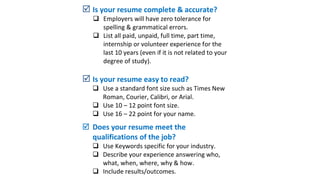
 Is your resume complete & accurate?
 Employers will have zero tolerance for
spelling & grammatical errors.
 List all paid, unpaid, full time, part time,
internship or volunteer experience for the
last 10 years (even if it is not related to your
degree of study).
 Is your resume easy to read?
 Use a standard font size such as Times New
Roman, Courier, Calibri, or Arial.
 Use 10 – 12 point font size.
 Use 16 – 22 point for your name.
 Does your resume meet the
qualifications of the job?
 Use Keywords specific for your industry.
 Describe your experience answering who,
what, when, where, why & how.
 Include results/outcomes.
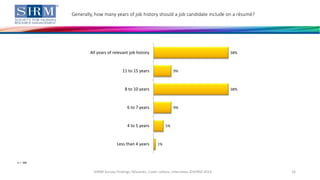
Generally, how many years of job history should a job candidate include on a résumé?
SHRM Survey Findings: Résumés, Cover Letters, Interviews ©SHRM 2014 16
n = 396
38%
9%
38%
9%
5%
1%
All years of relevant job history
11 to 15 years
8 to 10 years
6 to 7 years
4 to 5 years
Less than 4 years
 Is your resume complete & accurate?
 Employers will have zero tolerance for
spelling & grammatical errors.
 List all paid, unpaid, full time, part time,
internship or volunteer experience for the
last 10 years (even if it is not related to your
degree of study).
 Is your resume easy to read?
 Use a standard font size such as Times New
Roman, Courier, Calibri, or Arial.
 Use 10 – 12 point font size.
 Use 16 – 22 point for your name.
 Does your resume meet the
qualifications of the job?
 Use Keywords specific for your industry.
 Describe your experience answering who,
what, when, where, why & how.
 Include results/outcomes.
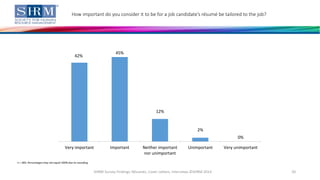
How important do you consider it to be for a job candidate’s résumé be tailored to the job?
SHRM Survey Findings: Résumés, Cover Letters, Interviews ©SHRM 2014 20
n = 383. Percentages may not equal 100% due to rounding.
42%
45%
12%
2%
0%
Very important Important Neither important
nor unimportant
Unimportant Very unimportant
 Does your resume meet the
qualifications of the job?
 Use Keywords specific for your industry.
 Describe your experience answering who,
what, when, where, why & how.
 Include results/outcomes.
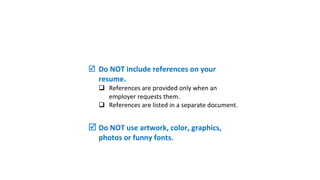
 Do NOT include references on your
resume.
 References are provided only when an
employer requests them.
 References are listed in a separate document.
 Do NOT use artwork, color, graphics,
photos or funny fonts.
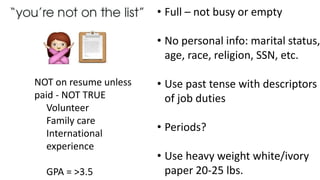
• Full – not busy or empty
• No personal info: marital status,
age, race, religion, SSN, etc.
• Use past tense with descriptors
of job duties
• Periods?
• Use heavy weight white/ivory
paper 20-25 lbs.
NOT on resume unless
paid - NOT TRUE
Volunteer
Family care
International
experience
GPA = >3.5
Live resume Critiques
• Use checklist
Or
• Resume Rubric

Live resume critique

  • 2.
    WHAT: A resumeis a short, concise document that states relevant information regarding your education, skills, experiences, accomplishments, and job-related interests. Your resume is a self- marketing tool (to get the IV) WHY: The purpose of the resume is to effectively communicate your assets in writing to an employer. Why Your Online Presence Will Replace Your Resume – Dan Schawbel, Contributor to Forbes Magazine
  • 7.
     Keep yourresume to one page in length.  Does your resume fill the page?  Only list qualifications relevant to the position you are seeking.  Is your resume visually appealing?  Are your margins no smaller than ½ inch and no larger than 1 inch?  Is your resume is easy to scan?  Does your resume use a consistent format?  Is your font size consistent?  Is your use of bold & italics consistent?  Did you use consistent spacing?
  • 10.
    format?  Is yourfont size consistent?  Is your use of bold & italics consistent?  Did you use consistent spacing?  Do NOT use abbreviations or jargon.  Use Associates of Applied Science Degree instead of AAS.  Use Basic Life Support instead of BLS.  Spell out acronyms and terms may need a brief explanation.  Do NOT a use narrative format.  Each bullet point starts with an Action Word.  Do not use I, We, They, etc.
  • 12.
    Examples: • GREAT EXAMPLE:Looking for a long term full time job where I can apply my extensive skills and knowledge to the position for which I am hired. • TERRIBLE EXAMPLE: To leverage my 5+ years of client-facing experience, public speaking skills, and expertise in the health care industry into a public relations role with Happy Tree Educational Animations.
  • 15.
     Is yourresume complete & accurate?  Employers will have zero tolerance for spelling & grammatical errors.  List all paid, unpaid, full time, part time, internship or volunteer experience for the last 10 years (even if it is not related to your degree of study).  Is your resume easy to read?  Use a standard font size such as Times New Roman, Courier, Calibri, or Arial.  Use 10 – 12 point font size.  Use 16 – 22 point for your name.  Does your resume meet the qualifications of the job?  Use Keywords specific for your industry.  Describe your experience answering who, what, when, where, why & how.  Include results/outcomes.
  • 16.
    Generally, how manyyears of job history should a job candidate include on a résumé? SHRM Survey Findings: Résumés, Cover Letters, Interviews ©SHRM 2014 16 n = 396 38% 9% 38% 9% 5% 1% All years of relevant job history 11 to 15 years 8 to 10 years 6 to 7 years 4 to 5 years Less than 4 years
  • 19.
     Is yourresume complete & accurate?  Employers will have zero tolerance for spelling & grammatical errors.  List all paid, unpaid, full time, part time, internship or volunteer experience for the last 10 years (even if it is not related to your degree of study).  Is your resume easy to read?  Use a standard font size such as Times New Roman, Courier, Calibri, or Arial.  Use 10 – 12 point font size.  Use 16 – 22 point for your name.  Does your resume meet the qualifications of the job?  Use Keywords specific for your industry.  Describe your experience answering who, what, when, where, why & how.  Include results/outcomes.
  • 20.
    How important doyou consider it to be for a job candidate’s résumé be tailored to the job? SHRM Survey Findings: Résumés, Cover Letters, Interviews ©SHRM 2014 20 n = 383. Percentages may not equal 100% due to rounding. 42% 45% 12% 2% 0% Very important Important Neither important nor unimportant Unimportant Very unimportant
  • 22.
     Does yourresume meet the qualifications of the job?  Use Keywords specific for your industry.  Describe your experience answering who, what, when, where, why & how.  Include results/outcomes.  Do NOT include references on your resume.  References are provided only when an employer requests them.  References are listed in a separate document.  Do NOT use artwork, color, graphics, photos or funny fonts.
  • 23.
    • Full –not busy or empty • No personal info: marital status, age, race, religion, SSN, etc. • Use past tense with descriptors of job duties • Periods? • Use heavy weight white/ivory paper 20-25 lbs. NOT on resume unless paid - NOT TRUE Volunteer Family care International experience GPA = >3.5
  • 27.
    Live resume Critiques •Use checklist Or • Resume Rubric

Editor's Notes

  • #2 Talk for days: Ideally only talk about what you don’t know… but so everyone is on the same page – rip through some basics 2 types of feedback Representative of industry My opinion
  • #3 The purpose: to get an interview Will online presence (such as LinkedIn) replace the resume? – Many seem to think so But the jury is still out – company’s still require them in the application process
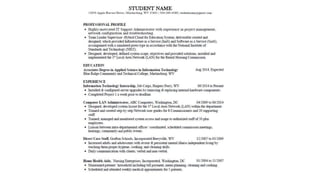
  • #4 Examples include: (NEXT SLIDE)
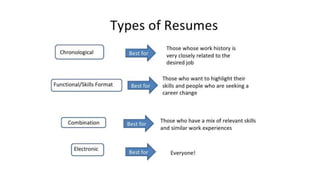
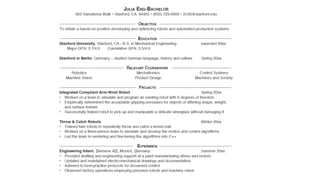
  • #5 Functional = Objective statement + Skills section
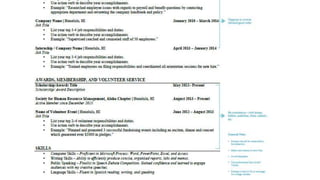
  • #6 Chrono = professional profile (nothing) + large experience section
  • #7 Click for links to both resources: BRCTC Resume Primer: http://www.blueridgectc.edu/wordpress/wp-content/uploads/2015/08/RESUME-PRIMER.pdf Resume for America Resume Builder: https://resumecompanion.com/resume-builder-edu-2/brctc/register
  • #8 1 Page 2 pages = executive, academic (graduate degree) SHRM study – Asked HR professional how long: most common answer was “as long as the applicant needs” How much info to put on - NOT everything Visually Applealing? EASILY SCANNABLE Another SHRM study – 78% look at resume for less than 5 min. Consistent formatting? EXP = EDUC
  • #9 Consistent formatting?
  • #11 Abbreviations: I hate this rule… but it’s the rule No narrative: Except in objective = fragment !!!!!!!!!!!!!EXAMPLE: what is BBA?!!!!!!!!!!!!!!!!!!!!!!!!!
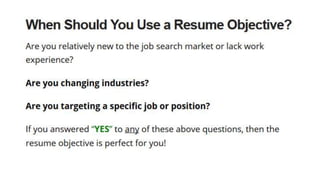
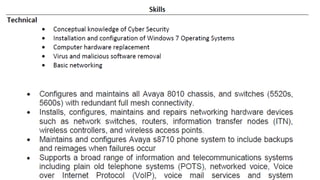
  • #13  Mistakes: Using the Same Objective For Every Job Application Being Too Vague Making It All About You Going On… And On… And On… Adding Absolutely No Value Quickly: 1) Who am I – what am I bringing to the table (unique) 2) How are you going to fulfill the needs of the company? This person’s skills section: Interpersonal client skills, public speaking skills, health care expertise EXAMPLE OF CYBER SKILLS SECTION….
  • #16 ***** LETS TALK ABOUT LISTING EXPERIENCE THAT IS NOT RELEVANT - How much work experience to include? (SLIDE)
  • #17 NOW…. HOW TO EXPLAIN WHAT YOU DID
  • #18 1…… 2…..3 Lets go over the example (slide)
  • #19 Back to the list
  • #20 Easy to read? good! Key words/Tailored? - How important is it to tailor your resume to the job?
  • #23 References: X = “references upon request” Color Boring and standard – so that HR can find what they need Ex: graphic design, performing arts,