What makes a GOOD Business Analyst Presented by Phil Rich Senior Business Analyst
The Fundamentals Analysis skills Logic skills Customer skills Tool skills Word UML BPMN
Analytical skills Logic skills Customer skills Tool skills Word UML BPMN Career Diversity Journalism (getting the story) Writing Interview skills Customer Service skills Negotiation skills My Fundamentals Body Language skills Psychological skills (personality profiling) Communication Skills Risk analysis skills Change Management skills Methodology Skills QA Skills Time and motion study skills JIT Analysis Skills (Just in time) Research Skills Audit Skills Mentoring Skills
If you can’t interview you can’t get the information If you can’t write you can’t communicate If you can’t write succinctly and explicitly your document will be of less quality – and worse will have less effect If you can’t write QUICKLY you’re already in trouble Journalism & Business Analysis
Journalism   & Business Analysis Interview skills Know who you are interviewing Either by personality or by position Interview Information recognition Developing an antennae for information Getting the story (the real one) Why hasn’t the problem been fixed before OR what has caused this new problem
Story Structuring Headline Lead 1 st  paragraph outline 2 nd  paragraph background Other paragraphs develop the story Final paragraph summarises the story Use OUTLINE mode Keep breaking down the headings until you can’t any more --- you just about have your text. Journalism & Business Analysis
General document Writing Use ACTIVE voice!!!!! Look out for watch words eg “Will”, “that” – any often used word Write STRONGLY Eg “It is believed due to unusual circumstances this situation has arisen because…” – change to “This situation has likely arisen due to…” Focus on the important wording KNOW YOUR AUDIENCE!!!!! Journalism & Business Analysis
Business Analysis Writing (Requirements) Waterfall the information Provide a complete background on the subject matter Break down the units of information to granular detail Use a waterfall approach to flowcharts Overview level (executive) Mid-Level (Management) Low-Level (Coal Face) Activity Diagrams to illustrate complexity Journalism & Business Analysis
Understanding the types of requirements User Requirements FPS Requirements SSS Requirements Does your CUSTOMER know the difference? Manage expectations Write a requirement with the TEST already understood Good requirements writing Measureable, testable, explicit, succinct, non-ambiguous Journalism & Business Analysis
How to learn journalism techniques Books on Journalism (the basics) Books on interviewing Writing magazines Learn Script Writing techniques These will teach story positioning in a given scene Active voice will be forced Learn Advertising copywriting Active and LEAN wording to get a message across DON’T be afraid to mix it up. Journalism & Business Analysis
Tips for editing your own work Unless your work has had time to go “cold”, then either: Get a person you respect to edit the work Edit the document yourself…. BACKWARDS! This stops you getting involved with the rhythm of the words Drone the words. Add NO inflection at all. Tips for writing (anything!!) Outline Mode Journalism & Business Analysis
Research is essential but retrieval is paramount Key word groupings – how you enter information is vital Wikipedia type approach (knowledge base) Thales Intelligence Tool London Bombings Using the information to identify gaps Researching & Business Analysis
Interviewing & Business Analysis Rapport – all important Rapport can be built easily just by observation Eg. Is the office all crowded in, allows a comment like “Boy, I thought my desk was crowded in – how do you guys cope with all the noise?” Expressing REAL sympathy is a valuable tool to establish rapport. If the person is difficult then understand why they are. Most of the time it is because they don't think they’ve been heard. To show they ARE being heard, start using their own words back at them in your questions.
Find the comfort zones Reflect their language eg lawyers tend to speak formally  helpdesk & IT combine IT terms into normal languages eg Interface (with people) Write EVERYTHING down that is said, even if you don’t think what’s been said is important. You’d be surprised where such information comes into it’s own later in a project. Listen for NUANCE!! Interviewing & Business Analysis
Body language & Business Analysis Security investigators (especially in retail) are trained in body language for a reason Look for the eye movements Watch body movements when discussing business functions or activities Discomfort can mean a political situation or lack of confidence in the picture A blocking movement can mean “Don’t go there” BUT body language MUST be read in clusters! How to learn –  Books (by Alan Pease) Lie to Me (TV series)
Profiling & Business Analysis Profiling is a valuable tool for a BA Learn the behavioural patterns Learn the cultural issues (multicultural users) Profile skill sets (Position Descriptions -> Reviews) Profile business units Profile Enterprise Utilise (or develop) the vision document Business Unit Enterprise Utilise (or develop) the strategy document Business Unit Enterprise
Just In Time To a Business Analyst At risk of rushed requirements Break up the workload into multi-phase To the end result Identify the low-hanging fruit – Phase 1 Identify the must haves – Phase 2 Identify the nice to haves – Phase 3 Identify the ideal world – Phase 4 JIT & Business Analysis
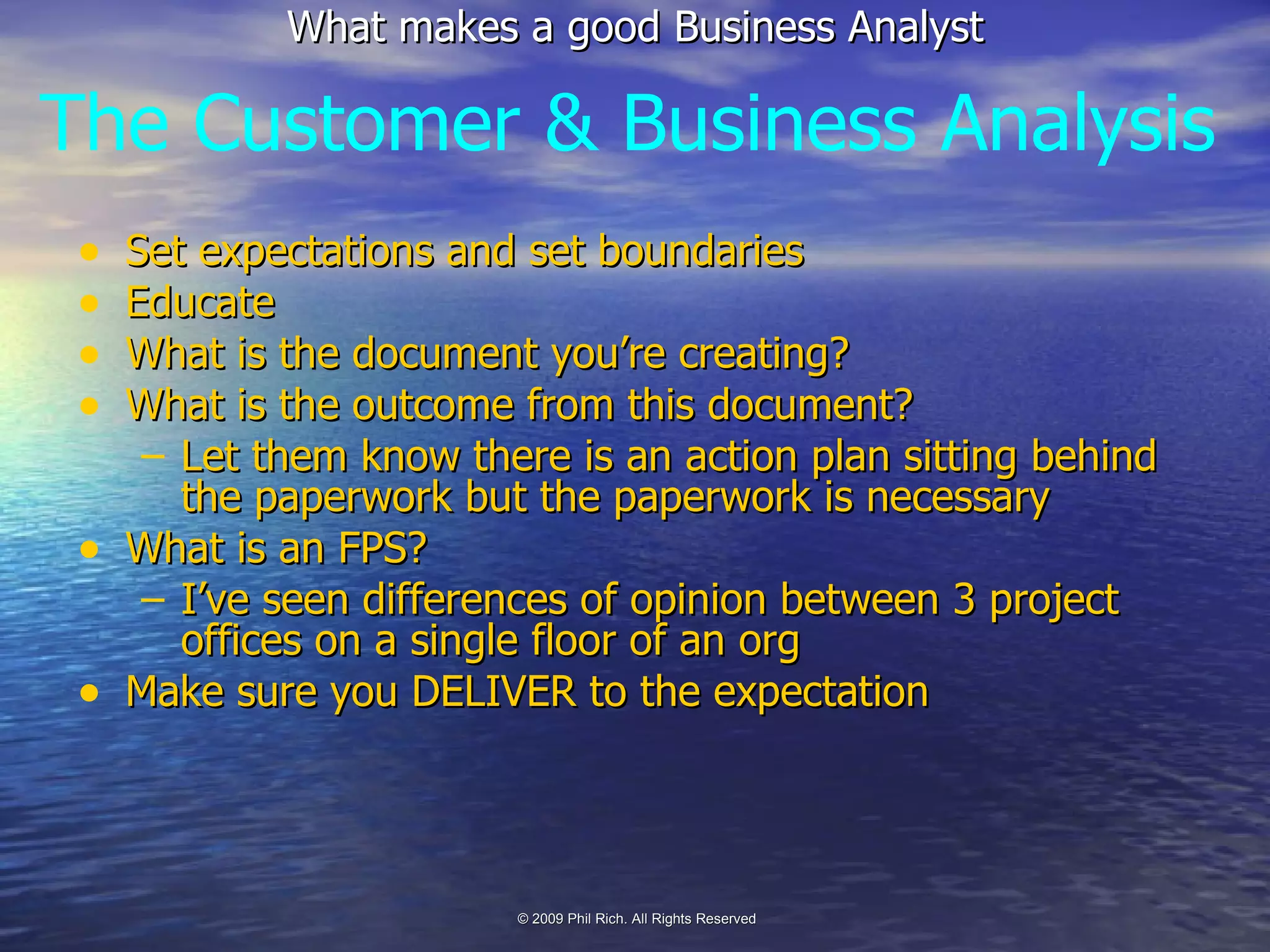
Set expectations and set boundaries Educate What is the document you’re creating? What is the outcome from this document? Let them know there is an action plan sitting behind the paperwork but the paperwork is necessary What is an FPS? I’ve seen differences of opinion between 3 project offices on a single floor of an org Make sure you DELIVER to the expectation The Customer & Business Analysis
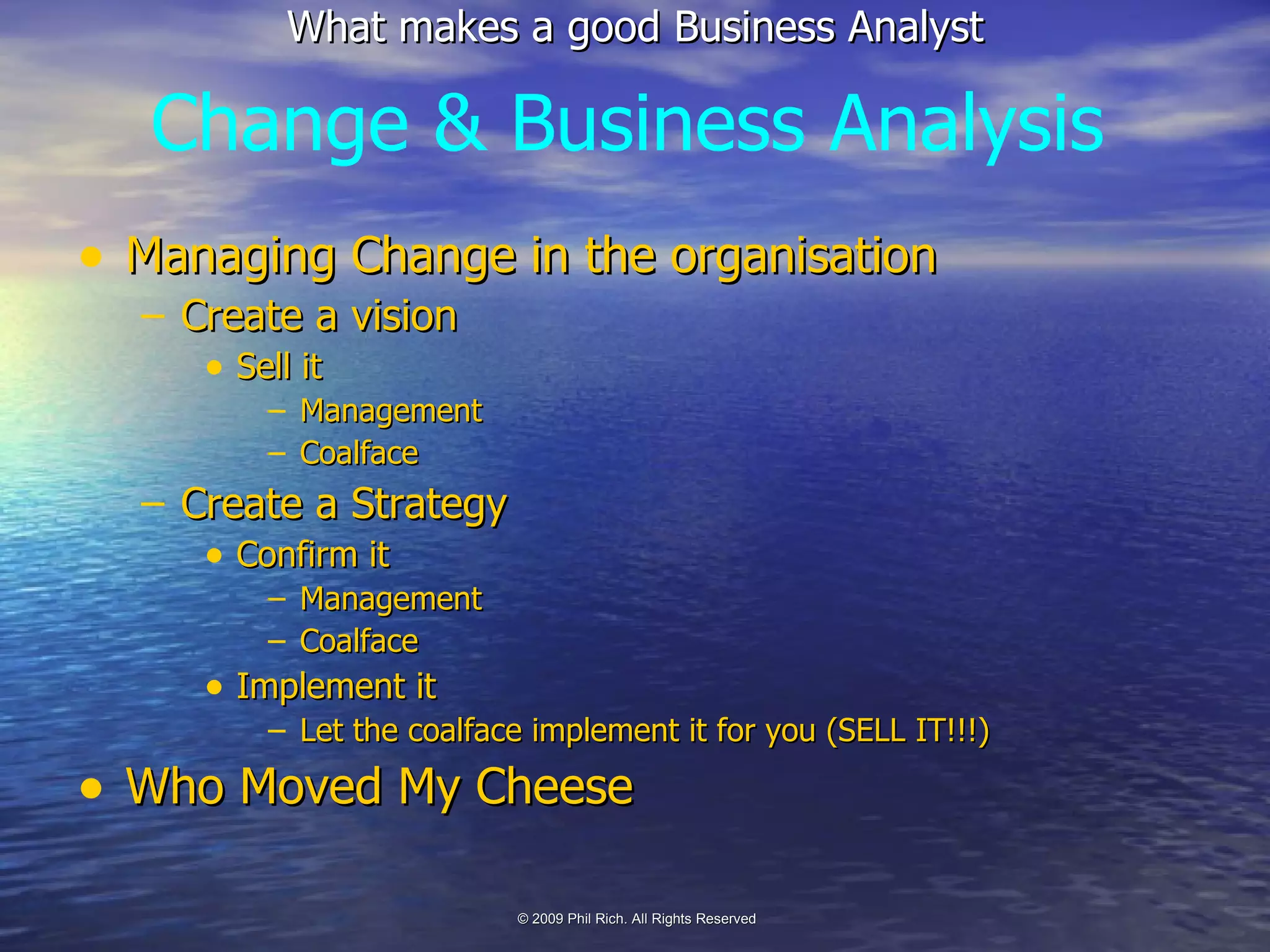
Managing Change in the organisation Create a vision Sell it Management Coalface Create a Strategy Confirm it Management Coalface Implement it Let the coalface implement it for you (SELL IT!!!) Who Moved My Cheese Change & Business Analysis
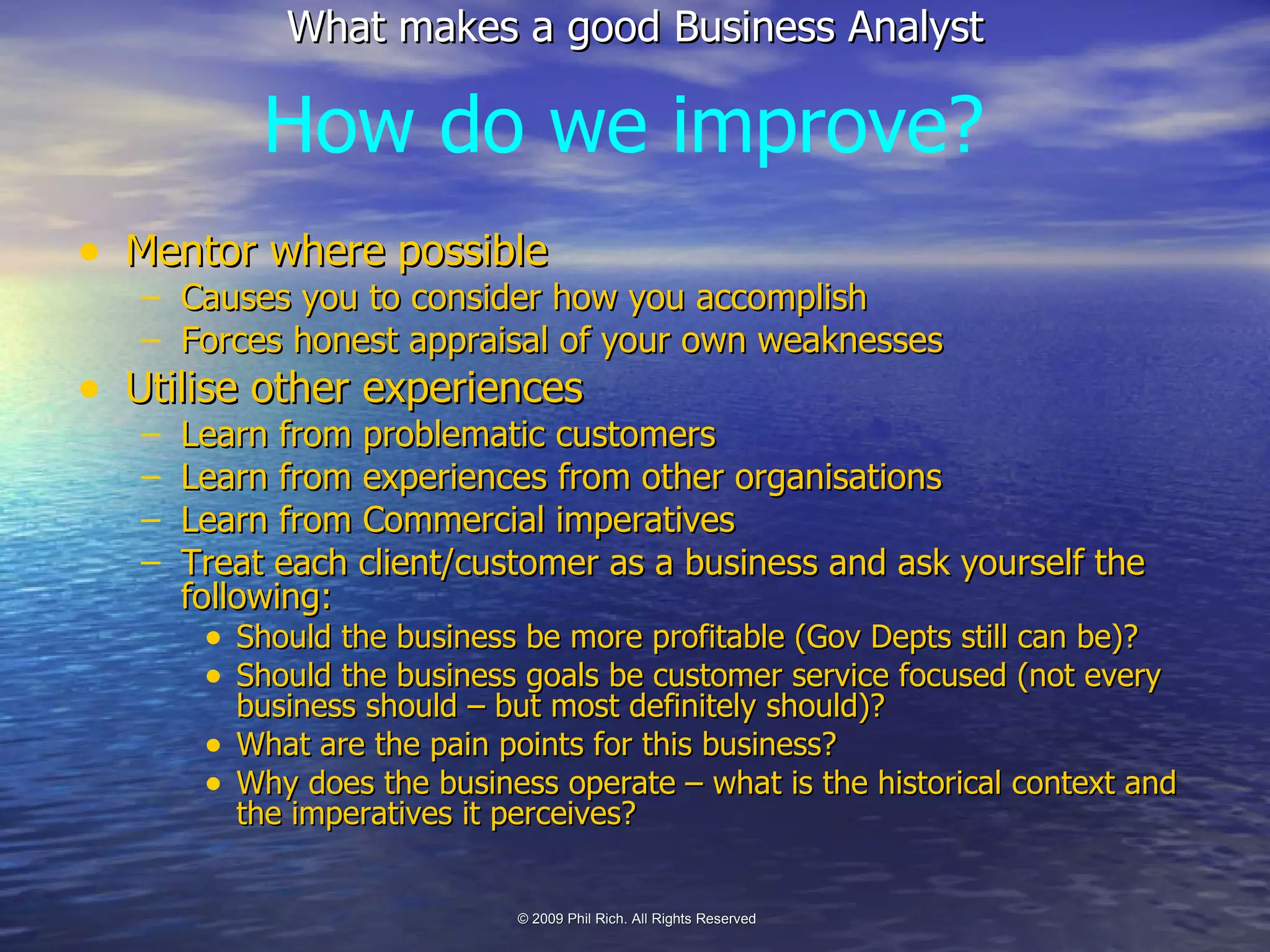
Mentor where possible Causes you to consider how you accomplish Forces honest appraisal of your own weaknesses Utilise other experiences Learn from problematic customers Learn from experiences from other organisations Learn from Commercial imperatives Treat each client/customer as a business and ask yourself the following: Should the business be more profitable (Gov Depts still can be)? Should the business goals be customer service focused (not every business should – but most definitely should)? What are the pain points for this business? Why does the business operate – what is the historical context and the imperatives it perceives? How do we improve?
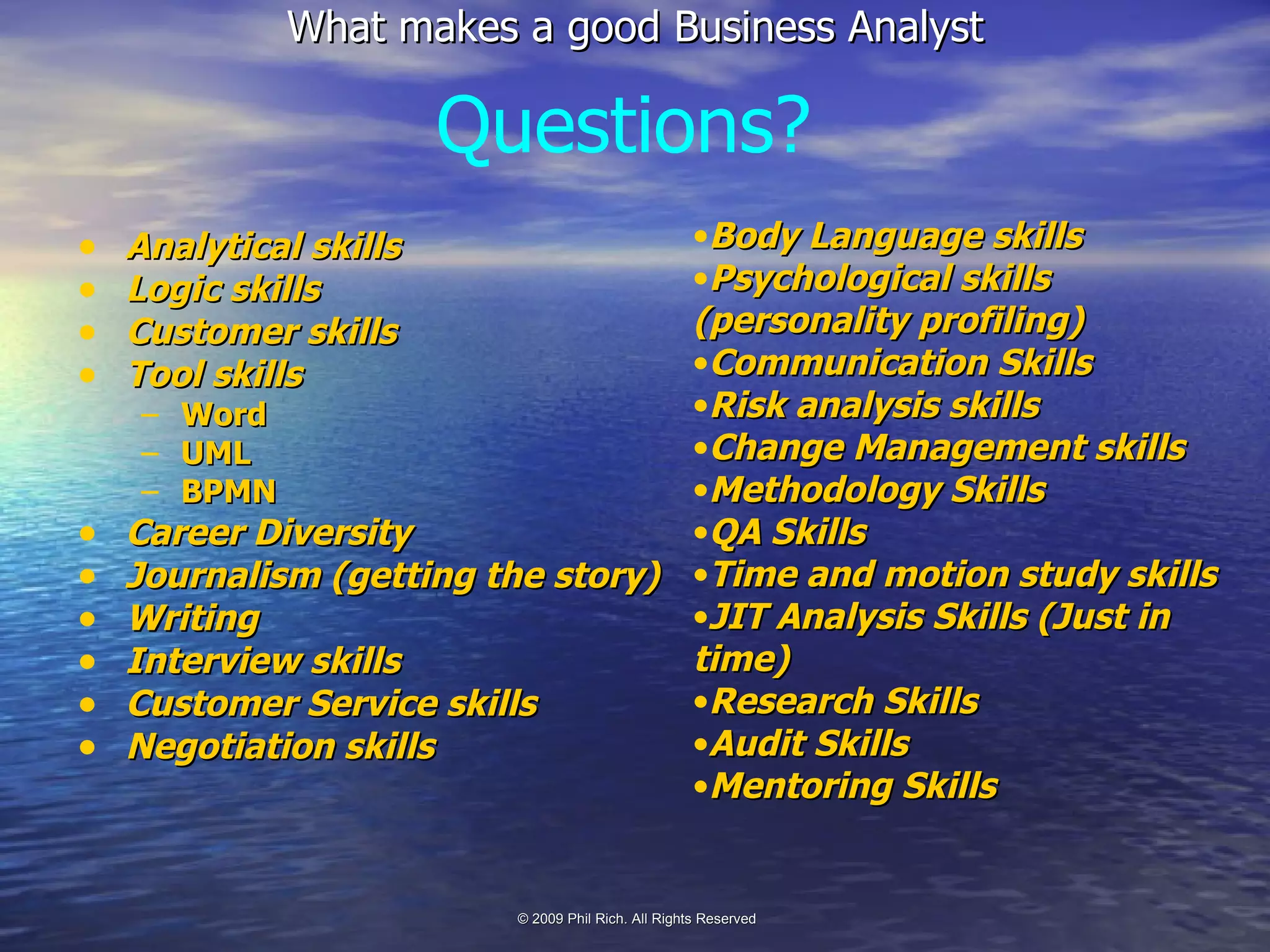
Analytical skills Logic skills Customer skills Tool skills Word UML BPMN Career Diversity Journalism (getting the story) Writing Interview skills Customer Service skills Negotiation skills Questions? Body Language skills Psychological skills (personality profiling) Communication Skills Risk analysis skills Change Management skills Methodology Skills QA Skills Time and motion study skills JIT Analysis Skills (Just in time) Research Skills Audit Skills Mentoring Skills

What Makes A Good Business Analyst

  • 1.
    What makes aGOOD Business Analyst Presented by Phil Rich Senior Business Analyst
  • 2.
    The Fundamentals Analysisskills Logic skills Customer skills Tool skills Word UML BPMN
  • 3.
    Analytical skills Logicskills Customer skills Tool skills Word UML BPMN Career Diversity Journalism (getting the story) Writing Interview skills Customer Service skills Negotiation skills My Fundamentals Body Language skills Psychological skills (personality profiling) Communication Skills Risk analysis skills Change Management skills Methodology Skills QA Skills Time and motion study skills JIT Analysis Skills (Just in time) Research Skills Audit Skills Mentoring Skills
  • 4.
    If you can’tinterview you can’t get the information If you can’t write you can’t communicate If you can’t write succinctly and explicitly your document will be of less quality – and worse will have less effect If you can’t write QUICKLY you’re already in trouble Journalism & Business Analysis
  • 5.
    Journalism & Business Analysis Interview skills Know who you are interviewing Either by personality or by position Interview Information recognition Developing an antennae for information Getting the story (the real one) Why hasn’t the problem been fixed before OR what has caused this new problem
  • 6.
    Story Structuring HeadlineLead 1 st paragraph outline 2 nd paragraph background Other paragraphs develop the story Final paragraph summarises the story Use OUTLINE mode Keep breaking down the headings until you can’t any more --- you just about have your text. Journalism & Business Analysis
  • 7.
    General document WritingUse ACTIVE voice!!!!! Look out for watch words eg “Will”, “that” – any often used word Write STRONGLY Eg “It is believed due to unusual circumstances this situation has arisen because…” – change to “This situation has likely arisen due to…” Focus on the important wording KNOW YOUR AUDIENCE!!!!! Journalism & Business Analysis
  • 8.
    Business Analysis Writing(Requirements) Waterfall the information Provide a complete background on the subject matter Break down the units of information to granular detail Use a waterfall approach to flowcharts Overview level (executive) Mid-Level (Management) Low-Level (Coal Face) Activity Diagrams to illustrate complexity Journalism & Business Analysis
  • 9.
    Understanding the typesof requirements User Requirements FPS Requirements SSS Requirements Does your CUSTOMER know the difference? Manage expectations Write a requirement with the TEST already understood Good requirements writing Measureable, testable, explicit, succinct, non-ambiguous Journalism & Business Analysis
  • 10.
    How to learnjournalism techniques Books on Journalism (the basics) Books on interviewing Writing magazines Learn Script Writing techniques These will teach story positioning in a given scene Active voice will be forced Learn Advertising copywriting Active and LEAN wording to get a message across DON’T be afraid to mix it up. Journalism & Business Analysis
  • 11.
    Tips for editingyour own work Unless your work has had time to go “cold”, then either: Get a person you respect to edit the work Edit the document yourself…. BACKWARDS! This stops you getting involved with the rhythm of the words Drone the words. Add NO inflection at all. Tips for writing (anything!!) Outline Mode Journalism & Business Analysis
  • 12.
    Research is essentialbut retrieval is paramount Key word groupings – how you enter information is vital Wikipedia type approach (knowledge base) Thales Intelligence Tool London Bombings Using the information to identify gaps Researching & Business Analysis
  • 13.
    Interviewing & BusinessAnalysis Rapport – all important Rapport can be built easily just by observation Eg. Is the office all crowded in, allows a comment like “Boy, I thought my desk was crowded in – how do you guys cope with all the noise?” Expressing REAL sympathy is a valuable tool to establish rapport. If the person is difficult then understand why they are. Most of the time it is because they don't think they’ve been heard. To show they ARE being heard, start using their own words back at them in your questions.
  • 14.
    Find the comfortzones Reflect their language eg lawyers tend to speak formally helpdesk & IT combine IT terms into normal languages eg Interface (with people) Write EVERYTHING down that is said, even if you don’t think what’s been said is important. You’d be surprised where such information comes into it’s own later in a project. Listen for NUANCE!! Interviewing & Business Analysis
  • 15.
    Body language &Business Analysis Security investigators (especially in retail) are trained in body language for a reason Look for the eye movements Watch body movements when discussing business functions or activities Discomfort can mean a political situation or lack of confidence in the picture A blocking movement can mean “Don’t go there” BUT body language MUST be read in clusters! How to learn – Books (by Alan Pease) Lie to Me (TV series)
  • 16.
    Profiling & BusinessAnalysis Profiling is a valuable tool for a BA Learn the behavioural patterns Learn the cultural issues (multicultural users) Profile skill sets (Position Descriptions -> Reviews) Profile business units Profile Enterprise Utilise (or develop) the vision document Business Unit Enterprise Utilise (or develop) the strategy document Business Unit Enterprise
  • 17.
    Just In TimeTo a Business Analyst At risk of rushed requirements Break up the workload into multi-phase To the end result Identify the low-hanging fruit – Phase 1 Identify the must haves – Phase 2 Identify the nice to haves – Phase 3 Identify the ideal world – Phase 4 JIT & Business Analysis
  • 18.
    Set expectations andset boundaries Educate What is the document you’re creating? What is the outcome from this document? Let them know there is an action plan sitting behind the paperwork but the paperwork is necessary What is an FPS? I’ve seen differences of opinion between 3 project offices on a single floor of an org Make sure you DELIVER to the expectation The Customer & Business Analysis
  • 19.
    Managing Change inthe organisation Create a vision Sell it Management Coalface Create a Strategy Confirm it Management Coalface Implement it Let the coalface implement it for you (SELL IT!!!) Who Moved My Cheese Change & Business Analysis
  • 20.
    Mentor where possibleCauses you to consider how you accomplish Forces honest appraisal of your own weaknesses Utilise other experiences Learn from problematic customers Learn from experiences from other organisations Learn from Commercial imperatives Treat each client/customer as a business and ask yourself the following: Should the business be more profitable (Gov Depts still can be)? Should the business goals be customer service focused (not every business should – but most definitely should)? What are the pain points for this business? Why does the business operate – what is the historical context and the imperatives it perceives? How do we improve?
  • 21.
    Analytical skills Logicskills Customer skills Tool skills Word UML BPMN Career Diversity Journalism (getting the story) Writing Interview skills Customer Service skills Negotiation skills Questions? Body Language skills Psychological skills (personality profiling) Communication Skills Risk analysis skills Change Management skills Methodology Skills QA Skills Time and motion study skills JIT Analysis Skills (Just in time) Research Skills Audit Skills Mentoring Skills