Legatum Center
Seminar and Workshop
Understand YOUR customer in
developing countries
October 30, 2015
Elaine Chen
Today’s agenda
• What do we need to understand?
• How do we build this knowledge?
2
Part 1:
What do we need to understand?
3
4
6
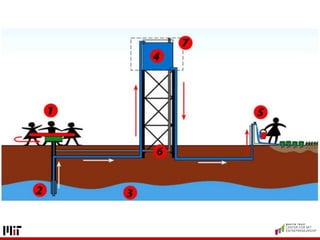
What happened?
8
Points to ponder
• What is the problem to be solved?
• What are some possible solutions?
• Who should have been involved in decision
making?
• What else should they have thought about?
• How could they have built knowledge about
all of the above?
9
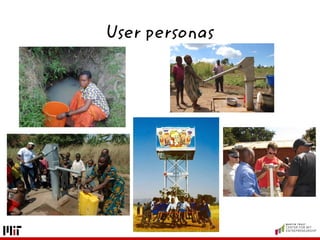
User personas
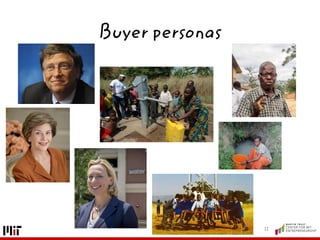
Buyer personas
11
1st step to understanding your customer:
Map the decision making unit
• Economic buyer
• Champions
• Influencers
• Veto powers
• End users
12
In class exercise
• Based on what you know, map your Decision
Making Unit (DMU)
• Make a list of hypotheses to be validated in
the field
• Write a hypothetical customer profile for one
of the people in your DMU. You will be playing
this person in a simulation exercise in the
second half of the seminar.
13
Sharing!
14
Part 2:
How do we build this knowledge?
15
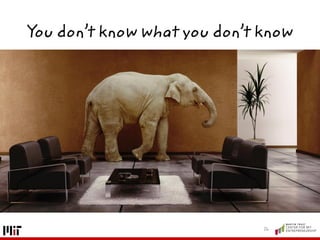
You don’t know what you don’t know
16
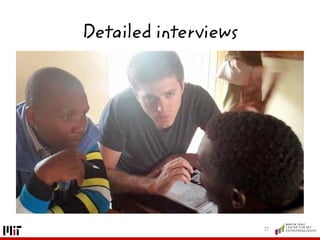
Detailed interviews
17
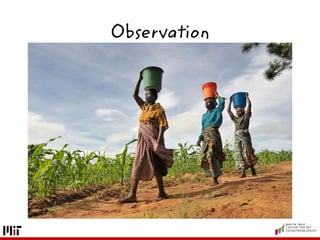
Observation
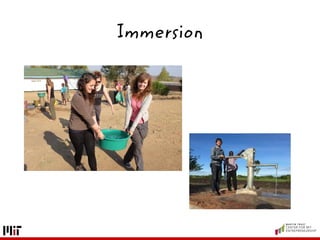
Immersion
On personas and interviews
20
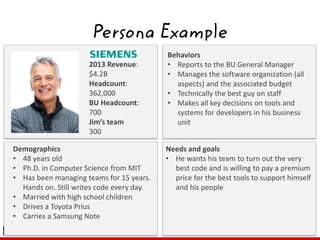
Persona Example
2013 Revenue:
$4.2B
Headcount:
362,000
BU Headcount:
700
Jim’s team
300
Behaviors
• Reports to the BU General Manager
• Manages the software organization (all
aspects) and the associated budget
• Technically the best guy on staff
• Makes all key decisions on tools and
systems for developers in his business
unit
Demographics
• 48 years old
• Ph.D. in Computer Science from MIT
• Has been managing teams for 15 years.
Hands on. Still writes code every day.
• Married with high school children
• Drives a Toyota Prius
• Carries a Samsung Note
Needs and goals
• He wants his team to turn out the very
best code and is willing to pay a premium
price for the best tools to support himself
and his people
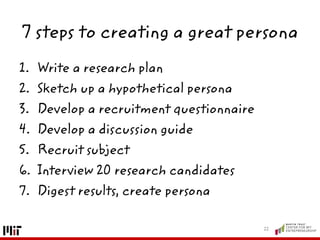
7 steps to creating a great persona
1. Write a research plan
2. Sketch up a hypothetical persona
3. Develop a recruitment questionnaire
4. Develop a discussion guide
5. Recruit subject
6. Interview 20 research candidates
7. Digest results, create persona
22
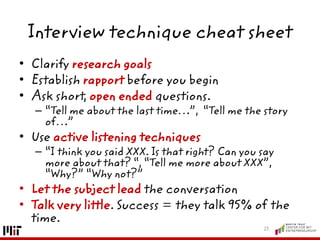
Interview technique cheat sheet
• Clarify research goals
• Establish rapport before you begin
• Ask short, open ended questions.
– “Tell me about the last time…”, “Tell me the story
of…”
• Use active listening techniques
– “I think you said XXX. Is that right? Can you say
more about that? “, “Tell me more about XXX”,
“Why?” “Why not?”
• Let the subject lead the conversation
• Talk very little. Success = they talk 95% of the
time.
23
Simulation
24
Sharing!
25
PMR for Procter and Gamble
• Long (months)
• Expensive (Millions of dollars not uncommon)
• 20-30 long sessions per market segment
• Multiple segments
• Multiple cities / multiple countries
• Subjects are paid an incentive for their time
• Often involves external research firms
=> High quality insights at a high price
26
PMR for student projects
• Better be fast! (days)
• Entirely free
• 20-30 short sessions per research project
• Start with 1 segment
• Remove coverage via video chat
• Subjects are unpaid
• DIY
=> Quick and dirty insights to cheaply iterate to
the right problems and right solutions
27
PMR for social enterprises
• Do as much prep work as possible remotely, via
skype interviews, google search, reading up on
reports, interviewing people who know people
who know people…
• Then go there and live there for a while and
practice ethnography for marketing.
=> You need to immerse yourself in the target
community to really understand how things work
and figure out what you don’t know.
28
Summary
• Primary market research is a science and an art
• Primary market research is learnable
• Primary market research saves time & $ - do it!
• Plan your research before talking to anybody
• Talk to humans face to face if possible
•Get out of the building!
Handouts
• “Talking to Humans” E-book
• PMR Primer
• Templates and samples
– Research protocol template
– Sample discussion guide
– Sample recruitment questionnaire
– Sample photo release form
– Interview notes template
– Persona template
– Example persona project – “The Science of Clean”
(15.S16, 2H 2012)
30
End
Questions?
31

Understand your customer in developing countries

  • 1.
    Legatum Center Seminar andWorkshop Understand YOUR customer in developing countries October 30, 2015 Elaine Chen
  • 2.
    Today’s agenda • Whatdo we need to understand? • How do we build this knowledge? 2
  • 3.
    Part 1: What dowe need to understand? 3
  • 4.
  • 6.
  • 8.
  • 9.
    Points to ponder •What is the problem to be solved? • What are some possible solutions? • Who should have been involved in decision making? • What else should they have thought about? • How could they have built knowledge about all of the above? 9
  • 10.
  • 11.
  • 12.
    1st step tounderstanding your customer: Map the decision making unit • Economic buyer • Champions • Influencers • Veto powers • End users 12
  • 13.
    In class exercise •Based on what you know, map your Decision Making Unit (DMU) • Make a list of hypotheses to be validated in the field • Write a hypothetical customer profile for one of the people in your DMU. You will be playing this person in a simulation exercise in the second half of the seminar. 13
  • 14.
  • 15.
    Part 2: How dowe build this knowledge? 15
  • 16.
    You don’t knowwhat you don’t know 16
  • 17.
  • 18.
  • 19.
  • 20.
    On personas andinterviews 20
  • 21.
    Persona Example 2013 Revenue: $4.2B Headcount: 362,000 BUHeadcount: 700 Jim’s team 300 Behaviors • Reports to the BU General Manager • Manages the software organization (all aspects) and the associated budget • Technically the best guy on staff • Makes all key decisions on tools and systems for developers in his business unit Demographics • 48 years old • Ph.D. in Computer Science from MIT • Has been managing teams for 15 years. Hands on. Still writes code every day. • Married with high school children • Drives a Toyota Prius • Carries a Samsung Note Needs and goals • He wants his team to turn out the very best code and is willing to pay a premium price for the best tools to support himself and his people
  • 22.
    7 steps tocreating a great persona 1. Write a research plan 2. Sketch up a hypothetical persona 3. Develop a recruitment questionnaire 4. Develop a discussion guide 5. Recruit subject 6. Interview 20 research candidates 7. Digest results, create persona 22
  • 23.
    Interview technique cheatsheet • Clarify research goals • Establish rapport before you begin • Ask short, open ended questions. – “Tell me about the last time…”, “Tell me the story of…” • Use active listening techniques – “I think you said XXX. Is that right? Can you say more about that? “, “Tell me more about XXX”, “Why?” “Why not?” • Let the subject lead the conversation • Talk very little. Success = they talk 95% of the time. 23
  • 24.
  • 25.
  • 26.
    PMR for Procterand Gamble • Long (months) • Expensive (Millions of dollars not uncommon) • 20-30 long sessions per market segment • Multiple segments • Multiple cities / multiple countries • Subjects are paid an incentive for their time • Often involves external research firms => High quality insights at a high price 26
  • 27.
    PMR for studentprojects • Better be fast! (days) • Entirely free • 20-30 short sessions per research project • Start with 1 segment • Remove coverage via video chat • Subjects are unpaid • DIY => Quick and dirty insights to cheaply iterate to the right problems and right solutions 27
  • 28.
    PMR for socialenterprises • Do as much prep work as possible remotely, via skype interviews, google search, reading up on reports, interviewing people who know people who know people… • Then go there and live there for a while and practice ethnography for marketing. => You need to immerse yourself in the target community to really understand how things work and figure out what you don’t know. 28
  • 29.
    Summary • Primary marketresearch is a science and an art • Primary market research is learnable • Primary market research saves time & $ - do it! • Plan your research before talking to anybody • Talk to humans face to face if possible •Get out of the building!
  • 30.
    Handouts • “Talking toHumans” E-book • PMR Primer • Templates and samples – Research protocol template – Sample discussion guide – Sample recruitment questionnaire – Sample photo release form – Interview notes template – Persona template – Example persona project – “The Science of Clean” (15.S16, 2H 2012) 30
  • 31.