NEXT-GEN SECURITY OPERATIONS CENTER
Group 12​
Simbarashe Musaka 12200300002074​
Hriday Shankar Nath 12200300002041​
Pranjal Goel 12200300002004​
Anvitha Muthabathula 12200300002026​
Hemil Ujawala 122003000020261
NEXT-GEN INTELLIGENT SOC
ď‚„ Building Next-gen Intelligent SOC
ď‚„ Before starting to build a Next-gen Intelligent SOC (Security Operations
Center)
ď‚„ What is a SOC?
ď‚„ SOC (Security Operations Center) is the central unit of an organization
and is responsible for monitoring and detecting the security posture of
the organization.
 Traditional SOC is where the organizations’ security posture detection is
based on analyst’s skills and time. Also, SOC is limited to traditional SIEM
(Security Information & Event Management) tools, threat feeds and
limited/critical assets in monitoring scope.
NEXT GEN INTELLIGENT SECURITY
OPERATIONS CENTRE CONT….
ď‚„In a Next Gen Intelligent SOC, monitoring
extends beyond critical assets to
organization’s whole assets, including cloud
assets, mobile, end user machines, CCTV,
door access, WIFI etc. This is because
attackers are becoming more sophisticated
in their methods and the tools that are
used to attack.
NEXT GEN INTELLIGENT SOC
REQUIREMENTS
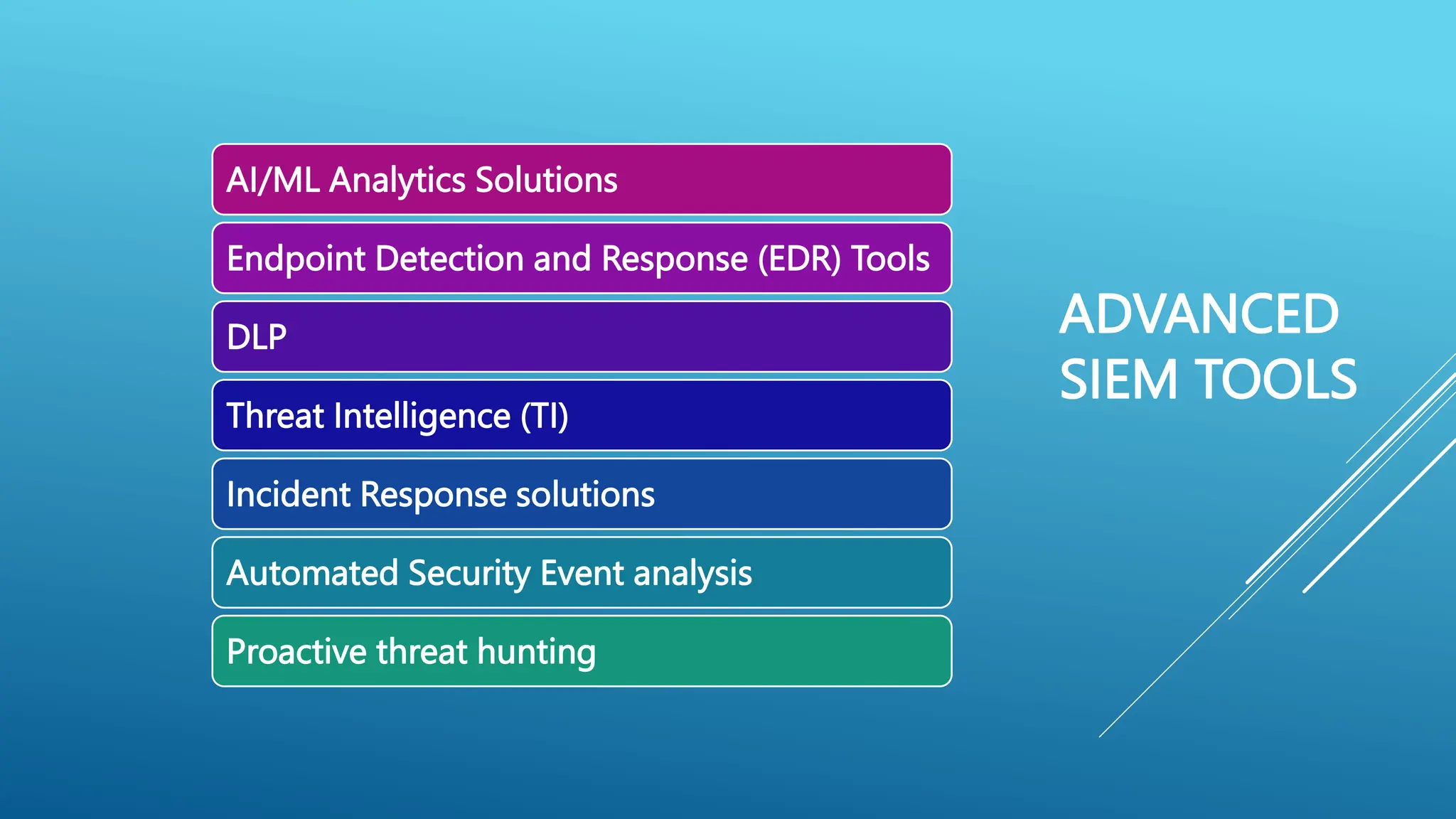
ADVANCED
SIEM TOOLS
AI/ML Analytics Solutions
Endpoint Detection and Response (EDR) Tools
DLP
Threat Intelligence (TI)
Incident Response solutions
Automated Security Event analysis
Proactive threat hunting
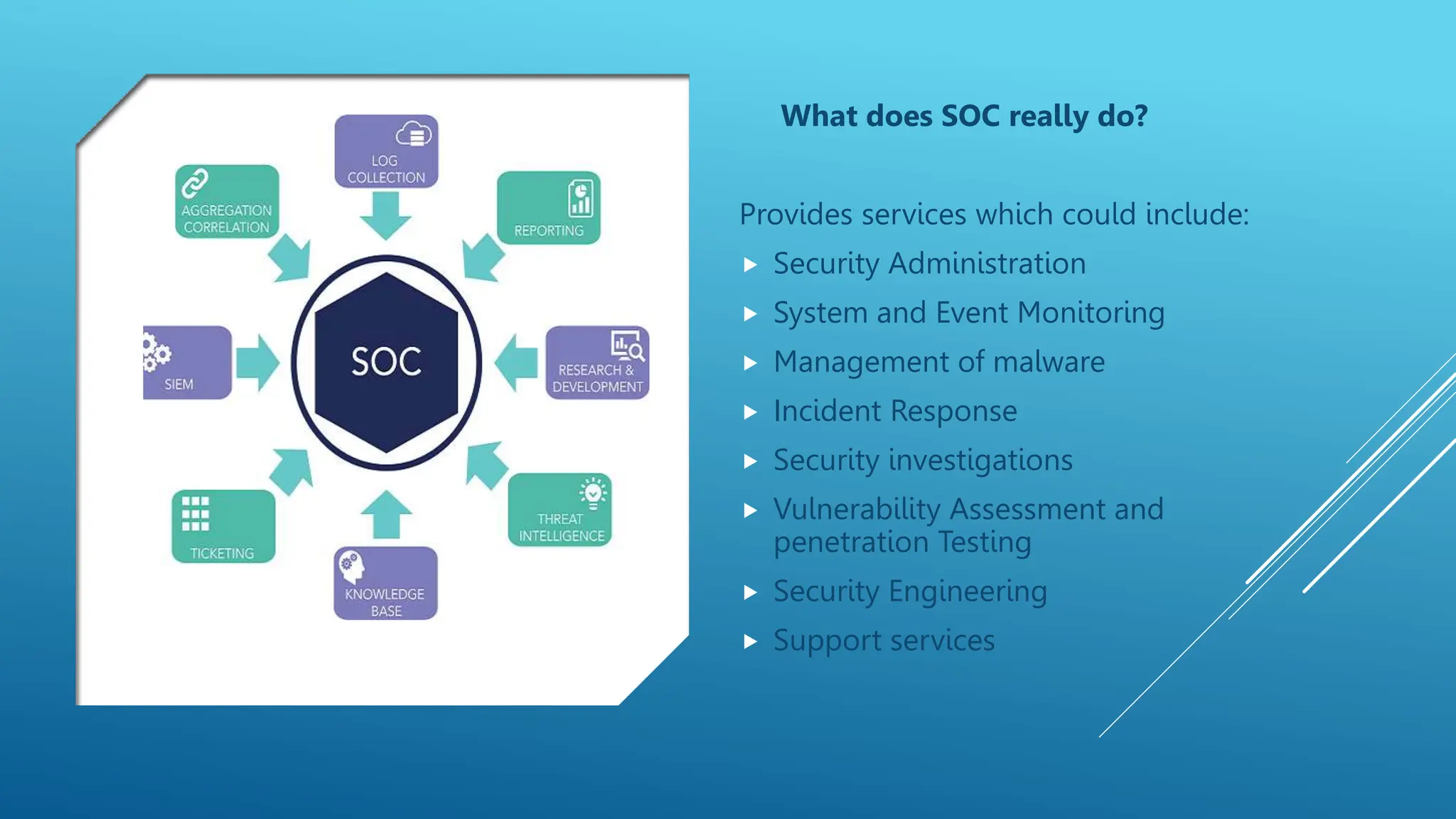
What does SOC really do?
Provides services which could include:
ď‚„ Security Administration
ď‚„ System and Event Monitoring
ď‚„ Management of malware
ď‚„ Incident Response
ď‚„ Security investigations
ď‚„ Vulnerability Assessment and
penetration Testing
ď‚„ Security Engineering
ď‚„ Support services
5 KEY ELEMENTS OF THE NEXT-GEN
SECURITY OPERATIONS CENTER
1. Cloud-based analytics and operations are essential
2. Managed services can take pressure off staff
3. Open architectures and layered analytics bring big picture to life
4. Automation and orchestration are key
5. Machine learning boosts threat hunting and investigations
1. CLOUD-
BASED
ANALYTICS
AND
OPERATIONS
ARE ESSENTIAL
ď‚„According to ESG's survey, 82% of organizations are
committed to moving the bulk of their workloads and
applications to the cloud. On-premises security information and
event management (SIEM) and other analytic tools alone will
not be sufficient to monitor and analyze cloud workloads.
Increasingly, companies are going to need to supplement or
replace on-premises tools with cloud-based products and
services. The cloud offers massive processing capabilities and
storage scaled to meet enterprise requirements. The attractive
pricing models and the opportunity to eliminate operational
overhead associated with on-premises technology are two
other factors that make cloud-based security technologies
attractive, the report states.
Thirty-eight percent of SOCs already use public cloud analytics
and operations tools, and 44% don't mind using it in a hybrid
environment. Over the relatively short term, a high-percentage
of organizations will “lift and shift” on-premises tools to the
cloud, replace on-premises tools with cloud-based
alternatives, or combine on-premises SOC technologies with
additional cloud-based tools. One in three organizations are
currently using their on-premises SIEM to monitor and analyze
cloud workloads.
The primary use cases for cloud security analytics include real-
time threat detection and response, risk management
monitoring and analysis, and threat intelligence.
2. MANAGED
SERVICES CAN
TAKE PRESSURE
OFF STAFF
ď‚„Managed security analytics and operations services
deliver a range of capabilities, including around-the-clock
threat monitoring of networks, endpoints, and
applications; incident detection and response; SIEM-to-
security orchestration, automation and response (SOAR)
integration; and compliance reporting.
ď‚„According to research firm Markets and Markets, the
market for managed SOC services will grow from around
$372 million in 2019 to $1.1 billion by 2024. Banking,
financial services companies, and insurance firms will be
the biggest adopters of managed SOC services, according
to the research firm.
About 75% of the organizations in the ESG survey claimed
that their security operations capabilities are being
undermined by a lack of available personnel, and 70% said
it was either difficult or extremely difficult to find and hire
qualified SOC staff.
To address the gap, many organizations are using managed
SOC services providers. Nearly three-quarters
(74%) already use such services, and more than nine in 10
organizations (91%) plan on ramping up the use of
managed security analytics services over the next 18
months.
3. OPEN
ARCHITECTURES
AND LAYERED
ANALYTICS
BRING BIG
PICTURE TO LIFE
ď‚„To improve operational and security efficiencies,
SOCs will require a next-generation SIEM or a
common security analytics and operations platform
architecture (SOAPA) to integrate data from multiple
security tools. SOCs will need an open architecture
and layered SIEM, user and entity behavior analytics
(UEBA), and SOAR capabilities. The data
management part, the analytics component, and the
data pipelining functions will all need to be
separate, said Jon Oltsik, an analyst at ESG and
author of the new report.
To be effective, next-gen SIEM platforms will require
a unified interface, or mission control, that will bring
together data from layered analytics tools so
analysts won't have to toggle from one interface to
another to see what the logs or the network is telling
them, Oltsik said. Thirty-six percent of organizations
in ESG's survey are actively working on enabling
such integration; another 48% are somewhat active
but don't consider it to be one of their top priorities
yet.
ď‚„Enterprises that have automated security processes
have reported increased SOC workflow performance
because staff can spend more time addressing
problems, the report said.
ESG's survey showed that 27% of organizations have
already extensively automated key security analytics
and operations capabilities, while another 38% have
done so on a more limited basis. Eighteen percent are
currently piloting an SOC process automation and
orchestration project, 7% plan on doing so in the near
future, and 6% plan to to do so over a slightly longer-
term.
The top use case for process automation is the
integration of security and IT operations capabilities,
with 35% of survey respondents saying that was their
immediate priority. Other use cases include enabling
better collaboration between security and operations
teams (34%) and automation of incident remediation
tasks (29%).
4. AUTOMATION
AND
ORCHESTRATION
ARE KEY
ď‚„As data volumes and security alerts increase, machine-
learning (ML) tools will become key to effective threat
detection and response.
ML-powered security tools are designed to help
organizations spot malicious activity by pinpointing
deviations from normal network or application behavior.
They come in two flavors—supervised and unsupervised ML.
A supervised tool uses existing datasets to "learn" what
normal behavior looks like so teams can detect and alert on
variations from the norm. Unsupervised tools use algorithms
to study network traffic and identify what normal behavior
looks like so it can spot deviations.
Many forward-leaning SOCs have already begun using ML-
based tools to bolster investigations and to improve their
ability to detect and respond to threats. ESG's survey showed
that more than half (52%) are already extensively using ML or
using it on a somewhat more limited basis. Twenty percent
are piloting ML projects, while another 18% are planning to
deploy or are interested in deploying ML for threat detection
and response.
According to the ESG survey, interest in ML primarily
stems from a desire to improve organizations' ability to
detect advanced threats (37%), to accelerate investigation
(34%), and to improve their ability to identify overall cyber
risk (34%).
5. MACHINE
LEARNING
BOOSTS THREAT
HUNTING AND
INVESTIGATIONS

SOC Analysis

  • 1.
    NEXT-GEN SECURITY OPERATIONSCENTER Group 12​ Simbarashe Musaka 12200300002074​ Hriday Shankar Nath 12200300002041​ Pranjal Goel 12200300002004​ Anvitha Muthabathula 12200300002026​ Hemil Ujawala 122003000020261
  • 2.
    NEXT-GEN INTELLIGENT SOC Building Next-gen Intelligent SOC  Before starting to build a Next-gen Intelligent SOC (Security Operations Center)  What is a SOC?  SOC (Security Operations Center) is the central unit of an organization and is responsible for monitoring and detecting the security posture of the organization.  Traditional SOC is where the organizations’ security posture detection is based on analyst’s skills and time. Also, SOC is limited to traditional SIEM (Security Information & Event Management) tools, threat feeds and limited/critical assets in monitoring scope.
  • 3.
    NEXT GEN INTELLIGENTSECURITY OPERATIONS CENTRE CONT…. In a Next Gen Intelligent SOC, monitoring extends beyond critical assets to organization’s whole assets, including cloud assets, mobile, end user machines, CCTV, door access, WIFI etc. This is because attackers are becoming more sophisticated in their methods and the tools that are used to attack.
  • 4.
    NEXT GEN INTELLIGENTSOC REQUIREMENTS ADVANCED SIEM TOOLS AI/ML Analytics Solutions Endpoint Detection and Response (EDR) Tools DLP Threat Intelligence (TI) Incident Response solutions Automated Security Event analysis Proactive threat hunting
  • 5.
    What does SOCreally do? Provides services which could include: ď‚„ Security Administration ď‚„ System and Event Monitoring ď‚„ Management of malware ď‚„ Incident Response ď‚„ Security investigations ď‚„ Vulnerability Assessment and penetration Testing ď‚„ Security Engineering ď‚„ Support services
  • 6.
    5 KEY ELEMENTSOF THE NEXT-GEN SECURITY OPERATIONS CENTER 1. Cloud-based analytics and operations are essential 2. Managed services can take pressure off staff 3. Open architectures and layered analytics bring big picture to life 4. Automation and orchestration are key 5. Machine learning boosts threat hunting and investigations
  • 7.
    1. CLOUD- BASED ANALYTICS AND OPERATIONS ARE ESSENTIAL Accordingto ESG's survey, 82% of organizations are committed to moving the bulk of their workloads and applications to the cloud. On-premises security information and event management (SIEM) and other analytic tools alone will not be sufficient to monitor and analyze cloud workloads. Increasingly, companies are going to need to supplement or replace on-premises tools with cloud-based products and services. The cloud offers massive processing capabilities and storage scaled to meet enterprise requirements. The attractive pricing models and the opportunity to eliminate operational overhead associated with on-premises technology are two other factors that make cloud-based security technologies attractive, the report states. Thirty-eight percent of SOCs already use public cloud analytics and operations tools, and 44% don't mind using it in a hybrid environment. Over the relatively short term, a high-percentage of organizations will “lift and shift” on-premises tools to the cloud, replace on-premises tools with cloud-based alternatives, or combine on-premises SOC technologies with additional cloud-based tools. One in three organizations are currently using their on-premises SIEM to monitor and analyze cloud workloads. The primary use cases for cloud security analytics include real- time threat detection and response, risk management monitoring and analysis, and threat intelligence.
  • 8.
    2. MANAGED SERVICES CAN TAKEPRESSURE OFF STAFF ď‚„Managed security analytics and operations services deliver a range of capabilities, including around-the-clock threat monitoring of networks, endpoints, and applications; incident detection and response; SIEM-to- security orchestration, automation and response (SOAR) integration; and compliance reporting. ď‚„According to research firm Markets and Markets, the market for managed SOC services will grow from around $372 million in 2019 to $1.1 billion by 2024. Banking, financial services companies, and insurance firms will be the biggest adopters of managed SOC services, according to the research firm. About 75% of the organizations in the ESG survey claimed that their security operations capabilities are being undermined by a lack of available personnel, and 70% said it was either difficult or extremely difficult to find and hire qualified SOC staff. To address the gap, many organizations are using managed SOC services providers. Nearly three-quarters (74%) already use such services, and more than nine in 10 organizations (91%) plan on ramping up the use of managed security analytics services over the next 18 months.
  • 9.
    3. OPEN ARCHITECTURES AND LAYERED ANALYTICS BRINGBIG PICTURE TO LIFE ď‚„To improve operational and security efficiencies, SOCs will require a next-generation SIEM or a common security analytics and operations platform architecture (SOAPA) to integrate data from multiple security tools. SOCs will need an open architecture and layered SIEM, user and entity behavior analytics (UEBA), and SOAR capabilities. The data management part, the analytics component, and the data pipelining functions will all need to be separate, said Jon Oltsik, an analyst at ESG and author of the new report. To be effective, next-gen SIEM platforms will require a unified interface, or mission control, that will bring together data from layered analytics tools so analysts won't have to toggle from one interface to another to see what the logs or the network is telling them, Oltsik said. Thirty-six percent of organizations in ESG's survey are actively working on enabling such integration; another 48% are somewhat active but don't consider it to be one of their top priorities yet.
  • 10.
    ď‚„Enterprises that haveautomated security processes have reported increased SOC workflow performance because staff can spend more time addressing problems, the report said. ESG's survey showed that 27% of organizations have already extensively automated key security analytics and operations capabilities, while another 38% have done so on a more limited basis. Eighteen percent are currently piloting an SOC process automation and orchestration project, 7% plan on doing so in the near future, and 6% plan to to do so over a slightly longer- term. The top use case for process automation is the integration of security and IT operations capabilities, with 35% of survey respondents saying that was their immediate priority. Other use cases include enabling better collaboration between security and operations teams (34%) and automation of incident remediation tasks (29%). 4. AUTOMATION AND ORCHESTRATION ARE KEY
  • 11.
    As data volumesand security alerts increase, machine- learning (ML) tools will become key to effective threat detection and response. ML-powered security tools are designed to help organizations spot malicious activity by pinpointing deviations from normal network or application behavior. They come in two flavors—supervised and unsupervised ML. A supervised tool uses existing datasets to "learn" what normal behavior looks like so teams can detect and alert on variations from the norm. Unsupervised tools use algorithms to study network traffic and identify what normal behavior looks like so it can spot deviations. Many forward-leaning SOCs have already begun using ML- based tools to bolster investigations and to improve their ability to detect and respond to threats. ESG's survey showed that more than half (52%) are already extensively using ML or using it on a somewhat more limited basis. Twenty percent are piloting ML projects, while another 18% are planning to deploy or are interested in deploying ML for threat detection and response. According to the ESG survey, interest in ML primarily stems from a desire to improve organizations' ability to detect advanced threats (37%), to accelerate investigation (34%), and to improve their ability to identify overall cyber risk (34%). 5. MACHINE LEARNING BOOSTS THREAT HUNTING AND INVESTIGATIONS