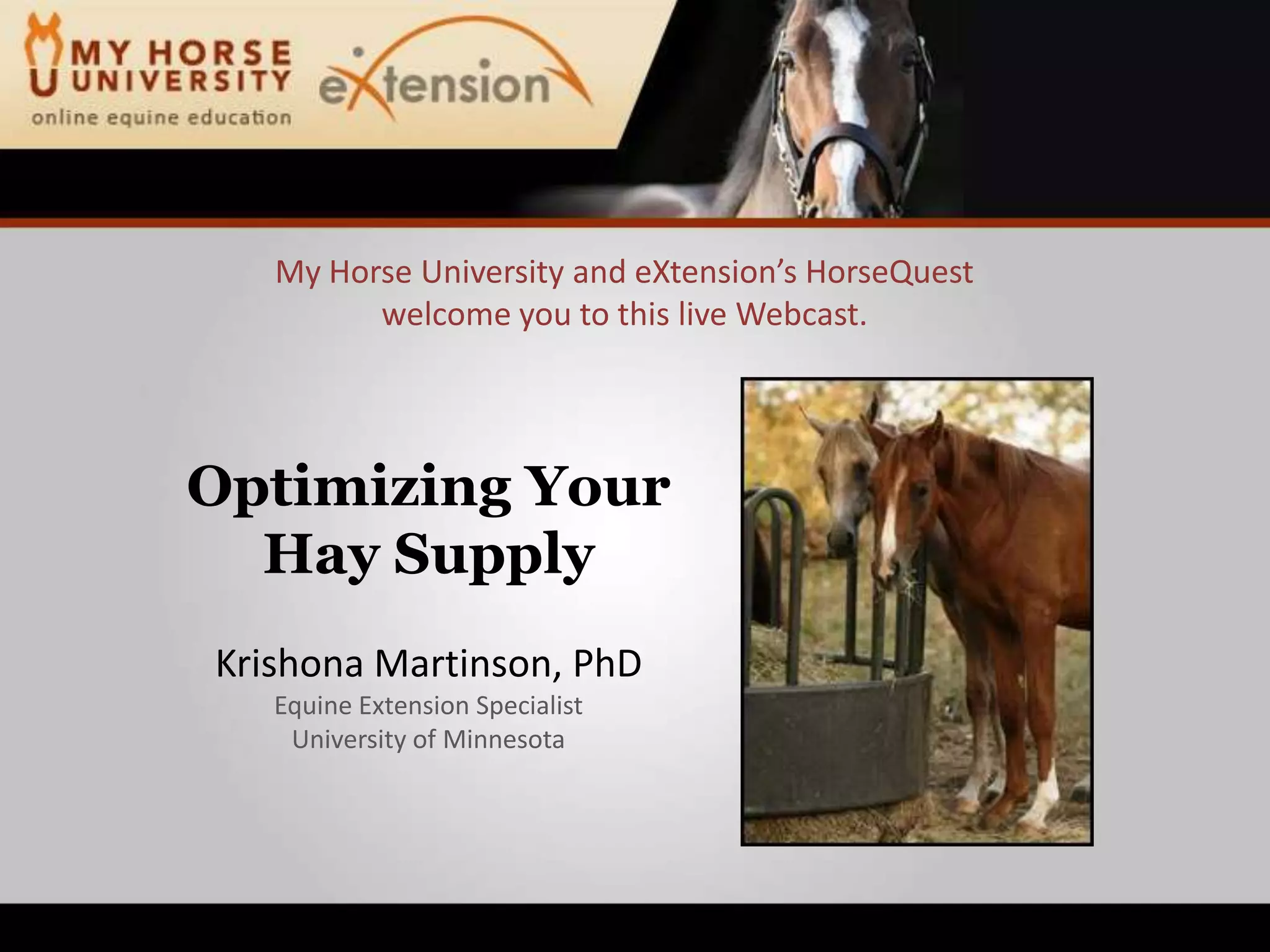
My Horse University and eXtension’sHorseQuestwelcome you to this live Webcast.Optimizing YourHay SupplyKrishona Martinson, PhDEquine Extension SpecialistUniversity of Minnesota
Meet our presenter:Questions facilitated by:Dr. Bridgett McIntoshEquine Extension SpecialistUniversity of TennesseeKrishona MartinsonEquine Extension SpecialistUniversity of Minnesota
OutlineBuy quality hayFeeding examplesHay testingReducing feedingand storage wasteResearch Update
Forage is the FoundationHorses are non-ruminant herbivores designed to utilize forages as the primary component of their diet.Horses required 2 to 3% of their body weight in feed each day.At least half of their daily feed intake should be in the form of roughage.
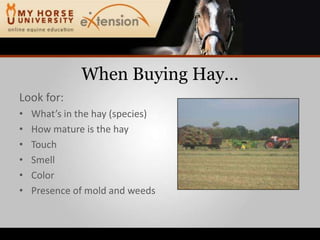
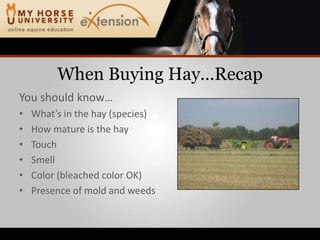
When Buying Hay…Look for:What’s in the hay (species)How mature is the hayTouchSmellColorPresence of mold and weeds
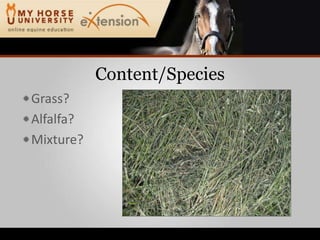
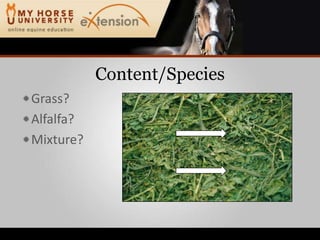
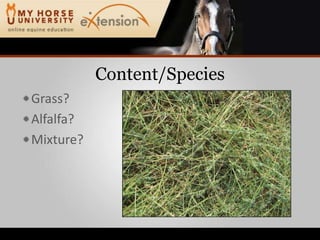
Buy Quality HayContent/SpeciesPercent of grass and legumes in the hay.Legumes have a higher protein content than grasses.Fiber from grasses is more digestible than that of alfalfa at the same stage of maturity.
Content/SpeciesGrass?Alfalfa?Mixture?
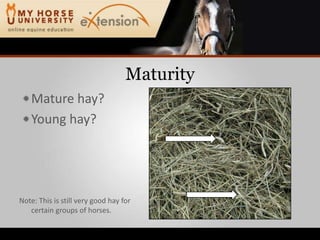
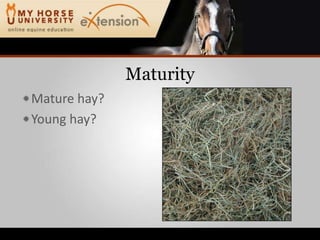
Buy Quality HayMaturityPlants have more fiber and less protein as they mature.Indicators of maturity are flowers for legumes, and seed heads for grasses.Leaves have more protein and digestible energy and less fiber than stems.
MaturityMature hay?Young hay?Note: This is still very good hay forcertain groups of horses.
MaturityMature hay?Young hay?
Buy Quality HayTouchA horse’s mouth, lips and tongue are very sensitive.Softer hay will usually be consumed more readily.If the hay feels rough to you, it will feel rough to your horse.
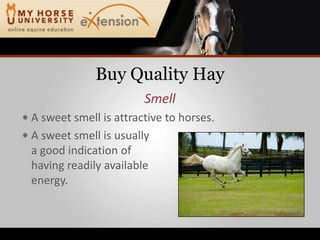
Buy Quality HaySmellA sweet smell is attractive to horses.A sweet smell is usuallya good indication ofhaving readily availableenergy.
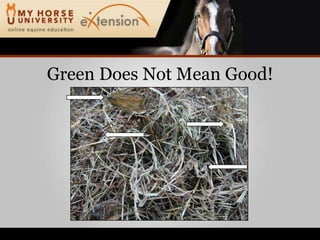
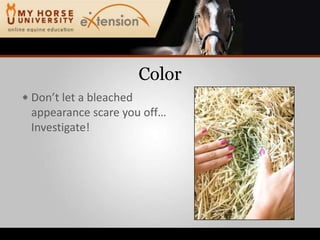
Buy Quality HayColorDo not get hung up on color!Green is very appealing and a good indicator of quality.Bleached color indicates exposure to sunlight or rain.Bleached hay can still contain many other essential nutrients and can be fed to horses.If in doubt, have the hay tested.
Green Does Not Mean Good!
ColorDon’t let a bleachedappearance scare you off…Investigate!
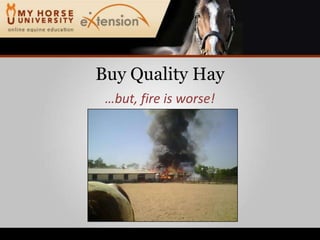
Buy Quality HayYou Should Know the MoistureHay baled between 10 and 17% moisture is optimum.Hay reserved for long term storage should be less than 17% moisture.Hay over 18% poses the threat of molding.Hay baled above 25% poses the threat of severe heat damage and serves as a potential fire hazard.Pennsylvania State Extension
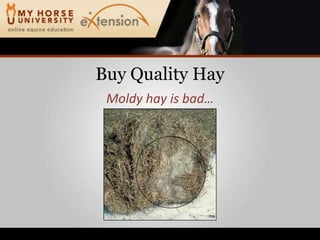
Hay CharacteristicsMold is a direct result of hay baled too wet (or storage issues)Mold is detrimental if the horse inhales it, and has the potential to be toxic and/or upset the digestive system.If they hay has been stored inside and is not moldy, then the risk of it getting mold is very low.Do not buy hay that is moldy, as it will only get worse.
Buy Quality HayMoldy hay is bad…
Buy Quality Hay…but, fire is worse!
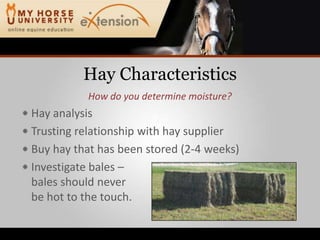
Hay CharacteristicsHow do you determine moisture?Hay analysisTrusting relationship with hay supplierBuy hay that has been stored (2-4 weeks)Investigate bales – bales should neverbe hot to the touch.
When Buying Hay…RecapYou should know…What’s in the hay (species)How mature is the hayTouchSmellColor (bleached color OK)Presence of mold and weeds
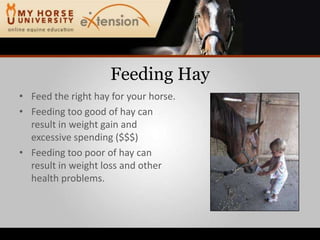
Feeding HayFeed the right hay for your horse.Feeding too good of hay canresult in weight gain andexcessive spending ($$$)Feeding too poor of hay canresult in weight loss and otherhealth problems.
Feeding HayExample 1: Adult Idle HorseHorse Weight: 1,000 lbsRequired Daily Feed Intake: 2% body weightTotal intake per day: 20 lbsPercentage of Hay in Daily Ration: 100%Percentage of Concentrate in Daily Ration: 0%Amount of Hay Required in Daily Ration: 20 lbsAmount of Concentrate Required in Daily Ration: 0 lbProvided by Dr. Bridgett McIntosh, University of Tennessee
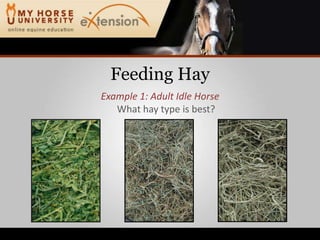
Feeding HayExample 1: Adult Idle Horse What hay type is best?
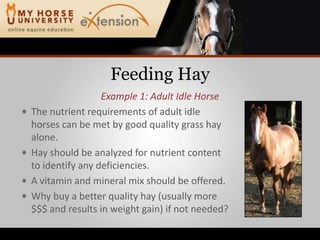
Feeding HayExample 1: Adult Idle HorseThe nutrient requirements of adult idlehorses can be met by good quality grass hayalone.Hay should be analyzed for nutrient contentto identify any deficiencies.A vitamin and mineral mix should be offered.Why buy a better quality hay (usually more$$$ and results in weight gain) if not needed?
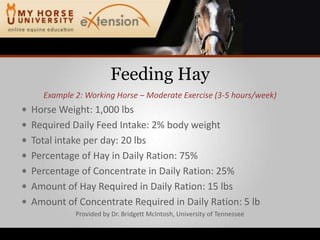
Feeding HayExample 2: Working Horse – Moderate Exercise (3-5 hours/week)Horse Weight: 1,000 lbsRequired Daily Feed Intake: 2% body weightTotal intake per day: 20 lbsPercentage of Hay in Daily Ration: 75%Percentage of Concentrate in Daily Ration: 25%Amount of Hay Required in Daily Ration: 15 lbsAmount of Concentrate Required in Daily Ration: 5 lbProvided by Dr. Bridgett McIntosh, University of Tennessee
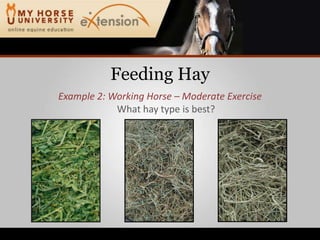
Feeding HayExample 2: Working Horse – Moderate ExerciseWhat hay type is best?
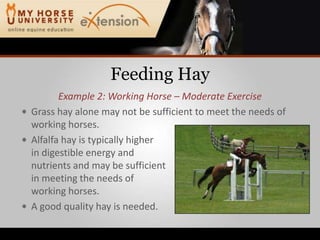
Feeding HayExample 2: Working Horse – Moderate Exercise Grass hay alone may not be sufficient to meet the needs of working horses.Alfalfa hay is typically higherin digestible energy andnutrients and may be sufficientin meeting the needs ofworking horses.A good quality hay is needed.
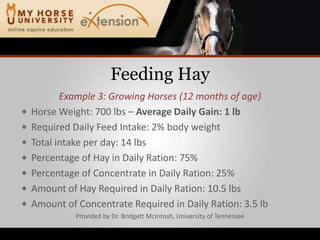
Feeding HayExample 3: Growing Horses (12 months of age)Horse Weight: 700 lbs – Average Daily Gain: 1 lbRequired Daily Feed Intake: 2% body weightTotal intake per day: 14 lbsPercentage of Hay in Daily Ration: 75%Percentage of Concentrate in Daily Ration: 25%Amount of Hay Required in Daily Ration: 10.5 lbsAmount of Concentrate Required in Daily Ration: 3.5 lbProvided by Dr. Bridgett McIntosh, University of Tennessee
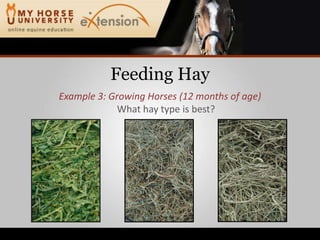
Feeding HayExample 3: Growing Horses (12 months of age) What hay type is best?
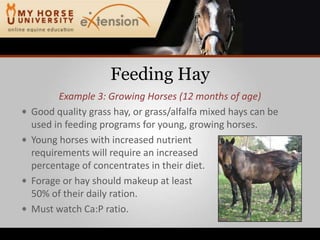
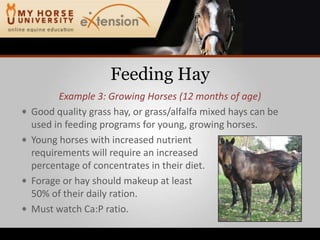
Feeding HayExample 3: Growing Horses (12 months of age)Good quality grass hay, or grass/alfalfa mixed hays can be used in feeding programs for young, growing horses.Young horses with increased nutrientrequirements will require an increasedpercentage of concentrates in their diet.Forage or hay should makeup at least50% of their daily ration.Must watch Ca:P ratio.
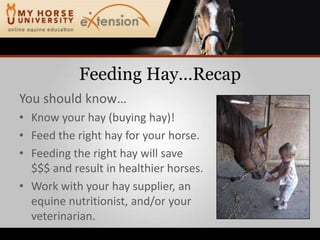
Feeding Hay…RecapYou should know…Know your hay (buying hay)!Feed the right hay for your horse.Feeding the right hay will save$$$ and result in healthier horses.Work with your hay supplier, anequine nutritionist, and/or yourveterinarian.
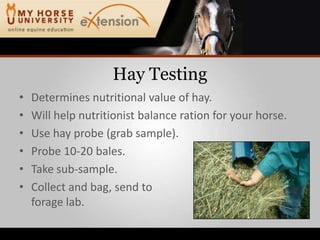
Hay TestingDetermines nutritional value of hay.Will help nutritionist balance ration for your horse.Use hay probe (grab sample).Probe 10-20 bales.Take sub-sample.Collect and bag, send toforage lab.
Hay TestingRequires Equine AnalysisApproximately $20 for each basic sampleEqui-analytical: 877-819-411*For example, in Minnesota:DHIA Labs: 800-369-2697*Dairyland Labs: 320-240-1737*Zumbrota Forage Labs:  507-732-4441**These labs are not endorsed by the University of Minnesota and may not be a complete list of available labs in MN.
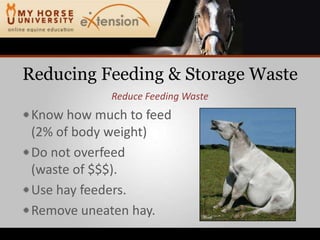
Reducing Feeding & Storage WasteReduce Feeding WasteKnow how much to feed(2% of body weight)Do not overfeed(waste of $$$).Use hay feeders.Remove uneaten hay.
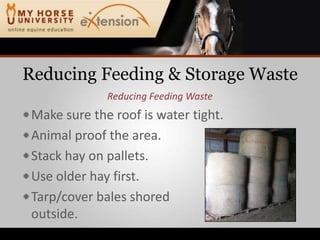
Reducing Feeding & Storage WasteReducing Feeding WasteMake sure the roof is water tight.Animal proof the area.Stack hay on pallets.Use older hay first.Tarp/cover bales shoredoutside.
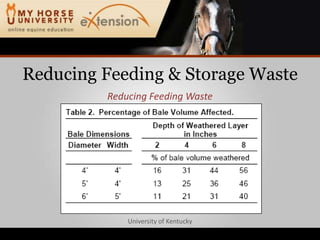
Reducing Feeding & Storage WasteReducing Feeding WasteUniversity of Kentucky
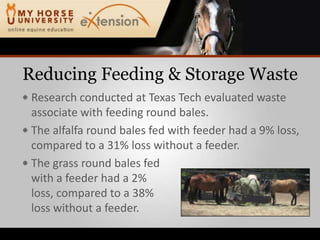
Reducing Feeding & Storage WasteResearch conducted at Texas Tech evaluated waste associate with feeding round bales.The alfalfa round bales fed with feeder had a 9% loss, compared to a 31% loss without a feeder.The grass round bales fedwith a feeder had a 2%loss, compared to a 38%loss without a feeder.
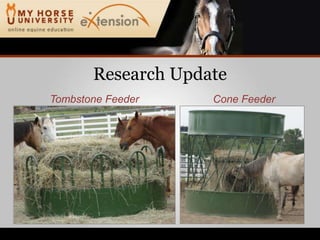
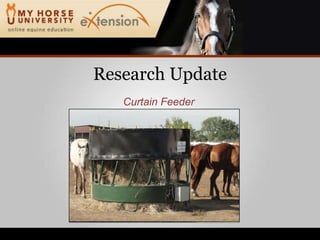
Research UpdatePreliminary Data from the Univ of MinnThree commercially available, equine round bale feeders were evaluated for hay waste.Tombstone FeederCone FeederCurtain Feeder
Research UpdateTombstone FeederCone Feeder
Research UpdateCurtain Feeder
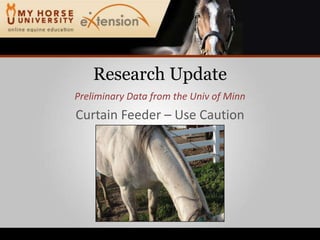
Research UpdatePreliminary Data from the Univ of MinnCurtain Feeder – Use Caution
Research UpdatePreliminary Data from the Univ of MinnTombstone Feeder Waste = 15%Cone Feeder Waste = 8%Curtain Feeder Waste = 9%Additional round bale feeder research planned for 2010.
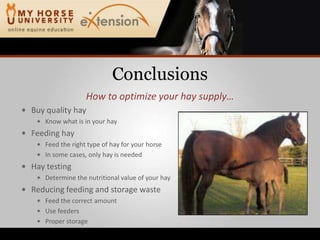
ConclusionsHow to optimize your hay supply…Buy quality hayKnow what is in your hayFeeding hayFeed the right type of hay for your horseIn some cases, only hay is neededHay testingDetermine the nutritional value of your hayReducing feeding and storage wasteFeed the correct amountUse feedersProper storage
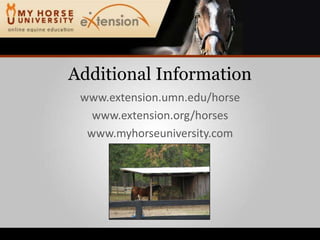
Additional Informationwww.extension.umn.edu/horsewww.extension.org/horseswww.myhorseuniversity.com
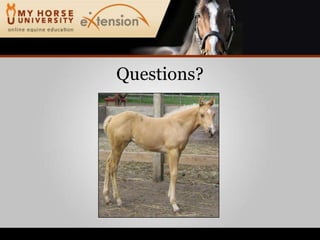
Questions?
Give us your feedback!You will receive an email with a link to an online survey. Please take a few minutes to answer give us your feedback on tonight’s webcast. It will help us to better serve you!
Upcoming WebcastsApplications for Equine GeneticsOctober 21, 2009 | 1:00 pm ETOn the Trail Ride: Best PracticesOctober 21, 2009 | 7:00 pm ETWhy Won’t My Mare Get Pregnant?November 24, 2009 | 7:00 pm ET
Thank you!Thank you for attending this live Web presentation!For more information aboutMy Horse University, please visit us at:www.myhorseuniversity.cominfo@myhorseuniversity.com | www.myhorseuniversity.com | 517-353-3123

Optimizing Hay And Feeding Storage (Martinson)

  • 1.
    My Horse Universityand eXtension’sHorseQuestwelcome you to this live Webcast.Optimizing YourHay SupplyKrishona Martinson, PhDEquine Extension SpecialistUniversity of Minnesota
  • 2.
    Meet our presenter:Questionsfacilitated by:Dr. Bridgett McIntoshEquine Extension SpecialistUniversity of TennesseeKrishona MartinsonEquine Extension SpecialistUniversity of Minnesota
  • 3.
    OutlineBuy quality hayFeedingexamplesHay testingReducing feedingand storage wasteResearch Update
  • 4.
    Forage is theFoundationHorses are non-ruminant herbivores designed to utilize forages as the primary component of their diet.Horses required 2 to 3% of their body weight in feed each day.At least half of their daily feed intake should be in the form of roughage.
  • 5.
    When Buying Hay…Lookfor:What’s in the hay (species)How mature is the hayTouchSmellColorPresence of mold and weeds
  • 6.
    Buy Quality HayContent/SpeciesPercentof grass and legumes in the hay.Legumes have a higher protein content than grasses.Fiber from grasses is more digestible than that of alfalfa at the same stage of maturity.
  • 7.
  • 8.
  • 9.
  • 10.
    Buy Quality HayMaturityPlantshave more fiber and less protein as they mature.Indicators of maturity are flowers for legumes, and seed heads for grasses.Leaves have more protein and digestible energy and less fiber than stems.
  • 11.
    MaturityMature hay?Young hay?Note:This is still very good hay forcertain groups of horses.
  • 12.
  • 13.
    Buy Quality HayTouchAhorse’s mouth, lips and tongue are very sensitive.Softer hay will usually be consumed more readily.If the hay feels rough to you, it will feel rough to your horse.
  • 14.
    Buy Quality HaySmellAsweet smell is attractive to horses.A sweet smell is usuallya good indication ofhaving readily availableenergy.
  • 15.
    Buy Quality HayColorDonot get hung up on color!Green is very appealing and a good indicator of quality.Bleached color indicates exposure to sunlight or rain.Bleached hay can still contain many other essential nutrients and can be fed to horses.If in doubt, have the hay tested.
  • 16.
    Green Does NotMean Good!
  • 17.
    ColorDon’t let ableachedappearance scare you off…Investigate!
  • 18.
    Buy Quality HayYouShould Know the MoistureHay baled between 10 and 17% moisture is optimum.Hay reserved for long term storage should be less than 17% moisture.Hay over 18% poses the threat of molding.Hay baled above 25% poses the threat of severe heat damage and serves as a potential fire hazard.Pennsylvania State Extension
  • 19.
    Hay CharacteristicsMold isa direct result of hay baled too wet (or storage issues)Mold is detrimental if the horse inhales it, and has the potential to be toxic and/or upset the digestive system.If they hay has been stored inside and is not moldy, then the risk of it getting mold is very low.Do not buy hay that is moldy, as it will only get worse.
  • 20.
  • 21.
  • 22.
    Hay CharacteristicsHow doyou determine moisture?Hay analysisTrusting relationship with hay supplierBuy hay that has been stored (2-4 weeks)Investigate bales – bales should neverbe hot to the touch.
  • 23.
    When Buying Hay…RecapYoushould know…What’s in the hay (species)How mature is the hayTouchSmellColor (bleached color OK)Presence of mold and weeds
  • 24.
    Feeding HayFeed theright hay for your horse.Feeding too good of hay canresult in weight gain andexcessive spending ($$$)Feeding too poor of hay canresult in weight loss and otherhealth problems.
  • 25.
    Feeding HayExample 1:Adult Idle HorseHorse Weight: 1,000 lbsRequired Daily Feed Intake: 2% body weightTotal intake per day: 20 lbsPercentage of Hay in Daily Ration: 100%Percentage of Concentrate in Daily Ration: 0%Amount of Hay Required in Daily Ration: 20 lbsAmount of Concentrate Required in Daily Ration: 0 lbProvided by Dr. Bridgett McIntosh, University of Tennessee
  • 26.
    Feeding HayExample 1:Adult Idle Horse What hay type is best?
  • 27.
    Feeding HayExample 1:Adult Idle HorseThe nutrient requirements of adult idlehorses can be met by good quality grass hayalone.Hay should be analyzed for nutrient contentto identify any deficiencies.A vitamin and mineral mix should be offered.Why buy a better quality hay (usually more$$$ and results in weight gain) if not needed?
  • 28.
    Feeding HayExample 2:Working Horse – Moderate Exercise (3-5 hours/week)Horse Weight: 1,000 lbsRequired Daily Feed Intake: 2% body weightTotal intake per day: 20 lbsPercentage of Hay in Daily Ration: 75%Percentage of Concentrate in Daily Ration: 25%Amount of Hay Required in Daily Ration: 15 lbsAmount of Concentrate Required in Daily Ration: 5 lbProvided by Dr. Bridgett McIntosh, University of Tennessee
  • 29.
    Feeding HayExample 2:Working Horse – Moderate ExerciseWhat hay type is best?
  • 30.
    Feeding HayExample 2:Working Horse – Moderate Exercise Grass hay alone may not be sufficient to meet the needs of working horses.Alfalfa hay is typically higherin digestible energy andnutrients and may be sufficientin meeting the needs ofworking horses.A good quality hay is needed.
  • 31.
    Feeding HayExample 3:Growing Horses (12 months of age)Horse Weight: 700 lbs – Average Daily Gain: 1 lbRequired Daily Feed Intake: 2% body weightTotal intake per day: 14 lbsPercentage of Hay in Daily Ration: 75%Percentage of Concentrate in Daily Ration: 25%Amount of Hay Required in Daily Ration: 10.5 lbsAmount of Concentrate Required in Daily Ration: 3.5 lbProvided by Dr. Bridgett McIntosh, University of Tennessee
  • 32.
    Feeding HayExample 3:Growing Horses (12 months of age) What hay type is best?
  • 33.
    Feeding HayExample 3:Growing Horses (12 months of age)Good quality grass hay, or grass/alfalfa mixed hays can be used in feeding programs for young, growing horses.Young horses with increased nutrientrequirements will require an increasedpercentage of concentrates in their diet.Forage or hay should makeup at least50% of their daily ration.Must watch Ca:P ratio.
  • 34.
    Feeding HayExample 3:Growing Horses (12 months of age)Good quality grass hay, or grass/alfalfa mixed hays can be used in feeding programs for young, growing horses.Young horses with increased nutrientrequirements will require an increasedpercentage of concentrates in their diet.Forage or hay should makeup at least50% of their daily ration.Must watch Ca:P ratio.
  • 35.
    Feeding Hay…RecapYou shouldknow…Know your hay (buying hay)!Feed the right hay for your horse.Feeding the right hay will save$$$ and result in healthier horses.Work with your hay supplier, anequine nutritionist, and/or yourveterinarian.
  • 36.
    Hay TestingDetermines nutritionalvalue of hay.Will help nutritionist balance ration for your horse.Use hay probe (grab sample).Probe 10-20 bales.Take sub-sample.Collect and bag, send toforage lab.
  • 37.
    Hay TestingRequires EquineAnalysisApproximately $20 for each basic sampleEqui-analytical: 877-819-411*For example, in Minnesota:DHIA Labs: 800-369-2697*Dairyland Labs: 320-240-1737*Zumbrota Forage Labs: 507-732-4441**These labs are not endorsed by the University of Minnesota and may not be a complete list of available labs in MN.
  • 38.
    Reducing Feeding &Storage WasteReduce Feeding WasteKnow how much to feed(2% of body weight)Do not overfeed(waste of $$$).Use hay feeders.Remove uneaten hay.
  • 39.
    Reducing Feeding &Storage WasteReducing Feeding WasteMake sure the roof is water tight.Animal proof the area.Stack hay on pallets.Use older hay first.Tarp/cover bales shoredoutside.
  • 40.
    Reducing Feeding &Storage WasteReducing Feeding WasteUniversity of Kentucky
  • 41.
    Reducing Feeding &Storage WasteResearch conducted at Texas Tech evaluated waste associate with feeding round bales.The alfalfa round bales fed with feeder had a 9% loss, compared to a 31% loss without a feeder.The grass round bales fedwith a feeder had a 2%loss, compared to a 38%loss without a feeder.
  • 42.
    Research UpdatePreliminary Datafrom the Univ of MinnThree commercially available, equine round bale feeders were evaluated for hay waste.Tombstone FeederCone FeederCurtain Feeder
  • 43.
  • 44.
  • 45.
    Research UpdatePreliminary Datafrom the Univ of MinnCurtain Feeder – Use Caution
  • 46.
    Research UpdatePreliminary Datafrom the Univ of MinnTombstone Feeder Waste = 15%Cone Feeder Waste = 8%Curtain Feeder Waste = 9%Additional round bale feeder research planned for 2010.
  • 47.
    ConclusionsHow to optimizeyour hay supply…Buy quality hayKnow what is in your hayFeeding hayFeed the right type of hay for your horseIn some cases, only hay is neededHay testingDetermine the nutritional value of your hayReducing feeding and storage wasteFeed the correct amountUse feedersProper storage
  • 48.
  • 49.
  • 50.
    Give us yourfeedback!You will receive an email with a link to an online survey. Please take a few minutes to answer give us your feedback on tonight’s webcast. It will help us to better serve you!
  • 51.
    Upcoming WebcastsApplications forEquine GeneticsOctober 21, 2009 | 1:00 pm ETOn the Trail Ride: Best PracticesOctober 21, 2009 | 7:00 pm ETWhy Won’t My Mare Get Pregnant?November 24, 2009 | 7:00 pm ET
  • 52.
    Thank you!Thank youfor attending this live Web presentation!For more information aboutMy Horse University, please visit us at:www.myhorseuniversity.cominfo@myhorseuniversity.com | www.myhorseuniversity.com | 517-353-3123