Submitted To,
Mr. Amardeep Singh
Ass. Proff. Mechanical
Career Point
University
Submitted By ,
Sanjay Singh
K12336
B.Tech 1st Year
Sec.A 2nd Sem.
 Casting is a manufacturing process in which a liquid material
is usually poured into a mold(Shaping Liquified material with
the help of frame), which contains a hollow cavity of the
desired shape, and then allowed to solidify.
 The solidified part is also known as a casting, which is
ejected or broken out of the mold to complete the process.
 Casting materials are usually metals or various cold
setting materials that cure (Harded or thoughed) after
mixing two or more components together; examples
are epoxy, concrete, plaster and clay.
 Casting is most often used for making complex shapes that
would be otherwise difficult or uneconomical to make by
other methods.
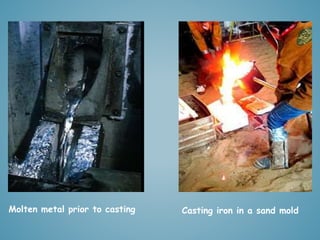
Molten metal prior to casting Casting iron in a sand mold
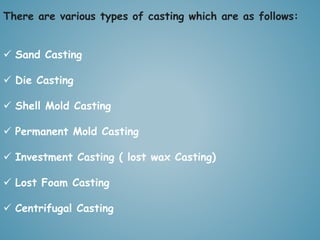
There are various types of casting which are as follows:
 Sand Casting
 Die Casting
 Shell Mold Casting
 Permanent Mold Casting
 Investment Casting ( lost wax Casting)
 Lost Foam Casting
 Centrifugal Casting
 Casting process simulation uses numerical methods to
calculate cast component quality considering mold filling,
solidification and cooling, and provides a quantitative
prediction of casting mechanical properties, thermal
stresses and distortion.
 Simulation accurately describes a cast component’s
quality up-front before production starts.
 The casting rigging (the apparatus through which the force of
the wind is used to propel sailboats and sailing ships forward) can
be designed with respect to the required component
properties.
 This has benefits beyond a reduction in pre-production
sampling, as the precise layout of the complete casting
system also leads to energy, material, and tooling
savings.
 The software supports the user in component design, the
determination of melting practice and casting methoding
through to pattern and mold making, heat treatment,
and finishing. This saves costs along the entire casting
manufacturing route.
1. Casting Simulation for Casting Defects Analysis
Computer simulation of casting process has emerged as a
powerful tool for achieving quality assurance without time
consuming trials. Software packages for simulating the
solidification of molten metal in the mold enable predicting
the location of shrinkage defects and optimizing the design
of feeders to improve the yield.
More advanced packages perform coupled simulation of
mold filling and casting solidification.
2. Need of Optimization during Casting Process
Optimization is the process of finding the best way of using your
resources, at the same time not violating any of the constraints that
are imposed. By "best" we usually mean highest profit, or lowest
cost. Even after spending significant resources (man-hours, materials,
machine overheads and energy) for casting development, one of the
following situations may arise during regular production.
i. Under design: Resulting in high percentage of defective castings. This
usually happens when the number or size of
feeders and gating elements are inadequate, or their placement is
incorrect. Sometimes the cause is an undersized neck or
a thin intermediate casting section, which prevents feed metal flow
from the feeder to the hot spot inside the casting.
ii. Over design: Leading to acceptable quality level, but poor yield and thereby higher cost. In
this case, the number
and/or size of feeders and gating elements is much higher than their respective optimal
values. This situation usually
arises because of lack of time or resources to fine-tune the methoding solution or to try
other alternative solutions.
iii. Borderline design: Irregular defect levels during regular production, although sample
castings are defect-free. This
happens when the methoding solution is just optimal (perhaps by accident), which will
produce good castings only under
controlled conditions. This is difficult to expect in practice, especially with manual molding
and pouring [3].
Figure 1 shows 2-D model of bracket chasis which is a one of the casting component from
which determination of general outline of casting component takes place.
Figure 1 2-D
model of bracket
chasis
3. Necessity of Simulation
Computer simulation of casting process has emerged as a powerful
tool for achieving quality assurance without time
consuming trials. Software packages for simulating the solidification
of molten metal in the mold enable predicting the
location of shrinkage defects and optimizing the design of feeders to
improve the yield; more advanced packages perform
coupled simulation of mold filling and casting solidification.
Casting simulation should be used when it can be economically
justified for at least one of the following three reasons:
 Quality enhancement by predicting and eliminating internal
defects like porosity.
 Yield improvement by reducing the volume of feeders and gating
channels per casting.
 Rapid development of a new casting by reducing the number of
foundry trials. The corresponding cost benefits can be
estimated.
 Quality improvement reduces the (avoidable) costs associated
with producing defective castings, including their
transport, and warranty or penalties.
 Yield improvement reduces the effective melting cost per casting,
and increases the net production capacity of the
foundry (without adding melting or moulding units).
 Faster development of castings through virtual trials eliminates
the wastage of production resources, and improves the
rate of conversion from enquiries to orders, giving foundries an
opportunity to select higher value orders.
Optimization of Casting Process

Optimization of Casting Process

  • 1.
    Submitted To, Mr. AmardeepSingh Ass. Proff. Mechanical Career Point University Submitted By , Sanjay Singh K12336 B.Tech 1st Year Sec.A 2nd Sem.
  • 2.
     Casting isa manufacturing process in which a liquid material is usually poured into a mold(Shaping Liquified material with the help of frame), which contains a hollow cavity of the desired shape, and then allowed to solidify.  The solidified part is also known as a casting, which is ejected or broken out of the mold to complete the process.  Casting materials are usually metals or various cold setting materials that cure (Harded or thoughed) after mixing two or more components together; examples are epoxy, concrete, plaster and clay.  Casting is most often used for making complex shapes that would be otherwise difficult or uneconomical to make by other methods.
  • 3.
    Molten metal priorto casting Casting iron in a sand mold
  • 4.
    There are varioustypes of casting which are as follows:  Sand Casting  Die Casting  Shell Mold Casting  Permanent Mold Casting  Investment Casting ( lost wax Casting)  Lost Foam Casting  Centrifugal Casting
  • 6.
     Casting processsimulation uses numerical methods to calculate cast component quality considering mold filling, solidification and cooling, and provides a quantitative prediction of casting mechanical properties, thermal stresses and distortion.  Simulation accurately describes a cast component’s quality up-front before production starts.  The casting rigging (the apparatus through which the force of the wind is used to propel sailboats and sailing ships forward) can be designed with respect to the required component properties.
  • 7.
     This hasbenefits beyond a reduction in pre-production sampling, as the precise layout of the complete casting system also leads to energy, material, and tooling savings.  The software supports the user in component design, the determination of melting practice and casting methoding through to pattern and mold making, heat treatment, and finishing. This saves costs along the entire casting manufacturing route.
  • 8.
    1. Casting Simulationfor Casting Defects Analysis Computer simulation of casting process has emerged as a powerful tool for achieving quality assurance without time consuming trials. Software packages for simulating the solidification of molten metal in the mold enable predicting the location of shrinkage defects and optimizing the design of feeders to improve the yield. More advanced packages perform coupled simulation of mold filling and casting solidification.
  • 9.
    2. Need ofOptimization during Casting Process Optimization is the process of finding the best way of using your resources, at the same time not violating any of the constraints that are imposed. By "best" we usually mean highest profit, or lowest cost. Even after spending significant resources (man-hours, materials, machine overheads and energy) for casting development, one of the following situations may arise during regular production. i. Under design: Resulting in high percentage of defective castings. This usually happens when the number or size of feeders and gating elements are inadequate, or their placement is incorrect. Sometimes the cause is an undersized neck or a thin intermediate casting section, which prevents feed metal flow from the feeder to the hot spot inside the casting.
  • 10.
    ii. Over design:Leading to acceptable quality level, but poor yield and thereby higher cost. In this case, the number and/or size of feeders and gating elements is much higher than their respective optimal values. This situation usually arises because of lack of time or resources to fine-tune the methoding solution or to try other alternative solutions. iii. Borderline design: Irregular defect levels during regular production, although sample castings are defect-free. This happens when the methoding solution is just optimal (perhaps by accident), which will produce good castings only under controlled conditions. This is difficult to expect in practice, especially with manual molding and pouring [3]. Figure 1 shows 2-D model of bracket chasis which is a one of the casting component from which determination of general outline of casting component takes place. Figure 1 2-D model of bracket chasis
  • 11.
    3. Necessity ofSimulation Computer simulation of casting process has emerged as a powerful tool for achieving quality assurance without time consuming trials. Software packages for simulating the solidification of molten metal in the mold enable predicting the location of shrinkage defects and optimizing the design of feeders to improve the yield; more advanced packages perform coupled simulation of mold filling and casting solidification. Casting simulation should be used when it can be economically justified for at least one of the following three reasons:  Quality enhancement by predicting and eliminating internal defects like porosity.  Yield improvement by reducing the volume of feeders and gating channels per casting.
  • 12.
     Rapid developmentof a new casting by reducing the number of foundry trials. The corresponding cost benefits can be estimated.  Quality improvement reduces the (avoidable) costs associated with producing defective castings, including their transport, and warranty or penalties.  Yield improvement reduces the effective melting cost per casting, and increases the net production capacity of the foundry (without adding melting or moulding units).  Faster development of castings through virtual trials eliminates the wastage of production resources, and improves the rate of conversion from enquiries to orders, giving foundries an opportunity to select higher value orders.