•Remote
•Sensing
•Laboratory


                  SMOS brightness temperature
              measurement and end-to-end calibration


        Francesc Torres(1), Ignasi Corbella(1), Nuria Duffo(1) and
                       Manuel Martín-Neira (2)
          (1) Remote Sensing Laboratory. Universitat Politècnica de Catalunya,
              Barcelona.SMOS Barcelona Expert Centre
          (2) European Space Agency (ESA-ESTEC). Noordwijk. The Netherlands


                                IGARSS 2011 Vancouver                            1/16
•Remote
•Sensing
•Laboratory

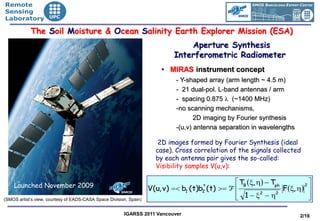
            The Soil Moisture & Ocean Salinity Earth Explorer Mission (ESA)
                                                                                 Aperture Synthesis
                                                                             Interferometric Radiometer
                                                                        • MIRAS instrument concept
                                                                             - Y-shaped array (arm length ~ 4.5 m)
                                                                             - 21 dual-pol. L-band antennas / arm
                                                                             - spacing 0.875 λ (~1400 MHz)
                                                                             -no scanning mechanisms,
                                                                                    2D imaging by Fourier synthesis
                                                                             -(u,v) antenna separation in wavelengths

                                                                       2D images formed by Fourier Synthesis (ideal
                                                                      case). Cross correlation of the signals collected
                                                                      by each antenna pair gives the so-called:
                                                                      Visibility samples V(u,v):

    Launched November 2009
                                                                                                 TB (ξ, η) − Tph        2
                                                                                                                           
                                                                    V(u, v) =< b1 (t)b (t) >= F 
                                                                                      *
                                                                                      2                           F(ξ, η) 
(SMOS artist’s view, courtesy of EADS-CASA Space Division, Spain)
                                                                                                 1−ξ −η
                                                                                                
                                                                                                          2    2
                                                                                                                           
                                                                                                                           

                                                        IGARSS 2011 Vancouver                                           2/16
•Remote
•Sensing
•Laboratory

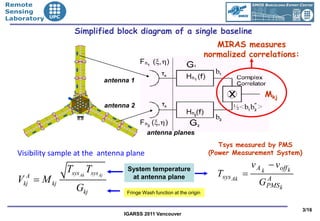
                    Simplified block diagram of a single baseline
                                                                               MIRAS measures
                                                                            normalized correlations:


                                 antenna 1

                                                                                               Mkj
                                 antenna 2


                                                antenna planes
                                                                                Tsys measured by PMS
   Visibility sample at the antenna plane                                    (Power Measurement System)

                 TsysAk TsysAj         System temperature
                                                                                           v A k − voff k
                                                                               Tsys Ak =
   V = M kj
      A
     kj
                                        at antenna plane                                       A
                                                                                             G PMSk
                    Gkj                Fringe Wash function at the origin


                                                                                                            3/16
                                      IGARSS 2011 Vancouver
•Remote
•Sensing
•Laboratory


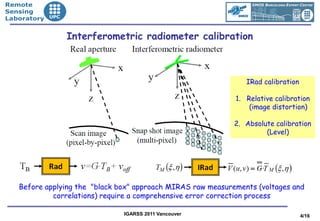
                Interferometric radiometer calibration


                                                                 IRad calibration

                                                              1. Relative calibration
                                                                  (image distortion)

                                                              2. Absolute calibration
                                                                       (Level)


    Before applying the "black box" approach MIRAS raw measurements (voltages and
             correlations) require a comprehensive error correction process

                                IGARSS 2011 Vancouver                               4/16
•Remote
•Sensing
•Laboratory


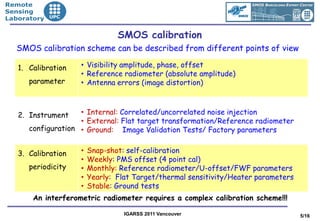
                                 SMOS calibration
   SMOS calibration scheme can be described from different points of view

    1. Calibration   • Visibility amplitude, phase, offset
                     • Reference radiometer (absolute amplitude)
       parameter     • Antenna errors (image distortion)


    2. Instrument    • Internal: Correlated/uncorrelated noise injection
                     • External: Flat target transformation/Reference radiometer
       configuration • Ground: Image Validation Tests/ Factory parameters


    3. Calibration   •   Snap-shot: self-calibration
                     •   Weekly: PMS offset (4 point cal)
       periodicity   •   Monthly: Reference radiometer/U-offset/FWF parameters
                     •   Yearly: Flat Target/thermal sensitivity/Heater parameters
                     •   Stable: Ground tests
        An interferometric radiometer requires a complex calibration scheme!!!

                                   IGARSS 2011 Vancouver                             5/16
•Remote
•Sensing
•Laboratory


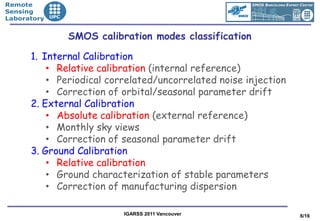
               SMOS calibration modes classification

       1. Internal Calibration
           • Relative calibration (internal reference)
           • Periodical correlated/uncorrelated noise injection
           • Correction of orbital/seasonal parameter drift
       2. External Calibration
           • Absolute calibration (external reference)
           • Monthly sky views
           • Correction of seasonal parameter drift
       3. Ground Calibration
           • Relative calibration
           • Ground characterization of stable parameters
           • Correction of manufacturing dispersion

                           IGARSS 2011 Vancouver                  6/16
•Remote
•Sensing
•Laboratory


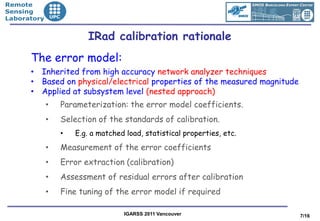
                         IRad calibration rationale
       The error model:
       • Inherited from high accuracy network analyzer techniques
       • Based on physical/electrical properties of the measured magnitude
       • Applied at subsystem level (nested approach)
              •   Parameterization: the error model coefficients.
              •   Selection of the standards of calibration.
                  •   E.g. a matched load, statistical properties, etc.
              •   Measurement of the error coefficients
              •   Error extraction (calibration)
              •   Assessment of residual errors after calibration
              •   Fine tuning of the error model if required

                                    IGARSS 2011 Vancouver                    7/16
•Remote
•Sensing
•Laboratory


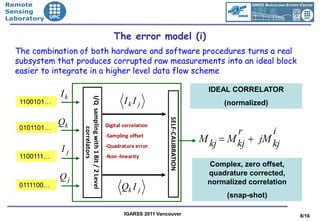
                                                           The error model (i)
   The combination of both hardware and software procedures turns a real
   subsystem that produces corrupted raw measurements into an ideal block
   easier to integrate complex normalized correlation scheme
                  Ideal in a higher level data flow

                                                                                                            IDEAL CORRELATOR
               Ik   I/Q sampling with 1 Bit / 2 Level
    1100101…                                                    Ik I j                                            (normalized)


                                                                                SELF-CALIBRATION
    0101101…
               Qk                                       Digital correlation                                 r       i
                                                                                                   =      M kj + jM kj
                              correlators


                                                                                                   M kj
                                                        -Sampling offset
                                                        -Quadrature error
               Ij
    1100111…                                            -Non -linearity
                                                                                                            Complex, zero offset,
                                                                                                           quadrature corrected,
               Qj                                                                                          normalized correlation
    0111100…                                                   Qk I j
                                                                                                                   (snap-shot)

                                                                IGARSS 2011 Vancouver                                               8/16
•Remote
•Sensing
•Laboratory

                                   The error model (ii)
   Residual error assessment and iterative fine tuning of the error model has
   been a key approach to improve subsystem performance
   Example: digital correlator offset
                                                               With 1-0 correction                              With 1-0 and truncation error correction
                                                0.6                                                      0.6

                                                              Mean= -0.21-0.22i cu
                                                0.4                                                      0.4
                                                              σ=0.03cu
                                                                                                                       Mean= -0.00061+0.00029i cu
                                                0.2                                                                    σ=0.029cu
                                                                                                         0.2
                                  ℑ m[M] (cu)


                                                                                           ℑ m[M] (cu)
                                                  0                                                        0

                                                -0.2                                                     -0.2

                                                -0.4                                                     -0.4
                    avg~1min                                                 avg ~12h                                                  avg ~12h
                                                       -0.4    -0.2      0    0.2    0.4         0.6                -0.4   -0.2    0     0.2    0.4    0.6
                                                                   ℜ e[M] (cu)                                                ℜ e[M] (cu)


              m≈10-3                                            m≈2·10-5                                          MIRAS:
                                                                                                                                  m≈6·10-8
 AMIRAS:                                         MIRAS:
              σ ≈10-4                                           σ ≈3·10-6                                                         σ ≈3·10-6
                                                  IGARSS 2011 Vancouver                                                                               9/16
•Remote
•Sensing
•Laboratory


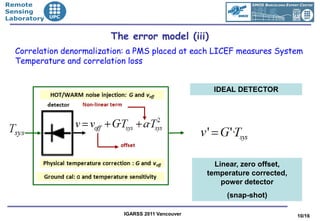
                          The error model (iii)
   Correlation denormalization: a PMS placed at each LICEF measures System
   Temperature and correlation loss


                                                      IDEAL DETECTOR


                                                       Linear, zero offset,
                                                     temperature corrected,
                                                         power detector
                                                          (snap-shot)

                             IGARSS 2011 Vancouver                            10/16
•Remote
•Sensing
•Laboratory


                                   The error model (iv)
    Correlation denormalization: PMS gain and correlator loss are measured in-
    flight well within requirements: amplitude error < 1%
                 Correlator loss                                                             PMS gain error
    5                                                      0.5


    4                                                      0.4


                                                           0.3


                                                  RMS[%]
    3
%


    2                                                      0.2


                                                           0.1
    1

                                                            0
    0                                                        0                      20                      40            60
     0    500   1000      1500     2000   2500                                              Receiver number
                                                             Test data start: 24-12-2009 00:44:39 to 25-12-200900:05:14
                Baseline number
  In-flight measured Correlation Loss ~1.5 %               RMS gain error after Tph correction ~0.2 %

                                      IGARSS 2011 Vancouver                                                                    11/16
•Remote
•Sensing
•Laboratory


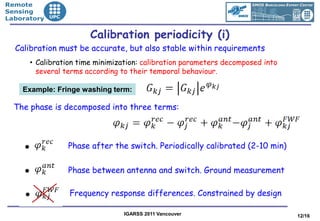
                        Calibration periodicity (i)
   Calibration must be accurate, but also stable within requirements
       • Calibration time minimization: calibration parameters decomposed into
         several terms according to their temporal behaviour.

     Example: Fringe washing term:

  The phase is decomposed into three terms:


                  Phase after the switch. Periodically calibrated (2-10 min)

                  Phase between antenna and switch. Ground measurement

                  Frequency response differences. Constrained by design

                                  IGARSS 2011 Vancouver                          12/16
•Remote
•Sensing
•Laboratory


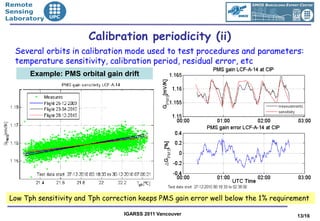
                        Calibration periodicity (ii)
   Several orbits in calibration mode used to test procedures and parameters:
   temperature sensitivity, calibration period, residual error, etc
       Example: PMS orbital gain drift


 Low Tph sensitivity and Tph correction keeps PMS gain error well below the 1% requirement

                                   IGARSS 2011 Vancouver                              13/16
•Remote
•Sensing
•Laboratory


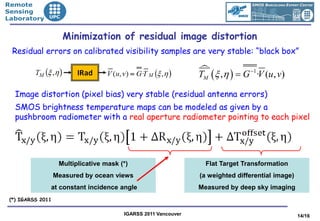
                     Minimization of residual image distortion
  Residual errors on calibrated visibility samples are very stable: “black box”

                                                                 
                                                                 TM (ξ ,η ) = G −1·V (u , v)

   Image distortion (pixel bias) very stable (residual antenna errors)
   SMOS brightness temperature maps can be modeled as given by a
   pushbroom radiometer with a real aperture radiometer pointing to each pixel


                    Multiplicative mask (*)                        Flat Target Transformation
                   Measured by ocean views                       (a weighted differential image)
               at constant incidence angle                       Measured by deep sky imaging
 (*) IGARSS 2011

                                         IGARSS 2011 Vancouver                                     14/16
•Remote
•Sensing
•Laboratory


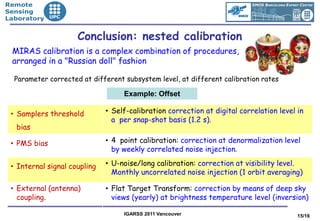
                      Conclusion: nested calibration
  MIRAS calibration is a complex combination of procedures,
  arranged in a "Russian doll" fashion

   Parameter corrected at different subsystem level, at different calibration rates

                                    Example: Offset

  • Samplers threshold         • Self-calibration correction at digital correlation level in
                                 a per snap-shot basis (1.2 s).
   bias

  • PMS bias                   • 4 point calibration: correction at denormalization level
                                 by weekly correlated noise injection.

  • Internal signal coupling   • U-noise/long calibration: correction at visibility level.
                                 Monthly uncorrelated noise injection (1 orbit averaging)

  • External (antenna)         • Flat Target Transform: correction by means of deep sky
    coupling.                    views (yearly) at brightness temperature level (inversion)

                                    IGARSS 2011 Vancouver                                 15/16
•Remote
•Sensing
•Laboratory


              SMOS brightness temperature
               measurement and end-to-end
                       calibration


                           End

                       IGARSS 2011 Vancouver   16/16

IGARSS11 End-to-end calibration v2.pdf

  • 1.
    •Remote •Sensing •Laboratory SMOS brightness temperature measurement and end-to-end calibration Francesc Torres(1), Ignasi Corbella(1), Nuria Duffo(1) and Manuel Martín-Neira (2) (1) Remote Sensing Laboratory. Universitat Politècnica de Catalunya, Barcelona.SMOS Barcelona Expert Centre (2) European Space Agency (ESA-ESTEC). Noordwijk. The Netherlands IGARSS 2011 Vancouver 1/16
  • 2.
    •Remote •Sensing •Laboratory The Soil Moisture & Ocean Salinity Earth Explorer Mission (ESA) Aperture Synthesis Interferometric Radiometer • MIRAS instrument concept - Y-shaped array (arm length ~ 4.5 m) - 21 dual-pol. L-band antennas / arm - spacing 0.875 λ (~1400 MHz) -no scanning mechanisms, 2D imaging by Fourier synthesis -(u,v) antenna separation in wavelengths 2D images formed by Fourier Synthesis (ideal case). Cross correlation of the signals collected by each antenna pair gives the so-called: Visibility samples V(u,v): Launched November 2009  TB (ξ, η) − Tph 2  V(u, v) =< b1 (t)b (t) >= F  * 2 F(ξ, η)  (SMOS artist’s view, courtesy of EADS-CASA Space Division, Spain)  1−ξ −η  2 2   IGARSS 2011 Vancouver 2/16
  • 3.
    •Remote •Sensing •Laboratory Simplified block diagram of a single baseline MIRAS measures normalized correlations: antenna 1 Mkj antenna 2 antenna planes Tsys measured by PMS Visibility sample at the antenna plane (Power Measurement System) TsysAk TsysAj System temperature v A k − voff k Tsys Ak = V = M kj A kj at antenna plane A G PMSk Gkj Fringe Wash function at the origin 3/16 IGARSS 2011 Vancouver
  • 4.
    •Remote •Sensing •Laboratory Interferometric radiometer calibration IRad calibration 1. Relative calibration (image distortion) 2. Absolute calibration (Level) Before applying the "black box" approach MIRAS raw measurements (voltages and correlations) require a comprehensive error correction process IGARSS 2011 Vancouver 4/16
  • 5.
    •Remote •Sensing •Laboratory SMOS calibration SMOS calibration scheme can be described from different points of view 1. Calibration • Visibility amplitude, phase, offset • Reference radiometer (absolute amplitude) parameter • Antenna errors (image distortion) 2. Instrument • Internal: Correlated/uncorrelated noise injection • External: Flat target transformation/Reference radiometer configuration • Ground: Image Validation Tests/ Factory parameters 3. Calibration • Snap-shot: self-calibration • Weekly: PMS offset (4 point cal) periodicity • Monthly: Reference radiometer/U-offset/FWF parameters • Yearly: Flat Target/thermal sensitivity/Heater parameters • Stable: Ground tests An interferometric radiometer requires a complex calibration scheme!!! IGARSS 2011 Vancouver 5/16
  • 6.
    •Remote •Sensing •Laboratory SMOS calibration modes classification 1. Internal Calibration • Relative calibration (internal reference) • Periodical correlated/uncorrelated noise injection • Correction of orbital/seasonal parameter drift 2. External Calibration • Absolute calibration (external reference) • Monthly sky views • Correction of seasonal parameter drift 3. Ground Calibration • Relative calibration • Ground characterization of stable parameters • Correction of manufacturing dispersion IGARSS 2011 Vancouver 6/16
  • 7.
    •Remote •Sensing •Laboratory IRad calibration rationale The error model: • Inherited from high accuracy network analyzer techniques • Based on physical/electrical properties of the measured magnitude • Applied at subsystem level (nested approach) • Parameterization: the error model coefficients. • Selection of the standards of calibration. • E.g. a matched load, statistical properties, etc. • Measurement of the error coefficients • Error extraction (calibration) • Assessment of residual errors after calibration • Fine tuning of the error model if required IGARSS 2011 Vancouver 7/16
  • 8.
    •Remote •Sensing •Laboratory The error model (i) The combination of both hardware and software procedures turns a real subsystem that produces corrupted raw measurements into an ideal block easier to integrate complex normalized correlation scheme Ideal in a higher level data flow IDEAL CORRELATOR Ik I/Q sampling with 1 Bit / 2 Level 1100101… Ik I j (normalized) SELF-CALIBRATION 0101101… Qk Digital correlation r i = M kj + jM kj correlators M kj -Sampling offset -Quadrature error Ij 1100111… -Non -linearity Complex, zero offset, quadrature corrected, Qj normalized correlation 0111100… Qk I j (snap-shot) IGARSS 2011 Vancouver 8/16
  • 9.
    •Remote •Sensing •Laboratory The error model (ii) Residual error assessment and iterative fine tuning of the error model has been a key approach to improve subsystem performance Example: digital correlator offset With 1-0 correction With 1-0 and truncation error correction 0.6 0.6 Mean= -0.21-0.22i cu 0.4 0.4 σ=0.03cu Mean= -0.00061+0.00029i cu 0.2 σ=0.029cu 0.2 ℑ m[M] (cu) ℑ m[M] (cu) 0 0 -0.2 -0.2 -0.4 -0.4 avg~1min avg ~12h avg ~12h -0.4 -0.2 0 0.2 0.4 0.6 -0.4 -0.2 0 0.2 0.4 0.6 ℜ e[M] (cu) ℜ e[M] (cu) m≈10-3 m≈2·10-5 MIRAS: m≈6·10-8 AMIRAS: MIRAS: σ ≈10-4 σ ≈3·10-6 σ ≈3·10-6 IGARSS 2011 Vancouver 9/16
  • 10.
    •Remote •Sensing •Laboratory The error model (iii) Correlation denormalization: a PMS placed at each LICEF measures System Temperature and correlation loss IDEAL DETECTOR Linear, zero offset, temperature corrected, power detector (snap-shot) IGARSS 2011 Vancouver 10/16
  • 11.
    •Remote •Sensing •Laboratory The error model (iv) Correlation denormalization: PMS gain and correlator loss are measured in- flight well within requirements: amplitude error < 1% Correlator loss PMS gain error 5 0.5 4 0.4 0.3 RMS[%] 3 % 2 0.2 0.1 1 0 0 0 20 40 60 0 500 1000 1500 2000 2500 Receiver number Test data start: 24-12-2009 00:44:39 to 25-12-200900:05:14 Baseline number In-flight measured Correlation Loss ~1.5 % RMS gain error after Tph correction ~0.2 % IGARSS 2011 Vancouver 11/16
  • 12.
    •Remote •Sensing •Laboratory Calibration periodicity (i) Calibration must be accurate, but also stable within requirements • Calibration time minimization: calibration parameters decomposed into several terms according to their temporal behaviour. Example: Fringe washing term: The phase is decomposed into three terms: Phase after the switch. Periodically calibrated (2-10 min) Phase between antenna and switch. Ground measurement Frequency response differences. Constrained by design IGARSS 2011 Vancouver 12/16
  • 13.
    •Remote •Sensing •Laboratory Calibration periodicity (ii) Several orbits in calibration mode used to test procedures and parameters: temperature sensitivity, calibration period, residual error, etc Example: PMS orbital gain drift Low Tph sensitivity and Tph correction keeps PMS gain error well below the 1% requirement IGARSS 2011 Vancouver 13/16
  • 14.
    •Remote •Sensing •Laboratory Minimization of residual image distortion Residual errors on calibrated visibility samples are very stable: “black box”  TM (ξ ,η ) = G −1·V (u , v) Image distortion (pixel bias) very stable (residual antenna errors) SMOS brightness temperature maps can be modeled as given by a pushbroom radiometer with a real aperture radiometer pointing to each pixel Multiplicative mask (*) Flat Target Transformation Measured by ocean views (a weighted differential image) at constant incidence angle Measured by deep sky imaging (*) IGARSS 2011 IGARSS 2011 Vancouver 14/16
  • 15.
    •Remote •Sensing •Laboratory Conclusion: nested calibration MIRAS calibration is a complex combination of procedures, arranged in a "Russian doll" fashion Parameter corrected at different subsystem level, at different calibration rates Example: Offset • Samplers threshold • Self-calibration correction at digital correlation level in a per snap-shot basis (1.2 s). bias • PMS bias • 4 point calibration: correction at denormalization level by weekly correlated noise injection. • Internal signal coupling • U-noise/long calibration: correction at visibility level. Monthly uncorrelated noise injection (1 orbit averaging) • External (antenna) • Flat Target Transform: correction by means of deep sky coupling. views (yearly) at brightness temperature level (inversion) IGARSS 2011 Vancouver 15/16
  • 16.
    •Remote •Sensing •Laboratory SMOS brightness temperature measurement and end-to-end calibration End IGARSS 2011 Vancouver 16/16