
1
OPTICAL BURST SWITCHING
Under the guidance of
Mr. Ejaz Aslam Lodhi
Indian Institute of Technology Kanpur (IITK)
Submitted By
Jigyasa Singh
M.TECH(ECE)
2
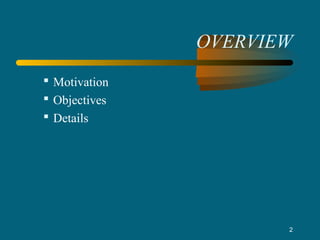
OVERVIEW
 Motivation
 Objectives
 Details
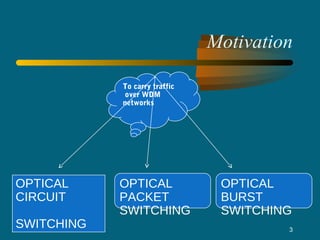
Motivation
3
To carry traffic
over WDM
networks
OPTICAL
CIRCUIT
SWITCHING
OPTICAL
BURST
SWITCHING
OPTICAL
PACKET
SWITCHING
4
Optical Circuit Switching
• Long circuit set-up (a 2-way process with
Req and Ack).
• Good for smooth traffic and QoS guarantee
due to fixed BW reservation.
• Either wasted BW during off/low-traffic
periods & too much overhead (e.g., delay)
due to frequent set-up/release (for every
burst).
5
Optical Packet Switching
• Problem is lack of optical buffer (RAM).
• Fiber delay lines (FDLs) are bulky and
provide only limited & deterministic delays.
– store-n-forward (with feed-back FDLs) leads to
fixed packet length and synchronous switching.
• Tight coupling of header and payload.
– requires stringent synchronization, and fast
processing and switching (ns or less).
6
Optical Burst Switching (OBS)
• Combines advantage of circuit & packet
switching.
• A burst has a long, variable length payload.
• It is assembled at an ingress router by
aggregating a no. of IP packets which may
be received from single host or multiple
host from same or different access network.
7
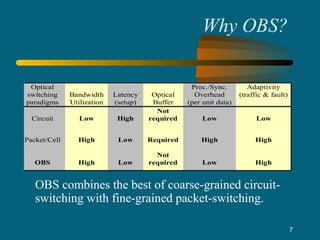
Why OBS?
Optical
switching
paradigms
Bandwidth
Utilization
Latency
(setup)
Optical
Buffer
Proc./Sync.
Overhead
(per unit data)
Adaptivity
(traffic & fault)
Circuit Low High
Not
required Low Low
Packet/Cell High Low Required High High
OBS High Low
Not
required Low High
OBS combines the best of coarse-grained circuit-
switching with fine-grained packet-switching.
Objectives
• Study of architecture of OBS.
• Study of burst assembly schemes.
• Study of burst scheduling algorithm.
• Study of contention resolution techniques.
• Study of QoS.
• Implementation.
• Analysis.
8
9
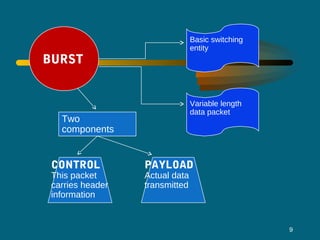
BURST
Basic switching
entity
Variable length
data packet
Two
components
PAYLOAD
Actual data
transmitted
CONTROL
This packet
carries header
information
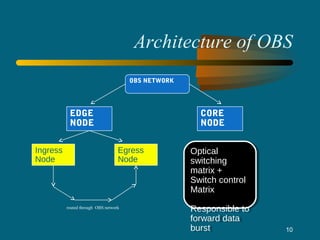
Architecture of OBS
routed through OBS network
10
OBS NETWORK
EDGE
NODE
CORE
NODE
Optical
switching
matrix +
Switch control
Matrix
Responsible to
forward data
burst
Optical
switching
matrix +
Switch control
Matrix
Responsible to
forward data
burst
Ingress
Node
Egress
Node
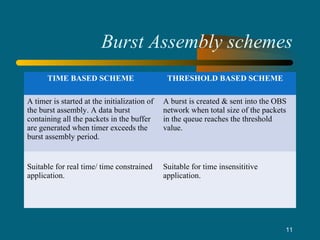
Burst Assembly schemes
TIME BASED SCHEME THRESHOLD BASED SCHEME
A timer is started at the initialization of
the burst assembly. A data burst
containing all the packets in the buffer
are generated when timer exceeds the
burst assembly period.
A burst is created & sent into the OBS
network when total size of the packets
in the queue reaches the threshold
value.
Suitable for real time/ time constrained
application.
Suitable for time insensititive
application.
11
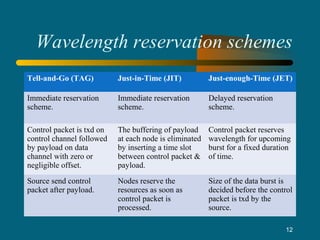
Wavelength reservation schemes
Tell-and-Go (TAG) Just-in-Time (JIT) Just-enough-Time (JET)
Immediate reservation
scheme.
Immediate reservation
scheme.
Delayed reservation
scheme.
Control packet is txd on
control channel followed
by payload on data
channel with zero or
negligible offset.
The buffering of payload
at each node is eliminated
by inserting a time slot
between control packet &
payload.
Control packet reserves
wavelength for upcoming
burst for a fixed duration
of time.
Source send control
packet after payload.
Nodes reserve the
resources as soon as
control packet is
processed.
Size of the data burst is
decided before the control
packet is txd by the
source.
12
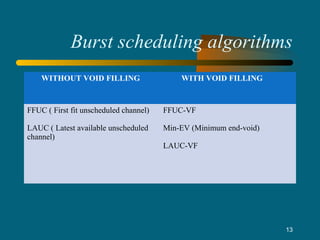
Burst scheduling algorithms
WITHOUT VOID FILLING WITH VOID FILLING
FFUC ( First fit unscheduled channel)
LAUC ( Latest available unscheduled
channel)
FFUC-VF
Min-EV (Minimum end-void)
LAUC-VF
13
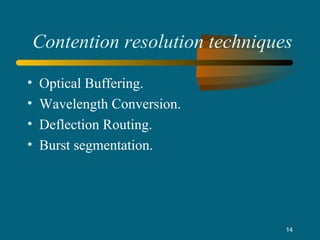
Contention resolution techniques
• Optical Buffering.
• Wavelength Conversion.
• Deflection Routing.
• Burst segmentation.
14
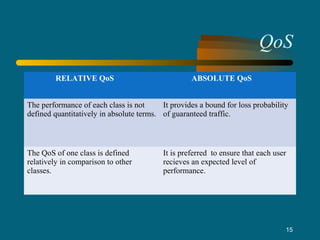
QoS
RELATIVE QoS ABSOLUTE QoS
The performance of each class is not
defined quantitatively in absolute terms.
It provides a bound for loss probability
of guaranteed traffic.
The QoS of one class is defined
relatively in comparison to other
classes.
It is preferred to ensure that each user
recieves an expected level of
performance.
15
THANK YOU. 
16

OPTICAL BURST SWITCHING

  • 1.
    1 OPTICAL BURST SWITCHING Underthe guidance of Mr. Ejaz Aslam Lodhi Indian Institute of Technology Kanpur (IITK) Submitted By Jigyasa Singh M.TECH(ECE)
  • 2.
  • 3.
    Motivation 3 To carry traffic overWDM networks OPTICAL CIRCUIT SWITCHING OPTICAL BURST SWITCHING OPTICAL PACKET SWITCHING
  • 4.
    4 Optical Circuit Switching •Long circuit set-up (a 2-way process with Req and Ack). • Good for smooth traffic and QoS guarantee due to fixed BW reservation. • Either wasted BW during off/low-traffic periods & too much overhead (e.g., delay) due to frequent set-up/release (for every burst).
  • 5.
    5 Optical Packet Switching •Problem is lack of optical buffer (RAM). • Fiber delay lines (FDLs) are bulky and provide only limited & deterministic delays. – store-n-forward (with feed-back FDLs) leads to fixed packet length and synchronous switching. • Tight coupling of header and payload. – requires stringent synchronization, and fast processing and switching (ns or less).
  • 6.
    6 Optical Burst Switching(OBS) • Combines advantage of circuit & packet switching. • A burst has a long, variable length payload. • It is assembled at an ingress router by aggregating a no. of IP packets which may be received from single host or multiple host from same or different access network.
  • 7.
    7 Why OBS? Optical switching paradigms Bandwidth Utilization Latency (setup) Optical Buffer Proc./Sync. Overhead (per unitdata) Adaptivity (traffic & fault) Circuit Low High Not required Low Low Packet/Cell High Low Required High High OBS High Low Not required Low High OBS combines the best of coarse-grained circuit- switching with fine-grained packet-switching.
  • 8.
    Objectives • Study ofarchitecture of OBS. • Study of burst assembly schemes. • Study of burst scheduling algorithm. • Study of contention resolution techniques. • Study of QoS. • Implementation. • Analysis. 8
  • 9.
    9 BURST Basic switching entity Variable length datapacket Two components PAYLOAD Actual data transmitted CONTROL This packet carries header information
  • 10.
    Architecture of OBS routedthrough OBS network 10 OBS NETWORK EDGE NODE CORE NODE Optical switching matrix + Switch control Matrix Responsible to forward data burst Optical switching matrix + Switch control Matrix Responsible to forward data burst Ingress Node Egress Node
  • 11.
    Burst Assembly schemes TIMEBASED SCHEME THRESHOLD BASED SCHEME A timer is started at the initialization of the burst assembly. A data burst containing all the packets in the buffer are generated when timer exceeds the burst assembly period. A burst is created & sent into the OBS network when total size of the packets in the queue reaches the threshold value. Suitable for real time/ time constrained application. Suitable for time insensititive application. 11
  • 12.
    Wavelength reservation schemes Tell-and-Go(TAG) Just-in-Time (JIT) Just-enough-Time (JET) Immediate reservation scheme. Immediate reservation scheme. Delayed reservation scheme. Control packet is txd on control channel followed by payload on data channel with zero or negligible offset. The buffering of payload at each node is eliminated by inserting a time slot between control packet & payload. Control packet reserves wavelength for upcoming burst for a fixed duration of time. Source send control packet after payload. Nodes reserve the resources as soon as control packet is processed. Size of the data burst is decided before the control packet is txd by the source. 12
  • 13.
    Burst scheduling algorithms WITHOUTVOID FILLING WITH VOID FILLING FFUC ( First fit unscheduled channel) LAUC ( Latest available unscheduled channel) FFUC-VF Min-EV (Minimum end-void) LAUC-VF 13
  • 14.
    Contention resolution techniques •Optical Buffering. • Wavelength Conversion. • Deflection Routing. • Burst segmentation. 14
  • 15.
    QoS RELATIVE QoS ABSOLUTEQoS The performance of each class is not defined quantitatively in absolute terms. It provides a bound for loss probability of guaranteed traffic. The QoS of one class is defined relatively in comparison to other classes. It is preferred to ensure that each user recieves an expected level of performance. 15
  • 16.