http://www.bing.com/videos/search?q=transformation+de+produit&FORM=VIRE1#view=detail&mid=C9
49375CF324DB7967ADC949375CF324DB7967AD
http://www.bing.com/videos/search?q=transformation+de+produit&FORM=VIRE1#view=detail&mid=C7942F8E2B2
BDB54CAC5C7942F8E2B2BDB54CAC5
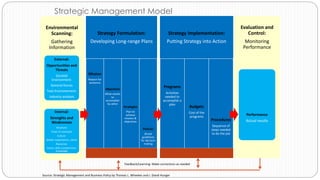
Strategic Management Model
Strategy Formulation:
Developing Long-range Plans
Mission
Reason for
existence
Objectives
What results
to
accomplish
by when
Strategies
Plan to
achieve
mission &
objectives
Policies
Broad
guidelines
for decision
making
Strategy Implementation:
Putting Strategy into Action
Programs
Activities
needed to
accomplish a
plan
Budgets
Cost of the
programs
Procedures
Sequence of
steps needed
to do the job
Environmental
Scanning:
Gathering
Information
External:
Opportunities and
Threats
Societal
Environment:
General forces
Task Environement:
Industry analysis
Internal:
Strenghts and
Weaknesses
Structure:
Chain of command
Culture:
Beliefs, expectations, values
Resources:
Assets, skills,competencies,
knowledge
Evaluation and
Control:
Monitoring
Performance
Performance
Actual results
Feedback/Learning: Make corrections as needed
Source: Strategic Management and Business Policy by Thomas L. Wheelen and J. David Hunger
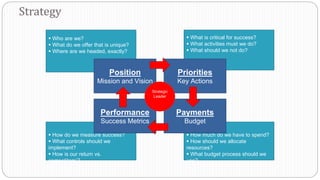
Strategy

 How do we measure success?
 What controls should we
implement?
 How is our return vs.
competitors’?

 How much do we have to spend?
 How should we allocate
resources?
 What budget process should we
use?
 What is critical for success?
 What activities must we do?
 What should we not do?
Priorities
Key Actions
Performance
Success Metrics
Payments
Budget
 Who are we?
 What do we offer that is unique?
 Where are we headed, exactly?
Position
Mission and Vision
4
Strategic
Leader
Environmental Analysis
•Economic
•Sociocultural
•Technological
•Political
Opportunities and threats
Evaluate current
Performance
•Mission
•Goals
•Objectives
•Strategies
Industry Analysis
•Structure
•Evolution
•Competition
Competitive analysis and
positioning
Strategy Options
•Business unit
•Corporate
Evaluation
•Resource requirements
•Risk/Return
Implementation
Company Analysis
•Structure
•Resources
•Processes
•Staffing
•Culture
Strengths and weaknesses
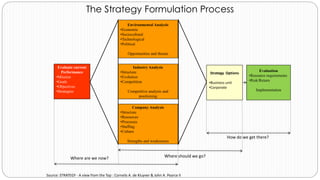
The Strategy Formulation Process
How do we get there?
Where should we go?Where are we now?
Source: STRATEGY - A view from the Top : Cornelis A. de Kluyver & John A. Pearce II
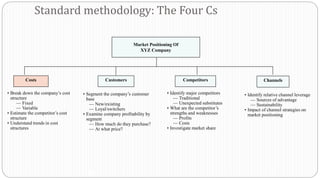
Standard methodology: The Four Cs
• Identify relative channel leverage
— Sources of advantage
— Sustainability
• Impact of channel strategies on
market positioning
Market Positioning Of
XYZ Company
• Break down the company’s cost
structure
— Fixed
— Variable
• Estimate the competitor’s cost
structure
• Understand trends in cost
structures
• Segment the company’s customer
base
— New/existing
— Loyal/switchers
• Examine company profitability by
segment
— How much do they purchase?
— At what price?
• Identify major competitors
— Traditional
— Unexpected substitutes
• What are the competitor’s
strengths and weaknesses
— Profits
— Costs
• Investigate market share
Costs Customers Competitors Channels
Tools
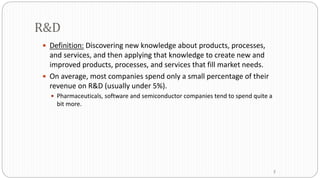
R&D
 Definition: Discovering new knowledge about products, processes,
and services, and then applying that knowledge to create new and
improved products, processes, and services that fill market needs.
 On average, most companies spend only a small percentage of their
revenue on R&D (usually under 5%).
 Pharmaceuticals, software and semiconductor companies tend to spend quite a
bit more.
7
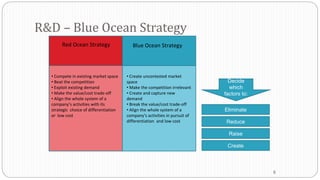
R&D – Blue Ocean Strategy
Red Ocean Strategy Blue Ocean Strategy
• Compete in existing market space
• Beat the competition
• Exploit existing demand
• Make the value/cost trade-off
• Align the whole system of a
company’s activities with its
strategic choice of differentiation
or low cost
• Create uncontested market
space
• Make the competition irrelevant
• Create and capture new
demand
• Break the value/cost trade-off
• Align the whole system of a
company’s activities in pursuit of
differentiation and low cost
Eliminate
Reduce
Raise
Create
Decide
which
factors to:
8
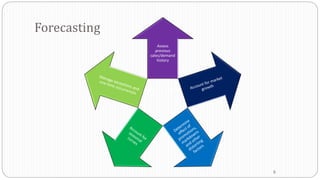
Forecasting
Assess
previous
sales/demand
history
9
Islamic banksIslamic banks
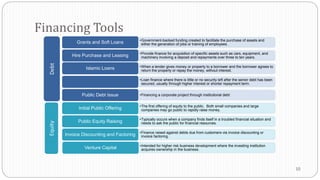
Financing Tools
10
•Government-backed funding created to facilitate the purchase of assets and
either the generation of jobs or training of employees.Grants and Soft Loans
•Provide finance for acquisition of specific assets such as cars, equipment, and
machinery involving a deposit and repayments over three to ten years.Hire Purchase and Leasing
•When a lender gives money or property to a borrower and the borrower agrees to
return the property or repay the money, without interest.
Islamic Loans
•Loan finance where there is little or no security left after the senior debt has been
secured, usually through higher interest or shorter repayment term.
•Financing a corporate project through institutional debtPublic Debt Issue
•The first offering of equity to the public. Both small companies and large
companies may go public to rapidly raise money.Initial Public Offering
•Typically occurs when a company finds itself in a troubled financial situation and
needs to ask the public for financial resources.Public Equity Raising
•Finance raised against debts due from customers via invoice discounting or
invoice factoring.Invoice Discounting and Factoring
•Intended for higher risk business development where the investing institution
acquires ownership in the business.Venture Capital
DebtEquity
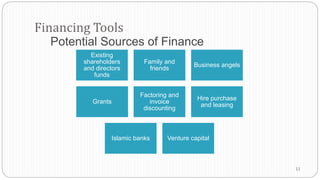
Financing Tools
11
Existing
shareholders
and directors
funds
Family and
friends
Business angels
Grants
Factoring and
invoice
discounting
Hire purchase
and leasing
Islamic banks Venture capital
Potential Sources of Finance
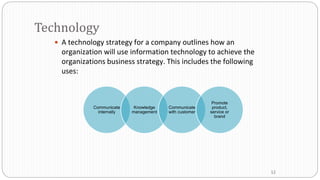
Technology
 A technology strategy for a company outlines how an
organization will use information technology to achieve the
organizations business strategy. This includes the following
uses:
Communicate
internally
Knowledge
management
Communicate
with customer
Promote
product,
service or
brand
12
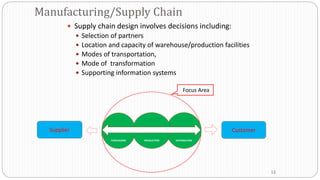
Manufacturing/Supply Chain
 Supply chain design involves decisions including:
 Selection of partners
 Location and capacity of warehouse/production facilities
 Modes of transportation,
 Mode of transformation
 Supporting information systems
13
Focus Area
CustomerSupplier
DISTRIBUTIONPRODUCTIONPURCHASING
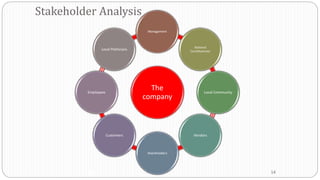
Stakeholder Analysis
The
company
Management
National
Constituencies
Local Community
Vendors
Shareholders
Customers
Employees
Local Politicians
14Tools
 Business Plan
Company Name
 Clearly state your company’s long-term mission.
 Try to use words that will help direct the growth of your company, but be as
concise as possible.
Mission Statement
 List CEO and key management by name.
 Include previous accomplishments to show that these are people with a
record of success.
 Summarize number of years of experience in this field.
The Team
 Summarize your market in the past, present, and future.
 Review those changes in market share, leadership, players, market shifts,
costs, pricing, or competition that provide the opportunity for your
company’s success.
Market Summary
 Identify problems and opportunities.
 State consumer problems, and define the nature of product/service
opportunities that are created by those problems.
Opportunities
 Summarize the key technology, concept, or strategy on which your
business is based.
Business Concept
 Summarize the competition.
 Outline your company’s competitive advantage.
Competition
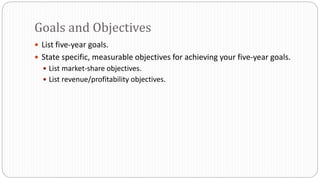
 List five-year goals.
 State specific, measurable objectives for achieving your five-year goals.
 List market-share objectives.
 List revenue/profitability objectives.
Goals and Objectives
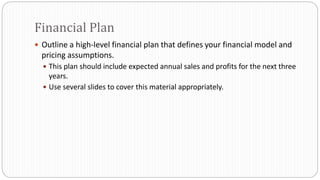
 Outline a high-level financial plan that defines your financial model and
pricing assumptions.
 This plan should include expected annual sales and profits for the next three
years.
 Use several slides to cover this material appropriately.
Financial Plan
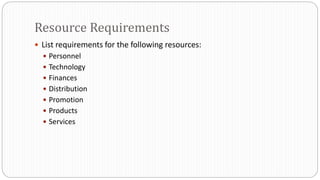
 List requirements for the following resources:
 Personnel
 Technology
 Finances
 Distribution
 Promotion
 Products
 Services
Resource Requirements
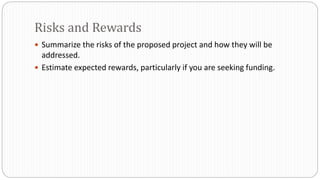
 Summarize the risks of the proposed project and how they will be
addressed.
 Estimate expected rewards, particularly if you are seeking funding.
Risks and Rewards
R&D
 Definition: Discovering new knowledge about products, processes,
and services, and then applying that knowledge to create new and
improved products, processes, and services that fill market needs.
 On average, most companies spend only a small percentage of their
revenue on R&D (usually under 5%).
 Pharmaceuticals, software and semiconductor companies tend to spend quite a
bit more.
Source: www.12manage.com
26
 Near term
 Identify key decisions and issues that need immediate or near-term
resolution.
 State consequences of decision postponement.
 Long term
 Identify issues needing long-term resolution.
 State consequences of decision postponement.
 If you are seeking funding, be specific about any issues that require
financial resources for resolution.
Key Issues
Competitors Plans
Global Competition
Substitutes
Threats
Industry Capacity
Cyclical / Seasonal
Economy
Consumer tastes
Market Trends
Market Demand
Bottlenecks
Design for manuf.
Improve Productivity
Add shifts
Acquire
Outsource
Add Capacity
Investment vs. Improvement
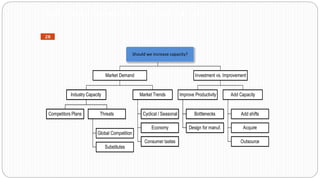
Should We Increase Capacity?
28
Case-specific Frameworks: Increase capacity
Should we increase capacity?
28
Product
Is quality sagging?
Price
Have sensitivities changed?
Overpriced versus our competition?
Place
Is our distribution getting squeezed out?
Are Customers Changing Channels?
Promotion
Are we spending?
Push vs. pull?
Has public image changed?
Company
Tastes changing?
Disposable income?
Demographics of our target?
Do new substitutes exist?
Customer
Are low cost competitors
stealing from us?
Are diffentiated competitors
stealing from us?
Are competitors integrating
into distribution and
shutting us out?
Are they offering our customers
special incentives to switch?
(particularly with substitutes)
Competition
Do new tax
incentives exist?
Any new regulations
restricting the use of our
product and favoring substitues?
Regulatory
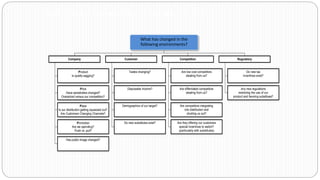
What Has Changed in
the Following Environments?
Case-specific Frameworks: Customer turnover
What has changed in the
following environments?
29
Susbsitutes
Demographic changes
New customers?
Values/Tastes
Disposable income
Mature market?
Price Sensitivity
Distribution channel
Bundled product?
Normal good?
Purchasing Habits
Customer
- What do they want?
- How do they choose?
Product
Place
Price
Promotion
Competitor
- Where are we positioned?
- Where is the competition?
Cost structure
Tangible
Intangible
Finances
Resources to respond?
Distributor
Vendor
Customer
Business relationships
Company
- How do we add value?
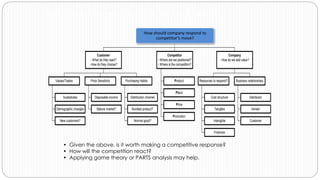
• Given the above, is it worth making a competitive response?
• How will the competition react?
• Applying game theory or PARTS analysis may help.
Case-specific Frameworks: Competitive Response
How should company respond to
competitor’s move?
30
Product
Have we done homework?
What does the segment want?
Proliferation of products already?
Price
Have we explored sensitivity?
Can we make a profit at this price?
Promotion
Push or Pull?
Cost of launch?
Will current promotions help?
Place
Is distribution aligned with customer?
Are we experienced in this channel?
Customer
Does product met a need?
Is market growing?
Can we eat the young?
Many
What wil be the strategy?
Low cost or Differentiated?
Few
Yes
Yes
Can we beat them?
No
Can we erect some?
Are there barriers to entry?
Any precious resource
that we own?
(Ricardian rents)
Will we be first movers?
No
Competition
Is there any?
Finance
Are we able to finance the launch?
Should we buy an existing producer?
Operations
D0 we have capacity?
Supply network?
Marketing
Will we cannibalize existing products?
Is this a complement / bundled good
Does it build on resources?
Company
Can we do it?
Case-specific Frameworks: New Product Introduction
Should company launch the new
product?
31
Doesit match our growth strategy?
- ROE/ROI
Alliance with local firm?
- Joint venture/distributor
Can our resources succeed overseas?
- Flexible enough to adapt?
Is organization consistent
with overseas 'autonomy'
Corporate Values
- Bribery
Worker's conditions / child labor
Internal
Cultural Differences of Customers
- Tastes / product preferences
- Values / gender roles
Methods of Conducting Business
- Introductions
- Government contacts
Educational Differences
Economy & Exchange Rates
Seasonality
- Weather
Distribution system
- Transportation infrastructure
- Different channels
Political Climate
- Instability
Local Market
- Size
- Competition
External
Amount
Timing
- Startup / disposition
- Operating
Discount Rate
Cash Flows
ROI / Hurdle Rate
Quantitative
Case-specific Frameworks: International Expansion
Should company expand internationally?
32

Saaba reflection group 2

  • 2.
  • 3.
    Strategic Management Model StrategyFormulation: Developing Long-range Plans Mission Reason for existence Objectives What results to accomplish by when Strategies Plan to achieve mission & objectives Policies Broad guidelines for decision making Strategy Implementation: Putting Strategy into Action Programs Activities needed to accomplish a plan Budgets Cost of the programs Procedures Sequence of steps needed to do the job Environmental Scanning: Gathering Information External: Opportunities and Threats Societal Environment: General forces Task Environement: Industry analysis Internal: Strenghts and Weaknesses Structure: Chain of command Culture: Beliefs, expectations, values Resources: Assets, skills,competencies, knowledge Evaluation and Control: Monitoring Performance Performance Actual results Feedback/Learning: Make corrections as needed Source: Strategic Management and Business Policy by Thomas L. Wheelen and J. David Hunger
  • 4.
    Strategy   How dowe measure success?  What controls should we implement?  How is our return vs. competitors’?   How much do we have to spend?  How should we allocate resources?  What budget process should we use?  What is critical for success?  What activities must we do?  What should we not do? Priorities Key Actions Performance Success Metrics Payments Budget  Who are we?  What do we offer that is unique?  Where are we headed, exactly? Position Mission and Vision 4 Strategic Leader
  • 5.
    Environmental Analysis •Economic •Sociocultural •Technological •Political Opportunities andthreats Evaluate current Performance •Mission •Goals •Objectives •Strategies Industry Analysis •Structure •Evolution •Competition Competitive analysis and positioning Strategy Options •Business unit •Corporate Evaluation •Resource requirements •Risk/Return Implementation Company Analysis •Structure •Resources •Processes •Staffing •Culture Strengths and weaknesses The Strategy Formulation Process How do we get there? Where should we go?Where are we now? Source: STRATEGY - A view from the Top : Cornelis A. de Kluyver & John A. Pearce II
  • 6.
    Standard methodology: TheFour Cs • Identify relative channel leverage — Sources of advantage — Sustainability • Impact of channel strategies on market positioning Market Positioning Of XYZ Company • Break down the company’s cost structure — Fixed — Variable • Estimate the competitor’s cost structure • Understand trends in cost structures • Segment the company’s customer base — New/existing — Loyal/switchers • Examine company profitability by segment — How much do they purchase? — At what price? • Identify major competitors — Traditional — Unexpected substitutes • What are the competitor’s strengths and weaknesses — Profits — Costs • Investigate market share Costs Customers Competitors Channels Tools
  • 7.
    R&D  Definition: Discoveringnew knowledge about products, processes, and services, and then applying that knowledge to create new and improved products, processes, and services that fill market needs.  On average, most companies spend only a small percentage of their revenue on R&D (usually under 5%).  Pharmaceuticals, software and semiconductor companies tend to spend quite a bit more. 7
  • 8.
    R&D – BlueOcean Strategy Red Ocean Strategy Blue Ocean Strategy • Compete in existing market space • Beat the competition • Exploit existing demand • Make the value/cost trade-off • Align the whole system of a company’s activities with its strategic choice of differentiation or low cost • Create uncontested market space • Make the competition irrelevant • Create and capture new demand • Break the value/cost trade-off • Align the whole system of a company’s activities in pursuit of differentiation and low cost Eliminate Reduce Raise Create Decide which factors to: 8
  • 9.
  • 10.
    Financing Tools 10 •Government-backed fundingcreated to facilitate the purchase of assets and either the generation of jobs or training of employees.Grants and Soft Loans •Provide finance for acquisition of specific assets such as cars, equipment, and machinery involving a deposit and repayments over three to ten years.Hire Purchase and Leasing •When a lender gives money or property to a borrower and the borrower agrees to return the property or repay the money, without interest. Islamic Loans •Loan finance where there is little or no security left after the senior debt has been secured, usually through higher interest or shorter repayment term. •Financing a corporate project through institutional debtPublic Debt Issue •The first offering of equity to the public. Both small companies and large companies may go public to rapidly raise money.Initial Public Offering •Typically occurs when a company finds itself in a troubled financial situation and needs to ask the public for financial resources.Public Equity Raising •Finance raised against debts due from customers via invoice discounting or invoice factoring.Invoice Discounting and Factoring •Intended for higher risk business development where the investing institution acquires ownership in the business.Venture Capital DebtEquity
  • 11.
    Financing Tools 11 Existing shareholders and directors funds Familyand friends Business angels Grants Factoring and invoice discounting Hire purchase and leasing Islamic banks Venture capital Potential Sources of Finance
  • 12.
    Technology  A technologystrategy for a company outlines how an organization will use information technology to achieve the organizations business strategy. This includes the following uses: Communicate internally Knowledge management Communicate with customer Promote product, service or brand 12
  • 13.
    Manufacturing/Supply Chain  Supplychain design involves decisions including:  Selection of partners  Location and capacity of warehouse/production facilities  Modes of transportation,  Mode of transformation  Supporting information systems 13 Focus Area CustomerSupplier DISTRIBUTIONPRODUCTIONPURCHASING
  • 14.
  • 15.
  • 16.
     Clearly stateyour company’s long-term mission.  Try to use words that will help direct the growth of your company, but be as concise as possible. Mission Statement
  • 17.
     List CEOand key management by name.  Include previous accomplishments to show that these are people with a record of success.  Summarize number of years of experience in this field. The Team
  • 18.
     Summarize yourmarket in the past, present, and future.  Review those changes in market share, leadership, players, market shifts, costs, pricing, or competition that provide the opportunity for your company’s success. Market Summary
  • 19.
     Identify problemsand opportunities.  State consumer problems, and define the nature of product/service opportunities that are created by those problems. Opportunities
  • 20.
     Summarize thekey technology, concept, or strategy on which your business is based. Business Concept
  • 21.
     Summarize thecompetition.  Outline your company’s competitive advantage. Competition
  • 22.
     List five-yeargoals.  State specific, measurable objectives for achieving your five-year goals.  List market-share objectives.  List revenue/profitability objectives. Goals and Objectives
  • 23.
     Outline ahigh-level financial plan that defines your financial model and pricing assumptions.  This plan should include expected annual sales and profits for the next three years.  Use several slides to cover this material appropriately. Financial Plan
  • 24.
     List requirementsfor the following resources:  Personnel  Technology  Finances  Distribution  Promotion  Products  Services Resource Requirements
  • 25.
     Summarize therisks of the proposed project and how they will be addressed.  Estimate expected rewards, particularly if you are seeking funding. Risks and Rewards
  • 26.
    R&D  Definition: Discoveringnew knowledge about products, processes, and services, and then applying that knowledge to create new and improved products, processes, and services that fill market needs.  On average, most companies spend only a small percentage of their revenue on R&D (usually under 5%).  Pharmaceuticals, software and semiconductor companies tend to spend quite a bit more. Source: www.12manage.com 26
  • 27.
     Near term Identify key decisions and issues that need immediate or near-term resolution.  State consequences of decision postponement.  Long term  Identify issues needing long-term resolution.  State consequences of decision postponement.  If you are seeking funding, be specific about any issues that require financial resources for resolution. Key Issues
  • 28.
    Competitors Plans Global Competition Substitutes Threats IndustryCapacity Cyclical / Seasonal Economy Consumer tastes Market Trends Market Demand Bottlenecks Design for manuf. Improve Productivity Add shifts Acquire Outsource Add Capacity Investment vs. Improvement Should We Increase Capacity? 28 Case-specific Frameworks: Increase capacity Should we increase capacity? 28
  • 29.
    Product Is quality sagging? Price Havesensitivities changed? Overpriced versus our competition? Place Is our distribution getting squeezed out? Are Customers Changing Channels? Promotion Are we spending? Push vs. pull? Has public image changed? Company Tastes changing? Disposable income? Demographics of our target? Do new substitutes exist? Customer Are low cost competitors stealing from us? Are diffentiated competitors stealing from us? Are competitors integrating into distribution and shutting us out? Are they offering our customers special incentives to switch? (particularly with substitutes) Competition Do new tax incentives exist? Any new regulations restricting the use of our product and favoring substitues? Regulatory What Has Changed in the Following Environments? Case-specific Frameworks: Customer turnover What has changed in the following environments? 29
  • 30.
    Susbsitutes Demographic changes New customers? Values/Tastes Disposableincome Mature market? Price Sensitivity Distribution channel Bundled product? Normal good? Purchasing Habits Customer - What do they want? - How do they choose? Product Place Price Promotion Competitor - Where are we positioned? - Where is the competition? Cost structure Tangible Intangible Finances Resources to respond? Distributor Vendor Customer Business relationships Company - How do we add value? • Given the above, is it worth making a competitive response? • How will the competition react? • Applying game theory or PARTS analysis may help. Case-specific Frameworks: Competitive Response How should company respond to competitor’s move? 30
  • 31.
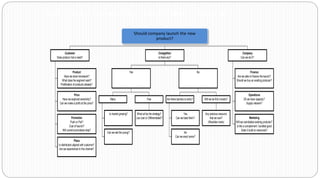
    Product Have we donehomework? What does the segment want? Proliferation of products already? Price Have we explored sensitivity? Can we make a profit at this price? Promotion Push or Pull? Cost of launch? Will current promotions help? Place Is distribution aligned with customer? Are we experienced in this channel? Customer Does product met a need? Is market growing? Can we eat the young? Many What wil be the strategy? Low cost or Differentiated? Few Yes Yes Can we beat them? No Can we erect some? Are there barriers to entry? Any precious resource that we own? (Ricardian rents) Will we be first movers? No Competition Is there any? Finance Are we able to finance the launch? Should we buy an existing producer? Operations D0 we have capacity? Supply network? Marketing Will we cannibalize existing products? Is this a complement / bundled good Does it build on resources? Company Can we do it? Case-specific Frameworks: New Product Introduction Should company launch the new product? 31
  • 32.
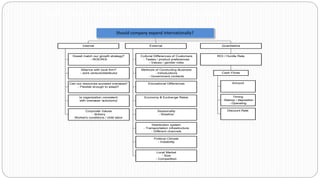
    Doesit match ourgrowth strategy? - ROE/ROI Alliance with local firm? - Joint venture/distributor Can our resources succeed overseas? - Flexible enough to adapt? Is organization consistent with overseas 'autonomy' Corporate Values - Bribery Worker's conditions / child labor Internal Cultural Differences of Customers - Tastes / product preferences - Values / gender roles Methods of Conducting Business - Introductions - Government contacts Educational Differences Economy & Exchange Rates Seasonality - Weather Distribution system - Transportation infrastructure - Different channels Political Climate - Instability Local Market - Size - Competition External Amount Timing - Startup / disposition - Operating Discount Rate Cash Flows ROI / Hurdle Rate Quantitative Case-specific Frameworks: International Expansion Should company expand internationally? 32