Procurement
Transformat ion St rat egy:
Prepared by: SShepperson
Procurement becomes a key enabler in achieving corporate objectives in
today?s challenging environment. As organisations continue to face highly
dynamic and increasingly, complex operating environments new solutions are
required to achieve competitive advantage.
Procurement is important and is strategic because firstly it affects the Gross
Profit through the products that are procured for resell.
Furthermore, procurement affects Indirect spend as well, and this dictates the
operating profit achieved.
Additionally, EBITDA, Cashflow and Capex are affected by Procurement.
So competitive advantage of an organisation is linked to Differentiation and
Cost, and so Procurement to a large extent dictates the group's success or lack
of it.
The procurement strategy is the heart of procurement, and the importance
that it should be 100% aligned to corporate strategy and objectives cannot be
overstated.
It is paramount for the Exco to recognise the actual business and
organisational impact of procurement and that at its core it supports
sustainable competitive advantage and long-term survival of the organisation.
Transforming procurement involves sending the message about the
importance of efficient procurement beyond the immediate function.
Procurement transformation requires strengthening team competencies and
building skills that provide a high return on investment (ROI). The importance
of communication and transparency are often underestimated, and negative
perceptions among employees can become the key barriers to change.
The ability to manage change and transform
procurement is key to business success.
ALIGNINGPROCUREMENT AND BUSINESS
GOALS
The centralised procurement organisation employs category managers,
contract specialists and buyers, while in the decentralised operating
company procurement is limited to tactical support activities.
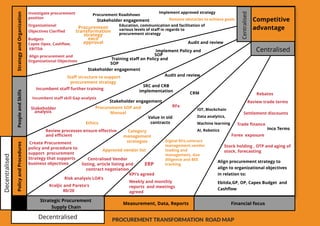
PROCUREMENT TRANSFORMATION ROAD MAP
St rat egic Procurement
Supply Chain
Measurement , Dat a, Report s
Organizat ional
Object ives Clarified
Align procurement and
Organizat ional Object ives
Procurement
t ransformat ion
st rat egy
exco
approval
St aff st ruct ure t o support
procurement st rat egy
Incumbent st aff skill Gap analysis
St akeholder
analysis
Procurement Roadshows
Budget s
Capex Opex, Cashflow,
EBITDA
Creat e Procurement
policy and procedure t o
support procurement
St rat egy t hat support s
business object ives
Procurement SOP and
Manual
Training st aff on Policy and
SOP
Implement Policy and
SOP
Incumbent st aff furt her t raining
Implement approved st rat egy
Educat ion, communicat ion and facilit at ion of
various levels of st aff in regards t o
procurement st rat egy
Remove obst acles t o achieve goals
Invest igat e procurement
posit ion
SRC and CRB
implement at ion
Cat egory
management
st rat egies
Risk analysis LOA's
Kraljic and Paret o's
80/20
CRM
Cent ralised Vendor
list ing, art icle list ing and
cont ract negot iat ion
Approved vendor list
RFx
Financial focus
Trade finance
Digit al RFx,cont ract
management ,vendor
loading and
management , due
diligence and BEE
t racking
KPI's agreed
Weekly and mont hly
report s and meet ings
agreed
Inco Terms
Align procurement st rat egy t o
align t o organizat ional object ives
in relat ion t o:
Ebit da,GP, OP, Capex Budget and
Cashflow
Value in old
cont ract s
Set t lement discount s
Review t rade t erms
Forex exposure
Rebat es
St ock holding , OTP and aging of
st ock, forecast ing
Compet it ive
advant age
IOT, Blockchain
Dat a analyt ics,
Machine learning
AI, Robot ics
ERP
Review processes ensure effect ive
and efficient
Et hics
Centralised
Decentralised
Audit and review
Audit and review
St akeholder engagement
Explain the REASON behind the Change and set a goal to achieve:
Examine market and competitive realities, identify and discuss
crises, potential crises or major opportunities.
Create Implementation Steerco:
Assemble a group with enough Authority, Mandate or Power to
lead the change effort and encourage it to work as a team
Develop a Transformation Implementation plan:
Create a vision to direct the change effort and develop
strategies for realising the vision.
Communicate the change vision and Plan:
Use every channel and vehicle possible to communicate the
vision and strategy.
Empower action:
Remove obstacles to change, change systems or structures that
seriously undermine or hinder the vision and encourage
creative and non-traditional ideas, activities and actions.
Generate short-term wins:
Plan for visible performance improvements, create those
improvements and recognise and reward employees involved in
the improvements.
Consolidate gainsand produce more change:
Use increased credibility to change systems, structures and
policies that don't fit the vision.Hire, promote, and develop
employees who can implement the vision and reinvigorate the
process with new projects, themes and change agents.
Anchor new approachesin the culture:
Articulate the connections between the new behaviours
and organisational success and develop the means to
ensure leadership development and succession.
TRANSFORMATION:
HOW TO IMPLEMENT ? Exco
Unilateral buy
in
The strategy phase
Action Plans
Implementation
Measurement and
Reporting. Continious
tracking and remedial /
Disciplinary action to
endure implementation
Although change is
challenging, rationally
provable benefits for
organisations can be
substantial if the process is
carefully planned and
executed.
Procurement
transformation is not only
about reducing costs, but it
can also benefit employees
by creating new
opportunities to improve
existing skills, learn and
assume more responsibility
for projects that add value.
The Performance
Monitoring and measuring
of business alignment and
stakeholder engagement
with the aim to demonstrate
a clear linkage between
business strategy,
achievement of
organisational goals and
procurement initiatives.
The St rat egic Transformat ion Process is support ed by
t he following.
1. Trust , t ransparency, engagement and collect ive
ownership.
2. Effect ive communicat ion and collaborat ion
st rat egies wit h st akeholders needs t o be
sust ained.
3. St andard language policies and Procedures for
all t hose involved in t he change.
4. There has t o be appreciat ion, underst anding
and address resist ance by providing a safe
place for aut hent ic dialogue over import ant
and crit ical issues t hat could result in conflict .
5. Full alignment of personnel, processes,
st ruct ures, wit h t he st rat egic change, is
paramount for result s.
6. Efficient performance management syst ems
are needed, t hey need t o be meaningful,
flexible, fast and learning-orient ed.
7. There must be a focus on successful
st akeholder part nerships and a change-cent ric
cult ure t hat welcomes change and openness
need t o nurt ure.
8. Furt hermore, leaders must cont inually
reinforce an organisat ional climat e t hat is
conducive and open t o change.
TRANSFORMATION:
WHAT NEXT ?
Procurement Transformation Strategy: Decentralised to Centralised

Procurement Transformation Strategy: Decentralised to Centralised

  • 1.
    Procurement Transformat ion Strat egy: Prepared by: SShepperson
  • 2.
    Procurement becomes akey enabler in achieving corporate objectives in today?s challenging environment. As organisations continue to face highly dynamic and increasingly, complex operating environments new solutions are required to achieve competitive advantage. Procurement is important and is strategic because firstly it affects the Gross Profit through the products that are procured for resell. Furthermore, procurement affects Indirect spend as well, and this dictates the operating profit achieved. Additionally, EBITDA, Cashflow and Capex are affected by Procurement. So competitive advantage of an organisation is linked to Differentiation and Cost, and so Procurement to a large extent dictates the group's success or lack of it. The procurement strategy is the heart of procurement, and the importance that it should be 100% aligned to corporate strategy and objectives cannot be overstated. It is paramount for the Exco to recognise the actual business and organisational impact of procurement and that at its core it supports sustainable competitive advantage and long-term survival of the organisation. Transforming procurement involves sending the message about the importance of efficient procurement beyond the immediate function. Procurement transformation requires strengthening team competencies and building skills that provide a high return on investment (ROI). The importance of communication and transparency are often underestimated, and negative perceptions among employees can become the key barriers to change. The ability to manage change and transform procurement is key to business success. ALIGNINGPROCUREMENT AND BUSINESS GOALS The centralised procurement organisation employs category managers, contract specialists and buyers, while in the decentralised operating company procurement is limited to tactical support activities.
  • 3.
    PROCUREMENT TRANSFORMATION ROADMAP St rat egic Procurement Supply Chain Measurement , Dat a, Report s Organizat ional Object ives Clarified Align procurement and Organizat ional Object ives Procurement t ransformat ion st rat egy exco approval St aff st ruct ure t o support procurement st rat egy Incumbent st aff skill Gap analysis St akeholder analysis Procurement Roadshows Budget s Capex Opex, Cashflow, EBITDA Creat e Procurement policy and procedure t o support procurement St rat egy t hat support s business object ives Procurement SOP and Manual Training st aff on Policy and SOP Implement Policy and SOP Incumbent st aff furt her t raining Implement approved st rat egy Educat ion, communicat ion and facilit at ion of various levels of st aff in regards t o procurement st rat egy Remove obst acles t o achieve goals Invest igat e procurement posit ion SRC and CRB implement at ion Cat egory management st rat egies Risk analysis LOA's Kraljic and Paret o's 80/20 CRM Cent ralised Vendor list ing, art icle list ing and cont ract negot iat ion Approved vendor list RFx Financial focus Trade finance Digit al RFx,cont ract management ,vendor loading and management , due diligence and BEE t racking KPI's agreed Weekly and mont hly report s and meet ings agreed Inco Terms Align procurement st rat egy t o align t o organizat ional object ives in relat ion t o: Ebit da,GP, OP, Capex Budget and Cashflow Value in old cont ract s Set t lement discount s Review t rade t erms Forex exposure Rebat es St ock holding , OTP and aging of st ock, forecast ing Compet it ive advant age IOT, Blockchain Dat a analyt ics, Machine learning AI, Robot ics ERP Review processes ensure effect ive and efficient Et hics Centralised Decentralised Audit and review Audit and review St akeholder engagement St akeholder engagement St akeholder engagement
  • 4.
    Explain the REASONbehind the Change and set a goal to achieve: Examine market and competitive realities, identify and discuss crises, potential crises or major opportunities. Create Implementation Steerco: Assemble a group with enough Authority, Mandate or Power to lead the change effort and encourage it to work as a team Develop a Transformation Implementation plan: Create a vision to direct the change effort and develop strategies for realising the vision. Communicate the change vision and Plan: Use every channel and vehicle possible to communicate the vision and strategy. Empower action: Remove obstacles to change, change systems or structures that seriously undermine or hinder the vision and encourage creative and non-traditional ideas, activities and actions. Generate short-term wins: Plan for visible performance improvements, create those improvements and recognise and reward employees involved in the improvements. Consolidate gainsand produce more change: Use increased credibility to change systems, structures and policies that don't fit the vision.Hire, promote, and develop employees who can implement the vision and reinvigorate the process with new projects, themes and change agents. Anchor new approachesin the culture: Articulate the connections between the new behaviours and organisational success and develop the means to ensure leadership development and succession. TRANSFORMATION: HOW TO IMPLEMENT ? Exco Unilateral buy in The strategy phase Action Plans Implementation Measurement and Reporting. Continious tracking and remedial / Disciplinary action to endure implementation
  • 5.
    Although change is challenging,rationally provable benefits for organisations can be substantial if the process is carefully planned and executed. Procurement transformation is not only about reducing costs, but it can also benefit employees by creating new opportunities to improve existing skills, learn and assume more responsibility for projects that add value. The Performance Monitoring and measuring of business alignment and stakeholder engagement with the aim to demonstrate a clear linkage between business strategy, achievement of organisational goals and procurement initiatives. The St rat egic Transformat ion Process is support ed by t he following. 1. Trust , t ransparency, engagement and collect ive ownership. 2. Effect ive communicat ion and collaborat ion st rat egies wit h st akeholders needs t o be sust ained. 3. St andard language policies and Procedures for all t hose involved in t he change. 4. There has t o be appreciat ion, underst anding and address resist ance by providing a safe place for aut hent ic dialogue over import ant and crit ical issues t hat could result in conflict . 5. Full alignment of personnel, processes, st ruct ures, wit h t he st rat egic change, is paramount for result s. 6. Efficient performance management syst ems are needed, t hey need t o be meaningful, flexible, fast and learning-orient ed. 7. There must be a focus on successful st akeholder part nerships and a change-cent ric cult ure t hat welcomes change and openness need t o nurt ure. 8. Furt hermore, leaders must cont inually reinforce an organisat ional climat e t hat is conducive and open t o change. TRANSFORMATION: WHAT NEXT ?