Accounting Issues in Hotels Dr. Ruth Mattimoe DCU Business School ©
Important questions to consider Q1:   How are some hotels more profitable than others, even within same grade and in similar location? Does the answer lie in revenue based issues alone? Q2:  Do hoteliers know which guests are profitable for them to serve? Guests generate revenue, but also create cost. Cost to serve them and cost to market to them. Can we identify these costs with guest segments and individual guests? Are guests with high sales volume highly profitable?
Questions of interest (1) What are the superior performing hotels doing to produce higher profits? The simple answer to enhancing profits is to increase revenues and reduce costs. Rather more difficult is to identify what precise methods and techniques can be employed and the extent to which these can be utilised in different markets and styles of hotel
Q1: Croston (1995) Research by Croston (1995) His hypothesis was that similarly sized hotels, offering a comparable range of facilities and amenities, located in close proximity to each other, and operated by an internationally recognised brand, ought to produce comparable levels of profit. To test this hypothesis, 10 pairs of hotels were selected from 10 European cities, which met the criteria set out. Then, the more profitable hotels from each pairing were grouped together as winners, while the all of the less profitable hotels were grouped together as losers. The screening criteria did not seek to identify hotels with dramatically different profitability profiles, in fact, quite the reverse was the case
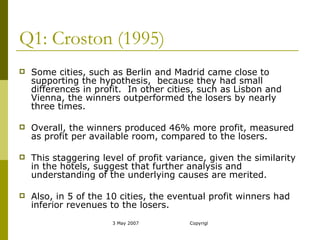
Q1: Croston (1995) Some cities, such as Berlin and Madrid came close to supporting the hypothesis,  because they had small differences in profit.  In other cities, such as Lisbon and Vienna, the winners outperformed the losers by nearly three times.  Overall, the winners produced 46% more profit, measured as profit per available room, compared to the losers. This staggering level of profit variance, given the similarity in the hotels, suggest that further analysis and understanding of the underlying causes are merited. Also, in 5 of the 10 cities, the eventual profit winners had inferior revenues to the losers.
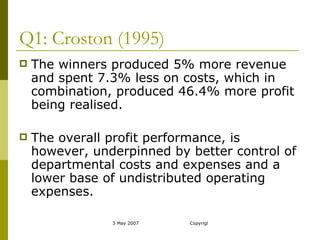
Q1: Croston (1995) The winners produced 5% more revenue and spent 7.3% less on costs, which in combination, produced 46.4% more profit being realised. The overall profit performance, is however, underpinned by better control of departmental costs and expenses and a lower base of undistributed operating expenses.
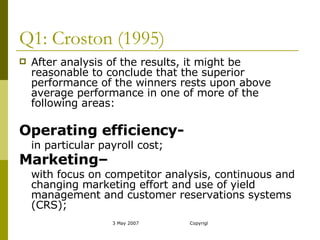
Q1: Croston (1995) After analysis of the results, it might be reasonable to conclude that the superior performance of the winners rests upon above average performance in one of more of the following areas: Operating efficiency-   in particular payroll cost; Marketing–   with focus on competitor analysis, continuous and changing marketing effort and use of yield management and customer reservations systems (CRS);
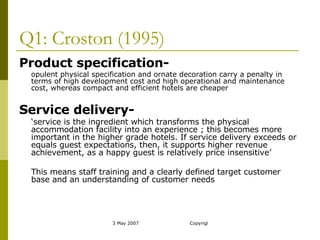
Q1: Croston (1995) Product specification-  opulent physical specification and ornate decoration carry a penalty in terms of high development cost and high operational and maintenance cost, whereas compact and efficient hotels are cheaper Service delivery- ‘ service is the ingredient which transforms the physical accommodation facility into an experience ; this becomes more important in the higher grade hotels. If service delivery exceeds or equals guest expectations, then, it supports higher revenue achievement, as a happy guest is relatively price insensitive’ This means staff training and a clearly defined target customer base and an understanding of customer needs
Q1: Some answers from Croston An important conclusion was drawn by Croston (1995, p.314) in the study: “ The complexity and inter-dependence of the issues and activities which contribute to superior profitability serve to emphasise that  success is a journey, not a destination .  In an ever more complex and dynamic marketplace, hoteliers will increasingly be required fundamentally to re-evaluate their methods of generating revenues and the means of reducing costs"
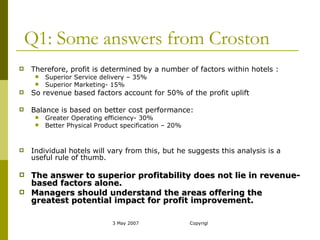
Q1: Some answers from Croston Therefore, profit is determined by a number of factors within hotels : Superior Service delivery – 35% Superior Marketing- 15% So revenue based factors account for 50% of the profit uplift Balance is based on better cost performance: Greater Operating efficiency- 30% Better Physical Product specification – 20% Individual hotels will vary from this, but he suggests this analysis is a useful rule of thumb. The answer to superior profitability does not lie in revenue-based factors alone.  Managers should understand the areas offering the greatest potential impact for profit improvement.
Q1: Harris (2006)-some answers The  effectiveness of managerial decision-making can enhance operational profitability  in hospitality operations He asks:- Can accountants  understand the product  and can operational managers in hotels understand the  accounting information? If managers are not able to see the relevance of financial information, or relate to financial information in operational terms, the perception of its value is diminished.
Q1 : Harris (2006) He suggests a  profit planning framework , which will help to provide more relevant  financial  information for decision-making. He suggests that this is not provided by the Uniform System of Hotel Accounts (USAH) framework, because this has a control emphasis and an upward reporting emphasis What is vital to Harris’s framework is an  understanding of cost behaviour and the ability to separate variable costs from fixed costs in the total cost structure of the hotel .
Q1: Harris (2006) Once cost and revenue behaviour patterns are established, it becomes possible to develop flexible budgets and  apply a range of cost volume profit (CVP) techniques  work out break even thresholds,  consider various profit and loss scenarios and  profit multiplier profiles (those factors, such as price, volume of sales, labour cost etc to which profit is most sensitive)  … all of which have a significant role to play in the decision-making process.
Q1: Harris (2006) Example The knowledge of cost behaviour helps to understand that the  more de-luxe  hotels will have  more fixed costs  and less variable costs in the total cost structure due to High cost locations Higher property and furnishing specifications More permanent highly-paid highly skilled labour to satisfy the quality of service demanded So, will require to have a  market/revenue   orientation , since they have a  higher break even point
Q1: Harris (2006) Example Hotels with high proportions of variable costs and  relatively lower fixed costs  in the total cost structure such as in budget hotels or in a hotels with more restaurant/bar/function room activity than rooms activity  will be cost oriented and will have lower break even point . However, up market hotels with a relatively small no of rooms offering extensive restaurant, banqueting and room service facilities, may display a lower fixed cost structure and therefore, tend to be cost-oriented.  Likewise, limited service budget hotels with restricted restaurant facilities, will have a high fixed cost structure, due to the dominance of the rooms activity and a subsequent lack of variable costs associated with the food and beverage services, resulting in a market oriented business
Q1: Harris (2006): Some answers This re-inforces the need for hotels to work out  break even point  and be aware of the  business orientation  of their hotel (market or cost) in the context of the hotel product. This knowledge can then drive performance measurement and management and lead to more informed decisions by the hoteliers AND BETTER PROFITS!
Q2: Krahmal (2006) and Collini (2006) Hotels have become more customer and service orientated, frequently investing capital and labour in their customer base. Are we aware of the  costs incurred as a result of the decisions  taken by management? In an effort to delight customers, companies often overlook whether they are actually making money from the “business of providing additional delight”  (Kaplan and Narayanan 2001)
Q2: Krahmal (2006) Are we aware of the costs incurred in relation to attracting  particular guest segments  to our hotel? Costs to market to customers and Costs to serve customers How can we add value to each customer relationship Can we transform unprofitable customers into profitable ones?
Krahmal (2006) Revenue does not contribute equally to profit- Profitability depends not only on the unit cost of a product or service, but also on the extra services required. Customer profitability analysis (CPA) is a very important new technique in management accounting, which is being applied to a growing no of industries. However, this type of information is not  routinely provided.
Krahmal (2006) Some customers may not be profitable for hotels even if they have high sales volume;  Hotels need to understand the drivers of individual customer profitability CPA is particularly useful in hotels, because the  costs of providing a service are usually determined by customer behaviour. But, these customer-related costs are hard to trace and have been elusive and difficult to capture and rarely drilled down to the customer level
Q2 : Krahmal (2006) Managerial accounting systems have traditionally focussed on the product or service line costs, due to compliance with regulatory financial accounting rules. But increasing tailoring and customisation for individuals, means that the  cost- to –serve component of each customer’s profit contribution requires measurement and visibility. Revenues and costs must be recorded not as traditionally done so, by operating and service departments, but by customer group.  The accounting technique of Activity Based costing (ABC) can help to do this.
Q2: Noone (1997) The only Irish study on this issue in hotels is that by Noone (1997) who applied her own Activity-Based CPA model very successfully to a 3-star 50-100 room city centre Dublin hotel site.   The results of her analysis at the site showed that  38% of the revenue generated  was contributing to 137% of total profits .  Her (1997) study has resulted in the availability of cost and revenue data by customer group, previously inaccessible to management, at her case site.
Q2: Noone The actual sources of information used for decision-making at Noone's (1997) site were the profit and loss account, occupancy statistics and forward bookings by customer group NOT CPA.  The managing director at the site felt that, despite the lack of CPA information,  management experience and intuition would supplement existing information sources and would be enough for decision-making.
Q2: Noone (1997) However, when asked to estimate revenues and profits generated by the different customer groups, and when results were compared to the researcher’s computer generated CPA model,  some significant differences  arose.  It was clear that: Management when acting as a team, had a  good insight  into the  revenues  generated by customer groups, but they had  difficulty  both collectively and individually gauging the  profitability  of customer groups.  (Noone 1997, p.127)
Q2: Noone Also, 'the concept of CPA, using ABC, is in its infancy in the hotel environment' (Noone 1997, p.135).  It is clear that insufficient information exists within the (Irish) hotel sector to make profitable customer decisions and this information deficit is widespread.  Krahmal (2006)agrees “most (UK) hotel companies still do not calculate CPA and neither have they installed the systems required”
Q2: Some answers The danger of not having a fully implemented CPA system is the possibility of mistaken management decisions… Therefore, to assure correct accounting for the customer relationship,  a much closer relationship is required between the accounting department and all other departments of the hotel, than heretofore…

Slides: Dr. Ruth Mattimoe

  • 1.
    Accounting Issues inHotels Dr. Ruth Mattimoe DCU Business School ©
  • 2.
    Important questions toconsider Q1: How are some hotels more profitable than others, even within same grade and in similar location? Does the answer lie in revenue based issues alone? Q2: Do hoteliers know which guests are profitable for them to serve? Guests generate revenue, but also create cost. Cost to serve them and cost to market to them. Can we identify these costs with guest segments and individual guests? Are guests with high sales volume highly profitable?
  • 3.
    Questions of interest(1) What are the superior performing hotels doing to produce higher profits? The simple answer to enhancing profits is to increase revenues and reduce costs. Rather more difficult is to identify what precise methods and techniques can be employed and the extent to which these can be utilised in different markets and styles of hotel
  • 4.
    Q1: Croston (1995)Research by Croston (1995) His hypothesis was that similarly sized hotels, offering a comparable range of facilities and amenities, located in close proximity to each other, and operated by an internationally recognised brand, ought to produce comparable levels of profit. To test this hypothesis, 10 pairs of hotels were selected from 10 European cities, which met the criteria set out. Then, the more profitable hotels from each pairing were grouped together as winners, while the all of the less profitable hotels were grouped together as losers. The screening criteria did not seek to identify hotels with dramatically different profitability profiles, in fact, quite the reverse was the case
  • 5.
    Q1: Croston (1995)Some cities, such as Berlin and Madrid came close to supporting the hypothesis, because they had small differences in profit. In other cities, such as Lisbon and Vienna, the winners outperformed the losers by nearly three times. Overall, the winners produced 46% more profit, measured as profit per available room, compared to the losers. This staggering level of profit variance, given the similarity in the hotels, suggest that further analysis and understanding of the underlying causes are merited. Also, in 5 of the 10 cities, the eventual profit winners had inferior revenues to the losers.
  • 6.
    Q1: Croston (1995)The winners produced 5% more revenue and spent 7.3% less on costs, which in combination, produced 46.4% more profit being realised. The overall profit performance, is however, underpinned by better control of departmental costs and expenses and a lower base of undistributed operating expenses.
  • 7.
    Q1: Croston (1995)After analysis of the results, it might be reasonable to conclude that the superior performance of the winners rests upon above average performance in one of more of the following areas: Operating efficiency- in particular payroll cost; Marketing– with focus on competitor analysis, continuous and changing marketing effort and use of yield management and customer reservations systems (CRS);
  • 8.
    Q1: Croston (1995)Product specification- opulent physical specification and ornate decoration carry a penalty in terms of high development cost and high operational and maintenance cost, whereas compact and efficient hotels are cheaper Service delivery- ‘ service is the ingredient which transforms the physical accommodation facility into an experience ; this becomes more important in the higher grade hotels. If service delivery exceeds or equals guest expectations, then, it supports higher revenue achievement, as a happy guest is relatively price insensitive’ This means staff training and a clearly defined target customer base and an understanding of customer needs
  • 9.
    Q1: Some answersfrom Croston An important conclusion was drawn by Croston (1995, p.314) in the study: “ The complexity and inter-dependence of the issues and activities which contribute to superior profitability serve to emphasise that success is a journey, not a destination . In an ever more complex and dynamic marketplace, hoteliers will increasingly be required fundamentally to re-evaluate their methods of generating revenues and the means of reducing costs"
  • 10.
    Q1: Some answersfrom Croston Therefore, profit is determined by a number of factors within hotels : Superior Service delivery – 35% Superior Marketing- 15% So revenue based factors account for 50% of the profit uplift Balance is based on better cost performance: Greater Operating efficiency- 30% Better Physical Product specification – 20% Individual hotels will vary from this, but he suggests this analysis is a useful rule of thumb. The answer to superior profitability does not lie in revenue-based factors alone. Managers should understand the areas offering the greatest potential impact for profit improvement.
  • 11.
    Q1: Harris (2006)-someanswers The effectiveness of managerial decision-making can enhance operational profitability in hospitality operations He asks:- Can accountants understand the product and can operational managers in hotels understand the accounting information? If managers are not able to see the relevance of financial information, or relate to financial information in operational terms, the perception of its value is diminished.
  • 12.
    Q1 : Harris(2006) He suggests a profit planning framework , which will help to provide more relevant financial information for decision-making. He suggests that this is not provided by the Uniform System of Hotel Accounts (USAH) framework, because this has a control emphasis and an upward reporting emphasis What is vital to Harris’s framework is an understanding of cost behaviour and the ability to separate variable costs from fixed costs in the total cost structure of the hotel .
  • 13.
    Q1: Harris (2006)Once cost and revenue behaviour patterns are established, it becomes possible to develop flexible budgets and apply a range of cost volume profit (CVP) techniques work out break even thresholds, consider various profit and loss scenarios and profit multiplier profiles (those factors, such as price, volume of sales, labour cost etc to which profit is most sensitive) … all of which have a significant role to play in the decision-making process.
  • 14.
    Q1: Harris (2006)Example The knowledge of cost behaviour helps to understand that the more de-luxe hotels will have more fixed costs and less variable costs in the total cost structure due to High cost locations Higher property and furnishing specifications More permanent highly-paid highly skilled labour to satisfy the quality of service demanded So, will require to have a market/revenue orientation , since they have a higher break even point
  • 15.
    Q1: Harris (2006)Example Hotels with high proportions of variable costs and relatively lower fixed costs in the total cost structure such as in budget hotels or in a hotels with more restaurant/bar/function room activity than rooms activity will be cost oriented and will have lower break even point . However, up market hotels with a relatively small no of rooms offering extensive restaurant, banqueting and room service facilities, may display a lower fixed cost structure and therefore, tend to be cost-oriented. Likewise, limited service budget hotels with restricted restaurant facilities, will have a high fixed cost structure, due to the dominance of the rooms activity and a subsequent lack of variable costs associated with the food and beverage services, resulting in a market oriented business
  • 16.
    Q1: Harris (2006):Some answers This re-inforces the need for hotels to work out break even point and be aware of the business orientation of their hotel (market or cost) in the context of the hotel product. This knowledge can then drive performance measurement and management and lead to more informed decisions by the hoteliers AND BETTER PROFITS!
  • 17.
    Q2: Krahmal (2006)and Collini (2006) Hotels have become more customer and service orientated, frequently investing capital and labour in their customer base. Are we aware of the costs incurred as a result of the decisions taken by management? In an effort to delight customers, companies often overlook whether they are actually making money from the “business of providing additional delight” (Kaplan and Narayanan 2001)
  • 18.
    Q2: Krahmal (2006)Are we aware of the costs incurred in relation to attracting particular guest segments to our hotel? Costs to market to customers and Costs to serve customers How can we add value to each customer relationship Can we transform unprofitable customers into profitable ones?
  • 19.
    Krahmal (2006) Revenuedoes not contribute equally to profit- Profitability depends not only on the unit cost of a product or service, but also on the extra services required. Customer profitability analysis (CPA) is a very important new technique in management accounting, which is being applied to a growing no of industries. However, this type of information is not routinely provided.
  • 20.
    Krahmal (2006) Somecustomers may not be profitable for hotels even if they have high sales volume; Hotels need to understand the drivers of individual customer profitability CPA is particularly useful in hotels, because the costs of providing a service are usually determined by customer behaviour. But, these customer-related costs are hard to trace and have been elusive and difficult to capture and rarely drilled down to the customer level
  • 21.
    Q2 : Krahmal(2006) Managerial accounting systems have traditionally focussed on the product or service line costs, due to compliance with regulatory financial accounting rules. But increasing tailoring and customisation for individuals, means that the cost- to –serve component of each customer’s profit contribution requires measurement and visibility. Revenues and costs must be recorded not as traditionally done so, by operating and service departments, but by customer group. The accounting technique of Activity Based costing (ABC) can help to do this.
  • 22.
    Q2: Noone (1997)The only Irish study on this issue in hotels is that by Noone (1997) who applied her own Activity-Based CPA model very successfully to a 3-star 50-100 room city centre Dublin hotel site. The results of her analysis at the site showed that 38% of the revenue generated was contributing to 137% of total profits . Her (1997) study has resulted in the availability of cost and revenue data by customer group, previously inaccessible to management, at her case site.
  • 23.
    Q2: Noone Theactual sources of information used for decision-making at Noone's (1997) site were the profit and loss account, occupancy statistics and forward bookings by customer group NOT CPA. The managing director at the site felt that, despite the lack of CPA information, management experience and intuition would supplement existing information sources and would be enough for decision-making.
  • 24.
    Q2: Noone (1997)However, when asked to estimate revenues and profits generated by the different customer groups, and when results were compared to the researcher’s computer generated CPA model, some significant differences arose. It was clear that: Management when acting as a team, had a good insight into the revenues generated by customer groups, but they had difficulty both collectively and individually gauging the profitability of customer groups. (Noone 1997, p.127)
  • 25.
    Q2: Noone Also,'the concept of CPA, using ABC, is in its infancy in the hotel environment' (Noone 1997, p.135). It is clear that insufficient information exists within the (Irish) hotel sector to make profitable customer decisions and this information deficit is widespread. Krahmal (2006)agrees “most (UK) hotel companies still do not calculate CPA and neither have they installed the systems required”
  • 26.
    Q2: Some answersThe danger of not having a fully implemented CPA system is the possibility of mistaken management decisions… Therefore, to assure correct accounting for the customer relationship, a much closer relationship is required between the accounting department and all other departments of the hotel, than heretofore…