The Opportunity Side of Open 2
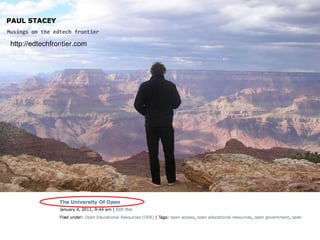
http://edtechfrontier.com
 
Learning materials that are freely available under a license that allows them to be: Reused Revised Remixed Redistributed
 
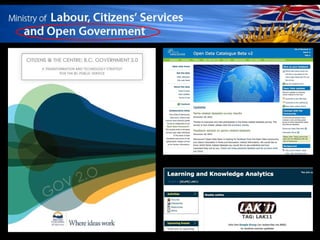
Open Data
Open Access
Open Pedagogies
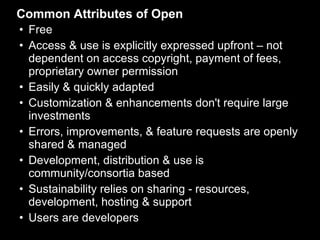
Common Attributes of Open Free Access & use is explicitly expressed upfront – not dependent on access copyright, payment of fees, proprietary owner permission Easily & quickly adapted Customization & enhancements don't require large investments Errors, improvements, & feature requests are openly shared & managed Development, distribution & use is community/consortia based  Sustainability relies on sharing - resources, development, hosting & support Users are developers
http://edtechfrontier.com
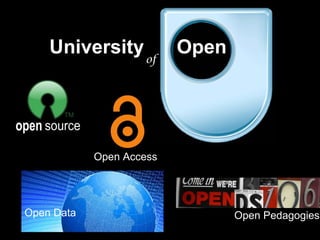
University  Open of Open Pedagogies Open Access Open Data
 
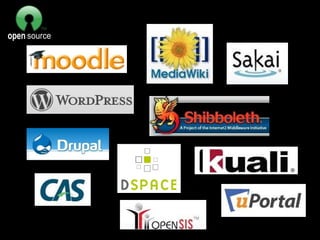
Benefits: $0 licensing fee easily and quickly adapted customization and enhancements don't require large investments not dependent on proprietary vendors implementation decision or timeline source code bugs, improvements and feature requests are all openly shared and managed education institutions can join forces to form community based developer networks or share hosting & support participants in the developer communities are also users of the software
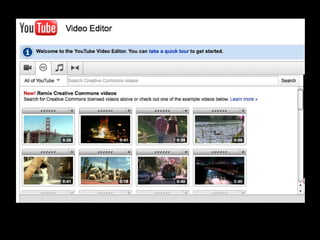
 
Open Data
 
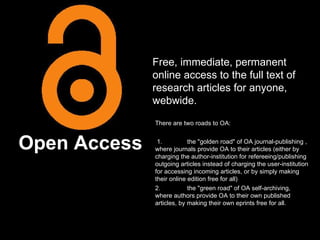
Open Access Free, immediate, permanent online access to the full text of research articles for anyone, webwide. There are two roads to OA: 1. the "golden road" of OA journal-publishing , where journals provide OA to their articles (either by charging the author-institution for refereeing/publishing outgoing articles instead of charging the user-institution for accessing incoming articles, or by simply making their online edition free for all) 2. the "green road" of OA self-archiving, where authors provide OA to their own published articles, by making their own eprints free for all.
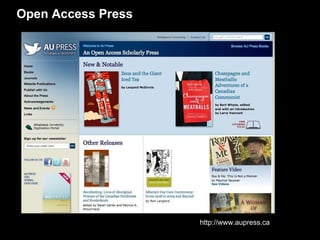
Open Access Press http://www.aupress.ca
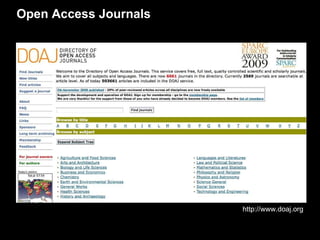
Open Access Journals http://www.doaj.org
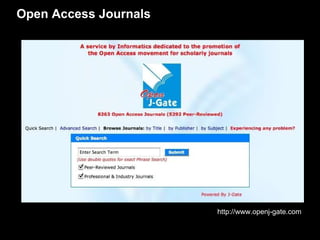
Open Access Journals http://www.openj-gate.com
Open Pedagogies
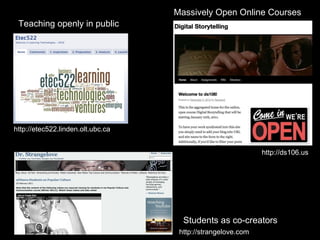
Teaching openly in public http://etec522.linden.olt.ubc.ca http://ds106.us http://strangelove.com Massively Open Online Courses Students as co-creators
 
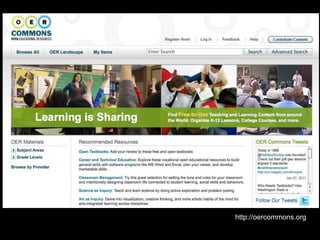
http://oercommons.org
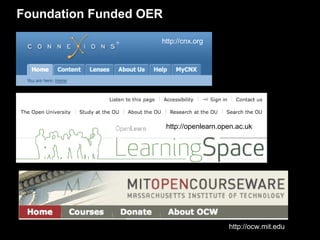
Foundation Funded OER http://cnx.org  http://openlearn.open.ac.uk  http://ocw.mit.edu
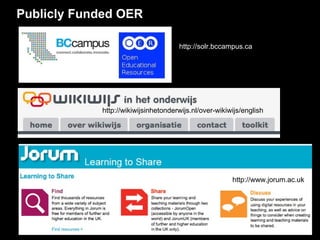
Publicly Funded OER http://solr.bccampus.ca  http://wikiwijsinhetonderwijs.nl/over-wikiwijs/english  http://www.jorum.ac.uk
Online Program Development Starting in 2003 BCcampus issued an annual Online Program Development Fund (OPDF) Request for Proposals (RFP) to all of BC's public post secondary institutions.  The OPDF call for proposals emphasizes inter-institutional collaboration and partnerships for development of online learning resources.  Development is focused on for-credit online learning resources that give students access to more programs leading to complete degrees, diplomas and certificates. http://opdf.pbworks.com
Online Program Development $9 million (2003-2010) 1 44 grants awarded (2003-2010) 100% participation across the post-secondary system 83% partnerships - mostly inter-institutional but also with K-12, health authorities, not-for-profits, professional associations, e-learning companies, First Nations, foundations, amongst others. 47 credentials developed in whole or part via OPDF 355 courses, 12 workshops, 19 web sites/tools and 396 course components (learning objects, labs, textbooks, manuals, videos) developed across almost all academic fields of study  100% licensed for open free sharing & reuse
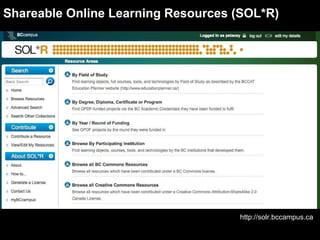
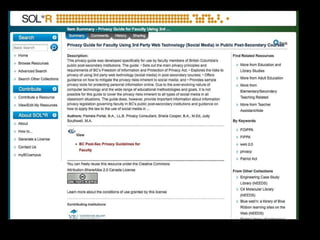
Shareable Online Learning Resources (SOL*R) http://solr.bccampus.ca
 
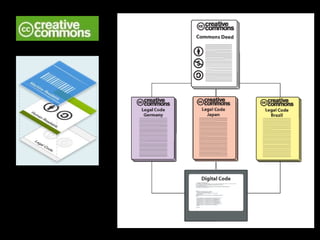
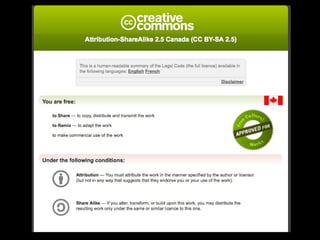
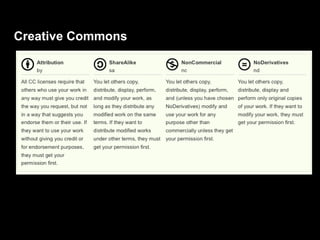
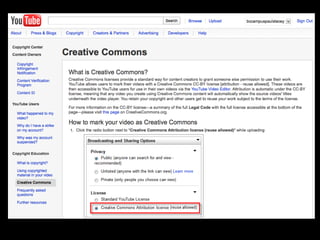
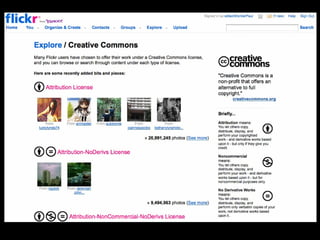
http://www.creativecommons.org
 
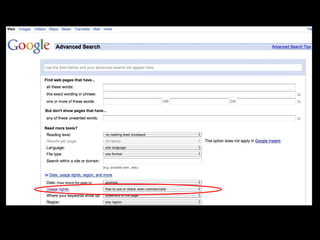
Creative Commons


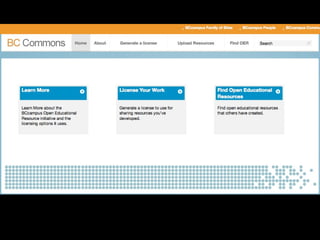
http://www.bccommons.ca
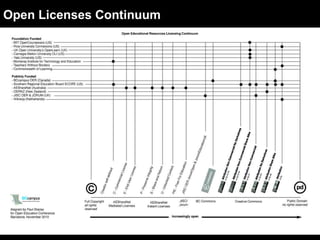
Open Licenses Continuum
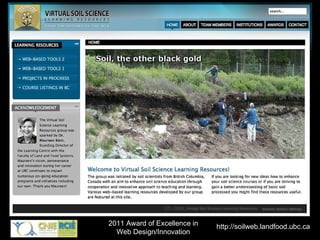
http://soilweb.landfood.ubc.ca 2011  Award of Excellence in Web Design/Innovation
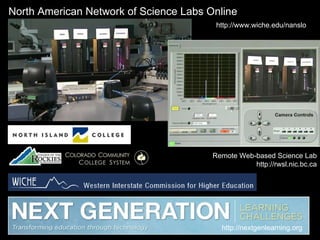
Remote Web-based Science Lab http://rwsl.nic.bc.ca North American Network of Science Labs Online http://nextgenlearning.org http://www.wiche.edu/nanslo
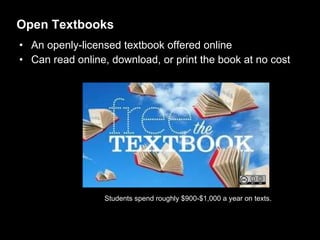
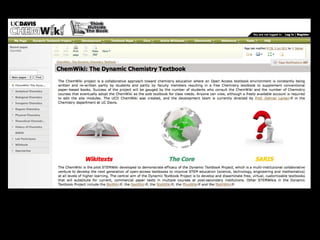
Open Textbooks An openly-licensed textbook offered online Can read online, download, or print the book at no cost Students spend roughly $900-$1,000 a year on texts.
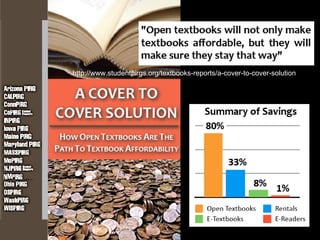
http://www.studentpirgs.org/textbooks-reports/a-cover-to-cover-solution
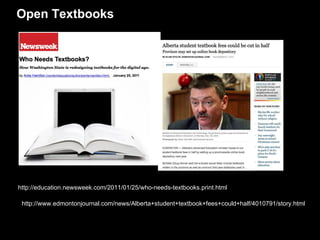
Open Textbooks http://education.newsweek.com/2011/01/25/who-needs-textbooks.print.html  http://www.edmontonjournal.com/news/Alberta+student+textbook+fees+could+half/4010791/story.html  “ Gov. Schwarzenegger Launches First-in-Nation Initiative to Develop Free Digital Textbooks for High School Students” “ Texas seeks open textbooks.”
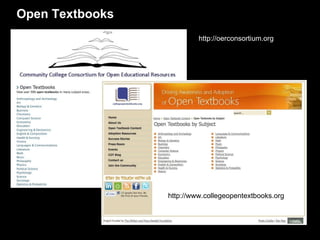
Open Textbooks http://www.collegeopentextbooks.org  http://oerconsortium.org
 
Open Faculty
Open Faculty Make intellectual projects & processes digitally visible & open to criticism/comment Do open research Publish in open access journals Self archive work for open peer and public review Create a new type of education work maximizing social learning, participatory pedagogies, connections Teach open courses Develop OER with communities of professional peers & students  Use open educational resources developed by others Assign and author open textbooks
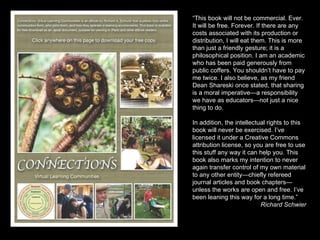
“ This book will not be commercial. Ever. It will be free. Forever. If there are any costs associated with its production or distribution, I will eat them. This is more than just a friendly gesture; it is a philosophical position. I am an academic who has been paid generously from public coffers. You shouldn’t have to pay me twice. I also believe, as my friend Dean Shareski once stated, that sharing is a moral imperative—a responsibility we have as educators—not just a nice thing to do. In addition, the intellectual rights to this book will never be exercised. I’ve licensed it under a Creative Commons attribution license, so you are free to use this stuff any way it can help you. This book also marks my intention to never again transfer control of my own material to any other entity—chiefly refereed journal articles and book chapters—unless the works are open and free. I’ve been leaning this way for a long time.” Richard Schwier
Open Student
Open Students Use OER to select institutions & courses of study Use OER for self-study Engage in open study around OER with global peers of students  Assemble OER and open/free software tools into personal learning environments Customize, enhance and develop OER (for credit) Actively participate in social learning and form networks and connections  Track and use open data on learning to plan and manage learning process Create open e-portfolios making learning projects, processes, and outcomes digitally visible
Open Institution
Open Institutions Work in consortia to develop and use OER for academic programs Use OER to market & promote programs & courses of study Use Open Source Software and contribute to developer community Reward (performance) and support (policy & funds) open access research publishing Generate and publish open data around learning, scholarly activities, and outcomes/achievements Create unique identity and establish value by extent of open activity and global benefits
Q&A – Followup Paul Stacey Director BCcampus 555 Seymour Street, Suite 200 Vancouver, BC V6B 3H6 web site: http://www.bccampus.ca  e-mail: pstacey@bccampus.ca blog: http://edtechfrontier.com Photos by Paul & Deborah Stacey Special thanks to Dali  & Gaudi Presentation slides available at:  http://www.slideshare.net/bccampus

Opportunity Side of Open 2

  • 1.
  • 2.
  • 3.
  • 4.
    Learning materials thatare freely available under a license that allows them to be: Reused Revised Remixed Redistributed
  • 5.
  • 6.
  • 7.
  • 8.
  • 9.
    Common Attributes ofOpen Free Access & use is explicitly expressed upfront – not dependent on access copyright, payment of fees, proprietary owner permission Easily & quickly adapted Customization & enhancements don't require large investments Errors, improvements, & feature requests are openly shared & managed Development, distribution & use is community/consortia based Sustainability relies on sharing - resources, development, hosting & support Users are developers
  • 10.
  • 11.
    University Openof Open Pedagogies Open Access Open Data
  • 12.
  • 13.
    Benefits: $0 licensingfee easily and quickly adapted customization and enhancements don't require large investments not dependent on proprietary vendors implementation decision or timeline source code bugs, improvements and feature requests are all openly shared and managed education institutions can join forces to form community based developer networks or share hosting & support participants in the developer communities are also users of the software
  • 14.
  • 15.
  • 16.
  • 17.
    Open Access Free,immediate, permanent online access to the full text of research articles for anyone, webwide. There are two roads to OA: 1. the "golden road" of OA journal-publishing , where journals provide OA to their articles (either by charging the author-institution for refereeing/publishing outgoing articles instead of charging the user-institution for accessing incoming articles, or by simply making their online edition free for all) 2. the "green road" of OA self-archiving, where authors provide OA to their own published articles, by making their own eprints free for all.
  • 18.
    Open Access Presshttp://www.aupress.ca
  • 19.
    Open Access Journalshttp://www.doaj.org
  • 20.
    Open Access Journalshttp://www.openj-gate.com
  • 21.
  • 22.
    Teaching openly inpublic http://etec522.linden.olt.ubc.ca http://ds106.us http://strangelove.com Massively Open Online Courses Students as co-creators
  • 23.
  • 24.
  • 25.
    Foundation Funded OERhttp://cnx.org http://openlearn.open.ac.uk http://ocw.mit.edu
  • 26.
    Publicly Funded OERhttp://solr.bccampus.ca http://wikiwijsinhetonderwijs.nl/over-wikiwijs/english http://www.jorum.ac.uk
  • 27.
    Online Program DevelopmentStarting in 2003 BCcampus issued an annual Online Program Development Fund (OPDF) Request for Proposals (RFP) to all of BC's public post secondary institutions. The OPDF call for proposals emphasizes inter-institutional collaboration and partnerships for development of online learning resources. Development is focused on for-credit online learning resources that give students access to more programs leading to complete degrees, diplomas and certificates. http://opdf.pbworks.com
  • 28.
    Online Program Development$9 million (2003-2010) 1 44 grants awarded (2003-2010) 100% participation across the post-secondary system 83% partnerships - mostly inter-institutional but also with K-12, health authorities, not-for-profits, professional associations, e-learning companies, First Nations, foundations, amongst others. 47 credentials developed in whole or part via OPDF 355 courses, 12 workshops, 19 web sites/tools and 396 course components (learning objects, labs, textbooks, manuals, videos) developed across almost all academic fields of study 100% licensed for open free sharing & reuse
  • 29.
    Shareable Online LearningResources (SOL*R) http://solr.bccampus.ca
  • 30.
  • 31.
  • 32.
  • 33.
  • 34.
  • 35.
  • 36.
  • 37.
  • 38.
  • 39.
  • 40.
    http://soilweb.landfood.ubc.ca 2011 Award of Excellence in Web Design/Innovation
  • 41.
    Remote Web-based ScienceLab http://rwsl.nic.bc.ca North American Network of Science Labs Online http://nextgenlearning.org http://www.wiche.edu/nanslo
  • 42.
    Open Textbooks Anopenly-licensed textbook offered online Can read online, download, or print the book at no cost Students spend roughly $900-$1,000 a year on texts.
  • 43.
  • 44.
    Open Textbooks http://education.newsweek.com/2011/01/25/who-needs-textbooks.print.html http://www.edmontonjournal.com/news/Alberta+student+textbook+fees+could+half/4010791/story.html “ Gov. Schwarzenegger Launches First-in-Nation Initiative to Develop Free Digital Textbooks for High School Students” “ Texas seeks open textbooks.”
  • 45.
  • 46.
  • 47.
  • 48.
    Open Faculty Makeintellectual projects & processes digitally visible & open to criticism/comment Do open research Publish in open access journals Self archive work for open peer and public review Create a new type of education work maximizing social learning, participatory pedagogies, connections Teach open courses Develop OER with communities of professional peers & students Use open educational resources developed by others Assign and author open textbooks
  • 49.
    “ This bookwill not be commercial. Ever. It will be free. Forever. If there are any costs associated with its production or distribution, I will eat them. This is more than just a friendly gesture; it is a philosophical position. I am an academic who has been paid generously from public coffers. You shouldn’t have to pay me twice. I also believe, as my friend Dean Shareski once stated, that sharing is a moral imperative—a responsibility we have as educators—not just a nice thing to do. In addition, the intellectual rights to this book will never be exercised. I’ve licensed it under a Creative Commons attribution license, so you are free to use this stuff any way it can help you. This book also marks my intention to never again transfer control of my own material to any other entity—chiefly refereed journal articles and book chapters—unless the works are open and free. I’ve been leaning this way for a long time.” Richard Schwier
  • 50.
  • 51.
    Open Students UseOER to select institutions & courses of study Use OER for self-study Engage in open study around OER with global peers of students Assemble OER and open/free software tools into personal learning environments Customize, enhance and develop OER (for credit) Actively participate in social learning and form networks and connections Track and use open data on learning to plan and manage learning process Create open e-portfolios making learning projects, processes, and outcomes digitally visible
  • 52.
  • 53.
    Open Institutions Workin consortia to develop and use OER for academic programs Use OER to market & promote programs & courses of study Use Open Source Software and contribute to developer community Reward (performance) and support (policy & funds) open access research publishing Generate and publish open data around learning, scholarly activities, and outcomes/achievements Create unique identity and establish value by extent of open activity and global benefits
  • 54.
    Q&A – FollowupPaul Stacey Director BCcampus 555 Seymour Street, Suite 200 Vancouver, BC V6B 3H6 web site: http://www.bccampus.ca e-mail: pstacey@bccampus.ca blog: http://edtechfrontier.com Photos by Paul & Deborah Stacey Special thanks to Dali & Gaudi Presentation slides available at: http://www.slideshare.net/bccampus