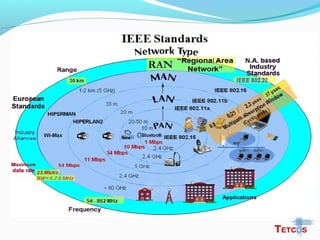
(IEEE 802.22- WRAN)
Result
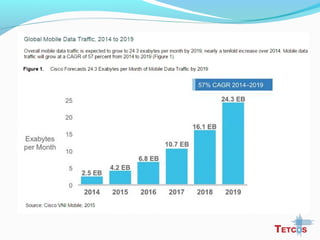
Spectrum Crunch
Spectrum crunch refers to the potential lack of sufficient
wireless frequency spectrum needed to support a growing
number of consumer devices, along with various
government and private sector uses of radio frequencies
within a broad spectrum allocated for different types of
wireless communications.
But…..
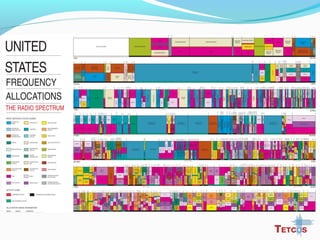
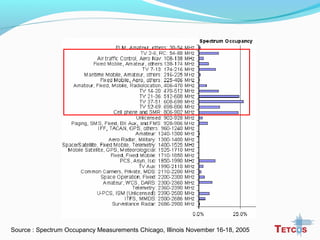
The goal for the Spectrum
Occupancy Measurements
at Chicago was to gain a
better understanding of the
actual utilization of
spectrum in this dense
urban environment with the
potential to identify
spectrum bands with low
occupancy
Source : Spectrum Occupancy Measurements Chicago, Illinois November 16-18, 2005
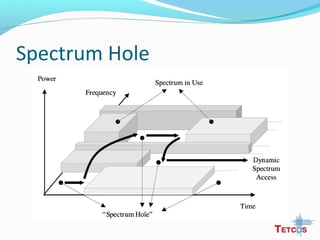
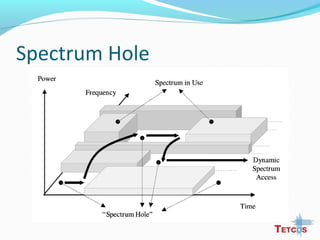
Spectrum Hole
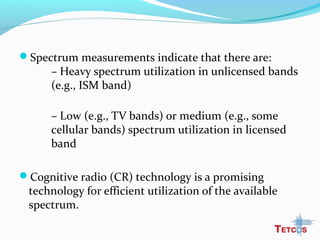
Spectrum measurements indicate that there are:
– Heavy spectrum utilization in unlicensed bands
(e.g., ISM band)
– Low (e.g., TV bands) or medium (e.g., some
cellular bands) spectrum utilization in licensed
band
Cognitive radio (CR) technology is a promising
technology for efficient utilization of the available
spectrum.
The TV band Notice of Proposed Rule Making (NPRM), released
in May 2004
– Proposes to allow unlicensed radios to operate in the TV
broadcast bands provided no harmful interference is caused to
incumbent services
– This can be accomplished by employing CR- based
technologies.
IEEE started the formation of the IEEE 802.22 for wireless
regional area networks (WRANs) in November 2004
– Task: developing an air interface (i.e., PHY and MAC) based on
CRs for unlicensed operation in the TV broadcast bands
What is Cognitive Radio
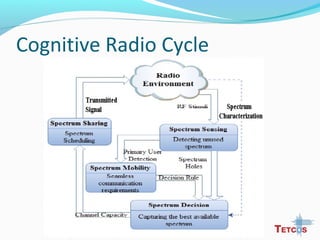
• Cognitive radio is a wireless communication system which
is aware of the environment and its changes and can adapt
its transmission parameters accordingly.
Cognitive Capability: The ability to sense the unused
spectrum at a specific time and location.
Reconfigurability: The ability to receive and transmit at
different frequency band enables the cognitive radio to
reconfigure its parameters and select the best band.
– This operates in 54 MHz to 862 MHz band.
Why Cognitive Radio?
Inefficient spectrum utilization
- Current wireless networks are regulated by fixed
spectrum assignment policy.
-According to Federal Communication
Commission, temporal and geographical variations in
the utilization of the assigned spectrum ranges from
15% to 85%.
- Cognitive radio network is a new paradigm that
provides the capability to share or use the spectrum in
an opportunistic manner.
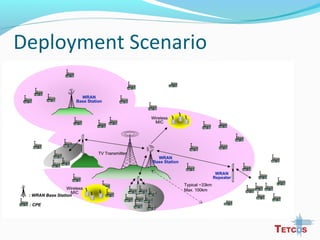
Deployment Scenario
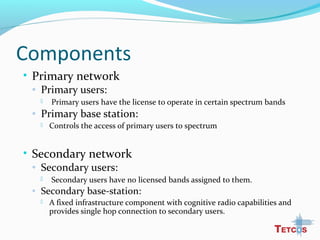
Components
• Primary network
◦ Primary users:
 Primary users have the license to operate in certain spectrum bands
◦ Primary base station:
 Controls the access of primary users to spectrum
• Secondary network
◦ Secondary users:
 Secondary users have no licensed bands assigned to them.
◦ Secondary base-station:
 A fixed infrastructure component with cognitive radio capabilities and
provides single hop connection to secondary users.
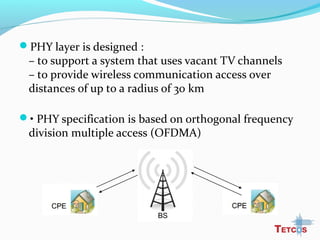
PHY layer is designed :
– to support a system that uses vacant TV channels
– to provide wireless communication access over
distances of up to a radius of 30 km
• PHY specification is based on orthogonal frequency
division multiple access (OFDMA)
Spectrum Hole
Functionalities of a CRN
• Spectrum sensing: Cognitive radio user has the ability
to sense the unused spectrum at any time and
location.
Functionalities of a CRN
• Spectrum management: Based on the availability of
the spectrum and other policies, CR user allocates the
best available spectrum band. Allocation of a channel
not only depends on spectrum availability but also
depends on internal and external policies.
Functionalities of a CRN(Cont..)
• Spectrum mobility: CR user shall vacate the spectrum
in the presence of any primary user and move to next
best available spectrum band. If the specific portion of
the spectrum is needed by a licensed user, the
communication needs be continued in another vacant
portion.
Functionalities of a CRN(Cont..)
• Spectrum sharing: CR network has to provide a fair
and optimal spectrum allocation method among
multiple CR users. Since there are multiple secondary
users trying to access the spectrum, their access
should be coordinated to avoid colliding in
overlapping portions of the spectrum
Cognitive Radio Cycle
Super Frame Structure
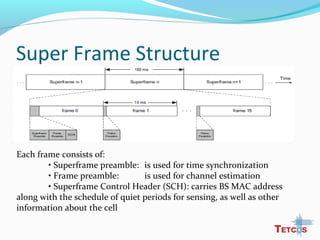
Each frame consists of:
• Superframe preamble: is used for time synchronization
• Frame preamble: is used for channel estimation
• Superframe Control Header (SCH): carries BS MAC address
along with the schedule of quiet periods for sensing, as well as other
information about the cell
Super Frame Structure
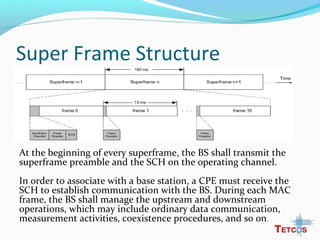
At the beginning of every superframe, the BS shall transmit the
superframe preamble and the SCH on the operating channel.
In order to associate with a base station, a CPE must receive the
SCH to establish communication with the BS. During each MAC
frame, the BS shall manage the upstream and downstream
operations, which may include ordinary data communication,
measurement activities, coexistence procedures, and so on.
Frame Structure
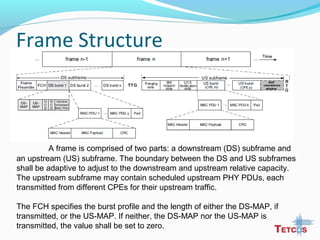
A frame is comprised of two parts: a downstream (DS) subframe and
an upstream (US) subframe. The boundary between the DS and US subframes
shall be adaptive to adjust to the downstream and upstream relative capacity.
The upstream subframe may contain scheduled upstream PHY PDUs, each
transmitted from different CPEs for their upstream traffic.
The FCH specifies the burst profile and the length of either the DS-MAP, if
transmitted, or the US-MAP. If neither, the DS-MAP nor the US-MAP is
transmitted, the value shall be set to zero.
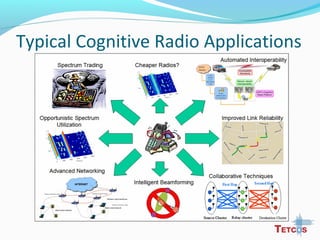
Typical Cognitive Radio Applications
References
 Cognitive Wireless RAN Medium Access Control (MAC) and Physical Layer (PHY)
Specifications: Policies and Procedures for Operation in the TV Bands by IEEE Computer
Society
 Spectrum Occupancy Measurements Chicago, Illinois November 16-18, 2005 by Mark A.
McHenry, Dan McCloskey, Dennis Roberson, John T. MacDonald
 Detection the Spectrum Holes in the Primary Bandwidth of the Cognitive Radio Systems
in Presence Noise and Attenuation by Ahmed S. Kadhim, Haider M. AlSabbagh
 Cognitive radio - The IEEE 802.22 standard by Dr.-Ing. Mohamed Kalil
Any Questions?
For Contact:
TETCOS
Jayanagar, Bangalore – 560041
Phone: + 91 8026630624
www.tetcos.com

Cognitive Radio 802.22 in NetSim

  • 1.
  • 4.
  • 5.
    Spectrum Crunch Spectrum crunchrefers to the potential lack of sufficient wireless frequency spectrum needed to support a growing number of consumer devices, along with various government and private sector uses of radio frequencies within a broad spectrum allocated for different types of wireless communications. But…..
  • 6.
    The goal forthe Spectrum Occupancy Measurements at Chicago was to gain a better understanding of the actual utilization of spectrum in this dense urban environment with the potential to identify spectrum bands with low occupancy
  • 7.
    Source : SpectrumOccupancy Measurements Chicago, Illinois November 16-18, 2005
  • 8.
  • 9.
    Spectrum measurements indicatethat there are: – Heavy spectrum utilization in unlicensed bands (e.g., ISM band) – Low (e.g., TV bands) or medium (e.g., some cellular bands) spectrum utilization in licensed band Cognitive radio (CR) technology is a promising technology for efficient utilization of the available spectrum.
  • 10.
    The TV bandNotice of Proposed Rule Making (NPRM), released in May 2004 – Proposes to allow unlicensed radios to operate in the TV broadcast bands provided no harmful interference is caused to incumbent services – This can be accomplished by employing CR- based technologies. IEEE started the formation of the IEEE 802.22 for wireless regional area networks (WRANs) in November 2004 – Task: developing an air interface (i.e., PHY and MAC) based on CRs for unlicensed operation in the TV broadcast bands
  • 11.
    What is CognitiveRadio • Cognitive radio is a wireless communication system which is aware of the environment and its changes and can adapt its transmission parameters accordingly. Cognitive Capability: The ability to sense the unused spectrum at a specific time and location. Reconfigurability: The ability to receive and transmit at different frequency band enables the cognitive radio to reconfigure its parameters and select the best band. – This operates in 54 MHz to 862 MHz band.
  • 12.
    Why Cognitive Radio? Inefficientspectrum utilization - Current wireless networks are regulated by fixed spectrum assignment policy. -According to Federal Communication Commission, temporal and geographical variations in the utilization of the assigned spectrum ranges from 15% to 85%. - Cognitive radio network is a new paradigm that provides the capability to share or use the spectrum in an opportunistic manner.
  • 14.
  • 15.
    Components • Primary network ◦Primary users:  Primary users have the license to operate in certain spectrum bands ◦ Primary base station:  Controls the access of primary users to spectrum • Secondary network ◦ Secondary users:  Secondary users have no licensed bands assigned to them. ◦ Secondary base-station:  A fixed infrastructure component with cognitive radio capabilities and provides single hop connection to secondary users.
  • 16.
    PHY layer isdesigned : – to support a system that uses vacant TV channels – to provide wireless communication access over distances of up to a radius of 30 km • PHY specification is based on orthogonal frequency division multiple access (OFDMA)
  • 17.
  • 18.
    Functionalities of aCRN • Spectrum sensing: Cognitive radio user has the ability to sense the unused spectrum at any time and location.
  • 19.
    Functionalities of aCRN • Spectrum management: Based on the availability of the spectrum and other policies, CR user allocates the best available spectrum band. Allocation of a channel not only depends on spectrum availability but also depends on internal and external policies.
  • 20.
    Functionalities of aCRN(Cont..) • Spectrum mobility: CR user shall vacate the spectrum in the presence of any primary user and move to next best available spectrum band. If the specific portion of the spectrum is needed by a licensed user, the communication needs be continued in another vacant portion.
  • 21.
    Functionalities of aCRN(Cont..) • Spectrum sharing: CR network has to provide a fair and optimal spectrum allocation method among multiple CR users. Since there are multiple secondary users trying to access the spectrum, their access should be coordinated to avoid colliding in overlapping portions of the spectrum
  • 22.
  • 23.
    Super Frame Structure Eachframe consists of: • Superframe preamble: is used for time synchronization • Frame preamble: is used for channel estimation • Superframe Control Header (SCH): carries BS MAC address along with the schedule of quiet periods for sensing, as well as other information about the cell
  • 24.
    Super Frame Structure Atthe beginning of every superframe, the BS shall transmit the superframe preamble and the SCH on the operating channel. In order to associate with a base station, a CPE must receive the SCH to establish communication with the BS. During each MAC frame, the BS shall manage the upstream and downstream operations, which may include ordinary data communication, measurement activities, coexistence procedures, and so on.
  • 25.
    Frame Structure A frameis comprised of two parts: a downstream (DS) subframe and an upstream (US) subframe. The boundary between the DS and US subframes shall be adaptive to adjust to the downstream and upstream relative capacity. The upstream subframe may contain scheduled upstream PHY PDUs, each transmitted from different CPEs for their upstream traffic. The FCH specifies the burst profile and the length of either the DS-MAP, if transmitted, or the US-MAP. If neither, the DS-MAP nor the US-MAP is transmitted, the value shall be set to zero.
  • 27.
  • 28.
    References  Cognitive WirelessRAN Medium Access Control (MAC) and Physical Layer (PHY) Specifications: Policies and Procedures for Operation in the TV Bands by IEEE Computer Society  Spectrum Occupancy Measurements Chicago, Illinois November 16-18, 2005 by Mark A. McHenry, Dan McCloskey, Dennis Roberson, John T. MacDonald  Detection the Spectrum Holes in the Primary Bandwidth of the Cognitive Radio Systems in Presence Noise and Attenuation by Ahmed S. Kadhim, Haider M. AlSabbagh  Cognitive radio - The IEEE 802.22 standard by Dr.-Ing. Mohamed Kalil
  • 29.
    Any Questions? For Contact: TETCOS Jayanagar,Bangalore – 560041 Phone: + 91 8026630624 www.tetcos.com