Presented by:
Nagashree N
Dept. of TCE.
 Introduction.
 Emerging Issues-Spectrum Management.
 Characteristics of Cognitive Radio.
• Cognitive Capability.
• Reconfigurability.
 Attacks and Detection Techniques.
• Incumbent Emulation attack.
• Spectrum Sensing Data Falsification attack.
 Advantages of CRN.
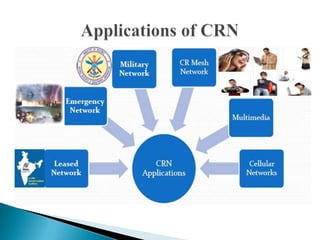
 Applications of CRN.
 Conclusion.
 References.
 A number of wireless applications have been growing over the
last decade. Most of the frequency spectrum has already been
licensed by government agencies, such as Federal
Communications Commission (FCC).
 Therefore, there exists an apparent spectrum scarcity for new
wireless applications and services. Cognitive radio can
efficiently utilize the unused spectrum for secondary usage
without interfering a primary licensed user.
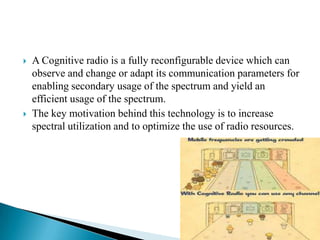
 A Cognitive radio is a fully reconfigurable device which can
observe and change or adapt its communication parameters for
enabling secondary usage of the spectrum and yield an
efficient usage of the spectrum.
 The key motivation behind this technology is to increase
spectral utilization and to optimize the use of radio resources.
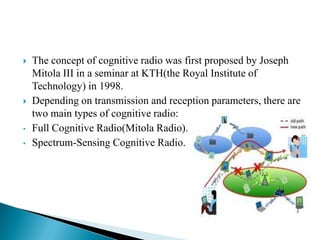
 The concept of cognitive radio was first proposed by Joseph
Mitola III in a seminar at KTH(the Royal Institute of
Technology) in 1998.
 Depending on transmission and reception parameters, there are
two main types of cognitive radio:
• Full Cognitive Radio(Mitola Radio).
• Spectrum-Sensing Cognitive Radio.
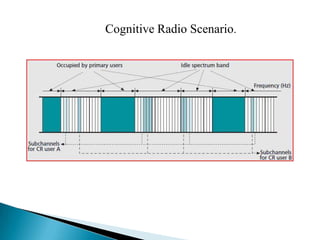
Cognitive Radio Scenario.
 Determine which portions of the spectrum are available:
Spectrum Sensing.
 Select the best available channel: Spectrum Decision.
 Coordinate access to this channel with other users: Spectrum
Sharing.
 Vacate the channel when a licensed user is detected:
Spectrum Mobility.
 Cognitive Radio have two main characteristics:
• Cognitive Capability.
• Reconfigurability.
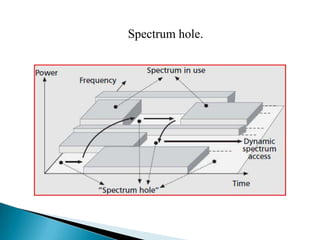
 Cognitive Capability: Identify the unused spectrum at a
specific time or location (Spectrum Holes/ White Spaces)
 Reconfigurability: Transmit and Receive on a variety of
frequencies. Use different access technologies.
Spectrum hole.
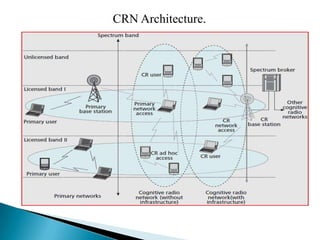
CRN Architecture.
 We define an attack on cognitive networks as any
activity that results in
(a) unacceptable interference to the licensed primary users
or
(b) missed opportunities for secondary users
Here we describe the attacks against CRs and CRNs
 Incumbent Emulation attacks.
 Spectrum Sensing Data Falsification attacks.
 Cross-layer attacks.
 We have identified and discussed two security threats
to CR networks: IE attacks and SSDF attacks. Both
attacks potentially pose a great threat to CR
networks. There are other types of attacks that can
disrupt operations in a CR network.
 For instance, simple jamming attacks may be very
effective in interfering with the spectrum sensing
process. However, we have limited our discussions to
security issues that are unique to CR networks, with
particular focus on security threats to DSS.
 When an incumbent is detected in a given band, all
secondaries avoid accessing that band.
 In an incumbent emulation (IE) attack, a malicious
secondary tries to gain priority over other secondaries
by transmitting signals that emulate the
characteristics of an incumbent’s.
 There may be “selfish” IE attack or “malicious” IE
attack.
 Malicious secondary users may take advantage of the
cooperative spectrum sensing and launch SSDF
attacks by sending false local spectrum sensing
results to others, resulting in a wrong spectrum
sensing decision.
 Three attack models are presented as follows:
• Selfish SSDF.
• Interference SSDF.
• Confusing SSDF
 Detection of SSDF attacks assume a model where a
number of SUs sense the environment and report
their findings to a FC.
 Fusion Centre fuses the reports provided by the rest
of nodes, uses several fusion rules to evaluate the
reports.
 Furthermore, reports are provided by SUs can be of
two types :
• Binary.
• Continuous.
 Binary type of reporting:
o In the proposed detection algorithm the Trust Values
of SUs and Consistency Values of each user is
computed.
• If both the values falls below a threshold the SU is
characterized as an outlier.
• A drawback of this work is that only one adversary has been
considered.
o In an another model proposed a Reputation Metric is
used to detect and isolate attackers from legitimate
SUs.
• For the computation of this metric the output of each SU is
compared to the decision made by the FC.
o E. Noon and H. Li study a specific case of an
attacker, the “hit-and-run” attacker.
• Deviates between an honest mode and a lying mode.
• The detection scheme combines a point system approach.
 Continuous type of reporting:
o A detection method using statistics is described.
• Here a grid of sensors, divided into clusters, send
information about their RSS, along with their location to the
FC.
• This approach has two phases.
• This approach does not restore the reputation of SU that
temporarily misbehaves as it increases a blacklist counter
each time if the filter’s output does not lie between the
defined thresholds.
o F. Yu, M. Huang, Z. Li and P. Mason propose a
scheme to defend against SSDF attack in a distributed
fashion for Cognitive ad-hoc radio networks.
• A key difference of this work is that no FC is used.
• SUs exchange information and decide independently upon
the presence of the primary transmissions.
• Each SU computes the max deviation of received from the
mean value.
• The simulation results show that distributed consensus
approach gives the best results.
 Unused spectrum are determined and made use of
them automatically.
 Improves the spectrum utilization by neglecting the
over occupied spectrum channels and filling the
unused spectrum channels
 Automatically improves and accomplishes its
progress and minimize interference.
 Spectrum Awareness concept.
 Spectrum sharing techniques can help us fill the
regulatory “gaps” in a particular interference
environment.
 A great deal of research still needs to be done on
simulating and explore these intelligent network
ideas.
 Cognitive radio technology can solve the problem of
spectrum underutilization.
 Simulation framework for security threats in cognitive radio networks
-E. Romero A. Mouradian J. Blesa J.M. Moya A. Araujo
ETSI Telecomunicación n, Universidad Polite cnica de Madrid, 28040
Madrid, Spain.
 Security Aspects in Software Defined Radio and Cognitive Radio
Networks: A Survey and A Way Ahead
-Gianmarco Baldini, Member, IEEE, Taj Sturman, Member, IEEE, Abdur
Rahim Biswas, Member, IEEE, Ruediger
Leschhorn, Member, IEEE, Gy oz o G odor, Member, IEEE, and Michael
Street.
 A Survey on Security Threats and Detection Techniques in Cognitive
Radio Networks
-Alexandors G. Fragkiadakis,Elias Z.Tragos, Ioannis G. Askoxylakis.
Contd…
 International Journal of Computer Applications (0975 – 8887) Volume 30–
No.1, September 2011 31 : Cognitive Radios: Need, Capabilities,
Standards, Applications and Research Challenges
-Prabhjot Kaur Department of Electronics and Communications ITM
University Gurgaon, India.Moin Uddin Delhi Technological University
Delhi, India.Arun Khosla , Department of Electronics and Communications
National Institute of Technology, Jalandhar, India.
 Attack prevention for collaborative spectrum sensing in cognitive radio
networks.
-Lingjie Duan, Alexander W. Min†, Jianwei Huang, Kang G. Shin
† Network Communications and Economics Lab, Dept. of Information
Engineering, The Chinese University of Hong Kong, Hong Kong
†Real-Time Computing Laboratory, Dept. of EECS, The University of
Michigan, Ann Arbor, MI 48109-2121.
Security threats in cognitive radio

Security threats in cognitive radio

  • 1.
  • 2.
     Introduction.  EmergingIssues-Spectrum Management.  Characteristics of Cognitive Radio. • Cognitive Capability. • Reconfigurability.  Attacks and Detection Techniques. • Incumbent Emulation attack. • Spectrum Sensing Data Falsification attack.  Advantages of CRN.  Applications of CRN.  Conclusion.  References.
  • 3.
     A numberof wireless applications have been growing over the last decade. Most of the frequency spectrum has already been licensed by government agencies, such as Federal Communications Commission (FCC).  Therefore, there exists an apparent spectrum scarcity for new wireless applications and services. Cognitive radio can efficiently utilize the unused spectrum for secondary usage without interfering a primary licensed user.
  • 4.
     A Cognitiveradio is a fully reconfigurable device which can observe and change or adapt its communication parameters for enabling secondary usage of the spectrum and yield an efficient usage of the spectrum.  The key motivation behind this technology is to increase spectral utilization and to optimize the use of radio resources.
  • 5.
     The conceptof cognitive radio was first proposed by Joseph Mitola III in a seminar at KTH(the Royal Institute of Technology) in 1998.  Depending on transmission and reception parameters, there are two main types of cognitive radio: • Full Cognitive Radio(Mitola Radio). • Spectrum-Sensing Cognitive Radio.
  • 6.
  • 7.
     Determine whichportions of the spectrum are available: Spectrum Sensing.  Select the best available channel: Spectrum Decision.  Coordinate access to this channel with other users: Spectrum Sharing.  Vacate the channel when a licensed user is detected: Spectrum Mobility.
  • 8.
     Cognitive Radiohave two main characteristics: • Cognitive Capability. • Reconfigurability.  Cognitive Capability: Identify the unused spectrum at a specific time or location (Spectrum Holes/ White Spaces)  Reconfigurability: Transmit and Receive on a variety of frequencies. Use different access technologies.
  • 9.
  • 10.
  • 11.
     We definean attack on cognitive networks as any activity that results in (a) unacceptable interference to the licensed primary users or (b) missed opportunities for secondary users Here we describe the attacks against CRs and CRNs  Incumbent Emulation attacks.  Spectrum Sensing Data Falsification attacks.  Cross-layer attacks.
  • 12.
     We haveidentified and discussed two security threats to CR networks: IE attacks and SSDF attacks. Both attacks potentially pose a great threat to CR networks. There are other types of attacks that can disrupt operations in a CR network.  For instance, simple jamming attacks may be very effective in interfering with the spectrum sensing process. However, we have limited our discussions to security issues that are unique to CR networks, with particular focus on security threats to DSS.
  • 13.
     When anincumbent is detected in a given band, all secondaries avoid accessing that band.  In an incumbent emulation (IE) attack, a malicious secondary tries to gain priority over other secondaries by transmitting signals that emulate the characteristics of an incumbent’s.  There may be “selfish” IE attack or “malicious” IE attack.
  • 14.
     Malicious secondaryusers may take advantage of the cooperative spectrum sensing and launch SSDF attacks by sending false local spectrum sensing results to others, resulting in a wrong spectrum sensing decision.  Three attack models are presented as follows: • Selfish SSDF. • Interference SSDF. • Confusing SSDF
  • 15.
     Detection ofSSDF attacks assume a model where a number of SUs sense the environment and report their findings to a FC.  Fusion Centre fuses the reports provided by the rest of nodes, uses several fusion rules to evaluate the reports.  Furthermore, reports are provided by SUs can be of two types : • Binary. • Continuous.
  • 16.
     Binary typeof reporting: o In the proposed detection algorithm the Trust Values of SUs and Consistency Values of each user is computed. • If both the values falls below a threshold the SU is characterized as an outlier. • A drawback of this work is that only one adversary has been considered.
  • 17.
    o In ananother model proposed a Reputation Metric is used to detect and isolate attackers from legitimate SUs. • For the computation of this metric the output of each SU is compared to the decision made by the FC. o E. Noon and H. Li study a specific case of an attacker, the “hit-and-run” attacker. • Deviates between an honest mode and a lying mode. • The detection scheme combines a point system approach.
  • 18.
     Continuous typeof reporting: o A detection method using statistics is described. • Here a grid of sensors, divided into clusters, send information about their RSS, along with their location to the FC. • This approach has two phases. • This approach does not restore the reputation of SU that temporarily misbehaves as it increases a blacklist counter each time if the filter’s output does not lie between the defined thresholds.
  • 19.
    o F. Yu,M. Huang, Z. Li and P. Mason propose a scheme to defend against SSDF attack in a distributed fashion for Cognitive ad-hoc radio networks. • A key difference of this work is that no FC is used. • SUs exchange information and decide independently upon the presence of the primary transmissions. • Each SU computes the max deviation of received from the mean value. • The simulation results show that distributed consensus approach gives the best results.
  • 20.
     Unused spectrumare determined and made use of them automatically.  Improves the spectrum utilization by neglecting the over occupied spectrum channels and filling the unused spectrum channels  Automatically improves and accomplishes its progress and minimize interference.
  • 22.
     Spectrum Awarenessconcept.  Spectrum sharing techniques can help us fill the regulatory “gaps” in a particular interference environment.  A great deal of research still needs to be done on simulating and explore these intelligent network ideas.  Cognitive radio technology can solve the problem of spectrum underutilization.
  • 23.
     Simulation frameworkfor security threats in cognitive radio networks -E. Romero A. Mouradian J. Blesa J.M. Moya A. Araujo ETSI Telecomunicación n, Universidad Polite cnica de Madrid, 28040 Madrid, Spain.  Security Aspects in Software Defined Radio and Cognitive Radio Networks: A Survey and A Way Ahead -Gianmarco Baldini, Member, IEEE, Taj Sturman, Member, IEEE, Abdur Rahim Biswas, Member, IEEE, Ruediger Leschhorn, Member, IEEE, Gy oz o G odor, Member, IEEE, and Michael Street.  A Survey on Security Threats and Detection Techniques in Cognitive Radio Networks -Alexandors G. Fragkiadakis,Elias Z.Tragos, Ioannis G. Askoxylakis. Contd…
  • 24.
     International Journalof Computer Applications (0975 – 8887) Volume 30– No.1, September 2011 31 : Cognitive Radios: Need, Capabilities, Standards, Applications and Research Challenges -Prabhjot Kaur Department of Electronics and Communications ITM University Gurgaon, India.Moin Uddin Delhi Technological University Delhi, India.Arun Khosla , Department of Electronics and Communications National Institute of Technology, Jalandhar, India.  Attack prevention for collaborative spectrum sensing in cognitive radio networks. -Lingjie Duan, Alexander W. Min†, Jianwei Huang, Kang G. Shin † Network Communications and Economics Lab, Dept. of Information Engineering, The Chinese University of Hong Kong, Hong Kong †Real-Time Computing Laboratory, Dept. of EECS, The University of Michigan, Ann Arbor, MI 48109-2121.