AYUSHI GADA - 06
OPERATIONS RESEARCH
ASSIGNMENT Problem
ASSIGNMENT PROBLEM
Introduction
The assignment problem deals with allocating
various resources (items) to various activities
(receivers) on a one to one basis, i.e., the number
of operations are to be assigned to an equal
number of operators where each operator
performs only one operation
•The Assignment Problem is a special type of
Linear Programming Problem
•It involves assigning tasks (jobs) to agents
(workers/machines) in an optimal way
•The objective is to minimize
cost or maximize efficiency
REAL LIFE APPLICATIONS
• Workforce Management: Assigning
employees to shifts/tasks
• Manufacturing: Allocating machines to jobs
• Logistics: Assigning delivery vehicles to routes
• Education: Assigning teachers to classes
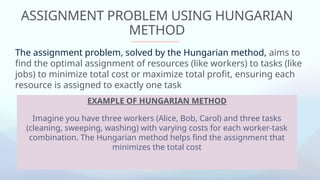
ASSIGNMENT PROBLEM USING HUNGARIAN
METHOD
The assignment problem, solved by the Hungarian method, aims to
find the optimal assignment of resources (like workers) to tasks (like
jobs) to minimize total cost or maximize total profit, ensuring each
resource is assigned to exactly one task
EXAMPLE OF HUNGARIAN METHOD
Imagine you have three workers (Alice, Bob, Carol) and three tasks
(cleaning, sweeping, washing) with varying costs for each worker-task
combination. The Hungarian method helps find the assignment that
minimizes the total cost
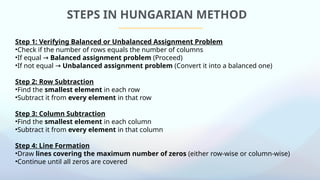
STEPS IN HUNGARIAN METHOD
Step 1: Verifying Balanced or Unbalanced Assignment Problem
•Check if the number of rows equals the number of columns
•If equal → Balanced assignment problem (Proceed)
•If not equal → Unbalanced assignment problem (Convert it into a balanced one)
Step 2: Row Subtraction
•Find the smallest element in each row
•Subtract it from every element in that row
Step 3: Column Subtraction
•Find the smallest element in each column
•Subtract it from every element in that column
Step 4: Line Formation
•Draw lines covering the maximum number of zeros (either row-wise or column-wise)
•Continue until all zeros are covered
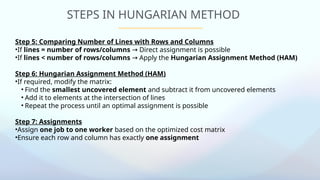
STEPS IN HUNGARIAN METHOD
Step 5: Comparing Number of Lines with Rows and Columns
•If lines = number of rows/columns Direct assignment is possible
→
•If lines < number of rows/columns Apply the
→ Hungarian Assignment Method (HAM)
Step 6: Hungarian Assignment Method (HAM)
•If required, modify the matrix:
• Find the smallest uncovered element and subtract it from uncovered elements
• Add it to elements at the intersection of lines
• Repeat the process until an optimal assignment is possible
Step 7: Assignments
•Assign one job to one worker based on the optimized cost matrix
•Ensure each row and column has exactly one assignment
THANK YOU!!!

Operations Research assignment problem ayushi

  • 1.
    AYUSHI GADA -06 OPERATIONS RESEARCH ASSIGNMENT Problem
  • 2.
    ASSIGNMENT PROBLEM Introduction The assignmentproblem deals with allocating various resources (items) to various activities (receivers) on a one to one basis, i.e., the number of operations are to be assigned to an equal number of operators where each operator performs only one operation •The Assignment Problem is a special type of Linear Programming Problem •It involves assigning tasks (jobs) to agents (workers/machines) in an optimal way •The objective is to minimize cost or maximize efficiency
  • 3.
    REAL LIFE APPLICATIONS •Workforce Management: Assigning employees to shifts/tasks • Manufacturing: Allocating machines to jobs • Logistics: Assigning delivery vehicles to routes • Education: Assigning teachers to classes
  • 4.
    ASSIGNMENT PROBLEM USINGHUNGARIAN METHOD The assignment problem, solved by the Hungarian method, aims to find the optimal assignment of resources (like workers) to tasks (like jobs) to minimize total cost or maximize total profit, ensuring each resource is assigned to exactly one task EXAMPLE OF HUNGARIAN METHOD Imagine you have three workers (Alice, Bob, Carol) and three tasks (cleaning, sweeping, washing) with varying costs for each worker-task combination. The Hungarian method helps find the assignment that minimizes the total cost
  • 5.
    STEPS IN HUNGARIANMETHOD Step 1: Verifying Balanced or Unbalanced Assignment Problem •Check if the number of rows equals the number of columns •If equal → Balanced assignment problem (Proceed) •If not equal → Unbalanced assignment problem (Convert it into a balanced one) Step 2: Row Subtraction •Find the smallest element in each row •Subtract it from every element in that row Step 3: Column Subtraction •Find the smallest element in each column •Subtract it from every element in that column Step 4: Line Formation •Draw lines covering the maximum number of zeros (either row-wise or column-wise) •Continue until all zeros are covered
  • 6.
    STEPS IN HUNGARIANMETHOD Step 5: Comparing Number of Lines with Rows and Columns •If lines = number of rows/columns Direct assignment is possible → •If lines < number of rows/columns Apply the → Hungarian Assignment Method (HAM) Step 6: Hungarian Assignment Method (HAM) •If required, modify the matrix: • Find the smallest uncovered element and subtract it from uncovered elements • Add it to elements at the intersection of lines • Repeat the process until an optimal assignment is possible Step 7: Assignments •Assign one job to one worker based on the optimized cost matrix •Ensure each row and column has exactly one assignment
  • 7.