The Assignment Method
Prepared by: Ma. Eda Dominique O. Equila
The Assignment Method
Is a way of allocating organizational resources to a certain
task. The effectiveness of assignment strategy will optimize
revenues by reducing costs, improving efficiency, and better
at managing processes that are a bottleneck.
A transportation problem with the capacity of 1:1
To illustrate:
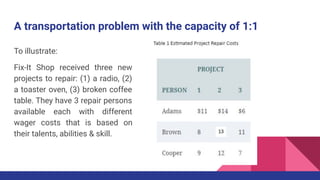
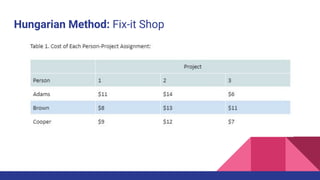
Fix-It Shop received three new
projects to repair: (1) a radio, (2)
a toaster oven, (3) broken coffee
table. They have 3 repair persons
available each with different
wager costs that is based on
their talents, abilities & skill.
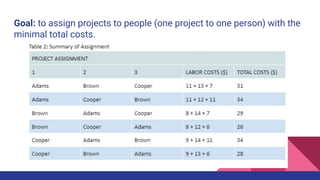
Goal: to assign projects to people (one project to one person) with the
minimal total costs.
The Hungarian Method
A method of assignment that provides efficient means of finding the
optimal solution, that operates on a principle of matrix reduction.
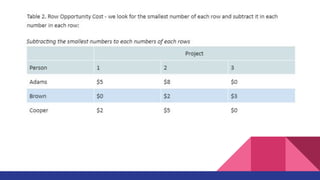
Matrix Reduction subtract or add the variables in the cost table where the
problem is reduced to a matrix of opportunity costs.
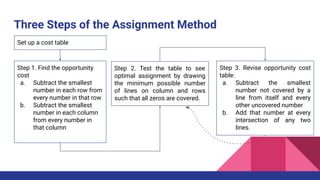
Three Steps of the Assignment Method
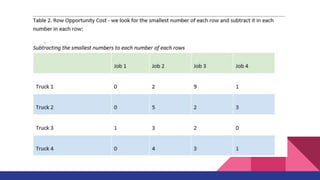
Set up a cost table
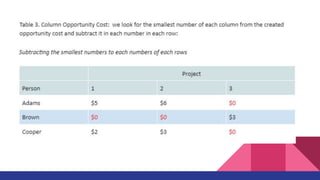
Step 1. Find the opportunity
cost
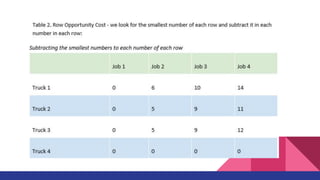
a. Subtract the smallest
number in each row from
every number in that row
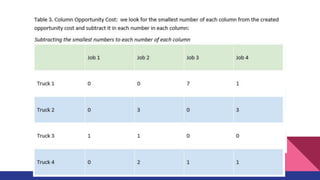
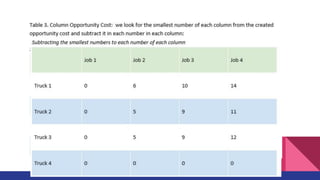
b. Subtract the smallest
number in each column
from every number in
that column
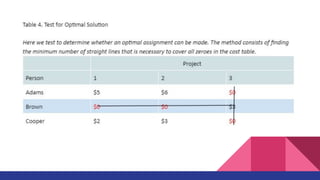
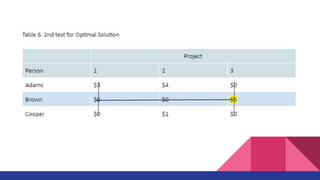
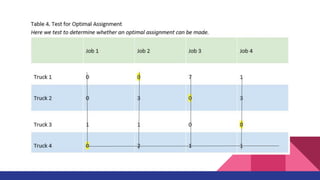
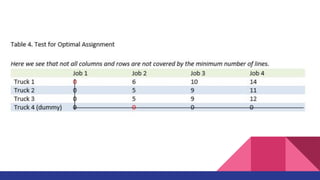
Step 2. Test the table to see
optimal assignment by drawing
the minimum possible number
of lines on column and rows
such that all zeros are covered.
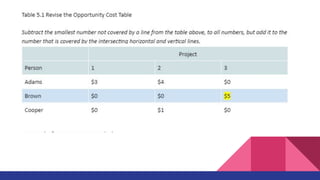
Step 3. Revise opportunity cost
table:
a. Subtract the smallest
number not covered by a
line from itself and every
other uncovered number
b. Add that number at every
intersection of any two
lines.
Hungarian Method: Fix-it Shop
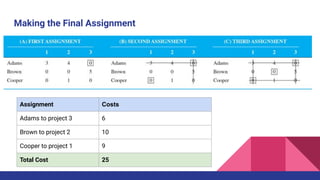
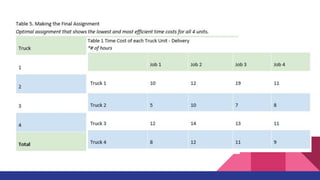
Making the Final Assignment
Assignment Costs
Adams to project 3 6
Brown to project 2 10
Cooper to project 1 9
Total Cost 25
Two types of Assignment Problem
Balanced Assignment Problem
Would require that the number of rows in the table equal the number of columns.
Unbalanced Assignment Problem
Number of people or objects does not equal the number of tasks or jobs. Either
there is more columns than row (or vice versa). If this happens, we add a dummy
row to allow us to solve the problem at equal dimensions.
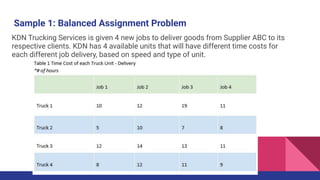
Sample 1: Balanced Assignment Problem
KDN Trucking Services is given 4 new jobs to deliver goods from Supplier ABC to its
respective clients. KDN has 4 available units that will have different time costs for
each different job delivery, based on speed and type of unit.
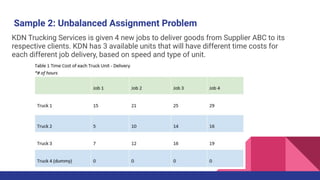
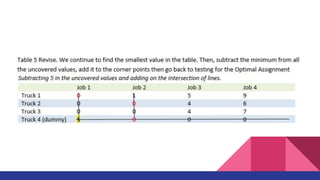
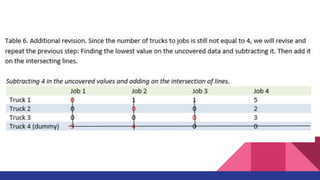
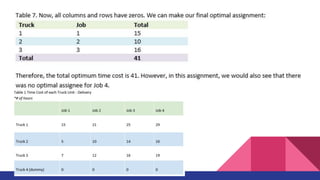
Sample 2: Unbalanced Assignment Problem
KDN Trucking Services is given 4 new jobs to deliver goods from Supplier ABC to its
respective clients. KDN has 3 available units that will have different time costs for
each different job delivery, based on speed and type of unit.
Q&A
Thank you

Equila_201_The Assignment Method.pdf

  • 1.
    The Assignment Method Preparedby: Ma. Eda Dominique O. Equila
  • 2.
    The Assignment Method Isa way of allocating organizational resources to a certain task. The effectiveness of assignment strategy will optimize revenues by reducing costs, improving efficiency, and better at managing processes that are a bottleneck.
  • 3.
    A transportation problemwith the capacity of 1:1 To illustrate: Fix-It Shop received three new projects to repair: (1) a radio, (2) a toaster oven, (3) broken coffee table. They have 3 repair persons available each with different wager costs that is based on their talents, abilities & skill.
  • 4.
    Goal: to assignprojects to people (one project to one person) with the minimal total costs.
  • 5.
    The Hungarian Method Amethod of assignment that provides efficient means of finding the optimal solution, that operates on a principle of matrix reduction. Matrix Reduction subtract or add the variables in the cost table where the problem is reduced to a matrix of opportunity costs.
  • 6.
    Three Steps ofthe Assignment Method Set up a cost table Step 1. Find the opportunity cost a. Subtract the smallest number in each row from every number in that row b. Subtract the smallest number in each column from every number in that column Step 2. Test the table to see optimal assignment by drawing the minimum possible number of lines on column and rows such that all zeros are covered. Step 3. Revise opportunity cost table: a. Subtract the smallest number not covered by a line from itself and every other uncovered number b. Add that number at every intersection of any two lines.
  • 7.
  • 13.
    Making the FinalAssignment Assignment Costs Adams to project 3 6 Brown to project 2 10 Cooper to project 1 9 Total Cost 25
  • 14.
    Two types ofAssignment Problem Balanced Assignment Problem Would require that the number of rows in the table equal the number of columns. Unbalanced Assignment Problem Number of people or objects does not equal the number of tasks or jobs. Either there is more columns than row (or vice versa). If this happens, we add a dummy row to allow us to solve the problem at equal dimensions.
  • 15.
    Sample 1: BalancedAssignment Problem KDN Trucking Services is given 4 new jobs to deliver goods from Supplier ABC to its respective clients. KDN has 4 available units that will have different time costs for each different job delivery, based on speed and type of unit.
  • 20.
    Sample 2: UnbalancedAssignment Problem KDN Trucking Services is given 4 new jobs to deliver goods from Supplier ABC to its respective clients. KDN has 3 available units that will have different time costs for each different job delivery, based on speed and type of unit.
  • 27.