ASSIGNMENT PROBLEM
ASSIGNMENT PROBLEM
By
DR. NEHA GUPTA
FACULTY OF COMMERCE & MANAGEMENT, SGT UNIVERSITY
ByDR. NEHA GUPTA (FACULTY OF COMMERCE & MANAGEMENT, SGT UNIVERSITY)ASSIGNMENT PROBLEM 1 / 6
ASSIGNMENT PROBLEM
ASSIGNMENT PROBLEM
In every workplace, there are jobs to be done and there are people available to do them.
But everyone is not equally efficient at every job. Someone may be more efficient on
one and less efficient on the other job, while it might be otherwise for someone else. The
relative efficiency is reflected in terms of the time taken for, or the cost associated with,
performance of different jobs by different people. An obvious problem for a manager to
handle is to assign jobs to various workers in a manner that they can be done in the
most efficient way. Such problems are known as Assignment Problem.
ByDR. NEHA GUPTA (FACULTY OF COMMERCE & MANAGEMENT, SGT UNIVERSITY)ASSIGNMENT PROBLEM 2 / 6
ASSIGNMENT PROBLEM
There are many situations where the assignment of people, machines, and so on may
be called for. Assignment of workers to machines, clerks to various checkout counters,
salesmen to different sales areas, service crews to different districts, are typical
examples of these. Assignment is a problem because people possess varying abilities
for performing different jobs and, therefore, the costs of performing those jobs are
different.
An assignment problem is a particular case of transportation problem where the
resources (say facilities) are assignees and the destinations are activities (say jobs).
ByDR. NEHA GUPTA (FACULTY OF COMMERCE & MANAGEMENT, SGT UNIVERSITY)ASSIGNMENT PROBLEM 3 / 6
ASSIGNMENT PROBLEM
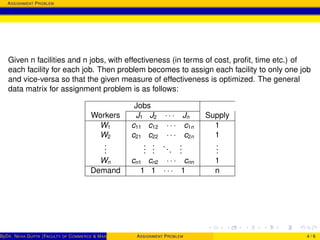
Given n facilities and n jobs, with effectiveness (in terms of cost, profit, time etc.) of
each facility for each job. Then problem becomes to assign each facility to only one job
and vice-versa so that the given measure of effectiveness is optimized. The general
data matrix for assignment problem is as follows:
Jobs
Workers J1 J2 · · · Jn Supply
W1 c11 c12 · · · c1n 1
W2 c21 c22 · · · c2n 1
...
...
...
...
...
...
Wn cn1 cn2 · · · cnn 1
Demand 1 1 · · · 1 n
ByDR. NEHA GUPTA (FACULTY OF COMMERCE & MANAGEMENT, SGT UNIVERSITY)ASSIGNMENT PROBLEM 4 / 6
ASSIGNMENT PROBLEM
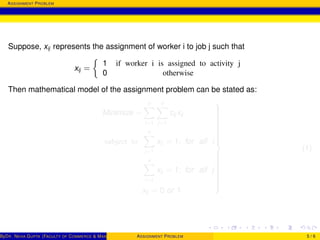
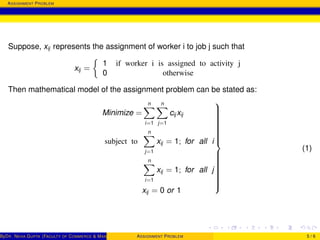
Suppose, xij represents the assignment of worker i to job j such that
xij =
1 if worker i is assigned to activity j
0 otherwise
Then mathematical model of the assignment problem can be stated as:
Minimize =
n
i=1
n
j=1
cij xij
subject to
n
j=1
xij = 1; for all i
n
i=1
xij = 1; for all j
xij = 0 or 1



(1)
ByDR. NEHA GUPTA (FACULTY OF COMMERCE & MANAGEMENT, SGT UNIVERSITY)ASSIGNMENT PROBLEM 5 / 6
ASSIGNMENT PROBLEM
Suppose, xij represents the assignment of worker i to job j such that
xij =
1 if worker i is assigned to activity j
0 otherwise
Then mathematical model of the assignment problem can be stated as:
Minimize =
n
i=1
n
j=1
cij xij
subject to
n
j=1
xij = 1; for all i
n
i=1
xij = 1; for all j
xij = 0 or 1



(1)
ByDR. NEHA GUPTA (FACULTY OF COMMERCE & MANAGEMENT, SGT UNIVERSITY)ASSIGNMENT PROBLEM 5 / 6
ASSIGNMENT PROBLEM
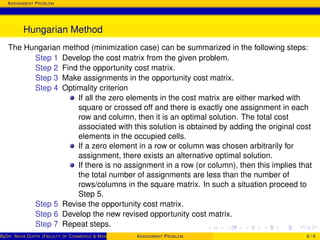
Hungarian Method
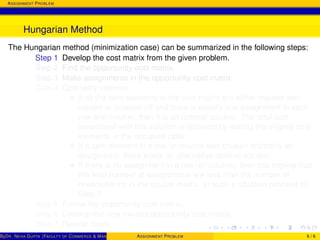
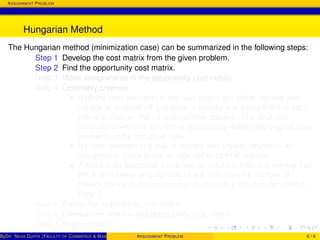
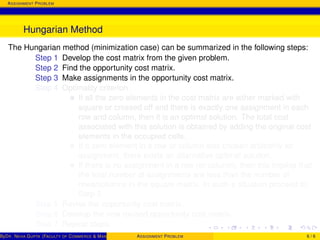
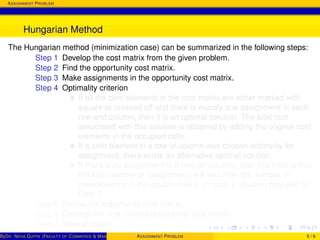
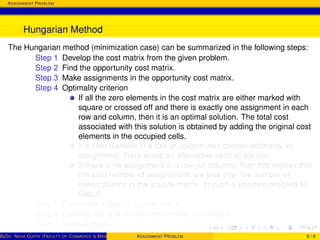
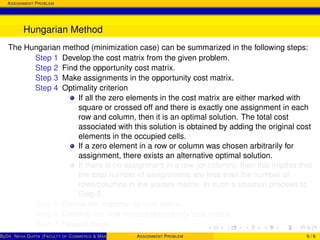
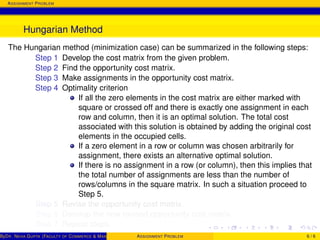
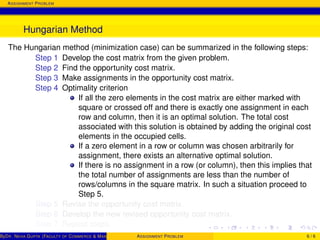
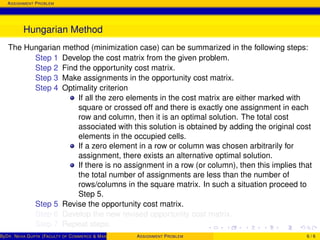
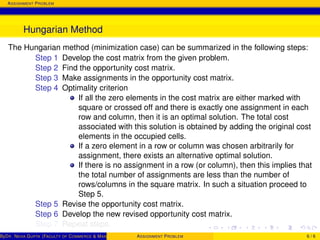
The Hungarian method (minimization case) can be summarized in the following steps:
Step 1 Develop the cost matrix from the given problem.
Step 2 Find the opportunity cost matrix.
Step 3 Make assignments in the opportunity cost matrix.
Step 4 Optimality criterion
If all the zero elements in the cost matrix are either marked with
square or crossed off and there is exactly one assignment in each
row and column, then it is an optimal solution. The total cost
associated with this solution is obtained by adding the original cost
elements in the occupied cells.
If a zero element in a row or column was chosen arbitrarily for
assignment, there exists an alternative optimal solution.
If there is no assignment in a row (or column), then this implies that
the total number of assignments are less than the number of
rows/columns in the square matrix. In such a situation proceed to
Step 5.
Step 5 Revise the opportunity cost matrix.
Step 6 Develop the new revised opportunity cost matrix.
Step 7 Repeat steps.
ByDR. NEHA GUPTA (FACULTY OF COMMERCE & MANAGEMENT, SGT UNIVERSITY)ASSIGNMENT PROBLEM 6 / 6
ASSIGNMENT PROBLEM
Hungarian Method
The Hungarian method (minimization case) can be summarized in the following steps:
Step 1 Develop the cost matrix from the given problem.
Step 2 Find the opportunity cost matrix.
Step 3 Make assignments in the opportunity cost matrix.
Step 4 Optimality criterion
If all the zero elements in the cost matrix are either marked with
square or crossed off and there is exactly one assignment in each
row and column, then it is an optimal solution. The total cost
associated with this solution is obtained by adding the original cost
elements in the occupied cells.
If a zero element in a row or column was chosen arbitrarily for
assignment, there exists an alternative optimal solution.
If there is no assignment in a row (or column), then this implies that
the total number of assignments are less than the number of
rows/columns in the square matrix. In such a situation proceed to
Step 5.
Step 5 Revise the opportunity cost matrix.
Step 6 Develop the new revised opportunity cost matrix.
Step 7 Repeat steps.
ByDR. NEHA GUPTA (FACULTY OF COMMERCE & MANAGEMENT, SGT UNIVERSITY)ASSIGNMENT PROBLEM 6 / 6
ASSIGNMENT PROBLEM
Hungarian Method
The Hungarian method (minimization case) can be summarized in the following steps:
Step 1 Develop the cost matrix from the given problem.
Step 2 Find the opportunity cost matrix.
Step 3 Make assignments in the opportunity cost matrix.
Step 4 Optimality criterion
If all the zero elements in the cost matrix are either marked with
square or crossed off and there is exactly one assignment in each
row and column, then it is an optimal solution. The total cost
associated with this solution is obtained by adding the original cost
elements in the occupied cells.
If a zero element in a row or column was chosen arbitrarily for
assignment, there exists an alternative optimal solution.
If there is no assignment in a row (or column), then this implies that
the total number of assignments are less than the number of
rows/columns in the square matrix. In such a situation proceed to
Step 5.
Step 5 Revise the opportunity cost matrix.
Step 6 Develop the new revised opportunity cost matrix.
Step 7 Repeat steps.
ByDR. NEHA GUPTA (FACULTY OF COMMERCE & MANAGEMENT, SGT UNIVERSITY)ASSIGNMENT PROBLEM 6 / 6
ASSIGNMENT PROBLEM
Hungarian Method
The Hungarian method (minimization case) can be summarized in the following steps:
Step 1 Develop the cost matrix from the given problem.
Step 2 Find the opportunity cost matrix.
Step 3 Make assignments in the opportunity cost matrix.
Step 4 Optimality criterion
If all the zero elements in the cost matrix are either marked with
square or crossed off and there is exactly one assignment in each
row and column, then it is an optimal solution. The total cost
associated with this solution is obtained by adding the original cost
elements in the occupied cells.
If a zero element in a row or column was chosen arbitrarily for
assignment, there exists an alternative optimal solution.
If there is no assignment in a row (or column), then this implies that
the total number of assignments are less than the number of
rows/columns in the square matrix. In such a situation proceed to
Step 5.
Step 5 Revise the opportunity cost matrix.
Step 6 Develop the new revised opportunity cost matrix.
Step 7 Repeat steps.
ByDR. NEHA GUPTA (FACULTY OF COMMERCE & MANAGEMENT, SGT UNIVERSITY)ASSIGNMENT PROBLEM 6 / 6
ASSIGNMENT PROBLEM
Hungarian Method
The Hungarian method (minimization case) can be summarized in the following steps:
Step 1 Develop the cost matrix from the given problem.
Step 2 Find the opportunity cost matrix.
Step 3 Make assignments in the opportunity cost matrix.
Step 4 Optimality criterion
If all the zero elements in the cost matrix are either marked with
square or crossed off and there is exactly one assignment in each
row and column, then it is an optimal solution. The total cost
associated with this solution is obtained by adding the original cost
elements in the occupied cells.
If a zero element in a row or column was chosen arbitrarily for
assignment, there exists an alternative optimal solution.
If there is no assignment in a row (or column), then this implies that
the total number of assignments are less than the number of
rows/columns in the square matrix. In such a situation proceed to
Step 5.
Step 5 Revise the opportunity cost matrix.
Step 6 Develop the new revised opportunity cost matrix.
Step 7 Repeat steps.
ByDR. NEHA GUPTA (FACULTY OF COMMERCE & MANAGEMENT, SGT UNIVERSITY)ASSIGNMENT PROBLEM 6 / 6
ASSIGNMENT PROBLEM
Hungarian Method
The Hungarian method (minimization case) can be summarized in the following steps:
Step 1 Develop the cost matrix from the given problem.
Step 2 Find the opportunity cost matrix.
Step 3 Make assignments in the opportunity cost matrix.
Step 4 Optimality criterion
If all the zero elements in the cost matrix are either marked with
square or crossed off and there is exactly one assignment in each
row and column, then it is an optimal solution. The total cost
associated with this solution is obtained by adding the original cost
elements in the occupied cells.
If a zero element in a row or column was chosen arbitrarily for
assignment, there exists an alternative optimal solution.
If there is no assignment in a row (or column), then this implies that
the total number of assignments are less than the number of
rows/columns in the square matrix. In such a situation proceed to
Step 5.
Step 5 Revise the opportunity cost matrix.
Step 6 Develop the new revised opportunity cost matrix.
Step 7 Repeat steps.
ByDR. NEHA GUPTA (FACULTY OF COMMERCE & MANAGEMENT, SGT UNIVERSITY)ASSIGNMENT PROBLEM 6 / 6
ASSIGNMENT PROBLEM
Hungarian Method
The Hungarian method (minimization case) can be summarized in the following steps:
Step 1 Develop the cost matrix from the given problem.
Step 2 Find the opportunity cost matrix.
Step 3 Make assignments in the opportunity cost matrix.
Step 4 Optimality criterion
If all the zero elements in the cost matrix are either marked with
square or crossed off and there is exactly one assignment in each
row and column, then it is an optimal solution. The total cost
associated with this solution is obtained by adding the original cost
elements in the occupied cells.
If a zero element in a row or column was chosen arbitrarily for
assignment, there exists an alternative optimal solution.
If there is no assignment in a row (or column), then this implies that
the total number of assignments are less than the number of
rows/columns in the square matrix. In such a situation proceed to
Step 5.
Step 5 Revise the opportunity cost matrix.
Step 6 Develop the new revised opportunity cost matrix.
Step 7 Repeat steps.
ByDR. NEHA GUPTA (FACULTY OF COMMERCE & MANAGEMENT, SGT UNIVERSITY)ASSIGNMENT PROBLEM 6 / 6
ASSIGNMENT PROBLEM
Hungarian Method
The Hungarian method (minimization case) can be summarized in the following steps:
Step 1 Develop the cost matrix from the given problem.
Step 2 Find the opportunity cost matrix.
Step 3 Make assignments in the opportunity cost matrix.
Step 4 Optimality criterion
If all the zero elements in the cost matrix are either marked with
square or crossed off and there is exactly one assignment in each
row and column, then it is an optimal solution. The total cost
associated with this solution is obtained by adding the original cost
elements in the occupied cells.
If a zero element in a row or column was chosen arbitrarily for
assignment, there exists an alternative optimal solution.
If there is no assignment in a row (or column), then this implies that
the total number of assignments are less than the number of
rows/columns in the square matrix. In such a situation proceed to
Step 5.
Step 5 Revise the opportunity cost matrix.
Step 6 Develop the new revised opportunity cost matrix.
Step 7 Repeat steps.
ByDR. NEHA GUPTA (FACULTY OF COMMERCE & MANAGEMENT, SGT UNIVERSITY)ASSIGNMENT PROBLEM 6 / 6
ASSIGNMENT PROBLEM
Hungarian Method
The Hungarian method (minimization case) can be summarized in the following steps:
Step 1 Develop the cost matrix from the given problem.
Step 2 Find the opportunity cost matrix.
Step 3 Make assignments in the opportunity cost matrix.
Step 4 Optimality criterion
If all the zero elements in the cost matrix are either marked with
square or crossed off and there is exactly one assignment in each
row and column, then it is an optimal solution. The total cost
associated with this solution is obtained by adding the original cost
elements in the occupied cells.
If a zero element in a row or column was chosen arbitrarily for
assignment, there exists an alternative optimal solution.
If there is no assignment in a row (or column), then this implies that
the total number of assignments are less than the number of
rows/columns in the square matrix. In such a situation proceed to
Step 5.
Step 5 Revise the opportunity cost matrix.
Step 6 Develop the new revised opportunity cost matrix.
Step 7 Repeat steps.
ByDR. NEHA GUPTA (FACULTY OF COMMERCE & MANAGEMENT, SGT UNIVERSITY)ASSIGNMENT PROBLEM 6 / 6
ASSIGNMENT PROBLEM
Hungarian Method
The Hungarian method (minimization case) can be summarized in the following steps:
Step 1 Develop the cost matrix from the given problem.
Step 2 Find the opportunity cost matrix.
Step 3 Make assignments in the opportunity cost matrix.
Step 4 Optimality criterion
If all the zero elements in the cost matrix are either marked with
square or crossed off and there is exactly one assignment in each
row and column, then it is an optimal solution. The total cost
associated with this solution is obtained by adding the original cost
elements in the occupied cells.
If a zero element in a row or column was chosen arbitrarily for
assignment, there exists an alternative optimal solution.
If there is no assignment in a row (or column), then this implies that
the total number of assignments are less than the number of
rows/columns in the square matrix. In such a situation proceed to
Step 5.
Step 5 Revise the opportunity cost matrix.
Step 6 Develop the new revised opportunity cost matrix.
Step 7 Repeat steps.
ByDR. NEHA GUPTA (FACULTY OF COMMERCE & MANAGEMENT, SGT UNIVERSITY)ASSIGNMENT PROBLEM 6 / 6
ASSIGNMENT PROBLEM
Hungarian Method
The Hungarian method (minimization case) can be summarized in the following steps:
Step 1 Develop the cost matrix from the given problem.
Step 2 Find the opportunity cost matrix.
Step 3 Make assignments in the opportunity cost matrix.
Step 4 Optimality criterion
If all the zero elements in the cost matrix are either marked with
square or crossed off and there is exactly one assignment in each
row and column, then it is an optimal solution. The total cost
associated with this solution is obtained by adding the original cost
elements in the occupied cells.
If a zero element in a row or column was chosen arbitrarily for
assignment, there exists an alternative optimal solution.
If there is no assignment in a row (or column), then this implies that
the total number of assignments are less than the number of
rows/columns in the square matrix. In such a situation proceed to
Step 5.
Step 5 Revise the opportunity cost matrix.
Step 6 Develop the new revised opportunity cost matrix.
Step 7 Repeat steps.
ByDR. NEHA GUPTA (FACULTY OF COMMERCE & MANAGEMENT, SGT UNIVERSITY)ASSIGNMENT PROBLEM 6 / 6
ASSIGNMENT PROBLEM
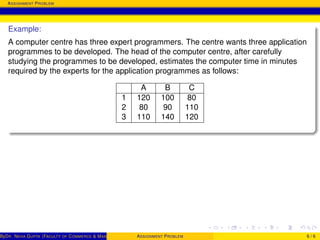
Example:
A computer centre has three expert programmers. The centre wants three application
programmes to be developed. The head of the computer centre, after carefully
studying the programmes to be developed, estimates the computer time in minutes
required by the experts for the application programmes as follows:
A B C
1 120 100 80
2 80 90 110
3 110 140 120
ByDR. NEHA GUPTA (FACULTY OF COMMERCE & MANAGEMENT, SGT UNIVERSITY)ASSIGNMENT PROBLEM 6 / 6

Assignment

  • 1.
    ASSIGNMENT PROBLEM ASSIGNMENT PROBLEM By DR.NEHA GUPTA FACULTY OF COMMERCE & MANAGEMENT, SGT UNIVERSITY ByDR. NEHA GUPTA (FACULTY OF COMMERCE & MANAGEMENT, SGT UNIVERSITY)ASSIGNMENT PROBLEM 1 / 6
  • 2.
    ASSIGNMENT PROBLEM ASSIGNMENT PROBLEM Inevery workplace, there are jobs to be done and there are people available to do them. But everyone is not equally efficient at every job. Someone may be more efficient on one and less efficient on the other job, while it might be otherwise for someone else. The relative efficiency is reflected in terms of the time taken for, or the cost associated with, performance of different jobs by different people. An obvious problem for a manager to handle is to assign jobs to various workers in a manner that they can be done in the most efficient way. Such problems are known as Assignment Problem. ByDR. NEHA GUPTA (FACULTY OF COMMERCE & MANAGEMENT, SGT UNIVERSITY)ASSIGNMENT PROBLEM 2 / 6
  • 3.
    ASSIGNMENT PROBLEM There aremany situations where the assignment of people, machines, and so on may be called for. Assignment of workers to machines, clerks to various checkout counters, salesmen to different sales areas, service crews to different districts, are typical examples of these. Assignment is a problem because people possess varying abilities for performing different jobs and, therefore, the costs of performing those jobs are different. An assignment problem is a particular case of transportation problem where the resources (say facilities) are assignees and the destinations are activities (say jobs). ByDR. NEHA GUPTA (FACULTY OF COMMERCE & MANAGEMENT, SGT UNIVERSITY)ASSIGNMENT PROBLEM 3 / 6
  • 4.
    ASSIGNMENT PROBLEM Given nfacilities and n jobs, with effectiveness (in terms of cost, profit, time etc.) of each facility for each job. Then problem becomes to assign each facility to only one job and vice-versa so that the given measure of effectiveness is optimized. The general data matrix for assignment problem is as follows: Jobs Workers J1 J2 · · · Jn Supply W1 c11 c12 · · · c1n 1 W2 c21 c22 · · · c2n 1 ... ... ... ... ... ... Wn cn1 cn2 · · · cnn 1 Demand 1 1 · · · 1 n ByDR. NEHA GUPTA (FACULTY OF COMMERCE & MANAGEMENT, SGT UNIVERSITY)ASSIGNMENT PROBLEM 4 / 6
  • 5.
    ASSIGNMENT PROBLEM Suppose, xijrepresents the assignment of worker i to job j such that xij = 1 if worker i is assigned to activity j 0 otherwise Then mathematical model of the assignment problem can be stated as: Minimize = n i=1 n j=1 cij xij subject to n j=1 xij = 1; for all i n i=1 xij = 1; for all j xij = 0 or 1    (1) ByDR. NEHA GUPTA (FACULTY OF COMMERCE & MANAGEMENT, SGT UNIVERSITY)ASSIGNMENT PROBLEM 5 / 6
  • 6.
    ASSIGNMENT PROBLEM Suppose, xijrepresents the assignment of worker i to job j such that xij = 1 if worker i is assigned to activity j 0 otherwise Then mathematical model of the assignment problem can be stated as: Minimize = n i=1 n j=1 cij xij subject to n j=1 xij = 1; for all i n i=1 xij = 1; for all j xij = 0 or 1    (1) ByDR. NEHA GUPTA (FACULTY OF COMMERCE & MANAGEMENT, SGT UNIVERSITY)ASSIGNMENT PROBLEM 5 / 6
  • 7.
    ASSIGNMENT PROBLEM Hungarian Method TheHungarian method (minimization case) can be summarized in the following steps: Step 1 Develop the cost matrix from the given problem. Step 2 Find the opportunity cost matrix. Step 3 Make assignments in the opportunity cost matrix. Step 4 Optimality criterion If all the zero elements in the cost matrix are either marked with square or crossed off and there is exactly one assignment in each row and column, then it is an optimal solution. The total cost associated with this solution is obtained by adding the original cost elements in the occupied cells. If a zero element in a row or column was chosen arbitrarily for assignment, there exists an alternative optimal solution. If there is no assignment in a row (or column), then this implies that the total number of assignments are less than the number of rows/columns in the square matrix. In such a situation proceed to Step 5. Step 5 Revise the opportunity cost matrix. Step 6 Develop the new revised opportunity cost matrix. Step 7 Repeat steps. ByDR. NEHA GUPTA (FACULTY OF COMMERCE & MANAGEMENT, SGT UNIVERSITY)ASSIGNMENT PROBLEM 6 / 6
  • 8.
    ASSIGNMENT PROBLEM Hungarian Method TheHungarian method (minimization case) can be summarized in the following steps: Step 1 Develop the cost matrix from the given problem. Step 2 Find the opportunity cost matrix. Step 3 Make assignments in the opportunity cost matrix. Step 4 Optimality criterion If all the zero elements in the cost matrix are either marked with square or crossed off and there is exactly one assignment in each row and column, then it is an optimal solution. The total cost associated with this solution is obtained by adding the original cost elements in the occupied cells. If a zero element in a row or column was chosen arbitrarily for assignment, there exists an alternative optimal solution. If there is no assignment in a row (or column), then this implies that the total number of assignments are less than the number of rows/columns in the square matrix. In such a situation proceed to Step 5. Step 5 Revise the opportunity cost matrix. Step 6 Develop the new revised opportunity cost matrix. Step 7 Repeat steps. ByDR. NEHA GUPTA (FACULTY OF COMMERCE & MANAGEMENT, SGT UNIVERSITY)ASSIGNMENT PROBLEM 6 / 6
  • 9.
    ASSIGNMENT PROBLEM Hungarian Method TheHungarian method (minimization case) can be summarized in the following steps: Step 1 Develop the cost matrix from the given problem. Step 2 Find the opportunity cost matrix. Step 3 Make assignments in the opportunity cost matrix. Step 4 Optimality criterion If all the zero elements in the cost matrix are either marked with square or crossed off and there is exactly one assignment in each row and column, then it is an optimal solution. The total cost associated with this solution is obtained by adding the original cost elements in the occupied cells. If a zero element in a row or column was chosen arbitrarily for assignment, there exists an alternative optimal solution. If there is no assignment in a row (or column), then this implies that the total number of assignments are less than the number of rows/columns in the square matrix. In such a situation proceed to Step 5. Step 5 Revise the opportunity cost matrix. Step 6 Develop the new revised opportunity cost matrix. Step 7 Repeat steps. ByDR. NEHA GUPTA (FACULTY OF COMMERCE & MANAGEMENT, SGT UNIVERSITY)ASSIGNMENT PROBLEM 6 / 6
  • 10.
    ASSIGNMENT PROBLEM Hungarian Method TheHungarian method (minimization case) can be summarized in the following steps: Step 1 Develop the cost matrix from the given problem. Step 2 Find the opportunity cost matrix. Step 3 Make assignments in the opportunity cost matrix. Step 4 Optimality criterion If all the zero elements in the cost matrix are either marked with square or crossed off and there is exactly one assignment in each row and column, then it is an optimal solution. The total cost associated with this solution is obtained by adding the original cost elements in the occupied cells. If a zero element in a row or column was chosen arbitrarily for assignment, there exists an alternative optimal solution. If there is no assignment in a row (or column), then this implies that the total number of assignments are less than the number of rows/columns in the square matrix. In such a situation proceed to Step 5. Step 5 Revise the opportunity cost matrix. Step 6 Develop the new revised opportunity cost matrix. Step 7 Repeat steps. ByDR. NEHA GUPTA (FACULTY OF COMMERCE & MANAGEMENT, SGT UNIVERSITY)ASSIGNMENT PROBLEM 6 / 6
  • 11.
    ASSIGNMENT PROBLEM Hungarian Method TheHungarian method (minimization case) can be summarized in the following steps: Step 1 Develop the cost matrix from the given problem. Step 2 Find the opportunity cost matrix. Step 3 Make assignments in the opportunity cost matrix. Step 4 Optimality criterion If all the zero elements in the cost matrix are either marked with square or crossed off and there is exactly one assignment in each row and column, then it is an optimal solution. The total cost associated with this solution is obtained by adding the original cost elements in the occupied cells. If a zero element in a row or column was chosen arbitrarily for assignment, there exists an alternative optimal solution. If there is no assignment in a row (or column), then this implies that the total number of assignments are less than the number of rows/columns in the square matrix. In such a situation proceed to Step 5. Step 5 Revise the opportunity cost matrix. Step 6 Develop the new revised opportunity cost matrix. Step 7 Repeat steps. ByDR. NEHA GUPTA (FACULTY OF COMMERCE & MANAGEMENT, SGT UNIVERSITY)ASSIGNMENT PROBLEM 6 / 6
  • 12.
    ASSIGNMENT PROBLEM Hungarian Method TheHungarian method (minimization case) can be summarized in the following steps: Step 1 Develop the cost matrix from the given problem. Step 2 Find the opportunity cost matrix. Step 3 Make assignments in the opportunity cost matrix. Step 4 Optimality criterion If all the zero elements in the cost matrix are either marked with square or crossed off and there is exactly one assignment in each row and column, then it is an optimal solution. The total cost associated with this solution is obtained by adding the original cost elements in the occupied cells. If a zero element in a row or column was chosen arbitrarily for assignment, there exists an alternative optimal solution. If there is no assignment in a row (or column), then this implies that the total number of assignments are less than the number of rows/columns in the square matrix. In such a situation proceed to Step 5. Step 5 Revise the opportunity cost matrix. Step 6 Develop the new revised opportunity cost matrix. Step 7 Repeat steps. ByDR. NEHA GUPTA (FACULTY OF COMMERCE & MANAGEMENT, SGT UNIVERSITY)ASSIGNMENT PROBLEM 6 / 6
  • 13.
    ASSIGNMENT PROBLEM Hungarian Method TheHungarian method (minimization case) can be summarized in the following steps: Step 1 Develop the cost matrix from the given problem. Step 2 Find the opportunity cost matrix. Step 3 Make assignments in the opportunity cost matrix. Step 4 Optimality criterion If all the zero elements in the cost matrix are either marked with square or crossed off and there is exactly one assignment in each row and column, then it is an optimal solution. The total cost associated with this solution is obtained by adding the original cost elements in the occupied cells. If a zero element in a row or column was chosen arbitrarily for assignment, there exists an alternative optimal solution. If there is no assignment in a row (or column), then this implies that the total number of assignments are less than the number of rows/columns in the square matrix. In such a situation proceed to Step 5. Step 5 Revise the opportunity cost matrix. Step 6 Develop the new revised opportunity cost matrix. Step 7 Repeat steps. ByDR. NEHA GUPTA (FACULTY OF COMMERCE & MANAGEMENT, SGT UNIVERSITY)ASSIGNMENT PROBLEM 6 / 6
  • 14.
    ASSIGNMENT PROBLEM Hungarian Method TheHungarian method (minimization case) can be summarized in the following steps: Step 1 Develop the cost matrix from the given problem. Step 2 Find the opportunity cost matrix. Step 3 Make assignments in the opportunity cost matrix. Step 4 Optimality criterion If all the zero elements in the cost matrix are either marked with square or crossed off and there is exactly one assignment in each row and column, then it is an optimal solution. The total cost associated with this solution is obtained by adding the original cost elements in the occupied cells. If a zero element in a row or column was chosen arbitrarily for assignment, there exists an alternative optimal solution. If there is no assignment in a row (or column), then this implies that the total number of assignments are less than the number of rows/columns in the square matrix. In such a situation proceed to Step 5. Step 5 Revise the opportunity cost matrix. Step 6 Develop the new revised opportunity cost matrix. Step 7 Repeat steps. ByDR. NEHA GUPTA (FACULTY OF COMMERCE & MANAGEMENT, SGT UNIVERSITY)ASSIGNMENT PROBLEM 6 / 6
  • 15.
    ASSIGNMENT PROBLEM Hungarian Method TheHungarian method (minimization case) can be summarized in the following steps: Step 1 Develop the cost matrix from the given problem. Step 2 Find the opportunity cost matrix. Step 3 Make assignments in the opportunity cost matrix. Step 4 Optimality criterion If all the zero elements in the cost matrix are either marked with square or crossed off and there is exactly one assignment in each row and column, then it is an optimal solution. The total cost associated with this solution is obtained by adding the original cost elements in the occupied cells. If a zero element in a row or column was chosen arbitrarily for assignment, there exists an alternative optimal solution. If there is no assignment in a row (or column), then this implies that the total number of assignments are less than the number of rows/columns in the square matrix. In such a situation proceed to Step 5. Step 5 Revise the opportunity cost matrix. Step 6 Develop the new revised opportunity cost matrix. Step 7 Repeat steps. ByDR. NEHA GUPTA (FACULTY OF COMMERCE & MANAGEMENT, SGT UNIVERSITY)ASSIGNMENT PROBLEM 6 / 6
  • 16.
    ASSIGNMENT PROBLEM Hungarian Method TheHungarian method (minimization case) can be summarized in the following steps: Step 1 Develop the cost matrix from the given problem. Step 2 Find the opportunity cost matrix. Step 3 Make assignments in the opportunity cost matrix. Step 4 Optimality criterion If all the zero elements in the cost matrix are either marked with square or crossed off and there is exactly one assignment in each row and column, then it is an optimal solution. The total cost associated with this solution is obtained by adding the original cost elements in the occupied cells. If a zero element in a row or column was chosen arbitrarily for assignment, there exists an alternative optimal solution. If there is no assignment in a row (or column), then this implies that the total number of assignments are less than the number of rows/columns in the square matrix. In such a situation proceed to Step 5. Step 5 Revise the opportunity cost matrix. Step 6 Develop the new revised opportunity cost matrix. Step 7 Repeat steps. ByDR. NEHA GUPTA (FACULTY OF COMMERCE & MANAGEMENT, SGT UNIVERSITY)ASSIGNMENT PROBLEM 6 / 6
  • 17.
    ASSIGNMENT PROBLEM Hungarian Method TheHungarian method (minimization case) can be summarized in the following steps: Step 1 Develop the cost matrix from the given problem. Step 2 Find the opportunity cost matrix. Step 3 Make assignments in the opportunity cost matrix. Step 4 Optimality criterion If all the zero elements in the cost matrix are either marked with square or crossed off and there is exactly one assignment in each row and column, then it is an optimal solution. The total cost associated with this solution is obtained by adding the original cost elements in the occupied cells. If a zero element in a row or column was chosen arbitrarily for assignment, there exists an alternative optimal solution. If there is no assignment in a row (or column), then this implies that the total number of assignments are less than the number of rows/columns in the square matrix. In such a situation proceed to Step 5. Step 5 Revise the opportunity cost matrix. Step 6 Develop the new revised opportunity cost matrix. Step 7 Repeat steps. ByDR. NEHA GUPTA (FACULTY OF COMMERCE & MANAGEMENT, SGT UNIVERSITY)ASSIGNMENT PROBLEM 6 / 6
  • 18.
    ASSIGNMENT PROBLEM Example: A computercentre has three expert programmers. The centre wants three application programmes to be developed. The head of the computer centre, after carefully studying the programmes to be developed, estimates the computer time in minutes required by the experts for the application programmes as follows: A B C 1 120 100 80 2 80 90 110 3 110 140 120 ByDR. NEHA GUPTA (FACULTY OF COMMERCE & MANAGEMENT, SGT UNIVERSITY)ASSIGNMENT PROBLEM 6 / 6