Theo Schlossnagle, Founder @Circonus, @postwait on Twitter
Operational Software
Ignorance
Buys
Pain
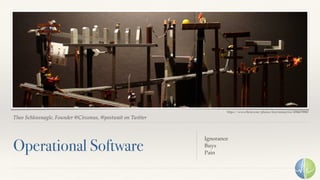
https://www.flickr.com/photos/hoyvinmayvin/4906678960
Tenet #1
Designing for the unknown
should never burden today
Compromise when forced.
Design with tomorrow’s expected volume,
but today’s functional requirements.
https://www.flickr.com/photos/alexander/20090860
Tenet #2
Never be left curious as to
what your software is doing
Observability is the only fast-path to success.
https://www.flickr.com/photos/jox1989/4764186425
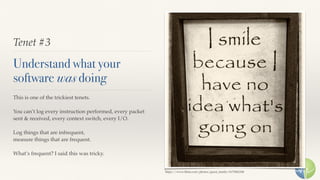
Tenet #3
Understand what your
software was doing
This is one of the trickiest tenets.
You can’t log every instruction performed, every packet
sent & received, every context switch, every I/O.
Log things that are infrequent,
measure things that are frequent.
What’s frequent? I said this was tricky.
https://www.flickr.com/photos/guest_family/6175062186
Tenet #4
Understand internal failures
The only thing worse than a malfunction in production,
is one without sufficient actionable data.
Core dump, stack trace analysis, etc.
These can wake people up.
https://www.flickr.com/photos/skipthefiller/2451481428
Tenet #5
Operator remediation of an
external failure is a bug
A system failing, a disk failing, a network partition, etc.
Once the external failure is remediated, no human being
should be involved in returning the (internal) system to
correct operation.
https://www.flickr.com/photos/timzim/2308099322
Tenet #6 & #7
Tight coupling

reduces resiliency
Loose coupling

reduces debug-ability
Tenet #8
Avoid difficult problems

if possible
One does not “just add” replication, consensus and fault
tolerance into systems.
Never solve a harder problem than you are presented.
The best solution to a problem is to remove the problem.
https://www.flickr.com/photos/shakestercody/2124972276
A tail of two systems
Queueing
Storage
https://www.flickr.com/photos/skynoir/8300610952
From RabbitMQ to Fq
RabbitMQ: Oh, the outages we’ve had.
violates #1, #2, #3, #5, #8
Fq:
(#1) build only semantics we need
(#2/#3) DTrace probes
(#4) cores dumps and backtrace.io
(#5) handled by simplicity of design and use
(#6/#7) push decoupling out, gain debug-ability
(#8) punt clustering downstream to clients
https://www.flickr.com/photos/fotologic/2165675515
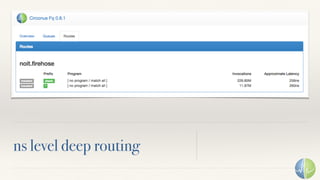
ns level deep routing
From Postgres to Snowth
Postgres 8… hacked in a column store using arrays
Tenet #3: build pg_statsd
Tenet #5: … build Snowth
Snowth: ring topology time-series store
(#1/#8) only commutative operations,
(#2) DTrace probes
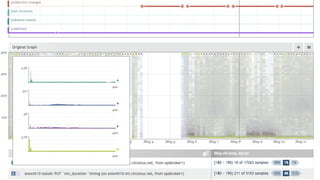
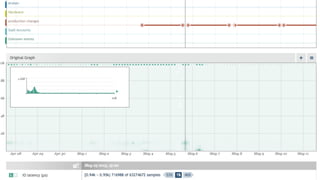
(#3) Circonus itself (statsd, histograms, etc.)
(#4) backtrace.io
(#7) implemented Zipkin (Dapper-like) tracing
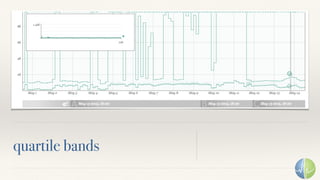
quartile bands
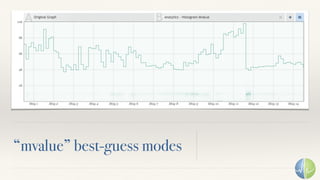
“mvalue” best-guess modes

Operational Software Design

  • 1.
    Theo Schlossnagle, Founder@Circonus, @postwait on Twitter Operational Software Ignorance Buys Pain https://www.flickr.com/photos/hoyvinmayvin/4906678960
  • 2.
    Tenet #1 Designing forthe unknown should never burden today Compromise when forced. Design with tomorrow’s expected volume, but today’s functional requirements. https://www.flickr.com/photos/alexander/20090860
  • 3.
    Tenet #2 Never beleft curious as to what your software is doing Observability is the only fast-path to success. https://www.flickr.com/photos/jox1989/4764186425
  • 4.
    Tenet #3 Understand whatyour software was doing This is one of the trickiest tenets. You can’t log every instruction performed, every packet sent & received, every context switch, every I/O. Log things that are infrequent, measure things that are frequent. What’s frequent? I said this was tricky. https://www.flickr.com/photos/guest_family/6175062186
  • 5.
    Tenet #4 Understand internalfailures The only thing worse than a malfunction in production, is one without sufficient actionable data. Core dump, stack trace analysis, etc. These can wake people up. https://www.flickr.com/photos/skipthefiller/2451481428
  • 6.
    Tenet #5 Operator remediationof an external failure is a bug A system failing, a disk failing, a network partition, etc. Once the external failure is remediated, no human being should be involved in returning the (internal) system to correct operation. https://www.flickr.com/photos/timzim/2308099322
  • 7.
    Tenet #6 &#7 Tight coupling
 reduces resiliency Loose coupling
 reduces debug-ability
  • 8.
    Tenet #8 Avoid difficultproblems
 if possible One does not “just add” replication, consensus and fault tolerance into systems. Never solve a harder problem than you are presented. The best solution to a problem is to remove the problem. https://www.flickr.com/photos/shakestercody/2124972276
  • 9.
    A tail oftwo systems Queueing Storage https://www.flickr.com/photos/skynoir/8300610952
  • 10.
    From RabbitMQ toFq RabbitMQ: Oh, the outages we’ve had. violates #1, #2, #3, #5, #8 Fq: (#1) build only semantics we need (#2/#3) DTrace probes (#4) cores dumps and backtrace.io (#5) handled by simplicity of design and use (#6/#7) push decoupling out, gain debug-ability (#8) punt clustering downstream to clients https://www.flickr.com/photos/fotologic/2165675515
  • 11.
  • 12.
    From Postgres toSnowth Postgres 8… hacked in a column store using arrays Tenet #3: build pg_statsd Tenet #5: … build Snowth Snowth: ring topology time-series store (#1/#8) only commutative operations, (#2) DTrace probes (#3) Circonus itself (statsd, histograms, etc.) (#4) backtrace.io (#7) implemented Zipkin (Dapper-like) tracing
  • 15.
  • 16.