






What’s in a Number?
          monitoring and measuring;
          the spiritual and the carnal.


Thursday, July 12, 12
Theo Schlossnagle                                                @postwait

                Entrepreneur: OmniTI, Message Systems, Circonus
                Author: Scalable Internet Architectures, Web Operations
                Speaker: over 50 speaking engagements around the world
                Engineer: Senior ACM Member, IEEE Member, ACM Queue
                Open Source:
                        Apache Traffic Server, Varnish, Node.js, node-iptrie, node-amqp,
                        Solaris HTTP accept filers, OpenSSH + SecurID, JLog, Mungo,
                        Portable umem, Reconnoiter, mod_log_spread/spreadlogd, Spread,
                        Wackamole, Zetaback, concurrencykit, Net::RabbitMQ, MCrypt,
                        node-gmp, node-compress, and others.


Thursday, July 12, 12
b le ”
          Theo Schlossnagle c
                                                          s               i@postwait
                                                    “i ra
                Entrepreneur: OmniTI, Message Systems, Circonus
                Author: Scalable Internet Architectures, Web Operations
                Speaker: over 50 speaking engagements around the world
                Engineer: Senior ACM Member, IEEE Member, ACM Queue
                Open Source:
                        Apache Traffic Server, Varnish, Node.js, node-iptrie, node-amqp,
                        Solaris HTTP accept filers, OpenSSH + SecurID, JLog, Mungo,
                        Portable umem, Reconnoiter, mod_log_spread/spreadlogd, Spread,
                        Wackamole, Zetaback, concurrencykit, Net::RabbitMQ, MCrypt,
                        node-gmp, node-compress, and others.


Thursday, July 12, 12
Monitoring ~ Voyeurism

                Watching from the outside in.
                Observing systems and their behaviors.
                Ultimately, a single observation distills into two things:
                        a set of circumstances
                        a value


Thursday, July 12, 12
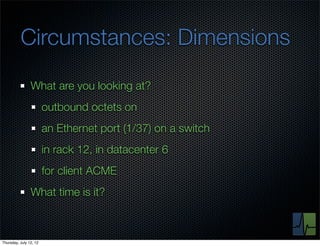
Circumstances: Dimensions
                What are you looking at?
                        outbound octets on
                        an Ethernet port (1/37) on a switch
                        in rack 12, in datacenter 6
                        for client ACME
                What time is it?


Thursday, July 12, 12
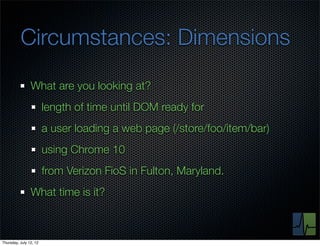
Circumstances: Dimensions
                What are you looking at?
                        length of time until DOM ready for
                        a user loading a web page (/store/foo/item/bar)
                        using Chrome 10
                        from Verizon FioS in Fulton, Maryland.
                What time is it?


Thursday, July 12, 12
Value
                Ultimately, there are two types of values we care about:
                        text
                          an version number, http code, ssh fingerprint
                        numeric
                          0.0000000000093123,
                          18446744064986053382,
                          1.1283e97, 6.33e-23,
                          0, -1, 1000, 42


Thursday, July 12, 12
Text Data
                Incredibly useful,
                because the “when” can be correlated
                with other events and conditions.
                Idea:
                        if the distinct set of text values is sufficiently small,
                        consider the text value as a dimension, and
                        the new value = 1


Thursday, July 12, 12
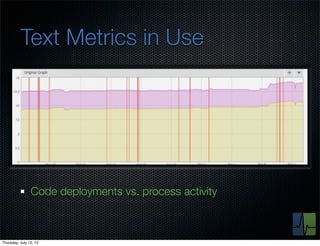
Text Metrics in Use


                Code deployments vs. process activity


Thursday, July 12, 12
Numeric Data

                There tends to be a lot of it.
                Example web hits:
                        one box, one metric, 1 billion / month.
                        that’s only 400 events/second.
                        each event has about 20 dimensions.


Thursday, July 12, 12
Numeric Metrics in Use


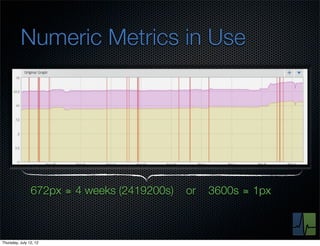
                672px ≅ 4 weeks (2419200s)   or   3600s ≅ 1px


Thursday, July 12, 12
Numeric Metrics in Use


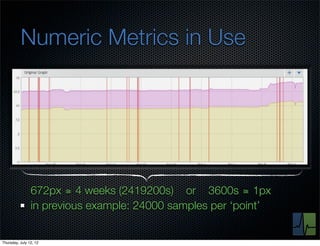
                672px ≅ 4 weeks (2419200s) or 3600s ≅ 1px
                in previous example: 24000 samples per ‘point’


Thursday, July 12, 12
Numeric Metrics in Use


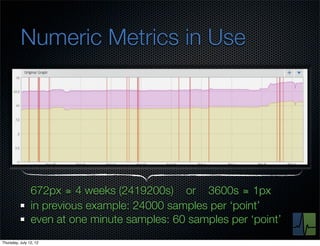
                672px ≅ 4 weeks (2419200s) or 3600s ≅ 1px
                in previous example: 24000 samples per ‘point’
                even at one minute samples: 60 samples per ‘point’
Thursday, July 12, 12
An Event
          each is a singularity:
          individual;
          unrepeatable;
          unique.
                                   mondolithic.com


Thursday, July 12, 12
Passive vs. Active
                Active is a synthesized event.
                        You perform some action an measure it.
                Passive is the collection of other events.
                        Stuff that really happened.


                Ask yourself which is better.


Thursday, July 12, 12
Conceding the Truth
                Passive events are ideal in high traffic environments.
                Active events are necessary in low traffic environments.


                “high and low” are relative, so...
                        you need both
                        always


Thursday, July 12, 12
Numbers: how they work.
                Think of a car’s speedometer.
                        it shows you how fast you are going (sorta)
                        at the moment you read it (almost)
                        the only reason this is acceptable is:
                          you have a rudimentary understanding of physics,
                          you are in the car, and
                          your body is exceptionally good
                          at detecting acceleration.
Thursday, July 12, 12
Computers are different.

                computers are fast: billions of instructions per second.
                you aren’t inside the computer.
                most “users” somehow forget rudimentary physics.
                interfaces and visual representations mislead you.
                a speedometer (or familiar readout) leads you to
                a false confidence in system stability between samples.


Thursday, July 12, 12
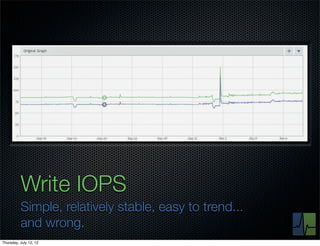
Write IOPS
          Simple, relatively stable, easy to trend...
          and wrong.
Thursday, July 12, 12
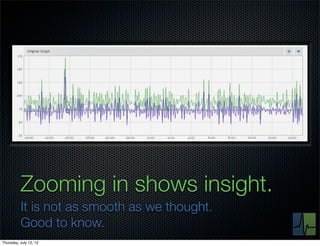
Zooming in shows insight.
          It is not as smooth as we thought.
          Good to know.
Thursday, July 12, 12
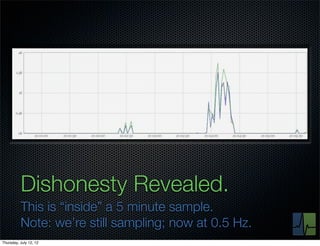
Dishonesty Revealed.
          This is “inside” a 5 minute sample.
          Note: we’re still sampling; now at 0.5 Hz.
Thursday, July 12, 12
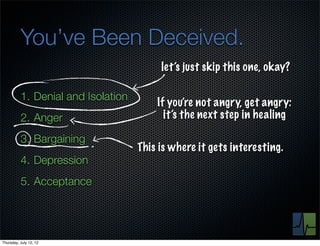
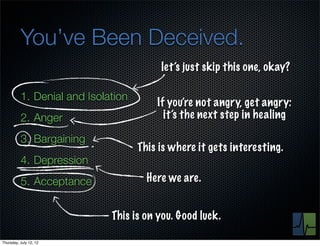
You’ve Been Deceived.

          1. Denial and Isolation
          2. Anger
          3. Bargaining
          4. Depression
          5. Acceptance


Thursday, July 12, 12
You’ve Been Deceived.
                                    let’s just skip this one, okay?

          1. Denial and Isolation
          2. Anger
          3. Bargaining
          4. Depression
          5. Acceptance


Thursday, July 12, 12
You’ve Been Deceived.
                                    let’s just skip this one, okay?

          1. Denial and Isolation
                                    If you’re not angry, get angry:
          2. Anger                    it’s the next step in healing

          3. Bargaining
          4. Depression
          5. Acceptance


Thursday, July 12, 12
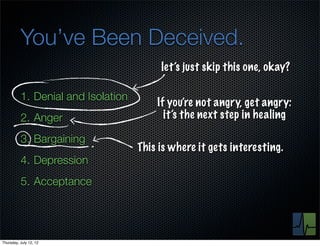
You’ve Been Deceived.
                                         let’s just skip this one, okay?

          1. Denial and Isolation
                                        If you’re not angry, get angry:
          2. Anger                        it’s the next step in healing

          3. Bargaining
                                    This is where it gets interesting.
          4. Depression
          5. Acceptance


Thursday, July 12, 12
Bargaining.

                I can’t reasonably store all the data:
                        likely true.
                Since I can’t store all the data,
                I have to store a summarization
                        yes; they’re called “aggregates.”


Thursday, July 12, 12
Bargaining: you’re losing.
                You are sampling things and losing data.
                        the speedometer example.


                or


                You are taking an average of a large set of samples.


Thursday, July 12, 12
“Average” is a bad bargain.

                The average of a set of numbers is:
                        the single most useful statistic
                By itself, it provides very little insight into
                the nature of the original set.
                Hello statistics!


Thursday, July 12, 12
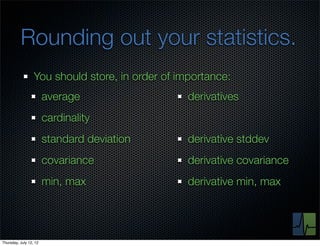
Rounding out your statistics.
                  You should store, in order of importance:
                        average                   derivatives
                        cardinality
                        standard deviation        derivative stddev
                        covariance                derivative covariance
                        min, max                  derivative min, max


Thursday, July 12, 12
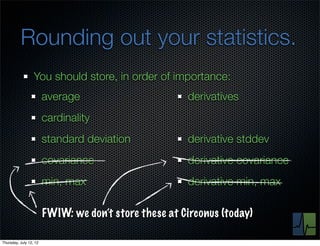
Rounding out your statistics.
                  You should store, in order of importance:
                        average                        derivatives
                        cardinality
                        standard deviation             derivative stddev
                        covariance                     derivative covariance
                        min, max                       derivative min, max

                        FWIW: we don’t store these at Circonus (today)

Thursday, July 12, 12
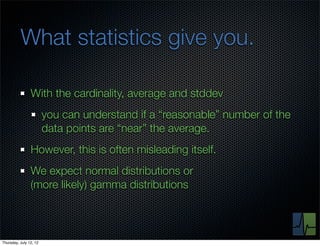
What statistics give you.

                With the cardinality, average and stddev
                        you can understand if a “reasonable” number of the
                        data points are “near” the average.
                However, this is often misleading itself.
                We expect normal distributions or
                (more likely) gamma distributions


Thursday, July 12, 12
So, we can make due.


                No.
                Let’s revisit the five stages of grieving.


Thursday, July 12, 12
You’ve Been Deceived.
                                         let’s just skip this one, okay?

          1. Denial and Isolation
                                        If you’re not angry, get angry:
          2. Anger                        it’s the next step in healing

          3. Bargaining
                                    This is where it gets interesting.
          4. Depression
          5. Acceptance


Thursday, July 12, 12
You’ve Been Deceived.
                                         let’s just skip this one, okay?

          1. Denial and Isolation
                                        If you’re not angry, get angry:
          2. Anger                        it’s the next step in healing

          3. Bargaining
                                    This is where it gets interesting.
          4. Depression
          5. Acceptance               Here we are.


Thursday, July 12, 12
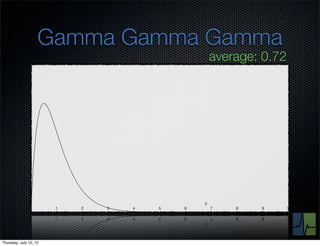
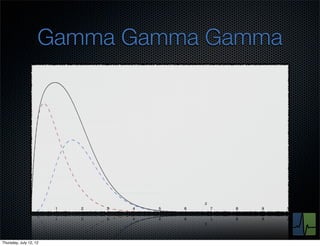
Gamma Gamma Gamma
                                                average: 0.72


               0        1   2   3   4   5   6   7   8   9       10


Thursday, July 12, 12
Gamma Gamma Gamma


               0        1   2   3   4   5   6   7   8   9   10


Thursday, July 12, 12
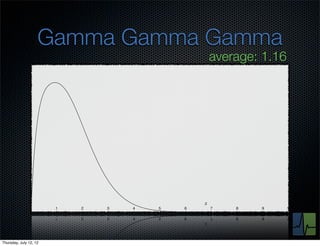
Gamma Gamma Gamma
                                                average: 1.16


               0        1   2   3   4   5   6   7   8   9       10


Thursday, July 12, 12
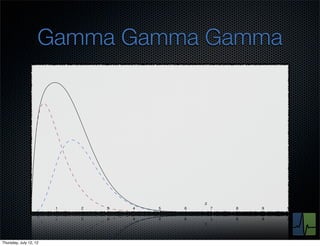
Gamma Gamma Gamma


               0        1   2   3   4   5   6   7   8   9   10


Thursday, July 12, 12
Gamma Gamma Gamma


Thursday, July 12, 12
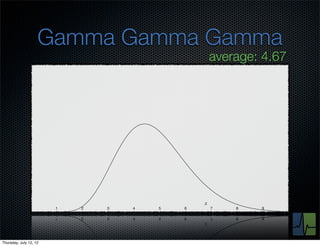
Gamma Gamma Gamma
                                                average: 4.67


               0        1   2   3   4   5   6   7   8   9


Thursday, July 12, 12
Do we need more?
                Wait. Stop.
                In some systems we know enough.
                We know their distributions,
                ... the leather seat, the inertia of the vessel.
                A sample here and there, an average, etc.
                Good enough: temperature, load, payments, bugs.
                Not enough: disk IOPS, memory use, CPU time.


Thursday, July 12, 12
We do need more.


                we have a lot of data sources from which
                we typically compose an average of many values, and
                understanding the distribution is extremely valuable.


Thursday, July 12, 12
Histograms: the need.
                Given an average of 4, and a cardinality of 1000
                maybe you had 1000 samples of exactly 4?
                Dunno.
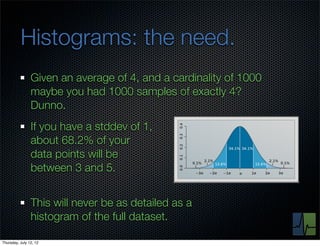
                If you have a stddev of 1,
                about 68.2% of your
                data points will be
                between 3 and 5.


                This will never be as detailed as a
                histogram of the full dataset.

Thursday, July 12, 12
Histograms: the want

                Ideally, we’d want histograms
                bucketed as we see fit
                with all data represented.
                Too much data: this isn’t tractable.
                So, how do we bucket?


Thursday, July 12, 12
Bucketing Basics
                If I had numbers bounded by a small space:
                        between 0ms and 10ms
                I could bucket [0-1),[1-2),...[9,10).
                        eleven buckets, fairly manageable.
                What do I do when I get 20? or 200? or 20000?
                What do I do when I get lots of data
                between 0.001 and 1?


Thursday, July 12, 12
How we do more.

                We make an assumption (yes: ass: u & mption)
                We assume the same thing floating point assumes:
                        The difference between “very large” numbers and the
                        difference between “very small” numbers can have
                        accuracy inversely proportional to their magnitude.
                We take this and build histograms.


Thursday, July 12, 12
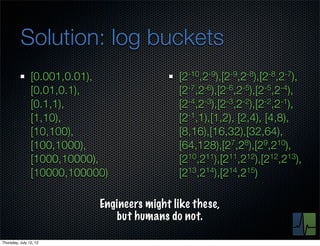
Solution: log buckets
                [0.001,0.01),                [2-10,2-9),[2-9,2-8),[2-8,2-7),
                [0.01,0.1),                  [2-7,2-6),[2-6,2-5),[2-5,2-4),
                [0.1,1),                     [2-4,2-3),[2-3,2-2),[2-2,2-1),
                [1,10),                      [2-1,1),[1,2), [2,4), [4,8),
                [10,100),                    [8,16),[16,32),[32,64),
                [100,1000),                  [64,128),[27,28),[29,210),
                [1000,10000),                [210,211),[211,212),[212,213),
                [10000,100000)               [213,214),[214,215)

                            Engineers might like these,
                               but humans do not.

Thursday, July 12, 12
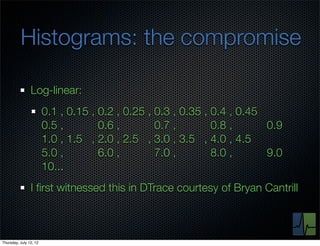
Histograms: the compromise

                Log-linear:
                        0.1 , 0.15 , 0.2 , 0.25 , 0.3 , 0.35 , 0.4 , 0.45
                        0.5 ,        0.6 ,        0.7 ,        0.8 ,      0.9
                        1.0 , 1.5 , 2.0 , 2.5 , 3.0 , 3.5 , 4.0 , 4.5
                        5.0 ,        6.0 ,        7.0 ,        8.0 ,      9.0
                        10...
                I first witnessed this in DTrace courtesy of Bryan Cantrill


Thursday, July 12, 12
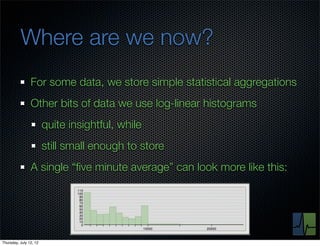
Where are we now?
                For some data, we store simple statistical aggregations
                Other bits of data we use log-linear histograms
                        quite insightful, while
                        still small enough to store
                A single “five minute average” can look more like this:


Thursday, July 12, 12
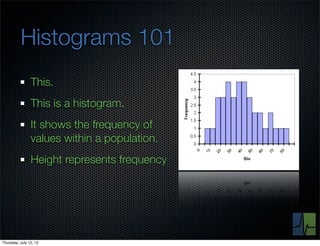
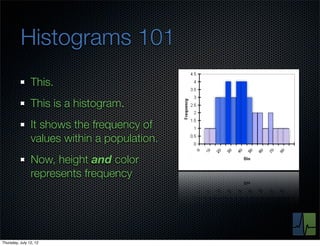
Histograms 101
                This.
                This is a histogram.
                It shows the frequency of
                values within a population.
                Height represents frequency


Thursday, July 12, 12
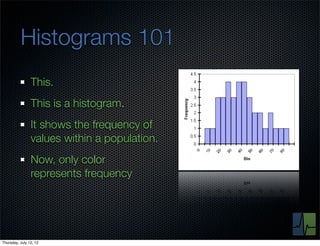
Histograms 101
                This.
                This is a histogram.
                It shows the frequency of
                values within a population.
                Now, height and color
                represents frequency


Thursday, July 12, 12
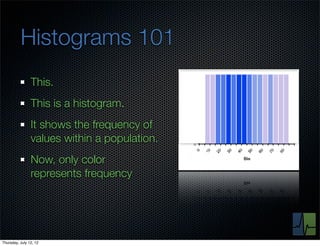
Histograms 101
                This.
                This is a histogram.
                It shows the frequency of
                values within a population.
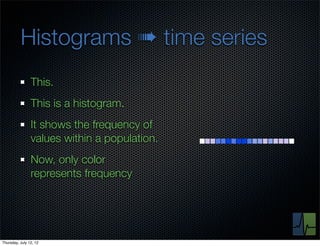
                Now, only color
                represents frequency


Thursday, July 12, 12
Histograms 101
                This.
                This is a histogram.
                It shows the frequency of
                values within a population.
                Now, only color
                represents frequency


Thursday, July 12, 12
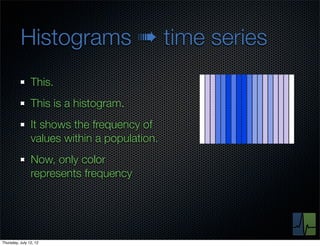
Histograms ➠ time series
                This.
                This is a histogram.
                It shows the frequency of
                values within a population.
                Now, only color
                represents frequency


Thursday, July 12, 12
Histograms ➠ time series
                This.
                This is a histogram.
                It shows the frequency of
                values within a population.
                Now, only color
                represents frequency


Thursday, July 12, 12
Histograms ➠ time series
                This.
                This is a histogram.
                It shows the frequency of
                values within a population.
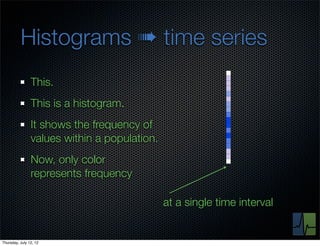
                Now, only color
                represents frequency

                                              at a single time interval


Thursday, July 12, 12
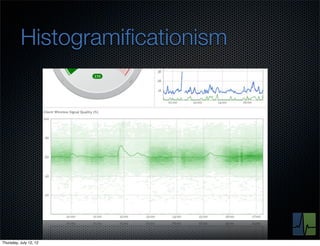
Histogramificationism


Thursday, July 12, 12
You’ve Been Deceived.
                                         let’s just skip this one, okay?

          1. Denial and Isolation
                                        If you’re not angry, get angry:
          2. Anger                        it’s the next step in healing

          3. Bargaining
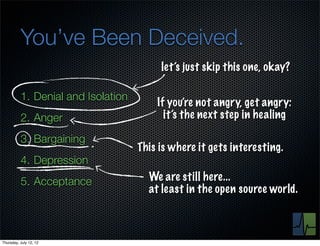
                                    This is where it gets interesting.
          4. Depression
          5. Acceptance               We are still here...
                                      at least in the open source world.


Thursday, July 12, 12
Reconnoiter

                Reconnoiter:
                        https://labs.omniti.com/labs/reconnoiter
                        https://github.com/omniti-labs/reconnoiter


                Open source (BSD)


Thursday, July 12, 12
Reconnoiter: backend
                C (as God intended),
                with lua bindings to ease plugin development
                Java (external) bridge for making things like JMX easier
                Esper (Java) for streaming queries (fault detection)
                AMQP and REST for component intercommunication
                PostgreSQL backing store
                Very actively developed


Thursday, July 12, 12
Reconnoiter: frontend

                HTML + CSS
                Javascript: JQuery, flot
                PHP for AJAX APIs


                Needs engineers.


Thursday, July 12, 12
Features (1)
                Data Collection:
                        most standard protocols (SNMP, REST, JDBC, etc.)
                        some nice bridges to legacy systems:
                        (nagios, munin, etc.)
                Data Storage:
                        supports sharding
                        never delete old data


Thursday, July 12, 12
Features (2)
                        We don’t do histograms now
                        Because all the old data is stored, we could
                          If we have enough data to make this worthwhile,
                          we will likley need an on-the-fly approach
                        We store raw data and rollups including:
                          average, cardinality, stddev, derivatives
                          (and counters)


Thursday, July 12, 12
Features (3)
                        separates data from visualization
                        drag-n-drop graphing
                        real-time data:
                          you can run checks “often” (every 100ms?)
                          you can see that data in the browser
                          you can compose a graph from disparate data


Thursday, July 12, 12
Active vs. Passive
                Reconnoiter supports passive metric submission
                        what version of code is deployed
                Reconnoiter’s design is focused on active collection
                        how may users have signed up
                        how many visitors to your site
                        how full is your disk
                        how many open bugs
                        how many hours spent

Thursday, July 12, 12
Bias
                Reconnoiter doesn’t solve all your problems
                (we’re busy trying to do that with Circonus)


                I believe Reconnoiter is the best tool available
                for heterogeneous, multi-datacenter, full-architecture
                monitoring.


                I am seriously biased.


Thursday, July 12, 12
You’ve Been Deceived.
                                         let’s just skip this one, okay?

          1. Denial and Isolation
                                        If you’re not angry, get angry:
          2. Anger                        it’s the next step in healing

          3. Bargaining
                                    This is where it gets interesting.
          4. Depression
          5. Acceptance               Here we are.


                             This is on you. Good luck.

Thursday, July 12, 12
Thank You!
          Questions?

Thursday, July 12, 12

Atldevops

  • 1.
    What’s in aNumber? monitoring and measuring; the spiritual and the carnal. Thursday, July 12, 12
  • 2.
    Theo Schlossnagle @postwait Entrepreneur: OmniTI, Message Systems, Circonus Author: Scalable Internet Architectures, Web Operations Speaker: over 50 speaking engagements around the world Engineer: Senior ACM Member, IEEE Member, ACM Queue Open Source: Apache Traffic Server, Varnish, Node.js, node-iptrie, node-amqp, Solaris HTTP accept filers, OpenSSH + SecurID, JLog, Mungo, Portable umem, Reconnoiter, mod_log_spread/spreadlogd, Spread, Wackamole, Zetaback, concurrencykit, Net::RabbitMQ, MCrypt, node-gmp, node-compress, and others. Thursday, July 12, 12
  • 3.
    b le ” Theo Schlossnagle c s i@postwait “i ra Entrepreneur: OmniTI, Message Systems, Circonus Author: Scalable Internet Architectures, Web Operations Speaker: over 50 speaking engagements around the world Engineer: Senior ACM Member, IEEE Member, ACM Queue Open Source: Apache Traffic Server, Varnish, Node.js, node-iptrie, node-amqp, Solaris HTTP accept filers, OpenSSH + SecurID, JLog, Mungo, Portable umem, Reconnoiter, mod_log_spread/spreadlogd, Spread, Wackamole, Zetaback, concurrencykit, Net::RabbitMQ, MCrypt, node-gmp, node-compress, and others. Thursday, July 12, 12
  • 4.
    Monitoring ~ Voyeurism Watching from the outside in. Observing systems and their behaviors. Ultimately, a single observation distills into two things: a set of circumstances a value Thursday, July 12, 12
  • 5.
    Circumstances: Dimensions What are you looking at? outbound octets on an Ethernet port (1/37) on a switch in rack 12, in datacenter 6 for client ACME What time is it? Thursday, July 12, 12
  • 6.
    Circumstances: Dimensions What are you looking at? length of time until DOM ready for a user loading a web page (/store/foo/item/bar) using Chrome 10 from Verizon FioS in Fulton, Maryland. What time is it? Thursday, July 12, 12
  • 7.
    Value Ultimately, there are two types of values we care about: text an version number, http code, ssh fingerprint numeric 0.0000000000093123, 18446744064986053382, 1.1283e97, 6.33e-23, 0, -1, 1000, 42 Thursday, July 12, 12
  • 8.
    Text Data Incredibly useful, because the “when” can be correlated with other events and conditions. Idea: if the distinct set of text values is sufficiently small, consider the text value as a dimension, and the new value = 1 Thursday, July 12, 12
  • 9.
    Text Metrics inUse Code deployments vs. process activity Thursday, July 12, 12
  • 10.
    Numeric Data There tends to be a lot of it. Example web hits: one box, one metric, 1 billion / month. that’s only 400 events/second. each event has about 20 dimensions. Thursday, July 12, 12
  • 11.
    Numeric Metrics inUse 672px ≅ 4 weeks (2419200s) or 3600s ≅ 1px Thursday, July 12, 12
  • 12.
    Numeric Metrics inUse 672px ≅ 4 weeks (2419200s) or 3600s ≅ 1px in previous example: 24000 samples per ‘point’ Thursday, July 12, 12
  • 13.
    Numeric Metrics inUse 672px ≅ 4 weeks (2419200s) or 3600s ≅ 1px in previous example: 24000 samples per ‘point’ even at one minute samples: 60 samples per ‘point’ Thursday, July 12, 12
  • 14.
    An Event each is a singularity: individual; unrepeatable; unique. mondolithic.com Thursday, July 12, 12
  • 15.
    Passive vs. Active Active is a synthesized event. You perform some action an measure it. Passive is the collection of other events. Stuff that really happened. Ask yourself which is better. Thursday, July 12, 12
  • 16.
    Conceding the Truth Passive events are ideal in high traffic environments. Active events are necessary in low traffic environments. “high and low” are relative, so... you need both always Thursday, July 12, 12
  • 17.
    Numbers: how theywork. Think of a car’s speedometer. it shows you how fast you are going (sorta) at the moment you read it (almost) the only reason this is acceptable is: you have a rudimentary understanding of physics, you are in the car, and your body is exceptionally good at detecting acceleration. Thursday, July 12, 12
  • 18.
    Computers are different. computers are fast: billions of instructions per second. you aren’t inside the computer. most “users” somehow forget rudimentary physics. interfaces and visual representations mislead you. a speedometer (or familiar readout) leads you to a false confidence in system stability between samples. Thursday, July 12, 12
  • 19.
    Write IOPS Simple, relatively stable, easy to trend... and wrong. Thursday, July 12, 12
  • 20.
    Zooming in showsinsight. It is not as smooth as we thought. Good to know. Thursday, July 12, 12
  • 21.
    Dishonesty Revealed. This is “inside” a 5 minute sample. Note: we’re still sampling; now at 0.5 Hz. Thursday, July 12, 12
  • 22.
    You’ve Been Deceived. 1. Denial and Isolation 2. Anger 3. Bargaining 4. Depression 5. Acceptance Thursday, July 12, 12
  • 23.
    You’ve Been Deceived. let’s just skip this one, okay? 1. Denial and Isolation 2. Anger 3. Bargaining 4. Depression 5. Acceptance Thursday, July 12, 12
  • 24.
    You’ve Been Deceived. let’s just skip this one, okay? 1. Denial and Isolation If you’re not angry, get angry: 2. Anger it’s the next step in healing 3. Bargaining 4. Depression 5. Acceptance Thursday, July 12, 12
  • 25.
    You’ve Been Deceived. let’s just skip this one, okay? 1. Denial and Isolation If you’re not angry, get angry: 2. Anger it’s the next step in healing 3. Bargaining This is where it gets interesting. 4. Depression 5. Acceptance Thursday, July 12, 12
  • 26.
    Bargaining. I can’t reasonably store all the data: likely true. Since I can’t store all the data, I have to store a summarization yes; they’re called “aggregates.” Thursday, July 12, 12
  • 27.
    Bargaining: you’re losing. You are sampling things and losing data. the speedometer example. or You are taking an average of a large set of samples. Thursday, July 12, 12
  • 28.
    “Average” is abad bargain. The average of a set of numbers is: the single most useful statistic By itself, it provides very little insight into the nature of the original set. Hello statistics! Thursday, July 12, 12
  • 29.
    Rounding out yourstatistics. You should store, in order of importance: average derivatives cardinality standard deviation derivative stddev covariance derivative covariance min, max derivative min, max Thursday, July 12, 12
  • 30.
    Rounding out yourstatistics. You should store, in order of importance: average derivatives cardinality standard deviation derivative stddev covariance derivative covariance min, max derivative min, max FWIW: we don’t store these at Circonus (today) Thursday, July 12, 12
  • 31.
    What statistics giveyou. With the cardinality, average and stddev you can understand if a “reasonable” number of the data points are “near” the average. However, this is often misleading itself. We expect normal distributions or (more likely) gamma distributions Thursday, July 12, 12
  • 32.
    So, we canmake due. No. Let’s revisit the five stages of grieving. Thursday, July 12, 12
  • 33.
    You’ve Been Deceived. let’s just skip this one, okay? 1. Denial and Isolation If you’re not angry, get angry: 2. Anger it’s the next step in healing 3. Bargaining This is where it gets interesting. 4. Depression 5. Acceptance Thursday, July 12, 12
  • 34.
    You’ve Been Deceived. let’s just skip this one, okay? 1. Denial and Isolation If you’re not angry, get angry: 2. Anger it’s the next step in healing 3. Bargaining This is where it gets interesting. 4. Depression 5. Acceptance Here we are. Thursday, July 12, 12
  • 35.
    Gamma Gamma Gamma average: 0.72 0 1 2 3 4 5 6 7 8 9 10 Thursday, July 12, 12
  • 36.
    Gamma Gamma Gamma 0 1 2 3 4 5 6 7 8 9 10 Thursday, July 12, 12
  • 37.
    Gamma Gamma Gamma average: 1.16 0 1 2 3 4 5 6 7 8 9 10 Thursday, July 12, 12
  • 38.
    Gamma Gamma Gamma 0 1 2 3 4 5 6 7 8 9 10 Thursday, July 12, 12
  • 39.
  • 40.
    Gamma Gamma Gamma average: 4.67 0 1 2 3 4 5 6 7 8 9 Thursday, July 12, 12
  • 41.
    Do we needmore? Wait. Stop. In some systems we know enough. We know their distributions, ... the leather seat, the inertia of the vessel. A sample here and there, an average, etc. Good enough: temperature, load, payments, bugs. Not enough: disk IOPS, memory use, CPU time. Thursday, July 12, 12
  • 42.
    We do needmore. we have a lot of data sources from which we typically compose an average of many values, and understanding the distribution is extremely valuable. Thursday, July 12, 12
  • 43.
    Histograms: the need. Given an average of 4, and a cardinality of 1000 maybe you had 1000 samples of exactly 4? Dunno. If you have a stddev of 1, about 68.2% of your data points will be between 3 and 5. This will never be as detailed as a histogram of the full dataset. Thursday, July 12, 12
  • 44.
    Histograms: the want Ideally, we’d want histograms bucketed as we see fit with all data represented. Too much data: this isn’t tractable. So, how do we bucket? Thursday, July 12, 12
  • 45.
    Bucketing Basics If I had numbers bounded by a small space: between 0ms and 10ms I could bucket [0-1),[1-2),...[9,10). eleven buckets, fairly manageable. What do I do when I get 20? or 200? or 20000? What do I do when I get lots of data between 0.001 and 1? Thursday, July 12, 12
  • 46.
    How we domore. We make an assumption (yes: ass: u & mption) We assume the same thing floating point assumes: The difference between “very large” numbers and the difference between “very small” numbers can have accuracy inversely proportional to their magnitude. We take this and build histograms. Thursday, July 12, 12
  • 47.
    Solution: log buckets [0.001,0.01), [2-10,2-9),[2-9,2-8),[2-8,2-7), [0.01,0.1), [2-7,2-6),[2-6,2-5),[2-5,2-4), [0.1,1), [2-4,2-3),[2-3,2-2),[2-2,2-1), [1,10), [2-1,1),[1,2), [2,4), [4,8), [10,100), [8,16),[16,32),[32,64), [100,1000), [64,128),[27,28),[29,210), [1000,10000), [210,211),[211,212),[212,213), [10000,100000) [213,214),[214,215) Engineers might like these, but humans do not. Thursday, July 12, 12
  • 48.
    Histograms: the compromise Log-linear: 0.1 , 0.15 , 0.2 , 0.25 , 0.3 , 0.35 , 0.4 , 0.45 0.5 , 0.6 , 0.7 , 0.8 , 0.9 1.0 , 1.5 , 2.0 , 2.5 , 3.0 , 3.5 , 4.0 , 4.5 5.0 , 6.0 , 7.0 , 8.0 , 9.0 10... I first witnessed this in DTrace courtesy of Bryan Cantrill Thursday, July 12, 12
  • 49.
    Where are wenow? For some data, we store simple statistical aggregations Other bits of data we use log-linear histograms quite insightful, while still small enough to store A single “five minute average” can look more like this: Thursday, July 12, 12
  • 50.
    Histograms 101 This. This is a histogram. It shows the frequency of values within a population. Height represents frequency Thursday, July 12, 12
  • 51.
    Histograms 101 This. This is a histogram. It shows the frequency of values within a population. Now, height and color represents frequency Thursday, July 12, 12
  • 52.
    Histograms 101 This. This is a histogram. It shows the frequency of values within a population. Now, only color represents frequency Thursday, July 12, 12
  • 53.
    Histograms 101 This. This is a histogram. It shows the frequency of values within a population. Now, only color represents frequency Thursday, July 12, 12
  • 54.
    Histograms ➠ timeseries This. This is a histogram. It shows the frequency of values within a population. Now, only color represents frequency Thursday, July 12, 12
  • 55.
    Histograms ➠ timeseries This. This is a histogram. It shows the frequency of values within a population. Now, only color represents frequency Thursday, July 12, 12
  • 56.
    Histograms ➠ timeseries This. This is a histogram. It shows the frequency of values within a population. Now, only color represents frequency at a single time interval Thursday, July 12, 12
  • 57.
  • 58.
    You’ve Been Deceived. let’s just skip this one, okay? 1. Denial and Isolation If you’re not angry, get angry: 2. Anger it’s the next step in healing 3. Bargaining This is where it gets interesting. 4. Depression 5. Acceptance We are still here... at least in the open source world. Thursday, July 12, 12
  • 59.
    Reconnoiter Reconnoiter: https://labs.omniti.com/labs/reconnoiter https://github.com/omniti-labs/reconnoiter Open source (BSD) Thursday, July 12, 12
  • 60.
    Reconnoiter: backend C (as God intended), with lua bindings to ease plugin development Java (external) bridge for making things like JMX easier Esper (Java) for streaming queries (fault detection) AMQP and REST for component intercommunication PostgreSQL backing store Very actively developed Thursday, July 12, 12
  • 61.
    Reconnoiter: frontend HTML + CSS Javascript: JQuery, flot PHP for AJAX APIs Needs engineers. Thursday, July 12, 12
  • 62.
    Features (1) Data Collection: most standard protocols (SNMP, REST, JDBC, etc.) some nice bridges to legacy systems: (nagios, munin, etc.) Data Storage: supports sharding never delete old data Thursday, July 12, 12
  • 63.
    Features (2) We don’t do histograms now Because all the old data is stored, we could If we have enough data to make this worthwhile, we will likley need an on-the-fly approach We store raw data and rollups including: average, cardinality, stddev, derivatives (and counters) Thursday, July 12, 12
  • 64.
    Features (3) separates data from visualization drag-n-drop graphing real-time data: you can run checks “often” (every 100ms?) you can see that data in the browser you can compose a graph from disparate data Thursday, July 12, 12
  • 65.
    Active vs. Passive Reconnoiter supports passive metric submission what version of code is deployed Reconnoiter’s design is focused on active collection how may users have signed up how many visitors to your site how full is your disk how many open bugs how many hours spent Thursday, July 12, 12
  • 66.
    Bias Reconnoiter doesn’t solve all your problems (we’re busy trying to do that with Circonus) I believe Reconnoiter is the best tool available for heterogeneous, multi-datacenter, full-architecture monitoring. I am seriously biased. Thursday, July 12, 12
  • 67.
    You’ve Been Deceived. let’s just skip this one, okay? 1. Denial and Isolation If you’re not angry, get angry: 2. Anger it’s the next step in healing 3. Bargaining This is where it gets interesting. 4. Depression 5. Acceptance Here we are. This is on you. Good luck. Thursday, July 12, 12
  • 68.
    Thank You! Questions? Thursday, July 12, 12