

















A tour through mathematical methods on systems telemetry 
Math in Big Systems If it was a 
simple math problem, 
we’d have 
solved all this by now.
The many faces of 
Theo Schlossnagle @postwait 
CEO Circonus
Choosing an approach is premature… 
Problems 
How do we determine the type of signal? 
How do we manage off-line modeling? 
How do we manage online fault detection? 
How do we reconcile so users don’t hate us? 
How we we solve this in a big-data context?
Picking 
an Approach 
Statistical? 
Machine learning? 
Supervised? 
Ad-hoc? 
ontological? (why it is what it is)
tl;dr 
Apply PhDs Apply PhDs 
Rinse 
Wash 
Repeat
Garbage in, category out. 
Classification Understanding a signal 
We found to be quite ad-hoc 
At least the feature extraction
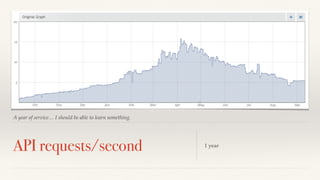
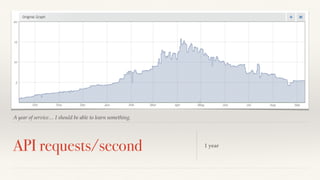
A year of service… I should be able to learn something. 
API requests/second 1 year
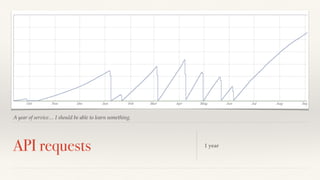
A year of service… I should be able to learn something. 
API requests 1 year
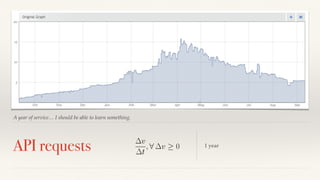
A year of service… I should be able to learn something. 
API requests 1 year 
Δv 
Δt 
, ! Δv ≥ 0
Some data goes both ways… 
Complicating Things 
Imagine disk space used… 
it makes sense as a gauge (how full) 
it makes sense as rate (fill rate)
Error + error + guessing = success 
How we categorize 
Human identify a variety of categories. 
Devise a set of ad-hoc features. 
Bayesian model of features to categories. 
Human tests. 
https://www.flickr.com/photos/chrisyarzab/5827332576
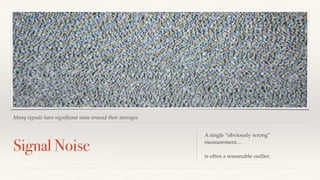
Many signals have significant noise around their averages 
Signal Noise A single “obviously wrong” 
measurement… 
is often a reasonable outlier.
A year of service… I should be able to learn something. 
API requests/second 1 year
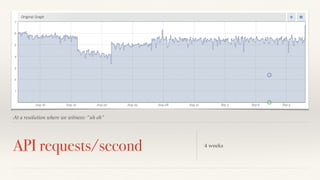
At a resolution where we witness: “uh oh” 
API requests/second 4 weeks
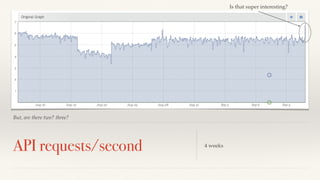
But, are there two? three? 
API requests/second 4 weeks 
Is that super interesting?
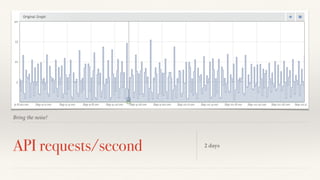
Bring the noise! 
API requests/second 2 days
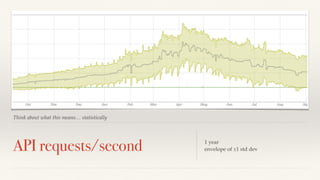
Think about what this means… statistically 
API requests/second 1 year 
envelope of ±1 std dev
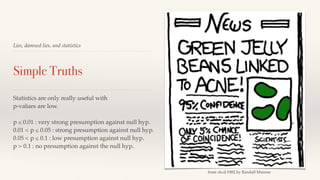
Lies, damned lies, and statistics 
Simple Truths 
Statistics are only really useful with 
p-values are low. 
p ≤ 0.01 : very strong presumption against null hyp. 
0.01 < p ≤ 0.05 : strong presumption against null hyp. 
0.05 < p ≤ 0.1 : low presumption against null hyp. 
p > 0.1 : no presumption against the null hyp. 
from xkcd #882 by Randall Munroe
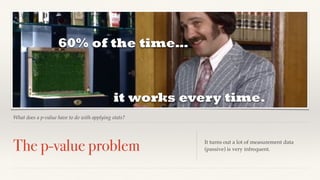
What does a p-value have to do with applying stats? 
The p-value problem It turns out a lot of measurement data 
(passive) is very infrequent. 
60% of the time… 
it works every time.
Our low frequencies lead us to 
questions of doubt… 
Given a certain statistical model: 
How many few points need to be seen before we 
are sufficiently confident that it does not fit the 
model (presumption against the null hypothesis)? 
With few, we simply have outliers or insignificant 
aberrations. 
http://www.flickr.com/photos/rooreynolds/
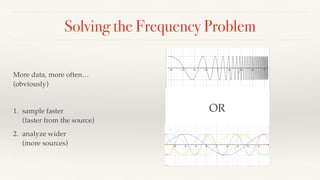
Solving the Frequency Problem 
More data, more often… 
(obviously) 
1. sample faster 
(faster from the source) 
2. analyze wider 
(more sources) 
OR
https://www.flickr.com/photos/whosdadog/3652670385 
Increasing frequency is the only option at times. 
Signals of Importance Without large-scale systems 
We must increase frequency
What do mean that my mean is mean? 
Why can’t math be nice to people? 
https://www.flickr.com/photos/imagesbywestfall/3606314694 
Most algorithms require measuring residuals from a mean 
Mean means Calculating means is “easy” 
There are some pitfalls
Newer data should influence our model. 
Signals change 
The model needs to adapt. 
Exponentially decaying averages are quite common 
in online control systems and used as a basis for 
creating control charts. 
Sliding windows are a bit more expensive.
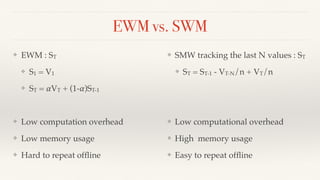
EWM vs. SWM 
âť– EWM : ST 
âť– S1 = V1 
❖ ST = 훼VT + (1-훼)ST-1 
âť– Low computation overhead 
âť– Low memory usage 
âť– Hard to repeat offline 
âť– SMW tracking the last N values : ST 
âť– ST = ST-1 - VT-N/n + VT/n 
âť– Low computational overhead 
âť– High memory usage 
âť– Easy to repeat offline
Repeatable outcomes are needed 
In our system… 
We need our online algorithms to match our offline 
algorithms. 
This is because human beings get pissed off when 
they can’t repeat outcomes that woke them up in 
the middle of the night. 
EWM: not repeatable 
SWM: expensive in online application
Repeatable, low-cost sliding windows 
Our solution: 
lurching windows 
fixed rolling windows 
of 
fixed windows 
SWM + EWM
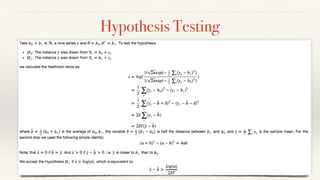
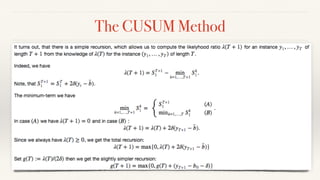
Putting it all together… How to test if we don’t match our model?
Hypothesis Testing
The CUSUM Method
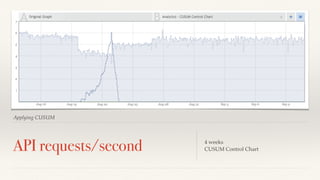
Applying CUSUM 
API requests/second 4 weeks 
CUSUM Control Chart
Can we do better? 
Investigations 
The CUSUM method has some issues. It’s challenging 
when signals are noise or of variable rate. 
We’re looking into the Tukey test: 
• compares all possible pairs of means 
• test is conservative in light of uneven sample sizes 
https://www.flickr.com/photos/st3f4n/4272645780
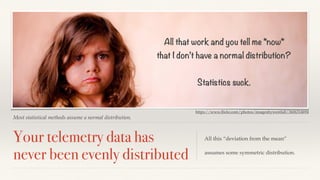
All that work and you tell me *now* 
that I don’t have a normal distribution? 
Most statistical methods assume a normal distribution. 
Your telemetry data has 
never been evenly distributed 
Statistics suck. 
https://www.flickr.com/photos/imagesbywestfall/3606314694 
All this “deviation from the mean” 
assumes some symmetric distribution.
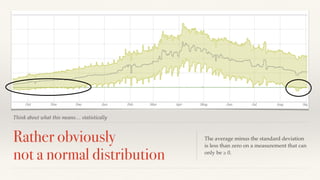
Think about what this means… statistically 
Rather obviously 
not a normal distribution 
The average minus the standard deviation 
is less than zero on a measurement that can 
only be ≥ 0.
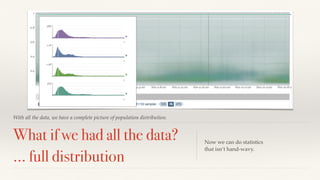
With all the data, we have a complete picture of population distribution. 
What if we had all the data? 
… full distribution 
Now we can do statistics 
that isn’t hand-wavy.
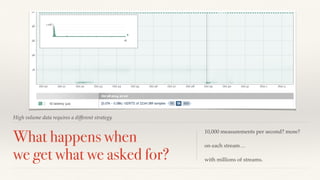
High volume data requires a different strategy 
What happens when 
we get what we asked for? 
10,000 measurements per second? more? 
on each stream… 
with millions of streams.
Let’s understand the scope of the problem. 
First some realities 
This is 10 billion to 1 trillion measurements per second. 
At least a million independent models. 
We need to cheat. 
https://www.flickr.com/photos/thost/319978448
https://www.flickr.com/photos/meddygarnet/3085238543 
When we have too much, simplify… 
Information compression We need to look to transform the data. 
Add error in the value space. 
Add error in the time space.
Summarization & Extraction 
âť– Take our high-velocity stream 
âť– Summarize as a histogram over 1 minute (error) 
âť– Extract useful less-dimensional characteristics 
âť– Apply CUSUM and Tukey tests on characteristics
Lorem Ipsum Dolor 
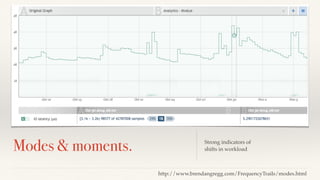
Modes & moments. Strong indicators of 
shifts in workload 
http://www.brendangregg.com/FrequencyTrails/modes.html
Lorem Ipsum Dolor 
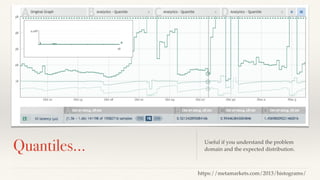
Quantiles… Useful if you understand the problem 
domain and the expected distribution. 
https://metamarkets.com/2013/histograms/
Lorem Ipsum Dolor 
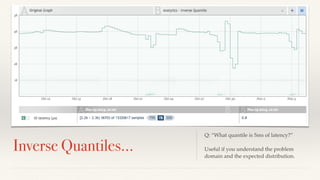
Inverse Quantiles… Q: “What quantile is 5ms of latency?” 
Useful if you understand the problem 
domain and the expected distribution.
Thank ou! and thank you to the real brains behind Circonus’ analysis systems: Heinrich and George.

The math behind big systems analysis.

  • 1.
    A tour throughmathematical methods on systems telemetry Math in Big Systems If it was a simple math problem, we’d have solved all this by now.
  • 2.
    The many facesof Theo Schlossnagle @postwait CEO Circonus
  • 3.
    Choosing an approachis premature… Problems How do we determine the type of signal? How do we manage off-line modeling? How do we manage online fault detection? How do we reconcile so users don’t hate us? How we we solve this in a big-data context?
  • 4.
    Picking an Approach Statistical? Machine learning? Supervised? Ad-hoc? ontological? (why it is what it is)
  • 5.
    tl;dr Apply PhDsApply PhDs Rinse Wash Repeat
  • 6.
    Garbage in, categoryout. Classification Understanding a signal We found to be quite ad-hoc At least the feature extraction
  • 7.
    A year ofservice… I should be able to learn something. API requests/second 1 year
  • 8.
    A year ofservice… I should be able to learn something. API requests 1 year
  • 9.
    A year ofservice… I should be able to learn something. API requests 1 year Δv Δt , ! Δv ≥ 0
  • 10.
    Some data goesboth ways… Complicating Things Imagine disk space used… it makes sense as a gauge (how full) it makes sense as rate (fill rate)
  • 11.
    Error + error+ guessing = success How we categorize Human identify a variety of categories. Devise a set of ad-hoc features. Bayesian model of features to categories. Human tests. https://www.flickr.com/photos/chrisyarzab/5827332576
  • 12.
    Many signals havesignificant noise around their averages Signal Noise A single “obviously wrong” measurement… is often a reasonable outlier.
  • 13.
    A year ofservice… I should be able to learn something. API requests/second 1 year
  • 14.
    At a resolutionwhere we witness: “uh oh” API requests/second 4 weeks
  • 15.
    But, are theretwo? three? API requests/second 4 weeks Is that super interesting?
  • 16.
    Bring the noise! API requests/second 2 days
  • 17.
    Think about whatthis means… statistically API requests/second 1 year envelope of ±1 std dev
  • 18.
    Lies, damned lies,and statistics Simple Truths Statistics are only really useful with p-values are low. p ≤ 0.01 : very strong presumption against null hyp. 0.01 < p ≤ 0.05 : strong presumption against null hyp. 0.05 < p ≤ 0.1 : low presumption against null hyp. p > 0.1 : no presumption against the null hyp. from xkcd #882 by Randall Munroe
  • 19.
    What does ap-value have to do with applying stats? The p-value problem It turns out a lot of measurement data (passive) is very infrequent. 60% of the time… it works every time.
  • 20.
    Our low frequencieslead us to questions of doubt… Given a certain statistical model: How many few points need to be seen before we are sufficiently confident that it does not fit the model (presumption against the null hypothesis)? With few, we simply have outliers or insignificant aberrations. http://www.flickr.com/photos/rooreynolds/
  • 21.
    Solving the FrequencyProblem More data, more often… (obviously) 1. sample faster (faster from the source) 2. analyze wider (more sources) OR
  • 22.
    https://www.flickr.com/photos/whosdadog/3652670385 Increasing frequencyis the only option at times. Signals of Importance Without large-scale systems We must increase frequency
  • 23.
    What do meanthat my mean is mean? Why can’t math be nice to people? https://www.flickr.com/photos/imagesbywestfall/3606314694 Most algorithms require measuring residuals from a mean Mean means Calculating means is “easy” There are some pitfalls
  • 24.
    Newer data shouldinfluence our model. Signals change The model needs to adapt. Exponentially decaying averages are quite common in online control systems and used as a basis for creating control charts. Sliding windows are a bit more expensive.
  • 25.
    EWM vs. SWM ❖ EWM : ST ❖ S1 = V1 ❖ ST = 훼VT + (1-훼)ST-1 ❖ Low computation overhead ❖ Low memory usage ❖ Hard to repeat offline ❖ SMW tracking the last N values : ST ❖ ST = ST-1 - VT-N/n + VT/n ❖ Low computational overhead ❖ High memory usage ❖ Easy to repeat offline
  • 26.
    Repeatable outcomes areneeded In our system… We need our online algorithms to match our offline algorithms. This is because human beings get pissed off when they can’t repeat outcomes that woke them up in the middle of the night. EWM: not repeatable SWM: expensive in online application
  • 27.
    Repeatable, low-cost slidingwindows Our solution: lurching windows fixed rolling windows of fixed windows SWM + EWM
  • 28.
    Putting it alltogether… How to test if we don’t match our model?
  • 29.
  • 30.
  • 31.
    Applying CUSUM APIrequests/second 4 weeks CUSUM Control Chart
  • 32.
    Can we dobetter? Investigations The CUSUM method has some issues. It’s challenging when signals are noise or of variable rate. We’re looking into the Tukey test: • compares all possible pairs of means • test is conservative in light of uneven sample sizes https://www.flickr.com/photos/st3f4n/4272645780
  • 33.
    All that workand you tell me *now* that I don’t have a normal distribution? Most statistical methods assume a normal distribution. Your telemetry data has never been evenly distributed Statistics suck. https://www.flickr.com/photos/imagesbywestfall/3606314694 All this “deviation from the mean” assumes some symmetric distribution.
  • 34.
    Think about whatthis means… statistically Rather obviously not a normal distribution The average minus the standard deviation is less than zero on a measurement that can only be ≥ 0.
  • 35.
    With all thedata, we have a complete picture of population distribution. What if we had all the data? … full distribution Now we can do statistics that isn’t hand-wavy.
  • 36.
    High volume datarequires a different strategy What happens when we get what we asked for? 10,000 measurements per second? more? on each stream… with millions of streams.
  • 37.
    Let’s understand thescope of the problem. First some realities This is 10 billion to 1 trillion measurements per second. At least a million independent models. We need to cheat. https://www.flickr.com/photos/thost/319978448
  • 38.
    https://www.flickr.com/photos/meddygarnet/3085238543 When wehave too much, simplify… Information compression We need to look to transform the data. Add error in the value space. Add error in the time space.
  • 39.
    Summarization & Extraction âť– Take our high-velocity stream âť– Summarize as a histogram over 1 minute (error) âť– Extract useful less-dimensional characteristics âť– Apply CUSUM and Tukey tests on characteristics
  • 40.
    Lorem Ipsum Dolor Modes & moments. Strong indicators of shifts in workload http://www.brendangregg.com/FrequencyTrails/modes.html
  • 41.
    Lorem Ipsum Dolor Quantiles… Useful if you understand the problem domain and the expected distribution. https://metamarkets.com/2013/histograms/
  • 42.
    Lorem Ipsum Dolor Inverse Quantiles… Q: “What quantile is 5ms of latency?” Useful if you understand the problem domain and the expected distribution.
  • 43.
    Thank ou! andthank you to the real brains behind Circonus’ analysis systems: Heinrich and George.