Techniques and Tools for
A Coherent Discussion
About Performance
in Complex Systems
Performance Must Matter
First it must be made relevant.
Then it must be made important.
If you don’t care about
Performance
You are in the wrong talk.
@postwait should throw you out.
Perhaps some justification is warranted
Performance…
makes a better user experience
increases loyalty
reduces product abandonment
increases speed of product development
lowers total cost of ownership
builds more cohesive teams
Consistent Terminology
Inconsistent terminology is the
best way to argue about agreeing
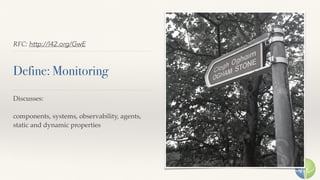
RFC: http://l42.org/GwE
Define: Monitoring
Discusses:


components, systems, observability, agents,
static and dynamic properties
–Heinrich Hartmann
“Monitoring is the action of observing and checking

static and dynamic properties of a system.”
tl;dr it’s all about latency…
Throughput vs. Latency
Lower latency often

affords increased throughput.
Throughput is a well tread topic

and uninteresting.
Latency is the focus.
–Artur Bergman
“Latency is the mind killer.”
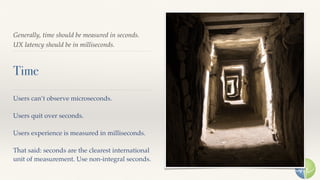
Generally, time should be measured in seconds.
UX latency should be in milliseconds.
Time
Users can’t observe microseconds.
Users quit over seconds.
Users experience is measured in milliseconds.


That said: seconds are the clearest international
unit of measurement. Use non-integral seconds.
–Douglas Adams
“Time is an illusion.

Lunchtime doubly so.”
–Theo Schlossnagle
“Seconds are the clearest unit of time measurement.

Use non-integral seconds for measuring time.
Convert for people later.”
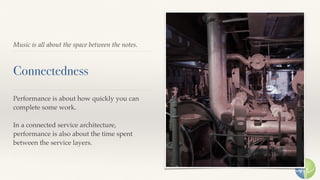
Music is all about the space between the notes.
Connectedness
Performance is about how quickly you can
complete some work.
In a connected service architecture,
performance is also about the time spent
between the service layers.
Developing a
Performance Culture
It is easy to develop a rather
unhealthy performance culture.
Focus on
Small Individual Wins
Report on and celebrate
Large Collective Wins
What’s next?
The Future of

Systems Observability
Have a deeply technical

cross-team conversation

about performance
To predict the future,

we look to the past.
Web monitoring:
• [2000]-> Synthetic Monitoring
• [2010] -> RUM
Systems monitoring:
• [2010] -> Synthetic Monitoring
• [????] -> Observed Behavior Monitoring
A search for the best representation of behavior
To win,

we must compromise
To conquer our information-
theoretic issue, we must take a
different approach.
Path 1
Full system tracing.

Sometimes.
Fun…
The way for deep contextual truth.
Often dirty and expensive.
Path 2
Keep the volume,

Lose the dimensionality.
You can’t find where

each grain of sand came from.
But you can

understand an accurate topology

of the beach over time

and reason about it.
Path 1
Tooling must transcend the team
and keep conversations consistent
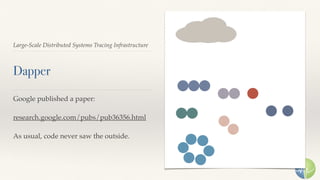
Large-Scale Distributed Systems Tracing Infrastructure
Dapper
Google published a paper:
research.google.com/pubs/pub36356.html
As usual, code never saw the outside.
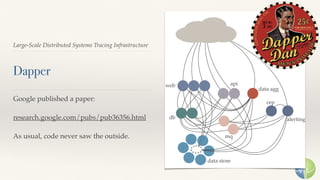
Large-Scale Distributed Systems Tracing Infrastructure
Dapper
Google published a paper:
research.google.com/pubs/pub36356.html
As usual, code never saw the outside.
web api
data agg
mq
db
data store
cep
alerting
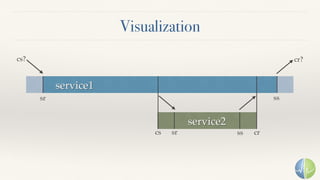
Visualization
service1
service2
sr
sr ss crcs
ss
cs? cr?
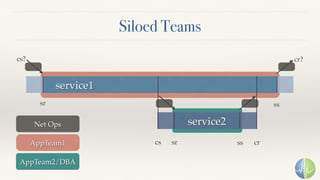
Siloed Teams
service1
service2
sr
sr ss crcs
ss
cs? cr?
Net Ops
AppTeam1
AppTeam2/DBA
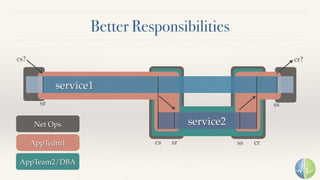
Better Responsibilities
service1
service2
sr
sr ss crcs
ss
cs? cr?
Net Ops
AppTeam1
AppTeam2/DBA
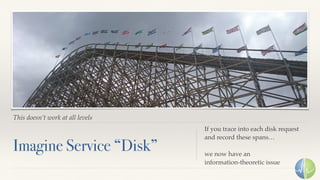
This doesn’t work at all levels
Imagine Service “Disk”
If you trace into each disk request
and record these spans…
we now have an
information-theoretic issue
A pseudo-Dapper
Zipkin OpenZipkin
Twitter sought to (re)implement Dapper.
Disappointingly few improvements.
Some unfortunate UX issues.
Sound. Simple. Valuable.
Thrift and Scribe should both die.
Scribe is Terrible
Terrible. Terrible Terrible.
Zipkin frames are thrift encoded.
Scribe is “strings” in Thrift.
Zipkin is Thift, in base64, in Thrift. WTF?
The whole point is to be low overhead
Screw Scribe
We push raw thrift over Fq

github.com/circonus-labs/fq
Completely async publishing,

lock free if using the C library.
Consolidating Zipkin’s bad decisions:
github.com/circonus-labs/fq2scribe
Telling computers what to do.
Zipkin is Java/Scala
Wrote C support:
github.com/circonus-labs/libmtev
Wrote Perl support:
github.com/circonus-labs/circonus-tracer-perl
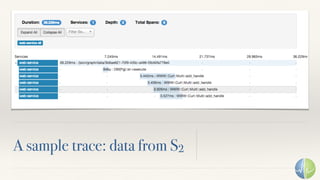
A sample trace: data from S2
Celebration
Day 1
Noticed unexpected topology queries.
Found a data location caching issue.
Shaved 350ms off every graph request.
Celebration
Day 4-7
Noticed frequent 150ms stalls in internal REST.
Frequent == 90%+
Found a libcurl issue (async resolver).
Shaved 150ms*(n*0.9) off ~50% of page loads.
Path 2 Tooling must expose fundamental
systems behavior.
Sampling frequencies need to change.
First some

statistical realities
If your model has outliers; and most do.
It is rare that you can confidently claim a
change in behavior from a single datapoint.
You need a lot of data.
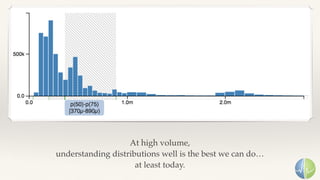
At high volume,

understanding distributions well is the best we can do…

at least today.
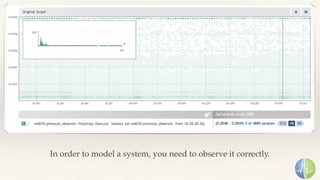
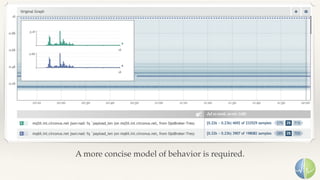
In order to model a system, you need to observe it correctly.
A more concise model of behavior is required.
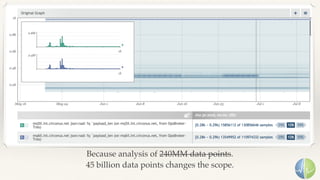
Because analysis of 240MM data points.
45 billion data points changes the scope.
Thanks!

SRECon Coherent Performance

  • 1.
    Techniques and Toolsfor A Coherent Discussion About Performance in Complex Systems
  • 2.
    Performance Must Matter Firstit must be made relevant. Then it must be made important.
  • 3.
    If you don’tcare about Performance You are in the wrong talk. @postwait should throw you out.
  • 4.
    Perhaps some justificationis warranted Performance… makes a better user experience increases loyalty reduces product abandonment increases speed of product development lowers total cost of ownership builds more cohesive teams
  • 5.
    Consistent Terminology Inconsistent terminologyis the best way to argue about agreeing
  • 6.
    RFC: http://l42.org/GwE Define: Monitoring Discusses:
 
 components,systems, observability, agents, static and dynamic properties
  • 7.
    –Heinrich Hartmann “Monitoring isthe action of observing and checking
 static and dynamic properties of a system.”
  • 8.
    tl;dr it’s allabout latency… Throughput vs. Latency Lower latency often
 affords increased throughput. Throughput is a well tread topic
 and uninteresting. Latency is the focus.
  • 9.
    –Artur Bergman “Latency isthe mind killer.”
  • 10.
    Generally, time shouldbe measured in seconds. UX latency should be in milliseconds. Time Users can’t observe microseconds. Users quit over seconds. Users experience is measured in milliseconds.
 
 That said: seconds are the clearest international unit of measurement. Use non-integral seconds.
  • 11.
    –Douglas Adams “Time isan illusion.
 Lunchtime doubly so.”
  • 12.
    –Theo Schlossnagle “Seconds arethe clearest unit of time measurement.
 Use non-integral seconds for measuring time. Convert for people later.”
  • 13.
    Music is allabout the space between the notes. Connectedness Performance is about how quickly you can complete some work. In a connected service architecture, performance is also about the time spent between the service layers.
  • 14.
    Developing a Performance Culture Itis easy to develop a rather unhealthy performance culture.
  • 15.
  • 16.
    Report on andcelebrate Large Collective Wins
  • 17.
    What’s next? The Futureof
 Systems Observability Have a deeply technical
 cross-team conversation
 about performance
  • 18.
    To predict thefuture,
 we look to the past. Web monitoring: • [2000]-> Synthetic Monitoring • [2010] -> RUM Systems monitoring: • [2010] -> Synthetic Monitoring • [????] -> Observed Behavior Monitoring
  • 19.
    A search forthe best representation of behavior To win,
 we must compromise To conquer our information- theoretic issue, we must take a different approach.
  • 20.
    Path 1 Full systemtracing.
 Sometimes. Fun… The way for deep contextual truth. Often dirty and expensive.
  • 21.
    Path 2 Keep thevolume,
 Lose the dimensionality. You can’t find where
 each grain of sand came from. But you can
 understand an accurate topology
 of the beach over time
 and reason about it.
  • 22.
    Path 1 Tooling musttranscend the team and keep conversations consistent
  • 23.
    Large-Scale Distributed SystemsTracing Infrastructure Dapper Google published a paper: research.google.com/pubs/pub36356.html As usual, code never saw the outside.
  • 24.
    Large-Scale Distributed SystemsTracing Infrastructure Dapper Google published a paper: research.google.com/pubs/pub36356.html As usual, code never saw the outside. web api data agg mq db data store cep alerting
  • 25.
  • 26.
    Siloed Teams service1 service2 sr sr sscrcs ss cs? cr? Net Ops AppTeam1 AppTeam2/DBA
  • 27.
    Better Responsibilities service1 service2 sr sr sscrcs ss cs? cr? Net Ops AppTeam1 AppTeam2/DBA
  • 28.
    This doesn’t workat all levels Imagine Service “Disk” If you trace into each disk request and record these spans… we now have an information-theoretic issue
  • 29.
    A pseudo-Dapper Zipkin OpenZipkin Twittersought to (re)implement Dapper. Disappointingly few improvements. Some unfortunate UX issues. Sound. Simple. Valuable.
  • 30.
    Thrift and Scribeshould both die. Scribe is Terrible Terrible. Terrible Terrible. Zipkin frames are thrift encoded. Scribe is “strings” in Thrift. Zipkin is Thift, in base64, in Thrift. WTF?
  • 31.
    The whole pointis to be low overhead Screw Scribe We push raw thrift over Fq
 github.com/circonus-labs/fq Completely async publishing,
 lock free if using the C library. Consolidating Zipkin’s bad decisions: github.com/circonus-labs/fq2scribe
  • 32.
    Telling computers whatto do. Zipkin is Java/Scala Wrote C support: github.com/circonus-labs/libmtev Wrote Perl support: github.com/circonus-labs/circonus-tracer-perl
  • 33.
    A sample trace:data from S2
  • 34.
    Celebration Day 1 Noticed unexpectedtopology queries. Found a data location caching issue. Shaved 350ms off every graph request.
  • 35.
    Celebration Day 4-7 Noticed frequent150ms stalls in internal REST. Frequent == 90%+ Found a libcurl issue (async resolver). Shaved 150ms*(n*0.9) off ~50% of page loads.
  • 36.
    Path 2 Toolingmust expose fundamental systems behavior.
  • 37.
    Sampling frequencies needto change. First some
 statistical realities If your model has outliers; and most do. It is rare that you can confidently claim a change in behavior from a single datapoint. You need a lot of data.
  • 38.
    At high volume,
 understandingdistributions well is the best we can do…
 at least today.
  • 39.
    In order tomodel a system, you need to observe it correctly.
  • 40.
    A more concisemodel of behavior is required.
  • 41.
    Because analysis of240MM data points. 45 billion data points changes the scope.
  • 42.