Operating System 39
First-In-First-Out (FIFO) Algorithm
Prof Neeraj Bhargava
Vaibhav Khanna
Department of Computer Science
School of Engineering and Systems Sciences
Maharshi Dayanand Saraswati University Ajmer
First-In-First-Out (FIFO) Algorithm
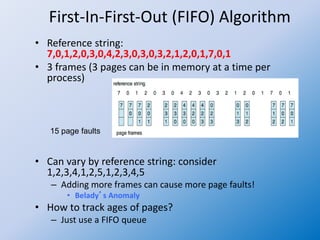
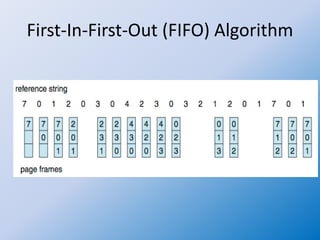
• Reference string:
7,0,1,2,0,3,0,4,2,3,0,3,0,3,2,1,2,0,1,7,0,1
• 3 frames (3 pages can be in memory at a time per
process)
• Can vary by reference string: consider
1,2,3,4,1,2,5,1,2,3,4,5
– Adding more frames can cause more page faults!
• Belady’s Anomaly
• How to track ages of pages?
– Just use a FIFO queue
15 page faults
First-In-First-Out (FIFO) Algorithm
FIFO Illustrating Belady’s Anomaly
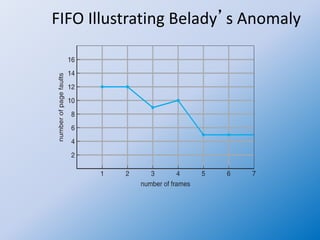
• Figure shows the curve of page faults versus
the number of available frames.
• We notice that the number of faults for four
frames (=10) is greater than the number of
faults for three frames (=9)! This result is most
unexpected and is known as Belady’s anomaly.
• Belady’s anomaly reflects the fact that, for
some page-replacement algorithms, the page-
fault rate may increase as the number of
allocated frames increases.
• We would expect that giving more memory to
a process would improve its performance.
• In some early research, investigators noticed
that this assumption was not always true.
Belady’s anomaly was discovered as a result
Optimal Algorithm
• One result of the discovery of Belady’s anomaly was
the search for an optimal page-replacement algorithm.
• An optimal page-replacement algorithm has the lowest
page-fault rate of all algorithms.
• An optimal algorithm will never suffer from Belady’s
anomaly.
• An optimal page-replacement algorithm exists, and has
been called OPT or MIN. Stated simply, it is:
• Replace the page that will not be used for the longest
period of time.
Optimal Algorithm
• Replace page that will not be used for longest
period of time
– 9 is optimal for the example
• How do you know this?
– Can’t read the future
• Used for measuring how well your algorithm
performs
Optimal Algorithm
• Use of this page-replacement algorithm guarantees the lowest
possible page-fault rate for a fixed number of frames
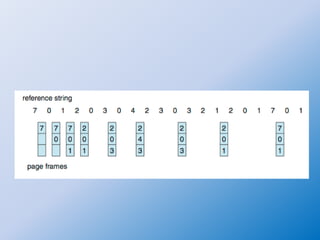
• For example, on our sample reference string, the optimal page-
replacement algorithm would yield nine page faults, as shown in
Figure .
• The reference to page 2 replaces page 7, because 7 will not be used
until reference 18, whereas page 0 will be used at 5, and page 1 at
14. The reference to page 3 replaces page 1, as page 1 will be the
last of the three pages in memory to be referenced again.
• With only nine page faults, optimal replacement is much better
than a FIFO algorithm, which had 15 faults.
• Unfortunately, the optimal page-replacement algorithm is
extremely difficult to implement because it requires prior
knowledge of the reference string and therefore, is often used for
comparison purpose alone
Assignment
• Explain the working of FIFO Algorithm
• How is optimal Algorithm different from FIFO

Operating system 39 first in first out algorithm

  • 1.
    Operating System 39 First-In-First-Out(FIFO) Algorithm Prof Neeraj Bhargava Vaibhav Khanna Department of Computer Science School of Engineering and Systems Sciences Maharshi Dayanand Saraswati University Ajmer
  • 2.
    First-In-First-Out (FIFO) Algorithm •Reference string: 7,0,1,2,0,3,0,4,2,3,0,3,0,3,2,1,2,0,1,7,0,1 • 3 frames (3 pages can be in memory at a time per process) • Can vary by reference string: consider 1,2,3,4,1,2,5,1,2,3,4,5 – Adding more frames can cause more page faults! • Belady’s Anomaly • How to track ages of pages? – Just use a FIFO queue 15 page faults
  • 3.
  • 4.
  • 5.
    FIFO Illustrating Belady’sAnomaly • Figure shows the curve of page faults versus the number of available frames. • We notice that the number of faults for four frames (=10) is greater than the number of faults for three frames (=9)! This result is most unexpected and is known as Belady’s anomaly.
  • 6.
    • Belady’s anomalyreflects the fact that, for some page-replacement algorithms, the page- fault rate may increase as the number of allocated frames increases. • We would expect that giving more memory to a process would improve its performance. • In some early research, investigators noticed that this assumption was not always true. Belady’s anomaly was discovered as a result
  • 7.
    Optimal Algorithm • Oneresult of the discovery of Belady’s anomaly was the search for an optimal page-replacement algorithm. • An optimal page-replacement algorithm has the lowest page-fault rate of all algorithms. • An optimal algorithm will never suffer from Belady’s anomaly. • An optimal page-replacement algorithm exists, and has been called OPT or MIN. Stated simply, it is: • Replace the page that will not be used for the longest period of time.
  • 8.
    Optimal Algorithm • Replacepage that will not be used for longest period of time – 9 is optimal for the example • How do you know this? – Can’t read the future • Used for measuring how well your algorithm performs
  • 10.
    Optimal Algorithm • Useof this page-replacement algorithm guarantees the lowest possible page-fault rate for a fixed number of frames • For example, on our sample reference string, the optimal page- replacement algorithm would yield nine page faults, as shown in Figure . • The reference to page 2 replaces page 7, because 7 will not be used until reference 18, whereas page 0 will be used at 5, and page 1 at 14. The reference to page 3 replaces page 1, as page 1 will be the last of the three pages in memory to be referenced again. • With only nine page faults, optimal replacement is much better than a FIFO algorithm, which had 15 faults. • Unfortunately, the optimal page-replacement algorithm is extremely difficult to implement because it requires prior knowledge of the reference string and therefore, is often used for comparison purpose alone
  • 11.
    Assignment • Explain theworking of FIFO Algorithm • How is optimal Algorithm different from FIFO