Cloud Native and
Container Technology
Landscape
Chris Aniszczyk (@cra)
Rise of Containers and Cloud Native Computing!
2
• Google running 2B+ containers per week!
– Internet scale companies are running containers too: Facebook, Twitter, Netflix, etc
• 75%+ companies are experimenting with containers!
– https://www.blackducksoftware.com/2016-future-of-open-source
• PokemonGo on containers (via Kubernetes and GCE)!
– https://cloudplatform.googleblog.com/2016/09/bringing-Pokemon-GO-to-life-on-Google-Cloud.html
Containers Adoption is Still Growing (But Fragmented)!
3
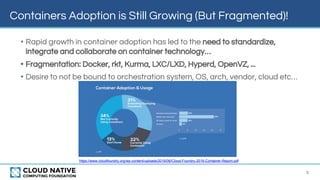
• Rapid growth in container adoption has led to the need to standardize,
integrate and collaborate on container technology…
• Fragmentation: Docker, rkt, Kurma, LXC/LXD, Hyperd, OpenVZ, ...
• Desire to not be bound to orchestration system, OS, arch, vendor, cloud etc…
https://www.cloudfoundry.org/wp-content/uploads/2016/06/Cloud-Foundry-2016-Container-Report.pdf
Lessons via Internet Scale Companies (i.e., Google)
4
• Sysadmins (Traditional Approach):
– respond to events/issues as they occur (manual work)
– grow team to absorb work as service grows
– ops is fundamentally at odds with dev (resistance to changes)
• Site Reliability Engineers [SRE] (Cloud Native Approach)
– software engineers do operations! automation vs manual labor
– SREs get bored doing manual tasks, automate them!
– culture of blameless postmortems
• Google: 1 SRE per 10000+ machines
• How did they get there? https://landing.google.com/sre/book.html
Non-Virtualized Servers: Sun (2000)
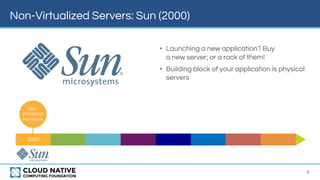
• Launching a new application? Buy
a new server; or a rack of them!
• Building block of your application is physical
servers
5
2000
Non-
Virtualized
Hardware
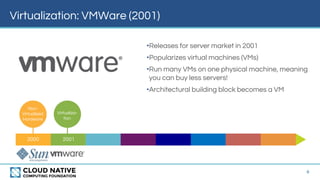
Virtualization: VMWare (2001)
•Releases for server market in 2001
•Popularizes virtual machines (VMs)
•Run many VMs on one physical machine, meaning
you can buy less servers!
•Architectural building block becomes a VM
6
2000 2001
Virtualiza-
tion
Non-
Virtualized
Hardware
IaaS: AWS (2006)
•Amazon Web Services (AWS) creates the
Infrastructure-as-a-Service market by
launching Elastic Compute Cloud (EC2) in 2006
•Rent servers by the hour
•Convert CapEx to OpEx
•Architectural building block is also a VM, called
an Amazon Machine Image (AMI)
7
2000 2001 2006
Virtualiza-
tion
Non-
Virtualized
Hardware
IaaS
PaaS: Heroku (2009)
•Heroku popularizes Platform-as-a-Service (PaaS)
with their launch in 2009
•Building block is a buildpack, which enables containerized
12-factor applications
– The process for building the container is opaque, but:
– Deploying new version of an app is just: git push heroku
8
PaaSIaaS
2000 2001 2006 2009
Virtualiza-
tion
Non-
Virtualized
Hardware
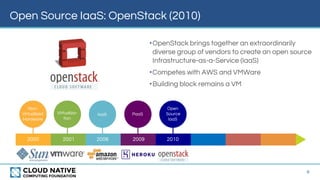
Open Source IaaS: OpenStack (2010)
•OpenStack brings together an extraordinarily
diverse group of vendors to create an open source
Infrastructure-as-a-Service (IaaS)
•Competes with AWS and VMWare
•Building block remains a VM
9
Open
Source
IaaS
PaaS
2000 2001 2006 2009 2010
Non-
Virtualized
Hardware
Virtualiza-
tion
IaaS
Open Source PaaS: Cloud Foundry (2011)
10
•Pivotal builds an open source alternative to
Heroku’s PaaS and launches the Cloud
Foundry Foundation in late 2014
•Building block is Garden containers, which can
hold Heroku buildpacks, Docker containers and
even non-Linux OSes
Open
Source
IaaS
PaaS
Open
Source
PaaS
2000 2001 2006 2009 2010 2011
Non-
Virtualized
Hardware
Virtualiza-
tion
IaaS
Containers
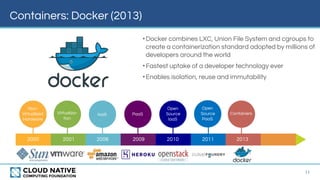
Containers: Docker (2013)
11
•Docker combines LXC, Union File System and cgroups to
create a containerization standard adopted by millions of
developers around the world
•Fastest uptake of a developer technology ever
•Enables isolation, reuse and immutability
Open
Source
IaaS
PaaS
Open
Source
PaaS
2000 2001 2006 2009 2010 2011
Non-
Virtualized
Hardware
2013
Virtualiza-
tion
IaaS
Containers
Cloud
Native
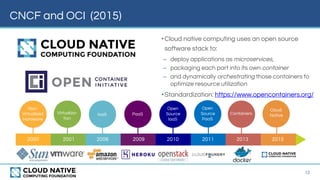
CNCF and OCI (2015)
12
•Cloud native computing uses an open source
software stack to:
– deploy applications as microservices,
– packaging each part into its own container
– and dynamically orchestrating those containers to
optimize resource utilization
•Standardization: https://www.opencontainers.org/
Open
Source
IaaS
PaaS
Open
Source
PaaS
Virtualiza-
tion
2000 2001 2006 2009 2010 2011
Non-
Virtualized
Hardware
2013 2015
IaaS
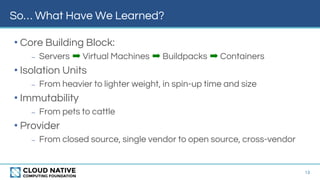
So… What Have We Learned?
13
• Core Building Block:
– Servers ➡ Virtual Machines ➡ Buildpacks ➡ Containers
• Isolation Units
– From heavier to lighter weight, in spin-up time and size
• Immutability
– From pets to cattle
• Provider
– From closed source, single vendor to open source, cross-vendor
OCI + CNCF in Detail
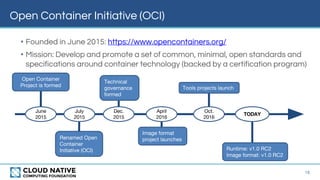
Open Container Initiative (OCI)
15
• Founded in June 2015: https://www.opencontainers.org/
• Mission: Develop and promote a set of common, minimal, open standards and
specifications around container technology (backed by a certification program)
OCI Projects
16
• Runtime spec: a spec for managing the container runtime
• Runtime tools: tools for testing container runtimes
• Runc: runs containers (implementation of runtime-spec)
• Image spec: a container image format spec
• Image tools: tools for testing of container images
implementing the OCI image specification
OCI Projects
17
Open Image Format Spec
• Open
Specification for
Container Image
• Started with
Docker v2.2
• Announced
April 14, 2016
OCI Adopters
18
https://github.com/docker/containerd
https://github.com/coreos/rkt
https://github.com/cloudfoundry/garden-runc-release
https://github.com/kubernetes-incubator/cri-o
https://issues.apache.org/jira/browse/MESOS-5011
https://github.com/docker/docker/pull/26369
OCI Contributors
19
As of 8 November, 2016
• The top 15 groups contributing to the OCI represent a
broad and diverse group of companies
• View the OCI dashboard: http://oci.biterg.io/
Cloud Native Computing Foundation (CNCF)
20
• Founded December 2015: https://www.cncf.io/
• Non-profit, part of the Linux Foundation
• Initial projects are Kubernetes, donated by Google,
and Prometheus, originally from SoundCloud
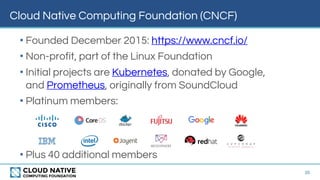
• Platinum members:
• Plus 40 additional members
Cloud Native [End User] Reference Architecture
Application Definition / Development
Orchestration & Management
Runtime
Provisioning
*Infrastructure (Bare Metal/Cloud)
•Application Definition, Composition,
Configuration, Tooling, Image Management
•Orchestration, Observability (logging, tracing),
Service Discovery, Service Management
•Container Runtime (via OCI), Container
Networking (CNI), Storage (Volume Drivers)
•Host Management (Devops Deployment Tooling
& Provisioning)
•*Out of scope for CNCF projects as we do not
define infrastructure vendors or cloud solutions
but part of reference architecture
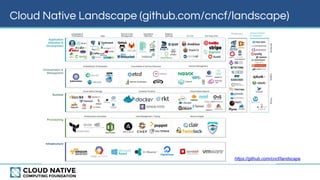
Cloud Native Landscape (github.com/cncf/landscape)
https://github.com/cncf/landscape
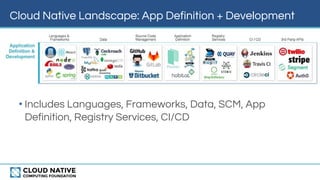
Cloud Native Landscape: App Definition + Development
• Includes Languages, Frameworks, Data, SCM, App
Definition, Registry Services, CI/CD
Cloud Native Landscape: Orchestration + Management
• Orchestration: Kubernetes, Mesos, Swarm, Nomad
• Service Discovery: etcd, Consult, ZK, CoreDNS
• Service Management: linkerd, gRPC, envoy
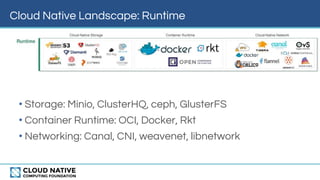
Cloud Native Landscape: Runtime
• Storage: Minio, ClusterHQ, ceph, GlusterFS
• Container Runtime: OCI, Docker, Rkt
• Networking: Canal, CNI, weavenet, libnetwork
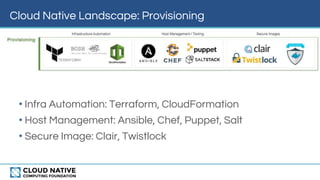
Cloud Native Landscape: Provisioning
• Infra Automation: Terraform, CloudFormation
• Host Management: Ansible, Chef, Puppet, Salt
• Secure Image: Clair, Twistlock
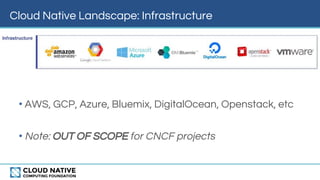
Cloud Native Landscape: Infrastructure
• AWS, GCP, Azure, Bluemix, DigitalOcean, Openstack, etc
• Note: OUT OF SCOPE for CNCF projects
CNCF Potential Projects and Community
• Potential future project areas:
– Logging (Fluentd): http://www.fluentd.org/
– Networking (CNI/Flannel/Calico/Weave): https://github.com/containernetworking/cni
– Messaging (NATS): http://nats.io/
– Configuration (etcd): https://github.com/coreos/etcd
– Storage (Minio): https://github.com/minio/
– RPC (GRPC): http://www.grpc.io/
– Tracing (OpenTracing, OpenZipkin): http://opentracing.io/
– Streaming (Heron): http://heronstreaming.io
– ...and more! https://github.com/cncf/toc#scheduled-community-presentations
Cloud Native
Value Propositions
30
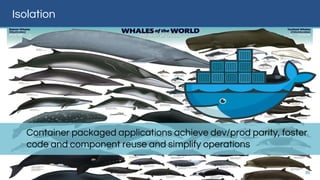
Isolation
Container packaged applications achieve dev/prod parity, foster
code and component reuse and simplify operations
No Lock-in
Open source software stack enables deployment on any
public or private cloud (or in combinations)
Unlimited Scalability
Optimized for modern distributed systems environments
capable of scaling to tens of thousands of self healing
multi-tenant nodes
(e.g., Google starts 2 billion containers per week)
Improved Efficiency and Resource Utilization
Via a central orchestrating process that dynamically
manages and schedules microservices. This reduces the
costs associated with maintenance and operations.
Resiliency
To failures of individual containers, machines, and even
data centers and to varying levels of demand
Hosting with the CNCF?
Software Foundations in a Post-GitHub World
36
• No one is impressed today by a software repo, mailing list,
or website
• Foundations need to offer a different set of services
• CNCF’s goal is to be the best place to host cloud native
software projects
Why You Should Host Your Project at CNCF
37
•Neutral home increases contributions
•Endorsement by CNCF’s Technical
Oversight Committee
•Priority access to $15 million, 1000
node Community Cluster
•Engagement with End User Board
•Full-time press relation and analyst
relation teams
•$20 K per year to improve your
project documentation
•Maintain your committers; just agree
to unbiased process
•Full-time staff eager to assist
•World-class events team, track at
CloudNativeCon/KubeCon around
the world, and custom events for your
project
•Worldwide meetup groups and Cloud
Native Roadshows
•Inclusion in the CNCF marketing
demo
Why You Should
Join the CNCF and OCI?
Help Set the Direction of Cloud Native and Containers!
• Participate in our hosted projects and attend our
events and roadshows!
• Design your applications and services to work with
a cloud native platform of orchestrated containers
of microservices
• Become a member of the Cloud Native Computing
Foundation (CNCF): https://cncf.io/join
• Become a member of the Open Container Initiative
(OCI): https://opencontainers.org/join
• Contact: cra@linuxfoundation.org
39
Thank you! Q&A?
@cra
Extra Slides
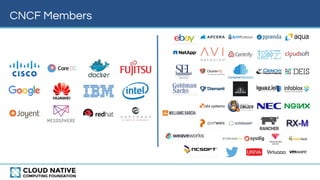
CNCF Members
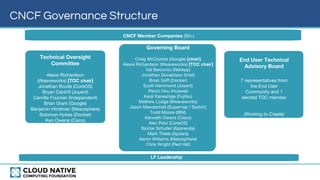
CNCF Governance Structure

Cloud Native Landscape (CNCF and OCI)

  • 1.
    Cloud Native and ContainerTechnology Landscape Chris Aniszczyk (@cra)
  • 2.
    Rise of Containersand Cloud Native Computing! 2 • Google running 2B+ containers per week! – Internet scale companies are running containers too: Facebook, Twitter, Netflix, etc • 75%+ companies are experimenting with containers! – https://www.blackducksoftware.com/2016-future-of-open-source • PokemonGo on containers (via Kubernetes and GCE)! – https://cloudplatform.googleblog.com/2016/09/bringing-Pokemon-GO-to-life-on-Google-Cloud.html
  • 3.
    Containers Adoption isStill Growing (But Fragmented)! 3 • Rapid growth in container adoption has led to the need to standardize, integrate and collaborate on container technology… • Fragmentation: Docker, rkt, Kurma, LXC/LXD, Hyperd, OpenVZ, ... • Desire to not be bound to orchestration system, OS, arch, vendor, cloud etc… https://www.cloudfoundry.org/wp-content/uploads/2016/06/Cloud-Foundry-2016-Container-Report.pdf
  • 4.
    Lessons via InternetScale Companies (i.e., Google) 4 • Sysadmins (Traditional Approach): – respond to events/issues as they occur (manual work) – grow team to absorb work as service grows – ops is fundamentally at odds with dev (resistance to changes) • Site Reliability Engineers [SRE] (Cloud Native Approach) – software engineers do operations! automation vs manual labor – SREs get bored doing manual tasks, automate them! – culture of blameless postmortems • Google: 1 SRE per 10000+ machines • How did they get there? https://landing.google.com/sre/book.html
  • 5.
    Non-Virtualized Servers: Sun(2000) • Launching a new application? Buy a new server; or a rack of them! • Building block of your application is physical servers 5 2000 Non- Virtualized Hardware
  • 6.
    Virtualization: VMWare (2001) •Releasesfor server market in 2001 •Popularizes virtual machines (VMs) •Run many VMs on one physical machine, meaning you can buy less servers! •Architectural building block becomes a VM 6 2000 2001 Virtualiza- tion Non- Virtualized Hardware
  • 7.
    IaaS: AWS (2006) •AmazonWeb Services (AWS) creates the Infrastructure-as-a-Service market by launching Elastic Compute Cloud (EC2) in 2006 •Rent servers by the hour •Convert CapEx to OpEx •Architectural building block is also a VM, called an Amazon Machine Image (AMI) 7 2000 2001 2006 Virtualiza- tion Non- Virtualized Hardware IaaS
  • 8.
    PaaS: Heroku (2009) •Herokupopularizes Platform-as-a-Service (PaaS) with their launch in 2009 •Building block is a buildpack, which enables containerized 12-factor applications – The process for building the container is opaque, but: – Deploying new version of an app is just: git push heroku 8 PaaSIaaS 2000 2001 2006 2009 Virtualiza- tion Non- Virtualized Hardware
  • 9.
    Open Source IaaS:OpenStack (2010) •OpenStack brings together an extraordinarily diverse group of vendors to create an open source Infrastructure-as-a-Service (IaaS) •Competes with AWS and VMWare •Building block remains a VM 9 Open Source IaaS PaaS 2000 2001 2006 2009 2010 Non- Virtualized Hardware Virtualiza- tion IaaS
  • 10.
    Open Source PaaS:Cloud Foundry (2011) 10 •Pivotal builds an open source alternative to Heroku’s PaaS and launches the Cloud Foundry Foundation in late 2014 •Building block is Garden containers, which can hold Heroku buildpacks, Docker containers and even non-Linux OSes Open Source IaaS PaaS Open Source PaaS 2000 2001 2006 2009 2010 2011 Non- Virtualized Hardware Virtualiza- tion IaaS
  • 11.
    Containers Containers: Docker (2013) 11 •Dockercombines LXC, Union File System and cgroups to create a containerization standard adopted by millions of developers around the world •Fastest uptake of a developer technology ever •Enables isolation, reuse and immutability Open Source IaaS PaaS Open Source PaaS 2000 2001 2006 2009 2010 2011 Non- Virtualized Hardware 2013 Virtualiza- tion IaaS
  • 12.
    Containers Cloud Native CNCF and OCI(2015) 12 •Cloud native computing uses an open source software stack to: – deploy applications as microservices, – packaging each part into its own container – and dynamically orchestrating those containers to optimize resource utilization •Standardization: https://www.opencontainers.org/ Open Source IaaS PaaS Open Source PaaS Virtualiza- tion 2000 2001 2006 2009 2010 2011 Non- Virtualized Hardware 2013 2015 IaaS
  • 13.
    So… What HaveWe Learned? 13 • Core Building Block: – Servers ➡ Virtual Machines ➡ Buildpacks ➡ Containers • Isolation Units – From heavier to lighter weight, in spin-up time and size • Immutability – From pets to cattle • Provider – From closed source, single vendor to open source, cross-vendor
  • 14.
    OCI + CNCFin Detail
  • 15.
    Open Container Initiative(OCI) 15 • Founded in June 2015: https://www.opencontainers.org/ • Mission: Develop and promote a set of common, minimal, open standards and specifications around container technology (backed by a certification program)
  • 16.
    OCI Projects 16 • Runtimespec: a spec for managing the container runtime • Runtime tools: tools for testing container runtimes • Runc: runs containers (implementation of runtime-spec) • Image spec: a container image format spec • Image tools: tools for testing of container images implementing the OCI image specification
  • 17.
    OCI Projects 17 Open ImageFormat Spec • Open Specification for Container Image • Started with Docker v2.2 • Announced April 14, 2016
  • 18.
  • 19.
    OCI Contributors 19 As of8 November, 2016 • The top 15 groups contributing to the OCI represent a broad and diverse group of companies • View the OCI dashboard: http://oci.biterg.io/
  • 20.
    Cloud Native ComputingFoundation (CNCF) 20 • Founded December 2015: https://www.cncf.io/ • Non-profit, part of the Linux Foundation • Initial projects are Kubernetes, donated by Google, and Prometheus, originally from SoundCloud • Platinum members: • Plus 40 additional members
  • 21.
    Cloud Native [EndUser] Reference Architecture Application Definition / Development Orchestration & Management Runtime Provisioning *Infrastructure (Bare Metal/Cloud) •Application Definition, Composition, Configuration, Tooling, Image Management •Orchestration, Observability (logging, tracing), Service Discovery, Service Management •Container Runtime (via OCI), Container Networking (CNI), Storage (Volume Drivers) •Host Management (Devops Deployment Tooling & Provisioning) •*Out of scope for CNCF projects as we do not define infrastructure vendors or cloud solutions but part of reference architecture
  • 22.
    Cloud Native Landscape(github.com/cncf/landscape) https://github.com/cncf/landscape
  • 23.
    Cloud Native Landscape:App Definition + Development • Includes Languages, Frameworks, Data, SCM, App Definition, Registry Services, CI/CD
  • 24.
    Cloud Native Landscape:Orchestration + Management • Orchestration: Kubernetes, Mesos, Swarm, Nomad • Service Discovery: etcd, Consult, ZK, CoreDNS • Service Management: linkerd, gRPC, envoy
  • 25.
    Cloud Native Landscape:Runtime • Storage: Minio, ClusterHQ, ceph, GlusterFS • Container Runtime: OCI, Docker, Rkt • Networking: Canal, CNI, weavenet, libnetwork
  • 26.
    Cloud Native Landscape:Provisioning • Infra Automation: Terraform, CloudFormation • Host Management: Ansible, Chef, Puppet, Salt • Secure Image: Clair, Twistlock
  • 27.
    Cloud Native Landscape:Infrastructure • AWS, GCP, Azure, Bluemix, DigitalOcean, Openstack, etc • Note: OUT OF SCOPE for CNCF projects
  • 28.
    CNCF Potential Projectsand Community • Potential future project areas: – Logging (Fluentd): http://www.fluentd.org/ – Networking (CNI/Flannel/Calico/Weave): https://github.com/containernetworking/cni – Messaging (NATS): http://nats.io/ – Configuration (etcd): https://github.com/coreos/etcd – Storage (Minio): https://github.com/minio/ – RPC (GRPC): http://www.grpc.io/ – Tracing (OpenTracing, OpenZipkin): http://opentracing.io/ – Streaming (Heron): http://heronstreaming.io – ...and more! https://github.com/cncf/toc#scheduled-community-presentations
  • 29.
  • 30.
    30 Isolation Container packaged applicationsachieve dev/prod parity, foster code and component reuse and simplify operations
  • 31.
    No Lock-in Open sourcesoftware stack enables deployment on any public or private cloud (or in combinations)
  • 32.
    Unlimited Scalability Optimized formodern distributed systems environments capable of scaling to tens of thousands of self healing multi-tenant nodes (e.g., Google starts 2 billion containers per week)
  • 33.
    Improved Efficiency andResource Utilization Via a central orchestrating process that dynamically manages and schedules microservices. This reduces the costs associated with maintenance and operations.
  • 34.
    Resiliency To failures ofindividual containers, machines, and even data centers and to varying levels of demand
  • 35.
  • 36.
    Software Foundations ina Post-GitHub World 36 • No one is impressed today by a software repo, mailing list, or website • Foundations need to offer a different set of services • CNCF’s goal is to be the best place to host cloud native software projects
  • 37.
    Why You ShouldHost Your Project at CNCF 37 •Neutral home increases contributions •Endorsement by CNCF’s Technical Oversight Committee •Priority access to $15 million, 1000 node Community Cluster •Engagement with End User Board •Full-time press relation and analyst relation teams •$20 K per year to improve your project documentation •Maintain your committers; just agree to unbiased process •Full-time staff eager to assist •World-class events team, track at CloudNativeCon/KubeCon around the world, and custom events for your project •Worldwide meetup groups and Cloud Native Roadshows •Inclusion in the CNCF marketing demo
  • 38.
    Why You Should Jointhe CNCF and OCI?
  • 39.
    Help Set theDirection of Cloud Native and Containers! • Participate in our hosted projects and attend our events and roadshows! • Design your applications and services to work with a cloud native platform of orchestrated containers of microservices • Become a member of the Cloud Native Computing Foundation (CNCF): https://cncf.io/join • Become a member of the Open Container Initiative (OCI): https://opencontainers.org/join • Contact: cra@linuxfoundation.org 39
  • 40.
  • 41.
  • 42.
  • 43.