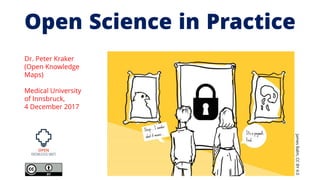
Dr. Peter Kraker
(Open Knowledge
Maps)
Medical University
of Innsbruck,
4 December 2017
Open Science in Practice
JamesBalm,CCBY4.0
CCBY-SA3.0StudioVirc
CCBY4.0,CenterforOpenScience
Open Science: Definition
Open Science means opening up the
research process
by making all of its outcomes, and the
way in which these outcomes were
achieved,
publicly available on the World Wide
Web
(Kraker et al. 2011)
Open Science: Instruments
Open Access Open Data
Open Source
Open
Methodology
Open
Science
Open Metrics
Open Peer Review
Open Educational
Resources
Open Discovery
Citizen Science
Preregistration
Preregistration
Plan study Do study
Submit to
journal
Respond to
reviewer
comments
Publish paper
Acceptance
Plan study
Submit to
journal
Respond to
reviewer
comments
Do study Publish paper
Acceptance
Adapted from D. Bishop, U. Oxford
CC BY Kaplan & Irvin (2015)
Registered Reports
CC BY 4.0, Center for Open Science
https://cos.io/rr/
Preregistration “light”
Plan study
Submit to
OSF
Plan checked
by OSF
statistician
Do study
Submit to
journal
Respond to
reviewer
comments
Publish
paper
Acceptance
Adapted from D. Bishop, U. Oxford
https://cos.io/prereg/
Advantages of preregistration
No guarantee of publication - but reviewers generally
positive about preregistered papers
Free methodological/statistical consulting:
http://cos.io/stats_consulting
Benefits of having well-worked out plan – less stress
when it comes to making sense of data
Errors get detected early in the process
And…
Open access
Online research outputs that are free of all
restrictions on access (e.g. access tolls) and free of
many restrictions on use (e.g. certain copyright and
license restrictions) [Wikipedia]
Open Definition
Roads to open access
Gold Road: open access at the publisher
Green Road: self-archiving in repositories
Open access articles get more
citations
McKiernan et al. (2016)
Open Access Advanced: Preprints
Depositing your work in a repository prior to
submitting it to a conference or journal
Adapted from B. Kramer &
J. Bosman (U. Utrecht)
Advantages of preprints
CC-BYknitgirl
http://www.oastories.org/
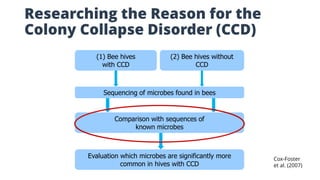
Researching the Reason for the
Colony Collapse Disorder (CCD)
(1) Bee hives
with CCD
(2) Bee hives without
CCD
Sequencing of microbes found in bees
Comparison with sequences of
known microbes
Evaluation which microbes are significantly more
common in hives with CCD
Cox-Foster
et al. (2007)
Genomic Sequencing Data
Bermuda Rules
“Primary Genomic Sequence Should be in the Public Domain”
“Primary Genomic Sequence Should be Rapidly Released”
International collaboration
• EMBL-Bank (Europe)
• GenBank (USA)
• DNA Data Bank of Japan
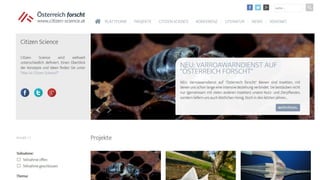
Citizen science
Scientific research conducted,
in whole or in part, by amateur
(or nonprofessional) scientists
[Wikipedia]
Academic literature search tools
(ALST) only serve a third or less
I find it easy to identify relevant
publications using ALST
I find it easy to formulate a query when
searching in an unknown research
topic/field
I find it hard to get an overview of academic
literature on a research topic using ALST
Academic literature search takes too much
time
28.6
%
31.4
%
33.3
%
34.4
%
n=107
Agreement
Agreement
Disagreement
Disagreement
Dark Knowledge
(Jonathan Jeschke)
It‘s time to change
the way we discover
research
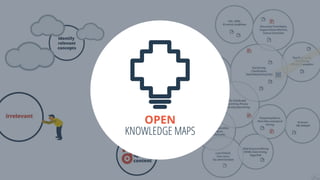
Open Knowledge Maps
A non-profit organization
dedicated to dramatically
improving the visibility
of scientific knowledge
for science and society alike
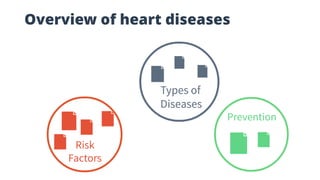
Overview of heart diseases
https://openknowledgemaps.org
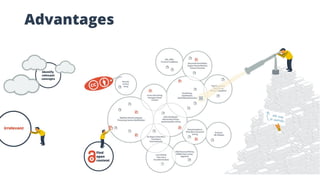
Advantages
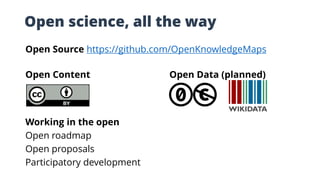
Open science, all the way
Open Source https://github.com/OpenKnowledgeMaps
Open Content Open Data (planned)
Working in the open
Open roadmap
Open proposals
Participatory development
The first 18 months
200,000+ visits on the site, 43,000+ maps
created, 400+ participants in workshops
http://openknowledgemaps.org/imed2016
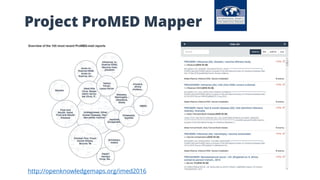
Project ProMED Mapper
Collaborative discovery
https://vimeo.com/188647919
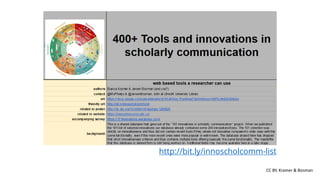
Kramer & Bosman (2014)https://101innovations.wordpress.com
CC BY, Kramer & Bosman
http://bit.ly/innoscholcomm-list
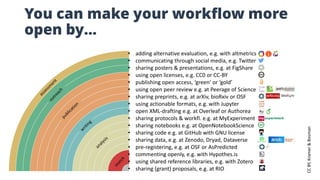
• adding alternative evaluation, e.g. with altmetrics
• communicating through social media, e.g. Twitter
• sharing posters & presentations, e.g. at FigShare
• using open licenses, e.g. CC0 or CC-BY
• publishing open access, ‘green’ or ‘gold’
• using open peer review e.g. at Peerage of Science
• sharing preprints, e.g. at arXiv, bioRxiv or OSF
• using actionable formats, e.g. with Jupyter
• open XML-drafting e.g. at Overleaf or Authorea
• sharing protocols & workfl. e.g. at MyExperiment
• sharing notebooks e.g. at OpenNotebookScience
• sharing code e.g. at GitHub with GNU license
• sharing data, e.g. at Zenodo, Dryad, Dataverse
• pre-registering, e.g. at OSF or AsPredicted
• commenting openly, e.g. with Hypothes.is
• using shared reference libraries, e.g. with Zotero
• sharing (grant) proposals, e.g. at RIO
You can make your workflow more
open by…
CCBY,Kramer&Bosman
https://is.gd/osworkshop17
Getting involved
http://oana.at
http://okfn.at/open-science
Dr. Peter Kraker
(Open Knowledge
Maps)
Medical University
of Innsbruck,
4 December 2017
Thank you for your attention!
JamesBalm,CCBY4.0

Open Science in Practice

  • 1.
    Dr. Peter Kraker (OpenKnowledge Maps) Medical University of Innsbruck, 4 December 2017 Open Science in Practice JamesBalm,CCBY4.0
  • 2.
  • 8.
  • 10.
    Open Science: Definition OpenScience means opening up the research process by making all of its outcomes, and the way in which these outcomes were achieved, publicly available on the World Wide Web (Kraker et al. 2011)
  • 11.
    Open Science: Instruments OpenAccess Open Data Open Source Open Methodology Open Science Open Metrics Open Peer Review Open Educational Resources Open Discovery Citizen Science
  • 13.
  • 14.
    Preregistration Plan study Dostudy Submit to journal Respond to reviewer comments Publish paper Acceptance Plan study Submit to journal Respond to reviewer comments Do study Publish paper Acceptance Adapted from D. Bishop, U. Oxford
  • 15.
    CC BY Kaplan& Irvin (2015)
  • 17.
    Registered Reports CC BY4.0, Center for Open Science https://cos.io/rr/
  • 18.
    Preregistration “light” Plan study Submitto OSF Plan checked by OSF statistician Do study Submit to journal Respond to reviewer comments Publish paper Acceptance Adapted from D. Bishop, U. Oxford https://cos.io/prereg/
  • 20.
    Advantages of preregistration Noguarantee of publication - but reviewers generally positive about preregistered papers Free methodological/statistical consulting: http://cos.io/stats_consulting Benefits of having well-worked out plan – less stress when it comes to making sense of data Errors get detected early in the process And…
  • 22.
    Open access Online researchoutputs that are free of all restrictions on access (e.g. access tolls) and free of many restrictions on use (e.g. certain copyright and license restrictions) [Wikipedia] Open Definition
  • 23.
    Roads to openaccess Gold Road: open access at the publisher Green Road: self-archiving in repositories
  • 24.
    Open access articlesget more citations McKiernan et al. (2016)
  • 25.
    Open Access Advanced:Preprints Depositing your work in a repository prior to submitting it to a conference or journal Adapted from B. Kramer & J. Bosman (U. Utrecht)
  • 26.
  • 29.
    Researching the Reasonfor the Colony Collapse Disorder (CCD) (1) Bee hives with CCD (2) Bee hives without CCD Sequencing of microbes found in bees Comparison with sequences of known microbes Evaluation which microbes are significantly more common in hives with CCD Cox-Foster et al. (2007)
  • 30.
    Genomic Sequencing Data BermudaRules “Primary Genomic Sequence Should be in the Public Domain” “Primary Genomic Sequence Should be Rapidly Released” International collaboration • EMBL-Bank (Europe) • GenBank (USA) • DNA Data Bank of Japan
  • 32.
    Citizen science Scientific researchconducted, in whole or in part, by amateur (or nonprofessional) scientists [Wikipedia]
  • 37.
    Academic literature searchtools (ALST) only serve a third or less I find it easy to identify relevant publications using ALST I find it easy to formulate a query when searching in an unknown research topic/field I find it hard to get an overview of academic literature on a research topic using ALST Academic literature search takes too much time 28.6 % 31.4 % 33.3 % 34.4 % n=107 Agreement Agreement Disagreement Disagreement
  • 39.
  • 40.
    It‘s time tochange the way we discover research
  • 42.
    Open Knowledge Maps Anon-profit organization dedicated to dramatically improving the visibility of scientific knowledge for science and society alike
  • 43.
  • 44.
  • 45.
  • 46.
    Open science, allthe way Open Source https://github.com/OpenKnowledgeMaps Open Content Open Data (planned) Working in the open Open roadmap Open proposals Participatory development
  • 47.
    The first 18months 200,000+ visits on the site, 43,000+ maps created, 400+ participants in workshops
  • 48.
  • 49.
  • 50.
    Kramer & Bosman(2014)https://101innovations.wordpress.com
  • 51.
    CC BY, Kramer& Bosman http://bit.ly/innoscholcomm-list
  • 52.
    • adding alternativeevaluation, e.g. with altmetrics • communicating through social media, e.g. Twitter • sharing posters & presentations, e.g. at FigShare • using open licenses, e.g. CC0 or CC-BY • publishing open access, ‘green’ or ‘gold’ • using open peer review e.g. at Peerage of Science • sharing preprints, e.g. at arXiv, bioRxiv or OSF • using actionable formats, e.g. with Jupyter • open XML-drafting e.g. at Overleaf or Authorea • sharing protocols & workfl. e.g. at MyExperiment • sharing notebooks e.g. at OpenNotebookScience • sharing code e.g. at GitHub with GNU license • sharing data, e.g. at Zenodo, Dryad, Dataverse • pre-registering, e.g. at OSF or AsPredicted • commenting openly, e.g. with Hypothes.is • using shared reference libraries, e.g. with Zotero • sharing (grant) proposals, e.g. at RIO You can make your workflow more open by… CCBY,Kramer&Bosman
  • 53.
  • 54.
  • 55.
    Dr. Peter Kraker (OpenKnowledge Maps) Medical University of Innsbruck, 4 December 2017 Thank you for your attention! JamesBalm,CCBY4.0