Open Research and Archaeology
Dr Lisa Lodwick, All Souls College
University of Oxford
@LisaLodwick
Why Open Research in
Archaeology?
• Archaeology is destructive – responsibility to record and
share
• Many archaeologist are not within academia – developer-
funded archaeology, museums, community archaeologists,
the public
• Research funding source
• Reproducibility based upon access to primary data
1.Open Access in Archaeology
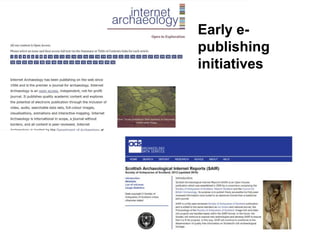
Early e-
publishing
initiatives
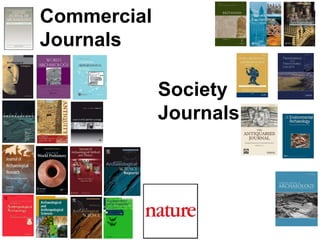
Society
Journals
Commercial
Journals
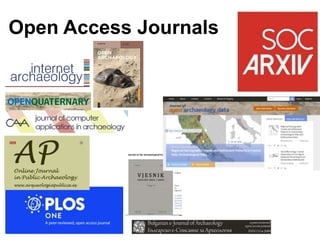
Open Access Journals
2. Open Data in Archaeology
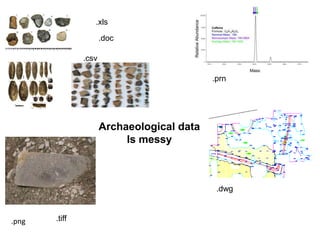
Archaeological data
Is messy
.xls
.doc
.tiff
.dwg
.prn
.png
.csv
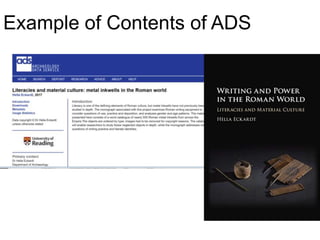
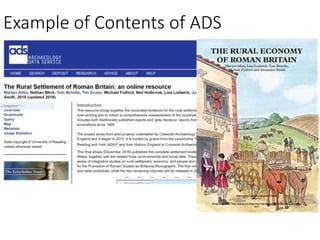
Example of Contents of ADS
Does primary data matter in
archaeology?
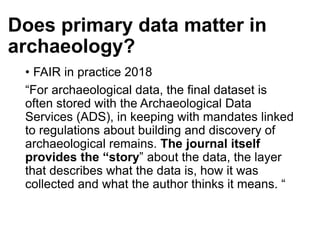
• FAIR in practice 2018
“For archaeological data, the final dataset is
often stored with the Archaeological Data
Services (ADS), in keeping with mandates linked
to regulations about building and discovery of
archaeological remains. The journal itself
provides the “story” about the data, the layer
that describes what the data is, how it was
collected and what the author thinks it means. “
How much primary data is
published?
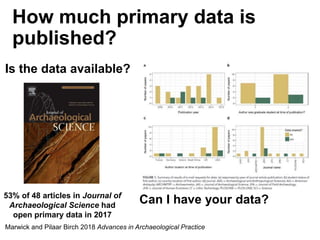
Marwick and Pilaar Birch 2018 Advances in Archaeological Practice
53% of 48 articles in Journal of
Archaeological Science had
open primary data in 2017
Can I have your data?
Is the data available?
How much primary data is
published?
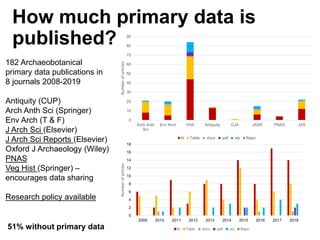
182 Archaeobotanical
primary data publications in
8 journals 2008-2019
0
10
20
30
40
50
60
70
80
90
Arch Anth
Sci
Env Arch VHA Antiquity OJA JASR PNAS JAS
Numberofarticles
N Table .docx .pdf .xls Repo
0
2
4
6
8
10
12
14
16
18
2009 2010 2011 2012 2013 2014 2015 2016 2017 2018
Numberofarticles
N Table .docx .pdf .xls Repo
Antiquity (CUP)
Arch Anth Sci (Springer)
Env Arch (T & F)
J Arch Sci (Elsevier)
J Arch Sci Reports (Elsevier)
Oxford J Archaeology (Wiley)
PNAS
Veg Hist (Springer) –
encourages data sharing
Research policy available
51% without primary data
3. ECR-driven initiatives
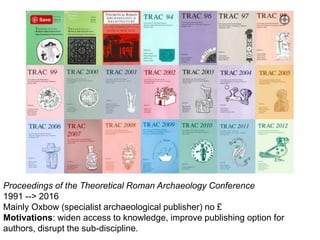
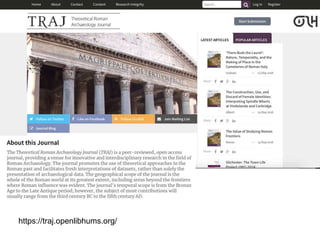
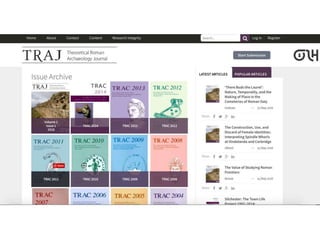
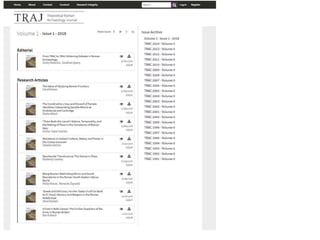
Proceedings of the Theoretical Roman Archaeology Conference
1991 --> 2016
Mainly Oxbow (specialist archaeological publisher) no £
Motivations: widen access to knowledge, improve publishing option for
authors, disrupt the sub-discipline.
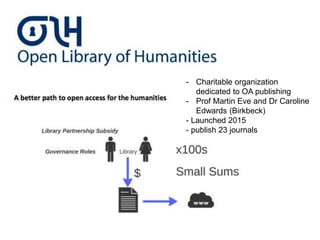
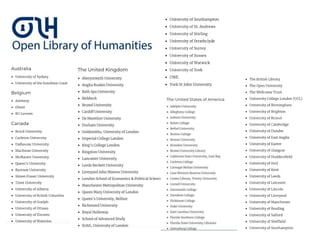
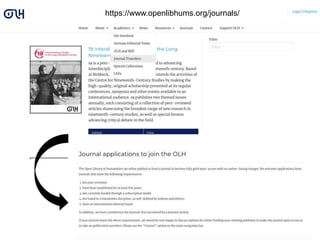
- Charitable organization
dedicated to OA publishing
- Prof Martin Eve and Dr Caroline
Edwards (Birkbeck)
- Launched 2015
- publish 23 journals
https://www.openlibhums.org/journals/
https://traj.openlibhums.org/
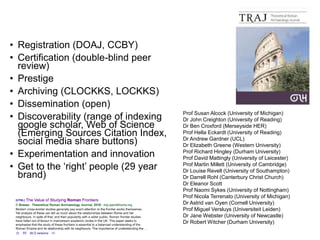
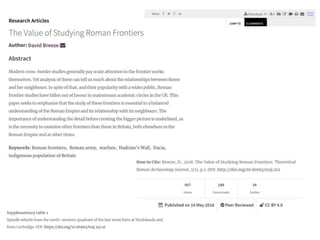
• Registration (DOAJ, CCBY)
• Certification (double-blind peer
review)
• Prestige
• Archiving (CLOCKKS, LOCKKS)
• Dissemination (open)
• Discoverability (range of indexing
google scholar, Web of Science
(Emerging Sources Citation Index,
social media share buttons)
• Experimentation and innovation
• Get to the ‘right’ people (29 year
brand)
Prof Susan Alcock (University of Michigan)
Dr John Creighton (University of Reading)
Dr Ben Croxford (Merseyside HER)
Prof Hella Eckardt (University of Reading)
Dr Andrew Gardner (UCL)
Dr Elizabeth Greene (Western University)
Prof Richard Hingley (Durham University)
Prof David Mattingly (University of Leicester)
Prof Martin Millett (University of Cambridge)
Dr Louise Revell (University of Southampton)
Dr Darrell Rohl (Canterbury Christ Church)
Dr Eleanor Scott
Prof Naomi Sykes (University of Nottingham)
Prof Nicola Terrenato (University of Michigan)
Dr Astrid van Oyen (Cornell University)
Prof Miguel Versluys (Universiteit Leiden)
Dr Jane Webster (University of Newcastle)
Dr Robert Witcher (Durham University)
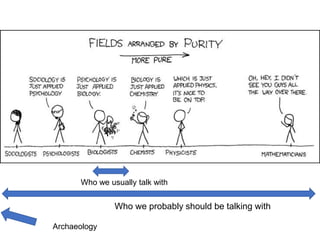
Who we usually talk with
Who we probably should be talking with
Archaeology
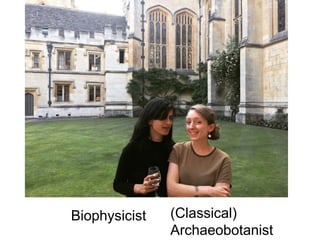
Biophysicist (Classical)
Archaeobotanist
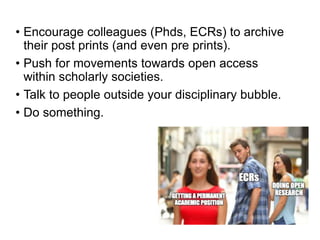
• Encourage colleagues (Phds, ECRs) to archive
their post prints (and even pre prints).
• Push for movements towards open access
within scholarly societies.
• Talk to people outside your disciplinary bubble.
• Do something.

Open Research and Archaeology

  • 1.
    Open Research andArchaeology Dr Lisa Lodwick, All Souls College University of Oxford @LisaLodwick
  • 4.
    Why Open Researchin Archaeology? • Archaeology is destructive – responsibility to record and share • Many archaeologist are not within academia – developer- funded archaeology, museums, community archaeologists, the public • Research funding source • Reproducibility based upon access to primary data
  • 5.
    1.Open Access inArchaeology
  • 6.
  • 7.
  • 8.
  • 9.
    2. Open Datain Archaeology
  • 10.
  • 12.
  • 13.
  • 14.
    Does primary datamatter in archaeology? • FAIR in practice 2018 “For archaeological data, the final dataset is often stored with the Archaeological Data Services (ADS), in keeping with mandates linked to regulations about building and discovery of archaeological remains. The journal itself provides the “story” about the data, the layer that describes what the data is, how it was collected and what the author thinks it means. “
  • 15.
    How much primarydata is published? Marwick and Pilaar Birch 2018 Advances in Archaeological Practice 53% of 48 articles in Journal of Archaeological Science had open primary data in 2017 Can I have your data? Is the data available?
  • 16.
    How much primarydata is published? 182 Archaeobotanical primary data publications in 8 journals 2008-2019 0 10 20 30 40 50 60 70 80 90 Arch Anth Sci Env Arch VHA Antiquity OJA JASR PNAS JAS Numberofarticles N Table .docx .pdf .xls Repo 0 2 4 6 8 10 12 14 16 18 2009 2010 2011 2012 2013 2014 2015 2016 2017 2018 Numberofarticles N Table .docx .pdf .xls Repo Antiquity (CUP) Arch Anth Sci (Springer) Env Arch (T & F) J Arch Sci (Elsevier) J Arch Sci Reports (Elsevier) Oxford J Archaeology (Wiley) PNAS Veg Hist (Springer) – encourages data sharing Research policy available 51% without primary data
  • 17.
  • 18.
    Proceedings of theTheoretical Roman Archaeology Conference 1991 --> 2016 Mainly Oxbow (specialist archaeological publisher) no £ Motivations: widen access to knowledge, improve publishing option for authors, disrupt the sub-discipline.
  • 19.
    - Charitable organization dedicatedto OA publishing - Prof Martin Eve and Dr Caroline Edwards (Birkbeck) - Launched 2015 - publish 23 journals
  • 21.
  • 22.
  • 23.
    • Registration (DOAJ,CCBY) • Certification (double-blind peer review) • Prestige • Archiving (CLOCKKS, LOCKKS) • Dissemination (open) • Discoverability (range of indexing google scholar, Web of Science (Emerging Sources Citation Index, social media share buttons) • Experimentation and innovation • Get to the ‘right’ people (29 year brand) Prof Susan Alcock (University of Michigan) Dr John Creighton (University of Reading) Dr Ben Croxford (Merseyside HER) Prof Hella Eckardt (University of Reading) Dr Andrew Gardner (UCL) Dr Elizabeth Greene (Western University) Prof Richard Hingley (Durham University) Prof David Mattingly (University of Leicester) Prof Martin Millett (University of Cambridge) Dr Louise Revell (University of Southampton) Dr Darrell Rohl (Canterbury Christ Church) Dr Eleanor Scott Prof Naomi Sykes (University of Nottingham) Prof Nicola Terrenato (University of Michigan) Dr Astrid van Oyen (Cornell University) Prof Miguel Versluys (Universiteit Leiden) Dr Jane Webster (University of Newcastle) Dr Robert Witcher (Durham University)
  • 27.
    Who we usuallytalk with Who we probably should be talking with Archaeology
  • 28.
  • 30.
    • Encourage colleagues(Phds, ECRs) to archive their post prints (and even pre prints). • Push for movements towards open access within scholarly societies. • Talk to people outside your disciplinary bubble. • Do something.