Research Methodologies  :: Open Research Jessy Kate Cowan-Sharp University of Maryland
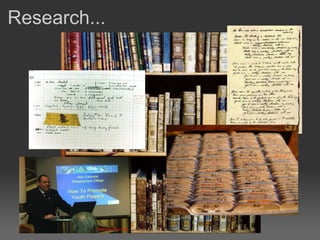
Research...
Research today <-->  The World is Changing
Science? {           Verifiable,           Repeatable,           Extensible,           Accessible  }
&quot;The Open Scholar is someone who makes their  intellectual projects and processes digitally visible ... who invites and encourages ongoing [dialog about] their work and secondary uses...&quot; http://www.academicevolution.com/2009/08/the-open-scholar.html Open Science == Science
In Practice? Product  Open Access Journals Machine readable formats Open Peer Review Licenses Process  Collaboration  Data  Licenses * (There’s tons out there on Open Educational Resources, OpenCourseWare… won't be going into that here.)
Open Access Journals Openly accessible regardless of affiliation or financial means Publication models: pay-to-publish || no fee Access models: print || digital
Public Library of Science (PLoS) plos.org Open Research Computation  ...for computational researchers openresearchcomputation.com Nature Communications  ...open access option (fee-based) http://www.nature.com/ncomms/open_access Theory of Computing ( Professor Srinivasan ) theoryofcomputing.org Arxive.org (Pr)e-prints  Directory of Open Access Journals  doaj.org Open Access Peer Reviewed Journals ... and many more
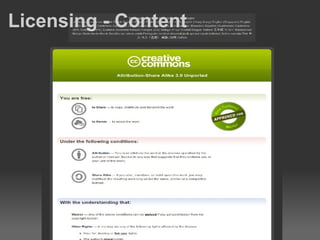
Licensing - Content
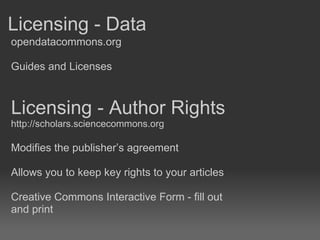
Licensing - Data Licensing - Author Rights http://scholars.sciencecommons.org Modifies the publisher’s agreement Allows you to keep key rights to your articles Creative Commons Interactive Form - fill out and print opendatacommons.org Guides and Licenses
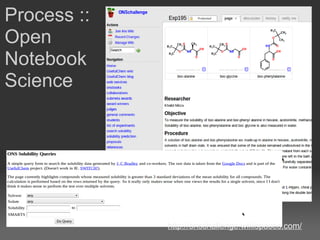
Process ::  Open  Notebook Science http://onschallenge.wikispaces.com/
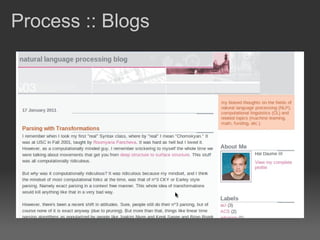
Process :: Blogs
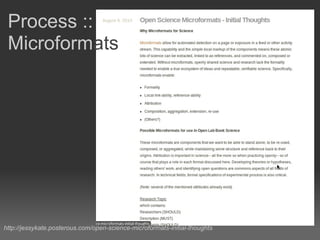
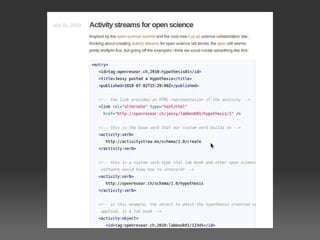
Process :: Microform ats http://jessykate.posterous.com/open-science-microformats-initial-thoughts
 
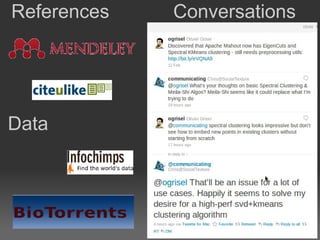
References            Conversations  Data
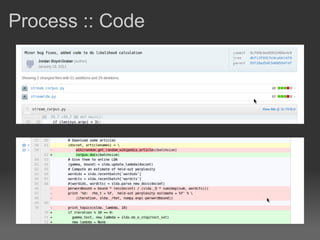
Process :: Code
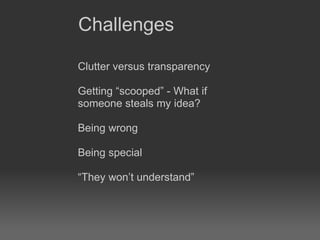
Clutter versus transparency  Getting “scooped” - What if someone steals my idea?  Being wrong  Being special   “They won’t understand” Challenges
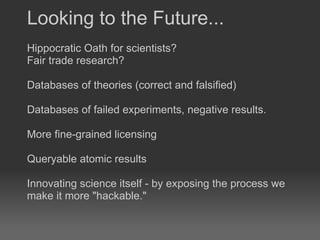
Hippocratic Oath for scientists?  Fair trade research?  Databases of theories (correct and falsified) Databases of failed experiments, negative results.  More fine-grained licensing Queryable atomic results Innovating science itself - by exposing the process we make it more &quot;hackable.&quot; Looking to the Future...
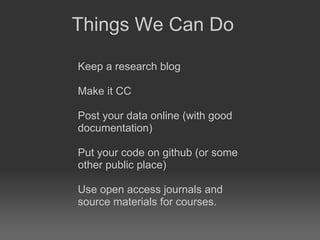
Keep a research blog  Make it CC  Post your data online (with good documentation)  Put your code on github (or some other public place)  Use open access journals and source materials for courses. Things We Can Do
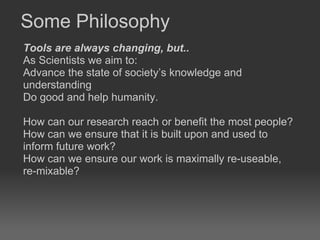
Some Philosophy Tools are always changing, but..  As Scientists we aim to: Advance the state of society’s knowledge and understanding  Do good and help humanity.  How can our research reach or benefit the most people?  How can we ensure that it is built upon and used to inform future work?  How can we ensure our work is maximally re-useable, re-mixable? 
:: Sharing process :: Sharing results :: Optimizing for re-usability and re- mix ability Summary
Initiatives - Get Involved Beyond the Impact Factor Science Hack Day Open Science Summit  Open Knowledge Foundation Open Science mailing list #openscience

Open Research methodologies

  • 1.
    Research Methodologies  ::Open Research Jessy Kate Cowan-Sharp University of Maryland
  • 2.
  • 3.
    Research today <--> The World is Changing
  • 4.
    Science? {          Verifiable,           Repeatable,           Extensible,           Accessible  }
  • 5.
    &quot;The Open Scholaris someone who makes their intellectual projects and processes digitally visible ... who invites and encourages ongoing [dialog about] their work and secondary uses...&quot; http://www.academicevolution.com/2009/08/the-open-scholar.html Open Science == Science
  • 6.
    In Practice? Product Open Access Journals Machine readable formats Open Peer Review Licenses Process Collaboration Data Licenses * (There’s tons out there on Open Educational Resources, OpenCourseWare… won't be going into that here.)
  • 7.
    Open Access JournalsOpenly accessible regardless of affiliation or financial means Publication models: pay-to-publish || no fee Access models: print || digital
  • 8.
    Public Library ofScience (PLoS) plos.org Open Research Computation  ...for computational researchers openresearchcomputation.com Nature Communications  ...open access option (fee-based) http://www.nature.com/ncomms/open_access Theory of Computing ( Professor Srinivasan ) theoryofcomputing.org Arxive.org (Pr)e-prints  Directory of Open Access Journals doaj.org Open Access Peer Reviewed Journals ... and many more
  • 9.
  • 10.
    Licensing - DataLicensing - Author Rights http://scholars.sciencecommons.org Modifies the publisher’s agreement Allows you to keep key rights to your articles Creative Commons Interactive Form - fill out and print opendatacommons.org Guides and Licenses
  • 11.
    Process ::  Open Notebook Science http://onschallenge.wikispaces.com/
  • 12.
  • 13.
    Process :: Microformats http://jessykate.posterous.com/open-science-microformats-initial-thoughts
  • 14.
  • 15.
    References           Conversations  Data
  • 16.
  • 17.
    Clutter versus transparency Getting “scooped” - What if someone steals my idea? Being wrong Being special   “They won’t understand” Challenges
  • 18.
    Hippocratic Oath for scientists? Fair trade research? Databases of theories (correct and falsified) Databases of failed experiments, negative results.  More fine-grained licensing Queryable atomic results Innovating science itself - by exposing the process we make it more &quot;hackable.&quot; Looking to the Future...
  • 19.
    Keep a researchblog Make it CC Post your data online (with good documentation) Put your code on github (or some other public place) Use open access journals and source materials for courses. Things We Can Do
  • 20.
    Some Philosophy Toolsare always changing, but.. As Scientists we aim to: Advance the state of society’s knowledge and understanding  Do good and help humanity.  How can our research reach or benefit the most people? How can we ensure that it is built upon and used to inform future work? How can we ensure our work is maximally re-useable, re-mixable? 
  • 21.
    :: Sharing process:: Sharing results :: Optimizing for re-usability and re- mix ability Summary
  • 22.
    Initiatives - GetInvolved Beyond the Impact Factor Science Hack Day Open Science Summit Open Knowledge Foundation Open Science mailing list #openscience