OPEN POLICY
Amanda Coolidge
Senior Manager of Open
Education
BCcampus
@acoolidge
Unless otherwise noted, this work is licensed
under a Creative Commons Attribution
License.
Feel free to use, modify or distribute any or all
of this presentation with attribution.
goo.gl/pmKCe7
1. What is Open?
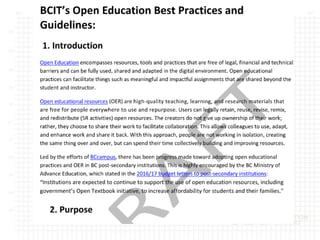
2. What is an open policy?
3. How is it implemented?
4. Introduction to the OER Policy Guide
5. Your turn
AGENDA
1. Define Open Policy
2. Articulate examples of open policies
3. Identify an open policy that you can implement
at your Institution
GOALS
WHAT IS
OPEN?
“Open means anyone can freely
access, use, modify, and share for
any purpose (subject, at most, to
requirements that preserve
provenance and openness).”
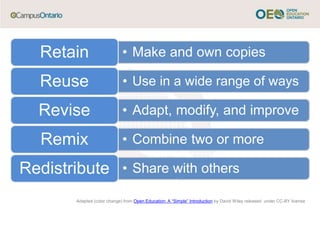
• Make and own copiesRetain
• Use in a wide range of waysReuse
• Adapt, modify, and improveRevise
• Combine two or moreRemix
• Share with othersRedistribute
Adapted (color change) from Open Education: A “Simple” Introduction by David Wiley released under CC-BY license
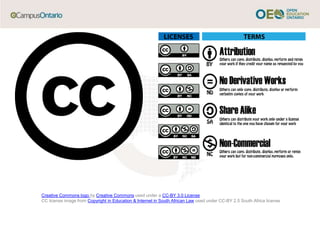
Creative Commons logo by Creative Commons used under a CC-BY 3.0 License
CC license image from Copyright in Education & Internet in South African Law used under CC-BY 2.5 South Africa license
WHAT IS AN
OPEN
POLICY?
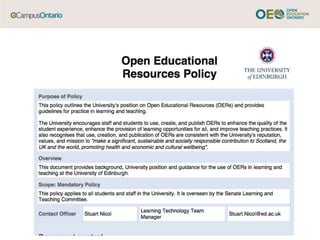
Open policies are laws, rules and
courses of action that facilitate the
creation, use or improvement of openly
licensed content.
The adoption of open policies can
maximize the return on public investments
and promote a global commons of
resources for innovative reuse.
Publicly funded resources should be
openly licensed resources.
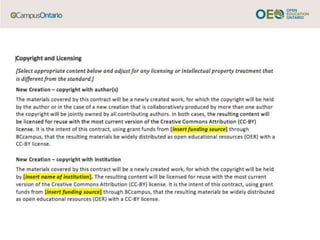
Open licensing policies typically have two
parts / options:
(1) how will my institution / government
openly license what we (staff) create?
(2) how will my institution / government
require openly licenses on works we
fund via grants, contracts, and/or
commission to be built?
Common Characteristics:
1. Specific and address a need
2. Developed collaboratively with
stakeholders
3. Make process public and transparent
4. Provide and allow for feedback
5. Evaluation and how do we evaluate
(data and stories)
6. How do we change if not working?
7. How will be policy be enforced?
IMPACT and
EXAMPLES
OPEN POLICY
IN EDUCATION
HOW?
1. Find your Institution’s mission/vision on the website
2. Share with your group
3. Discuss: How does your institutional
vision/mission align with Open Educational
practices? How can Open Education strategies
be an integral component of your institution's
operational and academic plans? What could be
done to facilitate that process at your
institution?
4. Report Out
THANK YOU

Open Policy- Ontario Open Education Summit

  • 1.
  • 2.
    Amanda Coolidge Senior Managerof Open Education BCcampus @acoolidge
  • 3.
    Unless otherwise noted,this work is licensed under a Creative Commons Attribution License. Feel free to use, modify or distribute any or all of this presentation with attribution.
  • 4.
  • 5.
    1. What isOpen? 2. What is an open policy? 3. How is it implemented? 4. Introduction to the OER Policy Guide 5. Your turn AGENDA
  • 6.
    1. Define OpenPolicy 2. Articulate examples of open policies 3. Identify an open policy that you can implement at your Institution GOALS
  • 7.
  • 8.
    “Open means anyonecan freely access, use, modify, and share for any purpose (subject, at most, to requirements that preserve provenance and openness).”
  • 9.
    • Make andown copiesRetain • Use in a wide range of waysReuse • Adapt, modify, and improveRevise • Combine two or moreRemix • Share with othersRedistribute Adapted (color change) from Open Education: A “Simple” Introduction by David Wiley released under CC-BY license
  • 10.
    Creative Commons logoby Creative Commons used under a CC-BY 3.0 License CC license image from Copyright in Education & Internet in South African Law used under CC-BY 2.5 South Africa license
  • 11.
  • 12.
    Open policies arelaws, rules and courses of action that facilitate the creation, use or improvement of openly licensed content.
  • 13.
    The adoption ofopen policies can maximize the return on public investments and promote a global commons of resources for innovative reuse. Publicly funded resources should be openly licensed resources.
  • 14.
    Open licensing policiestypically have two parts / options: (1) how will my institution / government openly license what we (staff) create? (2) how will my institution / government require openly licenses on works we fund via grants, contracts, and/or commission to be built?
  • 15.
    Common Characteristics: 1. Specificand address a need 2. Developed collaboratively with stakeholders 3. Make process public and transparent 4. Provide and allow for feedback 5. Evaluation and how do we evaluate (data and stories) 6. How do we change if not working? 7. How will be policy be enforced?
  • 16.
  • 20.
  • 25.
  • 27.
    1. Find yourInstitution’s mission/vision on the website 2. Share with your group 3. Discuss: How does your institutional vision/mission align with Open Educational practices? How can Open Education strategies be an integral component of your institution's operational and academic plans? What could be done to facilitate that process at your institution? 4. Report Out
  • 28.

Editor's Notes

  • #3 This morning we are based at OCAD University and I would like to acknowledge the ancestral and traditional territories of the Mississaugas of the New Credit, the Haudenosaunee, the Anishnabe and the Huron-Wendat, who are the original custodians of the land. I work at BCcampus , where we acknowledge the Coast and Straits Salish People on whose traditional territories we are privileged to live, work and play.
  • #4 As with all of the work we engage in at Bccampus, this presentation is CC BY which means you are free to use, modify or distribute any or all of this presentation.
  • #5 Resources, agenda can be found at: https://docs.google.com/document/d/1HQ9gSkXgsjREZ1pd53ifWstJmICSslmssOpGYhbHbZI/edit?usp=sharing
  • #13 Open policies promote access to, and open licensing of, resources financed through public funding. Open policies can maximize the impact of public investments in science, data, education, libraries, archives, museums, software and other resources through the efficient use and reuse of resources for the public good.
  • #14 The adoption of open policies can maximize the return on public investments and promote a global commons of resources for innovative reuse. Publicly funded resources should be openly licensed resources.
  • #18 Following the Ebola crisis and the concerns of the delay of critical information, the World Health Organization convened discussions on developing norms and standards for sharing data and results during public health emergencies. The Zika emergency tested these actions and 11 international journals including The New England Journal of Medicine, PLOS, Springer Nature, and Science journals, pledged that they will make all papers concerning the Zika virus freely available to anyone under a Creative Commons CC-BY license.
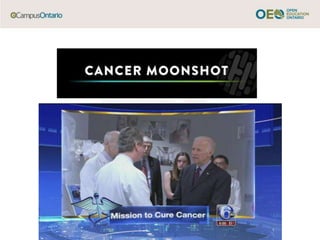
  • #19 Former US Vice-President Joe Biden announced his support for Open Access research to his $1 billion Cancer Moonshot initiative.  He highlights the public expenditure towards cancer research “And by the way, the taxpayers fund $5 billion in cancer research every year, but once it’s published, nearly all of that taxpayer-funded research sits behind walls. Tell me how this is moving the process along more rapidly.” This gets to the heart of the message that Publicly Funded Resources should be Publicly Available- Open and Free.
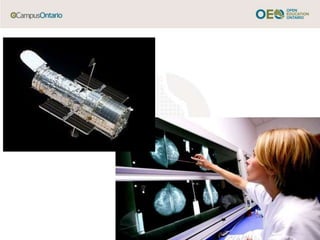
  • #20 NASA is a shining example: The open source code that allowed NASA researchers to remove blur from the flawed images from the Hubble Telescope would later be repurposed for breast cancer screening.
  • #25 (1) how will my institution / government openly license what we (staff) create?
  • #27 (1) how will my institution / government openly license what we (staff) create?
  • #28 Individually: find your institutional mission. Identify how the mission relates to the values of open, sharing, student success, access… Where do you see the convergence? Now, share this with your group. How might an open policy benefit the institution? Have a discsussion about the challenge and benefit of proposing such a policy. Could you do this? At a dept. Level? At a wider institutional level? In your classroom?