AMD is introducing “Seattle,”
a 64-bit ARM-based server
System-on a –Chip (SoC) built
on the same technology that
powers billions of today’s most
popular mobile devices. By fusing
AMD’s deep expertise in the
server processor space along
with ARM’s low-power, parallel
processing capabilities, Seattle
makes it possible for servers to
be tuned for targeted workloads
such as web/cloud hosting,
multi-media delivery, and data
analytics to enable optimized
performance at low power
thresholds.

The Advent
of ARM-Based
SoCs in the
Data Center.

©  013 Advanced Micro Devices, Inc.
2
All rights reserved. AMD, the AMD Arrow
logo, AMD Opteron, and combinations
thereof, are trademarks of Advanced
Micro Devices, Inc. Other names are for
informational purposes only and may be
trademarks of their respective owners.

note:
gray lines
will print
not as gray
but as
clear foil
Trim

OUTSIDE FLAP - FOLDS IN - PRINTER TO ADJUST SIZE - SO IT FOLDS IN PROPERLY

OUTSIDE MIDDLE PANEL

OUTSIDE FRONT COVER

5 inches

5 inches

Trim

5 inches

Trim

Trim

1.25”
SPECIAL
TRIM
45°

AMD is introducing “Seattle,”
a 64-bit ARM-based server
System-on a –Chip (SoC) built
on the same technology that
powers billions of today’s most
popular mobile devices. By fusing
AMD’s deep expertise in the
server processor space along
with ARM’s low-power, parallel
processing capabilities, Seattle
makes it possible for servers to
be tuned for targeted workloads
such as web/cloud hosting,
multi-media delivery, and data
analytics to enable optimized
performance at low power
thresholds.

The Advent
of ARM-Based
SoCs in the
Data Center.

note:
gray lines
will print
not as gray
but as
clear foil

10 inches

©  013 Advanced Micro Devices, Inc.
2
All rights reserved. AMD, the AMD Arrow
logo, AMD Opteron, and combinations
thereof, are trademarks of Advanced
Micro Devices, Inc. Other names are for
informational purposes only and may be
trademarks of their respective owners.

Trim

Trim

Trim

Fold

Fold

Trim
Overview:
The Push for Low-Power, Parallel Processing in Large Cloud Data Centers
The explosive demand for compute cycles generated by mobile devices, such
as tablets and smartphones, is driving fundamental shifts in server deployment
models. With much of the computing generated by these devices occurring
on the server side, operators of cloud data centers are facing huge pressures
to meet compute demands while minimizing their physical footprint or power
consumption. Data center managers are looking at opportunities to offload
certain parallel processing tasks onto new server and processor designs that
use numerous small, low-power processors working in unison in dense clusters.
AMD’s Data Center Strategy – Delivering Performance that Matters
We understand that compute requirements for many workloads are different
today. We also recognize that Total Cost of Ownership (TCO) has become an
essential measure of infrastructure deployments as the standard by which
server hardware is evaluated.
Our response to this impending shift in the data center has been to expand
processor choice and deliver platforms that are specifically tuned for
targeted workloads. We believe that by building server processors that
are purpose-designed for specific workloads, we can enable the optimum
amount of performance to efficiently carry out tasks while helping to provide
substantial cost improvements in terms of compute per-watt per-dollar.
Continuing on our long history of datacenter innovation, we have introduced
low-power, small footprint CPUs as well as Accelerated Processing Units
(APUs) for servers that help enable major efficiency gains in power use and
costs for multimedia-oriented workloads.
We have now added “Seattle,” a 64-bit ARM-based server processor, to
our server processor offering. Seattle combines the ARM A57 Core on a
System-on a–Chip (SoC) that contains all the standard server processor
elements you would expect from AMD. Seattle will be the industry’s only
64-bit ARM-based server SoC from a proven server processor supplier.

Introducing the industry’s only
64-bit ARM-based server SoC from
a proven server processor supplier.

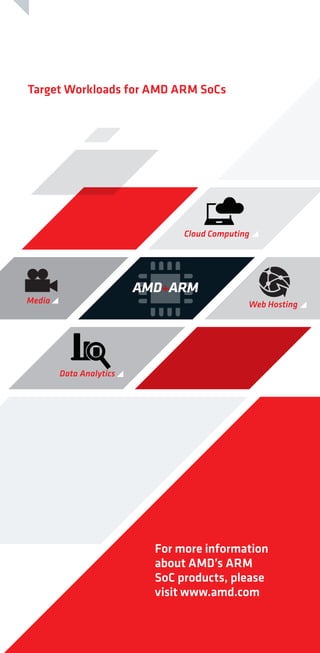
Target Workloads for AMD ARM SoCs

With ARM and AMD, you can expect:
Application-optimized performance
Maximum choice and flexibility
Extreme compute, space, and energy efficiency
Why AMD + ARM?
AMD is exceptionally well-suited to bringing ARM to the data center. We
have the server architecture engineering expertise. We have the experience
in dealing with the multiple layers of software integration required for
excellence in server processor design. We have invested more than a decade
in becoming a great server processor vendor and building an IP portfolio for
server applications. We have a history of pioneering disruptive technologies
for the data center, most notably introducing the first 64-bit implementation,
the first native multi-core processor, and the first hardware enabled
virtualization. It’s not a turn-key proposition to build chips that power
mission-critical applications in the data center. Our hard-won expertise
gives us mastery over a myriad of details and puts us farther down the
learning curve to deliver a truly disruptive and meaningful datacenter
infrastructure solution.
As a building block architecture, it is much more possible with ARM to
innovate and develop custom software/chip architectures that can deliver
meaningful gains in the processor’s execution of code instructions at low
power. Such innovation and custom tuning are the ultimate drivers of great
performance per watt and low total cost of ownership (TCO).

ARM

Cloud Computing

AMD+ARM

Media

Web Hosting

Data Analytics

®

AMD’s ARM Ecosystem
We are engaged with the ARM server processor ecosystem that will lead
the way to innovation and expanded choice. Our partnerships with builders
of ultra-dense server platforms, such as HP with Moonshot, gives us the
delivery vehicle necessary to enable the optimal performance of ARM-based
SoCs. Our participation in the Linaro organization, an engineering consortium
that is committed to consolidating and optimizing open source software
for the ARM architecture, helps us deliver advances in running standardized
Linux-based server OS for ARM infrastructure. It is the scope of this type of
software innovation that will drive gains in workload-optimized and energy
efficient parallel processing.

For more information
about AMD’s ARM
SoC products, please
visit www.amd.com
Overview:
The Push for Low-Power, Parallel Processing in Large Cloud Data Centers
The explosive demand for compute cycles generated by mobile devices, such
as tablets and smartphones, is driving fundamental shifts in server deployment
models. With much of the computing generated by these devices occurring
on the server side, operators of cloud data centers are facing huge pressures
to meet compute demands while minimizing their physical footprint or power
consumption. Data center managers are looking at opportunities to offload
certain parallel processing tasks onto new server and processor designs that
use numerous small, low-power processors working in unison in dense clusters.
AMD’s Data Center Strategy – Delivering Performance that Matters
We understand that compute requirements for many workloads are different
today. We also recognize that Total Cost of Ownership (TCO) has become an
essential measure of infrastructure deployments as the standard by which
server hardware is evaluated.
Our response to this impending shift in the data center has been to expand
processor choice and deliver platforms that are specifically tuned for
targeted workloads. We believe that by building server processors that
are purpose-designed for specific workloads, we can enable the optimum
amount of performance to efficiently carry out tasks while helping to provide
substantial cost improvements in terms of compute per-watt per-dollar.
Continuing on our long history of datacenter innovation, we have introduced
low-power, small footprint CPUs as well as Accelerated Processing Units
(APUs) for servers that help enable major efficiency gains in power use and
costs for multimedia-oriented workloads.
We have now added “Seattle,” a 64-bit ARM-based server processor, to
our server processor offering. Seattle combines the ARM A57 Core on a
System-on a–Chip (SoC) that contains all the standard server processor
elements you would expect from AMD. Seattle will be the industry’s only
64-bit ARM-based server SoC from a proven server processor supplier.

Introducing the industry’s only
64-bit ARM-based server SoC from
a proven server processor supplier.

Target Workloads for AMD ARM SoCs

With ARM and AMD, you can expect:
Application-optimized performance
Maximum choice and flexibility
Extreme compute, space, and energy efficiency
Why AMD + ARM?
AMD is exceptionally well-suited to bringing ARM to the data center. We
have the server architecture engineering expertise. We have the experience
in dealing with the multiple layers of software integration required for
excellence in server processor design. We have invested more than a decade
in becoming a great server processor vendor and building an IP portfolio for
server applications. We have a history of pioneering disruptive technologies
for the data center, most notably introducing the first 64-bit implementation,
the first native multi-core processor, and the first hardware enabled
virtualization. It’s not a turn-key proposition to build chips that power
mission-critical applications in the data center. Our hard-won expertise
gives us mastery over a myriad of details and puts us farther down the
learning curve to deliver a truly disruptive and meaningful datacenter
infrastructure solution.
As a building block architecture, it is much more possible with ARM to
innovate and develop custom software/chip architectures that can deliver
meaningful gains in the processor’s execution of code instructions at low
power. Such innovation and custom tuning are the ultimate drivers of great
performance per watt and low total cost of ownership (TCO).

ARM

Cloud Computing

AMD+ARM

Media

Web Hosting

Data Analytics

®

AMD’s ARM Ecosystem
We are engaged with the ARM server processor ecosystem that will lead
the way to innovation and expanded choice. Our partnerships with builders
of ultra-dense server platforms, such as HP with Moonshot, gives us the
delivery vehicle necessary to enable the optimal performance of ARM-based
SoCs. Our participation in the Linaro organization, an engineering consortium
that is committed to consolidating and optimizing open source software
for the ARM architecture, helps us deliver advances in running standardized
Linux-based server OS for ARM infrastructure. It is the scope of this type of
software innovation that will drive gains in workload-optimized and energy
efficient parallel processing.

For more information
about AMD’s ARM
SoC products, please
visit www.amd.com
Overview:
The Push for Low-Power, Parallel Processing in Large Cloud Data Centers
The explosive demand for compute cycles generated by mobile devices, such
as tablets and smartphones, is driving fundamental shifts in server deployment
models. With much of the computing generated by these devices occurring
on the server side, operators of cloud data centers are facing huge pressures
to meet compute demands while minimizing their physical footprint or power
consumption. Data center managers are looking at opportunities to offload
certain parallel processing tasks onto new server and processor designs that
use numerous small, low-power processors working in unison in dense clusters.
AMD’s Data Center Strategy – Delivering Performance that Matters
We understand that compute requirements for many workloads are different
today. We also recognize that Total Cost of Ownership (TCO) has become an
essential measure of infrastructure deployments as the standard by which
server hardware is evaluated.
Our response to this impending shift in the data center has been to expand
processor choice and deliver platforms that are specifically tuned for
targeted workloads. We believe that by building server processors that
are purpose-designed for specific workloads, we can enable the optimum
amount of performance to efficiently carry out tasks while helping to provide
substantial cost improvements in terms of compute per-watt per-dollar.
Continuing on our long history of datacenter innovation, we have introduced
low-power, small footprint CPUs as well as Accelerated Processing Units
(APUs) for servers that help enable major efficiency gains in power use and
costs for multimedia-oriented workloads.
We have now added “Seattle,” a 64-bit ARM-based server processor, to
our server processor offering. Seattle combines the ARM A57 Core on a
System-on a–Chip (SoC) that contains all the standard server processor
elements you would expect from AMD. Seattle will be the industry’s only
64-bit ARM-based server SoC from a proven server processor supplier.

Introducing the industry’s only
64-bit ARM-based server SoC from
a proven server processor supplier.

Target Workloads for AMD ARM SoCs

With ARM and AMD, you can expect:
Application-optimized performance
Maximum choice and flexibility
Extreme compute, space, and energy efficiency
Why AMD + ARM?
AMD is exceptionally well-suited to bringing ARM to the data center. We
have the server architecture engineering expertise. We have the experience
in dealing with the multiple layers of software integration required for
excellence in server processor design. We have invested more than a decade
in becoming a great server processor vendor and building an IP portfolio for
server applications. We have a history of pioneering disruptive technologies
for the data center, most notably introducing the first 64-bit implementation,
the first native multi-core processor, and the first hardware enabled
virtualization. It’s not a turn-key proposition to build chips that power
mission-critical applications in the data center. Our hard-won expertise
gives us mastery over a myriad of details and puts us farther down the
learning curve to deliver a truly disruptive and meaningful datacenter
infrastructure solution.
As a building block architecture, it is much more possible with ARM to
innovate and develop custom software/chip architectures that can deliver
meaningful gains in the processor’s execution of code instructions at low
power. Such innovation and custom tuning are the ultimate drivers of great
performance per watt and low total cost of ownership (TCO).

ARM

Cloud Computing

AMD+ARM

Media

Web Hosting

Data Analytics

®

AMD’s ARM Ecosystem
We are engaged with the ARM server processor ecosystem that will lead
the way to innovation and expanded choice. Our partnerships with builders
of ultra-dense server platforms, such as HP with Moonshot, gives us the
delivery vehicle necessary to enable the optimal performance of ARM-based
SoCs. Our participation in the Linaro organization, an engineering consortium
that is committed to consolidating and optimizing open source software
for the ARM architecture, helps us deliver advances in running standardized
Linux-based server OS for ARM infrastructure. It is the scope of this type of
software innovation that will drive gains in workload-optimized and energy
efficient parallel processing.

For more information
about AMD’s ARM
SoC products, please
visit www.amd.com
AMD is introducing “Seattle,”
a 64-bit ARM-based server
System-on a –Chip (SoC) built
on the same technology that
powers billions of today’s most
popular mobile devices. By fusing
AMD’s deep expertise in the
server processor space along
with ARM’s low-power, parallel
processing capabilities, Seattle
makes it possible for servers to
be tuned for targeted workloads
such as web/cloud hosting,
multi-media delivery, and data
analytics to enable optimized
performance at low power
thresholds.

The Advent
of ARM-Based
SoCs in the
Data Center.

©  013 Advanced Micro Devices, Inc.
2
All rights reserved. AMD, the AMD Arrow
logo, AMD Opteron, and combinations
thereof, are trademarks of Advanced
Micro Devices, Inc. Other names are for
informational purposes only and may be
trademarks of their respective owners.

note:
gray lines
will print
not as gray
but as
clear foil

Open compute technology

  • 1.
    AMD is introducing“Seattle,” a 64-bit ARM-based server System-on a –Chip (SoC) built on the same technology that powers billions of today’s most popular mobile devices. By fusing AMD’s deep expertise in the server processor space along with ARM’s low-power, parallel processing capabilities, Seattle makes it possible for servers to be tuned for targeted workloads such as web/cloud hosting, multi-media delivery, and data analytics to enable optimized performance at low power thresholds. The Advent of ARM-Based SoCs in the Data Center. © 013 Advanced Micro Devices, Inc. 2 All rights reserved. AMD, the AMD Arrow logo, AMD Opteron, and combinations thereof, are trademarks of Advanced Micro Devices, Inc. Other names are for informational purposes only and may be trademarks of their respective owners. note: gray lines will print not as gray but as clear foil
  • 2.
    Trim OUTSIDE FLAP -FOLDS IN - PRINTER TO ADJUST SIZE - SO IT FOLDS IN PROPERLY OUTSIDE MIDDLE PANEL OUTSIDE FRONT COVER 5 inches 5 inches Trim 5 inches Trim Trim 1.25” SPECIAL TRIM 45° AMD is introducing “Seattle,” a 64-bit ARM-based server System-on a –Chip (SoC) built on the same technology that powers billions of today’s most popular mobile devices. By fusing AMD’s deep expertise in the server processor space along with ARM’s low-power, parallel processing capabilities, Seattle makes it possible for servers to be tuned for targeted workloads such as web/cloud hosting, multi-media delivery, and data analytics to enable optimized performance at low power thresholds. The Advent of ARM-Based SoCs in the Data Center. note: gray lines will print not as gray but as clear foil 10 inches © 013 Advanced Micro Devices, Inc. 2 All rights reserved. AMD, the AMD Arrow logo, AMD Opteron, and combinations thereof, are trademarks of Advanced Micro Devices, Inc. Other names are for informational purposes only and may be trademarks of their respective owners. Trim Trim Trim Fold Fold Trim
  • 3.
    Overview: The Push forLow-Power, Parallel Processing in Large Cloud Data Centers The explosive demand for compute cycles generated by mobile devices, such as tablets and smartphones, is driving fundamental shifts in server deployment models. With much of the computing generated by these devices occurring on the server side, operators of cloud data centers are facing huge pressures to meet compute demands while minimizing their physical footprint or power consumption. Data center managers are looking at opportunities to offload certain parallel processing tasks onto new server and processor designs that use numerous small, low-power processors working in unison in dense clusters. AMD’s Data Center Strategy – Delivering Performance that Matters We understand that compute requirements for many workloads are different today. We also recognize that Total Cost of Ownership (TCO) has become an essential measure of infrastructure deployments as the standard by which server hardware is evaluated. Our response to this impending shift in the data center has been to expand processor choice and deliver platforms that are specifically tuned for targeted workloads. We believe that by building server processors that are purpose-designed for specific workloads, we can enable the optimum amount of performance to efficiently carry out tasks while helping to provide substantial cost improvements in terms of compute per-watt per-dollar. Continuing on our long history of datacenter innovation, we have introduced low-power, small footprint CPUs as well as Accelerated Processing Units (APUs) for servers that help enable major efficiency gains in power use and costs for multimedia-oriented workloads. We have now added “Seattle,” a 64-bit ARM-based server processor, to our server processor offering. Seattle combines the ARM A57 Core on a System-on a–Chip (SoC) that contains all the standard server processor elements you would expect from AMD. Seattle will be the industry’s only 64-bit ARM-based server SoC from a proven server processor supplier. Introducing the industry’s only 64-bit ARM-based server SoC from a proven server processor supplier. Target Workloads for AMD ARM SoCs With ARM and AMD, you can expect: Application-optimized performance Maximum choice and flexibility Extreme compute, space, and energy efficiency Why AMD + ARM? AMD is exceptionally well-suited to bringing ARM to the data center. We have the server architecture engineering expertise. We have the experience in dealing with the multiple layers of software integration required for excellence in server processor design. We have invested more than a decade in becoming a great server processor vendor and building an IP portfolio for server applications. We have a history of pioneering disruptive technologies for the data center, most notably introducing the first 64-bit implementation, the first native multi-core processor, and the first hardware enabled virtualization. It’s not a turn-key proposition to build chips that power mission-critical applications in the data center. Our hard-won expertise gives us mastery over a myriad of details and puts us farther down the learning curve to deliver a truly disruptive and meaningful datacenter infrastructure solution. As a building block architecture, it is much more possible with ARM to innovate and develop custom software/chip architectures that can deliver meaningful gains in the processor’s execution of code instructions at low power. Such innovation and custom tuning are the ultimate drivers of great performance per watt and low total cost of ownership (TCO). ARM Cloud Computing AMD+ARM Media Web Hosting Data Analytics ® AMD’s ARM Ecosystem We are engaged with the ARM server processor ecosystem that will lead the way to innovation and expanded choice. Our partnerships with builders of ultra-dense server platforms, such as HP with Moonshot, gives us the delivery vehicle necessary to enable the optimal performance of ARM-based SoCs. Our participation in the Linaro organization, an engineering consortium that is committed to consolidating and optimizing open source software for the ARM architecture, helps us deliver advances in running standardized Linux-based server OS for ARM infrastructure. It is the scope of this type of software innovation that will drive gains in workload-optimized and energy efficient parallel processing. For more information about AMD’s ARM SoC products, please visit www.amd.com
  • 4.
    Overview: The Push forLow-Power, Parallel Processing in Large Cloud Data Centers The explosive demand for compute cycles generated by mobile devices, such as tablets and smartphones, is driving fundamental shifts in server deployment models. With much of the computing generated by these devices occurring on the server side, operators of cloud data centers are facing huge pressures to meet compute demands while minimizing their physical footprint or power consumption. Data center managers are looking at opportunities to offload certain parallel processing tasks onto new server and processor designs that use numerous small, low-power processors working in unison in dense clusters. AMD’s Data Center Strategy – Delivering Performance that Matters We understand that compute requirements for many workloads are different today. We also recognize that Total Cost of Ownership (TCO) has become an essential measure of infrastructure deployments as the standard by which server hardware is evaluated. Our response to this impending shift in the data center has been to expand processor choice and deliver platforms that are specifically tuned for targeted workloads. We believe that by building server processors that are purpose-designed for specific workloads, we can enable the optimum amount of performance to efficiently carry out tasks while helping to provide substantial cost improvements in terms of compute per-watt per-dollar. Continuing on our long history of datacenter innovation, we have introduced low-power, small footprint CPUs as well as Accelerated Processing Units (APUs) for servers that help enable major efficiency gains in power use and costs for multimedia-oriented workloads. We have now added “Seattle,” a 64-bit ARM-based server processor, to our server processor offering. Seattle combines the ARM A57 Core on a System-on a–Chip (SoC) that contains all the standard server processor elements you would expect from AMD. Seattle will be the industry’s only 64-bit ARM-based server SoC from a proven server processor supplier. Introducing the industry’s only 64-bit ARM-based server SoC from a proven server processor supplier. Target Workloads for AMD ARM SoCs With ARM and AMD, you can expect: Application-optimized performance Maximum choice and flexibility Extreme compute, space, and energy efficiency Why AMD + ARM? AMD is exceptionally well-suited to bringing ARM to the data center. We have the server architecture engineering expertise. We have the experience in dealing with the multiple layers of software integration required for excellence in server processor design. We have invested more than a decade in becoming a great server processor vendor and building an IP portfolio for server applications. We have a history of pioneering disruptive technologies for the data center, most notably introducing the first 64-bit implementation, the first native multi-core processor, and the first hardware enabled virtualization. It’s not a turn-key proposition to build chips that power mission-critical applications in the data center. Our hard-won expertise gives us mastery over a myriad of details and puts us farther down the learning curve to deliver a truly disruptive and meaningful datacenter infrastructure solution. As a building block architecture, it is much more possible with ARM to innovate and develop custom software/chip architectures that can deliver meaningful gains in the processor’s execution of code instructions at low power. Such innovation and custom tuning are the ultimate drivers of great performance per watt and low total cost of ownership (TCO). ARM Cloud Computing AMD+ARM Media Web Hosting Data Analytics ® AMD’s ARM Ecosystem We are engaged with the ARM server processor ecosystem that will lead the way to innovation and expanded choice. Our partnerships with builders of ultra-dense server platforms, such as HP with Moonshot, gives us the delivery vehicle necessary to enable the optimal performance of ARM-based SoCs. Our participation in the Linaro organization, an engineering consortium that is committed to consolidating and optimizing open source software for the ARM architecture, helps us deliver advances in running standardized Linux-based server OS for ARM infrastructure. It is the scope of this type of software innovation that will drive gains in workload-optimized and energy efficient parallel processing. For more information about AMD’s ARM SoC products, please visit www.amd.com
  • 5.
    Overview: The Push forLow-Power, Parallel Processing in Large Cloud Data Centers The explosive demand for compute cycles generated by mobile devices, such as tablets and smartphones, is driving fundamental shifts in server deployment models. With much of the computing generated by these devices occurring on the server side, operators of cloud data centers are facing huge pressures to meet compute demands while minimizing their physical footprint or power consumption. Data center managers are looking at opportunities to offload certain parallel processing tasks onto new server and processor designs that use numerous small, low-power processors working in unison in dense clusters. AMD’s Data Center Strategy – Delivering Performance that Matters We understand that compute requirements for many workloads are different today. We also recognize that Total Cost of Ownership (TCO) has become an essential measure of infrastructure deployments as the standard by which server hardware is evaluated. Our response to this impending shift in the data center has been to expand processor choice and deliver platforms that are specifically tuned for targeted workloads. We believe that by building server processors that are purpose-designed for specific workloads, we can enable the optimum amount of performance to efficiently carry out tasks while helping to provide substantial cost improvements in terms of compute per-watt per-dollar. Continuing on our long history of datacenter innovation, we have introduced low-power, small footprint CPUs as well as Accelerated Processing Units (APUs) for servers that help enable major efficiency gains in power use and costs for multimedia-oriented workloads. We have now added “Seattle,” a 64-bit ARM-based server processor, to our server processor offering. Seattle combines the ARM A57 Core on a System-on a–Chip (SoC) that contains all the standard server processor elements you would expect from AMD. Seattle will be the industry’s only 64-bit ARM-based server SoC from a proven server processor supplier. Introducing the industry’s only 64-bit ARM-based server SoC from a proven server processor supplier. Target Workloads for AMD ARM SoCs With ARM and AMD, you can expect: Application-optimized performance Maximum choice and flexibility Extreme compute, space, and energy efficiency Why AMD + ARM? AMD is exceptionally well-suited to bringing ARM to the data center. We have the server architecture engineering expertise. We have the experience in dealing with the multiple layers of software integration required for excellence in server processor design. We have invested more than a decade in becoming a great server processor vendor and building an IP portfolio for server applications. We have a history of pioneering disruptive technologies for the data center, most notably introducing the first 64-bit implementation, the first native multi-core processor, and the first hardware enabled virtualization. It’s not a turn-key proposition to build chips that power mission-critical applications in the data center. Our hard-won expertise gives us mastery over a myriad of details and puts us farther down the learning curve to deliver a truly disruptive and meaningful datacenter infrastructure solution. As a building block architecture, it is much more possible with ARM to innovate and develop custom software/chip architectures that can deliver meaningful gains in the processor’s execution of code instructions at low power. Such innovation and custom tuning are the ultimate drivers of great performance per watt and low total cost of ownership (TCO). ARM Cloud Computing AMD+ARM Media Web Hosting Data Analytics ® AMD’s ARM Ecosystem We are engaged with the ARM server processor ecosystem that will lead the way to innovation and expanded choice. Our partnerships with builders of ultra-dense server platforms, such as HP with Moonshot, gives us the delivery vehicle necessary to enable the optimal performance of ARM-based SoCs. Our participation in the Linaro organization, an engineering consortium that is committed to consolidating and optimizing open source software for the ARM architecture, helps us deliver advances in running standardized Linux-based server OS for ARM infrastructure. It is the scope of this type of software innovation that will drive gains in workload-optimized and energy efficient parallel processing. For more information about AMD’s ARM SoC products, please visit www.amd.com
  • 6.
    AMD is introducing“Seattle,” a 64-bit ARM-based server System-on a –Chip (SoC) built on the same technology that powers billions of today’s most popular mobile devices. By fusing AMD’s deep expertise in the server processor space along with ARM’s low-power, parallel processing capabilities, Seattle makes it possible for servers to be tuned for targeted workloads such as web/cloud hosting, multi-media delivery, and data analytics to enable optimized performance at low power thresholds. The Advent of ARM-Based SoCs in the Data Center. © 013 Advanced Micro Devices, Inc. 2 All rights reserved. AMD, the AMD Arrow logo, AMD Opteron, and combinations thereof, are trademarks of Advanced Micro Devices, Inc. Other names are for informational purposes only and may be trademarks of their respective owners. note: gray lines will print not as gray but as clear foil